
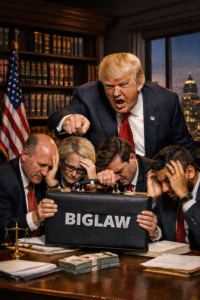
ChatGPT
Remember
when
the
Department
of
Justice
seemed
to
realize
that
defending
Donald
Trump’s
blatantly
unconstitutional
executive
orders
targeting
major
law
firms
was
a
bad
look?
Good
times.
That
lasted,
what,
a
day?
The
administration
is
now
back
in
appellate
court
insisting
those
same
executive
orders
were
perfectly
fine
all
along
—
and
explicitly
pointing
to
the
law
firms
that
didn’t
fight
back
as
proof
that
the
orders
worked
exactly
as
intended.
If
you’ve
been
following
along,
you’ll
recall
the
whiplash-inducing
saga.
First,
the
DOJ
announced
it
was
dropping
its
defense
of
Trump’s
orders
against
firms
like
WilmerHale,
Jenner
&
Block,
Perkins
Coie,
and
Susman
Godfrey.
That
move
left
the
firms
that
cut
deals
with
the
administration
looking…
less
than
thrilled
about
the
roughly
$940
million
in
pro
bono
payola
they’d
promised
to conservative
clients
or
approved
causes to
make
the
problem
go
away.
Despite
the
documented chilling
effect on
the
entire
industry.
Then
came
the
administration’s
“backsies,”
walking
back
the
retreat
and
signaling
that,
like
a
cockroach
after
WW3,
the
appeal
lives
on.
And
now?
The
government
has
filed
a
full-throated
appellate
brief
defending
the
orders
and
insisting
the
district
courts
that
blocked
them
were
completely
out
of
line.
Deep
sigh
as
we
sort
through
the
worst
of
what’s
in
there
(full
brief
available
below).
According
to
the
DOJ’s
brief,
signed
by
Deputy
Associate
Attorney
General
Abhishek
Kambli,
the
courts
simply
have
no
business
interfering
with
the
president’s
decisions
here:
“The
EOs
are
well
within
the
Presidential
prerogative.
Courts
cannot
tell
the
President
what
to
say.
Courts
cannot
tell
the
President
what
not
to
say.
They
cannot
tell
the
President
how
to
handle
national
security
clearances.
And
they
cannot
interfere
with
Presidential
directives
instructing
agencies
to
investigate
racial
discrimination
that
violates
federal
civil
rights
laws.”To
be
clear,
in
this
case,
multiple
courts
—
across
ideological
lines —
have
found
that
the
actions
of
the
president
violate
the
Constitution,
which
is
EXACTLY
the
role
of
courts
in
the
United
States.But
the
most
revealing
part
of
the
filing
comes
when
the
DOJ
addresses
the
broader
legal
industry,
and
specifically
the
firms
that
chose
a
different,
much
more
shameful,
path
than
the
four
challengers.
The
DOJ
points
to
the
firms
that
didn’t
sue,
the
yellow-bellied
nine
that
cut
deals
with
the
administration:“The
President
also
issued
(or
considered
issuing)
EOs
addressing
risks
and
practices
from
other
law
firms
not
parties
to
this
appeal.
In
fact,
many
law
firms
agreed
to
address
their
practices
and
commit
to
providing
pro
bono
work
in
the
public
interest.”Then
helpfully
lists
the
nine
firms
for
those
that
don’t
have
their
names
engraved
in
the
brain:
Allen
Overy
Shearman
Sterling;
Cadwalader,
Wickersham
&
Taft;
Kirkland
&
Ellis;
Latham
&
Watkins;
Milbank;
Paul,
Weiss;
Simpson
Thacher;
Skadden;
and
Wilkie
Farr.
And
contrasts
that
capitulation
with
the
plaintiffs,
“The
four
plaintiff
law
firms
instead
filed
suit.”The
DOJ
is
arguing
that
the
orders
are
legitimate,
in
part,
because
other
firms
folded.Which,
if
you’ve
been
reading
Above
the
Law
over
the
past
year,
is
the
exact
argument
that’s
been
lobbed
against
the
firms
that
took
a
knee.The
capitulating
firms
have
taken
a
lot
of
criticism
for
cutting
those
deals
—
because
yielding
to
unconstitutional
government
pressure
is
exactly
how
you
normalize
unconstitutional
government
pressure.
The
rule
of
law
doesn’t
survive
if
powerful
institutions
decide
it’s
cheaper
to
just
write
a
check.And
now
the
DOJ
is
using
that
compliance
as
evidence
the
system
works.Those
nine
firms
didn’t
defuse
the
threat
of
unconstitutional
executive
authority.
They
validated
it.
And
it’s
why
the
rest
of
Biglaw
should
be
hoping
WilmerHale,
Jenner,
Perkins
Coie,
and
Susman
Godfrey
win.
 Kathryn
Rubino
is
a
Senior
Editor
at
Above
the
Law,
host
of
The
Jabot
podcast,
and
co-host
of
Thinking
Like
A
Lawyer.
AtL
tipsters
are
the
best,
so
please
connect
with
her.
Feel
free
to
email
her
with
any
tips,
questions,
or
comments
and
follow
her
on
Twitter
@Kathryn1 or
Mastodon
@[email protected].