
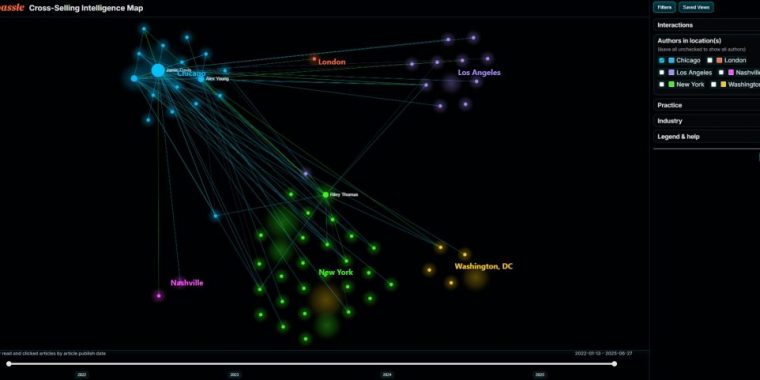
Passle,
a
technology
company
that
develops
thought
leadership
and
cross-selling
tools
for
law
firms,
has
unveiled
a
new
visualization
tool
for
its
CrossPitch
AI
platform
that
promises
to
make
cross-selling
activity
in
law
firms
visible,
actionable
and
measurable
for
the
first
time.
The
Cross-Selling
Intelligence
Map,
released
today,
creates
a
network
diagram
showing
how
thought
leadership
content
flows
among
a
firm’s
attorneys
across
different
offices
and
practice
areas.
The
Intelligence
Map
aims
to
address
what
Passle
characterizes
as
a
major
revenue
leak:
84%
of
law
firm
business
development
and
marketing
professionals
believe
their
firms
are
missing
cross-selling
opportunities,
with
99%
estimating
this
costs
them
at
least
10%
of
annual
revenue,
according
to
a
Passle-commissioned
study.
AI
to
Drive
Cross-Selling
The
map
is
an
expansion
of
the
company’s
CrossPitch
AI,
which
it
launched
in
June
and
which
uses
artificial
intelligence
to
analyze
attorney-authored
thought
leadership
content,
such
as
blog
posts,
articles
and
client
alerts.
Using
attorneys’
public-facing
biographical
information,
the
system
automatically
identifies
which
colleagues
might
have
clients
interested
in
that
content
and
sends
them
personalized
email
notifications
with
AI-generated
summaries.
“The
AI
reads
the
thought
leadership
that’s
been
created
in
the
firm
and
it
reads
the
bio
pages,
profile
pages
of
all
the
attorneys
at
the
firm
and
it
matches
the
two
together,”
James
Barclay,
Passle’s
CEO,
explained
in
an
interview
with
LawSites
last
week.
The
notifications
include
an
80-100
word
summary
so
attorneys
can
quickly
understand
the
content’s
relevance
without
reading
the
full
article.
To
supplement
what
the
AI
gleans
from
their
public
bios,
attorneys
can
add
an
“enhanced
profile”
within
Passle
where
they
specify
topics
of
interest
in
natural
language
–
such
as
“anything
about
the
pharmaceutical
industry”
or
“artificial
intelligence.”
A
firm’s
business
development
teams
can
set
a
relevancy
threshold
(typically
70-75%,
according
to
Barclay)
to
control
how
many
notifications
attorneys
receive,
balancing
comprehensiveness
against
information
overload.
The
platform
also
generates
pre-written
“I
saw
this
and
thought
of
you”
emails
that
attorneys
can
send
to
clients
with
a
single
click,
requiring
only
that
they
add
a
personal
greeting.
Visualizing
the
Invisible
Building
on
this
Crosspitch
AI
platform,
the
new
Intelligence
Map
launched
today
transforms
this
notification
data
into
an
interactive
network
visualization.
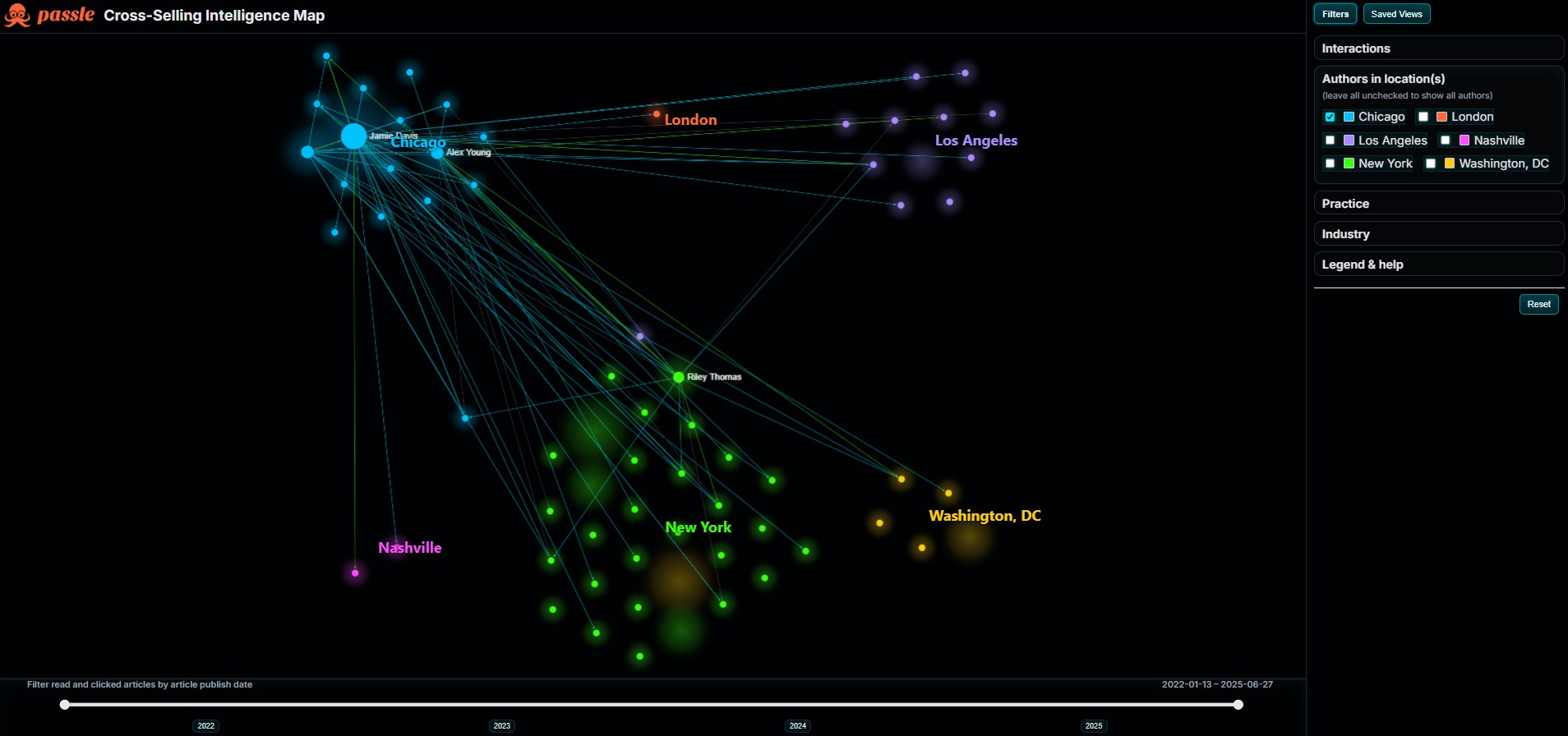
Larger
dots
represent
more
active
attorneys
who
create
and
share
more
content.
Connections
between
dots
show
where
thought
leadership
is
being
shared
across
the
firm.
Light
and
dark
patches
reveal
areas
of
high
and
low
activity.
Users
can
filter
the
map
by
location,
practice
area
or
industry,
and
use
a
timeline
slider
to
track
changes
over
time.
This
allows
leadership
to
see
insights
such
as
whether
a
newly
acquired
lateral
hire
or
practice
group
is
integrating
into
the
firm’s
knowledge-sharing
ecosystem
or
remaining
isolated.
In
his
conversations
with
large
law
firms,
Barclay
said,
they
always
want
to
know
how
they
can
show
collaboration
among
attorneys
and
practice
groups,
particularly
in
the
wake
of
a
merger
or
acquisition.
This
map,
he
said,
lets
them
do
exactly
that,
in
a
visual
manner.
The
Cross-Selling
Challenge
The
map
addresses
two
fundamental
barriers
to
cross-selling
that
Barclay
sees
time
and
again
in
firms:
awareness
and
trust.
“We
don’t
know
what
our
colleagues
know,
and
we
need
to
know
that,”
Barclay
said.
As
one
managing
partner
told
him:
“I
kind
of
knew
what
the
people
on
my
floor
knew.
I
didn’t
really
know
what
the
people
upstairs
or
downstairs
knew.
And
I
certainly
didn’t
know
what
L.A.
or
London
was
talking
about.”
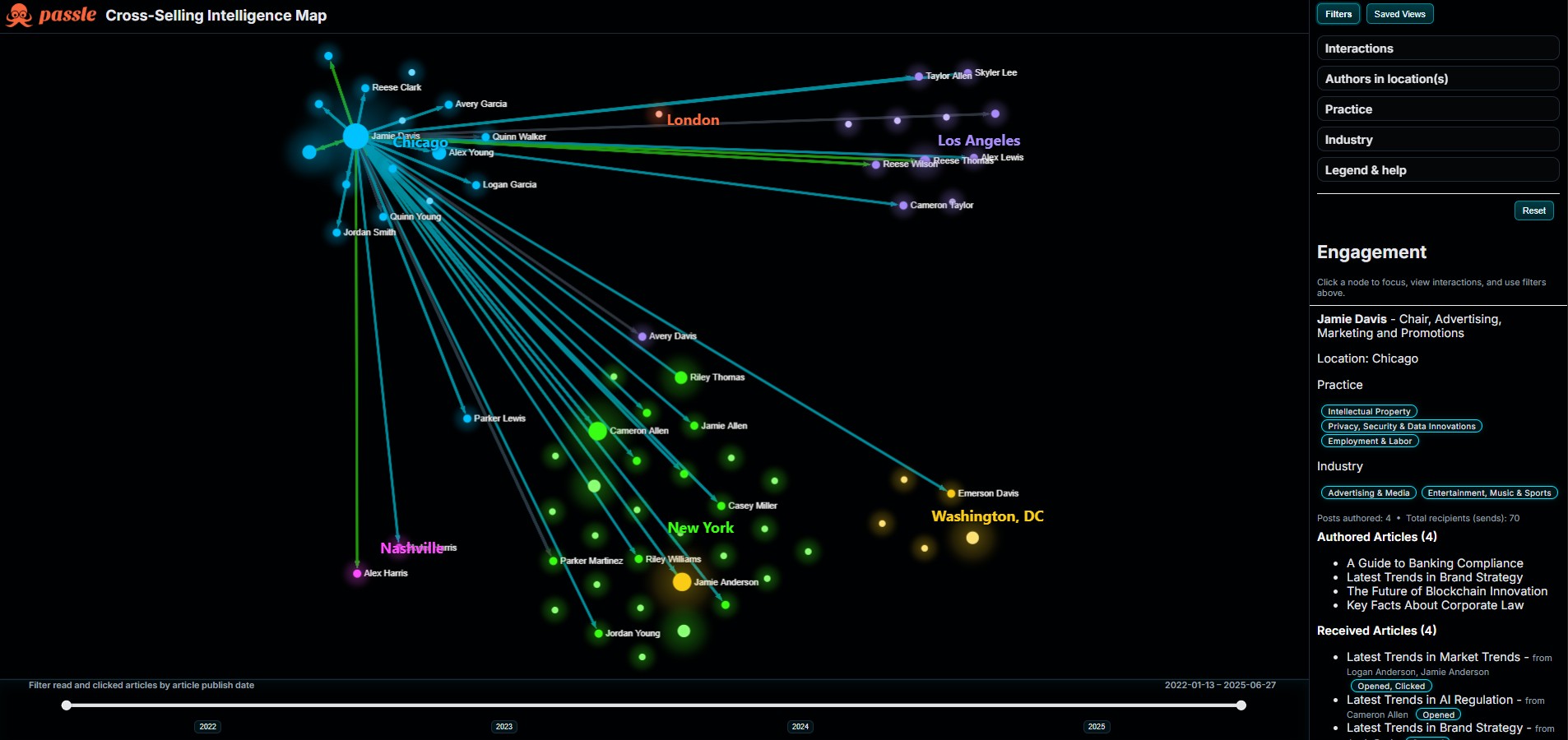
The
map
can
show
activity
and
engagement
for
a
specific
lawyer.
The
trust
barrier
is
equally
significant.
“I’ve
just
spent
15
years
building
a
book
of
business
and
I
don’t
know
if
I
want
to
introduce
Jenny,
who
I
haven’t
heard
of,
to
my
client,”
Barclay
said,
describing
how
that
trust
issue
might
inhibit
attorneys
from
cross
selling.
By
repeatedly
exposing
attorneys
to
colleagues’
expertise
through
relevant
content
summaries,
the
platform
aims
to
build
both
familiarity
and
confidence.
He
described
an
attorney,
Alice,
receiving
alerts
about
her
partner
Oscar’s
articles
on
autonomous
vehicles.
The
first
time
she
receives
it,
she
might
barely
notice
it.
The
second
time,
she
might
think
“Oh,
that’s
interesting,
Oscar’s
still
writing
about
autonomous
vehicles.
That’s
kind
of
cool.”
By
the
third
time,
she
might
realize
she
wants
to
get
in
touch
with
Oscar.
Eliminating
Guesswork
Since
launching
in
June,
CrossPitch
AI
has
been
adopted
by
29
law
firms,
including
Barnes
&
Thornburg,
Loeb
&
Loeb,
Manatt,
and
firms
from
both
the
Am
Law
200
and
UK
Top
50.
Passle
reports
that
open
rates
for
CrossPitch
notifications
average
42%,
more
than
double
the
18%
industry
average
for
legal
marketing
emails.
“With
CrossPitch
AI,
we’ve
eliminated
guesswork
and
replaced
it
with
a
data-driven
roadmap
showing
where
our
insights
will
have
their
greatest
impact,”
Trish
Lilley,
chief
marketing
and
business
development
officer
at
Barnes
&
Thornburg,
said
in
a
statement
provided
by
Passle.
“This
fact-fueled
approach
allows
us
to
deliver
optimal
value
to
our
clients
by
bringing
the
right
people
together
faster.”
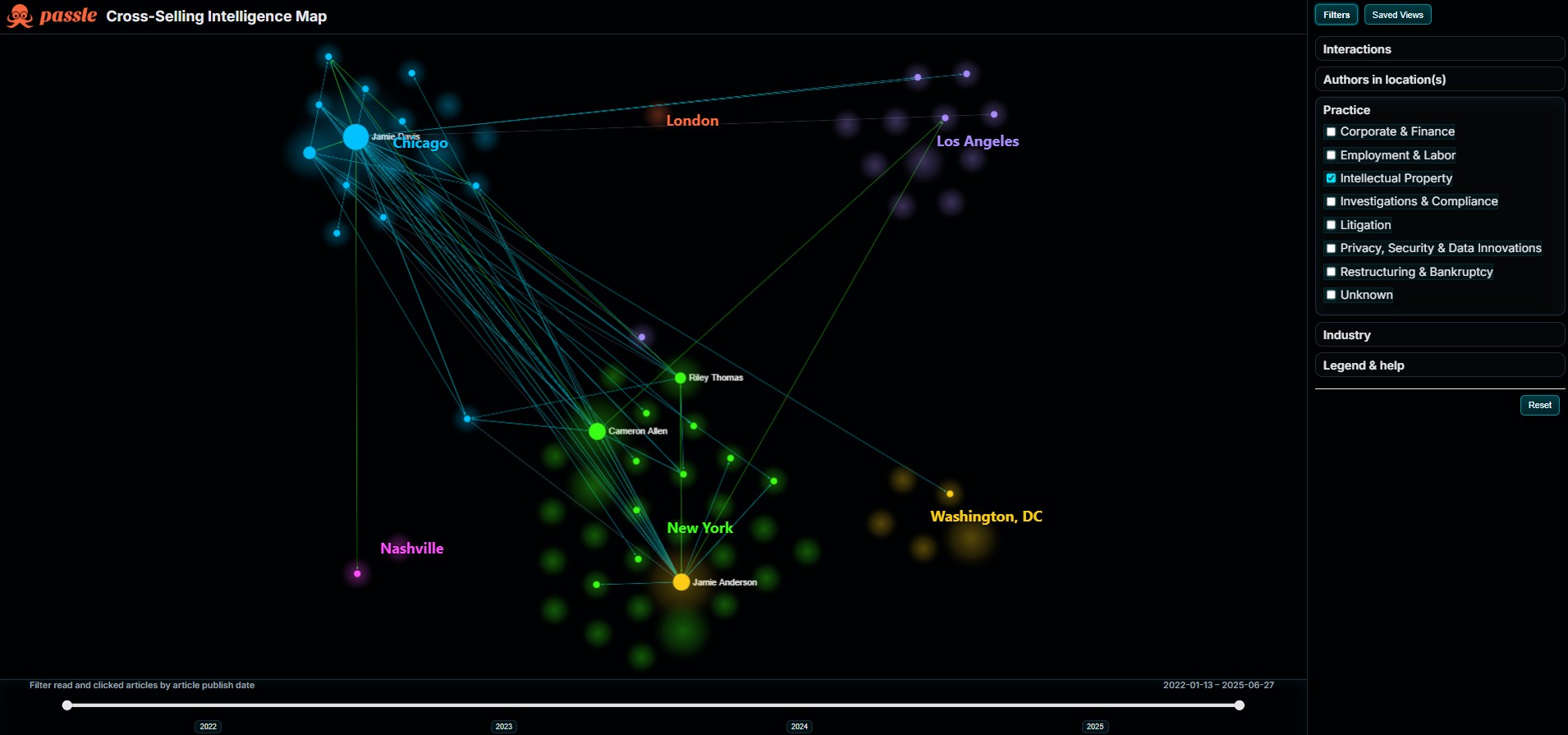
Activity
can
be
filtered
by
practice
areas.
Notably,
CrossPitch
AI
only
analyzes
publicly
available
information,
such
as
published
thought
leadership
and
public-facing
attorney
bios,
to
avoid
any
concerns
law
firms
might
have
about
providing
an
AI
tool
with
access
to
confidential
client
data
or
internal
firm
documents.
“Vendors
like
us
come
along
and
say,
hey,
we’ve
got
an
absolute
silver
bullet
…
and
all
we
need
to
do
is
go
into
all
your
most
secret
stuff
and
learn
it
and
read
it
and
don’t
worry,
it’ll
be
fine,”
Barclay
said.
Passle
has
deliberately
taken
a
different
approach,
using
only
public-facing
sources
of
content.
Not
only
does
that
assuage
firms’
fears
of
exposing
their
data,
but
it
also
enables
them
to
implement
the
product
much
more
quickly
–
within
just
a
week,
Barclay
said.
The
AI
platform
can
work
alongside
any
content
source
and
does
not
require
firms
to
use
Passle’s
separate
thought
leadership
platform.
Integrating
Lateral
Hires
Beyond
general
cross-selling,
the
Intelligence
Map
specifically
targets
lateral
hire
integration
–
a
persistent
challenge
given
that
approximately
50%
of
lateral
hires
leave
within
five
years,
by
some
industry
estimates.
For
a
lateral
who
cost
$750,000
to
several
million
dollars
to
recruit,
the
map
can
show
managing
partners
and
business
development
teams
whether
that
attorney
is
becoming
known
throughout
the
firm
by
creating
and
sharing
expertise
–
or
remaining
disconnected
from
potential
cross-selling
relationships.
“The
reason
you’re
here,”
Barclay
said
of
lateral
hires,
“is
essentially
to
cross
sell.
You
build
your
book,
you
bring
your
book
and
you
make
sure
that
other
people
know
that
you’re
there
and
that
we
can
sell
off
the
back
of
you
and
your
knowledge
and
what
you
do.”
What
the
Map
Cannot
Show
The
Intelligence
Map
tracks
three
types
of
activity:
creating
thought
leadership,
receiving
notifications
about
colleagues’
content,
and
taking
action
on
those
notifications
(clicking
through
to
articles
or
sharing
them).
Business
development
teams
can
drill
down
to
see
why
specific
attorneys
were
matched
with
specific
content,
based
on
what
the
AI
extracted
from
their
bios.
However,
the
map
does
not
capture
follow
up
–
whether
recipients
of
a
notification
actually
contacted
the
content
authors,
introduced
them
to
clients,
or
generated
any
cross-selling
revenue.
It
visualizes
key
indicators
of
cross-selling
behavior
rather
than
outcomes.
“It’s
not
necessarily
[that]
we’re
going
to
be
able
to
say,
okay,
there
was
a
$3
million
deal
done
because
a
notification
was
sent,”
Barclay
acknowledged.
“But
we
know
that
those
notifications
will
definitely
help.”
The
tool
represents
a
bet
that
making
previously
invisible
knowledge-sharing
activity
visible
will
drive
behavior
change,
even
without
directly
measuring
revenue
impact.
Whether
that
visibility
alone
can
overcome
the
structural
and
cultural
barriers
that
have
made
cross-selling
a
perennial
challenge
in
law
firms
remains
to
be
seen.