

by
ChatGPT)
The
biggest
argument
I’ve
gotten
into
lately
—
in
the
legal
tech
space
anyway
—
is
over
so-called
“Agentic
AI.”
I
say,
“so-called”
because
most
of
the
tools
billing
themselves
as
“agentic”
don’t
bear
much
resemblance
to
the
“Agentic
AI”
being
talked
about
in
every
other
sector.
Consumer
AI
companies
extol
the
virtues
of
agents
that
autonomously
make
reservations
for
you
based
on
scanning
your
horoscope
that
morning.
“Agentic”
is
the
buzzword
of
the
hour.
It’s
what
gets
all
the
VCs
setting
their
money
on
fire
investing
in
AI
so
excited
and
the
technophiles
intrigued.
And
so
legal
tech
companies
need
to
adopt
that
vernacular
too.
However,
lawyers
considering
new
products
aren’t
necessarily
psyched
about
the
idea
of
AI
using
black
box
decision-making.
Because
the
buzzword
we
use
for
that
in
this
profession
is
“malpractice.”
The
good
news
is
that,
despite
the
moniker,
most
of
the
products
being
described
as
agentic
in
the
legal
space
more
closely
resemble
a
batch
file
of
professionally
manicured
chat
prompts.
Which
is
good!
The
providers
behind
these
elaborate
automations
have
spent
a
lot
of
time
and
money
to
make
sure
the
AI
provides
the
best
possible
results.
AI
hallucinations
are
real,
but
the
greatest
source
of
error
remains
between
the
keyboard
and
the
chair.
Bad
prompts
lead
to
bad
results…
and
even
hallucinated
ones.
Lawyers
—
whether
in-house
or
at
a
firm
—
are
likely
to
feel
a
lot
better
about
a
product
described
as
“an
expert-curated
workflow
to
maximize
AI’s
potential
while
protecting
against
errors”
than
an
“autonomous
agent.”
The
legal
industry
gets
its
cues
from
the
tech
providers
and
those
providers
need
to
be
able
to
communicate
what
they
can
offer
in
terms
that
lawyers
are
ready
to
hear.
Plat4orm
and
Lumen
Advisory
Group
just
dropped
a
report
to
help
translate
technobabble
to
legalese:
From
Hours
to
Outcomes:
The
Legal
Tech
Executive
Playbook
for
Value
Creation
in
the
AI
Era.
It’s
the
first
in
a
series
of
planned
playbooks,
this
one
offering
a
strategic
guide
to
coach
up
legal
tech
providers
on
how
they
can
guide
their
own
clients
through
the
AI
waters.
As
someone
who
interviews
tech
providers
all
the
time,
it’s
usually
clear
when
a
company
is
represented
by
folks
like
Plat4orm
and
when
they
aren’t.
This
guide
offers
a
slice
of
insight
into
why.
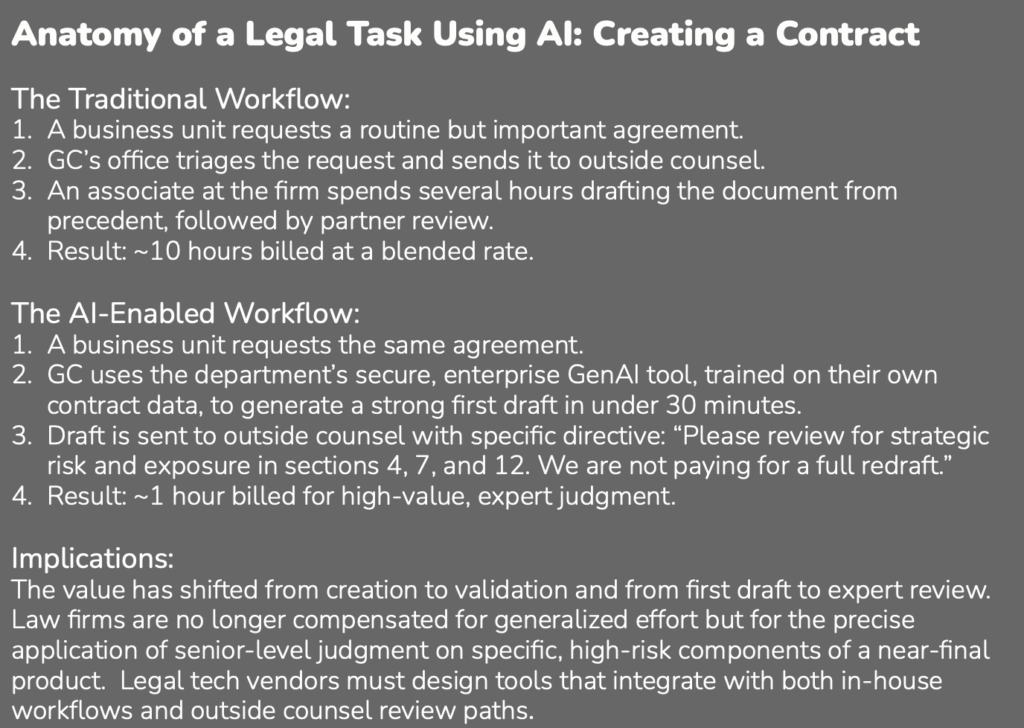
AI
providers
will
always
talk
about
time-savings,
but
it
matters
how
they
describe
time
savings.
Silicon
Valley
tech
bros
describe
time
savings
in
terms
of
AI
“taking
over”
decisions.
They
gush
about
how
they
have
built
something
to
replace
humans.
And,
yes,
they’ll
probably
drop
something
about
it
being
“agentic”
and
“autonomous.”
Contrast
that
with
the
description
above.
Note
that
words
like
“secure”
and
“trained
on
their
own
contract
data”
show
up
before
anyone
mentions
time.
Note
how
it’s
stressed
that
the
AI
created
“a
strong
first
draft,”
implicitly
reassuring
the
lawyer
customer
that
we’re
only
talking
about
a
draft
out
of
the
gate.
Legal
advice
is
“high-value”
and
“expert”
—
keeping
those
egos
stroked
—
while
describing
a
literal
decimation
of
billable
time.
Don’t
leave
it
in
terms
of
billed
time
lost,
focus
on
real
time
gained.
“Reframe
the
conversation
from
‘hours
saved’
to
‘strategic
capacity
unlocked,’”
as
the
playbook
explains.
An
MIT
study
found
that
some
95%
of
generative
AI
pilots
fail
to
deliver
measurable
business
impact.
There’s
no
single
cause
for
this,
but
at
least
part
of
it
is
the
general
confusion
among
lawyers
over
what
all
this
stuff
even
means.
How
do
you
make
the
plunge
and
sink
resources
into
AI
—
and
once
you
do,
how
do
you
commit
to
overcoming
the
adoption
hurdle
—
when
you
aren’t
even
sure
you’re
making
the
right
AI
decisions?
The
resulting
inaction
ends
up
like
a
middle
school
dance:
everyone
standing
awkwardly
along
the
walls
while
the
unruly
kids
try
to
spike
the
punch
with
bootleg
Four
Lokos
while
no
one’s
looking.
People
using
ChatGPT
for
legal
research
are
the
Four
Lokos
kids
of
this
analogy.
What
this
playbook
offers
is
a
responsible
chaperone
for
that
dance.
 Joe
Joe
Patrice is
a
senior
editor
at
Above
the
Law
and
co-host
of
Thinking
Like
A
Lawyer.
Feel
free
to email
any
tips,
questions,
or
comments.
Follow
him
on Twitter or
Bluesky
if
you’re
interested
in
law,
politics,
and
a
healthy
dose
of
college
sports
news.
Joe
also
serves
as
a
Managing
Director
at
RPN
Executive
Search.