

you
there,
Donald?
It’s
me,
John.
(Photo
by
Jabin
Botsford
–
Pool/Getty
Images)
Exercising
tremendous
restraint,
Chief
Justice
Roberts
managed
not
to
write
“Executor?
I
hardly
knew
her!”
on
this
morning’s
opinion
functionally
overruling
Humphrey’s
Executor.
Alas,
that
was
the
only
restraint
Roberts
mustered
today,
employing
the
infamous
“shadow
docket”
to
toss
90
years
of
Supreme
Court
precedent
to
fit
the
dementia-fueled
whims
of
his
patron
in
the
White
House.
He
may
be
named
John,
but
he’s
very
much
not
the
John
in
this
relationship.
Donald
Trump
wants
to
fire
FTC
commissioner
Rebecca
Slaughter,
which
the
FTC’s
authorizing
legislation
and
Supreme
Court
precedent
—
the
aforementioned
Humphrey’s
Executor
—
forbid.
He
fired
her
anyway
and
she
sued.
Both
the
district
and
appellate
court
blocked
the
firing
on
the
grounds
that
the
law,
in
fact,
prevents
Trump
from
doing
this.
In
reversing
the
lower
courts
and
allowing
Trump
to
fire
Slaughter,
it’s
really
too
bad
that
Roberts
declined
to
add
the
glib,
two-sentence
“hardly
knew
her”
joke,
because
it
would
have
DOUBLED
the
number
of
sentences
he
devoted
to
ending
nearly
a
century
of
precedent.
And
would’ve
come
much
closer
to
providing
a
coherent
justification
than
anything
he
did
write.
In
his
annual
report,
Roberts
chastised
judicial
critics
for
failing
to
understand
the
opinions.
“Read
the
opinion,”
as
Justice
Barrett
would
say.
So,
let’s
be
fair
and
lay
out
the
precise
defense
Roberts
offers
for
this
bold
decision.
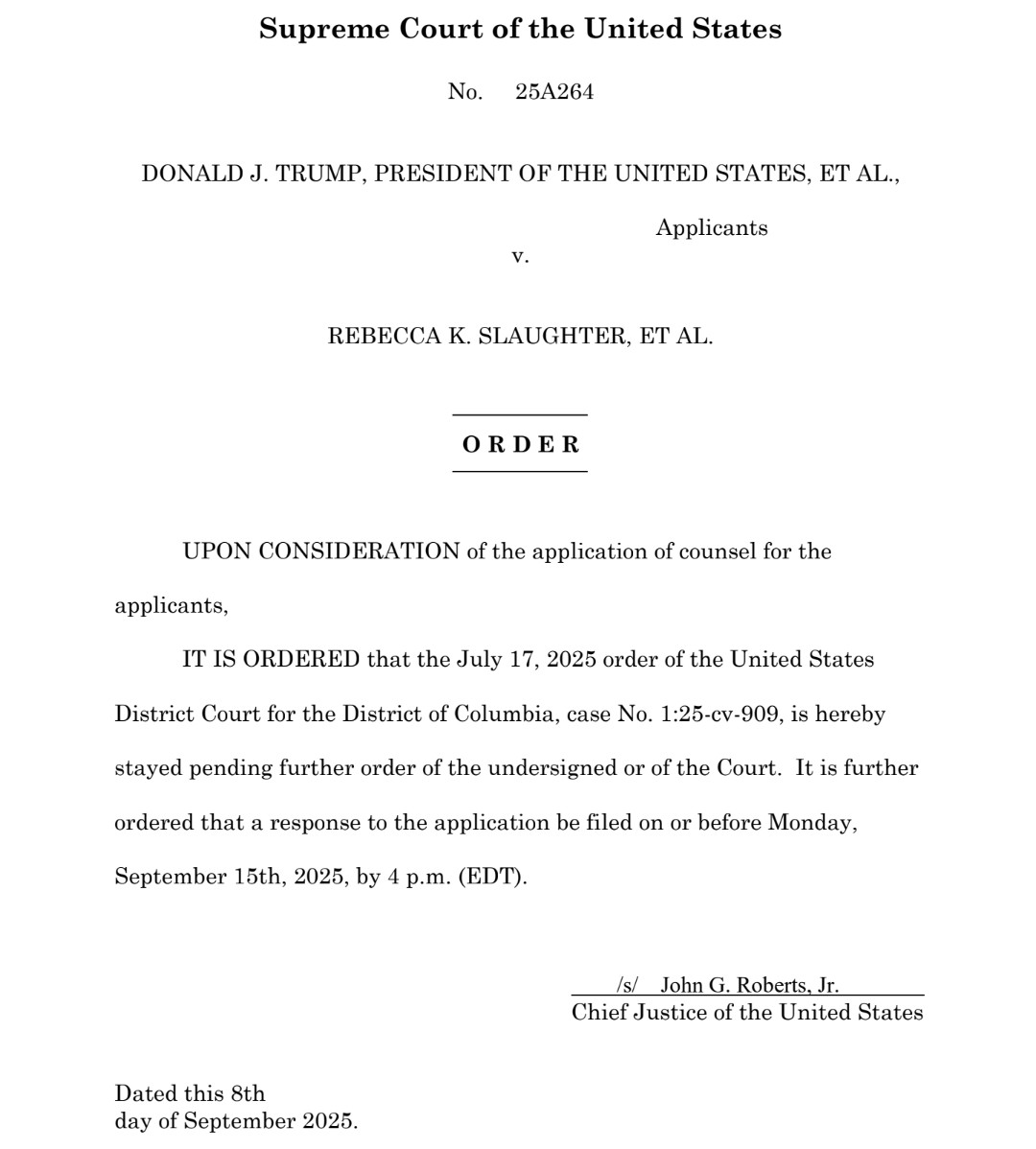
That’s
it.
In
fact,
that’s
not
even
an
opinion
because
he
put
out
the
order
without
an
opinion.
This
Supreme
Court
may
want
to
overrule
Humphrey’s,
but
the
fact
is
that
they
have
not
done
so
yet.
The
shadow
docket
—
or
whatever
sanitized
name
the
Federalist
Society
wants
to
rename
it
—
is
where
the
Supreme
Court
decides
emergency
requests
while
cases
work
their
way
through
the
legal
process.
In
this
case,
the
Trump
administration
said
that
it
really
wanted
to
fire
one
of
the
voting
members
of
the
Federal
Trade
Commission
immediately
rather
than
wait
to
see
if
the
Supreme
Court
eventually
overturns
established
precedent.
The
typical
rules
of
equitable
relief
would
dictate
keeping
Slaughter
in
her
position
until
the
matter
is
decided.
Roberts
chose
differently
based
on
four
key
factors:
First,
Donald
Trump
asked
him
to.
Second,
overturning
Humphrey’s
through
the
judicial
process
that
ostensibly
applies
to
everyone
equally
under
the
law…
takes
a
lot
of
time!
Think
of
all
the
corrupt
trade
practices
that
will
go
unused
while
we
wait
to
see
if
Humphrey’s
—
which,
again,
is
still
technically
THE
LAW
—
will
be
there
when
a
future
Supreme
Court
gets
around
to
it.
Third,
ruling
on
the
merits
requires
writing
a
decision.
The
conservatives
already
tried
to
thread
the
Humphrey’s
needle
via
the
shadow
docket
once,
struggling
to
explain
why
it’s
no
longer
the
law
to
the
extent
Trump
wants
to
gut
consumer
protection
but
IS
still
the
law
when
it
comes
to
protecting
the
Federal
Reserve
from
Trump
blowing
up
the
stock
market.
And,
as
they
say,
all
they
got
was
this
lousy
merciless
depantsing
from
Elena
Kagan.
The
lesson
the
Republican
justices
took
from
watching
their
written
reasoning
get
snidely
dismantled
was…
stop
writing
reasons.
Fourth,
Donald
Trump
asked
him
to.
Customarily,
a
shadow
docket
opinion
like
this
would
only
apply
to
Slaughter’s
case
until
it
reaches
the
Supreme
Court
on
the
merits
(or
she
gives
up
because
this
order
makes
the
case
fruitless
to
pursue).
That’s
part
of
the
trade-off:
the
Supreme
Court
can
take
significant
action
without
the
benefit
of
full
briefing
in
part
because
it’s
temporary
relief,
but
also
because
it’s
restrained
to
a
single
matter.
But,
as
the
appeal
of
making
up
law
without
the
restrictive
constraints
of
the
judicial
process
grew,
the
justices
have
rewritten
the
rules
to
empower
themselves
more.
“Lower
court
judges
may
sometimes
disagree
with
this
Court’s
decisions,
but
they
are
never
free
to
defy
them,”
Justice
Gorsuch
recently
wrote,
accusing
a
lower
court
of
correctly
applying
existing
precedent
instead
of
taking
an
unrelated
and
unexplained
temporary
stay
and
imagining
what
the
law
might
someday
be
if
the
Supreme
Court
had
written
a
merits
decision
about
that
stay!
It
feels
like
it
was
just
last
week
that
multiple
lower
court
judges
told
the
media
that
the
Supreme
Court’s
insistence
on
unexplained
opinions
unceremoniously
overruling
decisions
that
blocked
Trump
action
has
resulted
in
increased
threats
to
their
personal
safety.
That’s
because
it
was
just
last
week.
In
response,
Roberts
has
doubled
down,
overruling
lower
courts
while
refusing
to
offer
any
explanation
that
might
counter
the
White
House’s
own
claims
that
the
lower
courts
were
just
“rogue,”
“unhinged,”
“outrageous,”
and
“crooked.”
One
might
have
thought,
fresh
off
a
somewhat
unprecedented
critique
from
fellow
judges
over
issues
as
deeply
serious
as
their
personal
safety
and
public
faith
in
the
rule
of
law,
Roberts
would
sit
down
and
bang
out
a
few
pages
attempting
to
explain
that
the
lower
court
judges
weren’t
acting
in
bad
faith
to
thwart
Trump’s
messianic
mission.
But
he
just
doesn’t
care.
Obviously,
some
judges
are
outrageous
and
crooked.
That
said,
it’s
probably
not
the
ones
who
wrote
detailed
opinions
citing
decades
of
precedent
in
blocking
Slaughter’s
firing.
It’s
more
likely
the
sort
of
judge
who
doesn’t
have
the
guts
to
explain
himself.
Earlier:
Watch
The
Exact
Moment
John
Roberts
Realizes
He
Whored
Himself
Out
Elena
Kagan
Does
That
Thing
Elena
Kagan
Does
Where
She
Humiliates
The
Majority
In
A
Bold
Move,
Federal
Judges
Are
Calling
Out
The
Supreme
Court’s
Bullsh*t
 Joe
Joe
Patrice is
a
senior
editor
at
Above
the
Law
and
co-host
of
Thinking
Like
A
Lawyer.
Feel
free
to email
any
tips,
questions,
or
comments.
Follow
him
on Twitter or
Bluesky
if
you’re
interested
in
law,
politics,
and
a
healthy
dose
of
college
sports
news.
Joe
also
serves
as
a
Managing
Director
at
RPN
Executive
Search.