
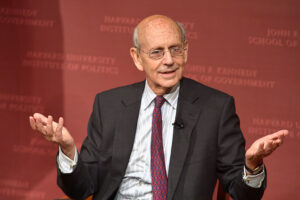
by
Paul
Marotta/Getty
Images,)
It
feels
borderline
therapeutic
these
days
to
be
in
a
room
with
someone
who
still
believes
the
Supreme
Court
can
be
coaxed
back
into
functioning
like
a
responsible
branch
of
government
instead
of
the
feral
political
creature
rampaging
across
constitutional
order.
Last
week,
Justice
Stephen
Breyer
received
the
inaugural
David
Boies
Prize
at
a
ceremony
hosted
by
the
NYU
School
of
Law,
projecting
a
level
of
hopefulness
typically
reserved
for
Cubs
fans
in
March.
The
sort
of
hope
that
comes
with
an
understanding
that
they
will
let
you
down
over
and
over,
but
sticking
with
it
because
it
will
all
be
worth
it
if
it
ever
does
pay
off.
David
Boies
presented
the
award,
bestowed
upon
a
recipient
for
their
“exceptional
commitment
to
justice
and
the
betterment
of
society,”
introducing
his
former
Senate
Judiciary
Committee
colleague
and
sitting
down
for
a
brief
fireside
chat.
It
was
Breyer’s
second
speaking
engagement
of
the
day,
having
opened
the
morning
with
an
NYU
panel
discussion
on
“Democratic
Institutions
Under
Pressure:
A
Judicial
Perspective”
with
retired
Canadian
Supreme
Court
Justice
Rosalie
Abella
and
moderated
by
NYU
Constitutional
Law
Professor
Sam
Issacharoff.
Over
the
course
of
the
two
events,
Breyer
laid
out
cautious
optimism
at
a
time
when
threats
to
the
judiciary
and
democracy
continue
to
pile
up.
Boies
jumped
directly
to
the
former,
asking
about
the
heightened
threat
level
courts
are
dealing
with.
It’s
a
topic
that
dominated
a
panel
at
the
recent
Society
for
the
Rule
of
Law
conference
as
well.
Recently,
twelve
anonymous
judges
called
upon
the
Supreme
Court
to
do
something
to
improve
the
situation.
In
response
to
these
grave
threats
to
personal
safety
and
the
pall
it
places
over
the
judicial
system,
Republicans
have
called
for
an
investigation
to
punish
the
judges
for
speaking
out.
Breyer
praised
the
security
that’s
been
stepped
up
to
deal
with
the
new
environment,
while
tying
these
human
fears
to
the
institutional
risk
of
a
judiciary
losing
its
actual
or
perceived
independence
if
judges
fear
for
themselves
or
their
children.
The
judges
begging
the
Supreme
Court
to
use
its
position
to
protect
the
judiciary
specifically
flagged
the
Court’s
unexplained
shadow
docket
rulings
for
feeding
the
Trump
administration’s
narrative
that
lower
court
judges
are
acting
lawlessly.
The
Deputy
Attorney
General
is
calling
on
the
same
yahoos
who
stormed
the
Capitol
to
go
to
“war”
with
federal
judges,
and
the
Supreme
Court
—
fully
aware
of
this
fact
—
keep
firing
off
“we
can’t
explain
why,
but
let’s
just
say
you’re
wrong”
opinions
seized
upon
by
these
bad
faith
actors.
Unsurprisingly,
the
shadow
docket
took
a
starring
role
in
the
earlier
panel
discussion.
Justice
Abella,
serving
as
the
audience’s
surrogate,
offered
the
outsider
perspective
that
the
current
use
of
the
shadow
docket
is
as
loony
as
a
Canadian
dollar.
“The
idea
of
injunctive
relief
is
not
anything
new,”
she
explained.
“Our
tradition
is
‘irreparable
harm.’
Where
is
there
irreparable
harm?
But
what
seems
to
be
happening
in
this
shadow
topic
regime
is,
rather
than
a
protection
of
the
status
quo,
is
a
protection
of
the
new
status
quo.”
Justice
Breyer
kept
things
positive,
noting
that
the
emergency
docket
isn’t
new,
and
laying
out
reasons
why
the
Court
would
want
to
avoid
becoming
locked
into
a
decision
prematurely.
And
yet,
that’s
a
hallmark
of
every
preliminary
injunction.
A
judge
has
to
devote
some
ink
to
“likelihood
of
success.”
Do
district
judges
possess
some
magical
power
to
overcome
this
snap
judgment
that
the
Supreme
Court
lacks?
Reading
between
the
lines
of
Breyer’s
comments,
he
would
likely
say
the
Supreme
Court’s
thoughts
can
carry
unintended
persuasive
power.
That
is
a
sound
explanation
historically,
but
runs
headlong
into
the
current
majority’s
angry
insistence
that
lower
courts
should
give
the
Court’s
shadow
docket
outcomes
persuasive
power.
Which
strikes
at
the
heart
of
the
primary
criticism
Justice
Breyer
has
taken
in
recent
years.
He’s
an
enthusiastic
cheerleader
for
an
idyllic
system
that
just
doesn’t
exist
right
now.
And
yet,
after
taking
flack
for
implying
that
retiring
to
preserve
a
Democratic
appointment
on
the
Supreme
Court
would
damage
the
institution
by
making
it
appear
too
political,
he
channeled
his
inner
Cincinnatus
to
ensure
that
Justice
Ketanji
Brown
Jackson
could
take
his
seat.
He
won’t
call
out
the
increasingly
explicit
cynicism
of
the
Supreme
Court’s
majority,
but
he’ll
write
thoughtful,
respectful
critiques
of
originalism
—
a
favor
that
the
conservative
legal
movement
would
never
return,
as
they
run
to
Fox
News
to
declare
judges
applying
settled
caselaw
as
“radical
activist
judges.”
Breyer
often
cites
“the
7th
graders,”
the
students
he
speaks
with
about
civics
in
“the
nurseries
of
democracy”
(to
quote
Breyer’s
opinion
in Mahanoy
Area
School
District
v.
B.L.).
Relentless
positivity
is
all
well
and
good
for
a
classroom,
but
adults
might
need
a
bracing
dose
of
“y’all
in
danger!”
For
that
matter,
does
the
young
adult
audience
preparing
to
enter
the
proto-Hunger
Games
of
Trumpist
America
even
need
this
positivity
anymore?
In
Breyer’s
experience,
the
only
thing
that
gets
the
students
to
stop
idly
looking
out
the
window
and
engaged
in
the
conversation
is
the
promise
of
participation.
The
idea
that,
“they
find
people
who
disagree
with
them,
and
that
they
talk
those
people
and
find
out
how
we
get
together.”
He
cites
Ted
Kennedy’s
model,
pointing
out
that
Kennedy
handed
out
credit
to
Republicans
to
get
practical
wins.
“And
it’s
the
look
in
their
eyes.
It’s
that
look
in
their
eyes
when
they’re
thinking
of
what
they’re
actually
going
to
do
to
help
keep
these
340
million
people
stay
together
as
a
nation.
Stay
together,
despite
their
diversity.
When
I
see
that
look
in
their
eyes
—
in
the
seventh
grader
in
the
high
schooler
—
I
suddenly
say,
‘I
have
cause
for
optimism.’”
He
avoids
mentioning
that
those
same
Republicans
would
turn
around
and
use
Kennedy
as
a
campaign
punching
bag,
an
empty
signifier
of
liberal
moral
decay
and
symbol
of
the
civil
rights
era
to
gin
up
their
own
racist
voters.
That
part
of
the
story
is
less
inspiring.
Breyer
keeps
appealing
to
the
better
angels
of
the
judiciary’s
nature,
even
when
those
angels
long
ago
split
town.
Probably
for
a
luxury
vacation
financed
by
conservative
donors.
While
this
can
frustrate
critics
who
think
Breyer
fails
to
understand
the
precariousness
of
the
moment,
his
hopefulness
(like
that
of
the
aforementioned
Cubs
fan)
should
not
be
mistaken
for
naiveté.
During
the
panel,
Breyer
quoted
Albert
Camus
—
a
notably
cheery
author
—
to
remind
the
audience
that
point
of
The
Plague
is
that
the
plague
germ
—
Nazism
—
never
dies.
“It
goes
into
remission.
It
goes
into
remission
and
it
lurks.
It
lurks
in
the
attics,
it
lurks
in
the
file
cabinets,
it
lurks
in
the
basement,
it
works
in
the
hallway…
For
one
day,
for
the
education,
or
perhaps
for
the
misfortune
of
mankind,
evil
once
again,
since
it’s
rats
into
a
once
happy
city.”
Starting
to
see
why
the
conservatives
have
such
a
visceral
distaste
of
vaccines.
Breyer
continues,
“the
rule
of
law
is
one
weapon,
not
the
only
weapon,
but
one
weapon,
that
people
have
to
go
over
long
periods
of
time.
to
try
to
keep
those
rats
in
remission.”
Sure.
But
where
does
optimism
fit
into
sharpening
that
weapon?
In
a
poignant,
unintentional
juxtaposition,
Justice
Abella
and
Justice
Breyer
told
two
different
formative
anecdotes
rooted
in
their
post-War
upbringings.
“I
was
born
in
Germany
in
1946,”
Justice
Abella
explained.
“My
parents
were
in
a
concentration
camp.
I
was
revenge.
And
I
honestly
believe
that
without
strong,
fearless
courts,
there’s
no
hope
for
democracy
anywhere.”
Growing
up
in
San
Francisco,
Justice
Breyer
recounted
his
father
taking
him
to
City
Hall
in
1945,
and
telling
the
six-year-old
Breyer,
“Those
people
are
here
to
write
the
United
Nations
charter,”
and
pointing
out
global
dignitaries.
Competing
childhood
encounters
with
the
trauma
of
the
20th
century.
And
Abella
is
the
more
outwardly
skeptical.
Worried
about
hate
speech
and
demagoguery,
frightened
that
the
American
judicial
system
might
be
buckling
from
the
top,
and
sounding
the
alarm
that
the
rats
are
already
entering
the
city.
Breyer
is
optimistically
evangelizing
about
the
the
spirit
of
community
and
the
peace
to
come.
Those
worldviews
may
seem
in
tension,
but
the
post-War
order
was
built
on
both.
Abella
warns
us
what
happens
if
we
fall
asleep.
Breyer
insists
we
can
still
wake
up.
Fighting
the
rot
all
the
time
collapses
into
nihilism
without
a
little
hope.
Preserving
democracy
is
a
team
sport.
Not
everyone
needs
to
be
railing
against
the
horrors
all
the
time.
Someone
needs
to
get
in
the
trenches
and
do
the
less
glamorous
offensive
line
work,
hyping
the
world
where
institutions
once
functioned
free
from
cynicism
and
corruption
and
might
do
so
one
day
again.
Maybe
this
is
now
a
Bears
fan
analogy?
In
any
event,
criticizing
Breyer
for
not
joining
the
chorus
raging
against
the
depredations
upon
constitutional
order
misses
the
role
he’s
playing.
Yes,
he’s
blocking
for
the
problematic
mixed
bag
offense
that
is
the
2025
federal
judiciary,
but
it’s
protection
that
needs
to
be
there
if
the
new
draft
picks
are
ever
going
to
fix
things.
And
sometimes
defending
the
whole
team
means
pretending
the
current
QB
isn’t
a
feckless
degenerate.
The
Boies
Prize
says
“exceptional
commitment
to
justice
and
the
betterment
of
society.”
It
doesn’t
assign
a
role
to
how
the
recipient
gets
there.
Breyer
continues
to
hold
up
the
hope
side
of
the
equation
so
we
don’t
have
to.
 Joe
Joe
Patrice is
a
senior
editor
at
Above
the
Law
and
co-host
of
Thinking
Like
A
Lawyer.
Feel
free
to email
any
tips,
questions,
or
comments.
Follow
him
on Twitter or
Bluesky
if
you’re
interested
in
law,
politics,
and
a
healthy
dose
of
college
sports
news.
Joe
also
serves
as
a
Managing
Director
at
RPN
Executive
Search.