
Ed.
note:
Please
welcome
Renee
Knake
Jefferson
back
to
the
pages
of
Above
the
Law.
Subscribe
to
her
Substack,
Legal
Ethics
Roundup, here.
Welcome
to
what
captivates,
haunts,
inspires,
and
surprises
me
every
week
in
the
world
of
legal
ethics.
Happy
Monday!
Hello
from
Praha.
My
son’s
spring
break
was
last
week,
so
as
I
write
this
we
are
wrapping
up
travels
through
Czechia
and
Germany.
I
love
a
good
library,
so
a
highlight
was
touring
the
Klementinum,
which
houses
the
National
Library
of
the
Czech
Republic.
Here’s
a
peek
inside.

Baroque
Library,
Old
Town
Prague
(photo
by
Renee
Jefferson)
It
was
a
big
week
for
legal
ethics
news.
We
suffered
whiplash
as
the
administration
went
from
dropping
the
pursuit
of
its
Executive
Orders
against
law
firms
to
doubling-down
on
them
24
hours
later.
And
that
wasn’t
the
only
whiplash-reversal.
Check
out
the
headline
below
from
the
Florida
Bar
for
more
on
that.
Meanwhile
a
serious
threat
to
states’
rights
looms
with
the
Justice
Department
directing
bar
authorities
on
how
to
handle
discipline
of
its
lawyers.
I
also
spoke
with National
Law
Journal reporter Avalon
Zoppo who
has
analyzed
interesting
data
about
the
number
and
categories
of
judicial
complaints
over
the
past
15
years.
You
can
read
more
about
her
study
along
with
the
other
top
ten
headlines.
Highlights
from
Last
Week
–
Top
Ten
Headlines
#1
“What
Was
Behind
a
Spike
in
Judicial
Misconduct
Complaints
Last
Year?” From The
National
Law
Journal: “The
number
of
judicial
misconduct
complaints
filed
against
federal
judges
spiked
last
year,
according
to
the
most
recent
statistics
released
by
the Administrative
Office
of
the
U.S.
Courts.
A
little
over
1,850
ethics
complaints
were
commenced
against
judges
during
the
12-month
period
that
ended
Sept.
30,
an
almost
23%
increase
compared
to
the
same
period
a
year
prior
and
higher
than
recent
years.
Court
watchers
said
it’s
difficult
to
pin
down
what
could
be
behind
the
increase,
but
one
driver
could
be
a
ramping
up
of
public
officials’
criticism
of
judges
and
the
courts.
… University
of
Houston
Law
Center professor Renee
Knake
Jefferson said
the
public
may
be
more
aware
about
the
process
for
raising
concerns
about
judges
compared
to
20
years
ago,
leading
to
more
complaints.
‘The
reason
why
I
think
there’s
a
heightened
awareness
by
the
public
is
because
we
saw
challenges
to
judges,
both
in
the
context
of
election-related
disputes,
but
also
because
we
have
a
president
who
has
called
out
judges
and
raised
concerns
about
the
judges
when
he’s
unhappy
with
the
substantive
outcome
of
a
matter,’
said
Knake
Jefferson,
who
studies
judicial
and
lawyer
ethics.”
Read
more here.
#2
“Trump
Administration,
in
Reversal,
Tries
to
Continue
Fight
Against
Law
Firms.” From The
New
York
Times: “The
administration
told
a
court
on
Monday
that
it
was
abandoning
its
defense
of
executive
orders
targeting
the
firms.
But
on
Tuesday,
the
Justice
Department
abruptly
changed
its
position.”
Read
more here.
#3
“Florida
Bar
Reverses
Itself,
Says
It
Is
Not
Investigating
Lindsey
Halligan.” From The
Washington
Post: “A
spokesperson
said
the
bar’s
counsel
‘erroneously’
stated
there
was
a
‘pending
investigation’;
instead,
a
complaint
against
Halligan
remains
at
a
preliminary
stage.”
Read
more here (gift
link).
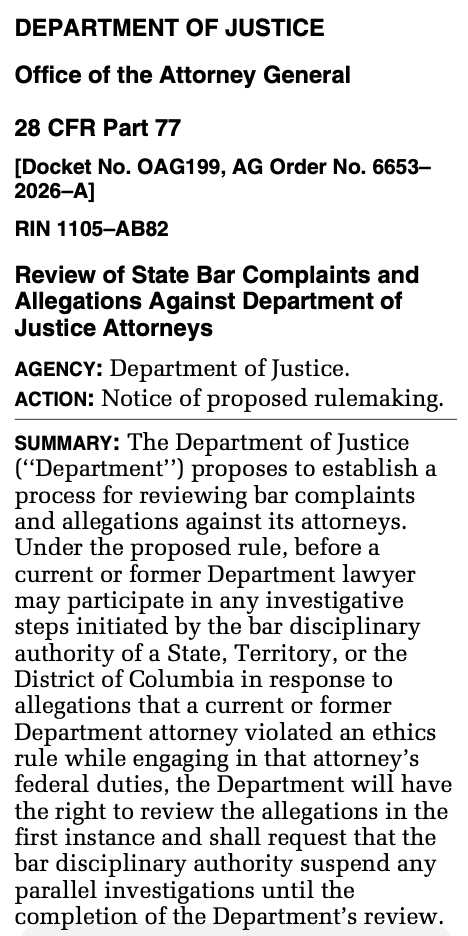
#3
“Trump
Justice
Dept.
Seeks
to
Stall
State
Bar
Discipline
of
Its
Lawyers.” From The
New
York
Times: “The
administration
has
no
control
over
the
disciplinary
authorities
of
state
bar
associations,
but
a
new
proposal
would
let
the
attorney
general
ask
them
to
suspend
proceedings
involving
department
lawyers.”
Read
more here (gift
link).
View
the
full
proposal
in
the
Federal
Register here.
#5
“The
Cathedral
of
Justice
is
Crumbling.” From
former Attorney
General
Alberto
Gonzalez at Checks
&
Balances: “As
Attorney
General
during
the George
W.
Bush administration,
I
witnessed
the
countless
efforts
of
department
lawyers
and
employees
to
protect
the
rule
of
law
and
maintain
the
cathedral
of
justice.
…
Today
it
appears
to
many
former
DOJ
employees
and
officials
that
the
cathedral
of
justice
is
being
dismantled
stone
by
stone.
Prosecutors
appear
to
no
longer
enjoy
prosecutorial
independence.
Prosecutions
at
the
federal
district
level
against
perceived
political
or
personal enemies of
the
administration’s
leadership
are,
in
many
cases,
now
directed
by
senior
leaders
at
the
Department
or
by
subordinates
at
the
White
House.
Further,
we
see
the
entire
legal
profession
weakened
by attacks on
law
firms.
Politically
motivated
criticism
of
our
judges,
as
well
as threats to
their
families,
threaten
to
undermine
the
independence
of
the
courts.
Recently,
it
was reported that
leaders
in
the
various
93
US
offices
were
told
to
provide
DOJ
headquarters
with
examples
of
perceived
judicial
activism
that
would
serve
as
the
basis
for
referral
to
the
House
of
Representatives
for
possible
impeachment
proceedings.
There
are
growing
complaints
about
executive
branch
defiance
of
court
orders.
Some
prosecutions
now
appear
to
be
motivated
not
by
justice—but
by
politics,
intimidation,
or
retribution.
Recent
prosecutions
of
perceived
political
enemies
of
the
current
administration—including
former FBI
Director
James
Comey, New
York
Attorney
General
Letitia
James,
and
six
members
of
Congress,
including Sen.
Mark
Kelly—have
all failed to
an
embarrassing
level.”
Read
more here.
#6
“California
Ban
on
Fee
Sharing
Prompts
Firm
to
Ditch
Owners.” From Bloomberg
Law: “A
new
California
law
has
already
forced
one
out-of-state
law
firm
to
change
its
ownership
structure.
Eleos
LLP,
an
Arizona
firm
affiliated
with
California’s
Wisner
Baum,
removed
non-lawyers
from
its
ownership
in
order
to
comply
with
the
law,
partners
at
Wisner
Baum
said
in
interviews.
The
law bans firms
in
California
from
sharing
contingency
fees
with
other
firms
that
are
owned
by
non-lawyers.
The
move
is
an
early
example
of
the
law’s
impact
since
taking
effect
in
January
on
firms
operating
under
relaxed
ownership
rules
in
Arizona
and
a
handful
of
other
jurisdictions.”
Read
more here.
#7
“UK
Law
Sector’s
Private
Equity
Boom
Offers
Lessons
For
US.” From Law360: “Private
equity
money
is
pouring
into
the
UK
legal
sector,
fueling
a
wave
of
consolidation
in
consumer-facing
practices
and
offering
a
glimpse
of
what
it
could
look
like
if
outside
investment
in
the
US
legal
industry
takes
off.”
Read
more here.
#8
“Social
Media
Threats
are
Disrupting
Rule
of
Law
for
Judges.” From Judge
Derwin
L.
Webb in
the The
Courier-Journal: “As
chief
judge
of
family
court,
I
do
not
ask
to
be
shielded
from
criticism.
I
ask
only
that
criticism
remain
within
the
bounds
of
law
and
civility.”
Read
more here.
#9
“DOJ
Attorney
Used
Fabricated
Quotes
in
Court
Filing.” From Bloomberg
Law: “An
assistant
US
attorney
in
North
Carolina
filed
a
response
with
the
court
that
included
‘fabricated
quotations
and
misstatements
of
case
holdings’
and
then
made
‘false
or
misleading
statements’
of
how
they
got
included,
a
magistrate
judge
said.
‘Because
of
the
seriousness
of
these
issues,’
senior
leaders
from
the
US
Attorney’s
Office
for
the
Eastern
District
of
North
Carolina
must
appear
at
a
show
cause
hearing
next
week
for
why
the
civil
litigator
responsible
shouldn’t
be
sanctioned
and
why
the
entire
office
shouldn’t
be
held
jointly
responsible, US
Magistrate
Judge
Robert
Numbers said
in
a
March
2 order.”
Read
more here.
#10
“11
Law
School
Deans
Oppose
Proposal
to
Speed
Up
Approval
Process
for
Accreditation
Changes.” From
the ABA
Journal: “Deans
at
11
law
schools
have
argued
the
council
for
the
ABA
Section
of
Legal
Education
and
Admissions
to
the
Bar
should
not
approve
a
proposal
that
would
speed
up
the
process
of
revising
or
creating
new
accreditation
standards.
Currently,
as
specified
by
Rule
55,
the
ABA
is
allowed
to
weigh
in
on
proposed
revisions
to
standards
twice
before
the
council
determines
the
specifics
of
the
change.
The
proposed
changes
would
give
the
ABA
only
one
chance
to
provide
its
input.
But
the
Feb.
20 memo addressed
to
council
chair Daniel
Thies and
signed
by
deans
including Angela
Onwuachi-Willig at
Boston
University
School
of
Law, Paul
Litton at
the
University
of
Missouri
School
of
Law
and Marcilynn
A.
Burke at
Tulane
Law
School,
stated
‘we
believe
that
the
council
should
prioritize
adopting
the
best
possible
standards,
interpretations
and
rules
over
reducing
the
time
it
may
take
to
implement
a
change.’”
Read
more here.
[Full
disclosure:
I
am
a
member
of
the
Accreditation
Council
for
the
ABA
Section
of
Legal
Education
and
Admission
to
the
Bar.]
Get
Hired
Did
you
miss
the
450+
job
postings
from
previous
weeks?
Find
them
all here.
Upcoming
Ethics
Events
&
Other
Announcements
️
Did
you
miss
an
announcement
from
previous
weeks?
Find
them
all here.
Keep
in
Touch
-
News
tips?
Announcements?
Events? A
job
to
post? Reading
recommendations? Email
[email protected]
–
but
be
sure
to
subscribe
first,
otherwise
the
email
won’t
be
delivered. -
Do
you
have
colleagues
who
care
about
legal
ethics? Please
share
the
Roundup
with
them.
I’d
love
to
see
our
community
continue
to
grow!
Renee
Knake
Jefferson
holds
the
endowed
Doherty
Chair
in
Legal
Ethics
and
is
a
Professor
of
Law
at
the
University
of
Houston.
Check
out
more
of
her
writing
at
the Legal
Ethics
Roundup.
Find
her
on
X
(formerly
Twitter)
at @reneeknake or
Bluesky
at legalethics.bsky.social.