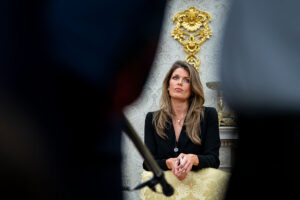
Halligan
(Photo
by
Al
Drago/Getty
Images)
On
Thursday,
Donald
Trump’s
insurance
lawyer,
Lindsey
Halligan,
will
defend
her
right
to
lead
the
US
Attorney’s
Office
in
the
Eastern
District
of
Virginia.
It
will
likely
be
one
of
her
last
acts
on
the
job.
The
only
real
question
is
whether
she’ll
take
the
James
Comey
and
Letitia
James
indictments
with
her,
or
whether
they’ll
limp
on
a
bit
longer
under
some
other
prosecutorial
authority.
The
Three
Hat
Dance
Attorney
General
Pam
Bondi
certainly
knows
how
to
hand
a
US
Attorney’s
Office
over
to
one
of
Trump’s
cronies.
Since
July,
she’s
been
using
the
same
maneuver
to
install
unconfirmable
MAGA
dolts
to
the
top
prosecutor’s
job:
-
Step
1:
Appoint
crony
as
interim
US
Attorney
for
120
days
under
28
USC
§
546. -
Step
2:
When
it
becomes
clear
that
no
Senate
confirmation
is
coming,
appoint
said
crony
as
first
assistant
US
Attorney,
and
then
claim
that
crony
is
automatically
promoted
to
acting
US
Attorney
by
operation
of
the
Federal
Vacancies
Reform
Act. -
Step
3:
Simultaneously
appoint
crony
as
a
special
attorney
under
28
USC
§
509,
510,
and
515.
It’s
a
little
rickety,
but
it’s
more
or
less
worked,
so
far
— at
least
to
the
extent
that
the
cronies
have
still
been
able
to
charge
cases.
Three
federal
courts
ruled
that
Steps
1
and
2
aren’t
legal,
since
they
would
effectively
eliminate
Senate
confirmation
for
US
Attorneys.
Why
would
any
president
bother
nominating
someone
when
he
can
string
together
an
endless
string
of
interim
appointments,
potentially
of
the
same
crony?
But
no
judge
has
dismissed
a
case
based
on
the
US
Attorney’s
unlawful
appointment,
since
Assistant
US
Attorneys
who
do
the
actual
work
of
charging
cases
have
the
power
to
indict
and
prosecute
as
well.
But
on
September
22,
Pam
Bondi
only
slapped
the
first
hat
on
Lindsey
Halligan,
appointing
her
interim
US
Attorney
under
§
546.
That
was
tempting
fate,
since
a
federal
judge
in
Pennsylvania
had
already
ruled
that
§
546
only
allows
for
one
120-day
interim
appointment,
after
which
only
the
district’s
judges
may
appoint
an
interim
lead
prosecutor
until
the
Senate
confirms
a
pending
nominee.
And
it
was
doubly
tempting
fate
since
Halligan
was
the
only
lawyer
at
EDVA
who
would
get
anywhere
near
the
Comey
and
James
cases.
Halligan
was
the
sole
lawyer
to
present
those
indictments
to
a
grand
jury,
and
she’s
the
only
one
who
signed
them.
So
if
she
wasn’t
legally
appointed,
those
cases
would
appear
to
be
DOA.
Hot
Tub
Time
Machine
DOJ
Pam
Bondi
is
currently
trying
to
do
the
three-hat
dance
in
reverse.
After
Comey
and
James
filed
motions
to
dismiss
noting
that
three
courts
have
found
that
the
president
cannot
make
successive
interim
appointments,
Bondi
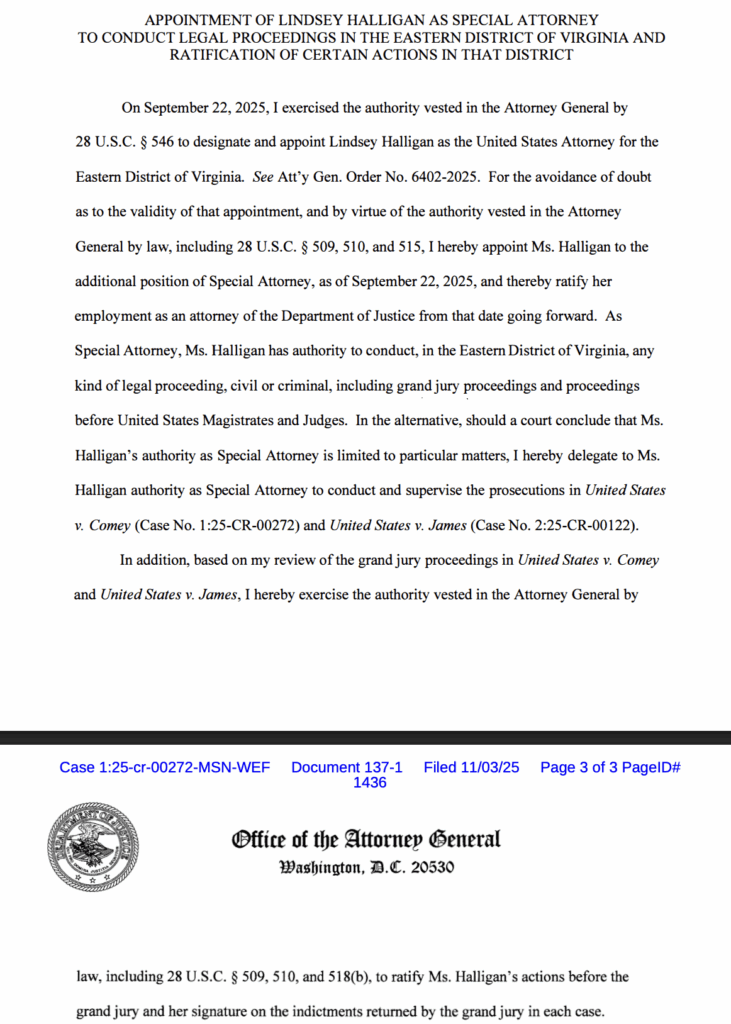
signed
a
new
order
purporting
to
retroactively
designate
Halligan
as
a
special
attorney
under
§§ 509,
510,
and
515
“as
of
September
22”
—
effectively
traveling
back
in
time
six
weeks
and
sticking
the
third
hat
on
Halligan
before
she
secured
the
indictments.
Alternatively,
Bondi
claimed
to
have
“ratified”
the
indictments,
blessing
them
post
facto
and
curing
any
defect
arising
from
the
unfortunate
technicality
that
Halligan
had
no
right
to
be
in
the
grand
jury
room.
After
Pat
Fitzgerald
and
Abbe
Lowell
spent
ten
solid
minutes
laughing
their
asses
off
—
PRESUMABLY!
—
they
filed
their
replies.
Lipstick
on
a
pig
“Attorney
General
Bondi
does
not
have
a
time
machine,”
James’s
lawyers
jeered,
adding
that
“Just
as
President
Trump
could
not
announce
tomorrow
that
he
is
‘appointing’
Attorney
General
Bondi
as
the
acting
Administrator
of
NASA
from
January
2025
to
March
2025,
Attorney
General
Bondi
lacked
the
power
announce
an
appointment
of
Ms.
Halligan
that
bent
space
and
time.”
They
were
similarly
derisive
about
the
government’s
claim
that
Halligan
was
functionally
an
AUSA
in
September,
rather
than
a
White
House
aide
tasked
with
de-woke-ing
the
Smithsonian:
“The
problem
is
that
Ms.
Halligan
brought
this
indictment
as
a
private
citizen
with
no
authority
to
litigate
on
behalf
of
the
United
States.
No
amount
of
ex-post
maneuvering
can
rescue
this
unlawful
indictment
from
dismissal.”
James
calls
dismissal
with
prejudice
“the
only
remedy
that
will
promote
the
interests
protected
by
the
Appointments
Clause
and
deter
the
government
from
deploying
unlawful
appointments
to
effectuate
retaliation
against
perceived
political
opponents”
— essentially
tying
it
into
her
motion
to
dismiss
for
selective
and
vindictive
prosecution.
Comey’s
reply
echoes
James’s,
scoffing
at
Bondi’s
reliance
on
a
theory
of
§
546
that
has
already
been
rejected
by
three
courts.
But
his
argument
against
Bondi’s
“ratification”
and
for
dismissal
with
prejudice
is
even
stronger
than
James’s,
since
the
statute
of
limitations
on
his
“crimes”
has
now
expired.
Comey
quotes
the
Supreme
Court’s
holding
in
FEC
v.
NRA
Political
Victory
Fund,
finding
it
“essential
that
the
party
ratifying
should
be
able
not
merely
to
do
the
act
ratified
at
the
time
the
act
was
done,
but
also
at
the
time
the
ratification
was
made.”
Bondi
could
not
indict
him
today
because
the
statute
of
limitations
has
run,
and
so
she
can’t
retroactively
ratify
an
indictment
that
was
improperly
obtained
six
weeks
ago.
Something
to
remember
you
by
This
morning
Judge
Cameron
McGowan
Currie
will
consider
the
motions
to
disqualify
Halligan
and
dismiss
the
indictments.
We
may
also
get
an
indication
of
how
egregiously
inappropriate
Halligan’s
grand
jury
presentations
were,
since
the
court
has
been
mulling
them
over
for
more
than
a
week.
Judge
Currie,
who
was
seconded
from
the
District
Court
of
South
Carolina
to
hear
the
disqualification
motion,
ordered
the
government
to
turn
grand
jury
transcripts
in
both
cases
for
in
camera
review.
In
the
Comey
case,
she
later
filed
a
second
order
noting
that
the
government’s
production
“fails
to
include
remarks
made
by
the
indictment
signer
both
before
and
after
the
testimony
of
the
sole
witness,
which
remarks
were
referenced
by
the
indictment
signer
during
the
witness’s
testimony.”
Halligan
also
forgot
to
include
information
on
the
first
indictment,
for
which
she
got
no-billed.
So,
things
are
not
looking
great
for
the
“indictment
signer.”
And
that’s
before
she
has
to
defend
these
fakakta
cases
on
the
merits!
But,
even
if
she
does
get
get
tossed
off
this
case
tomorrow
or
next
week,
Halligan
will
take
a
souvenir
with
her
—
something
to
remember
this
day
by.
And
that
something
is
…
a
bar
complaint.
On
Tuesday,
the
Campaign
for
Accountability
notified
the
Florida
and
Virginia
bars
of
potential
violations
of
their
respective
rules
of
professional
conduct.
The
nonprofit
suggests
that
Halligan:
violated
her
obligations
of
candor
and
competence;
made
extrajudicial
statements;
brought
a
prosecution
she
knows
is
not
supported
by
probable
cause;
and
engaged
in
conduct
involving
dishonesty,
deceit,
misrepresentation,
or
conduct
prejudicial
to
the
administration
of
justice.
So,
whatever
happens,
she’s
got
that
to
look
forward
to.
Subscribe
to
read
more
at
Law
and
Chaos….
Liz
Dye produces
the
Law
and
Chaos Substack and podcast. You
can
subscribe
by
clicking
the
logo: