
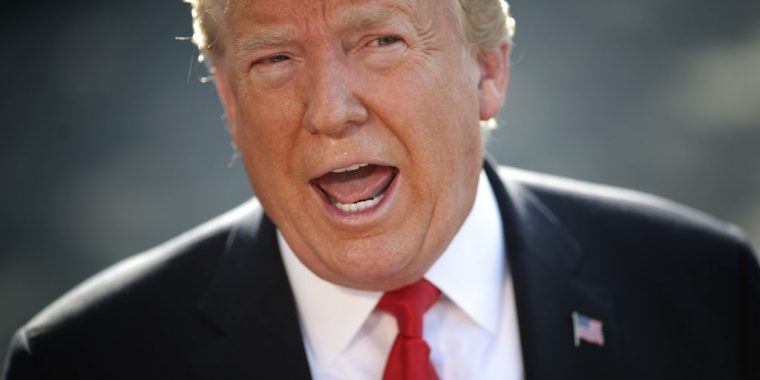
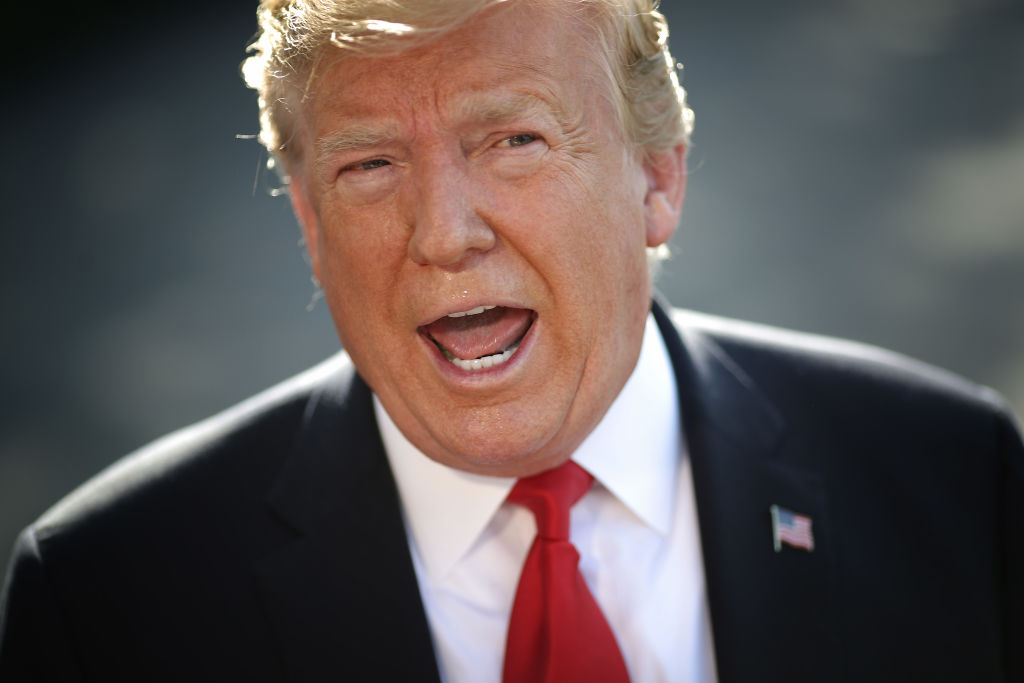
by
Win
McNamee/Getty
Images)
Believe
it
or
not,
President
Donald
Trump
is
in
serious
trouble.
Whether
his
unfavorability
ratings
for
handling
the
economy
are 55%, 57%,
or 60%,
those
ratings
are
about
as
deep
underwater
as
a
U.S.
president
can
be. And
that
unfavorability
is
on
the
very
issue
that
he
rode
to
the
White
House
a
year
ago. Trump’s
unpopularity
could
reduce
his
control
over
the
Republican
Party
(because
members
of
Congress
need
not
fear
Trump
so
much)
or
show
up
in
next
year’s
midterm
elections
(which
would
end
Trump’s
legislative
hopes
and
result
in
a
spate
of
new
investigations).
What’s
a
poor,
beleaguered
president
to
do?
Remarkably,
the
Supreme
Court
may
come
to
Trump’s
rescue.
The
Supreme
Court
will
hear
argument
later
this
week
on
whether
Trump
has
the
constitutional
and
statutory
authority
to
impose
tariffs
under
the
International
Emergency
Economic
Powers
Act
(IEEPA). I’m
no
expert
on
trade
law,
but
I
can
read Article
1,
Section
8
of
the
Constitution,
which
grants
Congress
the
authority
to
“regulate
commerce
with
foreign
nations,
and
among
the
several
states.”
With
that
as
a
starting
point,
I
wouldn’t
be
shocked
if
the
Supreme
Court
holds,
a
few
weeks
or
months
from
now,
that
Trump
improperly
imposed
sweeping
tariffs
for
reasons
such
as
“Brazil
is
prosecuting
Jair
Bolsonaro”
and
“I
didn’t
like
the advertisement the
Province
of
Ontario
ran
during
the
World
Series.”
What
then? What
if
Trump
loses
in
the
Supreme
Court?
Trump
isn’t
one
to
accept
losing
with
grace.
But
assume
for
the
moment
that
Trump
doesn’t
give
a
speech
telling
his
supporters
to
attack
the
Supreme
Court
building
and
hang
John
Roberts.
Assume
Trump
doesn’t
tell
the
Supreme
Court,
“Screw
you,”
and
maintain
the
tariffs
despite
the
ruling.
A
normal
president
might
retreat
to
statutes
other
than
the
IEEPA
that
grant
the
authority
to
impose
tariffs. Trump
might
try,
for
example,
to
impose
tariffs
under Section
301
of
the
Trade
Act
of
1974
(for
unfair
trade
practices)
or
Section
232
of
the
Trade
Expansion
Act
of
1962
(for
tariffs
on
national
security
grounds). Neither
of
these
statues,
however,
gives
Trump
the
unbridled
power
to
impose
sweeping
tariffs
that
he’s
claimed
under
the
IEEPA.
A
normal
president
might
ask
Congress
to
approve
the
tariffs
that
he
has
in
mind. That
would
be
hopeless,
however,
even
in
more
traditional
times. Republicans
have
historically
been
free
traders;
at
least
a
few
would
stand
by
their
principles. And
Democrats
would
never
give
Trump
this
legislative
win.
Suppose
Trump
does
the
unexpected
and
simply
accepts
the
loss: “I’m
right
on
tariffs,
but
the
low-IQ
RINOs
on
the
Supreme
Court
don’t
understand
the
Constitution. Thank
you
for
your
attention
to
this
matter.”
Think
what
that
would
do
to
cure
Trump’s
polling
ills
on
economic
issues.
With
tariffs
reduced
to
their
pre-Liberation
Day
levels,
international
trade
could
flourish
again. We’d
no
longer
owe
50%
more
on
Brazilian
coffee
or
15%
more
for
French
wines. Prices
probably
wouldn’t
drop
dramatically,
but
the
inflation
numbers
would
improve
a
little.
At
the
same
time,
the
uncertainty
hanging
over
the
market,
because
Trump
now
claims
the
authority
to
impose
tariffs
at
whim,
would
disappear. Companies
could
start
building
and
hiring
again,
because
they’d
know
that
future
tariffs
could
be
imposed
only
after
going
through
an
intelligent
process. The
stock
market
would
surely
get
a
lift.
And
—
my
point
at
last!
—
the
Supreme
Court
would
have
helped
solve
Trump’s
economic
woes. By
eliminating
the
president’s
unfettered
ability
to
impose
tariffs,
the
Supreme
Court
would
simultaneously
have
reduced
the
pressures
on
inflation
and
employment
that
make
people
disapprove
of
Trump’s
handling
the
economy.
All
of
this
depends,
of
course,
on
the
Supreme
Court
standing
up
to
Trump,
by
invalidating
his
tariffs,
and
Trump
then
standing
down
to
the
Supreme
Court,
by
begrudgingly
accepting
its
decision.
Perhaps
those
concepts
are
delusional,
but
they
just
might
redound
to
Trump’s
benefit.
Mark Herrmann spent
17
years
as
a
partner
at
a
leading
international
law
firm
and
later
oversaw
litigation,
compliance
and
employment
matters
at
a
large
international
company.
He
is
the
author
of The
Curmudgeon’s
Guide
to
Practicing
Law and Drug
and
Device
Product
Liability
Litigation
Strategy (affiliate
links).
You
can
reach
him
by
email
at [email protected].