
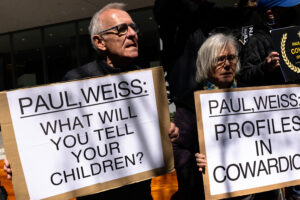
by
Michael
M.
Santiago/Getty
Images)
Earlier
this
week,
Fabio
Bertoni,
General
Counsel
at
the
New
Yorker,
took
to
the
pages
of
the
magazine
for
a
long,
hard
look
at
the
deterioration
of
the
rule
of
law
that
characterizes
2025.
Unsurprisingly,
for
those
of
us
who
follow
the
legal
industry,
he
points
the
finger
at
the
deals
nine
Biglaw
firms
inked
with
the
Trump
administration,
writing,
“Counterfactuals
are
impossible
to
prove,
but
it
doesn’t
require
a
giant
speculative
leap
to
conclude
that,
had
major
U.S.
law
firms
not so
quickly
surrendered to
Trump,
this
spring,
he
would
have
been
denied
early
momentum
for
his
lawlessness.
Perhaps
a
united
opposition
might
have
even
provided
the
opposite
momentum,
toward
a
defense
of
the
rule
of
law.”
That
seems
like
a
tall
order. I’m anything
but an apologist for
the
capitulating
firms,
but they can’t
shoulder
all
of
the
blame. Donald
Trump
spent
almost
every
second
since
January
6
telling
anyone
who
would
listen
that
his
next
administration
would
be
a
lawless
hellscape.
To
the
extent
anyone
bears
a
responsibility
for
throwing
a
wrench
into
the
slide
into
authoritarianism,
there
are,
after
all,
actual
REPUBLICANS
who
hold
elected
office
and
federal
judgeships
who
have
refused
to
lift
a
finger.
Or,
in
many
cases,
have
actively
cheered
on
the
decay.
But
even
if
they
weren’t
America’s
last
clear
chance
to
avoid
fascism,
the
firms
can’t
escape
blame
for
the
sorry
state
of
the
rule
of
law. You’ll
recall,
early
in
his
second
term,
Donald
Trump
launched
a war
on
Biglaw
through unconstitutional
Executive
Orders designed to
break
major
law
firms unless
they
bent
the
knee. In
the
face
of
financial
harm,
nine
major
firms sought Trump’s
seal
of
approval,
providing
millions
in
pro
bono
payola,
that
is,
free
legal
services
on
behalf
of conservative
clients
or
approved
causes in
order
to
avoid
Trumpian
retribution.
The
firm
that
started
the
wave
of
capitulation
was
Paul,
Weiss.
The
firm shocked
the
world
of
Biglaw in
March
when
they became
the
first to
agree
to
a
deal
with
Trump.
But,
instead
of
standing
up
for
the
rule
of
law
and
suing
the
Administration
for
its
unlawful
executive
order,
[Firm
Chair
Brad]
Karp
and
Paul,
Weiss
settled
a
mere six days
after
Trump
issued
it.
That
settlement
obligated
the
firm
to
provide
forty
million
dollars
in
pro-bono
services
to
“support
the
Administration’s
initiatives,”
and
to
“not
adopt,
use,
or
pursue
any
DEI
policies.”
Eight
other
global
law
firms
quickly
followed
suit,
reaching
settlements
totalling
a
reported
nearly
billion
dollars
in
pro-bono
services
for
causes
championed
by
the
Administration.
And,
although
all
the
firms
claimed
to
have
retained
control
over
what
specific
pro-bono
work
they
will
do,
Trump
clearly
doesn’t
see
it
that
way,
suggesting
during
one
Cabinet
meeting
that
he
could
use
the
legal
work
as
sort
of
a
personal
piggy
bank
of
services
even
after
he
leaves
office,
saying,
of
the
accumulated
total,
“Hopefully
I
won’t
need
that,”
he
said,
“after
it
ends—after,
after
we
leave.
Maybe
I’ll
need
it.”
The
inadequacies
of
the
Republican
party
are
disappointing,
but
not
terribly
surprising.
Paul
Weiss’s,
on
the
other
hand,
were
genuinely
shocking.
The
deal
they
struck
with
the
administration
reverberated
throughout
the
industry.
The
PW
deal
stands
out
not
just
because
it
was
the
first
of
the
Biglaw
deals
with
Trump,
but
because
it
was
Paul,
Weiss.
The
firm
*had*
a
well-earned
reputation
for
pursuing
social
justice
initiatives
and
“being
guided
by
what
is
right
and
having
the
moral
courage
to
lead
others
to
follow.”
(Those
were
Karp’s
words,
pre-Trump
deal.)
The
deal
is
anything
but
that.
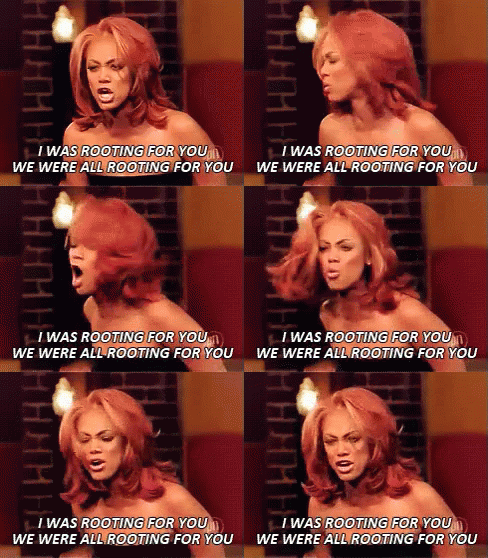
To
use
an
iconic
pop
culture
moment,
we
were
all
rooting
for
you.
And,
like
Tyra,
we
were
let
down.
Bertoni,
like
many,
sees
the
Paul,
Weiss
deal
as
selling
out
the
legal
system
to
take
care
of
its
own
bottom
line.
A
firm
of
the
size
and
power
of
Paul,
Weiss
should
have
looked
out
for
the
system
a
little
bit.
Karp,
his
partners,
and
their
peers
at
the
other
firms
that
settled
should
have
taken
care
of
the
system
just
a
little
bit.
Instead,
they
took
a
dive
for
the
short-end
money.
In
a
cynical
way,
you
can
argue
Paul,
Weiss
got
a
“good”
deal
out
of
the
administration.
They
are
only
on
the
hook
for
$40
million
in
pro
bono
payola,
a
figure
that
is
significantly
smaller
than
what
the
other
capitulating
firms
are
gifting
to
the
administration,
and
a
mere
fraction
of
PW’s
historical
outlays
of
pro
bono
expenses
meaning
they
could
potentially
be
free
from
their
obligations
in
under
a
year.
And
financial
reports
indicate
that,
despite
the
public
exodus
of
a
number
of
attorneys,
business
is
thriving.
As
these
firms
see
it,
they
got
out
from
Trump’s
thumb
without
giving
up
anything
that
really
mattered.
No
harm,
no
foul!
But
that
kinda
misses
the
point.
Because
whatever
the
firms
thought
they
gave
up,
it
was
more.
The
administration
is
openly
talking
about
using
them
to
defend
police
brutality.
Lawmakers
are
looking
into
reports
of
free
–
and
illegal
—
work
supporting
the
Commerce
Department.
All
of
it
well
beyond
what
the
deals
claimed
to
cover.
Even
if
they
disagree
with
that
characterization,
as
some
have
in
letters
to
congress,
there’s
little
to
no
trust
that
they
actually
would
stand
up
to
an
administration
altering
the
deal.
Not
to
mention
there’s
a
carryover
effect
in
Biglaw
proper.
The
Paul,
Weiss
deal
—
again,
a
firm
noted
for
its
storied
liberal
background
—
signaled
the
all-clear
for
other
firms
to
get
on
Trump’s
good
side.
More
than
twice
as
many
firms
capitulated
to
Trump
than
fought
against
the
Executive
Orders.
And
as
the
number
of
deals
grew,
the
impact
reverberated
far
beyond
the
individual
firms
themselves.
Biglaw
firms
that
did
not
deal
with
the
admin
are
changing
their
DEI
programs,
eliminating
affinity
groups,
and
scrubbing
pronouns
from
attorney
email
signatures
to
avoid
any
unwanted
attention.
There’s
a
documented
chilling
effect
in
the
work
Biglaw
is
taking
on
too: pro
bono
and
public
interest
representations
by
Biglaw
firms are
down
—
significantly —
as
firms
don’t
want
to
risk
provoking
Trump’s
ire.
Perkins
Coie,
one
of
the
few
Biglaw
firms
to
fight
Trump
on
his
Executive
Order,
is
taking
a
hard
line
with
their
attorneys’
personal
expression
in,
what
reads
as,
an
attempt
to
*not*
court
any
more
ginned
up
controversy.
If
Trump
wanted
to
derail
the
legal
industry’s
capacity
to
stand
up
to
his
onslaught,
he
could
hardly
have
done
better
than
to
send
a
message
to
the
broader
industry
that
they
might
be
the
next
crushed
under
a
payola
deal
if
they
don’t
take
their
considerable
resources
and
sit
on
the
sidelines
while
he
takes
aim
at
immigrants,
victims
of
racial
discrimination,
and
public
dissent.
The
capitulating
firms
may
think
the
deals
they
made
on
paper
didn’t
impact
them
all
that
much,
but
they’ve
have
an
indelible
—
negative
—
impact
on
the
industry
at
large.
Regrettably,
the
last
100
years
have
taught
us
a
lot
about
how
authoritarianism
takes
hold
of
a
country.
It’s
rarely
with
the
full-throated
support
of
powerful
institutions
or
over
their
furious
objections.
More
often
power
is
consolidated
on
the
back
of
the
acquiescences
of
those
institutions.
After
all,
it’s
just
“good
business”
to
keep
their
heads
down.
 Kathryn
Rubino
is
a
Senior
Editor
at
Above
the
Law,
host
of
The
Jabot
podcast,
and
co-host
of
Thinking
Like
A
Lawyer.
AtL
tipsters
are
the
best,
so
please
connect
with
her.
Feel
free
to
email
her
with
any
tips,
questions,
or
comments
and
follow
her
on
Twitter
@Kathryn1 or
Mastodon
@[email protected].