
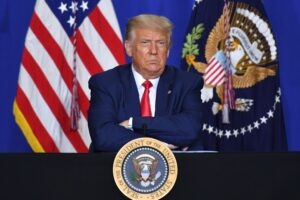
by
MANDEL
NGAN/AFP
via
Getty
Images)
The
Trump
administration
literally
tore
down
the
White
House
yesterday.
After
lying
that
his
golden
imperial
ballroom
—
a
Versailles-powered-by-Home-Depot
monstrosity
—
“won’t
interfere
with
the
current
building,”
crews
destroyed
the
whole
East
Wing
—
all
during
a
government
shutdown
that
put
essential
government
services
on
hold.
This
all-too-on-the-nose
metaphor
wasn’t
lost
on
the
crowd
gathered
at
the
annual
summit
of
the
Society
for
the
Rule
of
Law.
The
organization,
comprised
of
mostly
conservative
and
libertarian
lawyers
conceived
during
the
first
Trump
administration,
convened
in
a
Washington
hotel
ballroom
for
a
day
long
lament
over
the
collapse
of
constitutional
order.
It
didn’t
take
long
for
a
speaker
to
link
the
physical
destruction
—
and
the
circumstances
around
it
—
to
the
topic
of
the
summit.
A
certain
gallows
humor
over
the
prospect
of
democratic
collapse
loomed
over
the
conference.
It
manifested
right
at
the
start.
After
being
wanded
and
searched
by
the
team
of
security
guards
whose
presence
never
quite
faded
into
the
background
in
this
cramped
space,
a
staffer
handing
out
badges
asked
if
I
was
a
Society
member.
“Press,”
I
declared.
Another
swooped
in.
“Press?
I’ll
take
care
of
them.”
The
table
laughed
and
repeated
“take
care
of
them”
in
mock
ominous
tones.
“Hey,
I
thought
this
was
the
other
kind
of
conference,”
I
replied.
Some
of
the
biggest
laugh
lines
of
the
day
came
when
people
would
make
suggestions
like
the
separation
of
powers
holding
or
asking
if
voter
suppression
efforts
are
intentionally
devious.
Early
in
the
day,
former
Maricopa
County
Recorder
Stephen
Richer
let
it
slip
that
the
Society’s
Executive
Director,
Gregg
Nunziata,
asked
moderators
to
try
to
coax
something
positive
from
each
panel,
which
felt
more
like
a
dare
than
advice.
Everyone’s
struggle
to
do
so
became
the
running
joke
of
the
day.
George
Conway
and
Norm
Eisen
kept
the
room
in
stitches
as
they
playfully
bantered
about
the
“strange
bedfellows”
that
constitutional
collapse
creates.
Paradoxically,
all
the
levity
conveyed
a
better
grasp
of
the
grim
reality
than
reading
stern
letters
penned
by
Democratic
leadership.
As
the
conference
explored
topics
ranging
from
the
unitary
executive
theory
to
election
security,
an
unspoken
theme,
which
only
a
few
of
the
speakers
seemed
to
grasp,
was
whether
the
work
of
this
is
an
opposition
organization
that
can
bring
the
old
conservative
legal
movement
back
from
the
brink,
or
if,
like
the
physical
East
Wing,
the
charge
of
the
moment
is
realizing
that
it’s
gone
and
figuring
out
what
gets
built
in
its
stead.
It’s
a
question
rooted
in
the
cognitive
dissonance
many
of
these
folks
must
feel.
Because
amidst
the
sea
of
blazers
and
bowties,
with
the
right
set
of
eyes,
you
could
still
pick
out
a
few
guys
dressed
as
overgrown
hot
dogs
assuring
the
audience
“we’re
all
looking
for
the
guy
who
did
this!“
The
event
took
place
in
the
same
hotel
where
I
lived
for
three
months
as
a
junior
Biglaw
associate.
Back
then,
George
W.
Bush
had
just
imposed
the
PATRIOT
Act,
built
an
offshore
prison
the
light
of
the
law
could
theoretically
never
touch,
and
prepared
to
take
over
Iraq
based
on
vague
claims
about
WMDs
that
never
existed
outside
the
administration’s
own
fever
dreams.
So
it
came
as
a
bit
of
a
jarring
juxtaposition
as
a
parade
of
Bush
alumni
and
Federalist
Society
exiles
who
would’ve
nodded
approvingly
at
torture
memos
twenty
years
ago
all
took
turns
lamenting
the
collapse
of
constitutional
order.
But
to
quote
the
Washingtonian
fantasy
that
inadvertently
poisoned
a
generation,
we
will
“forget
the
fact
that
you’re
coming
a
little
late
to
the
party and
embrace
the
fact
that
you
showed
up
at
all.”
Though
there
were
still
a
few
who
couldn’t
quite
let
go
and
spent
the
time
crafting
reasons
why
Trump’s
abuses
are
really
the
fault
of
Democrats
or
dismissing
Trump’s
power
grab
as
the
natural
and
logical
consequence
of
their
decades-long
push
for
a
limitlessly
powerful
unitary
executive.
These
coping
mechanisms
often
paired
with
a
charmingly
tragic
naiveté,
as
though
this
isn’t
the
natural
and
logical
conclusion
of
the
conservative
legal
movement’s
Nixonian
obsession
with
fluffing
the
legal
foundation
for
unchecked
executive
power.
Federalist
Society
minds
spent
their
careers
arguing
the
president
should
have
king-like
powers
over
the
executive
branch
and
are
now
shocked
—
SHOCKED
—
that
someone
might
use
those
to
be
king.
Like
a
Scooby-Doo
villain
voice
swearing
that
it
would’ve
worked
too,
if
it
weren’t
for
that
pesky
Trump!
“This
organization
needs
to
be
nonpartisan
and
focused
on
the
Constitution
and
the
rule
of
law,
and
not
just
be
anti-MAGA,
anti-Trump,”
Jonathan
Rauch
of
the
Brookings
Institution
explained.
“That
said,
it
is
equally
important
if
you’re
going
to
survive
in
the
wilderness,
you
must
not
confuse
tigers
and
pussycats.”
When
terms
like
unprecedented
get
thrown
around,
it’s
unproductive
to
spend
time
and
effort
attacking
the
slippery
slope
like
an
American
Ninja
Warrior
to
find
some
way
to
hang
this
on
something
a
backbencher
Democrat
said
20
years
ago
or
trying
to
square-peg-round-hole
Biden’s
student
loan
forgiveness
plan
as
the
precursor
to
Trump
zero-budgeting
the
Department
of
Education.
Judge
Michael
Luttig
had
no
trouble
distinguishing
the
tigers
from
the
pussycats.
In
what
can
best
be
described
as
measured
fury,
Judge
Luttig
called
out
the
administration’s
“explicit,
express
defiance”
of
the
judiciary
and
the
Supreme
Court’s
abject
failure
to
do
anything
about
it:
Every
day
of
the
week,
for
the
past
10
months,
judges
like
Judge
Gertner
and
Judge
Grimm
are
facing
the
President
of
the
United
States,
and
Attorney
General
of
the
United
States…
lying
to
their
face.
Lying
to
the
judges.
The
prosecutors
are
lying
to
the
federal
courts.
Meanwhile,
outside
the
courtroom,
the
President
of
the
United
States,
and
the
Attorney
General
of
the
United
States,
are
trashing
the
federal
courts.
Trashing
the
individual
judges.
Calling
them
every
name
in
the
book.
Never
in
American
history
has
this
ever
happened.
And
these
people
who
are
trying
to
do
their
job
under
those
circumstances,
are
looking
up
at
the
Supreme
Court
of
the
United
States,
who
they
know,
to
a
virtual
certainty,
would
reverse
them
in
a
second
if
they
held
Donald
Trump
in
contempt.
This
is
Supreme
Court
is
the
apotheosis
of
the
conservative
legal
movement.
For
all
the
talk
of
liberty
and
small
government,
when
the
chips
are
down,
all
it
seems
to
mean
to
the
justices
is
the
liberty
to
pollute
drinking
water
and
a
small
government
that
just
cuts
out
the
part
fighting
consumer
fraud.
Against
this
backdrop,
we
return
to
the
question:
what
is
the
role
of
the
principled
conservative
at
this
moment?
Richard
Bernstein,
a
former
Biglaw
partner
and
Scalia
clerk,
discussing
what
happens
if
Mike
Johnson’s
current
refusal
to
seat
a
duly
elected
member
metastasizes
into
a
full-scale
rejection
after
the
midterms,
“if
they
allow
people
duly
elected,
certified
in
their
states,
not
to
become
members
of
Congress,
then
the
game’s
over.
The
game’s
over.
Then,
then
we’re
not
at
the
opposition.
We’re
the
resistance.
And
I’m
too
chicken
to
be
the
resistance.”
The
omnipresent,
stone-faced
security
certainly
gave
more
of
a
resistance
energy.
Joking
aside,
is
this
an
opposition
or
a
resistance?
Former
Congresswoman
Barbara
Comstock
invoked
the
concept
of
“civil
society,”
which
played
such
a
profound
role
in
post-Soviet
transitions.
Norm
Eisen
didn’t
touch
on
this
subject,
but
it
struck
me
that
he
had
served
as
the
ambassador
to
the
Czech
Republic,
a
nation
held
up
as
an
example
of
how
robust,
underground
civil
society
structures
can
facilitate
post-authoritarian
recovery.
Is
that
the
future
of
this
group?
Building
a
“conservative”
legal
movement
from
the
rubble
of
the
last
one?
If
so,
it’s
going
to
require
even
more
folks
to
take
a
harsh
look
at
what
really
brought
Trump
to
this
point.
Whatever
the
answer
is,
the
Society
seems
committed
to
figuring
it
out.
Hopefully
before
next
year’s
conference
when
we’ll
be
probably
be
meeting
in
an
El
Salvadoran
labor
camp.
 Joe
Joe
Patrice is
a
senior
editor
at
Above
the
Law
and
co-host
of
Thinking
Like
A
Lawyer.
Feel
free
to email
any
tips,
questions,
or
comments.
Follow
him
on Twitter or
Bluesky
if
you’re
interested
in
law,
politics,
and
a
healthy
dose
of
college
sports
news.
Joe
also
serves
as
a
Managing
Director
at
RPN
Executive
Search.