

The
billable
hour’s
obituary
has
become
a
genre
unto
itself.
Every
few
years,
the
trendy
prediction
is
that
the
clock
will
soon
hit
midnight
for
the
billable
hour.
And
every
few
years,
law
firms
manage
to
charge
more
for
those
metaphorical
minutes.
It’s
the
circle
of
life,
if
the
life
cycle
begins
with
a
hot
take,
spawns
a
thousand
“well,
actually”
replies
on
LinkedIn,
and
then
settles
into
everyone
returning
to
billing
six-minute
increments.
But
—
as
the
infamous
last
words
go
—
this
time
is
different.
The
2026
Legal
Industry
Report
from
8am
released
this
morning,
detailing
its
findings
from
a
survey
of
more
than
1,300
legal
professionals
about
where
the
practice
of
law
is
heading.
Since
this
is
2026,
the
AI
adoption
numbers
will
dominate
the
conversation.
Individual
use
of
generative
AI
tools
more
than
doubled
year
over
year
—
from
31
percent
of
legal
professionals
in
2025
to
69
percent
today.
Nearly
three-quarters
of
lawyers
are
now
regularly
deploying
ChatGPT,
Gemini,
and
Claude
for
actual
work
product.
Thirty-eight
percent
of
these
AI
users
report
saving
one
to
five
hours
per
week.
Another
14
percent
save
6-10
hours
weekly.
Even
the
skeptics
mostly
concede
something:
33
percent
say
AI
improved
the
quality
of
their
work
even
when
it
produced
no
measurable
efficiency
gains.
The
share
reporting
zero
productivity
benefit
dropped
from
16
percent
last
year
to
just
6
percent.
There’s
a
lot
to
say
about
these
numbers,
but
let’s
put
that
aside
for
the
moment
and
focus
on
what
this
portends
for
the
billable
hour.
If
lawyers
start
losing
6-10
hours
of
work
every
week,
at
a
$300/hr
rate,
that’s
$86,000-$144,000
lost
per
year
(assuming
a
comfortable
4
weeks’
worth
of
vacation).
Maybe
they’re
finding
new
work
to
fill
those
hours,
but
it’s
not
like
most
small
law
firms
are
turning
down
work
right
and
left.
And
because
our
cardinal
rule
around
here
is
that
lawyers
like
money,
they’re
going
to
find
some
way
to
get
that
money
back.
When
the
report
asked
lawyers
to
predict
AI’s
impact
on
firm
billing
practices,
nearly
half
said
they
expect
some
change
—
25
percent
predicted
reduced
billable
hours
per
matter,
and
22
percent
anticipated
a
broader
shift
toward
flat
fees
and
alternative
fee
arrangements.
Lawyers
can’t
bill
hourly
for
the
hypothetical
time
they
saved
with
AI.
Well,
they
CAN,
but
then
they’ll
rightly
end
up
getting
reamed
by
disciplinary
authorities.
Assuming
lawyers
want
to
keep
their
licenses,
they
won’t
be
billing
for
fictional
time
and
that
means
they’ve
got
to
find
a
new
way
to
collect.
There
are
really
two
options:
raise
hourly
rates
or
start
billing
a
flat
fee
that
pegged
to
what
the
work
traditionally
brought
in
under
the
hourly
billing
model.
The
former
risks
client
sticker
shock,
making
the
latter
almost
inevitable.
Conventional
wisdom
—
operating
from
the
premise
that
they
are
the
whiniest
population
on
the
planet
—
assumed
that
clients
would
react
to
AI
by
demanding
massive
discounts
on
their
bills.
But
the
report
found
that
market
pressure
isn’t
actually
coming
from
clients.
At
least
so
far.
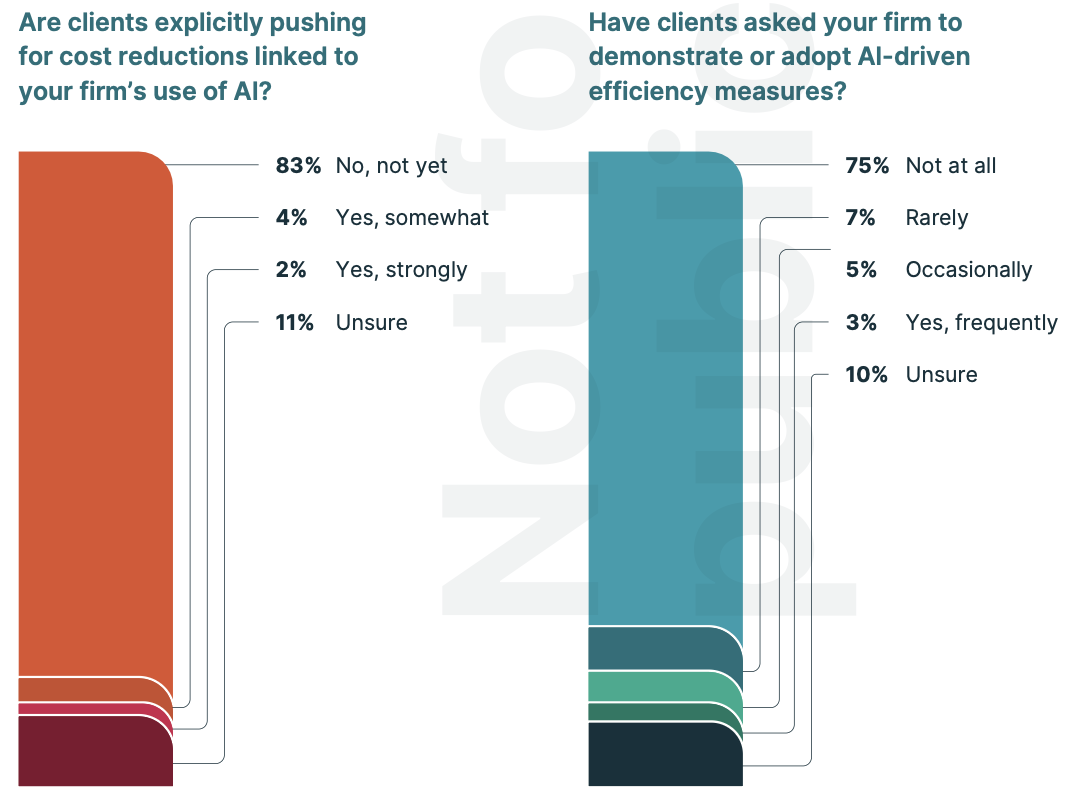
According
to
the
survey,
83
percent
of
respondents
said
clients
are
not
pushing
for
AI-related
price
reductions.
In
fact,
75
percent
said
clients
haven’t
even
asked
their
firms
to
demonstrate
AI-driven
efficiency.
There’s
the
window.
Start
using
AI
to
save
time
and
replace
that
lost
revenue
with
a
value
model
that
the
clients
will
pay
because
they’ve
already
made
it
clear
that
they’re
willing
to
pay
the
current
price.
And
when
you
take
into
account
that
AI
might
save
lawyers
money
as
well
as
time,
adoption
would
leave
the
practice
with
both
of
legal’s
two
most
precious
resources.
The
8am
report
also
asked
about
access
to
justice,
and
the
results
were
as
bleak
as
you’d
expect.
The
profession
has
nominally
committed
to
addressing
this
for
decades,
with
results
roughly
consistent
with
things
that
have
been
nominally
committed
to
for
decades.
More
than
half
of
lawyers
described
the
current
state
of
access
to
justice
in
the
United
States
as
“poor.”
The
primary
barrier,
according
to
72
percent
of
respondents,
was
cost,
and
55
percent
percent
said
expanded
funding
for
legal
aid
and
public
defenders
would
be
the
single
most
effective
solution.
Most
of
the
buzz
around
AI
and
access
to
justice
focuses
on
directly
using
the
tools
for
pro
bono
matters.
According
to
the
survey,
76
percent
of
respondents
believe
AI
has
the
potential
to
help
narrow
the
access-to-justice
gap,
noting
the
potential
to
automate
routine
legal
tasks
(53
percent),
expand
self-help
tools
(52
percent),
and
increase
remote
services
(51
percent).
But
these
are
all
downstream.
The
underrated,
indirect
advantage
of
AI
adoption
is
the
basic
efficiency
argument:
AI
frees
up
lawyer
time,
and
time
can
be
used
for
people
who
can’t
pay
for
it.
Flat-fee
arrangements
and
AI
efficiency
can
provide
revenue
stability
while
building
structural
space
for
more
pro
bono
work.
A
hypothetical
lawyer
who
previously
spending
12
hours
on
a
straightforward
transactional
matter
can
complete
it
in
six
hours,
collect
their
fixed-fee,
keep
the
same
(or
more)
revenue,
and
have
six
hours
freed
up
to
provide
for
the
underserved.
The
pessimistic
read
is
that
client
pressure
hasn’t
arrived
yet,
so
firms
may
simply
absorb
the
surplus
into
profit.
But
the
optimistic
read
is
that
we
have
a
window
to
get
ahead
and
make
a
deliberate
choice
about
what
happens
to
the
hours
AI
gives
back.
And
maybe
nothing
happens…
but
if
we
take
the
lawyers
lamenting
the
justice
gap
at
their
word,
this
is
their
moment
to
do
something
that
brings
real
change.
Earlier:
Law
Firms
Prepare
To
Automate
Themselves
Out
Of
Their
Own
Business
Model
Biglaw’s
Worst
Enemy
Isn’t
AI,
It’s
Clients
Using
AI
To
Stop
Paying
Them
Billable
Hour
Dying
So
Slowly,
You’d
Think
It’s
Billing
By
The
Hour
 Joe
Joe
Patrice is
a
senior
editor
at
Above
the
Law
and
co-host
of
Thinking
Like
A
Lawyer.
Feel
free
to email
any
tips,
questions,
or
comments.
Follow
him
on Twitter or
Bluesky
if
you’re
interested
in
law,
politics,
and
a
healthy
dose
of
college
sports
news.
Joe
also
serves
as
a
Managing
Director
at
RPN
Executive
Search.