
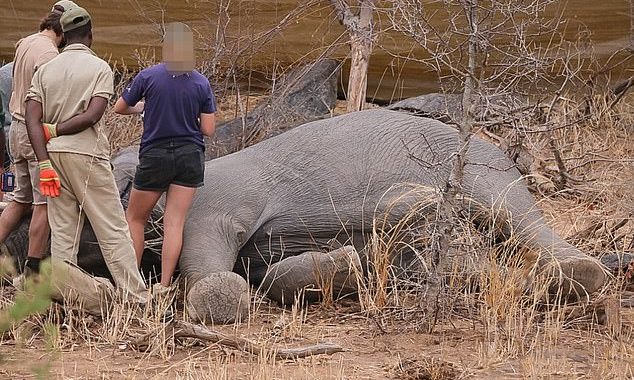
A
three-ton
bull
elephant
lies
dead
on
the
ground
in
a
remote
corner
of
Africa.
His
life
has
been
snuffed
out
by
a
marksman’s
bullet
fired
into
his
brain.
In
a
few
seconds
it
was
all
over.
He
will
have
known
nothing.
Within
minutes
of
his
death
ten
days
ago,
a
wildlife
vet
was
running
to
the
elephant
to
check
he
was
shot
cleanly
and
had
felt
no
pain.
An
hour
later,
I
was
able
to
stand
by
him,
marvelling
at
the
dark
eyes
perfectly
circled
by
bristly
lashes
and
his
four
jumbo
feet,
each
bigger
than
a
dinner
plate,
which
will
never
tramp
the
bush
again.
The
22-year-old
bull
might
have
survived
another
four
decades,
roaming
wild
with
950
other
elephants
on
the
giant
Sango
Conservancy
stretching
over
231
square
miles
–
a
third
of
the
size
of
Greater London –
in
south-east
Zimbabwe,
near
the
border
with
Mozambique.
He
was
killed
because
here
there
are
far
too
many
elephants.
At
least
100,000
(17,000
more
than
a
decade
ago)
trudge
the
country,
annihilating
the
land
where
they
live.
The
bull
was
among
54
elephants
killed
in
a
purge
at
Sango
to
control
numbers.
By
the
end
of
next
year,
the
private
conservancy
plans
to
have
slaughtered
600,
almost
two-thirds
of
its
resident
elephants,
in
southern
Africa’s
biggest
mass
cull
for
three
and
a
half
decades.
‘It
is
a
horrible
job,
which
we
don’t
like
doing,’
says
the
owner,
Willy
Pabst.
‘There
is
an
elephant
overpopulation,
which
means
they
imperil
their
own
survival.
The
biggest
danger
to
the
elephant
is
the
elephant
itself.’
We
are
sitting
together
at
his
imposing
conservancy,
which
teems
with
every
kind
of
African
wildlife
from
lions,
hippos,
zebras
and
leopards
to
baboons
and
hyenas.
Members
of
the
Zimbabwe
National
Parks
and
veterinarians
examine
the
bull
elephant,
capturing
data
on
the
size
and
weight
of
the
animal

By
the
end
of
next
year,
the
private
conservancy
plans
to
have
slaughtered
600,
almost
two-thirds
of
its
resident
elephants,
in
southern
Africa’s
biggest
mass
cull
for
three
and
a
half
decades

Marksmen
poised
to
cull
a
family
of
elephants
herded
by
helicopter
into
an
enclosure
at
Sango
Conservancy,
Zimbabwe
‘We
were
at
the
end
of
our
tether
about
what
to
do,’
he
continues.
‘Thousands
of
our
trees,
much
of
our
forest,
have
been
destroyed
by
elephants.
‘We
are
trying
to
save
the
elephants
and
the
conservancy.’
Before
we
watched
the
cull,
Kim
Wolhuter,
Sango’s
wildlife
filmmaker,
drove
us
miles
to
see
the
devastation
wreaked
by
elephants
in
their
relentless
quest
for
food.
‘They
are
eating
themselves
out
of
house
and
home,’
he
said.
‘There
are
too
many
for
the
land
and
their
numbers
keep
going
up.’
Sango
experts
stress
that
southern
Africa
is
not
a
Disneyland
full
of
gentle
jumbos
as
portrayed
in
Western
children’s
films.
Neither,
in
many
parts
of
Africa,
are
elephants
an
endangered
species,
despite
the
claims
of
animal
rights
charities
and
their
wealthy
Western
donors.
The
experts
add:
‘Elephants
are
not
fluffy
toys.
A
lion
is
not
a
vegan.
These
are
wild
animals
that,
to
survive,
will
consume
or
kill
everything
in
their
path
just
like
they
always
have.’
Today,
the
hideous
consequences
of
Sango’s
elephant
overpopulation
are
clear.
Some
of
the
conservancy
resembles
a
desert.
Nearly
80
per
cent
of
the
grass
has
disappeared
because
ever-hungry
elephants
use
their
powerful
trunks
to
rip
up
stems
and
roots
together
–
which
means
it
can
never
regrow.
A
third
of
Sango’s
forest
of
mopane
trees,
native
to
southern
Africa,
are
now
dead
or
stunted
because
the
elephants
like
to
gorge
on
them.
Hundreds
of
huge
1,000-year-old
baobab
trees
have
toppled
over
after
being
assaulted
by
beasts
that
need
to
eat
300
pounds
of
vegetation
a
day
and
drink
enough
water
to
fill
a
bathtub.
The
animals
tear
off
the
baobab
bark
up
to
19
ft,
the
height
their
trunk
tips
can
reach.
Then
they
suck
the
sap
inside
to
slake
their
thirst.
Under
this
attack,
the
ancient
tree
is
hollowed
out.
Finally,
it
collapses,
leaving
a
pile
of
what
resembles
sawdust.
The
result
is
a
single
baobab
can
die
in
a
few
weeks.
Known
in
Africa
as
the
‘upside
down’
tree
(because
its
branches
resemble
roots),
the
baobab
has
thrived
at
Sango
since
the
Middle
Ages
–
until
now.

Rifle
shells
are
gathered
afterwards
so
an
accurate
record
of
how
many
shots
were
fired
during
the
culling

Pictured: A
bull
elephant
rushes
into
the
enclosure
alone
as
professional
hunters
and
members
of
the
Zimbabwe
National
Parks
wait
for
the
rest
of
the
group
to
enter
the
enclosure
As
a
rule
of
thumb,
ecologists
say
an
adult
elephant
needs
almost
a
square
mile
of
the
southern
African
bush
to
thrive
(without
destroying
its
own
habitat).
But
even
in
vast
Sango
there
are
five
living
in
this
space
‘far
more
than
we
can
feed’,
said
Pabst.
David
Goosen,
a
Sango
director
and
wildlife
expert,
added:
‘We
had
to
figure
out
a
way
to
save
our
950
elephants
from
themselves.
‘We
may
have
to
cull
over
and
over
again
into
the
future
to
keep
down
numbers.
They
are
destroying
their
own
habitat
and
that
of
other
wildlife
too.’
The
controversial
action
at
Sango
follows
last
year’s
decision
by
the
Zimbabwean
government
to
kill
elephants
to
control
numbers.
It
ended
a
35-year
hiatus
on
culls,
which
wildlife
activists
worldwide
dubiously,
but
successfully,
argued
were
‘cruel
and
unnecessary’.
In
desperation,
ignoring
the
critics,
Zimbabwe
slaughtered
200
elephants
to
feed
its
citizens
left
hungry
by
the
worst
drought
in
decades.
Nearly
half
the
country’s
people
faced
‘acute
food
shortages’,
said
the
United
Nations.
The
environment
minister
said
enormous
elephant
numbers
–
more
than
in
any
country
apart
from
Botswana
–
were
endangering
human
life.
Marauding
animals
had
marched
into
villages
and
grown
fearless
of
people.
Some
31
people
in
Zimbabwe
died
from
elephant
attacks
last
year.
A
few
were
farmers
collecting
their
livestock
in
the
evening
or
tending
their
crops.
Children
and
old
people
walking
near
their
round
thatched
homes,
known
as
‘rondavels’,
were
killed
or
injured
when
the
animals
confronted
them.
In
the
middle
of
last
year’s
state-ordered
cull,
I
visited
villages
deep
in
the
bush
where
desperately
hungry
Zimbabweans
were
being
handed
elephant
meat
by
government
officials.
The
people
said
they
hated
and
feared
elephants
and
wanted
them
dead.
‘They
have
become
so
dangerous
and
there
are
so
many
of
them,’
said
one.
‘We
cannot
go
out
at
night
without
hiding
from
an
elephant.
These
animals,
which
we
never
used
to
see
in
our
villages,
take
everything
we
have.’
So
it
was
on
a
Wednesday
morning
that
I
watched
the
first
shootings
at
Sango.
They
were
run
like
a
military
operation
after
months
of
planning.
Since
the
early
hours,
a
helicopter
pilot
with
a
vet
had
begun
searching
Sango’s
rivers
where
elephants
gather
to
drink.
When
a
herd
with
up
to
100
animals
was
spotted,
their
position
was
radioed
to
a
team
below,
which
set
up
an
enclosure,
or
‘boma’
in
Swahili,
made
of
black
plastic
sheeting
to
capture
some
of
them.
The
boma
site
was
chosen
near
a
road
so
that
trucks
carrying
skinners
and
butchers
could
transport
the
carcasses.
The
meat
was
taken
away
to
a
cold
store
to
await
distribution
to
local
communities
or
sale
on
the
commercial
market
(with
villagers
sharing
in
the
proceeds).
At
9.34am
that
morning,
a
suitable
herd
of
elephants
had
been
spotted
from
the
air.
Four
shooters
were
ready,
hidden
from
sight
on
a
platform
at
the
top
end
of
the
boma
and
overlooking
what
the
Sango
team
call,
with
brutal
honesty,
the
shoot
box.
The
helicopter
began
gently
driving
the
herd,
the
wind
behind
them
so
they
could
not
smell
the
plastic
sheeting
or
shooters,
from
the
bush
towards
the
100-yard-wide
entrance
of
the
boma.

A
family
group
of
elephant
who
were
driven
into
the
enclosure
with
the
help
of
a
helicopter
As
they
moved
along,
with
the
helicopter
sounding
an
occasional
siren
to
chivvy
them,
the
animals
split
naturally
into
family
groups.
One
consisted
of
seven
animals
selected
from
the
air.
This
group
(two
females,
four
calves
and
the
22-year-old
bull)
was
then
pushed
towards,
and
into,
the
boma,
which
narrowed
as
it
led
towards
the
shoot
box.
As
the
elephants
trundled
on,
a
series
of
curtains
–
again
made
of
black
plastic
–
were
pulled
shut
behind
them.
Once
past
the
first
curtain,
there
was
no
going
back.
The
animals
were
destined
to
die
in
just
a
few
minutes’
time.
The
Sango
team
expected
the
matriarch,
the
leader
and
most
experienced
female
of
any
elephant
family
group,
to
lead
the
way
and
be
shot
first.
But
the
bull
was
ahead
and
he
entered
the
shooting
area
on
his
own.
A
marksman
instantly
stood
up
and
fired
a
bullet
into
the
animal’s
brain
in
front
of
the
left
ear.
Once
he
was
killed,
the
shooters
abandoned
the
platform,
jumping
down
and
walking
towards
the
remaining
six
elephants,
killing
them
from
the
ground.
‘We
had
no
choice.
They
were
already
far
into
the
boma
but
would
not
have
gone
into
the
box
with
the
dead
bull
ahead
of
them,’
explained
one.
It
was
a
clean
sweep,
over
in
the
blink
of
an
eye.
Some
elephants
escaped
the
cull.
One
family
group,
led
by
a
wily
matriarch,
refused
to
enter
the
boma.
It
hid
under
a
patch
of
trees
to
avoid
the
helicopter.
‘We
let
them
go.
They
deserved
their
freedom,’
the
shooters
told
me.
There
are
few
alternatives
to
culling.
Firing
contraceptive-laden
darts
from
the
air
has
been
tried
–
but
it
failed.
The
mass
translocation
of
herds
to
new
habitats
often
leads
to
unhappy
and
unsettled
elephants,
provoking
more conflict
with
humans.
A
few
years
ago,
Sango
sent
101
elephants
hundreds
of
miles
by
road
to
another
conservancy.
Vets
put
monitoring
collars
on
the
14
matriarchs
to
track
them.
Eight
of
these
females,
crucial
to
each
family
group,
have
unexpectedly
died
from
what
Sango’s
wildlife
experts
believe
is
stress.
Later,
as
we
talked,
sitting
on
a
rock
among
the
carcasses,
one
of
the
Sango
wildlife
vets
said:
‘This
is
the
first
time
in
the
world
that
our
boma
method
has
been
used
to
cull
elephants.
It
is
humane,
there
is
no
screaming
by
them,
no
panicking,
no
stress.’
Of
the
group
of
seven
shot
that
day,
he
made
this
suggestion:
‘We
think
the
lone
bull
had
joined
this
family
group
because
a
female
was
on
heat.’
The
vet
team,
Sango
ecologists
and
researchers,
watched
by
Zimbabwe
wildlife
monitors,
examined
the
animals
immediately
after
they
fell
to
the
ground.
They
counted
the
bullet
wounds,
taking
the
precise
measurements
of
teeth,
ears,
tusks
and
limbs
in
order
to
learn
more
about
the
herds
roaming
the
conservancy.
Soon
enough,
the
enormous
bodies
were
carried
by
crane
or
lorry
to
the
butchery
area
set
up
in
a
bush
clearing.
Over
the
next
few
hours,
on
a
mercifully
cool,
cloudy
day,
they
were
skinned
and
de-boned,
with
the
flesh
sliced
from
every
inch
possible
so
nothing
was
wasted
in
a
country
dogged
by
poverty.
Overhead,
vultures
from
Sango’s
85
nesting
sites
arrived
on
the
bloody
scene.
They
circled
over
the
carcasses,
hoping
to
swoop
down
for
the
remaining
scraps
and
shreds
of
flesh.
That
morning
at
11.50am,
another
eight
elephants
were
culled,
bringing
the
tally
to
15.
It
was
late
afternoon
before
the
grisly
task
of
dealing
with
the
bodies
was
over.
To
one
side
of
the
site,
where
the
ground
was
stained
red,
a
village
chef
called
Livingstone,
49,
was
cooking
scraps
to
make
kebabs.
He
handed
me
a
stick
of
the
meat
to
eat,
as
I
tried
in
vain
to
forget
that
it
came
from
a
wild
animal
living
free
in
the
African
bush
until
that
morning.

Village
chef
Livingstone
cooks
kebabs
from
elephant
meat
near
the
culling
site

Estanaty,
60,
stands
in
front
of
her
home
with
a
gifted
handful
of
the
elephant
meat
In
what
had
become
a
celebratory
atmosphere,
Livingstone
handed
kebab
sticks
to
villagers
of
all
ages
who
gathered
in
droves.
‘The
children
aren’t
frightened
of
eating
elephant,’
he
said.
‘They
are
happy
that
they
are
dead.’
The
Sango
cull
was
not
a
pretty
business.
Some
of
the
dead
female
elephants
were
pregnant.
One
was
carrying
a
male
calf
three
weeks
from
being
born.
This
was
removed
respectfully
from
her
body
by
the
butchers,
watched
over
by
the
vets,
and
laid
gently
on
the
ground.
The
trunks
of
the
adult
beasts
were
given
to
the
village
chiefs
as
a
gift.
They
are
a
delicacy,
which
is
often
cooked
for
two
days
in
milk
and
onions
to
make
a
stew.
Just
after
the
first
15
were
culled,
I
visited
the
village
of
Muvava,
near
where
hundreds
of
elephants
live,
to
see
the
first
of
the
meat
distributed
by
Sango’s
community
liaison
manager
Tsumbei
Nemabwe.
The
children
clapped
with
joy
and
a
group
of
ten
year
olds
at
the
primary
school
told
me,
sweetly:
‘We
love
eating
the
elephant’s
meat.
It
is
our
favourite.’
Winfilda
Nedombkie,
the
49-year-old
chief
councillor
and
mother
of
two
daughters,
said:
‘The
elephants
eat
our
crops,
they
damage
and
trample
on
everything
if
they
get
into
the
village
or
our
fields.’
She
said
that
an
electric
fence
had
been
put
up
between
Sango
Conservancy
and
Muvava
village
to
try
to
halt
a
constant
stream
of
marauding,
hungry,
elephants
coming
in.
A
few
years
back,
an
old
lady
from
the
area
was
killed
by
one
of
the
beasts
as
she
walked
in
a
dried-up
river
bed.
As
we
sat
in
the
village
square,
Winfilda
said:
‘The
meat
from
this
cull
will
give
the
children
nutrition,
some
protein.
We
normally
have
a
diet
of
vegetables,
beans
and
maize
mash.
That
does
not
help
our
young
ones
grow
strong
bones
or
get
tall.’
As
we
drove
away,
the
children
ran
after
our
vehicle
shouting
goodbye.
Suddenly,
the
driver
brought
us
to
a
sharp
halt
alongside
a
settlement
of
small
rondavels
on
the
village
outskirts.
In
one
was
a
60-year-old
called
Estanaty
who
was
presented
with
a
large
slab
of
elephant.
Because
of
her
frailty,
she
was
awarded
the
meat
early
(the
rest
of
the
village
were
made
to
wait
a
few
more
days
until
the
official
distribution).
Estanaty’s
response
was
to
give
an
enormous
toothless
grin.
‘Thank
you.
I
am
very
pleased
today,’
she
said,
holding
the
meat
aloft.
To
this
hungry
Zimbabwean,
living
hand-to-mouth
as
so
many
do
near
Sango,
the
meat
she
received
that
day
was
as
precious
as
a
bar
of
gold.
Post
published
in:
Agriculture