by
Stephen
Lam/San
Francisco
Chronicle
via
Getty
Images)
If
there’s
one
lesson
of
the
Trump
era,
it’s
that
the
president
can
lie
with
reckless
abandon
and
face
zero
consequences.
The
jury’s
still
out
on
whether
his
underlings
enjoy
the
same
immunity.
And
by
jury,
we
mean
the
Ninth
Circuit
Court
of
Appeals,
which
must
now
decide
whether
it
matters
that
the
Department
of
Justice
told
a
lie
in
defense
of
the
president’s
raging
whopper
about
hordes
of
ANTIFA
laying
waste
to
an
immigration
detention
center
in
Portland,
Oregon.
The
genesis
of
this
conflict
is
fittingly
ridiculous.
In
September,
Homeland
Security
spokesliar
Tricia
McLaughlin
went
on
Fox
News
to
spew
nonsense
about
poor,
beleaguered
ICE
agents
being
attacked
as
they
went
about
their
noble
task
of
kidnapping
every
brown
person
they
can
get
their
hands
on.
Fox
backed
up
McLaughlin’s
pitch
with
B-roll
from
protests
in
Portland
five
years
ago,
which
President
Couch
Potato
decided
was
an
accurate
representation
of
the
situation
on
the
ground
today.
And
despite
the
fact
that
the
ICE
facility
in
Portland
drew
only
sporadic
protests
this
year,
Trump
decreed
that
the
city
would
be
next
on
the
list
of
Democratic
strongholds
to
involuntarily
host
hundreds
of
federalized
National
Guard
troops.
The
DOJ
scrambled
to
back-formulate
a
legal
justification
for
this
military
onslaught,
and,
as
in
so
many
cases
lately,
it
wasn’t
too
concerned
about
the
veracity
of
its
evidence.
So
now
the
Ninth
Circuit
Court
of
Appeals
has
to
decide
whether
a
comparatively
little
lie
matters
when
they’ve
already
credited
the
big
lie
it
supports.
Off
to
a
Bad
Start
In
a
very
real
sense,
the
Ninth
Circuit
laid
this
trap
for
itself
in
earlier
litigation
over
National
Guard
troops
in
California.
In
June,
trial
Judge
Charles
Breyer
issued
a
temporary
restraining
order
declaring
that
none
of
the
preconditions
for
federalizing
the
state
militia
under
10
U.S.C.
§
12406
had
been
met:
There
was
no
invasion
or
rebellion
in
Los
Angeles,
and
the
president
was
not
“unable
with
the
regular
forces
to
execute
the
laws
of
the
United
States.”
But
a
conservative
panel
of
the
Ninth
Circuit,
including
two
Trump
appointees,
disagreed.
Citing
the
brief
spasm
of
rioting
—
which
was
quickly
put
down
by
the
Los
Angeles
Police
Department
—
they
determined
that
the
president
made
a
“colorable”
claim
that
he
was
unable
to
execute
the
laws.
The
slim
silver
lining
was
that
the
panel
in
Newsom
v.
Trump
was
unwilling
to
cede
the
field
entirely
to
the
executive
branch.
The
Department
of
Justice
takes
the
position
that,
whenever
Trump
declares
an
emergency
under
§
12406,
his
determination
is
absolutely
unreviewable
by
any
court.
If
the
president
says
that
there
is
rebellion,
then
there
is
rebellion,
and
no
judge
can
decide
whether
he’s
lying
or
not.
The
original
Ninth
Circuit
panel
rejected
that
maximalist
argument,
holding
that,
while
they
were
obliged
to
“give
a
great
level
of
deference
to
the
President’s
determination
that
a
predicate
condition
exists,”
the
president’s
determination
is
subject
to
judicial
review.
But
deference
to
the
president’s
claims,
no
matter
how
patently
false,
incentivizes
the
Justice
Department
to
play
fast
and
loose
when
called
upon
to
invent
post
facto
justifications
—
particularly
this
Justice
Department.
And
because
the
Ninth
Circuit
got
the
first
crack,
their
highly
deferential
standard
was
accepted
by
subsequent
courts,
including
a
second
panel
of
Ninth
Circuit
judges
that
reviewed
the
Oregon
National
Guard
deployment,
as
well
as
the
Seventh
Circuit’s
review
of
the
parallel
case
in
Illinois.
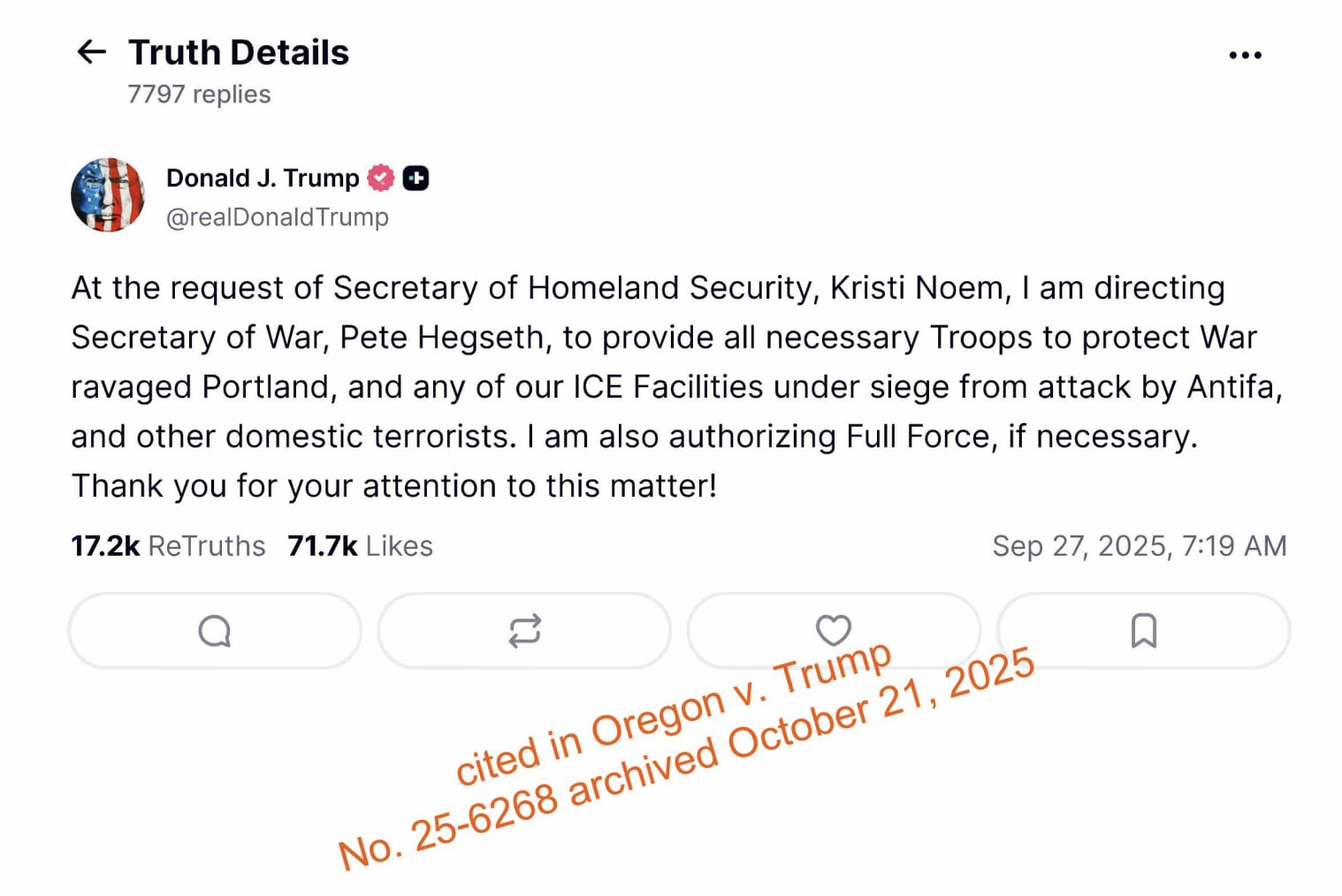
Antifa
Fantasies
Contrary
to
what
the
President
says
on
social
media,
there
is
no
“War”
in
Portland
and
no
“ICE
facilities
under
siege
from
attack
by
Antifa
and
other
domestic
terrorists.”
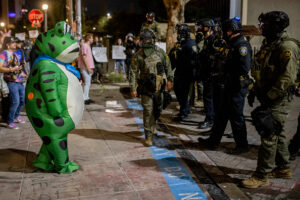
There
are,
however,
a
lot
of
protesters
dressed
up
as
frogs
and
rainbow
unicorns.
Nevertheless,
the
second
Ninth
Circuit
panel
considering
Trump’s
federalization
order
in
Oregon
found
that
the
president’s
emergency
determination
“reflects
a
colorable
assessment
of
the
facts
and
law
within
a
range
of
honest
judgment.”
That
panel
also
had
two
Trump
appointees,
including
Judge
Ryan
Nelson
who
penned
a
concurrence
endorsing
the
DOJ’s
previously-rejected
assertion
that
the
president’s
emergency
determination
is
“unreviewable
by
the
federal
courts.”
To
Nelson,
“the
President’s
decision
in
this
area
is
absolute,”
so
it
doesn’t
matter
that
Trump
openly
lies
about
imaginary
Antifas
conducting
make-believe
sieges.
As
it
turns
out,
Trump’s
lackeys
in
the
DOJ
have
also
lied.
A
lot.
In
fact,
while
the
Ninth
Circuit
was
considering
the
Oregon
federalization
appeal,
the
DOJ
admitted
that
one
of
its
central
claims
in
support
of
the
emergency
declaration
was
grossly
inaccurate.
That
lie
came
in
a
supporting
affidavit
by
Robert
Cantu,
the
Deputy
Director
of
the
Federal
Protective
Services,
who
attested
that
115
of
the
776
members
of
his
agency
had
been
forced
to
surge
into
Portland
to
protect
its
immigration
facility:
The
sustained
violence
associated
with
the
protests
in
Portland
has
required
FPS
Region
10
to
deploy
officers
from
the
other
FPS
Regions.
To
date,
115
FPS
officers
have
had
to
deploy
to
Portland
to
maintain
a
24/7
operational
tempo.
Removing
these
officers
from
their
normal
duty
stations
means
that
the
buildings
they
are
assigned
to
must
rely
on
other
FPS
officers
or
the
local
police
force
to
respond
to
law
enforcement
incidents.
Moreover,
the
security
related
functions
that
the
assigned
officers
normally
perform
end
up
being
delayed.
Judge
Nelson
and
Judge
Bridget
Bade,
the
two
Trump
appointees
considering
the
appeal,
cited
Cantu’s
declaration
18
times
in
the
majority
opinion,
which
bemoaned
the
“lack
of
support”
from
local
law
enforcement
and
the
drain
on
operational
capacity
of
federal
law
enforcement
nationwide.
“The
record
reflects
that
115
FPS
officers—nearly
25%
of
FPS
officers
nationwide—were
diverted
to
Portland”
they
tut-tutted.
“The
President
may
reasonably
rely
on
this
evidence
in
determining
whether
he
is
unable
to
execute
the
law.”
In
dissent,
Judge
Susan
Graber,
a
Clinton
appointee,
noted
that
something
seemed
fishy
about
Cantu’s
“vague,
carefully
worded
assertion.”
Crediting
his
assertion,
we
know
that
a
total
of
115
officers
from
elsewhere
were
deployed
in
Portland
during
the
preceding
four
months.
The
record
contains
no
information
about
how
many
officers
were
in
Portland
at
any
given
time.
For
all
we
know,
FPS
sent
a
different
8
officers
to
Portland
every
week
for
14
or
15
weeks,
meaning
that
Portland’s
drain
on
FPS’s
staff
from
elsewhere
on
any
particular
day
was
8
people,
not
115.
Indeed,
the
only
description
in
the
record
of
a
“[s]urge”
in
officers
was
the
deployment
of
8
officers.
The
fact
that
there
were
26
FPS
officers
on
duty
on
September
6,
as
the
majority’s
order
emphasizes,
says
nothing
about
whether
any
or
all
of
those
individuals
were
from
somewhere
other
than
Portland.
The
record
does
not
reveal
the
number
of
local
FPS
officers.
The
majority
all
but
mocked
Judge
Graber,
scoffing
the
she
“only
reaches
a
different
conclusion
by
characterizing
this
evidence
as
‘staffing
difficulties’
and
committing
the
same
error
as
the
district
court
in
discounting,
minimizing,
and
discrediting
[the
government’s]
undisputed
evidence
on
this
point.”
Except
that
Judge
Graber
was
absolutely
right
to
discount,
minimize,
and
discredit
the
government’s
evidence.
In
discovery,
FPS
admitted
that
it
did
exactly
what
Graber
suspected,
rotating
different
officers
through
Portland
each
month
and
aggregating
the
total
to
make
it
appear
as
if
the
agency
was
dedicating
a
quarter
of
its
resources
to
maintaining
order
in
Portland.
In
reality,
there
are
four
agents
permanently
stationed
in
Portland,
and
FPS
deployed
waves
of
27,
31,
and
29
agents
from
other
regions.
In
the
month
leading
up
to
Trump’s
emergency
declaration,
a
mere
20
agents
were
pulled
in.
That
does
not
support
an
honest
judgment
that
Portland
was
under
siege.
And
the
government
repeated
this
lie
in
its
brief
opposing
en
banc
reconsideration:
FPS,
which
is
charged
with
protecting
the
Lindquist
Building,
is
stretched
to
the
point
of
collapse.
The
sustained
violence
and
security
risks
have
required
FPS
to
provide
24/7
protection
for
the
building,
a
task
it
is
simply
not
resourced
to
accomplish.
To
date,
115
FPS
officers
have
deployed
to
Portland
in
order
to
maintain
this
operational
tempo.
DHS
has
been
forced
to
reassign
members
of
Homeland
Security
Investigations
(HSI)
Portland’s
Special
Response
Team
(SRT)
to
support
FPS,
significantly
impeding
HSI’s
ability
to
accomplish
the
missions
with
which
SRT
is
tasked.
Lies,
Lies,
Lies
Lawyers
for
the
state
of
Oregon
flagged
this
“material
factual
error”
in
a
supplement
to
its
request
for
en
banc
review
of
the
Nelson/Bade
order.
They
noted
the
centrality
of
the
Cantu
affidavit
to
the
ruling,
and
pointed
out
that
the
DOJ
repeated
the
lie
at
oral
argument:
The
dissent
noted
that
defendants’
declaration
on
the
actual
extent
of
the
deployment
was
“carefully
worded”
to
the
point
of
“vague.”
(Dissent
16-21).
But
defendants’
counsel
emphasized
at
oral
argument
the
“magnitude”
and
“unsustainab[ility]”
of
having
115
FPS
offices
redeployed;
then,
when
asked
directly
whether
all
115
officers
remained
in
Portland,
counsel
stated
only
that
“some”
had
gone
home
but
“many”
remained.
That
looks
like
a
deliberate
attempt
to
mislead
the
court
about
the
true
state
of
the
FPS
deployment
—
yet
another
comparatively
little
lie
in
service
of
the
much
bigger
one
about
“war
ravaged”
Portland.
And
it
illustrates
the
folly
of
treating
the
president’s
fact-free
rantings
as
presumptively
correct.
Even
with
the
court’s
deferential
thumb
on
the
scale
in
favor
of
the
president,
the
DOJ
was
still
forced
to
backfill
the
tiny
crack
left
for
judicial
review
with
slurry
of
falsehood
and
deception.
This
episode
highlights
the
disaster
of
the
first
Ninth
Circuit
panel’s
ruling,
which
works
from
the
premise
that
the
president
probably
gets
to
declare
reality
by
executive
fiat,
and
then
invites
the
DOJ
to
concoct
a
rationale
to
back
it
up.
Because
like
ChatGPT,
the
Trump
DOJ
will
come
up
with
“facts”
to
support
Trump’s
claims
—
they
just
might
not
be
true.
Whether
this
will
wind
up
mattering
remains
to
be
seen.
Senior
Judge
Sidney
R.
Thomas,
the
En
Banc
Coordinator
for
the
Ninth
Circuit,
administratively
stayed
the
Nelson/Bade
order
pending
a
vote
by
the
full
Ninth
Circuit.
In
practical
terms,
that
means
that
the
Trump
administration
remains
unable
to
deploy
federalized
national
guard
units
to
the
streets
of
Portland
until
at
least
October
28
—
and
possibly
longer
if
the
court
grants
the
motion
for
reconsideration.
Will
Trump
then
be
allowed
to
flood
the
streets
with
soldiers
based
on
an
obvious
lie,
backed
up
by
even
more
untruths?
As
the
state
urged,
“This
Court
must
act
swiftly
to
prevent
defendants
from
attempting
to
benefit
from
their
own
material
mistake
to
deploy
military
forces
to
peaceful
civilian
streets,
contravening
the
rule
of
law
and
our
nation’s
history
and
traditions.”
Subscribe
to
read
more
at
Law
and
Chaos….
Liz
Dye and Andrew
Torrez produce
the
Law
and
Chaos Substack and podcast. You
can
subscribe
to
their
Substack
by
clicking
the
logo: