
Could Artificial Intelligence Bankrupt Social Security? – Above the Law

As
artificial
intelligence
becomes
more
mainstream,
many
people
are
using
it
to
do
things
that
they
would
normally
hire
someone
else
to
do.
AI
is
helping
people
conduct
research,
analyze
options,
and
even
create
artistic
works.
While
this
makes
certain
things
easier
and
more
efficient,
it
means
that
some
people
will
get
reduced
work
or
lose
their
livelihoods.
For
governments
that
have
to
look
at
the
big
picture,
this
means
more
unemployment
which
translates
to
less
tax
revenue,
with
an
emphasis
on
social
security
funding.
Could
AI
pose
a
serious
threat
to
future
social
security
and
Medicare
funding?
If
so,
what
can
be
done
about
it?

Many
people
are
concerned
AI
will
take
over
white
collar
jobs
that
humans
do
now.
While
the
technology
is
not
perfect

which
some
lawyers
have

learned
the
hard
way


it
is
improving.
The
worry
was
so
bad
that
in
2023,
Hollywood
writers
and
actors

went
on
strike
.
to
prevent
studios
from
using
AI
for
drafting
stories
and
using
actors’
likenesses.

Employees
and
business
owners
pay
into
social
security
and
Medicare.
Employees
do
so
through
paycheck
withholdings
and
business
owners
pay
self-employment
taxes
on
their
net
business
profit.
While
this
tax
is
pretty
substantial

7.65%
for
employees
and
15.3%
for
self-employed
business
owners,
there
is
a
cap
on
the
income
that
is
subject
to
the
tax.
For
2026,
the
income
cap
is
$184,500
so
any
income
above
that
is
not
subject
to
social
security
taxes
although
it
is
subject
to
Medicare
taxes.

If
jobs
are
replaced
by
AI,
then
the
government
will
lose
these
social
security
tax
and
Medicare
tax
payments.
The
solvency
of
the
social
security
trust
fund
has
been
a
concern
in
the
past
few
decades
and,
based
on
projections,
the
trust
fund
is
on
track
to
be

insolvent
in
2032
.
If
insolvency
is
certain,
then
the
government
will
have
to
make
tough
decisions
to
save
the
social
security
trust
fund,
either
by
cutting
benefits,
raising
the
eligibility
age,
or
raising
taxes.

Skeptics
will
note
that
technological
disruption
is
nothing
new
and
despite
the
doomsday
talk,
the
economy
will
adapt.
Most
will
cite
complex
machines
replacing
most
assembly-line
workers
in
the
20th
century.
Or
e-commerce
disrupting
the
Main
Street
brick-and-mortar
stores.

Several
proposals
have
been
made
to
address
this
potential
problem.
One
is
to
impose
additional
taxes
on
AI
companies
and
businesses
that
use
AI
to
compensate
for
the
revenue
lost
due
to
increased
unemployment.
Imposing
this
tax
on
small
businesses
will
be
unpopular
and
the
tax
could
be
passed
on
to
the
customer
if
economic
conditions
allow
it.
Also,
detecting
whether
a
business
is
using
AI
could
be
difficult.

Another
idea
getting
a
lot
of
attention
lately
is
universal
basic
income
(UBI)
where
everyone
gets
a
regular
cash
payment
whether
they
are
working
or
not.
It
could
act
as
a
safety
net
which
will
let
people
cover
basic
living
expenses
even
if
automation
wipes
out
their
job.
But
 UBI
could
disincentivize
people
to
work
and
mouth
off
whatever
nonsense
is
in
their
mind
without
fear
of
financial
consequences.
Considering
the
very
large
cost
and
the
potential
negative
incentives,
UBI
is
likely
to
be
used
as
a
last
resort
to
prevent
bigger
societal
problems.

Probably
the
easiest
solution
is
to
change
the
way
how
social
security
is
funded.
In
short,
enact
new
taxes
or
raise
existing
ones.
Or
impose
a
new
tariff.

The
final
and
possibly
the
most
sensible
solution
is
to
wait
and
see.
The
proliferation
of
AI
could
result
in
jobs
that
were
previously
not
available.
Granted,
most
of
the
new
jobs
will
involve

servicing
and
maintaining

the
AI
infrastructure.
But
jobs
involving
other
disciplines
and
skill
sets
could
be
available.
For
example,
philosophers,
ethicists,
and
religious
leaders
could
be
hired
to
help
with
the
AI’s
moral
programming.

AI
is
transforming
work
in
ways
we
haven’t
seen
before,
and
it
has
the
potential
to
strain
social
security
systems
by
potentially
shrinking
the
number
of
contributors.
But
if
we
get
ahead
of
it

with
things
like
exploring
UBI,
updating
funding
models,
and
sparking
new
kinds
of
jobs

we
can
make
sure
the
upsides
of
AI
benefit
everyone,
not
just
a
few.
The
trick
is
to
embrace
the
tech
while
protecting
the
people
who
get
caught
in
the
transition.


Steven
Chung
is
a
tax
attorney
in
Los
Angeles,
California.
He
helps
people
with
basic
tax
planning
and
resolve
tax
disputes.
He
is
also
sympathetic
to
people
with
large
student
loans.
He
can
be
reached
via
email
at [email protected].
Or
you
can
connect
with
him
on
Twitter
(
@stevenchung)
and
connect
with
him
on 
LinkedIn.

NYU Langone Health: We’re Close to Clinical AI with No Human in the Loop – MedCity News

The
medical
community’s
comfort
with
deploying
AI
in
clinical
care
is
rapidly
evolving

because
it
has
to,
according
to
health
informatics
leaders
at

NYU
Langone
Health
.

They
said
that
AI
agents
will
likely
be
performing
clinical
tasks
completely
on
their
own

with
no
human
in
the
loop

in
the
near
future.
Take
blood
pressure
medication
titration
for
example.

“We
already
have
an
AI
assistant
we
built
for
our
home
blood
pressure
monitoring
program

that
right
now
still
has
a
human
in
loop
for
doing
the
titrations
of
the
meds.
Five
years
from
now,
we’re
not
going
to
have
a
human
doing
those
titrations,”
said
Dr.
Devin
Mann,
senior
director
for
informatics
innovation
at
NYU’s
Center
for
Healthcare
Innovation
and
Delivery
Science.

Dr.
Paul
Testa,
NYU’s
chief
health
informatics
officer,
agreed,
saying
“there’s
no
reason
to.”

In
his
eyes,
hypertension
management
is
a
clear
example
of
where
full
automation
makes
sense.
Under
current
care
models,
getting
a
patient
to
their
target
blood
pressure
can
take
six
to
nine
months,
largely
because
of
slow,
incremental
medication
adjustments
that
require
repeated
interactions
with
the
health
system
and
its
human
clinicians.

But
those
steps,
Dr.
Testa
said,
follow
well-established
clinical
guidelines
and
rely
on
objective
home
blood
pressure
data

making
them
well
suited
for
AI-powered
decision
making.

Full
automation
could
also
significantly
improve
a
patient’s
“time
to
therapy,”
Dr.
Testa
added.
Patients
typically
experience
a
delay
between
diagnosis
and
effective
treatment,
and
this
period
is
often
unnecessarily
long

not
because
clinicians
don’t
know
what
to
do,
but
because
the
healthcare
system
moves
slowly,
he
explained.

AI
could
shrink
that
window
by
automating
routine
steps
like
data
review,
guideline-based
decisions
and
patient
follow-ups
to
reach
the
right
treatment
faster,
Dr.
Testa
stated.

He
also
pointed
out
that
there
are
some
clinical
workflows
that
no
longer
require
human
interpretation,
such
as
diabetic
retinopathy
screening.
The
rate
of
screening
for
this
disease
remains
low
nationwide,
hovering
around
15%

but
with
full
automation,
Dr.
Testa
argued
that
those
rates
could
approach
100%.

Screening
rates
remain
low
because
the
process
still
depends
on
a
series
of
manual
steps

ordering
the
test,
interpreting
results
and
placing
referrals

each
of
which
introduces
friction
and
opportunities
for
delay.
Fully
automated
screening
and
referral
could
eliminate
those
handoffs
and
ensure
eligible
patients
are
identified
and
routed
to
care
consistently.

Dr.
Mann
emphasized
that
this
push
for
full
automation
isn’t
just
about
efficiency
or
speed

it’s
about
the
fact
that
the
workforce
to
deliver
guideline-recommended
care
simply
doesn’t
exist.

Clinical
guidelines
often
call
for
far
more
lifestyle
counseling
and
ongoing
support
than
health
systems
can
realistically
provide,
he
noted.
In
areas
like
nutrition
and
chronic
disease
management,
the
number
of
clinicians
required
would
be
orders
of
magnitude
higher
than
the
workforce
that’s
actually
out
there.

“There’s
a
missing
workforce
that
[AI]
will
just
step
into.
We’re
never
going
to
hire
50,000
dietitians.
They
don’t
even
exist,
let
alone
the
fact
that
the
reimbursement
is
not
really
there
for
them.
So
[AI]
will,
I
think,
create
roles
that
we
always
wanted
to
be
in
there
with
humans,
but
the
humans
just
aren’t
there,”
Dr.
Mann
said.

He
also
pointed
out
that
human
effort
should
shift
to
relationship-based
and
complex
care.
As
routine
work
is
automated,
clinicians
could
spend
more
time
on
patient
education,
shared
decision
making
and
edge
cases

areas
where
persuasion,
trust
and
nuance
still
matter
and
where
AI
struggles.

Taken
together,
Drs.
Mann
and
Testa
see
a
future
in
which
fully
autonomous
AI
is
not
a
fringe
experiment,
but
a
practical
response
to
the
realities
of
modern
healthcare.


Photo:
ThongSam,
Getty
Images

California AG Says Paul, Weiss Sold Out The Profession – Above the Law

(Photo
by
Mark
Wilson/Getty
Images)

California
Attorney
General
Rob
Bonta
isn’t
going
to
pretend
the
Biglaw
deals
with
Trump
are
anything
but
terrible.

In
a
recent
sitdown

with
Bloomberg
News
,
Bonta
took
direct
aim
at
the

nine
Biglaw
firms

that
struck
deals
with
the
Trump
administration

arrangements
that
traded
Trump-approved
pro
bono
work
for
relief
from
executive
orders
that
federal
judges
have
repeatedly
found

unconstitutional
.
Or,
in
some
cases,
relief
from
nothing
more
than
the

threat

of
an
executive
order.
Which
somehow
made
the
capitulation
worse,
not
better.

This
was,
in
Bonta’s
words,
cowardice.

“It
was
weak,
it
was
cowardly,
it
was
craven
for
Paul
Weiss
to
do
it
at
the
beginning
and
sort
of
send
a
signal
to
the
other
firms
that
this
is
what
we’re
doing,”
Bonta
said.
“We’re
doing
deals,
we’re
caving,
we’re
bending
the
knee.”

He
wasn’t
subtle
about
the
firm
he
sees
as
Patient
Zero:

Paul,
Weiss
,
the
first
Biglaw
shop
to
decide
that
fighting
an
unlawful
executive
order
was
just
too
stressful.
Better
to
offer
up

pro
bono
payola
,
that
is
free
legal
services
for
conservative
clients
and
causes
favored
by
Donald
Trump,
in
exchange
for
regulatory
peace.

And
once
Paul,
Weiss
blinked,
others
followed.
Because
nothing
says
“rule
of
law”
like
letting
the
loudest
bully
in
the
room
set
the
terms.

Bonta,
notably,
is
not
speaking
from
some
abstract,
academic
perch.
California
has
filed
roughly
50
lawsuits
against
the
Trump
administration,
and
the
state
legislature
handed
Bonta
$25
million
last
year
specifically
to
keep
suing.
While
Biglaw
firms
were
tripping
over
themselves
to
make
deals,
California
was
doing
what
lawyers
are
theoretically
supposed
to
do
when
faced
with
unconstitutional
government
action:
litigate.

“We
have
the
luxury
of
being
able
to
do
the
work
ourselves,
because
we’re
so
well
resourced
and
so
large,”
Bonta
said.

Despite
the
reputational
damage
Paul,
Weiss
has
absorbed
since
the
deal
became
public,
the
firm
doesn’t
appear
to
be
losing
much
sleep
over
it.
The
firm
recently
went
through
a
leadership
shakeup,
with
longtime
chair
Brad
Karp

stepping
aside
earlier
this
month

amid
scrutiny
over
his
connections
to
Jeffrey
Epstein.
His
replacement,
Scott
Barshay,
a

corporate
partner
,
was
reportedly
a
major
internal
proponent
of
the
Trump
deal.

That
tells
you
a
lot
about
how
this
decision
is
being
framed
internally
as
a
savvy
business
move
designed
to
protect
a
client
list,
not
the
constitution.

Bonta’s
critique
lands
because
it
exposes
the
lie
at
the
heart
of
Biglaw’s
self-image.
When
the
moment
came
to
defend
the
profession,
the
constitution,
or
even
their
own
institutional
independence,
too
many
firms
chose
instead
to
negotiate
with
the
threat.


Kathryn
Rubino
is
a
Senior
Editor
at
Above
the
Law,
host
of

The
Jabot
podcast
,
and
co-host
of

Thinking
Like
A
Lawyer
.
AtL
tipsters
are
the
best,
so
please
connect
with
her.
Feel
free
to
email

her

with
any
tips,
questions,
or
comments
and
follow
her
on
Twitter

@Kathryn1
 or
Mastodon

@[email protected].

Morning Docket: 02.18.26 – Above the Law

*
Federal
judges
granted
limited
freedom
to
respond
to
“illegitimate
forms
of
criticism
and
attacks.”
[ABA
Journal
]

*
Law
firms
continue
to
drive
the
commercial
real
estate
market,
with
Linklaters
committing
to
expand
office
by
50
percent.
Maybe
Biglaw
isn’t
planning
to
lay
everyone
off
and
switch
to
AI
after
all.
[New
York
Law
Journal
]

*
Trump
administration
sued
over
removing
Pride
flag
from
Stonewall
monument
as
if
it’s
a
national
monument
for
its
drink
specials.
[NY
Times
]

*
Justice
Department
isn’t
acting
like
it
used
to
say
Criminal
Defense
Lawyers
For
Understatement.
[NPR]

*
CFTC
asserts
its
regulatory
authority
to
affirmatively
shield
websites
skirting
gambling
laws
from
meaningful
regulation.
The
president’s
son
is
deeply
invested
in
Polymarket…
probably
just
a
coincidence.
[CNBC]

*
Judge
declares
mistrial
over
lawyer’s
attire.
[Guardian]

*
Harvey
signs

Suits

star
whose
character
inspired
its
name
as
spokesperson.
[LawSites]

What Is This, A Louis C.K. Bit? – See Also – Above the Law

Prosecution
Argues
Defendant’s
Potential
Masturbation
Wasn’t
That
Big
Of
A
Deal:
Won’t
be
able
to
get
off
that
easy!
Err…
Pentagon
Rules
Out
DOD
Tuition
Assistance
Programs
For
Elite
Law
Schools
To
Fight
Woke:
Its
like
DEI
for
lower
ranked
schools!
Trump
Administration
Fails
To
Undercut
Substantive
Rights:
Judge
Paula
Xinis
stops
ICE
from
trying
to
“rewrite
history.”
Trump
Appointed
Federal
Judge
Sounds
Constitutional
Alarm:
Judge
restrains
ICE
from
violating
the
Constitution.
Get
Your
Paperwork
In
Order:
Transparent
finances
could
stand
between
Appalachian
School
of
Law
and
millions.
Is
Your
Dream
School
In
The
Budget?:
Federal
loan
caps
could
be
a
monkey
wrench
in
financing
your
degree.

Supreme Court Adopts ‘New’ Process To Avoid Conflicts Of Interest 20 Years Too Late – Above the Law

(Photographer:
Stefani
Reynolds/Bloomberg)

Only
the
Supreme
Court
could
announce
a
bare
minimum
ethical
guardrail
that
lower
courts
have
used
since
the
George
W.
Bush
administration
and
act
like
it’s
a
bold
blow
against
the
appearance
of
impropriety.

The
Supreme
Court

announced
Tuesday

that
it
will
now
employ
software
to
help
the
justices
identify
when
they
should
probably
recuse
themselves
from
cases.
We
say
“probably,”
because
there’s
still
no
actually
enforceable
ethics
code
binding
Supreme
Court
justices
and
the
Chief
Justice
has
made
very
clear
that

he
will
ignore
any
attempt
to
impose
one
.
Instead,

the
Supreme
Court
drafted
a
14-page
pinky
swear

that
they
will
follow

some

of
the
same
rules
that
bind
lower
court
judges.
According
to
this
toothless
document,
the
justices
aren’t
supposed
to
hear
matters
where
they
have
direct
financial
stakes
in
the
parties.
Thus,
this
new
software
package
and
a
tweak
to
the
filing
rules
to
require
parties
include
their
stock
ticker
symbols.

To
be
clear,
lower
court
judges
have
been
using
conflict-checking
software
since
2007.
The
Supreme
Court
first
hinted
that
it
might
start
using
conflict-checking
software
in
2023.
After
that,
the
Court
went
silent
and
just
continued
running
its
recusal
process
with
all
the
organization
and
transparency
of
the
worst
owner
in
your
fantasy
football
league
on
draft
day.

Eight
hundred
and
twenty-seven
days
later:
mission
accomplished!

Gabe
Roth
of
Fix
the
Court
put
a
fine
point
on
the
situation:

Per
their
most
recent
disclosures,
only
two
justices,
Chief
Justice
Roberts
and
Justice
Alito,
own
individual
stocks,
with
the
former
holding
shares
in
two
companies
and
the
latter
holding
shares
in
more
than
two
dozen.
So
although
the
new
rule
is
a
net
positive
since
it
comes
in
service
of
the
full
Court’s
adoption
of
conflict-check
software,
it’s
not
a
major
improvement,
and
it
should
not
have
taken
827
days
post-Code
to
implement.
That’s
especially
true
since
lower
court
judges
have
been
required
to
use
software-based
conflict
screening
for
20
years,
and
several
justices
have
been
rumored
to
continue
to
use
it
after
they
were
elevated.

Justice
Alito’s
stock
portfolio
has
become
a
recurring
subplot
in
the
Court’s
ongoing
ethics
drama.
Just
last
month,

Alito
recused
himself


right
before
oral
arguments

from
the
high-profile

Chevron
USA
v.
Plaquemines
Parish

case
because
of
his
holdings
in
ConocoPhillips,
whose
subsidiary
Burlington
Resources
remained
a
party
in
the
lower
court
proceedings.
Alito
holds
stock
in
more
than
two
dozen
companies
and
accounts
for
roughly
a
third
of
all
recusals
at
the
Court.
Chief
Justice
Roberts
holds
stock
in
two
companies.

Meanwhile,
the
other
seven
justices
have
figured
out
how
to
manage
their
finances
without
being
ethical
drags
upon
the
Court.
The
Supreme
Court
took
over
two
years
to
institute
a
new
software
solution
to
fix
a
problem
that
exists
solely
because
these
two
refuse
to
divest
from
the
market
as
a
small
price
to
pay
for
being
the
nation’s
SuperLegislature.

If
the
justices
wanted
to
institute
a
more
effective
change
related
to
their
ethics
and
their
investments,
they’d
agree
as
a
Court
not
to
hold
any
stocks
during
their
tenures,
since
all
it
does
is
cause
unnecessary
recusals.
An
investor-justice
could
own
a
blended
fund,
mutual
fund
or
ETF
and
reap
the
same
benefits
with
a
far
reduced
conflict
exposure.
In
fact,
seven
of
the
nine
justices
have
made
this
very
calculation.

When
Pete
Rose
got
banned
from
baseball
for
gambling
on
games,
one
of
the
popular
arguments
people
made
in
his
defense
was
that
he
never
bet
against
his
team.
He
wasn’t
throwing
games
or
anything…
he
was
just

confident

in
himself!
Except
when
he
looked
at
the
other
dugout
and
decided
to
NOT
bet
on
himself,
that
was
a
signal
too.
Note
that
Sam
Alito
owns
ConocoPhillips
and
not
“Happy
Green
Solar
Farms.”
And
while
it’s
not
an
issue
with
the
Court’s
current
6-3
majority,
if
Alito
thought
his
fossil
fuel
holdings
might
jeopardize
a
ruling
in
favor
of
polluters,
he
could
adjust
his
portfolio
accordingly.
The
fact
that
this
is
even
possible
is
that
appearance
of
impropriety.

Speaking
of
gambling,
our
former

Above
the
Law

colleague

Elie
Mystal
of

The
Nation

recently
speculated

that
Alito
plans
to
retire
at
the
end
of
this
Term.
Pointing
to
the
announcement
that
Alito’s
new
book
will
drop
right
before
the
next
Supreme
Court
Term,
Elie
sees
a
clear
signal
that
Alito
is
planning
to
be
on
a
book
tour
the
next
time
the
justices
convene.
Dahlia
Lithwick
and
Mark
Joseph
Stern

echoed
this
prediction

over
at

Slate
.
Then
it
became
full-blown
conventional
wisdom
(though
our
other
former

Above
the
Law

colleague

David
Lat
has
a
counterargument
).
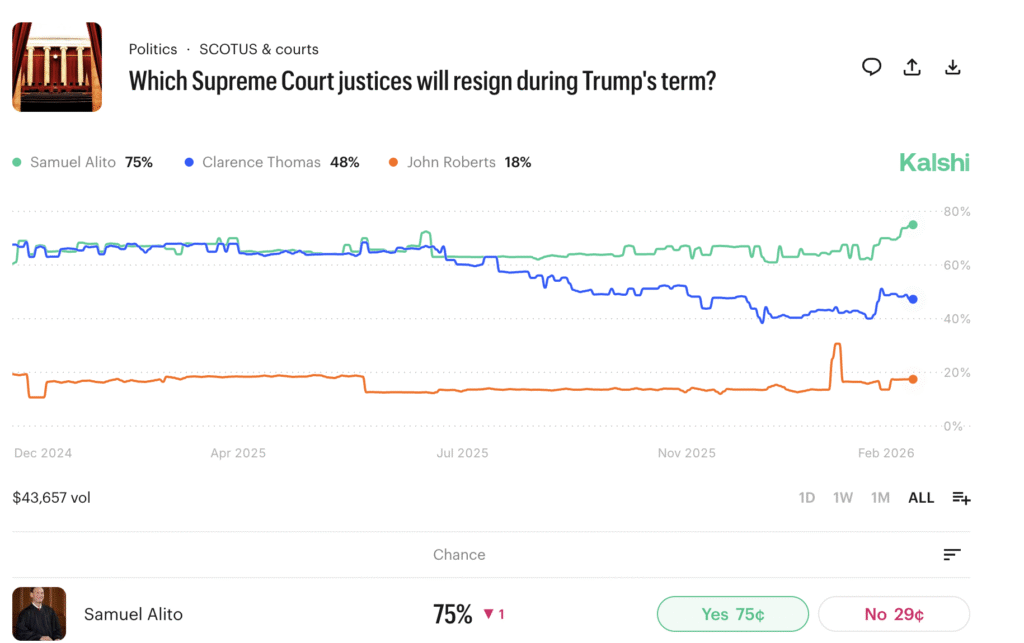
Over
at
we’re-not-a-gambling-site-except-in-the-way-that-we’re-totally-a-gambling-site
Kalshi,
you
can
trace
Alito’s
literal
stock
rising
off
Elie’s
musings.

Is
Sam
Alito
out
there
spamming
that
“No”
contract
preparing
to
reap
the
benefits
in
an
epic
bid
to
own
the
libs
like
Elie?
Food
for
thought.

Back
to
the
topic
at
hand.
Given
the
unlikelihood
of
a
voluntary
selloff,
Roth
pointed
to

a
legislative
proposal

to
ban
stock
ownership
for
justices
and
lower
court
judges
alike

the
latter
having
their

own
well-documented
ethical
issues

with
investments.
House
Republicans
have
already
watered
down
this
proposal
with
loopholes.

Roth
also
flagged
something
that
often
gets
lost
in
the
polite
coverage
of
Supreme
Court
procedural
updates:

Public
service
also
demands
public
input,
and
it’s
a
bit
ridiculous
that
the
Court
can
simply
release
new
rules
without
a
notice-and-comment
period
or
opportunity
for
public
views.
It’s
yet
another
example
of
the
Court
acting
exceptionally
in
all
the
wrong
ways.

In
the
Court’s
defense,
the
majority
seems
hellbent
on
bending
the
rest
of
the
government
toward
their
state
of
exception.
Other
than
the
Federal
Reserve


which
the
majority
will
go
to
comical
lengths
to
protect


this
Court
seems
perfectly
comfortable
with
a
dementia-addled
president
unilaterally
rewriting
the
rules
and
regulations
governing
every
executive
agency.
Why
not
impose
Supreme
Court
rule
changes
by
imperial
decree?

Anyway…
the
Supreme
Court
has
a
new
ethics
process.
Don’t
get
too
excited.


HeadshotJoe
Patrice
 is
a
senior
editor
at
Above
the
Law
and
co-host
of

Thinking
Like
A
Lawyer
.
Feel
free
to email
any
tips,
questions,
or
comments.
Follow
him
on Twitter or

Bluesky

if
you’re
interested
in
law,
politics,
and
a
healthy
dose
of
college
sports
news.
Joe
also
serves
as
a

Managing
Director
at
RPN
Executive
Search
.

Trump Administration Learns To Its Dismay It ‘Cannot Alter Substantive Rights’ – Above the Law

Kilmar
Abrego
Garcia
Photo
by:
Graeme
Sloan/Bloomberg
via
Getty
Images

Today
a
federal
court
rejected
the
“let’s
just
ignore
the
last
year”
theory
advanced
by
the
government
in
the

saga
of
Kilmar
Abrego
Garcia
.
Abrego
Garcia
is,
of
course,
the
man
the
Trump
administration
famously
and
wrongly
deported
to
an
El
Salvadoran
slave
labor
camp
and
then
spent
the
better
part
of
a
year
trying
to
punish
for
embarrassing
them
by
surviving.

U.S.
District
Judge
Paula
Xinis
ruled
that
Abrego
Garcia
cannot
be
detained
again
by
Immigration
and
Customs
Enforcement,
because
the
statutory
90-day
removal
period
that
would
allow
ICE
to
hold
him
expired
“long
ago.”

Although
all
parties
agreed
to
a
retroactive
correction
of
the
immigration
record,
Judge
Xinis
made
clear
that
paperwork
time
travel
doesn’t
revive
expired
detention
authority.
“The
‘removal
period’
for
which
Abrego
Garcia’s
detention
had
been
compelled
was
over
long
ago,”
she
wrote.

“Respondents’
reading
would
also
conveniently
erase
this
last
year
of
Abrego
Garcia’s
Detention,”
she
wrote,
adding
that
the
Trump
administration
“cannot
alter
substantive
rights
or
rewrite
history.”

Since
August
2025,
ICE
has
floated
what
Judge
Xinis
described
as
“phantom
removals
to
three
(maybe
four)
African
countries,”
that
were
“empty
threats”
with
“no
real
chance
of
success.”

Meanwhile,
the
one
country
that

has

consistently
offered
to
accept
Abrego
Garcia
and
that
he
is
willing
to
go
to
(Costa
Rica),
has
been
deliberately
ignored.
Which
tells
you
the
Trump
administration’s
dogged
pursuit
of
Abrego
Garcia
is
not
about
removal,
but
about
the
vindictive,
cruel
desire
to
make
an
example
of
him.

“In
her
decision
today,
she
recognized
that
if
the
government
were
truly
trying
to
remove
Mr.
Abrego
Garcia
from
the
United
States,
they
would
have
sent
him
to
Costa
Rica
long
before
today,”
Simon
Sandoval-Moshenberg,
an
attorney
for
Abrego
Garica
said.
“We
hope
the
government
does
not
appeal
this
order,
and
instead
finally
comes
to
the
table
in
good
faith
to
work
out
the
details
of
a
removal
plan
to
Costa
Rica.”

That
hope
may
be
optimistic.
But
Judge
Xinis
has
now
made
it
very
clear
that
the
government
doesn’t
get
to
keep
a
man
in
legal
limbo
forever
just
to
save
face.


Kathryn
Rubino
is
a
Senior
Editor
at
Above
the
Law,
host
of

The
Jabot
podcast
,
and
co-host
of

Thinking
Like
A
Lawyer
.
AtL
tipsters
are
the
best,
so
please
connect
with
her.
Feel
free
to
email

her

with
any
tips,
questions,
or
comments
and
follow
her
on
Twitter

@Kathryn1
 or
Mastodon

@[email protected].

Trump Ally Jason Miller Attacks His Paternity Case Judge In Social Media Blast – Above the Law

Jason
Miller
was
all
set
to
be
the
White
House
communications
director
for
the
first
Trump
administration
when
news
circulated
that
he’d
had
an
affair
with
fellow
campaign
staffer,
Arlene
“AJ”
Delgado.
Delgado
has
a
7-year-old
son
that
she
contends
belongs
to
Miller.
The
pair
have
spent
the
better
part
of
a
decade
now
litigating
all
over
the
place,
from
sex
discrimination
claims
in
New
York
federal
court
to
paternity
and
child
support
claims
floating
around
Florida.
The
Florida
claims
have,
as

Florida
Bulldog

put
it
yesterday,
“gone
through
a
carousel
of
judges
in
three
judicial
districts
due
to
conflicts
of
interest
and
accusations
of
bias.”

And
now
they’ve
added
another.

Miami-Dade
Circuit
Court
Judge
Spencer
Multack
drew
the
short
straw
and
took
on
the
paternity
case
in
2021,
becoming
the
ninth
judge
in
this
litigation
which
is
basically

Bleak
House

except
with
a
very
real
7-year-old
child.
Up
until
recently,
it
was
Delgado
who
sought
to
toss
Multack
from
the
case,
alleging
bias
in
Miller’s
favor.
But
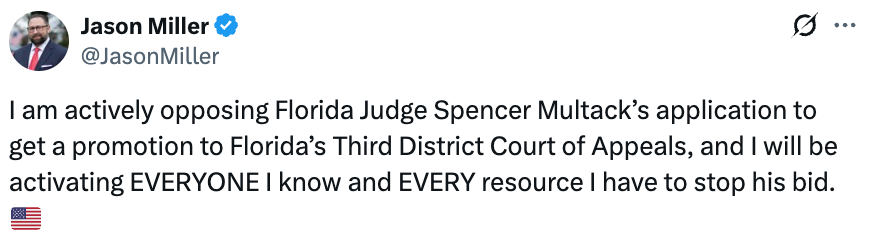
then,
after
an
appellate
court
opening
arose,
Miller
went
on
the
former
Twitter
to
announce:

Judge
Multack
recused
himself
four
hours
later.
Delgado’s
attorney
in
the
New
York
case
informed
that
judge
of
the
development
last
week,
characterizing
Miller’s
remarks
as
“very
real
threats
of
professional
harm.”

Any
normal
lawyer
representing
a
client
like
this
would
have
seen
that
tweet
land
and
immediately
aged
twenty
years.

“You
know
what
would
really
help
your
ongoing
child
support
battle?
Publicly
threatening
the
judge’s
career
on
social
media!”
said
no
lawyer
ever.
Let’s
put
aside
whether
it’s
fair
to
characterize
a
citizen
stating
his
preference
for
an
open
judgeship
as
a
“threat”
with
the
intent
of
influencing
the
judge

which
would
open
the
door
to
a

first-degree
misdemeanor
in
Florida


and
focus
on
how
it’s
just
gobsmackingly
stupid.
The
next
judge
that
ends
up
hearing
this
dumpster
fire
litigation
isn’t
likely
to
say
anything
explicit,
but
unless
Miller
manages
to
draw
a
judge
with
some
deep
seated,
comic-book
enmity
toward
Judge
Multack,
everything
Miller
does
from
now
on
will
draw
healthy
judicial
side-eye.

This
was
also
stupid
because,
if
Miller
actually
had
the
juice
to
torpedo
a
judicial
appointment,
he
wouldn’t
need
to
announce
it
to
625,000
followers.
If
he
had
the
sort
of
pull
that
could
directly
or
indirectly
convince
Ron
DeSantis
to
pass
over
Multack,
he’d
just
do
it.
He
would
pick
up
the
phone
or
have
lunch
with
the
right
donor
and
end
it.
No
need
for
a
public
show.
Peak
beta
male
move,
as
the
kids
might
say.

Ultimately,
this
illustrates
what
public
policy
professor
Don
Moynihan
has
called
the
clicktatorship

the
MAGA
brain
rot
brought
on
by
the
toxic
intersection
of
extreme
social
media
brain
and
authoritarian
impulses.
As
Moynihan
put
it,
Trump
culture
embraces
a
world
where
“everything
is
content,”
and
its
acolytes
don’t
just
use
social
media
for
communication,
but
rewire
their
dopamine
loops
around
online
engagement.
The
platform
is
the
message,
if
you
will.

Which
is
why
Miller
couldn’t
keep
his
battle
in
the
courtroom.
He
just

had

to
spill
it
over
to
social
media
and
flex
the
power
he
imagines
that
his
600K+
followers
give
him
over
Florida
judicial
politics.
When
“EVERY
resource
I
have,”
is
a
few
hundred
thousand
followers,
that’s
not
the
flex
he
thinks
it
is.
In
any
event,
Judge
Multack
is
off
the
case
and
Delgado
is
moving
to
get
the
case
moved
to
a
whole
new
judicial
circuit.

So
we
beat
on,
briefs
against
the
current,
borne
back
ceaselessly
into
the
2016
campaign.


Trump
campaign
mouthpiece
Jason
Miller
threatens
judge
in
his
paternity
case

[Florida
Bulldog]


HeadshotJoe
Patrice
 is
a
senior
editor
at
Above
the
Law
and
co-host
of

Thinking
Like
A
Lawyer
.
Feel
free
to email
any
tips,
questions,
or
comments.
Follow
him
on Twitter or

Bluesky

if
you’re
interested
in
law,
politics,
and
a
healthy
dose
of
college
sports
news.
Joe
also
serves
as
a

Managing
Director
at
RPN
Executive
Search
.

Federal Judge Tells The Trump Administration To Quit Acting Like Big Brother – Above the Law

LOS
ANGELES,
CA

JANUARY
25:
A
copy
of
George
Orwell’s
novel
‘1984’
sits
on
a
shelf
at
The
Last
Bookstore
on
January
25,
2017
in
Los
Angeles,
California.
George
Orwell’s
68
year-old
dystopian
novel
‘1984’
has
surged
to
the
top
of
Amazon.com’s
best
seller
list
and
its
publisher
Penguin
has
put
in
an
order
for
75,000
reprints.
(Photo
by
Justin
Sullivan/Getty
Images)


As
if
the
Ministry
of
Truth
in
George
Orwell’s

1984

now
existed,
with
its
motto
‘Ignorance
is
Strength,’
this
Court
is
now
asked
to
determine
whether
the
federal
government
has
the
power
it
claims—to
dissemble
and
disassemble
historical
truths
when
it
has
some
domain
over
historical
facts.
It
does
not.


Judge
Cynthia
M.
Rufe
granting
the
City
of
Philadelphia
a
preliminary
injunction

holding

the
federal
government
must
restore
signage,
displays
and
videos
at
the
President’s
House
site
in
Philly
that
discuss
the
slaves
that
George
Washington
owned
at
that
location.
Attorneys
for
the
Trump
administration
argued,
“the
government
gets
to
choose
the
message
it
wants
to
convey.”

Judge
Rufe
was
not
impressed

with
the
efforts
to
memory-hole
slavery,
characterizing
it
as
“dangerous”
and
“horrifying”
during
oral
arguments.