Morning Docket: 02.06.26 – Above the Law

*
The
most
popular
way
to
win
over
this
Supreme
Court
is
to
quote
Scalia.
Very
originalist
to
be
primarily
swayed
whose
seat
is
still
warm.,
[CNN]

*
Yale
Law
fires
its
law
librarian

one
of
only
three
Black
women
on
faculty

after
she
filed
a
complaint
which
itself
followed
an
internal
investigation
about
working
conditions
in
the
library.
[Yale
Daily
News
]

*
Starbucks
beats
back
Missouri
AG
lawsuit
over
“DEI”
policies.
[Reuters]

*
Lawyers
stepping
up
to
represent
ICE
victims.
[Law.com]

*
Uber
owes
$8.5M
in
sexual
assault
verdict.
[Law360]

*
Baker
McKenzie
layoffs
continue.
[Roll
on
Friday
]

*
EEOC
rescinds
anti-discrimination
guidance.
[ABA
Journal
]

Zimbabwe’s Mugabe latest former African leader to be mentioned in Epstein files

AFP/Getty
Images
Robert
Mugabe,
flanked
here
by
his
wife
Grace,
dominated
Zimbabwe’s
political
landscape
for
nearly
four
decades

In
an
email
exchange
from
2015
with
Japanese
entrepreneur
Joi
Ito,
the
disgraced
financier
suggested
they
approach
then-President
Mugabe
to
provide
Zimbabwe
with
a
new
currency
after
the
local
dollar
collapsed
because
of
hyperinflation.

FBI
documents
from
2017
also
released
had
unverified
testimony
from
a
“human
confidential
source”,
who
claimed
Epstein
was
a
wealth
manager
for
Russia’s
President
Vladimir
Putin
and
provided
the
same
service
for
Mugabe.

Being
named
among
the
Epstein
files
is
not
an
indication
of
wrongdoing.

The
BBC
has
asked
the
Mugabe
family
for
a
response.

Robert
Mugabe,
Zimbabwe’s
independence
leader
and
long-time
president,
died
in
September
2019
aged
95

two
years
after
being
ousted
in
a
coup.

Epstein,
a
well-connected
US
financier
and
convicted
sex
offender,
was
found
dead
in
prison
by
suicide
while
awaiting
trial
on
sex-trafficking
charges
in
August
2019.

He
had
been
convicted
in
2008
of
soliciting
sex
from
a
14-year-old
girl
in
Florida
and
completed
his
sentence
in
July
2010.

The
latest
tranche
of
files
released
by
the
US
Department
of
Justice
(DOJ)
show
the
email
correspondence
between
Joichi
“Joi”
Ito
and
Epstein
that
took
place
five
years
later.

In
response
to
the
email
about
providing
Zimbabwe
with
a
new
currency,
with
the
subject
“fertile
land
for
exploration”,
Ito,
whose
email
address
is
redacted,
asked
if
Epstein
was
friends
with
Mugabe,
to
which
he
replied:
“No,
but
can
easily
get
his
attention,
zimbabwe
would
be
a
great
petrie
dish,
its
also
supposed
to
be
beautiful.”

US Department of Justice A screengrab of an email conversation between Jeffrey Epstein and Japanese entrepreneur Joi Ito in June 2015 under the subject heading 'fertile land for exploration'.US
Department
of
Justice

Ito
resigned
in
September
2019
as
head
of
MIT’s
Media
Lab
over
donations
the
academic
centre
had
received
from
Epstein.

The
BBC
has
contacted
the
FBI
for
more
information
about
the
documents
contained
in
the
recent
release
of
Epstein
files

as
the
US
financier
would
have
been
violating
sanctions
had
he
been
Mugabe’s
wealth
manager.

Mugabe
was
put
under
US
sanctions
from
2003

and
US
companies
and
citizens
were
prohibited
from
trading
or
conducting
financial
transactions
with
him.

Zimbabwe
and
Mugabe
come
up
in
other
correspondence
in
the
Epstein
files.

An
email
written
in
April
2012
suggested
incorrectly
that
Mugabe
was
on
his
death
bed
in
Italy.

The
sender’s
full
name
and
email
are
redacted
but
the
message
is
signed
off
as
“jonathan”.
He
asks
Epstein
for
possible
contacts
in
the
country,
adding
“they
have
some
great
companies
if
this
guy
is
really
done
whi=h
he
is”.

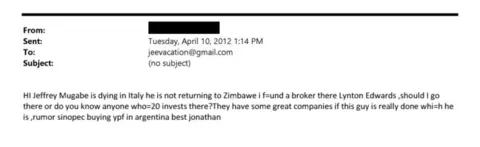
US Department of Justice A screengrab of an email sent to Jeffrey Epstein in April 2012 alleging that Mugabe was on his death bed in Italy.US
Department
of
Justice

Mugabe
was
then
88
years
old

and
appeared
fit
and
well
days
later
on
his
return
from
Singapore
to
lead
independence
celebrations.

One
of
his
old
allies,
who
asked
to
remain
anonymous,
told
the
BBC
that
such
inaccuracies
suggested
the
information
on
Mugabe
was
fabricated.

Zimbabwe
is
still
governed
by
Mugabe’s
Zanu-PF
party

and
struggled
with
inflation
for
decades
following
the
abandonment
of
the
Zimbabwean
dollar
in
2009.

Several
attempts
to
introduce
a
new
currency
failed,
but
a
gold-backed
currency
called
the
Zig,
launched
two
years
ago,
has
managed
to
stabilise
the
economy after
a
shaky
start
 –
though
many
people
still
rely
on
the
US
dollar.

Post
published
in:

Featured

Legislative Agenda for New Session of Parliament


When
the
President
delivered
his
State
of
the
Nation
Address
on
the
28th
October
last
year,
he
outlined
the
Government’s
legislative
programme
for
the
new
session
of
Parliament

that
is
to
say,
he
announced
the
Bills
which
the
Government
hopes
to
present
in
Parliament
during
the
coming
year.

With
Parliament
resuming
its
sittings
next
Tuesday

for
its
agenda
when
it
resumes
see
Bill
Watch
1/2026 [link] –
this
is
an
appropriate
time
to
look
at
the
Government’s
legislative
programme
for
the
rest
of
the
year.

Uncompleted
Bills

The
President
began
by
noting
that
several
Bills
announced
in
previous
years
had
not
been
passed
by
Parliament; 
the
total
backlog
of
Bills,
he
said,
was
unacceptable.

Some
of
the
Bills
he
mentioned
in
this
context
are
currently
at
various
stages
in
their
passage
through
Parliament:


  1. Insurance
    and
    Pensions
    Commission
    Amendment
    Bill
     [link]
    This
    Bill
    is
    awaiting
    its
    Second
    Reading
    in
    the
    National
    Assembly.

  2. Mines
    and
    Minerals
    Bill
     [link]
    The
    PLC
    has
    reported
    adversely
    on
    this
    Bill,
    and
    the
    report
    is
    being
    considered
    by
    the
    Assembly.

  3. Occupational
    Safety
    and
    Health
    Bill
     [link]
    This
    Bill
    is
    due
    to
    undergo
    its
    Committee
    Stage
    in
    the
    Assembly.

  4. Pipelines
    Amendment
    Bill
     [link]
    This
    Bill
    has
    since
    been
    passed
    by
    both
    the
    National
    Assembly
    and
    the
    Senate,
    and
    is
    now
    awaiting
    presidential
    assent.

  5. Police
    Amendment
    Bill
     [link]
    This
    Bill
    is
    ready
    to
    be
    presented. 
    The
    President
    erroneously
    suggested
    it
    had
    lapsed
    at
    the
    end
    of
    the
    Ninth
    Parliament.  It
    should
    be
    noted
    that,
    despite
    its
    title,
    the
    Bill
    will
    also
    amend
    the
    Private
    Voluntary
    Organisations
    Act
    and
    the
    Criminal
    Law
    Code.

  6. Public
    Procurement
    and
    Disposal
    of
    Public
    Assets
    Amendment
    Bill
     [link]
    This
    Bill
    too
    is
    due
    to
    begin
    its
    Committee
    Stage
    in
    the
    Assembly.

  7. Public
    Service
    Amendment
    Bill
     [link]
    The
    PLC
    issued
    an
    adverse
    report
    on
    this
    Bill,
    and
    the
    Assembly
    is
    due
    to
    debate
    the
    report.

  8. State
    Service
    (Pensions)
    Bill
     [link]
    This
    Bill
    was
    amended
    in
    Committee
    by
    the
    National
    Assembly
    and
    the
    amendments
    received
    an
    adverse
    report
    from
    the
    PLC. 
    The
    Assembly
    is
    still
    to
    debate
    the
    report.

Other
uncompleted
Bills
the
President
mentioned
have
not
been
presented
in
Parliament
or
published
in
the
Gazette,
so
presumably
they
are
still
being
drafted. 
They
are:


  1. Biological
    and
    Toxin
    Weapons
    Crimes
    Bill

  2. Electronic
    Transactions
    and
    Electronic
    Commerce
    Bill

  3. Legal
    Practitioners
    Amendment
    Bill

  4. Rural
    Electrification
    Fund
    Amendment
    Bill

  5. Standards
    Bill

  6. Teaching
    Professions
    Council
    Bill.

The
President
failed
to
mention
quite
a
number
of
Bills
which
have
been
published
in
the
Gazette
but
have
not
yet
been
presented
in
Parliament,
or
which
are
currently
going
through
Parliament:


  1. Climate
    Change
    Management
    Bill
     [link]
    This
    Bill
    is
    awaiting
    its
    Second
    Reading
    in
    the
    National
    Assembly.

  2. Medical
    Services
    Amendment
    Bill
     [link]
    This
    Bill
    was
    passed
    by
    the
    National
    Assembly
    with
    amendments
    (relating
    to
    the
    termination
    of
    pregnancy). 
    It
    is
    now
    awaiting
    its
    Second
    Reading
    in
    the
    Senate.

  3. National
    Drug
    and
    Substance
    Abuse
    Control
    and
    Enforcement
    Agency
    Bill
     [link]
    This
    Bill
    has
    not
    been
    presented.

  4. Postal
    and
    Telecommunications
    Amendment
    Bill
     [link]
    This
    Bill
    too
    has
    not
    yet
    been
    presented.

  5. Tourism
    Bill
     [link]
    This
    Bill
    is
    due
    to
    be
    given
    its
    Second
    Reading
    in
    the
    Assembly.

  6. Zimbabwe
    School
    Examinations
    Council
    Amendment
    Bill
     [link]
    This
    Bill
    is
    awaiting
    its
    Committee
    Stage
    in
    the
    National
    Assembly.

One
of
the
Bills
the
President
mentioned
as
uncompleted,
the Persons
with
Disabilities
Bill
,
has
in
fact
passed
through
Parliament
and
been
published
as
Act
number
3
of
2025 [link].

Altogether
Parliament
has
a
backlog
of
20
Bills
outstanding
from
the
previous
session. 
With
only
six
Acts
published
so
far
this
year,
the
President’s
criticism
of
Parliament’s
legislative
record
seems
justified.

New
Bills
Announced

The
President
went
on
to
announce
many
new
Bills
which
he
said
would
be
placed
before
Parliament
during
the
new
session. 
He
did
not
name
all
of
them
specifically,
so
some
of
the
names
in
the
following
list
represent
what
Veritas
assumes
will
be
the
Bills’
short
titles:


  1. Commercial
    Premises
    (Lease
    Control)
    Amendment
    Bill
    ,
    to
    create
    fairness
    in
    the
    commercial
    rental
    market

  2. Competition
    Amendment
    Bill
    ,
    to
    protect
    consumers

  3. Defence
    Amendment
    Bill

  4. Disaster
    Risk
    Management
    Bill
    ,
    to
    replace
    the
    current
    Civil
    Protection
    Act

  5. Foreign
    Affairs
    and
    International
    Trade
    Bill

  6. Iron
    and
    Steel
    Industry
    Amendment
    Bill

  7. Meteorological
    Services
    Amendment
    Bill
    .

  8. National
    Heroes
    Amendment
    Bill

  9. National
    Languages
    Bill

  10. National
    Productivity
    Institute
    Bill
    ,
    to
    drive
    increased
    productivity
    across
    all
    industries

  11. Red
    Cross
    Amendment
    Bill

  12. Research
    Amendment
    Bill
    ,
    to
    establish
    a
    sustainable
    framework
    for
    funding
    research
    institutions

  13. Sport,
    Leisure
    and
    Recreation
    Bill

  14. Sports
    Integrity
    Bill

  15. Sugar
    Production
    Control
    Amendment
    Bill

  16. Veterans
    of
    the
    Liberation
    War
    Amendment
    Bill

  17. War
    Victims
    Compensation
    Amendment
    Bill

  18. Zimbabwe
    Media
    Commission
    Amendment
    Bill
    .

Further
Legislation
Mentioned

In
addition
to
the
Bills
listed
above,
the
President
mentioned
the
following:

  • He
    said
    Government
    was
    working
    on
    “a
    legislative
    framework”
    for
    the
    commercialisation
    of
    products
    emanating
    from
    innovation
    hubs.
  • “A
    notable
    number
    of
    Bills”,
    he
    said,
    would
    be
    tabled
    from
    “our
    transport
    sector”
    – whatever
    that
    is.
  • There
    would
    be
    Bills
    relating
    to
    devolution
    and
    decentralisation
    as
    well
    as
    local
    government.

He
also
said
that
the
following
Acts
should
be
considered
for
amendment,
though
he
did
not
go
so
far
as
to
say
that
amending
Bills
would
be
ready
for
this
Parliamentary
session:


  1. Censorship
    and
    Entertainments
    Control
    Act

  2. Citizenship
    of
    Zimbabwe
    Act
     [This
    Act
    has
    not
    been
    aligned
    with
    the
    Constitution]

  3. Lotteries
    and
    Gaming
    Act

  4. National
    Archives
    of
    Zimbabwe
    Act

  5. Official
    Secrets
    Act

  6. Private
    Investigators
    and
    Security
    Guards
    (Control)
    Act
    .

  7. Unlawful
    Organisations
    Act

Treaties
for
Ratification

The
President
ended
his
address
by
announcing
that
various
treaties
would
be
brought
to
Parliament
for
approval
in
terms
of
section
327(2)
of
the
Constitution,
which
says
that
international
treaties
do
not
bind
Zimbabwe
until
they
have
been
approved
by
Parliament

i.e.
the
National
Assembly
and
the
Senate. 
The
treaties
he
mentioned
were:


  • Arms
    Trade
    Treaty
    2013
     [link]

  • Geneva
    Act
    of
    the
    Lisbon
    Agreement
    on
    Appellations
    of
    Origin
    and
    Geographical
    Indications
    2015
     [link]

  • Hague
    Agreement
    Concerning
    the
    International
    Registration
    of
    Industrial
    Designs
    (1925)
     [link]

  • Protocol
    Against
    the
    Illicit
    Manufacturing
    of
    and
    Trafficking
    in
    Firearms,
    Their
    Parts,
    Components
    and
    Ammunition
     [link]

  • Protocol
    Against
    the
    Smuggling
    of
    Migrants
    by
    Land,
    Sea
    and
    Air
    (2000)
     [link]

  • Protocol
    Amending
    the
    Trade-Related
    Aspects
    of
    Intellectual
    Property
    Rights
    (TRIPS)
    Agreement
    2005
     [link]

  • Treaty
    on
    the
    Prohibition
    of
    Nuclear
    Weapons
    2017
     [link]

Comments

The
legislative
agenda
announced
by
the
President
is
unrealistically
ambitious,
specifically
listing
more
than
24
new
Bills
plus
the
14
which
are
still
going
through
Parliament

more
than
38
in
all.
 At
Parliament’s
current
rate
of
enacting
legislation

only
six
Acts
were
passed
in
2025
and
only
seven
in
2024

it
will
take
Parliament
more
than
six
years
to
get
through
all
the
Bills
the
President
mentioned.
 In
other
words,
the
legislative
agenda
is
a
wish
list
rather
than
a
statement
of
serious
intent.

It
is
doubtful
if
even
the
President
intended
anyone
to
take
the
legislative
agenda
seriously. 
In
most
cases
when
he
mentioned
proposed
Bills
he
gave
their
names
only
and
did
not
describe
their
contents,
leaving
his
audience
to
guess
what
they
are
expected
to
achieve

no
easy
task
in
relation
to
the
Foreign
Affairs
and
International
Trade
Bill,
for
example. 
All
this
suggests
that
responsible
Ministries
have
not
yet
worked
out
what
to
put
into
many
of
their
proposed
Bills
and
that
a
great
deal
of
hard
work
remains
to
be
done
before
they
are
even
sent
to
the
Attorney-General’s
Office
for
drafting,
much
less
presented
in
Parliament.

One
notable
omission
from
the
legislative
agenda
is
a
Constitution
Amendment
Bill
to
extend
the
President’s
term
of
office.  Such
a
Bill
will
be
necessary
if
he
is
to
stay
in
office
beyond
2028,
and
there
have
been
statements
from
government
and
ZANU-PF
officials
suggesting
that
the
Bill
has
been
drafted.  No
doubt
Parliament
will
be
informed
in
due
course
why
the
President
omitted
to
mention
the
Bill.

Veritas
makes
every
effort
to
ensure
reliable
information,
but
cannot
take
legal
responsibility
for
information
supplied.

Post
published
in:

Featured

Brad Karp Steps Down As Chair Of Paul Weiss – See Also – Above the Law

Too
Much
Attention
In
The
Spotlight:
He
remains
a
partner
at
the
firm.
Did
Jones
Day
Represent
Ghislaine
Maxwell?:
Would
explain
the
sums
of
cash
she
transferred
to
the
firm’s
client
trust
account!
“Trading
Russians
Is
One
Thing,
But
I
Draw
The
Line
At
DEI”:
Did
Goldman
Sachs’s
Kathryn
Ruemmler
just
make
a
human
trafficking
joke
or
was
there
something
more?
Charlie
Adelson
Wants
A
Retrial:
His
lawyer
argues
that
the
jury
pool
was
tainted
by
media
coverage.
On
This
Week
Of
Thinking
Like
A
Lawyer:
Arresting
journalists,
Epstein
files,
and
accountability.

LSC Issues Blueprint for Narrowing the Justice Gap through Technology Innovation in Civil Legal Services

In
2013,
the

Legal
Services
Corporation

published
the
landmark
study,


Report
of
The
Summit
on
the
Use
of
Technology
to
Expand
Access
to
Justice
.
The
report
forcefully
made
the
case
that
technology
could
be
a
powerful

indeed,
essential

tool
in
narrowing
the
justice
gap,
and
its
recommendations
helped
shape
the
last
decade
of
legal
innovation
in
the
United
States.

“Technology
can
and
must
play
a
vital
role
in
transforming
service
delivery
so
that
all
poor
people
in
the
United
States
with
an
essential
civil
legal
need
obtain
some
form
of
effective
assistance,”
that
report
presciently
asserted.

Now,
marking
its
most
comprehensive
technology
initiative
since
that
seminal
report,
the
LSC
has
released
a
new
report,


The
Next
Frontier:
Harnessing
Technology
to
Close
the
Justice
Gap
,
which
represents
the
findings
of
an
extensive
two-year
Technology
Summit
process
that
kicked
off
with
LSC’s
50th
anniversary
in
2024.


Related:

LawNext
Episode
58:
Jim
Sandman,
President
of
the
Legal
Services
Corporation
.

Like
its
predecessor,
this
new
report
offers
an
ambitious
roadmap
for
leveraging
technology
to
narrow
America’s
justice
gap.
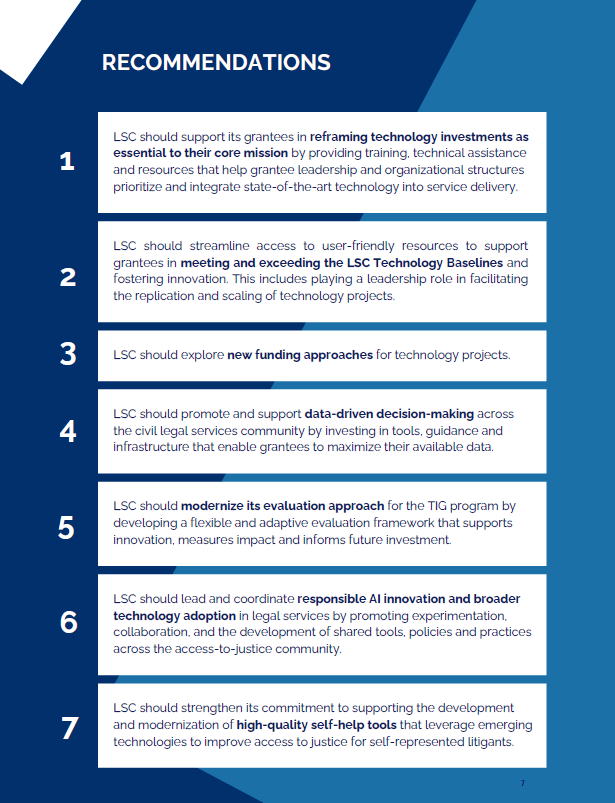
It
presents
seven
detailed
recommendations
aimed
at
helping
the
nation’s
130
LSC-funded
legal
services
organizations
adopt
cutting-edge
technologies

particularly
artificial
intelligence

to
expand
access
to
justice
for
low-income
Americans.


A
Collaborative
Process

The
report,
which
was
published
in
December,
is
the
end
result
of
a
deliberative
process
that
started
when
more
than
50
technology
leaders,
legal
services
practitioners,
court
personnel,
and
other
stakeholders
participated
in
a
full-day
workshop
in
Charlotte,
N.C.,
in
February
2024,
ahead
of
LSC’s
Innovations
in
Technology
Conference
that
year.

(I
was
among
the
50
who
participated
that
day.)

The
process
continued
over
subsequent
months
through
four
focused
workgroups
that
examined:

  • Supporting
    more
    legal
    services
    organizations
    to
    adopt
    baseline
    technologies.
  • Supporting
    more
    LSC
    grantees
    to
    adopt
    advanced
    technological
    practices
    and
    processes.
  • Supporting
    LSC
    and
    its
    grantees
    to
    use
    technology
    to
    measure
    impact
    more
    effectively.
  • Supporting
    LSC
    and
    the
    field
    to
    identify
    and
    promote
    innovative
    solutions
    including
    AI
    technologies,
    to
    drive
    efficiency
    improvements
    that
    would
    result
    in
    greater
    impact.

The
initiative
also
included
extensive
stakeholder
interviews,
focus
groups
with
field
experts
and
grantees,
and
strategic
conversations
among
LSC
leadership
about
strengthening
the
LSC’s
Technology
Initiative
Grant
(TIG)
program

which
has
awarded
923
grants
totaling
more
than
$92
million
since
2000.


Seven
Recommendations
to
Narrow
the
Justice
Gap

The
report
opens
with
sobering
context:

LSC’s
2022
Justice
Gap
Report

found
that
low-income
Americans
received
inadequate
or
no
legal
help
for
92%
of
their
civil
legal
problems.
Whether
facing
eviction,
unemployment,
child
custody
issues
or
domestic
violence,
too
many
low-income
Americans
navigate
the
legal
system
alone.

Despite
this
need,
LSC
grantees
had
to
turn
away
one
of
every
two
requests
for
help
they
received
in
the
prior
year
due
to
limited
resources.

To
help
address
this
justice
gap,
the
summit
produced
seven
interconnected
recommendations
that
LSC
characterizes
as
“a
call
to
action”
for
accelerating
transformative
technology
use:


  1. Reframe
    Technology
    as
    Core
    Mission

The
report’s
first
recommendation
is
that
LSC
should
support
grantees
in
treating
technology
investments
as
essential
to
their
core
mission

not
as
a
luxury

by
providing
training,
technical
assistance
and
resources
that
help
leadership
prioritize
and
integrate
state-of-the-art
technology
into
service
delivery.

The
report
notes
that
legal
services
organizations
often
struggle
with
a
“scarcity
mindset”
that
causes
them
to
eschew
potentially
game-changing
technology
investments.
The
report
cites

2024
survey
that
found
that
45%
of
nonprofits
said
they
spend
too
little
on
technology,
with
“lack
of
available
budget”
cited
as
the
most
common
barrier.

The
report
identifies
several
ways
in
which
LSC
can
encourage
and
support
LSOs
to
embrace
“culture
change”
on
issues
of
technology.
Among
them:

  • Documenting
    compelling
    stories
    about
    technology
    investments
    that
    dramatically
    improved
    efficiencies
    and
    impact.
  • Conducting
    surveys
    of
    grantee
    technology
    practices
    to
    highlight
    priorities
    and
    opportunities.
  • Integrating
    comprehensive
    technology
    assessments
    into
    LSC’s
    oversight
    visits.
  • Providing
    training
    on
    using
    dashboards
    and
    data
    visualization
    for
    strategic
    planning,
    operational
    decision-making
    and
    service
    delivery.

  1. Streamline
    Access
    to
    Resources

The
second
recommendation
is
that
LSC
should
create
user-friendly,
centralized
resources
to
help
grantees
meet
and
exceed
the
LSC
Technology
Baselines

a
guide
to
the
key
technologies
LOSs
should
have
in
place

while
also
fostering
innovation,
including
facilitating
replication
and
scaling
of
successful
technology
projects.


The
report
acknowledges
that
while
LSC,
LSNTAP
(Legal
Services
National
Technology
Assistance
Project),
and
others
provide
various
resources,
grantees
need
“curated
information
and
guidance”
to
cut
through
what
one
participant
called
the
“firehose”
of
technology
developments.

To
that
end,
the
report
recommends
that
LSC:

  • Develop
    a
    centralized,
    user-friendly
    hub
    for
    technology
    resources,
    case
    studies
    and
    promising
    practices.
  • Coordinate
    with
    LSNTAP
    and
    stakeholders
    to
    ensure
    consistent
    messaging
    and
    reduce
    duplication.
  • Share
    information
    about
    commonly
    used
    technology
    products.
  • Promote
    replicable
    projects
    through
    webinars,
    case
    studies
    and
    shared
    toolkits.
  • Create
    clear
    guidance
    on
    data
    collection
    and
    evaluation
    expectations.

  1. Explore
    New
    Funding
    Approaches

The
report’s
third
recommendation
is
that
LSC
should
explore
alternative
funding
models
for
technology
projects
to
better
match
the
pace
of
technological
change
and
grantees’
evolving
needs.

The
current
TIG
process

from
application
to
grant
approval
to
beginning
work

can
take
10
months
to
a
year.
“Sometimes
there’s
a
sense
that
you
are
designing
a
tech
project
and
then
you
have
to
twiddle
your
thumbs
to
fill
time,”
said
Eli
Mattern
of
Community
Legal
Services
in
Orlando.

The
report
recommends
several
activities
LSC
can
pursue
to
explore
new
funding
approaches
and
ensure
that
the
TIG
program
remains
a
key
driver
of
technology
innovation.
Among
them:

  • Implement
    rolling
    application
    deadlines
    throughout
    the
    year.
  • Fast-track
    planning
    grants
    or
    “proof-of-concept”
    grants
    for
    initial
    research.
  • Allow
    flexible
    implementation
    periods
    for
    grantees
    to
    adjust
    strategies.
  • Create
    “sandbox
    environments”
    for
    collaborative
    experimentation
    on
    common
    challenges.
  • Fund
    cohorts
    of
    grantees
    working
    on
    similar
    challenges
    to
    promote
    collaborative
    innovation.
  • Prioritize
    projects
    with
    high
    replication
    and
    scalability
    potential.

  1. Promote
    Data-Driven
    Decision-Making

Fourth
of
the
recommendations
is
that
LSC
should
invest
in
tools,
guidance
and
infrastructure
that
enable
grantees
to
maximize
their
available
data
for
strategic
planning,
operational
decisions
and
service
delivery,
the
report
recommends.

The
report
highlights
success
stories
such
as
Legal
Aid
Society
of
Cleveland’s
discovery
through
website
analytics
that
driver’s
license
suspensions
related
to
unpaid
fines
was
a
major
concern,
leading
to
research
and
a
report
that
helped
change
state
policy.

However,
the
report
says
that
summit
participants
identified
an
array
of 
barriers
that
keep
them
from
making
data-informed
practices
more
central
to
their
work.
These
include:

  • Resource
    constraints
    and
    cultural
    resistance
    among
    lawyers.
  • Lack
    of
    standard
    measures
    across
    organizations.
  • Data
    quality
    issues
    and
    confidentiality
    concerns.
  • Difficulty
    accessing
    and
    using
    court
    data.

To
address
these
issues
and
encourage
more
data-driven
decision
making,
the
report
says
that
LSC
should:

  • Fund
    TIG
    projects
    that
    advance
    data-informed
    practices
    (dashboards,
    automated
    data
    collection,
    performance
    analytics).
  • Modify
    reporting
    requirements
    to
    support
    streamlined,
    automated
    data
    collection.
  • Provide
    technical
    assistance
    on
    interpreting
    and
    applying
    data.
  • Identify
    and
    share
    effective
    data
    use
    examples. 

  1. Modernize
    TIG’s
    Evaluation
    Approach

The
next
recommendation
is
that
LSC
should
modernize
its
evaluation
approach
for
the
TIG
grant
program
by
developing
a
flexible,
adaptive
evaluation
framework
that
supports
innovation,
measures
impact
and
informs
future
investment,
the
report
says.

Current
evaluation
requirements
can
feel
like
“rote
compliance”
exercises.
The
report
calls
for
evaluation
formats
that
better
match
project
scope
and
complexity.
These
might
include:

  • Iterative/rapid
    assessments
    for
    short-term
    grants
    and
    pilot
    projects.
  • Rolling
    report
    models
    capturing
    midcourse
    learning.
  • Developmental
    evaluations
    for
    projects
    with
    evolving
    goals.
  • Longitudinal
    or
    post-grant
    evaluations
    of
    selected
    projects.

In
addition,
the
report
recommends
that
LSC: 

  • Ensure
    TIG
    awards
    include
    adequate
    evaluation
    funding.
  • Create
    a
    repository
    of
    proven
    evaluation
    techniques
    and
    templates.
  • Incorporate
    findings
    into
    grantmaking
    decisions
    and
    technical
    assistance.
  • Fund
    projects
    exploring
    new
    technology
    methods
    for
    data
    collection.

  1. Lead
    Responsible
    AI
    Innovation

The
sixth
recommendation
is
that
LSC
should
coordinate
responsible
AI
innovation
and
broader
technology
adoption
by
promoting
experimentation,
collaboration
and
development
of
shared
tools,
policies
and
practices
across
the
access-to-justice
community.

This
is
perhaps
the
report’s
most
forward-looking
recommendation.
While
acknowledging
concerns
about
AI
accuracy,
ethics
and
privacy,
summit
participants
expressed
strong
support
for
LSC
helping
legal
services
organizations
identify
the
best
current
AI
uses
while
exploring
safety
and
security
issues.

The
report
cites
survey
data
from
LSC’s
AI
Peer
Learning
Labs
(which
had
enrolled
570
legal
aid
providers
as
of
summer
2025)
showing
significant
openness
to
this.
Eighty-five
percent
of
participants
rated
their
organizations
as
moderately
to
very
open
to
working
with
AI,
although
70%
cited
“lack
of
knowledge
about
AI
and
how
to
use
it”
as
a
barrier.

To
advance
the
responsible
use
of
AI
in
legal
services,
the
report
says,
LSC
should:

  • Leverage
    its
    convening
    power
    through
    regular
    collaboration
    among
    providers,
    technologists
    and
    courts.
  • Establish
    a
    centralized
    repository
    of
    AI
    case
    studies,
    trusted
    platforms
    and
    implementation
    guidance.
  • Create
    model
    data
    privacy
    and
    governance
    policies.
  • Share
    and
    promote
    commonly
    used
    AI
    platforms
    with
    safety
    guidance.
  • Invest
    in
    standardized,
    trusted
    technology
    projects
    implementable
    across
    jurisdictions.
  • Establish
    sandbox
    environments
    for
    safe
    experimentation.

The
report
highlights
several
promising
LSC-funded
AI
projects,
including:

  • Lone
    Star
    Legal
    Aid’s
    development
    of
    a
    suite
    of
    customized
    AI-powered
    chatbots
    providing
    24/7
    legal
    information.
  • Southeast
    Louisiana
    Legal
    Services’
    AI-driven
    legal
    needs
    screening
    integrated
    with
    the
    Louisiana
    211
    network.
  • Legal
    Aid
    of
    North
    Carolina’s
    Justice
    Hub
    with
    AI-enabled
    mobile-friendly
    intake.

  1. Strengthen
    Self-Help
    Tools

The
report’s
final
recommendation
is
that
LSC
should
support
development
and
modernization
of
high-quality
self-help
tools
that
leverage
emerging
technologies
to
improve
access
for
self-represented
litigants.

The
report
quotes
David
Bonebrake,
deputy
director
of
LSC’s
Office
of
Program
Performance,
who
said
that,
with
LSOs
turning
away
half
of
all
help
requests,
low-income
people
are
not
just

facing
an
access-to-justice
gap.
“There’s
also
a
self-help
gap
where
people
lack
high-quality,

usable
tools
to
navigate
the
legal
process
themselves.”

To
address
this,
the
report
recommends
that
LSC:

  • Fund
    emerging
    technologies
    such
    as
    AI-driven
    chatbots,
    intelligent
    document
    assembly
    and
    triage
    systems).
  • Encourage
    user-centered
    design
    with
    self-represented
    litigants
    involved
    in
    tool
    development.
  • Facilitate
    collaboration
    and
    knowledge-sharing
    on
    successful
    self-help
    models.
  • Encourage
    integration
    among
    self-help
    platforms
    and
    other
    systems,
    such
    as
    courts,
    libraries
    and
    referral
    networks.
  • Provide
    guidance
    on
    improving
    usability,
    accessibility
    and
    equity.
  • Support
    multilingual
    resources
    and
    accessibility
    features.
  • Explore
    how
    self-help
    tools
    can
    support
    community
    justice
    workers
    and
    other
    non-lawyers.


Technology
Spotlights

Throughout
the
report,
LSC
highlights
successful
TIG-funded
projects
demonstrating
the
potential
of
these
recommendations.
They
include:


  • Bay
    Area
    Legal
    Services
    (Florida)

    integrated
    document
    automation
    and
    case
    management
    firm-wide,
    training
    more
    than
    100
    staff
    in
    business
    process
    improvements
    and
    automating
    29
    commonly
    used
    documents.

  • Kansas
    Legal
    Services

    enhanced
    the
    statewide
    DLAW
    platform
    and
    legal
    information
    website
    with
    mobile-friendly
    design,
    better
    navigation,
    and
    a
    chatbot

    improvements
    benefiting
    legal
    aid
    organizations
    in
    other
    states
    using
    the
    same
    open-source
    platform.

  • Community
    Legal
    Services
    of
    Mid-Florida

    developed
    a
    guided
    navigation
    chatbot
    that
    had
    more
    than
    11,500
    unique
    visitors
    and
    more
    than
    3,000
    conversations
    in
    just
    three
    months.

  • Legal
    Aid
    of
    North
    Carolina

    is
    creating
    an
    AI-enabled
    Justice
    Hub
    as
    a
    mobile-friendly
    online
    intake
    and
    client
    portal
    to
    serve
    3
    million
    eligible
    residents.

  • Lone
    Star
    Legal
    Aid
    (Texas)

    has
    emerged
    as
    a
    national
    leader
    with
    guided
    online
    interviews
    that
    have
    helped
    over
    100,000
    individuals,
    a
    Legal
    Aid
    Content
    Intelligence
    platform
    that
    automatically
    monitors
    legal
    changes,
    and
    a
    suite
    of
    AI-powered
    chatbots.


Comparing
the
Summit
Reports

While
both
the
2013
and
2025
summit
reports
share
the
goal
of
transforming
legal
services
delivery
through
technology,
they
reflect
dramatically
different
technological
landscapes.

The
2013
report
focused
on
then-emerging
technologies
such
as
mobile
access,
cloud
computing
and
statewide
legal
information
websites.
It
proposed
ambitious
visions
for
document
assembly,
triage
systems
and
data
integration,
many
of
which
have
since
been
implemented.

The
2025
report
builds
on
that
foundation
but
reflects
the
AI
revolution.
Where
the
2013
report
discussed
basic
automation
and
information
access,
the
2025
report
grapples
with
generative
AI,
chatbots
capable
of
real-time
legal
guidance,
and
intelligent
systems
that
can
draft
documents
and
analyze
case
patterns.

The
new
report
also
places
much
greater
emphasis
on:

  • Data-driven
    decision-making
    and
    evaluation
    (receiving
    dedicated
    recommendations).
  • User
    experience
    and
    design
    thinking.
  • Replication
    and
    scaling
    of
    successful
    projects.
  • Cultural
    change
    within
    organizations
    around
    technology
    adoption.
  • Responsible
    innovation
    given
    AI’s
    risks
    and
    uncertainties.

Perhaps
most
significantly,
the
2025
report
is
more
action-oriented
and
specific.
Where
the
2013
report
was
more
a
visionary
blueprint,
this
latest
report
is
more
an
operational
roadmap.
Rather
than
painting
a
broad
vision,
it
provides
detailed,
implementable
recommendations
with
concrete
suggested
actions
for
LSC.

As
one
summit
participant,
Margaret
Hagan,
executive
director
of
the
Legal
Design
Lab
at
Stanford
University,
said
in
the
report:
“Now
is
the
time
to
strike.
More
and
more
people
are
open
to
using
these
technologies
as
they
hear
more
about
their
potential.

“If
our
goal
is
to
close
the
justice
gap
and
get
more
legal
services
to
more
people,”
she
continued,
“then
it’s
time
to
demonstrate
the
power
and
effectiveness
of
these
AI
tools
in
making
that
happen.”


What’s
Next

LSC
has
pledged
to
act
on
these
recommendations
“in
ways
that
support
its
grantees
in
leveraging
technology
in
civil
legal
services
to
ensure
that
more
low-income
Americans
can
find
the
legal
advice,
support
and
representation
they
need.”

But
the
organization
acknowledges
that
it
cannot
and
should
not
do
it
alone

funders,
courts,
law
schools,
technology
vendors
and
others
must
play
important
roles
in
a
field-wide
effort,
it
says.

For
legal
aid
organizations,
technology
vendors,
and
access-to-justice
advocates,
this
report
provides
a
thoughtful
roadmap
for
the
next
phase
of
legal
services
innovation.

Its
emphasis
on
AI,
data-driven
practices,
and
user-centered
design
reflects
the
route
we
should
all
follow
to
meaningfully
narrow
the
justice
gap.

“Technology
alone
will
not
close
the
justice
gap
in
the
U.S.
today,”
the
report
says,
“but
it
can
and
must
play
a
vital
supporting
role.”


Running Your Cases – Above the Law

Most
young
lawyers
don’t
lose
cases
because
they
don’t
know
the
law.

They
lose
cases
because
they
don’t

run
the
case
.

They
don’t
drive
it.
They
don’t
manage
it.
They
don’t
control
it.
They
let
it
control
them.
And
then
one
day,
they
look
up
and
realize
discovery
closed
last
week,
the
client
is
asking
why
nobody
has
taken
the
key
depo,
the
adjuster
wants
a
status
report
“by
the
end
of
the
day,”
and
the
partner
is
asking
the
question
that
makes
your
stomach
drop:

“Where
are
we
on
this
file?”

If
you
want
to
run
a
case
from
beginning
to
end,
here’s
the
mindset
shift:


You
are
not
assigned
to
the
file.
The
file
is
assigned
to
you.

Own
it.

And
yes,
it’s
a
lot,
which
is
why
we’re
going
to
reduce
it
to
basics,

blocking
and
tackling,

and
turn
chaos
into
a
workflow.

Because
everything
we
do
can
be
reduced
to

workflows,
checklists,
and
decision
trees
,
and
if
you
build
the
right
ones,
you
stop
reacting
and
start
running
the
show.

Here’s
the
playbook
from
intake
to
closing
letter.


1.
Start
With
The
End

Before
you
do
anything,
do
the
thing
nobody
does:


Start
with
the
end.

Not
a
trial.
Not
summary
judgment.
The
end.

What
is
the
best
realistic
outcome
for
your
client?
What
is
the
worst?
What
does
“winning”
look
like
in

this

jurisdiction,
with

this

judge,
with

this

plaintiff,
with

this

venue?


What’s
the
hill
we’re
trying
to
take?

If
you
don’t
know
the
hill,
you’ll
be
sprinting
in
random
directions
until
you
collapse.

So:
read
the
complaint.
Then
read
it
again.
Then
read
it
like
you’re
the
plaintiff’s
lawyer
trying
to
beat
you.
Identify:

  • The
    legal
    elements
    that
    matter
    (not
    all
    the
    elements,

    the

    elements)
  • The
    facts
    you
    can
    prove
    today
  • The
    facts
    you
    need
    to
    prove
    later
  • The
    facts
    you
    can’t
    ever
    prove
    (which
    is
    where
    your
    leverage
    lives)

Then
create
your
case
theme
in
one
sentence.
Not
a
paragraph.
One
sentence.

If
you
can’t
say
it
in
one
sentence,
you
don’t
own
the
case
yet.


2.
The
First
72
Hours:
Triage,
Don’t
Tour

New
file
comes
in.
Everyone
panics.
People
start
doing
busywork.
They
“tour
the
file.”

Don’t
tour
the
file.


Triage
it.

Like
the
ER.
Who
is
bleeding?
What
is
time-sensitive?
What
is
about
to
explode?


Start
with
three
lists:


  1. Deadlines

    (answer
    date,
    removal,
    responsive
    pleading,
    preservation,
    early
    disclosures)

  2. Evidence

    (what
    exists,
    what
    can
    disappear,
    what
    you
    need
    to
    lock
    down
    now)

  3. People

    (who
    matter,
    who
    know
    what,
    who
    need
    to
    be
    interviewed
    before
    memories
    rot)


Calendar
is
king.

Set
the
answer
date.
Set
every
downstream
deadline
you
can
reasonably
predict.
Set
reminders
in
the
calendar
that
prompt
you
to
act
early,
not
on
the
due
date.
The
due
date
is
a
tombstone.

And
call
your
client
early.
Not
to
recite
the
complaint.
To
establish
trust.

Clients
don’t
want
a
lawyer
who
sounds
smart.
They
want
a
lawyer
who
sounds
like
they
have
a
plan.

So
give
them
the
plan.
High
level.
Calm.
Confident.


3.
Early
Case
Evaluation:
Numbers
And
Reality

One
of
the
most
difficult
jobs
for
trial
lawyers
is
placing
a
dollar
value
on
a
case
and
making
decisions
based
on
that
valuation.

You
can’t
run
a
case
if
you
don’t
know
what
it’s
worth.

So
early
on,
do
a
disciplined
evaluation:

  • Liability
    exposure
  • Damages
    exposure
  • Venue
    risk
  • Plaintiff
    counsel
    risk
  • Your
    client’s
    risk
    tolerance
  • Insurance/indemnity
    landscape
  • Evidence
    quality

And
here’s
a
line
that
should
live
in
your
head:


A
different
jury
may
agree
with
them.

That
sentence
keeps
you
humble
and
strategic.
It
reminds
you
that
litigation
isn’t
math.

It’s
human
beings.

So
build
a
range.
Not
one
number.
A
range.
Then
revisit
it
as
facts
develop.


Update
the
number,
or
the
number
will
update
you.


4.
Pleadings:
Don’t
Just
Answer,
Position

Pleadings
are
not
paperwork.
They’re
positioning.

Yes,
you
answer
the
complaint.
But
you’re
also
laying
tracks
for
the
train
you
want
to
run
six,
12,
18
months
from
now.

Ask
yourself:

  • What
    defenses
    actually
    matter?
  • What
    affirmative
    defenses
    do
    we
    need
    to
    preserve?
  • Are
    there
    jurisdictional
    issues?
  • Arbitration?
    Venue?
    Immunity?
    Statutes?
  • Third-party
    practice?
    Crossclaims?

And
if
you’re
going
to
file
a
motion
to
dismiss
or
motion
for
more
definite
statement,
don’t
do
it
because
it’s
what
lawyers
do.

Do
it
because
it
moves
the
case.


Motion
practice
without
strategy
is
just
exercise.


5.
Discovery:
Build
The
Map
Before
You
Start
Walking

Most
associates
approach
discovery
like
a
buffet.

A
little
of
this.
A
little
of
that.
No
plan.

Start
with
the
map.

Here’s
the
workflow:


A.
Written
discovery

Your
first
set
should
be
aligned
with
your
theme
and
valuation
drivers.
Not
“standard
interrogatories”
because
someone
used
them
in
2009.

Think:

  • What
    facts
    do
    I
    need
    to
    prove?
  • What
    facts
    do
    I
    need
    to
    disprove?
  • What
    facts
    does
    the
    plaintiff
    need
    that
    I
    can
    force
    them
    to
    commit
    to
    early?


B.
Document
strategy

Documents
are
where
cases
are
won
quietly.

Set
up
a
system
so
you
can
find
things
fast
later.
Because
“I
know
it’s
in
there
somewhere”
is
not
a
strategy.
It’s
a
cry
for
help.


If
you
can’t
find
it
in
30
seconds,
it
doesn’t
exist.


C.
The
discovery
plan

Write
it
down.
One
page.

  • Key
    issues
  • Key
    witnesses
  • Key
    documents
  • Key
    experts
  • Sequence
    (what
    must
    happen
    first)

That
one
page
becomes
your
compass
when
the
file
starts
trying
to
drag
you
into
the
weeds.


6.
Depositions:
You’re
A
Human
Lie
Detector

Depositions
are
not
theatre.
They
are
intel
gathering.

In
deposition,
you
are
a
human
lie
detector.
Set
a
baseline
early
with
easy
questions
and
note
changes
in
tone,
cadence,
pauses,
and
body
language
when
you
get
pointed.

That’s
not
just
a
cool
line.
It’s
a
method.


Start
with
a
baseline.
Then
apply
pressure.

And
keep
this
in
mind:
a
deposition
is
often
less
about
the
transcript
and
more
about
the
story
you’re
building
for
trial.
You’re
collecting:

  • Admissions
  • Inconsistencies
  • Themes
  • Future
    impeachment
  • “This
    witness
    is
    not
    credible”
    moments
    (subtle,
    not
    melodramatic)

Also:
use
the
phone.
The
actual
phone.

You
know
that
thing
we
hold
in
our
hands
all
day?
It
makes
phone
calls.
Call
opposing
counsel.
Call
the
court
reporter.
Call
the
witness
coordinator.
It
works
wonders.

A
lot
of
“litigation
problems”
are
actually
“nobody
talked
to
anyone”
problems.


7.
Experts:
Don’t
Wait
Until
You’re
Desperate

Experts
are
not
a
checkbox.
They’re
your
translator
to
the
jury.

Identify
early:

  • Do
    you
    need
    them?
  • On
    what
    issues?
  • When
    do
    you
    need
    to
    retain?
  • What
    documents
    must
    they
    review?

Then
budget
it
and
communicate
it
to
the
client
before
it
comes
as
a
surprise
invoice.

Here’s
the
rule:


No
surprises.
No
excuses.


8.
Mediation
And
Settlement:
Give
Them
A
Way
To
Save
Face

Settlement
is
not
a
weakness.
It’s
a
strategy.

Prepare
like
it’s
a
trial

because
if
you
don’t,
you’ll
negotiate
from
fear.

And
remember
the
truth
that
too
many
young
lawyers
learn
too
late:


If
you
corner
someone,
they
don’t
surrender;
they
bite.

So
give
the
other
side
a
path.
A
narrative
they
can
tell
their
client.
A
way
to
save
face.
That’s
how
deals
get
done.

Also,
don’t
walk
into
mediation
without
updating
your
evaluation.
See
above.
Update
the
number,
or
the
number
will
update
you.


9.
Pretrial:
Make
It
Boring

The
best
trial
lawyers
make
trial
prep
boring.
Not
because
the
trial
is
boring.
Because
they’ve
built
systems
that
remove
chaos.

Pretrial
is:

  • Motions
    in
    limine
  • Exhibit
    lists
  • Witness
    lists
  • Depo
    designations
  • Jury
    instructions/verdict
    forms
  • Theme
    refinement
  • Demonstratives
  • Trial
    binders
    (physical
    or
    digital,
    but
    organized)


Win
the
file
before
you
walk
into
the
courtroom.

Trial
is
often
the
final
act.
The
verdict
is
the
applause
(or
the
booing).
The
work
was
done
months
earlier.


10.
Trial:
Mission
Mindset

I
once
knew
a
trial
lawyer
who
described
himself
as
a
mercenary
dropped
into
the
jungle:
fulfill
the
mission,
seize
the
hill,
blow
up
the
target,
get
out
in
one
piece.

That’s
not
bad
framing.

At
trial,
you
need
blinders.
You
need
purpose.
You
need
to
be
calm.

And
you
need
to
remember:
jurors
don’t
care
how
hard
you
worked.
They
care
whether
your
story
makes
sense.

So
tell
a
story
they
can
repeat
at
dinner.


11.
Post-Trial
And
Closing:
Finish
Like
A
Pro

A
case
is
not
over
when
the
verdict
comes
in.

Post-trial
is:

  • Judgment
    entry
  • Costs
  • Post-trial
    motions
  • Preservation
    for
    appeal
  • Client
    debrief
  • File
    closing
    letter
  • Lessons
    learned
    memo
    to
    yourself
    (yes,
    really)

Do
a
debrief
even
if
you
“won.”
Especially
if
you
won.

Because
the
goal
isn’t
to
win
one
case,
the
goal
is
to
become
a
lawyer
who
wins
consistently.

And
if
you’re
in
the
middle
of
it
right
now,
overwhelmed,
behind,
staring
at
a
deadline
like
it’s
a
guillotine,
here’s
what
you
do:


Start
with
one
thing.

One
call.
One
email.
One
outline.
One
calendar
entry.
One
task
completed.

Then
do
the
next
thing.

Keep
going.

You
got
this.


Frank
Ramos
is
a
partner
at
Goldberg
Segalla
in
Miami,
where
he
practices
commercial
litigation,
products,
and
catastrophic
personal
injury. You
can
follow
him
on LinkedIn,
where
he
has
about
80,000
followers
.

Epstein Files Fallout Sparks Leadership Doubts, Possible Partner Exit Fears At Paul, Weiss – Above the Law

Are
partners
willing
to
run
away
from
the
firm?


Ed.
note
:
Welcome
to
our
daily
feature, Quote
of
the
Day
.


The
aftermath
will
go
on
for
months
[because
of
the
sudden
change
in
management].
How
many
people
are
going
to
be
really
ultimately
comfortable
going
through
this
major
upheaval
and
can
stand
by
new
management?
It’s
a
big
question
mark.
[This
is]
going
to
have
profound
ripples
in
the
marketplace.


— A
concerned
industry
source,
in
comments
given
to
the

American
Lawyer
,
concerning
Brad
Karp’s

sudden
resignation

as
Paul,
Weiss
chair,
in
light
of
his

presence
in
the
Epstein
files
,
and
what
it
will
mean
for
the
firm
and
the
profession
going
forward.
This
source
claims
that
partners
at
the
firm
immediately
began
submitting
their
resumes
elsewhere
upon
Karp’s
unexpected
announcement.


Staci
Zaretsky
 is
the
managing
editor
of
Above
the
Law,
where
she’s
worked
since
2011.
She’d
love
to
hear
from
you,
so
please
feel
free
to email her
with
any
tips,
questions,
comments,
or
critiques.
You
can
follow
her
on BlueskyX/Twitter,
and Threads, or
connect
with
her
on LinkedIn.

Accountability In An Age Of Unaccountability – Above the Law

A
flurry
of
stories
hit
the
legal
world
all
at
once
last
week,
with
the
government
responding
to
another
ICE
killing
in
Minnesota
by…

arresting
journalists
and
dumping
Epstein
files
.
And
while
the
Epstein
files
don’t
represent
the
entire
universe

or,
perhaps,
even
the
most
relevant
files
about
Epstein’s
dealings

they
have
set
off
downstream
shockwaves
in
the
legal
industry.
Meanwhile,
another
judge
learns
that

we
frown
upon
judges
arbitrarily
handcuffing
lawyers
.
Finally,
it’s
time
for
the
profession
to
come
together
behind
helping
our
self-regulators

hold
Trump
administration
lawyers
accountable
.
The
ethical
breaches
keep
adding
up
and
while
there’s
never
going
to
be
the
warranted
criminal
law
reckoning,
we
can
at
least
make
sure
our
profession
is
protected
by
disbarring
all
these
administration
lawyers
getting
caught
affirmatively
lying
to
courts…
and
worse.

Charlie Adelson Pushes For Retrial – Above the Law

By
now,
you’ve
all
heard
of
Charlie
Adelson,
the
man
accused
of
taking
part
in
a
conspiracy
to
kill
Florida
State
law
professor
Dan
Markel.
And
that
could
be
part
of
the
problem.
After
being
sentenced
to

life
in
prison
back
in
2023
,
Adelson
has
attempted
to
get
his
time
in
prison
reduced.
Now,
he’s
moving
for
a
whole
new
trial.

WTXL

has
coverage:

Michael
Ufferman,
representing
Adelson,
along
with
Laurel
Cornell
Niles,
told
the
appellate
court
that
40%
of
potential
jurors
screened
already
had
preconceived
notions
about
his
client’s
guilt.
He
argued
this
level
of
bias
made
it
impossible
to
select
an
impartial
jury.

Ufferman
pointed
to
specific
instances
where
potential
jurors
allegedly
lied
about
their
knowledge
of
the
case.
He
cited
two
examples
where
jurors
denied
forming
opinions
about
guilt
or
posting
on
social
media,
despite
evidence
showing
they
had
made
posts
about
the
case.

You
can
hear
Ufferman
here:

Assuming
he
is
right
about
the
two
jurors,
is
that
enough
to
give
Adelson
a
new
trial?
The
state
argued
that
this
doesn’t
do
enough
to
prove
that
the
entire
jury
pool
was
tainted.
That
said,
who
is
to
say
that
the
two
known
jurors
were
the
only
ones
who
formed
opinions
prior
to
seeing
the
evidence
in
court?

The
panel
of
judges
has
180
days
to
decide
whether
to
grant
the
request.
Due
process
is
a
foundational
pillar
to
the
rule
of
law;
if
it
turns
out
that
there
was
actual
bias
on
the
jury,
Charlie
Adelson
deserves
a
fail
trial
just
as
much
as
everyone
else.


Charlie
Adelson’s
Attorneys
Argue
For
New
Trial,
Citing
Jury
Bias
Concerns

[WTXL]


Earlier
:

Judge
Answers
Charlie
Adelson’s
Request
For
Resentencing


9
Years
After
Law
Professor
Murdered,
Jury
Finds
Charlie
Adelson
Guilty


Chris
Williams
became
a
social
media
manager
and
assistant
editor
for
Above
the
Law
in
June
2021.
Prior
to
joining
the
staff,
he
moonlighted
as
a
minor
Memelord™
in
the
Facebook
group Law
School
Memes
for
Edgy
T14s
.
 He
endured
Missouri
long
enough
to
graduate
from
Washington
University
in
St.
Louis
School
of
Law.
He
is
a
former
boatbuilder
who
is
learning
to
swim, is
interested
in
critical
race
theory,
philosophy,
and
humor,
and
has
a
love
for
cycling
that
occasionally
annoys
his
peers.
You
can
reach
him
by
email
at [email protected]
and
by
tweet
at @WritesForRent.