Zimbabwe
is
highly
vulnerable
to
the
adverse
impacts
of
climate
change.
The
Global
Climate
Risk
Index
ranks
it
34th on
a
list
of
174
countries
most
affected
by
extreme
weather
events
between
1995
and
2024
(Germanwatch,
2025).
And
the
Notre
Dame
Global
Adaptation
Initiative
(2026)
places
Zimbabwe
171st out
of
187
countries,
combining
high
vulnerability
to
climate
change
with
low
readiness
to
deal
with
climate-change
impacts.
The
country’s
major
challenges
include
reduced
and
erratic
rainfall
(Government
of
Zimbabwe
&
UNDP,
2017).
Whereas
droughts
occurred
in
one
in
10
growing
seasons
between
1902
and
1979,
their
frequency
increased
to
one
in
four
between
1980
and
2011.
Climate
change
has
also
been
associated
with
increases
in
average
temperatures,
numerous
mid
season
dry
spells,
and
a
shortening
of
the
rainy
season
since
1960
(World
Bank,
2024).
In
2024,
President
Emmerson
Mnangagwa
declared
a
state
of
national
disaster
in
response
to
the
impact
of
an
El
Niño-induced
drought
(Guardian,
2024).
This
followed
a
declaration
of
a
state
of
national
disaster
in
2019
after
Cyclone
Idai
ravaged
the
eastern
part
of
Zimbabwe,
particularly
the
Chimanimani
and
Chipinge
districts
of
Manicaland,
leaving
31
dead
and
more
than
100
missing
(United
Nations
Office
for
the
Coordination
of
Humanitarian
Affairs,
2019). In
January
it
was
reported
that
heavy
rains
during
the
summer
had
already
left
70 people
dead
and
51
injured,
and
destroyed
at
least
1,000
houses
(Shamu,
2026).
The
government’s
response
to
climate
change
is
anchored
in
the
National
Climate
Change
Adaptation
Plan
(2024-2030).
The
document
serves
as
a
roadmap
toward
a
climate-resilient,
low-carbon
economy,
which
it
seeks
to
achieve
by
mobilising
climate
finance
and
fostering
climate-change-adaptation
research,
innovation,
and
technology
development
and
transfer.
The
plan
lays
out
how
the
government
will
plan,
implement,
monitor,
and
evaluate
climate-adaptation
initiatives,
as
well
as
how
these
will
be
integrated
into
sectoral
development
programmes.
Other
strategic
priorities
include
strengthening
institutional
capacity
for
climate-change
management,
enhancing
climate-information
systems,
and
improving
disaster
preparedness
(Government
of
Zimbabwe,
2024).
In
September
2025,
Zimbabwe
gazetted
the
Climate
Change
Management
Bill,
a
legal
framework
designed
to
bolster
the
country’s
response
to
climate
change.
If
passed
by
Parliament
and
signed
into
law
by
the
president,
the
legislation
will
establish
a
national
climate
fund
that
will
draw
on
taxes
and
proceeds
from
the
trading
of
carbon
credits
to
fund
adaptation,
mitigation,
and
capacity
building.
Among
other
things,
the
bill
provides
for
the
obligations
of
sub-national
governments,
establishes
units
to
monitor
and
regulate
environmental
and
meteorological
outcomes,
and
allows
for
“green”
financial
incentives
(Chishuvo,
2025).
This
dispatch
reports
on
a
special
survey
module
in
the
Afrobarometer
Round
10
questionnaire
that
explores
Zimbabweans’
experiences
and
perceptions
of
climate
change
and
changing
weather
patterns.
Findings
show
that
overwhelming
majorities
of
citizens
report
worsening
drought
and
crop
failure
over
the
past
decade.
More
than
one-third
report
having
adapted
to
changing
weather
patterns
by
adjusting
water
consumption,
reducing
or
rescheduling
outdoor
work,
modifying
the
crops
they
plant
or
foods
they
eat,
and,
among
those
who
have
livestock,
altering
livestock
management.
A
slim
majority
of
citizens
have
heard
of
climate
change.
Among
them,
more
than
nine
in
10
say
it
is
making
life
worse,
and
two-thirds
say
human
activity
is
to
blame
for
the
changing
climate,
either
on
its
own
or
in
conjunction
with
natural
processes.
Majorities
say
that
the
Zimbabwean
government
must
take
urgent
action
to
limit
climate
change
and
that
rich
countries
should
help
fund
the
country’s
response.
Among
all
citizens,
majorities
support
a
range
of
potential
policy
responses
to
changing
weather
conditions,
including
greater
pressure
on
developed
countries
to
provide
climate
aid,
investment
in
climate-resilient
infrastructure
and
renewable
technologies,
use
of
cleaner
burning
cookstoves,
and
a
ban
on
cutting
trees
for
firewood
or
charcoal.
E.C.T
Shonhiwa
Property
Developers,
is
one
of
several
private
land
developers
contracted
to
service
residential
stands
in
Bulawayo.
The
company
owned
by
the
late
Edmund
Campion
Takawira
Shonhiwa
was
allocated
91
stands
in
Pelandaba
West
suburb
in
2006.
However,
the
developer
did
not
fully
service
the
stands
but
was
issued
with
a
certificate
of
completion
in
2021
.
A
Compliance
Certificate
is
issued
when
a
land
developer
has
provided
services
such
as
tarred
roads,
sewer
reticulation,
water
supply
and
drainages
to
required
quality
standards.
Besides,
without
a
Compliance
Certificate,
title
deeds
cannot
be
processed
for
individual
stands.
Private
land
developers
need
to
be
certified
before
they
can
hand
over
serviced
stands
to
the
Bulawayo
City
Council.
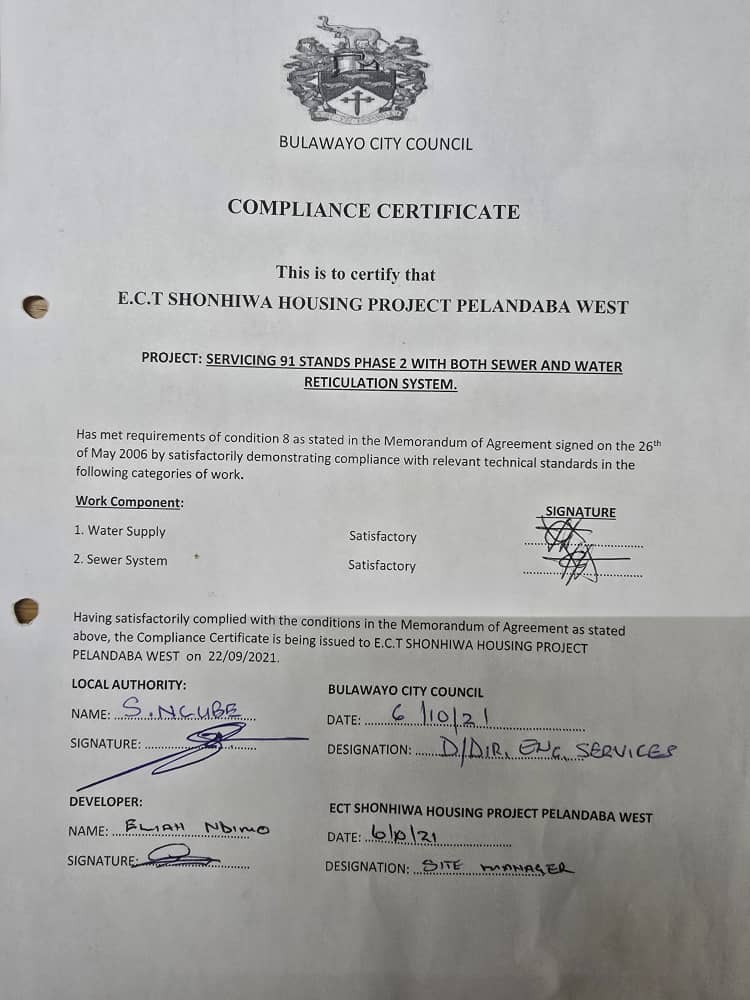
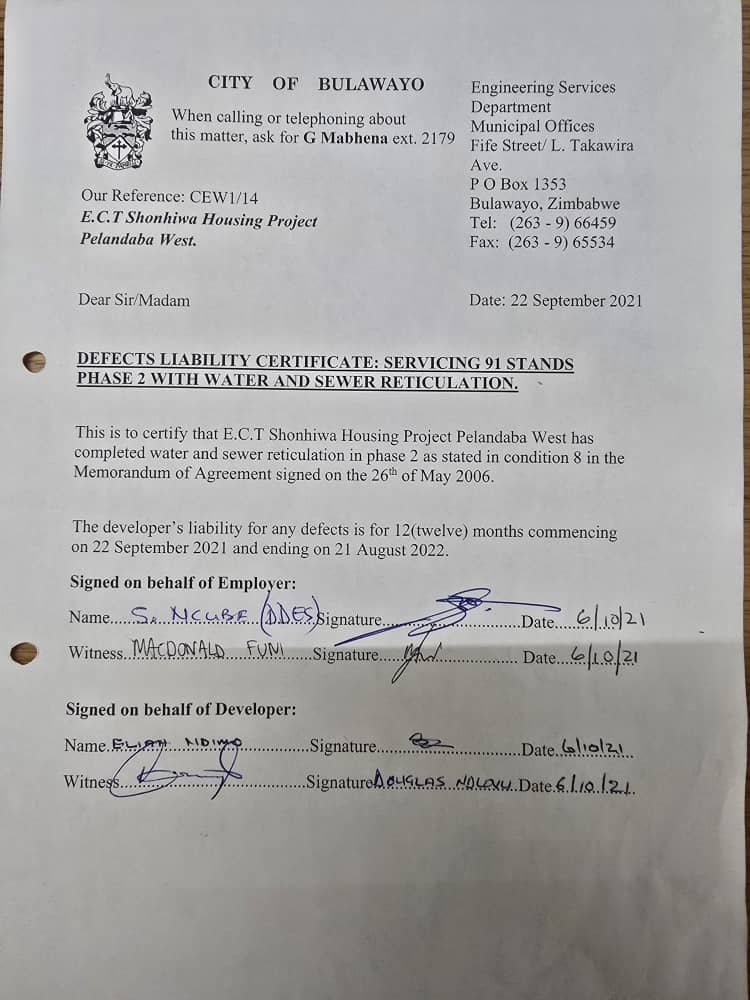
A
Compliance
Certificate
issued
on
22
September
2021
to
E.C.T
Shonhiwa
Property
Developers
seen
by
CITE
was
signed
by
Sikhumbuzo
Ncube,
then
Deputy
Director
of
Engineering
Services
on
6
October
2022.
Ncube
was
appointed
Director
of
Engineering
Services
in
April
2023.
The
Compliance
Certificate
states
that
BCC
was
satisfied
with
the
servicing
of
91
stands
under
phase
2
with
both
sewer
and
water
reticulation
systems.
“…Has
met
requirements
of
condition
8
as
stated
in
the
Memorandum
of
Agreement
signed
on
the
26th of
May
2006
by
satisfactorily
demonstrating
compliance
with
relevant
technical
standards
in
the
following
categories
of
work:
water
supply
and
sewer
system,”
read
the
Compliance
Certificate.
“We
Were
Told
Everything
Was
Ready”
E.C.T
Shonhiwa
Property
Developers,
sold
residential
stands
in
Pelandaba
West
in
2015,
assuring
buyers
that
the
area
would
have
paved
roads,
functional
sewer
systems
and
piped
water.
More
than
a
decade
later,
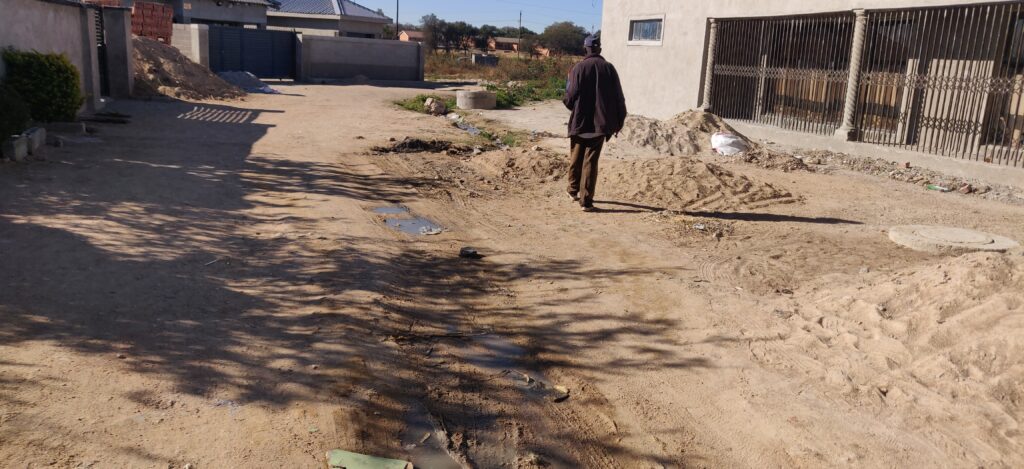
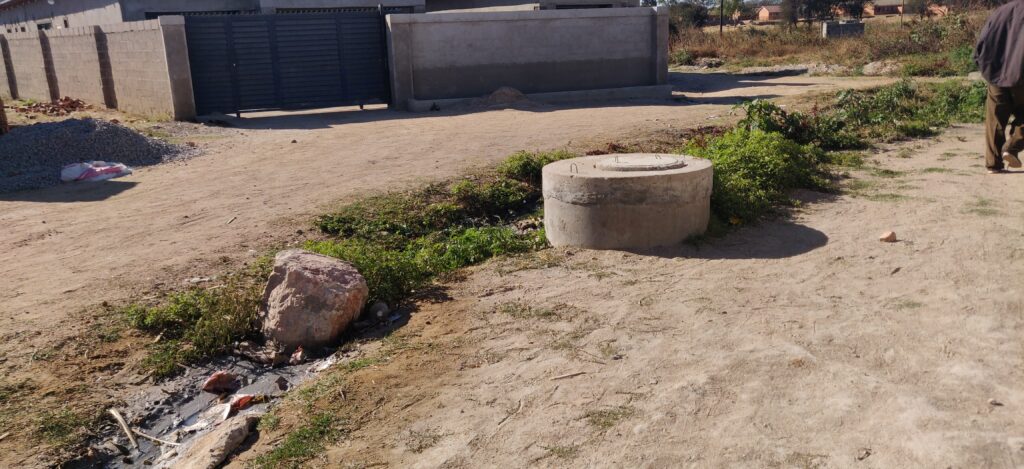
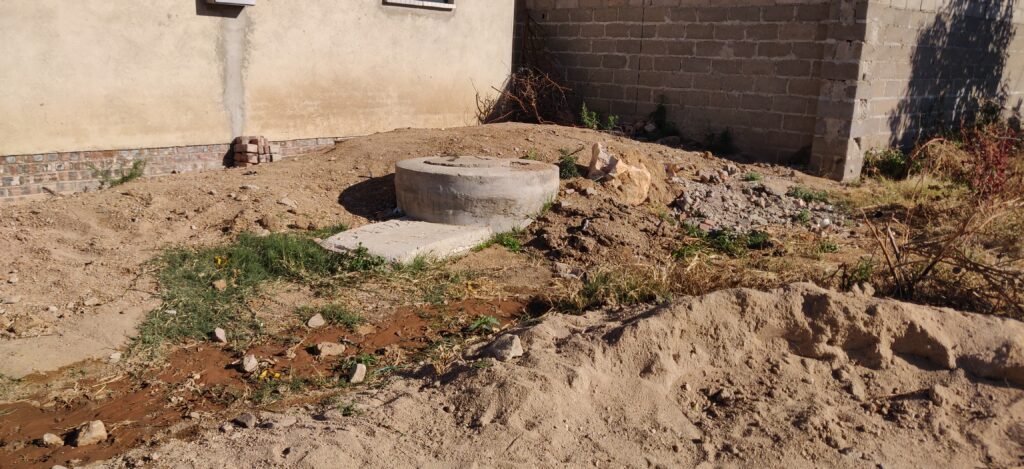
residents
say
they
are
living
with
collapsing
sewer
lines,
poor
drainage
and
gravel
roads
that
become
muddy
and
impassable
during
the
rainy
season.
Different
private
land
developers
were
contracted
to
service
Pelandaba
West
suburb,
but
residents
complain
that
water,
sewer
and
road
infrastructure
was
not
fully
installed.
Residents
were
forced
to
pay
for
water
to
be
connected
to
their
homes.
Residents
of
Pelandaba
West
say
they
were
deceived
into
believing
their
stands
were
fully
serviced
before
they
began
construction.
Gatsheni,
who
also
chairs
Ward
18
residents
under
the
Bulawayo
Progressive
Residents
Association
(BPRA),
recalls:
“The
challenge
we
are
facing
began
in
2015
when
we
started
building
here,
we
were
told
that
the
stands
were
fully
serviced.
We
don’t
know
how
Bulawayo
City
Council
(BCC)
approved
the
sale
of
stands
before
they
were
fully
serviced.”
When
we
had
settled,
we
discovered
that
there
was
no
drainage
system,
when
it
rains
water
floods
our
houses,”
he
said.
“For
us
to
be
given
green
light
to
build,
services
such
as
roads,
water
should
have
been
there,
but
as
I
am
saying,
when
we
came
here,
there
were
no
water
pipes
until
we
took
the
matter
to
court,
now
there
is
sewer
problems
we
don’t
even
know
how
the
challenge
will
be
fixed
and
there
is
no
tarred
roads,”
he
said.
He
added
that
as
residents
leaders,
their
wish
is
for
private
land
developers
to
fully
service
the
area
and
put
all
facilities
such
as
the
road
infrastructure
,
water
pipes
and
sewer
pipes
before
selling
the
stands
so
that
residents
don’t
face
service
delivery
challenges.
E.C.T Shonhiwa Property
Developers
said
they
are
trying
to
resuscitate
other
businesses
to
raise
money
to
finish
the Pelandaba West
project.
“We
do
not
have
funds
because
the
estate
of
Edmund
Campion
Takawira
Shonhiwa
is
not
yet finalized, everything
is
still
under
the
government.
However,
there
is
a
project
that
we
are
trying
to
resuscitate
like
our
mine,
so
once
that
has
been finalized,
we
want
to
complete
the Pelandaba project,
drainage systems and
the
roads,”
said
Mark Shohniwa a
grandson of
the
late
Edmund
Shonhiwa.
Shonhiwa
said
he
has
contacted
one
of
his
relatives
with
a
plumbing
company
to
assess
the
situation
in Pelandaba West.
He
admitted
that
the
sewers
were
an
outstanding
item
the
land
developers
needed
to
fix.
“We
plead
with
the
community
of Pelandaba West
to
give
us
time
because
this
Estate
does
not
have
money.
We
are
working
on
our
mine
because
we
intend
to
keep
the
company
alive
because
right
now,
we
can
simply
walk
away
and
say
this
was
Edmund
Shonhiwa’s
project,
he
is
gone,
but
it’s
not
going
to
help
anyone,
we
want
to
maintain
a
good
reputation
and
intend
to
keep
the
business
alive.”
Shoniwa
explained
that
the
only
payments
he
is
aware
of
are
those
made
for purchasing stands
and
water
connections,
which
were
paid
to
the
developer
before
the
project
was
handed
over
to
the
City
Council.
The
Environmental
Management
Report
of
26
September
2025
indicates
that
E.C.T Shonhiwa Property
Developers
had
completed
sewer
and
water
reticulation
and
had
done
a
partial
handover.
“This
was
private
land
that
the
owner
had
subdivided
and
intended
to
fully
service
the
land
before handing over
to council.
Unfortunately,
the
developer failed
to fully
service
the
said
land
and
as
a
result
some
of
the
properties
were
inaccessible. Most of
the
roads
were
just
bush
cleared
and
no
formal
construction
had
been
carried
out,”
read
a
confidential
report.
Certified
but
work
half
done
Other
private
land
developers
accused
of
not
completing
the
servicing
of
residential
stands
have
also
been
issued
with
certificates
of
completion,
meaning
they
met
the
conditions
of
the
contract
to
service
stands.
Residents
in
Bulawayo
have
questioned
how
private
land
developers
were
issued
Compliance
Certificates
by
the
Bulawayo
City
Council
(BCC)
despite
what
they
describe
as
incomplete
and
substandard
infrastructure
in
their
suburb.
Another
private
land
developer,
A.P.
Glendinning
Private
Limited
was
allocated
stands
for
servicing
in
Pelandaba
West
Phase
4.
Residents
complain
that
AP
Glendenning
did
not
complete
the
development
of
roads
and
installation
of
water
and
sewer
systems.
“We
have
no
tarred
roads,
when
it
is
raining,
we
face
a
lot
of
challenges,”
bemoaned
Sakhile
Tshuma,
a
residents
leader
in
Pelandaba
West.
“There
are
no
drainage
systems,
and
the
sewer
system
was
not
properly
constructed,
it
constantly
bursts.”
Tshuma
moved
into
Pelandaba
West
in
2016,
and
her
stand
had
no
water
connection.
She
and
other
residents
had
to
pay
for
water
connection
to
their
stands.
Tshuma
said
they
have
engaged
A.P.
Glendinning
Private
Limited,
with
no
joy.
They
say
the
private
land
developer
told
them
the
Pelandaba
West
Phase
4
project
has
been
handed
over
to
the
local
authority.
The
company
has
maintained
that
it
completed
its
portion
of
the
servicing
of
the
stands.
Reached
for
a
comment,
a
manager
at
A.P.
Glendinning
Private
Limited,
who
identified
himself
as
Paul
Youngman
said:
“When
we
do
servicing
of
stands,
it
has
to
comply
to
BCC,
after
we
do
a
partial
handover
where
you
are
under
maintenance
for
12
months
under
city
council
and
then
once
you
have
done
your
12
months,
city
council
will
come
back
and
inspect
that
everything
is
satisfactory
and
then
they
give
you
a
handover
certificate,”
he
said.
“Once
the
12
months
have
lapsed
and
they
come
and
inspect
and
they
are
satisfied,
it
is
now
handed
over
to
the
council.
So,
anything
from
that
date
is
now
in
the
council’s
obligation
to
sort
out.”
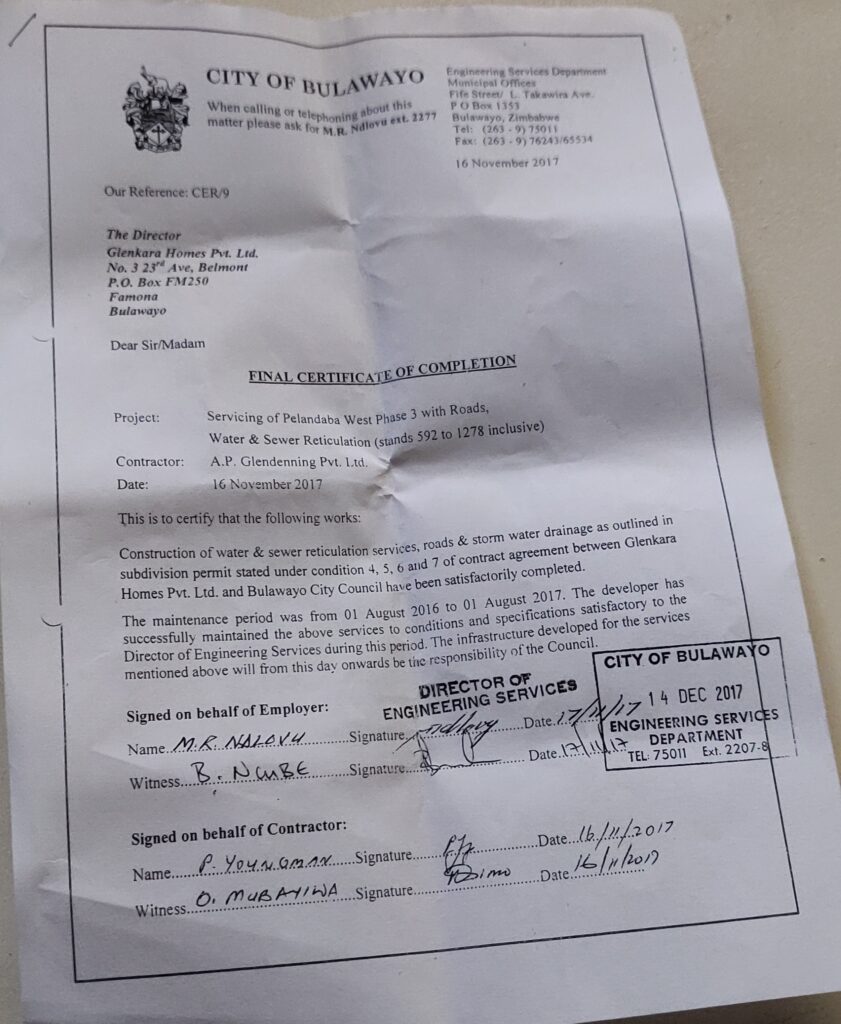
AP
Glendinning
Private
Limited
showed
CITE
copies
of
Certificate
of
Completion
which
were
granted
and
signed
in
a
phase
approach.
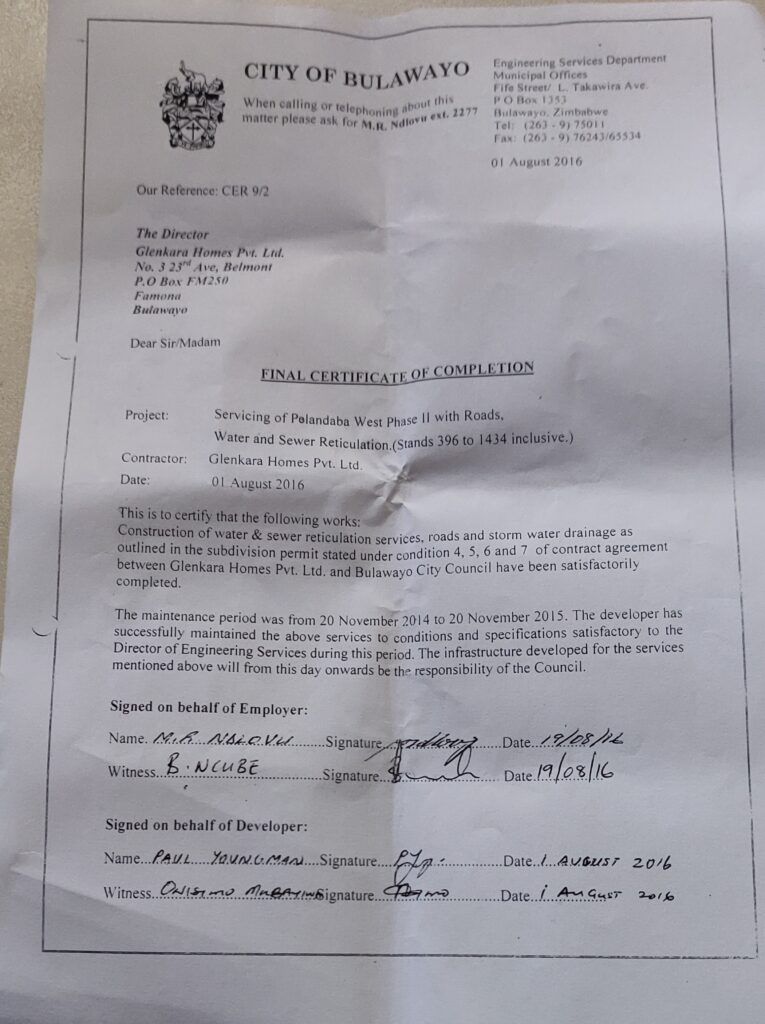
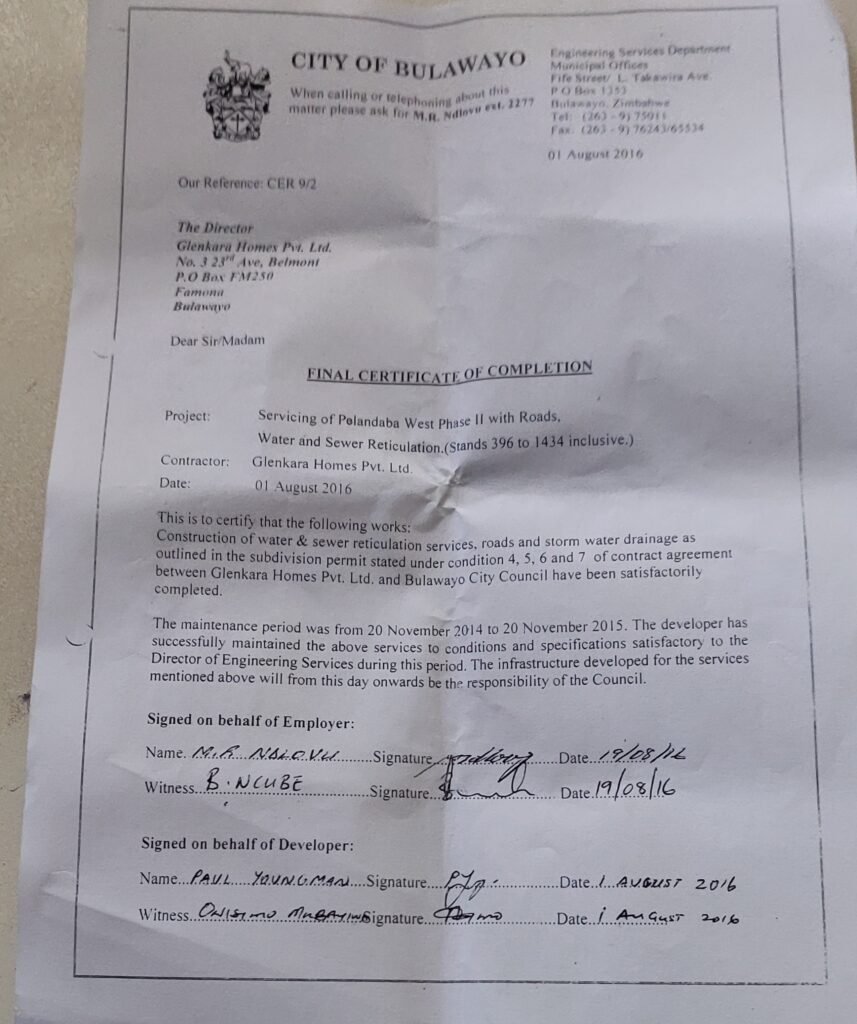
In
2016,
the
developer
completed
the
servicing
of
Pelandaba
Wet
phase
11
with
road,
water
and
sewer
reticulation
for
stands
396
to
1434.
On
14
December
2017,
the
land
developer
received
the
certificate
of
completion
for
servicing
of
Pelandaba
West
phase
1
with
roads,
water
and
sewer
reticulation
from
stand
number
1339
to
1738.
“The
maintenance
period
was
from
24
November
2014
to
23
November
2015.
The
developer
has
successfully
maintained
the
above
service
to
conditions
and
specifications
satisfactory
to
the
Director
of
Engineering
Services
during
this
period.
The
infrastructure
developed
for
the
services
mentioned
above
will
from
this
day
onwards
be
the
responsibility
of
the
City
Council,”
read
the
Certificate
of
Completion
dated
14
December
2017.
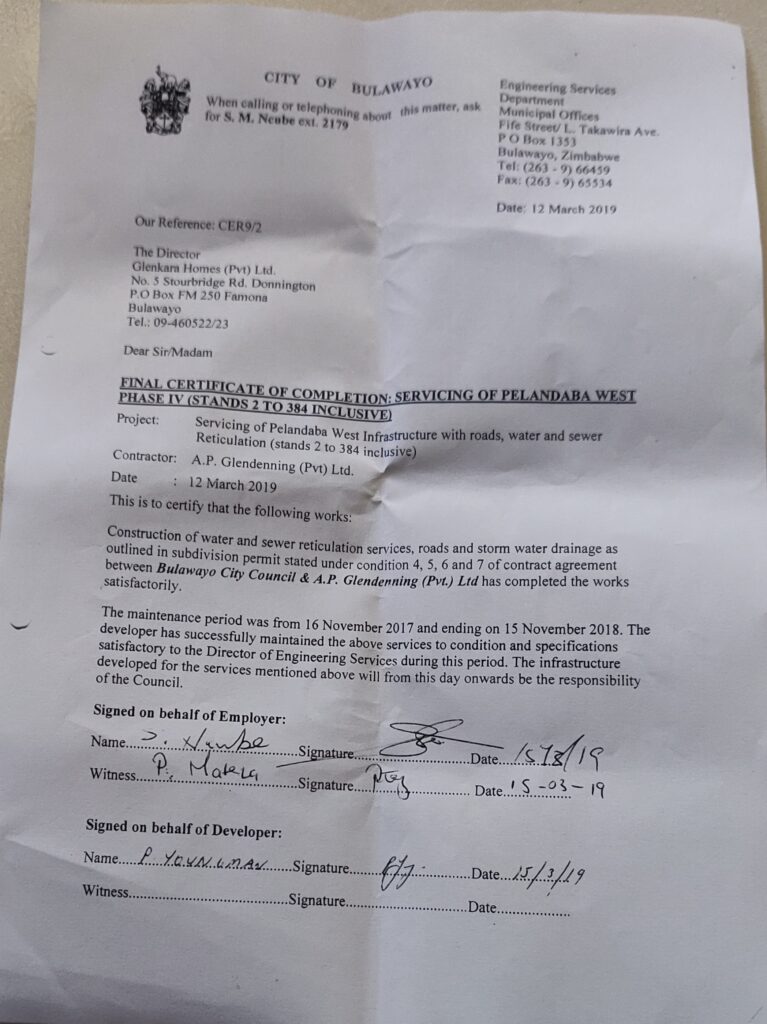
In
2019,
the
developer
completed
the
servicing
of
Pelandaba
West
with
roads,
water
and
sewer
for
stands
2
to
384.
The
certificates
were
all
signed
by
officials
from
the
local
authority.
However,
residents
say
the
quality
of
roads
in
Pelandaba
West
is
poorer
than
in
older
suburbs,
raising
questions
about
the
standards
applied
to
recent
private
developments
as
on
resident
remarked
“
This
is
a
new
suburb
but
now
looks
like
an
old
suburb.”
Documents
reviewed
by
CITE
and
interviews
with
residents
suggest
that
BCC
may
have
failed
to
enforce
its
own
regulations
as
empowered
by
the
Urban
Councils
Act
(Chapter
29:15)
to
inspect
and
approve
developments
before
issuing
Compliance
Certificates.
While
E.C.T
Shonhiwa
Property
Developers
has
a
Compliance
Certificate,
residents
under
his
phase
indicated
that
they
still
don’t
have
title
deeds
as
the
project
was
partially
handed
over.
Developers
Shift
Responsibility
Hawkflight,
another
private
land
developer
accused
of
delivering
substandard
work
in
Pelandaba
West
suburb
was
issued
with
a
Compliance
Certificate.
However,
contacted
by
CITE
for
comment,
the
Operations
Manager
at
Hawkflight,
Martin
Moyo,
said
they
could
not
show
their
Compliance
Certificate
because
the
Pelandaba
West
project
was
long
done
and
the
certificates
are
filed
in
their
archives.
“We
don’t
have
personnel
who
can
go
and
dig
the
archives
and
look
for
those
records,
I
cannot
be
asked
to
comment
on
what
is
happening,
that
is
not
my
suburb
at
the
moment
and
is
not
even
under
my
supervision.
I
handed
it
over
to
the
responsible
authority.
If
there
are
any
other
problems
the
responsible
authority
should
answer
that,”
he
said.
“We
don’t
keep
our
files
forever,
at
that
time
we
had
no
such
digital
platform,”
said
Moyo,
insisting
that
Hawkflight
had
completed
its
work
and
handed
the
project
over.
“We
are
no
longer
responsible
for
maintenance
of
sewer
and
water
lines.
Any
problems
should
be
directed
to
the
responsible
authority,”
said
Moyo.
Council
reports,
however,
note
that
Hawkflight
was
yet
to
submit
all
handover
documentation
to
the
city
council
for
future
maintenance
despite
claiming
completion
“For
the
projects
that
were
completed
and
handed
over
to
Council,
the
maintenance
is
now
the
responsibility
of
the
Engineering
Services
Department.
The
maintenance
will
now
be
carried
out
using
the
general
maintenance
now
competing
with
other
projects
city
wide,”
read
the
minutes.
Red
Flags
Bulawayo
Ward
13
Councillor,
Felix
Madzana,
confirmed
that
compliance
certificates
were
issued
to
private
land
developers
even
though
they
had
not
installed
roads,
water
and
sewer
lines
in
residential
stands
they
were
contracted
to
service.
“When
I
asked
why
developments
were
accepted
without
tarred
roads,
storm
drains
and
tower
lights,
I
was
told
this
was
what
had
been
agreed,”
Madzana
said
in
an
interview
with
CITE.
“We
need
to
ensure
that
the
department
of
Engineering
Services
does
proper
supervision.
We
have
roads
which
were
done
five
years
ago
that
look
older
than
the
roads
done
before
independence.
Even
in
some
areas
where
we
are
commissioning
stands,
the
roads
that
we
see
don’t
meet
standards
of
the
second
largest
city
in
the
country,”
Cllr
Madzana
said,
calling
for
strict
supervision
“so
that
we
don’t
carry
the
burden
of
substandard
work
which
should
be
done
by
private
developers.”
Claude
Phuti,
Programmes
Manager
for
Bulawayo
Progressive
Residents
Association
(BPRA),
a
community-based
organisation
advocating
for
residents’
rights,
said
Pelandaba
West
is
one
of
several
suburbs
where
residents
are
victims
of
incomplete
servicing.
“We’ve
received
similar
complaints
from
Magwegwe
West,
Pumula
South,
and
others,”
Phuti.
“Some
houses
in
Pelandaba
West
were
even
built
on
wetlands
without
inspection,
and
you
now
see
them
developing
structural
problems.
Some
are
too
close
to
each
other.
The
system
is
failing
residents.”
Council
tightens
vetting
of
private
land
developers
Reached
for
comment,
the
Bulawayo
City
Council
confirmed
that
under
the
previous
prepaid
scheme,
residents
made
payments
in
advance
before
a
contractor
was
appointed
to
service
the
land.
“This
arrangement
adversely
affected
beneficiaries,
particularly
when
the
national
currency
transitioned
from
the
United
States
Dollar
to
RTGS,
resulting
in
significant
value
erosion
of
the
funds
paid.
Consequently,
residents
were
later
required
to
make
additional
top-up
payments
to
cover
the
short
fall,”
said
BCC
Corporate
Communications
Officer,
Bongiwe
Ngwenya.
She
said
in
view
of
these
past
challenges,
the
current
developer-led
model
ensures
that
land
servicing
is
completed
prior
to
stand
allocation,
“thereby
protecting
beneficiaries
from
financial
loss
and
ensuring
that
only
fully
serviced
stands
are
brought
to
the
market.”
Ngwenya
said
the
City
has
taken
several
measures
against
private
land
developers
who
fail
to
meet
their
contractual
obligation
and
one
such
measure
is
the
withholding
of
completion
certificates
and
title
processing
until
the
developer
meets
all
servicing
and
contractual
requirements.
Meanwhile,
she
said
the
City
is
continuously
monitoring
all
ongoing
residential
development
projects
to
ensure
that
development
progresses
in
line
with
approved
layouts,
servicing
standards,
designs
and
timelines.
Ngwenya
admitted
that
most
complaints
from
residents
involve
incomplete
works
rather
than
poor
workmanship,
adding
that
“the
few
cases
of
substandard
works
generally
stem
from
projects
implemented
before
2009,
when
the
City
was
affected
by
brain
drain
and
reduced
technical
capacity.”
“In
respect
of
incomplete
works,
residents
have
been
requested
to
contribute
top-up
funds
to
facilitate
completion
of
outstanding
services,
since
funding
for
such
projects
is
solely
derived
from
the
sale
of
stands,”
she
said.
According
to
Ngwenya,
the
BCC
has
introduced
stricter
vetting
of
land
developers
and
performance-based
contracts
with
penalties
for
non-compliance
as
well
as
regular
inspections
by
city
engineers.
“Collaboration
between
the
Water
and
Sanitation
and
Works
Services,
Housing,
Town
Planning
and
Audit
Departments
has
been
enhanced
to
improve
oversight
and
information
sharing,”
Ngwenya
noted,
emphasizing
that
the
council
was
only
approving
land
developers
with
proven
technical
capacity,
financial
stability
and
a
track
record
of
successful
project
delivery
to
undertake
projects.
“The
city
has
taken
a
number
of
measures
against
private
land
developers
who
fail
to
meet
their
contractual
obligations,”
Ngwenya
said,
adding
that,
“These
Issuance
of
warning
letters
and
notice
of
breach,
cancellation
of
development
permits
in
cases
of
persistent
non-performance
and
utilization
of
performance
bonds
were
applicable.”
She
urged
residents
to
report
issues
through
ward
offices
and
the
City’s
customer
Contact
Centre
to
enable
early
identification
and
correction
of
deficiencies.
“The
City
has
established
procedures
for
addressing
complaints
from
residents
regarding
substandard
work
on
services
such
as
sewer,
roads,
and
water
infrastructure.
When
such
complaints
are
received,
the
following
steps
are
undertaken:
Receipt
and
Logging
of
Complaints,
Technical
Assessment
and
Inspection,
Engagement
with
the
Developer
or
Contractor,
Follow-Up
and
Verification
and
Enforcement
Action
(if
necessary),”
said
Ngwenya.
The
calls
come
as
the
country
joins
the
rest
of
the
world
in
marking
World
Wetlands
Day
under
the
theme “Wetlands
and
traditional
knowledge:
Celebrating
cultural
heritage.” The
day
highlights
the
role
of
indigenous
practices
in
sustaining
wetlands
and
safeguarding
cultural
identity.
The
Zimbabwe
Environmental
Law
Organisation
(ZELO)
said
conservation
initiatives
that
sideline
local
communities
were
failing.
“ZELO
joins
the
global
commemoration
by
calling
for
greater
integration
of
communities
in
conserving
these
vital
ecosystems,
reflecting
the
organisation’s
people-centred
and
inclusive
values,”
the
organisation
said
in
a
statement.
It
added
that
traditional
knowledge
systems
and
the
active
participation
of
communities
were
essential
to
effective
wetland
conservation,
and
that
incorporating
such
knowledge
into
national
and
global
monitoring
frameworks
would
improve
understanding
of
ecosystem
change
and
enable
meaningful
involvement
of
indigenous
peoples.
ZELO
said
wetlands
across
cultures
are
cultural
landscapes
embedded
in
identity,
art
and
spirituality,
but
rapid
social
and
economic
change
has
threatened
their
preservation.
“Significant
declines
have
been
recorded
in
Latin
America,
the
Caribbean
and
Africa,
while
degradation
has
also
increased
in
Europe,
North
America
and
Oceania,”
the
organisation
said.
It
warned
that
wetlands
continue
to
disappear
faster
than
they
are
being
restored,
citing
the
Global
Wetland
Outlook
2025,
which
shows
that
rates
of
degradation
vary
by
region
and
over
time,
driven
largely
by
development
and
land-use
change.
Wetlands
play
a
critical
role
in
water
supply,
biodiversity
conservation,
climate
resilience
and
food
security,
particularly
for
rural
and
peri-urban
communities
that
depend
on
them
for
livelihoods.
However,
rapid
economic
development
has
pushed
construction,
agriculture
and
mining
into
protected
wetland
areas,
often
with
limited
consideration
of
long-term
environmental
impacts.
“Despite
policy
commitments,
wetland
integrity
remains
threatened
by
encroachment
from
agriculture,
mining
and
urban
development,”
ZELO
said.
In
Harare
alone,
an
estimated
3,717
hectares
of
wetlands,
about
16%
of
the
city’s
total,
have
been
affected
by
construction.
The
organisation
said
embedding
cultural
values
and
traditions
into
wetland
management
remains
one
of
the
most
effective
ways
to
achieve
good
ecological
conditions.
It
urged
government
and
development
partners
to
invest
in
community-led
wetland
restoration
projects,
particularly
in
areas
affected
by
mining,
agriculture
and
urban
expansion,
while
safeguarding
cultural
heritage
and
local
livelihoods.
ZELO
also
called
for
wetland
management
to
be
integrated
into
national
and
local
land-use
planning,
including
stricter
enforcement
of
Environmental
Impact
Assessments
and
a
ban
on
destructive
activities
in
wetlands
and
their
buffer
zones.
Zimbabwe
recognises
wetlands
as
central
to
biodiversity
protection,
water
regulation
and
climate
resilience
under
National
Development
Strategy
1
and
has
pledged
to
strengthen
protection
measures
under
NDS
2.
Wetland
protection
is
also
anchored
in
Section
73
of
the
Constitution
and
the
Environmental
Management
Act.
The
country
currently
holds
the
Ramsar
Conference
of
the
Parties
presidency
for
the
2025–2028
triennium,
placing
it
at
the
centre
of
global
wetland
governance.
Zimbabwe
has
committed
to
restoring
250,000
hectares
of
degraded
land
and
designating
five
new
Ramsar
sites
by
2030.
“This
offers
an
opportunity
to
lead
in
conserving
pristine
wetlands
and
rehabilitating
degraded
ones,”
ZELO
said.
The
campaign
forms
part
of
the
National
Clean-Up
Day
initiative,
established
in
2018
to
promote
a
clean,
safe
and
healthy
environment.
Speaking
to
CITE
ahead
of
the
exercise,
ZCC
national
chairperson
Reverend
Mbongeni
P
Dube
said
the
initiative
was
inspired
by
President
Emmerson
Mnangagwa’s
declaration
that
environmental
cleanliness
should
be
treated
as
a
national
priority.
“From
the
Zimbabwe
Council
of
Churches,
mainly
this
clean-up
campaign
is
on
the
foundation
of
the
president,
Ed
Mnangagwa,
who
declared
in
December
2018
that
there
should
be
a
clean,
safe
and
healthy
environment
which
we
can
manage,”
he
said.
Reverend
Dube
said
churches
in
Bulawayo
had
agreed
to
work
collectively
and
in
partnership
with
other
organisations
to
support
the
city’s
cleanliness
drive.
“As
churches
we
sat
down
and
we
saw
fit
that
we
should
join
together
to
clean
Bulawayo
and
to
unite
with
other
organisations
such
as
the
city
council
and
many
others,”
he
said.
He
added
that
the
campaign
had
drawn
broad-based
support
from
different
religious
groups
and
civic
organisations.
“We
have
also
united
with
the
Muslim
community,
the
Latter-day
Saints,
and
vendors’
associations
as
well.
They
are
part
of
us,
so
a
lot
of
organisations
have
come
on
board,”
he
said.
Reverend
Dube
said
the
church
felt
compelled
to
lead
by
example,
describing
environmental
stewardship
as
part
of
its
moral
and
spiritual
responsibility.
“The
Bible
says
we
are
the
light
and
the
salt
of
the
earth,
so
as
churches
we
need
to
lead
by
example
as
we
clean
our
Bulawayo,”
he
said.
He
added
that
the
initiative
was
rooted
in
Christian
teaching
that
humanity
has
a
duty
to
care
for
the
earth.
“Our
theology
is
that
God
gave
us
a
mandate
to
take
care
of
the
garden.
So
we
have
been
given
Bulawayo,
this
is
where
we
eat,
this
is
where
we
work
—
and
God
reminds
us
to
take
care
of
this
garden
that
we
have
been
given,”
he
said.
The
clean-up
will
take
place
at
the
Unity
Village
entrance
along
6th
Avenue,
starting
at
7am
and
ending
at
10am.
Reverend
Dube
said
the
campaign
is
open
to
all
residents.
“So
this
has
been
our
initiative.
Everyone
has
been
invited
to
this
clean-up
campaign,”
he
said.
Beyond
the
immediate
exercise,
the
ZCC
hopes
to
roll
out
community
workshops
to
raise
awareness
about
proper
waste
management
and
the
dangers
of
littering.
“It
is
our
hope
that
as
we
go
forward
we
will
have
workshops
to
teach
people
on
the
harmful
effects
of
littering,
because
sometimes
people
are
ignorant
about
what
they
are
supposed
to
do,”
he
said.
The
campaign
comes
against
the
backdrop
of
growing
concern
by
the
Bulawayo
City
Council
over
illegal
dumping,
which
it
has
described
as
a
“cancer”
spreading
across
the
city.
Late
last
year,
council
officials
said
they
were
considering
increasing
littering
fines
by
up
to
900%
in
a
bid
to
deter
offenders.
Proposals
include
raising
the
maximum
fine
for
illegal
dumping
from
US$30
to
US$300.
Bulawayo
Mayor
David
Coltart
has
also
urged
authorities
to
target
construction
companies
and
businesses
that
dump
waste
illegally,
suggesting
penalties
of
around
US$300
per
tonne,
arguing
that
it
should
be
more
expensive
to
dump
illegally
than
to
use
official
landfill
sites.
President
Mnangagwa
has
previously
noted
that
Zimbabwe’s
Constitution
guarantees
every
citizen
the
right
to
a
clean
and
safe
environment
that
does
not
harm
their
health
and
wellbeing.
He
declared
the
first
Friday
of
every
month
National
Clean-Up
Day
in
December
2018.
It
wasn’t
1929
for
the
legal
tech
industry,
but
it
wasn’t
great
either.
Thomson
Reuters
lost
around
15
percent
of
its
value.
LexisNexis’s
parent
company
dropped
about
14
percent.
DocuSign
fell
11
percent.
A
lot
of
the
industry
isn’t
publicly
traded,
so
we
didn’t
get
to
see
how
their
investors
responded
to
the
news,
but
it
probably
looked
similarly
grim
over
at
Harvey
HQ.
The
catalyst
for
this
carnage
—
which
the
Jefferies
Group
is
calling
the
“SaaSpocalypse”
—
had
nothing
to
do
with
the
ongoing
hallucination
and
slopification
problems
unleashed
by
artificial
intelligence.
We’ve
had
those
for
months
now
and
they’ve
only
succeeded
in
inflating
the
tech
bubble
further.
Instead,
the
precipitous
decline
arrived
because
Anthropic
released
a
plugin.
And
threatened
to
take
over
legal
tech
in
the
process.
The
company
behind
Claude
has
been
riding
high
recently
off
its
Claude
Code
buzz.
The
company
reportedly
used
their
fancy
coding
agent
to
write
up
Claude
Cowork,
offering
more
user-friendly
access
to
its
agentic
properties.
Yesterday,
they
dropped
a
legal
plugin
for
Cowork,
promising
to
automate
a
number
of
legal
workflows
from
contracts
to
briefings.
It’s
open
source
and
therefore
configurable
to
meet
whatever
shop
idiosyncrasies
a
firm
wants
to
include.
For
the
first
time,
a
foundation-model
company
is
packaging
a
legal
workflow
product
directly
into
its
platform,
rather
than
merely
supplying
an
API
to
legal-tech
vendors.
Therein
lies
the
problem
for
every
legal
AI
company
that’s
been
building
on
top
of
Anthropic
all
this
time.
For
years,
the
legal
tech
playbook
has
been
straightforward:
take
a
foundation
model
from
Anthropic
or
OpenAI,
wrap
it
in
legal-specific
prompts
and
guardrails,
add
some
integrations,
slap
a
subscription
fee
on
it,
and
call
yourself
a
legal
AI
company.
The
assumption
was
that
the
model
providers
would
stay
in
their
lane,
happy
to
collect
API
fees
while
legal
tech
startups
captured
enterprise
value.
Anthropic
just
announced
“I
can
haz
enterprise
value.”
What’s
legal
tech
going
to
do
now
that
their
supplier
is
their
competitor?
Personally,
I’d
prefer
tools
designed
by
professionals
with
industry
experience
as
opposed
to
a
plugin
built
by
a
robot
coder.
But
this
is
where
AI’s
persistent
limitations
work
against
companies
adding
value.
If
it’s
going
to
hallucinate
so
much
that
lawyers
need
to
review
it
with
a
fine-tooth
comb
either
way,
why
not
use
the
retail
solution?
Well,
a
lot
of
reasons.
As
Artificial
Lawyer
noted,
legal
data
titans
have
spent
decades
building
proprietary
datasets
and
customer
relationships
that
can’t
be
easily
replicated
by
a
plugin.
As
Prompt
Armor
notes,
Cowork
also
brings
serious
security
risks
that
everyone
seems
to
be
shrugging
off
at
their
peril.
That
said,
when
an
industry
is
built
on
a
“model
+
wrapper
+
workflow”
model
—
as
Ambrogi
calls
it
—
if
the
model
creator
can
cut
out
the
middle,
it
creates
a
crisis.
Even
if
most
lawyers
stick
with
the
old
standbys,
at
least
some
chunk
of
the
market
will
walk
away
from
high
fees
and
give
Claude
a
whirl.
Legal
tech
companies
have
been
hyping
“agentic
AI”
as
the
future
for
a
year
now
without
a
whole
lot
to
show
for
it.
Now
a
foundation
model
company
is
releasing
an
agentic
legal
tool,
and
suddenly
the
market
decides
that
democratizing
legal
AI
could
also
democratize
legal
tech’s
customer
base
into
oblivion.
But
major
law
firms
and
legal
departments
already
have
deals
with
sophisticated
vendors
they’re
not
going
to
abandon
overnight.
They
still
need
the
massive
datasets
offered
by
Thomson
Reuters
and
LexisNexis,
which
should
keep
most
customers
signed
up
for
now.
And,
as
someone
who
has
experimented
with
Claude
Cowork
a
lot
over
the
past
two
weeks,
there’s
also
the
way
that
it
screws
up
most
workflows
that
involve
more
than
a
couple
tasks.
That’s
not
to
say
there
aren’t
success
stories
floating
around
out
there,
but
to
the
extent
I’ve
been
able
to
put
it
through
its
paces,
the
results
have
been…
underwhelming.
Maybe
pump
the
brakes
before
putting
your
contract
workflow
in
there.
If
investors
think
lawyers
will
walk
away
from
Thomson
Reuters
and
put
their
faith
in
a
plugin
for
a
product
written
by
a
robot
coder
over
the
last
couple
weeks…
well,
then
the
market
may
be
the
one
with
the
problem.
HARARE
–
Dozens
of
passengers
escaped
death
when
a
bus
crashed
into
a
tree
in
Harare
on
Tuesday
morning,
but
their
ordeal
took
a
dramatic
turn
when
they
were
attacked
by
a
swarm
of
bees,
police
said.
The
accident
occurred
at
the
intersection
of
Acturus
Road
and
Harare
Drive.
National
police
spokesperson
Commissioner
Paul
Nyathi
said
the
driver
lost
control
of
the
bus,
causing
it
to
veer
off
the
road
and
ram
into
a
tree
that
had
a
swarm
of
bees.
“Several
passengers
sustained
injuries
while
others
were
attacked
by
bees
from
the
tree,”
Nyathi
said
in
a
statement
on
Wednesday.
Emergency
services
attended
the
scene
and
ferried
the
injured
to
nearby
medical
facilities
for
treatment.
The
police
statement
did
not
disclose
the
extent
of
the
injuries.
HARARE
–
Police
have
arrested
a
28-year-old
man
after
discovering
human
skulls
and
other
remains
at
his
home
following
an
initial
arrest
at
a
mine
in
Bindura.
Police
confirmed
the
arrest
of
Alfred
Chinjiva,
28,
who
was
first
apprehended
on
February
2,
2026,
for
possession
of
articles
of
criminal
use
after
he
was
found
carrying
a
dummy
pistol
at
a
mine
in
Bindura.
Following
the
arrest,
detectives
conducted
a
search
at
Chinjiva’s
residence
in
Chipandura
Park,
where
they
made
a
gruesome
discovery
of
suspected
human
remains.
Police
recovered
two
human
skulls,
one
of
which
had
two
cuts
at
the
back
and
was
wrapped
in
a
yellow
cloth,
while
the
other
was
wrapped
in
a
red
cloth.
Officers
also
found
a
single
bone
wrapped
in
a
red
cloth,
two
buckets
containing
bones
wrapped
in
green,
yellow,
black
and
blue
cloths,
as
well
as
three
plastic
containers
filled
with
soil
mixed
with
suspected
human
bones
and
hair.
One
of
the
skulls
found
at
Bindura
man’s
home
Police
said
investigations
are
ongoing
to
establish
the
origin
of
the
remains
and
whether
any
criminal
offences,
including
murder
or
grave
desecration,
were
committed.
“More
details
will
be
released
as
investigations
progress,”
national
police
spokesman
Commissioner
Paul
Nyathi
said.
A
human’s
lower
jaw
among
items
recovered
at
Bindura
man’s
home
Human
remains
found
at
home
of
man
arrested
for
carrying
toy
gun
MASVINGO
–
The
High
Court
has
interdicted
a
Masvingo
traditional
chief
from
interfering
with
the
operations
of
a
newly
established
private
school
after
finding
that
his
actions
amounted
to
unlawful
self-help
rather
than
the
lawful
exercise
of
traditional
authority.
Justice
Josephine
Zisengwe
of
the
Masvingo
High
Court
granted
an
urgent
interim
interdict
barring
Chief
Murinye,
real
name
Ephias
Munodawafa,
from
blocking
access
to
Riverton
Academy
Extension,
a
private
school
located
in
the
Murinye
and
Machingura
villages,
following
a
dramatic
standoff
at
the
start
of
the
January
2026
school
term.
The
court
heard
that
on
January
11,
Munodawafa
physically
blocked
the
road
leading
to
the
school
with
his
vehicle,
preventing
parents
from
dropping
off
children
who
had
already
been
enrolled.
The
chief
allegedly
threatened
to
unleash
snakes
on
the
school
premises
to
stop
lessons
from
commencing.
The
school’s
owner,
Philimon
Mutangiri,
approached
the
High
Court
on
an
urgent
basis
seeking
protection
from
what
he
described
as
vigilante-style
conduct
by
the
chief.
In
opposing
the
application,
Munodawafa
argued
that
the
school
had
been
constructed
on
communal
land
without
his
authority,
without
approval
from
Masvingo
Rural
District
Council,
and
without
compliance
with
statutory
requirements
including
an
environmental
impact
assessment.
He
maintained
that,
as
chief,
he
was
empowered
under
the
Traditional
Leaders
Act
to
prevent
unauthorised
settlement
on
communal
land.
Justice
Zisengwe
rejected
that
argument,
holding
that
while
chiefs
wield
significant
administrative
and
judicial
authority,
they
are
not
above
the
law.
“At
its
most
basic
form
the
principle
of
the
rule
of
law
propounds
that
everyone,
including
the
government,
is
accountable
to
publicly
available
and
equally
enforced
laws
that
are
independently
judged,”
the
judge
said.
She
ruled
that
Munodawafa
could
not
“arrogate
unto
himself
the
role
of
complainant,
judge,
jury
and
executioner
in
his
own
case,”
adding
that
even
if
he
believed
the
school
was
unlawfully
established,
the
law
provided
formal
mechanisms
for
enforcement.
“The
provisions
relied
upon
do
not
necessarily
permit
taking
matters
into
one’s
own
hands,”
Zisengwe
said,
noting
that
customary
court
judgments
must
be
enforced
through
procedures
set
out
in
the
Customary
Law
and
Local
Courts
Act,
not
by
physical
obstruction.
The
judge
dismissed
a
series
of
preliminary
objections
raised
by
the
chief,
including
claims
that
the
application
was
defective,
that
he
had
been
wrongly
cited
in
his
personal
capacity,
and
that
a
court
could
not
interdict
what
he
characterised
as
a
lawful
act.
Several
of
those
objections
were
deemed
abandoned
after
they
were
not
pursued
in
heads
of
argument.
On
the
merits,
the
court
found
that
Mutangiri
had
established
a
prima
facie
right
to
the
peaceful
operation
of
the
school,
even
though
compliance
with
all
regulatory
requirements
remained
in
dispute.
“The
applicant
did
not
construct
the
school
from
the
utter
blue,”
Zisengwe
said,
noting
that
land
had
initially
been
allocated
by
local
headmen
and
that
applications
and
fees
had
been
submitted
to
the
rural
district
council.
The
judge
held
that
the
balance
of
convenience
favoured
allowing
the
school
to
operate,
warning
that
continued
interference
would
cause
irreparable
harm
to
learners
by
depriving
them
of
learning
time
that
could
not
be
recovered.
Pending
final
determination
of
the
matter,
the
court
interdicted
Munodawafa
and
those
acting
through
him
from
blocking
access
roads
or
interfering
in
any
way
with
learning
and
other
operations
at
Riverton
Academy
Extension.
I
recently
lost
a
good
friend.
Men
and
women
I’ve
known
since
we
were
boys
and
girls
poured
into
my
Minnesota
hometown
for
the
funeral
last
Friday,
some
from
as
far
away
as
the
coasts.
Outside
the
church,
at
the
crack
of
the
rifles
for
his
military
honors,
a
tear
ran
down
my
cheek
and
promptly
froze
into
the
upper
reaches
of
my
beard.
He
will
be
greatly
missed.
Mitch
had
been
a
staple
at
a
longstanding
tradition
amongst
a
group
of
his
peers:
hockey
weekend.
This
tradition
entails
everyone
meeting
up
from
wherever
they’ve
ended
up
in
the
country
then
going
somewhere
for
the
weekend
to
attend
a
Minnesota
college
hockey
game
(not
necessarily
in
Minnesota,
the
Dakotas
and
other
nearby
states
are
in
the
mix
too).
We
also
gear
up
like
old
times
and
attempt
to
play
a
hockey
game
ourselves.
Since
we’d
planned
this
year’s
hockey
weekend
for
the
Twin
Cities
several
months
ago,
and
since
almost
everyone
going
was
at
the
funeral
anyway,
we
decided
to
go
ahead
with
it.
In
the
past,
outdoor
ice
conditions
had
occasionally
prevented
us
from
doing
the
amateur
hockey
game
part
of
hockey
weekend.
Though
we
are
all
citizens,
the
skin
tones
of
a
couple
of
our
buddies
nonetheless
served
as
a
compelling
reminder
that
outdoor
ICE
conditions
in
the
Twin
Cities
merited
a
postponement
of
that
part
of
the
tradition.
We
would
still
watch
a
college
hockey
game,
though.
This
year
we
were
traveling
to
the
St.
Paul
campus
of
my
old
law
school
alma
mater
to
see
its
brand
new
stadium.
Of
course,
a
dozen
hockey
hooligans
need
a
hearty
meal
and
a
few
rounds
with
which
to
toast
their
fallen
compadre
before
watching
any
competitive
athletics.
We
headed
to
Tiffany’s
(the
local
sports
bar,
not
the
fancy
jewelry
store).
We
arrived
at
sunset
to
the
large
four-way
intersection
where
Tiffany’s
is.
A
group
of
several
hundred
anti-ICE
protesters
braved
the
cold
to
gather
there.
Wanting
to
show
my
support
(especially
given
that
a
little
toasting
had
already
taken
place),
as
we
crossed
at
the
stoplight
I
formed
a
megaphone
with
my
hands
and
yelled
as
loudly
as
I
could,
“FUCK
ICE!!”
My
breath
boiled
from
my
body
and
whipped
away
in
the
wind.
The
intersection
was
big
enough
that
it
took
a
couple
seconds
for
the
sound
to
reach
every
corner,
and
for
the
applause
and
cheering
to
make
its
way
back
to
me.
Encouraged,
I
reared
back
again,
and
this
time
bellowed,
“FUCK
BOVINO!!”
It
was
a
cool
moment.
As
I
write
this
two
days
later
it
still
sounds
like
I’ve
been
taking
voice
lessons
from
RFK
Jr.
whenever
I
try
to
speak
—
totally
worth
it.
When
we
finally
arrived
at
the
game
(a
little
late
for
puck-drop),
another
wave
of
sound
hit
us
as
we
found
our
way
to
our
seats.
We
assumed
the
home
team
had
scored
a
goal,
only
to
discover
it
was
the
visiting
fans
of
the
Michigan
Tech
Huskies
who’d
generated
such
a
robust
roar.
This
was
not
an
isolated
incident.
Lots
of
Michigan
Tech
students
made
the
long
journey
to
cheer
on
their
team.
On
the
other
hand,
I
saw
almost
no
one
who
wasn’t
on
the
ice
who
I’d
take
to
be
student-aged
wearing
a
Tommies
jersey.
Most
of
the
hometown
fans
seemed
to
be
stoney-faced
older
white
men.
Though
the
hockey
was
competitive,
the
energy
advantage
was
overwhelmingly
in
favor
of
the
Huskies.
It
probably
didn’t
help
that
the
stadium
was
half-empty.
It
was
a
beautiful
building,
though
one,
as
we
soon
discovered,
in
which
an
attendee
of
the
proper
age
had
no
ability
to
purchase
an
alcoholic
beverage.
To
see
a
hockey
arena
without
beer
in
Minnesota
was
almost
akin
to
encountering
a
panda
bear
on
the
streets
of
St.
Paul:
the
vague
familiarity
of
the
shape
isn’t
necessarily
out-of-place,
but
the
overall
picture
is
uncanny
and
somehow
wrong.
I
took
a
walk
to
clear
my
head
and
find
the
manager
in
charge
of
the
Jumbotron
to
see
if
he’d
flash
“Goodbye,
Mitch”
briefly
on
the
screen.
This
request
was
denied.
I
mean,
fine,
it’s
not
the
end
of
the
world,
but
I
wasn’t
asking
for
a
10-minute
video
tribute
or
anything.
Two
words
of
text
for
a
few
seconds
didn’t
seem
completely
unreasonable
as
a
favor
to
an
alum
who’d
walked
in
accompanied
by
a
meaningful
percentage
of
the
whole
crowd
at
$35
a
ticket.
I
could
have
missed
it,
I
suppose,
but
as
the
game
went
on
I
saw
no
acknowledgement
of
the
other
two
great
Minnesotans
we
lost
this
month
either,
whereas
an
earlier
event
that
day
at
the
History
Center
in
St.
Paul
that
a
few
of
us
had
planned
on
going
to
was
canceled
entirely
due
to
the
federal
occupation
of
the
metro
area.
By
the
time
we
left
the
game
(early)
I
found
myself
cheering
for
the
Huskies.
I
spent
about
a
week
in
Houghton
versus
three
years
in
law
school,
and
by
the
end
this
hockey
game
caused
me
to
shamefully
pocket
the
St.
Thomas
stocking
cap
and
mittens
I’d
been
wearing.
Well,
all
things
considered
it
was
a
great
weekend
which
featured
a
lot
of
great
tributes
to
my
friend,
and
which
could
have
turned
out
a
lot
worse
considering
how
masked
federal
goons
have
been
needlessly
abusing
protesters
and
bystanders
alike
in
the
Twin
Cities
these
past
few
weeks.
Still,
that
hockey
game
was
a
definite
lowlight.
Hopefully
next
year
we’ll
be
somewhere
else
for
hockey
weekend,
maybe
with
something
to
celebrate
instead
of
someone
to
mourn,
and
maybe
even
in
a
city
that
isn’t
besieged
by
the
federal
government.
Jonathan
Wolf
is
a
civil
litigator
and
author
of Your
Debt-Free
JD (affiliate
link).
He
has
taught
legal
writing,
written
for
a
wide
variety
of
publications,
and
made
it
both
his
business
and
his
pleasure
to
be
financially
and
scientifically
literate.
Any
views
he
expresses
are
probably
pure
gold,
but
are
nonetheless
solely
his
own
and
should
not
be
attributed
to
any
organization
with
which
he
is
affiliated.
He
wouldn’t
want
to
share
the
credit
anyway.
He
can
be
reached
at [email protected].
The
president
took
a
break
from
overseeing
a
domestic
occupation,
issuing
threats
to
Iran,
and
pretending
he’s
not
deeply
implicated
in
the
latest
Epstein
file
dump.
Speaking
of
dumps,
Trump
finds
himself
so
overburdened
these
days
that
he’s
taken
his
capacity
for
multitasking
to
extreme
levels.
And
yet
he
still
has
time
for
his
passion
project:
authoring
a
real-time
record
of
his
sundowning
through
his
vanity
social
media
outlet.
Yesterday,
his
ire
fell
upon
Federalist
Society
bigwig
Leonard
Leo,
whom
Trump
considers
a
sleazebag.
That’s
the
most
powerful
person
on
Earth
blasting
his
rage
wank
to
millions
of
followers
about
the
“big
and
very
dangerous
mouth”
on
an
“influencer”
so
notoriously
behind
the
scenes
that
almost
no
one
outside
the
legal
nerd
cult
even
knows
who
he
is.
This
is
not
the
first
time
Trump’s
lashed
out
at
Leo.
Last
year,
when
the
Court
of
International
Trade
struck
down
Trump’s
attempt
to
unilaterally
issue
tariffs
on
products
from
everywhere
up
to
and
including
an
uninhabited
penguin
reserve,
the
president
took
to
social
media
to
bash
Leo
as
a
“sleazebag.”
Who
are
we
to
argue
with
the
president?
While
Trump
complains
about
Leo
claiming
the
legal
system
is
“RIGGED”
his
actual
complaint
seems
to
be
the
possibility
that
it
is
not.
Having
railed
against
Leo
when
the
Trade
court
ruled
against
the
illegal
tariff
regime,
he’s
back
at
it
now
that
the
Supreme
Court
—
generally
exceedingly
compliant
to
the
administration’s
whims
—
appears
likely
to
break
with
the
White
House
on
both
tariffs
and
his
attempt
to
seize
control
of
the
Federal
Reserve.
Add
in
the
various
Republican
judges
around
the
country
refusing
to
allow
the
administration
to
run
roughshod
over
the
Constitution,
and
Trump
might
feel
genuinely
misled.
Still,
it’s
a
weird
complaint
to
air
in
public
when
Trump
has
three
more
years
to
work
and
no
viable
alternative
for
vetting
judicial
nominees.
The
Federalist
Society
manages
the
MAGA
cursus
honorum
and
cutting
ties
with
the
group
leaves
the
administration
picking
judges
based
on
vibes.
Presumably
Leo
—
directly
or
indirectly
—
guided
the
administration
in
choosing
the
FedSoc
all-stars
most
willing
to
embrace
the
president’s
agenda
as
opposed
to
the
squishy
libertarians
only
showing
up
for
low
taxes
and
free
Chick-fil-A.
But
it’s
a
reminder
that
the
White
House’s
obsession
with
loyalty
remains
a
one-way
street.
No
amount
of
obsequious
service
will
ever
be
enough
to
satisfy
Trump.
Presumably,
Leo
doesn’t
really
care.
He
managed
substantially
stock
the
courts
with
enough
low-hanging
fruit
to
deliver
activist-friendly
one-judge
courthouses
and
appellate
courts
more
interested
in
clicks
than
laws
that
will
pay
off
for
ages.
They
may
not
always
deliver
for
Trump,
but
when
they
don’t
they’re
just
delivering
for
traditional
Republican
values.
Leo’s
success
will
outlast
Trump.