A
Manhattan
federal
judge
on
Friday
ruled
that
prosecutors
would
not
be
able
to
seek
the
death
penalty
at
the
trial
of
Luigi
Mangione,
the
27-year-old
man
accused
of
assassinating
UnitedHealthcare’s
chief
executive
in
2024. … Judge
Garnett
said
in
her
opinion
that
two
stalking
charges
against
Mr.
Mangione,
one
of
which
carried
a
maximum
sentence
of
death,
did
not
meet
the
legal
definition
of
a
crime
of
violence,
and
had
to
be
dismissed.
You
can
hear
his
legal
team
here:
VICTORY
LAP:
Luigi
Mangione’s
defense
team
applauds
judge’s
decision
to
take
death
penalty
off
the
table,
praises
supporters
of
suspected
CEO
assassin
pic.twitter.com/rCzT1trxNF
The
legal
team
still
has
a
tough
battle
ahead.
Despite
the
warrantless
search
of
his
backpack,
the
judge
ruled
that
the
evidence
seized
may
be
used
against
him.
Now,
the
weightiest
consequence
he
faces
is
life
without
parole.
If
it
comes
to
that,
good
luck
keeping
the
man
behind
bars:
A
nation
governed
by
the
rule
of
law
must
abide
in
a
way
that
gives
due
process
to
anyone
accused
of
a
crime.
High
profile
cases
like
this
may
put
liberty
to
the
test,
but
they
also
show
us
who
we
are
when
it
matters.
Chris
Williams
became
a
social
media
manager
and
assistant
editor
for
Above
the
Law
in
June
2021.
Prior
to
joining
the
staff,
he
moonlighted
as
a
minor
Memelord™
in
the
Facebook
group Law
School
Memes
for
Edgy
T14s
.
He
endured
Missouri
long
enough
to
graduate
from
Washington
University
in
St.
Louis
School
of
Law.
He
is
a
former
boatbuilder
who
is
learning
to
swim, is
interested
in
critical
race
theory,
philosophy,
and
humor,
and
has
a
love
for
cycling
that
occasionally
annoys
his
peers.
You
can
reach
him
by
email
at [email protected]
and
by
tweet
at @WritesForRent.
As
most
people
within
and
without
the
legal
profession
already
know,
lawyers
need
to
follow
ethical
rules
that
govern
the
practice
of
law.
This
usually
means
that
lawyers
cannot
lie
to
their
adversaries,
since
the
administration
of
justice
typically
requires
that
practitioners
be
truthful
in
their
statements
to
one
another. While
misstatements
about
settlement
authority
and
other
trivial
issues
might
be
dismissed,
lawyers
often
lie
in
egregious
ways. Attorneys
should
trust
what
their
adversaries
say,
but
always
verify
statements
that
are
made,
since
lawyers
may
make
misstatements
about
the
facts
or
law
to
advance
a
client’s
position.
At
the
beginning
of
my
career,
I
was
tasked
with
handling
an
appeal
for
a
matter
that
another
lawyer
handled
before
the
trial
court. My
adversary
agreed
to
discontinue
the
case
in
the
trial
court,
which
would
mean
that
the
appeal
we
filed
was
moot. However,
since
one
of
the
parties
was
not
represented
by
counsel
and
could
not
be
reached,
we
had
to
get
the
court
to
approve
the
stipulation
of
discontinuance
that
was
signed
by
all
of
the
parties
who
had
active
counsel.
As
the
deadline
for
my
adversary
to
file
opposition
papers
to
our
appeal
approached,
the
adversary
tried
to
bully
me
into
discontinuing
the
appeal
prematurely. However,
there
was
a
chance
the
court
would
not
agree
to
sign
our
stipulation
of
discontinuance,
in
which
case
we
needed
to
have
the
appeal
remain
active. This
adversary
called
me
one
day
and
told
me
that
he
received
a
letter
from
the
appellate
court
informing
him
that
my
appeal
would
be
considered
frivolous,
and
potentially
subject
me
to
sanctions,
if
I
did
not
discontinue
the
appeal
soon.
I
was
worried
about
what
my
adversary
told
me.
At
that
point,
I
was
only
practicing
law
for
a
few
years,
and
I
did
not
know
how
the
legal
system
operated. However,
I
knew
that
being
found
guilty
of
frivolous
conduct
would
be
horrible,
and
I
was
worried
there
was
some
truth
to
my
adversary’s
assertion. However,
the
more
I
thought
about
the
situation,
the
more
skeptical
I
became. Why
would
the
appellate
court
send
a
letter
to
just
my
adversary
and
not
me,
the
parties
that
was
supposedly
advancing
frivolous
conduct? I
asked
my
adversary
to
forward
a
copy
of
this
letter,
and
although
he
said
he
would,
no
letter
was
ever
forwarded.
It
was
clear
that
my
adversary
made
up
this
story
to
try
to
bully
me
to
prematurely
discontinue
my
appeal.
Another
time,
I
was
reviewing
court
records,
and
I
saw
that
a
new
action
had
been
filed
against
my
client. I
reached
out
to
the
lawyer
that
brought
the
action
for
an
extension
of
time
to
answer,
and
he
said
that
the
papers
had
already
been
served
and
my
time
to
respond
had
expired. I
conveyed
that
even
if
the
papers
had
been
served
the
same
day
the
case
was
filed
(a
rare
occurrence)
an
answer
would
still
be
timely,
and
I
asked
to
see
the
affidavit
of
service. My
adversary
said
the
affidavit
of
service
with
the
earlier
service
was
on
file
in
his
office,
but
that
he
did
not
have
access
to
this
document
at
the
moment.
When
I
later
reviewed
the
filed
affidavit
of
service,
I
discovered
the
papers
had
not
even
been
served
by
the
time
that
communication
had
taken
place. Of
course,
it
is
possible
that
this
lawyer
merely
mixed
up
two
different
cases. However,
it
is
also
possible
that
this
lawyer
lied
to
me
to
try
and
have
me
rush
to
file
an
answer
that
potentially
omitted
defenses
my
client
had
in
that
case.
All
told,
most
lawyers
are
trustworthy
practitioners,
and
it
is
important
to
be
honest
as
a
lawyer
to
build
a
good
reputation
in
the
legal
industry.
However,
some
lawyers
lie
to
their
adversaries
so
attorneys
should
verify
information
they
receive
from
counterparts.
Jordan
Rothman
is
a
partner
of The
Rothman
Law
Firm,
a
full-service
New
York
and
New
Jersey
law
firm.
He
is
also
the
founder
of Student
Debt
Diaries,
a
website
discussing
how
he
paid
off
his
student
loans.
You
can
reach
Jordan
through
email
at jordan@rothman.law.
Donald
Trump’s
whizbang
libelslander
lawyer
Alejandro
Brito
has
done
it
again!
This
time
the
president
is
suing
the
IRS
for
$10
billion.
It’s
like
suing
himself
—
only
US
taxpayers
have
to
pay
the
bill.
The
case
involves
the
unlawful
release
of
Trump’s
tax
returns
in
2020
by
Charles
Littlejohn,
an
IRS
contractor
employed
by
Booz
Allen
Hamilton.
Littlejohn
stole
hundreds
of
thousands
of
tax
documents
and
leaked
them
to
news
outlets
like
ProPublica,
which
published
articles
highlighting
the
paltry
sums
the
ultra-wealthy
contribute
to
the
common
wealth.
Littlejohn
pled
guilty
in
2023
and
was
sentenced
to
five
years
in
prison.
In
September
of
2020,
the
New
York
Times
published
a
series
of
explosive
stories
on
Trump’s
tax
returns
that
highlighted
how
little
he
paid
in
taxes,
thanks
to
write-offs
and
carried
losses.
Trump,
along
with
his
eldest
sons
and
the
family
business,
claim
that
these
disclosures
“incurred
substantial
financial
and
other
damages,
including
having
to
defend
against
a
meritless
civil
suit
brought
by
the
New
York
Attorney
General
based
on
wrongful
interpretation
of
unauthorized
disclosures
of
their
confidential
tax
returns
and
related
tax
information.”
And
so
they
demand
recompense
under
the
Privacy
Act
and
26
U.S.
Code
§
7431.
The
case
is
modeled
on
a
similar
suit
filed
in
2022
by
Ken
Griffin,
the
CEO
of
Citadel,
who
was
represented
by
Quinn
Emanuel,
and
so
it
hews
more
closely
to
the
norms
of
pleading
than
Brito’s
regular
offerings.
And
yet
there
may
be
one
or
two
teensy
tiny
problems
with
Trump’s
latest
complaint.
Like,
say,
the
statute
of
limitations
which
expires
two
years
after
the
discovery
of
the
disclosure.
Trump
says
that
the
first
he
heard
of
it
was
January
of
2024
when
the
Treasury
sent
him
a
letter
informing
him
of
Littlejohn’s
sentencing.
This
is
somewhat
undercut
by
the
numerous
articles
published
in
2020
which
“wrongly
and
specifically
alleged
various
improprieties
related
to
Plaintiffs’
financial
records
and
taxpayer
history”
cited
in
this
very
complaint
as
evidence
of
damages.
Trump
also
cites
articles
based
on
the
2022
disclosure
of
his
tax
returns
by
the
House
Ways
and
Mean
Committee,
’cause
YOLO.
Then
there’s
the
theory
of
liability
based
on
the
IRS’s
failure
to
adequately
supervise
its
contractors.
Trump
crows
that
Griffin’s
suit
survived
a
motion
to
dismiss
because
Judge
Robert
Scola
said
there
was
a
live
dispute
as
to
whether
the
IRS
was
responsible
for
Littlejohn’s
crimes.
But
if
Littlejohn
was
functionally
IRS
employee
in
2020,
then
his
boss
was
the
plaintiff
himself
…
which
may
complicate
matters.
And
then
there’s
the
question
of
damages.
Trump
spent
ten
years
saying
he’d
be
“proud”
to
release
his
tax
returns.
In
interview
I
told
@AP
that
my
taxes
are
under
routine
audit
and
I
would
release
my
tax
returns
when
audit
is
complete,
not
after
election!
“I
have
big
returns,
as
you
know,
and
I
have
everything
all
approved
and
very
beautiful
and
we’ll
be
working
that
over
in
the
next
period
of
time,”
he
said
on
Meet
the
Press
in
January
of
2016.
Now
he
says
the
publication
of
true
information
he
vowed
continually
to
release
himself
“caused
Plaintiffs
reputational
and
financial
harm,
public
embarrassment,
unfairly
tarnished
their
business
reputations,
portrayed
them
in
a
false
light,
and
negatively
affected
President
Trump,
and
the
other
Plaintiffs’
public
standing”
to
the
tune
of
$10
billion.
In
any
event,
Griffin
did
not
win
his
lawsuit.
His
Privacy
Act
claim
was
dismissed
for
failure
to
allege
any
actual
damages,
and
he
settled
in
2024
for
zero
dollars
and
a
public
apology.
But,
of
course,
Trump
has
something
Griffin
didn’t:
He
controls
the
entire
apparatus
of
the
federal
government
and
can
just
order
the
Treasury
to
loot
the
public
fisc
for
his
own
benefit.
Indeed,
he’s
already
ordered
it
to
pay
him
$230
million
for
the
“illegal”
raid
on
Mar-a-Lago.
Q:
Why
are
you
suing
the
IRS?TRUMP:
Who
are
you
with?Q:
ABC
NewsTRUMP:
You
are
a
loud
person.
Let
somebody
else
have
a
chanceQ:
Can
you
answer
the
question?TRUMP:
ABC
fake
news.
I
didn’t
call
on
you
Whether
you’re
cross-examining
or
putting
forth
an
expert
witness,
effectively
managing
their
testimony
is
a
difficult
task.
Experts
must
garner
the
respect
of
the
judge
and
jury
while
also
defending
their
own
credibility
—
a
precarious
balancing
act,
particularly
when
faced
with
effective
cross-examination.
In
this
webinar,
Above
the
Law’s
Bob
Ambrogi
is
joined
by
litigator
Ryan
Baker
of
Waymaker
LLP
and
Dr.
Tom
Smith
of
Emory
University,
an
experienced
expert
witness,
to
explore
all
things
expert
testimony
in
2026.
•
What
“winning”
expert
testimony
looks
like •
Examples
of
expert
testimony
from
notable
cases •
How
effective
lawyers
cross-examine
experts •
How
top
expert
witnesses
translate
specialized
jargon
for
factfinders •
Trends
in
expert
witness
preparation,
including
the
role
of
technology
A
Texas
judge
is
now
on
the
other
side
of
the
bench.
Judge
Rosie
Speedlin
Gonzalez
has
been
indicted
on
charges
of
unlawful
restraint
by
a
judicial
officer
and
misdemeanor
official
oppression,
stemming
from
a
2024
courtroom
incident
involving
defense
attorney
Elizabeth
Russell.
According
to
reports,
Russell
was
representing
a
client
at
a
hearing
on
a
motion
to
revoke
probation.
After
the
defendant
pleaded
“true”
to
one
allegation,
Russell
asked
for
a
moment
to
confer
with
her
client,
and
that
request
set
Speedlin
Gonzalez
off.
The
judge
shut
that
down
immediately,
telling
Russell
that
attorneys
are
not
allowed
to
“coach”
their
clients.
When
Russell
objected
after
the
judge
moved
forward
with
the
plea,
things
got
worse…
fast.
“Stop.
It’s
on
the
record.
Your
argumentative
ways
are
not
going
to
work
today,”
Speedlin
Gonzalez
said,
according
to
the
transcript.
“Stop,
or
I’ll
hold
you
in
contempt,
Ms.
Russell.
I
will
hold
you
in
contempt.”
The
judge
accused
Russell
of
arguing
“just
for
the
sake
of
argument”
before
ordering
deputies
to
take
her
into
custody.
“Take
her
into
custody
and
put
her
in
the
box,”
the
judge
said.
Speedlin
Gonzalez
then
went
further,
chastising
Russell
in
language
that
reads
super
personal.
“You
will
not
run
around
these
courtrooms,
especially
[courtroom]
13,
and
think
that
you
can
just
conduct
yourself
in
the
way
you’ve
been
conducting
yourself
for
at
least
the
last
six
years,”
the
judge
said.
Russell
corrected
her
that
she
had
only
been
licensed
for
five
years.
Which,
I
mean…
sure,
but
sometime
discretion
is
the
better
part
of
valor.
The
indictment
landed
just
two
weeks
after
a
KSAT
Investigates
report
laid
out
a
pattern
of
alleged
behavior
from
the
judge,
painting
a
picture
of
a
courtroom
increasingly
governed
by
volatility.
Especially
as
Speedlin
Gonzalez’s
courtroom
is
a
Reflejo
Court,
a
trauma-informed
treatment
program
designed
to
help
offenders
address
the
root
causes
of
their
behavior.
Cynthia
Garcia,
a
former
group
facilitator
who
provided
therapy
to
participants
in
Reflejo
Court,
told
KSAT
that
Speedlin
Gonzalez’s
demeanor
changed
dramatically
in
recent
years.
“She
began
lashing
out
at
defendants
in
court,”
Garcia
said.
“I
couldn’t
believe
some
of
the
things
that
were
being
put
on
the
record.”
Garcia
described
multiple
problematic
incidents.
In
one
Reflejo
docket
appearance,
a
female
defendant
who
experienced
a
pregnancy
scare
was
allegedly
told
by
Speedlin
Gonzalez
to
invest
in
batteries.
“And
get
basically
a
vibrator.
Less
trouble.
And
that
is
what
blew
my
mind
the
first
time,”
said
Garcia.
That’s
advice
you
expect
to
get
in
the
group
chat,
not
in
a
courtroom.
In
another
incident,
Garcia
said
an
18-year-old
participant
who
was
homeless
and
living
in
a
group
setting,
was
berated
in
open
court
after
staff
found
sexual
content
on
his
phone.
The
judge
allegedly
called
him
a
“f—ing
poser,”
leaving
the
young
man
visibly
shaken.
“It
was
ugly,”
Garcia
said.
“It
was
ugly.”
Crystal
Ochoa,
a
former
complex
care
manager
for
the
Center
for
Health
Care
Services
(CHCS),
said,
“The
behavior
she
gave
was
aggressive,
when
it
did
not
need
to
be.
It
became
very
like
‘No,
this
is
what
I’m
saying.
I’m
the
judge.
I’m
going
to
do
this,
whether
you
all
like
it
or
not.
It
just
was
not
appropriate,
especially
it
being
a
trauma-informed
type
of
setting.”
Both
Garcia
and
Ochoa
say
the
judge’s
influence
and/or
fear
of
retaliation
from
the
judge
led
to
their
departures
from
their
respective
organizations.
Speedlin
Gonzalez
told
KSAT,
“At
this
time,
I
will
not
be
disclosing
information
regarding
any
individual
or
non
profit
vendor
involved.
Out
of
respect
for
process,
privacy,
and
the
integrity
of
our
partnerships,
it
is
important
that
we
allow
the
appropriate
systems
to
function
without
speculation
or
distraction.”
On
Thursday,
Speedlin
Gonzalez
turned
herself
in
and
appeared
in
court
for
an
initial
appearance
where
the
judge’s
bond
was
set
at
$20,000.
Kathryn
Rubino
is
a
Senior
Editor
at
Above
the
Law,
host
of
The
Jabot
podcast,
and
co-host
of
Thinking
Like
A
Lawyer.
AtL
tipsters
are
the
best,
so
please
connect
with
her.
Feel
free
to
email
her
with
any
tips,
questions,
or
comments
and
follow
her
on
Twitter
@Kathryn1 or
Mastodon
@[email protected].
One
thing
I
noticed while practicing law: we
tend
to
focus
on
reports,
data,
surveys, and
even
conferences that
are
directed solely
at legal.
Yet
there
is
a
world
of
valuable
information about
those
we
serve:
our
clients. Indeed,
one
thing you
hear over
and
over from
in-house
counsel
and business
people is
that
their
lawyers
don’t
understand
their
business. One
way
to
do
that
is
to
get
out
of
the
box
and
listen
to
what they
are saying.
That’s
why
the
annual Risk Barometer Report of the
global
insurance
carrier, Allianz,
about what
keeps
business
people
up at night
is
so
important. And
what
keeps
them
up? According
to
the
Survey, they
believe
the top
risks to
their
business are cyber
incidents
(42%)
followed
by
AI
(32%). Both
ranked
in
the
top
five
in
every
region
and
across
every
sector.
For
US
businesses,
cyber
is
also
number
one,
followed
by
business
interruption
and, not
surprisingly,
legislative
change.
AI
risks
were
fourth.
The
Survey
While
I
can’t
vouch
for
everything
in
the Survey,
to
say
it’s pretty
comprehensive would
be
an
understatement. Allianz
talked
to
some
3,338
customers,
risk
consultants,
underwriters,
senior
managers,
claims
experts,
and
other
risk
professionals.
It
included
representatives
from
23
industry
sectors. And
the
nature
of
it
lends
credibility:
the
information
is
just
as
valuable
to
Allianz
as it
is
to
its
insureds,
so
it
better
be unbiased.
So???
So
why
is knowing
about
business
risks important
to
lawyers?
Law
firms
are
businesses that face
the
same
risks
as
every
other
business.
It’s thus a
good
idea to
know
what
the
world
of
business considers
the
significant risks
to
them and
their
revenue.
It
helps
to
prepare
and
be
proactive.
Secondly,
for
those
lawyers
who
represent
businesses, the
best way
to
get
a
better
understanding of
a
client’s business is
to
know
what they
think
endangers
their
livelihood.
It
helps
us
guide
and
advise them.
And,
in
the
process, become more valuable.
The top two risks
—
cyber
and
AI
—
are particularly important both
for
law
firms
and
for lawyers advising
and
representing clients.
The
Cyber
Threat
This
is
the
fifth
year
in
a
row
that
cyber
risks
have
topped
the
list. And
the
margin
is
higher
than
ever
before.
It’s
the
top
risk identified by
businesses
in
almost
every
country and
across
businesses
of
all
sizes. The particular cyber risks
cited
included
cybercrime,
IT
network
and
service
disruptions,
malware/ransomware,
data
breaches,
fines,
and
penalties.
Reflecting
the
growing
concern
with
cyber,
a
decade ago
it
was
eighth. Indeed, according
to
the
Report, the growth is
reflective
of the deepening
reliance on digital technology
while
the
bad
guys continuously evolve their attack mechanisms.
The Report also
notes that
“AI
is
supercharging
threats,
increasing
the
attack
surface
and
adding to
existing
vulnerabilities”:
At
the
same
time,
attackers
are
also
increasingly
using
AI
to
automate
attack
processes,
which
enables
them
to
carry
out
more
attacks,
faster
and
more
efficiently.
AI
is
also
lowering
the
bar
for
threat
actors,
making
it
easier
for
criminals
who
lack
technical
skills
and
ransomware
expertise
to
execute
attacks.
Companies
are
also
seeing
tightening
regulations
globally
particularly with
respect
to
privacy
and
cyber
security
which
also
increases
risk.
Cyber
and
Legal
I
have recently written about
the
threat
of
cyber
to
law
firms
and
the
legal
community.
It’s
a
threat
that
is
often
not
taken
as
seriously
as
it
should.
But
the
Allianz Report underscores the
danger
and
risks
to
every
business,
including
law
firms. Like
most
other
businesses,
law
firms increasingly rely
on
the
digital
world, magnifying the
risks.
And
like
all
businesses,
law
firms
need
to
recognize
the
impact
of AI
on
cyber
threats. It’s not
time
to
get
complacent.
Think
about
this:
your
law
firm
is
hit
with
a cyber
attack and
your
timekeeping
and
billing systems are
frozen.
Your
attorneys
can’t
do
work
and
bill
time.
Consider
the
business interruption
cost. If
that
doesn’t
keep
you
up
at
night,
I
don’t
know
what
will.
Law
firms
have
sensitive
valuable
client
communications
and
information
in
their
digital
vaults.
That
makes
that
information
valuable
both
to
the
law
firm
and
to
the
bad
guys.
Moreover,
arming ourselves
with
knowledge
of
the cyber risks
and client concerns makes us valuable. We need
to be
able
to
convince
our
clients
we
are
serious
about cybersecurity and that we
are
protecting the information entrusted
to
us. We need
to
be able to
advise
clients
about
the
threats,
warning
them
of
things
like
creating digital discovery
trails and
the
AI
threats.
Moreover, those
lawyers
with
expertise
in cybersecurity and
handling
cyber
incidents
will
be
in
demand. So, there
are
lots
of opportunities for
lawyers
to
take
advantage
of
their clients’
legitimate
cyber
worries.
And all
of
this
is
compounded
by
the
second
big
risk:
that
posed
by
AI.
AI
Risks
Clearly AI exponentially
increases the cyber
threat.
But the respondents also
identified
risks posed
by AI
implementation,
liability
exposure,
and
misinformation/disinformation as
concerns.
Indeed, AI
risk
climbed
from
number
10
last
year
to
number
two
this
year.
It
was
one
of
the
top
five
concerns
in
every
industry
sector;
most
believe
the
risk will
continue
to intensify. The
rapid
spread
of
generative
and
agentic
AI
systems, paired
with
their
growing real-world use,
has also raised awareness
of
just
how
exposed organizations have
become.
Interestingly, about
half
of
the respondents think
the benefits of
AI outweigh the
risks. About
20%
say
just
the
opposite; the
rest
aren’t quite
sure
yet. Businesses
are
concerned
about
things
like
education, retraining,
and
upskilling
their
workforces
and
are
taking
actions
in
these
areas.
And
despite
all
the
hype,
according
to
the
Report, most
organizations
remain
in
pilot
mode with only
a
few
scaling
AI
across
their enterprise.
This means investments
and
expectations are
rising but
ROI
may
not
be obvious.
This can
lead
to false
conclusions
about
AI
impact
which
in
turn
increases
risk.
Importantly: “new liability
exposures
are
emerging
around
automated
decision-making,
biased
or discriminatory models,
intellectual
property misuse and uncertainty over
who
is
responsible
when
AI
generated
outputs
cause
harm.”
The
Report
also mentions
the threats of
deepfakes and automated persuasion to
brand integrity and political stability.
AI
and
Legal
Just
as
with
the
cyber
threats, lawyers,
legal
professionals,
and
law
firms
would
be
well
advised
to recognize the
AI
risks
to
themselves
and to their
clients. AI
not
only increases cyber
risks
to
law firms, but
it
also
poses
the
same
education,
retraining,
and
upskilling
challenges identified
by the
Survey respondents.
An
even
bigger
challenge
is
that
posed
to
law
firms and their business
models,
as
I,
along
with
countless
others have
discussed over
and
over.
Not recognizing these
challenges
is
folly.
As Michael
Bruch,
Global
Head
of
Risk Consulting
Advisory
Services
of
Allianz
Commercial,
is
quoted
in
the
Report:
AI’s
transformative
potential
means
it
cannot
be
underestimated…Those
businesses
that
can
develop
risk
management strategy and resilience strategies—that
are
forward
looking,
strategic
and
functional,
and
agile enoughto
adopt
to
rapid
change—will
be
best placed
to capture opportunities presented
by
transformative technologies…
Keeping abreast
of
developments,
reading industry
reports
like
that
of
Allianz,
and
becoming
skilled
in the risks
and
benefits
of AI
are
all
ways
to
meet
the
challenges.
Bottom
line:
take
AI
seriously.
For
better
or
worse
it
threatens
to
change
the
profession.
Knowing
that
is
critical.
And
when
AI
is
the
number
two
concern
of
our
clients,
we
better
know
as
much
as
they
do
about
it. We need
to
lead our clients,
not
wait
for
them to tell
us
what
to
do
and mandate AI use. Want
to
be valuable to
your
clients:
help
them
understand
the
risks
and
benefits
of
AI.
Help
them implement
(or
decide
not
to
implement)
AI
tools.
To
do
that,
you have
to know
as
much
about
AI as
your
clients,
if
not
more.
Getting
Outside
the
Box
As
I
said
at
the
outset, finding
out
what’s
important
to
our
clients (remember
them,
those
you
serve?) means getting
outside
the
legal
box. Do
that by reading what
they
read and going
where
they
go.
I
remember
the
first
time
I
attended the
annual
CLOC conference and
being
amazed
at
how
few
actual
practicing
lawyers were
there.
Yet
it
was
an
ideal
way
to
learn
about
what
businesses were doing
and
how
they
saw
the
legal
ecosystem.
About
skating
to
where
the
puck
is
going
not
where it’s been,
to
use
a well-worn sporting cliche.
The
same
thing
applies
to
reports
like
that
of Allianz. Reading
it forces
you
to
get
outside
the legal
ecosystem and
look
at business concerns.
Want
to
be
valued
by
your
client?
Learn
and
understand
those concerns.
Help
them
sleep
better
at
night.
You
can’t
do
that
by reading
legal
reports
and going
to
conventions
with
rooms
full
of
lawyers
just
like
you.
Stephen
Embry
is
a
lawyer,
speaker,
blogger,
and
writer.
He
publishes TechLaw
Crossroads,
a
blog
devoted
to
the
examination
of
the
tension
between
technology,
the
law,
and
the
practice
of
law.
As
yet
another
government
attorney
faces
a
verbal
lashing
from
a
frustrated
judge,
it
seems
like
a
good
time
to
consider
how
often
Justice
Department
lawyers
have
to
show
up
in
court
to
defend
the
president’s
policies.
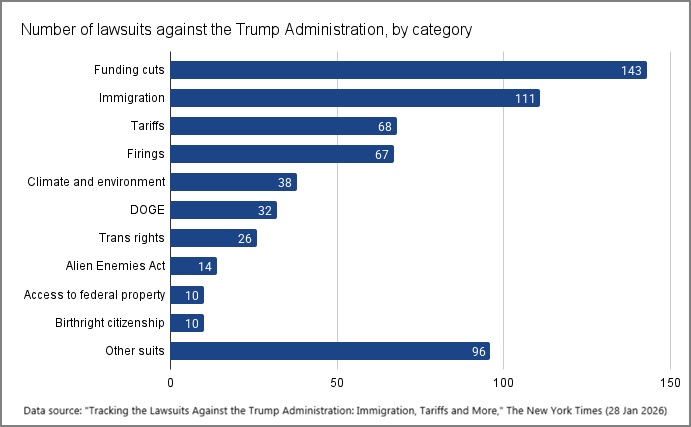
More
than
600
lawsuits
have
been
filed
against
the
administration
since
Trump
took
office
a
year
ago,
according
to
The
New
York
Times,
which
has
been
tracking
the
cases.
Trump’s
extensive
cuts
to
federal
funding
—
in
areas
such
as
scientific
research,
foreign
aid,
disaster
preparedness,
transportation
infrastructure,
among
many
others
—
have
triggered
the
most
lawsuits
(143).
Immigration
is
the
second-most
frequent
subject
of
litigation
(111
cases).
Tariffs
and
the
firing
of
federal
officials
have
also
prompted
dozens
of
lawsuits.
Other
actions
involve
the
Alien
Enemies
Act,
birthright
citizenship,
environmental
policies,
DOGE
cuts,
transgender
rights,
and
access
to
federal
property
(notably
four
law
firms’
successful
challenges
to
Trump’s
punitive
executive
orders).
The
decisive,
overwhelming
support
from
our
partnerships
reflects
a
shared
passion
and
commitment
to
meeting
our
clients’
desire
for
a
unified
team
across
the
Atlantic—one
that
delivers
unparalleled
advice
and
capability
in
the
areas
that
matter
most
to
them.
—Steve
D’Amore,
Winston
&
Strawn’s
chair,
said
in
a
statement
announcing
the
proposed
merger
between
Winston
&
Strawn
and
Taylor
Wessing
has
garnered
the
approval
of
the
firms’
partners.
The
combined
firm
will
have
1,400
lawyers
worldwide
and
revenue
of
more
than
$1.75
billion.
For
the
first
time,
a
huge
group
of
parents,
teens
and
school
districts
is
taking
on
the
world’s
most
powerful
social
media
companies
in
open
court,
accusing
the
tech
giants
of
intentionally
designing
their
products
to
be
addictive.
The
blockbuster
legal
proceedings
may
see
multiple
CEOs,
including
Meta’s Mark
Zuckerberg,
face
harsh
questioning.
A
long-awaited
series
of
trials
kicks
off
in
Los
Angeles
superior
court
on
Tuesday,
in
which
hundreds
of
US
families
will
allege
that Meta, Snap, TikTok and YouTube’s
platforms
harm
children.
Once
young
people
are
hooked,
the
plaintiffs
allege,
they
fall
prey
to
depression,
eating
disorders,
self-harm
and
other
mental
health
issues.
Approximately
1,600
plaintiffs
are
included
in
the
proceedings,
involving
more
than
350
families
and
250
school
districts.
The
lawyers
involved
are
explicitly
using
the
tobacco
playbook,
comparing
social
media
to
cigarettes.
But
there’s
an
important
point
here:
“social
media
addiction”
isn’t
actually
a
recognized
clinical
addiction.
And
a
fascinating
new
study
in
Nature’s
Scientific
Reports
suggests
that our
collective
insistence
on
using
addiction
language
might
actually
be
making
things
worse
for
users who
want
to
change
their
behavior.
The
researchers
conducted
two
studies.
In
the
first,
they
surveyed
a
nationally
representative
sample
of
adult
Instagram
users
and
found
something
striking:
only
about
2%
of
users
showed
symptoms
that
would
put
them
at
risk
for
addiction
based
on
the
clinical
criteria
in
the Bergen
Social
Media
Addiction
Scale.
But
when
asked
directly
if
they felt addicted,
18%
of
users
agreed
at
least
somewhat.
In
other
words,
people
are dramatically
overestimating whether
they’re
actually
addicted.
This
matters
a
lot,
because
calling
yourself
addicted
can
have
serious
consequences.
The
study
found
that
users
who
perceived
themselves
as
more
addicted
(but
not
necessarily
more
habitual)
reported
feeling
less
control
over
their
use
and
had
made
more
unsuccessful
attempts
to
change
their
behavior.
From
the
study:
Self-labeling
of
clinical
conditions
(e.g.,
I
think
I’m
depressed)
has
proved
to
be
associated
with
maladaptive
responses,
including
lowered
self-efficacy
and
perceived
control
over
the
pathology
To
test
whether
the
addiction
framing
actually
causes
these
problems
rather
than
just
correlating
with
them,
the
researchers
ran
a
second
study.
They
had
some
participants
reflect
on
their
own
“addictive”
Instagram
use
after
reading
language
from
the
U.S.
Surgeon
General’s somewhat
questionable report
warning
that
“frequent,
excessive
social
media
use
is
addictive.”
The
control
group
answered
the
same
questions
but
without
the
addiction
framing
first.
The
results
were
clear
and
somewhat
striking:
simply
priming
people
to
think
about
their
social
media
use
as
an
addiction reduced
their
perceived
control,
increased
both
self-blame
and
blaming
the
app,
and
made
them
recall
more
failed
attempts
to
cut
back.
The
addiction
framing
itself
creates
a
feeling
of
helplessness!
The
addiction
to
“addiction
framing”
may
be
a
big
part
of
the
problem!
It
is
impressive
that
even
the
two-minute
exposure
to
addiction
framing
in
our
research
was
sufficient
to
produce
a
statistically
significant
negative
impact
on
users.
This
effect
is
aligned
with
past
literature
showing
that
merely
seeing
addiction
scales
can
negatively
impact
feelings
of
well-being.
Presumably,
continued
exposure
to
the
broader
media
narrative
around
social
media
addiction
has
even
larger
and
more
profound
effects.
In
conclusion,
the
addiction
label
does
not
empower
users
to
regain
control
over
their
use.
Instead,
it
hinders
users
by
reducing
feelings
of
control,
increasing
self-blame,
and
making
the
experience
slightly
less
positive.
Perhaps
one
could
argue
that
everyone
screaming
about
social
media
addiction
is
doing
more
real
harm
than
any
actual
social
media
product
itself.
This
matters
because
for
the
vast
majority
of
heavy
social
media
users,
the
problem
isn’t
addiction
in
any
clinical
sense.
It’s
habit.
Habits
and
addictions
are
different
psychological
phenomena
requiring
different
interventions.
As
the
researchers
note:
For
the
majority
of
social
media
users,
however,
curbing
excessive
use
involves
primarily
controlling
habits.
Like
any
other
habit,
social
media
habits
can
become
misaligned
with
the
original
motivations
for
use
(e.g.,
to
obtain
social
rewards),
or
conflict
with
other
goals
(e.g.,
sharing
true
information).
Strong
habits
are
notoriously
difficult
to
control
with
willpower
alone.
For
habitual
social
media
users,
the
narrative
of
addiction
and
willpower-based
attempts
to
control
behavior
could
profitably
be
replaced
with
habit
change
strategies
to
realign
their
social
media
use
with
their
current
preferences.
Habits
are
context-triggered
automatic
behaviors.
You
pick
up
your
phone
in
certain
situations
because
you’ve
done
it
a
thousand
times
before,
not
because
you’re
experiencing
withdrawal
symptoms
or
uncontrollable
cravings,
like
an
addiction.
And
habit
change
strategies—like
removing
triggers,
changing
your
environment,
or
practicing
substitute
activities—are
fundamentally
different
from
addiction
treatment.
But
you
wouldn’t
know
any
of
this
from
the
media
coverage.
The
researchers
analyzed
three
years
of
news
articles
and
found
that
stories
about
“social
media
addiction”
vastly
outnumber
stories
about
“social
media
habits.”
The
addiction
framing
is
everywhere.
And
every
time
the
Surgeon
General
warns
about
addiction,
every
time
a
lawsuit
alleges
platforms
are
designed
to
be
addictive,
every
time
a
news
story
describes
teens
as
hooked,
it
reinforces
the
idea
that
users
are
powerless
victims.
Indeed,
the
study
found
that
the
very
lawsuits
that
went
to
trial
this
week are
likely
contributing
to
the
problem.
In
addition,
over
the
36
assessment
months,
the
number
of
articles
discussing
“social
media
habits”
never
approached
the
number
of
articles
including
the
term
“social
media
addiction”
(see
Fig.
2).The
stories
driving
these
effects
were
often
lawsuits.
For
example,
the
May
2022
and
October
2024
peaks
for
“social
media
addiction”
related
to
news
reporting
on
multiple
lawsuits
against
Meta
(owners
of
Instagram).
In
addition,
the
May
2023
Surgeon
General’s
warning
about
social
media
addiction
seems
to
have
contributed
to
the
steady
drumbeat
of
new
articles
during
the
April-June
2023
period
for
“social
media
addiction.”
To
be
clear:
most
social
media
companies
absolutely
design
their
products
with
increasing
engagement
in
mind.
There
are
plenty
of
corporate
incentives
to
keep
you
using
the
app
longer.
And
some
people
genuinely
do
use
social
media
in
ways
that
harm
their
lives.
Both
things
can
be
true
while
“addiction”
remains
the
wrong
frame.
The
question
is
whether
calling
it
an
addiction
actually
helps
anyone,
or
whether
it
just
makes
people
feel
powerless.
But
there’s
a
meaningful
difference
between
“this
product
is
designed
to
form
habits”
and
“this
product
is
chemically
addictive
like
heroin.”
A
chemical
addiction
involves
tolerance,
withdrawal,
and
physiological
dependence.
The
study
found
that
only
about
4%
of
users
reported
experiencing
anything
akin
to
withdrawal
symptoms
(restlessness
or
trouble
when
prohibited
from
using)
often
or
very
often.
The
most
common
“symptom”
was
simply
thinking
about
Instagram
a
lot—which
probably
describes
anyone
who
uses
any
service
frequently.
I
think
about
Techdirt
a
lot.
Am
I
“addicted”
to
it?
The
addiction
framing removes
human
agency
from
the
equation.
It
treats
users
as
helpless
victims
who
can’t
possibly
resist
the
siren
song
of
the
infinite
scroll.
But
the
same
study
that
found
2%
of
users
at
risk
for
addiction
also
found
that
50%
of
frequent
users
recognized
they
had
habits
around
Instagram
use.
Those
users
aren’t
powerless.
They
can
change
their
environment,
their
cues,
their
routines.
But
first
they
have
to
believe
that’s
possible—and
the
addiction
narrative
tells
them
it
isn’t.
Misclassifying
frequent
social
media
and
technology
use
as
addictive
has
muddled
public
understanding
of
the
psychology
behind
these
behaviors
and
likely
inhibits
users’
understanding
of
the
ways
to
effectively
control
their
own
behavior.
It
also
makes
the
technology
appear inherently harmful,
when
(as
pretty
much
every
study
keeps
showing)
only
a
very
small
percentage
of
people
seem
to
have
truly
negative
experiences
with
it.
That
should
be
cause
to
create
targeted
solutions
for
those
who
are
genuinely
struggling,
not
to
declare
an
entire
category
of
technology
dangerous
for
everyone.
So
here
we
are:
lawsuits
claiming
to
protect
users
from
social
media’s
harms
may
themselves
be
contributing
to
those
harms
by
amplifying
the
addiction
narrative.
The
lawyers
will
get
paid
either
way.
But
if
we
actually
want
to
help
people
develop
healthier
relationships
with
technology,
we
could
start
by
not
telling
them
they’re
powerless
addicts—and
instead
give
them
the
tools
to
change
their
habits.
*
Trump
suing
the
IRS
for
$10
billion
over
leaking
of
the
tax
documents
that
he
promised
repeatedly
he
was
going
to
release
and
never
did.
Surely
Pam
Bondi
will
fight
this
case
zealously
to
protect
taxpayers!
[CNN]
*
Someone
tried
to
free
Luigi
using
a
pizza
cutter.
[Reuters]
*
Deputy
AG
Todd
Blanche
apparently
held
six
figures
worth
of
crypto
investments
while
using
his
job
to
shut
down
crypto
investigations.
[ProPublica]
*
California
Chief
Justice
wants
limits
on
ICE
presence
in
courthouses.
[The
Recorder]
*
Proposed
judiciary
AI
rule
may
come
away
from
criticism
stronger
than
ever.
[Law360]
*
Study
finds
jurors
perform
just
as
well
in
person
as
they
do
online.
[ABA
Journal]
*
Senate
may
repeal
law
that
allowed
colleagues
to
sue
the
government
over
federal
investigations.
[Politico]








 Kathryn