Bulawayo dams at 50% as mining disrupts catchment areas

Council
authorities
say
the
situation
has
been
worsened
by
extensive
mining
activities
in
dam
catchment
areas
in
Matabeleland
South,
where
most
of
Bulawayo’s
water
sources
are
located.

On
Friday,
councillors,
engineers,
media
and
other
stakeholders
joined
a
Bulawayo
City
Council
(BCC)
inspection
tour
of
three
of
the
city’s
six
supply
dams,
Upper
Ncema,
Inyankuni
and
Mzingwane.

The
visit
revealed
widespread
mining
operations
close
to
the
reservoirs,
including
active
sites
using
large
water
bowsers
and
storage
tanks.

Residents
across
Bulawayo
continue
to
endure
prolonged
water
shedding,
with
some
suburbs
going
up
to
four
days
without
supply.

Bulawayo
Mayor
David
Coltart
has
repeatedly
raised
concerns
about
mining
in
catchment
areas,
warning
that
it
is
disrupting
water
inflows
into
the
dams
and
threatening
the
city’s
long-term
water
supply.

Council
figures
show
that
as
of
31
January
2026,
Bulawayo’s
operational
dams
were
only
48.35%
full,
a
level
officials
say
is
inconsistent
with
the
amount
of
rainfall
received
this
season.

Speaking
on
the
sidelines
of
the
tour,
BCC
Director
of
Engineering
Services
Sikhumbuzo
Ncube
described
the
situation
as
“dire”.

“We
last
experienced
this
level
of
rainfall
around
2017
or
2018.
By
the
end
of
January
then,
our
supply
dams
were
about
70%
full,”
he
said.

“Now,
despite
the
good
rains,
the
dam
levels
are
not
looking
good
at
all.”

Eng
Ncube
said
Upper
Ncema
Dam,
one
of
the
city’s
most
critical
reserves,
was
only
40%
full.

“This
is
the
dam
we
rely
on
most
when
the
others
dry
up.
Normally,
we
begin
drawing
from
it
around
August
or
September,
but
at
this
rate
we
are
not
sure
it
will
have
sufficient
capacity,”
he
said.

He
added
that
addressing
the
problem
would
require
cooperation
among
all
stakeholders,
including
mining
interests.

“We
have
seen
the
extent
of
digging
in
the
catchment
areas.
Decisions
around
this
cannot
be
made
by
one
person.
All
stakeholders
need
to
come
together
to
discuss
how
best
to
protect
the
environment
and
ensure
adequate
water
for
Bulawayo,”
he
said.

The
chairperson
of
the
council’s
Future
Water
Committee,
Councillor
Khalazani
Ndlovu,
said
the
inspection
had
highlighted
the
scale
of
the
disruption
affecting
the
city’s
water
sources.

“After
such
a
good
rainy
season,
we
had
hoped
to
ease
water
shedding,
but
the
dam
levels
are
worrying,”
he
said.

“Our
residents
are
currently
on
a
96-hour
water
shedding
schedule.
If
we
reduce
the
shedding
hours
now,
we
may
fail
to
make
it
to
the
next
rainy
season.”

She
described
Upper
Ncema
as
the
city’s
most
important
reserve,
adding:
“At
40%,
it
is
simply
not
where
it
should
be.
It
is
a
serious
concern
for
Bulawayo.”

Solarised borehole brings relief to Njube and Old Lobengula residents

A
solarised
borehole,
funded
through
the
Constituency
Development
Fund
(CDF)
at
a
cost
of
ZiG
440
000,
was
officially
handed
over
on
Friday
in
a
ceremony
attended
by
community
leaders
and
education
officials.

Prince
Dube,
Member
of
Parliament
for
the
area,
which
covers
Entumbane
Ward
10,
Njube
Ward
12,
and
part
of
Lobengula,
said
improving
access
to
water
was
the
constituency’s
top
development
priority.

“In
terms
of
development,
our
main
focus
through
the
Constituency
Development
Fund
is
the
needs
of
the
people,
and
water
is
a
key
issue,”
Dube
said.
“Bulawayo
is
a
dry
city,
so
our
first
step
was
to
replace
old
borehole
equipment
with
modern
technology.
Water
should
be
available
for
everyone.”

He
urged
the
community
to
safeguard
the
new
borehole
to
ensure
it
continues
to
serve
residents
for
years
to
come.

“We
hope
the
people
use
and
protect
this
solarised
borehole.
Any
incidents
of
vandalism
should
be
reported
so
we
can
address
them
promptly.
Development
is
immediate
with
the
CDF
because
we,
including
the
senator
and
councillors,
are
directly
involved
in
identifying
and
responding
to
local
needs,”
he
added.

Dube
also
highlighted
that
the
CDF
supports
local
development
projects
using
domestic
resources.

“The
CDF
funds
come
in
our
local
currency
and
focus
on
home-grown
development,
showing
that
we
are
building
using
our
own
resources
rather
than
importing
from
outside,”
he
said.

Proportional
Representation
Councillor
Siboniso
Moyo
welcomed
the
new
facility,
noting
the
relief
it
has
brought
to
residents,
particularly
women.

“It
used
to
be
very
difficult
to
access
water,
often
requiring
long
trips,
especially
for
women,”
Moyo
said.
“Now
it
is
much
easier.
The
solarised
borehole
has
been
a
huge
help
to
our
community,
improving
access
to
clean
water
for
everyone.”

Judge Charged For Handcuffing Attorney – See Also – Above the Law

Didn’t
Teach
The
Lesson
You
Intended
To:
Not
a
smart
move
from
a
judge.
Nothing
Says
Fighting
The
KKK
Like
Arresting
Black
Journalists:
The
Don
Lemon
arrest
is
just
the
tip
of
the
iceberg.
Trump
Sues
IRS
For
$10B:
You
can
just
make
up
whatever
numbers
you
want
when
you’re
president.
The
FTC
Is
Coming
For
The
Mansfield
Rule:
They’re
trying
to
turn
hiring
minorities
in
to
a
Sherman
Act
violation.
Death
Is
Off
The
Table:
Luigi
Mangione
scores
huge
legal
win.

The Biglaw Firm Working To Overturn One Of Sports’ Biggest Injustices – Above the Law

(Photo
by
Naomi
Baker/Getty
Images)


Ed.
Note:

Welcome
to
our
daily
feature

Trivia
Question
of
the
Day!


Jordan
Chiles
won
a
victory
at
Switzerland’s
supreme
court
in
her
quest
to
keep
the
bronze
medal
awarded
to
her
at
the
2024
Olympic
Games.
Which
Biglaw
firm,
along
with
Zurich-headquartered
firm
Homburger
AG,
represents
Chiles?


Hint:
Chiles’s
third
place
award
was
overturned
by
an
appeal
by
the
Romanian
team
on
the
grounds
that
Team
USA’s
challenge
of
Chiles’s
original
score
(which
gave
her
the
extra
tenths
necessary
to
secure
the
bronze
medal) was
not
submitted
within
the
one
minute
allowed
by
the
rules.
The
court’s
new
ruling
means
the
Court
of
Arbitration
for
Sport
must
examine
recorded
evidence
that
the
challenge
was
submitted
within
the
designated
timeframe.


See
the
answer
on
the
next
page.

How Appealing Weekly Roundup – Above the Law


Ed.
Note
:

A
weekly
roundup
of
just
a
few
items
from
Howard
Bashman’s

How
Appealing
blog
,
the
Web’s
first
blog
devoted
to
appellate
litigation.
Check
out
these
stories
and
more
at
How
Appealing.


Handling
of
Pretti
investigation
has
some
prosecutors
on
verge
of
quitting;
Federal
prosecutors
in
Minneapolis,
frustrated
by
the
response
to
the
shootings
of
Renée
Good
and
Alex
Pretti,
have
suggested
they
could
resign
en
masse”:
 Perry
Stein
of
The
Washington
Post
has this
report
.


“Ninth
Circuit
revives
challenge
to
Idaho
library
book
censorship
law;
The
court
found
the
law
likely
violates
the
First
Amendment
by
allowing
subjective,
age-based
censorship”:
 Monique
Merrill
of
Courthouse
News
Service
has this
report
 on a
ruling
 that
the U.S.
Court
of
Appeals
for
the
Ninth
Circuit
 issued
today.


“Tom
Goldstein
Saga
Could
Go
From
Courtroom
To
Big
Screen”:
 Rachel
Rippetoe
of
Law360
has this
report
 (subscription
required
for
full
access).


“Appeals
Court
Rules
in
Favor
of
Protections
for
Venezuelans;
The
Trump
administration
has
sought
to
end
Temporary
Protected
Status
for
more
than
a
million
people
from
troubled
nations;
About
600,000
are
from
Venezuela”:
 Jazmine
Ulloa
of
The
New
York
Times
has this
report
.


“An
Ethicist
‘in
the
Scalia
Mold’:
The
Minnesota
Judge
Blasting
ICE;
Judge
Patrick
Schiltz,
an
appointee
of
George
W.
Bush,
became
an
unlikely
foil
for
his
criticism
of
the
Trump
administration’s
tactics
in
Minnesota.”
 Zach
Montague
of
The
New
York
Times
has this
report
.


“The
Supreme
Court
Should
Take
Up
the
USAA
Case
to
Bring
Clarity
to
the
Esoteric
‘Abstract
Ideas’
Doctrine
of Alice”:
 Gene
Quinn
has this
post
 at
IPWatchdog.

Epic vs. Health Gorilla: Inside the Battle Over Who Controls Your Medical Records – MedCity News

Earlier
this
month,

Epic
,
together
with
a
handful
of
healthcare
providers,
filed
a
federal
lawsuit
against
health
data
network

Health
Gorilla

aimed
at
stopping
an
alleged
scheme
to
exploit
and
monetize
patient
medical
records
without
consent. 

Ultimately,
the
dispute
reflects
unresolved
ambiguities
in
how
data
interoperability
should
be
governed
across
the
healthcare
industry.
Experts
think
the
lawsuit
is
less
about
stopping
one
bad
actor

and
more
about
the
need
to
define
standardized
rules
and
boundaries
around
healthcare
data
exchange.


Alleged
conspiracy
to
monetize
patient
data


The
complaint
,
filed
January
13,
claims
that
Health
Gorilla
enabled
other
companies
to
inappropriately
access
and
monetize
nearly
300,000
patient
medical
records.
Health
Gorilla
has
denied
the
allegations.

The
plaintiffs
are
Epic,

Trinity
Health
,

UMass
Memorial
Health
,

Reid
Health

and

OCHIN
.
They
allege
that
Health
Gorilla
and
a
network
of
other
companies
set
up
fictitious
healthcare
providers,
shell
websites
and
fake
provider
IDs
to
make
it
look
like
records
requests
were
for
real
treatment
purposes.
Instead,
the
data
was
allegedly
diverted
for
non-treatment
uses

such
as
marketing
to
lawyers
seeking
potential
claimants
for
lawsuits.

The
other
companies
involved
in
the
network
are
a
cluster
of
small
telehealth,
data
and
shell
companies

many
allegedly
linked
to
the
same
founders
and
operators

that
the
plaintiffs
say
were
used
to
pose
as
legitimate
providers.

The
complaint
also
stated
that
the
defendants
inserted
“junk”
information
into
records
to
hide
their
activity
and
give
the
appearance
of
genuine
care,
which
in
turn
risked
patient
safety
and
wasted
clinician
time.

When
one
fraudulent
entity
was
exposed,
the
same
actors
allegedly
created
new
companies
to
continue
the
same
conduct,
operating
“like
a
Hydra,”
according
to
the
lawsuit.

The
lawsuit
alleges
violations
of
HIPAA,
as
well
as
other
federal
and
state
privacy
protections.
It
also
frames
the
scheme
as
threatening
both
patient
privacy
and
the
integrity
of
interoperable
health
data
sharing
systems.

The
plaintiffs
are
seeking
injunctive
relief
to
immediately
put
an
end
to
the
alleged
misconduct.

Health
Gorilla
is
“fully
prepared”
to
defend
its
conduct,
according
to
a

statement

released
this
week
by
CEO
Bob
Watson. 

“Epic’s
lawsuit
not
only
fails
to
provide
all
the
facts,
but
reflects
an
irresponsible
use
of
litigation
as
a
weapon
rather
than
to
advance
serious
claims.
As
Epic
knows,
when
Health
Gorilla
learned
of
the
allegations
Epic
raises
in
its
complaint,
Health
Gorilla
immediately
suspended
the
connections
in
question
and
began
investigating
their
use
of
healthcare
data,”
Watson
stated.

Although
Health
Gorilla’s
investigation
is
still
ongoing,
the
connections
in
question
have
remained
suspended,
he
added.

Watson
also
said
that
“Epic
has
done
the
equivalent
of
shouting
‘fire’
in
the
middle
of
a
crowded
theater”
when
it
comes
to
interoperability,
suggesting
that
the
EHR
giant’s
claims
could
unnecessarily
alarm
the
industry
and
disrupt
progress
toward
legitimate
data
exchange.


Interoperability
vs.
governance

The
core
issue
of
this
legal
battle
isn’t
interoperability

it’s
governance,
pointed
out
Jackie
Mattingly,
senior
director
of
consulting
services
at
healthcare
security
and
compliance
firm

Clearwater
.

“It’s
not
a
case
about
interoperability
failing

it’s
the
governance
that’s
lagging
behind.
Obviously
we
do
need
interoperability

because
we
travel,
and
we
go
to
different
places,
and
our
data
needs
to
be
accessible.
But
the
governance
hasn’t
caught
up,”
she
declared.

Governance
weakens
once
data
leaves
the
EHR,
Mattingly
noted.
While
hospitals
typically
have
strong
controls
within
their
EHRs,
oversight
can
crumble
when
data
flows
to
external
platforms,
analytics
tools
and
third
parties.
Accountability
doesn’t
end
when
data
leaves
Epic,
she
said.

She
thinks
access
controls
have
to
get
stricter,
saying
that
granting
data
access
can’t
be
a
“set
it
and
forget
it”
process.
Healthcare
organizations
need
purpose-based
access
controls
and
continuous
reassessment
of
whether
data
sharing
is
still
justified,
Mattingly
stated. 

That
gap
between
technical
interoperability
and
accountability
is
increasingly
seen
as
a
systemic
flaw
in
today’s
data
sharing
infrastructure.
Another
healthcare
leader

Tyler
Giesting,
director
of
healthcare
M&A
at
West
Monroe

said
that
the
lawsuit
exposes
shortcomings
and
ambiguities
in

TEFCA
’s
current
rules
for
exchanging
clinical
data.
The
Trusted
Exchange
Framework
and
Common
Agreement
(TEFCA)
is
a
federal
initiative
designed
to
standardize
rules
and
technical
standards
for
nationwide
health
data
exchange.

The
framework
is
new
and
still
evolving,
so
it
lacks
clear,
enforceable
definitions
around
who
can
access
data
and
for
what
purposes,
Giesting
noted.

To
him,
this
case
highlights
the
need
for
stricter,
possibly
federally-led
standards
governing
nationwide
data
exchange. 

And
it’s
not
the
only
recent
legal
battle
that
has
shone
light
on
this
issue

in
the
past
two
years,
courts
have
also
seen
lawsuits
against
data
brokers
like

BetterHelp

and

Meta

over
alleged
misuse
of
sensitive
health
data,
as
well
as

disputes

involving
EHR
vendors
and
interoperability
networks
over
how
patient
information
can
be
shared.

Providers
are
concerned
about
the
problem
too.
Last
week,
more
than
60
health
systems

including

Stanford
Health
Care

and

NYU
Langone
Health


sent
a
letter

to
Mariann
Yeager,
CEO
of

The
Sequoia
Project
,
a
nonprofit
that
influences
the
governance
of
health
data
sharing
networks,
demanding
better
oversight
and
transparency.


Closing
the
gaps

In
Giesting’s
view,
the
industry
would
benefit
by
shifting
to
a
“trust
but
verify”
framework.

“[TEFCA]
is
a
trust-based
model.
I
think
the
lawsuit
is
potentially
exposing
that
there
may
need
to
be
some
type
of
a
shift
to
a
‘trust
but
verify’
model.
Is
the
person
requesting
the
health
information,
truly
who
they
say
they
are?
And
do
they
have
an
authorized
reason
to
receive
the
clinical
record?
That
is
not
fully
ironed
out
in
the
current
framework,”
he
stated.

TEFCA
also
has
gray
areas
around
third-party
data
use,
Giesting
added.
The
framework
doesn’t
clearly
address
scenarios
where
data
is
requested
for
purposes
outside
direct
patient
care

so
Health
Gorilla
could
argue
it
followed
existing
rules
and
TEFCA
guidance
as
a
designated
qualified
health
information
network.

The
lawsuit
could
make
healthcare
organizations
more
cautious
about
sharing
data,
Giesting
predicted.
He
thinks
some
companies
may
limit
participation
in
TEFCA
or
data
exchange
to
avoid
privacy
or
legal
risks.

He
noted
that
this
could
slow
progress
on
industry-wide
interoperability
until
clearer
federal
guidance
emerges

echoing
the
concerns
raised
by
Watson,
Health
Gorilla’s
CEO.

Despite
this
near-term
friction,
interoperability
is
too
central
to
healthcare

in
terms
of
cost
control,
data-driven
care
improvements
and
clinical
research
innovation

to
disappear,
Giesting
said.

He
noted
that
the
case
underscores
a
broader
pattern:
private-sector
innovation
moves
faster
than
regulation

especially
in
the
healthcare
world.

“I
think
the
private
sector
generally
kind
of
pushes
the
bar
to
the
next
phase.
Even
with
AI,
there
will
be
innovation,
and
then
regulatory
measures
will
catch
up.
I
think
that’s
what’s
happening
here,
and
it
just
points
out
the
importance
of
having
very
close
coordination
between
companies
in
the
technology
ecosystem,
like
Epic
and
Health
Gorilla,”
Giesting
remarked.


Boosting
oversight
to
protect
trust

In
order
to
improve
data
sharing
across
the
sector,
interoperability
frameworks
must
actively
enforce
rules,
not
just
move
data,
according
to
Jason
Prestinario,
CEO
of
data
platform

Particle
Health

He
argued
that
frameworks
like
TEFCA
and
Carequality
can’t
be
“passive
pipes,”
saying
they
need
better
oversight,
compliance
monitoring
and
enforcement.
When
they
fail
to
do
this,
trust
breaks
down,
he
stated.

Particle
Health
is
dealing
with
an
Epic
lawsuit
of
its
own,
though
in
this
case
Epic
is
the
defendant
and
not
the
plaintiff.
In
September
2024,
Particle
Health

sued

Epic
over
claims
that
the
EHR
vendor
is
using
its
dominance
in
the
market
to
prevent
competition
in
the
payer
platform
space.
The
complaint
claims
that
Epic
imposed
technical
and
contractual
barriers
that
limited
access
to
patient
data,
which
has
effectively
blocked
rivals
from
building
competing
payer-facing
platforms.
Last
September,
a
federal
judge

advanced

the
antitrust
lawsuit.

Even
though
Particle
and
Epic
aren’t
on
the
friendliest
terms
right
now,
Prestinario
still
believes
that
Epic
is
raising
legitimate
concerns
about
suspicious
activity
and
the
need
for
stronger
protections
in
health
data
exchange.

He
noted
that
Epic’s
complaint
said
that
it
had
raised
concerns
to
Health
Gorilla
and
other
network
participants
about
suspicious
data
access
and
potential
misuse
of
patient
records
several
months
before
filing
the
lawsuit.

“Under
the
assumption
that
that
timeline
is
accurate,
that’s
unacceptable.
It
puts
every
single
implementer
out
there,
including
Particle,
in
a
difficult
position,”
Prestinario
declared. 

In
other
words,
if
what
Epic
is
alleging
is
true,
then
this
lack
of
transparency
and
inadequate
data
control
poses
a
systemic
risk
to
interoperability
and
competition
in
the
health
data
ecosystem.

Epic
allegedly
had
no
visibility
into
what
was
investigated
or
how.
Prestinario
warned
that
this
lack
of
transparency
can
erode
trust
and
restrict
legitimate
data
access.

In
his
view,
scandals
like
this
have
two
damaging
effects:
they
often
lead
to
reduced
participation
in
nationwide
health
data
exchange,
as
well
as
tighter
restrictions
on
necessary
data
access
under
the
guise
of
security.

“Every
scandal
becomes
a
reason
to
restrict
access,
and
I
worry
that
this
sets
up
a
dynamic
where
Epic
eventually
says,
‘We’re
out
of
these
frameworks
entirely.’
The
answer
to
all
of
this
is
not
less
interoperability.
It’s
not
for
us
to
move
away
from
the
democratization
of
legitimate
data
access.
It’s
better
enforcement
of
the
rules
on
all
sides,”
Prestinario
remarked. 

He
said
he
hopes
the
industry
can
tighten
safeguards
while
keeping
data
accessible.


Photo:


Aitor
Diago,
Getty
Images

It’s ‘Flood The Zone Friday’ As DOJ Arrests Black Journalists Under KKK Act, Probes Criminal Charges For Minneapolis, And Drops (A Sliver Of) The Epstein Files – Above the Law

Department
of
Justice

This
is
what
happens
when
flooding
the
zone
meets
Friday
news
dump.
Two
of
DC’s
most
infamous
distraction
techniques
came
together
over
the
last
24
hours,
putting
a
strain
on
any
legal
analyst
trying
to
flag
and
explain
what’s
going
on.


Trump
is
suing
the
federal
government
to
get
$10
billion
in
taxpayer
dollars

over
the
“perfect”
leaked
tax
records
that
Trump
himself
promised
to
disclose
publicly.
After
breaching
his
promise
and
being
proven
a
liar,
he
realized
that
he
can
just
sue
his
own
government.
Will
Attorney
General
Pam
Bondi
honor
her
oath
to
the
country
and
tell
him
“no
way,
we’ll
see
you
in
court!”

While
I
haven’t
checked
out
Polymarket
yet,
my
guess
is
that
the
“no”
contract
is
trading
right
around
the
Browns
Super
Bowl
chances.

It’s
not
a
great
look
for
an
already
deeply
unpopular
regime.
But
when
life
gives
you
a
lemon…
directly
disobey
multiple
federal
courts
finding
no
legal
basis
for
a
lawful
arrest.

Don
Lemon,
in
this
case.
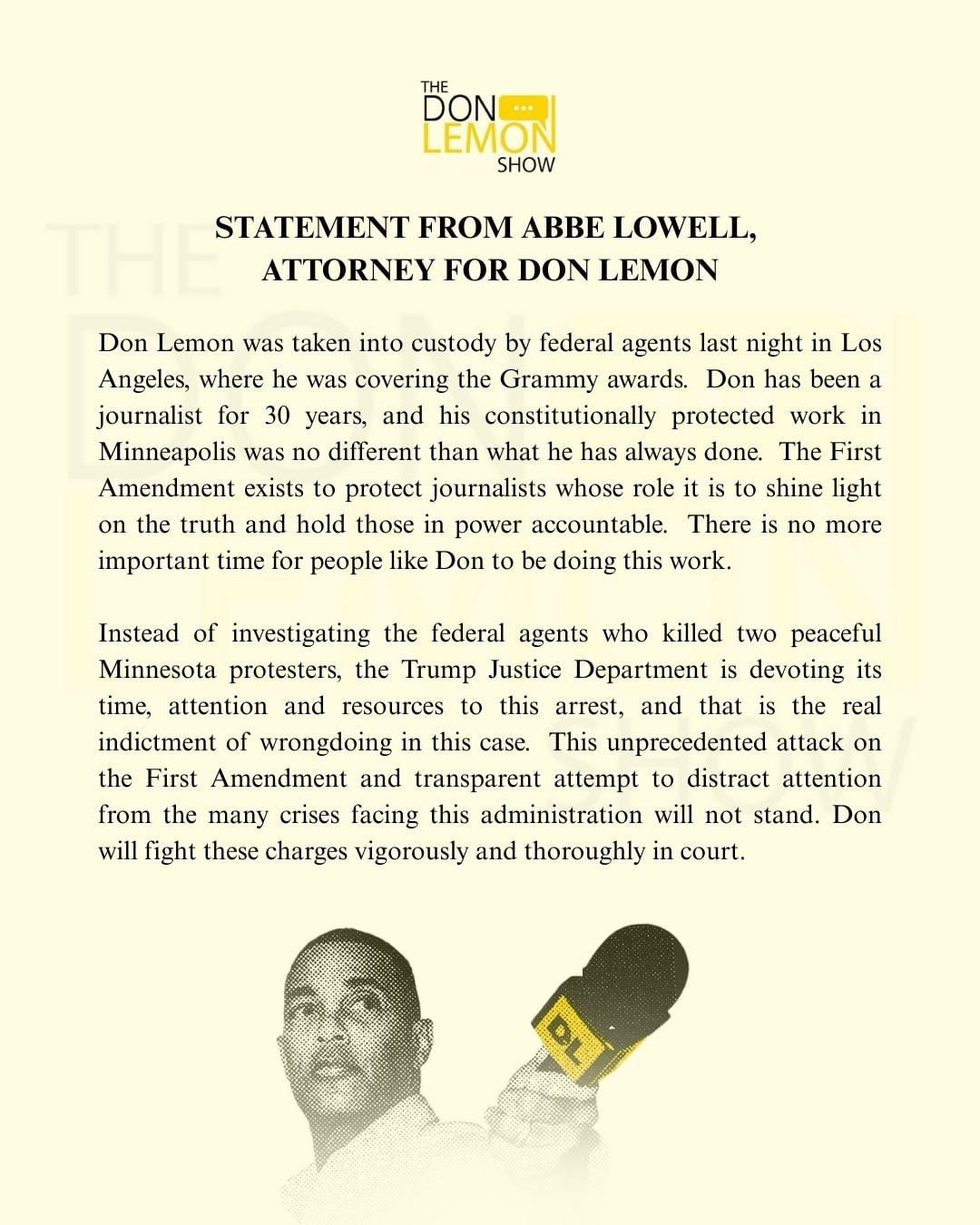
Abbe
Lowell
released
a
statement
on
behalf
of
his
client,
announcing
that
federal
agents
had
arrested
the
journalist
in
Los
Angeles
while
he
was
covering
the
Grammy
awards.

The
DOJ
has
been
trying

and
spectacularly
failing

to
arrest
Lemon
for
a
while
now.
Attorney
General
Pam
Bondi
keeps
tweeting
about
Lemon’s
role
in
a
“coordinated
attack”
on
a
January
18th
service
at
Cities
Church
in
St.
Paul.
In
reality,
protesters
disrupted
the
service
to
call
out
pastor
David
Easterwood

who
moonlights
as
the
leader
of
the
local
ICE
field
office.
Lemon
did
not
participate
in
the
protest,
but
did
livestream
the
event
as
a
journalist.

The
arrest
is
at
once
shocking
and
completely
unsurprising.
Shocking
because
the
DOJ’s
attempt
to
contrive
any
legal
justification
to
arrest
Lemon
already
earned
a
thorough
and
absolute
ass-kicking
in
federal
court.
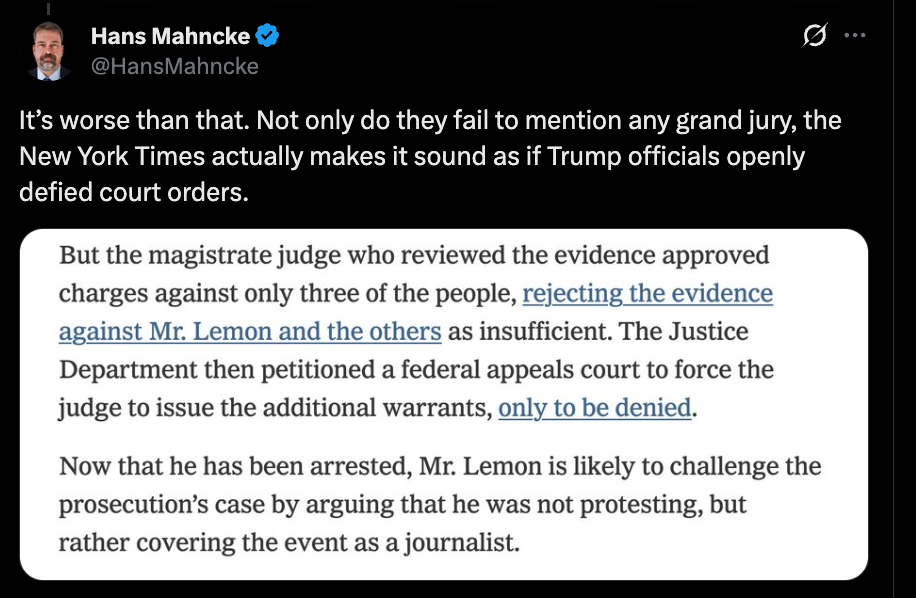
When
federal
prosecutors
initially
sought
arrest
warrants
for
Lemon
and
four
others,
Magistrate
Judge
Douglas
Micko
took
one
look
at
their
evidence
and
laughed
them
out
of
court,
refusing
to
sign
the
warrants
for
lack
of
probable
cause.
Unwilling
to
accept
this
loss,
the
DOJ
first
tried
to
convince
Chief
Judge
Patrick
Schiltz
to
overrule
the
magistrate
judge
and,
when
he
raised
concerns
that
this
would
be,
you
know,

baseless
and
possibly
illegal
,
the
DOJ
ducked
out
of
a
scheduled
hearing
and
tried
to
convince
the
Eighth
Circuit
to
issue
a
writ
of
mandamus
ordering
the
judge
to
issue
the
warrant.

The
appellate
panel
did
not
issue
the
writ
and
the
DOJ
dropped
the
request.
But
the
whole
episode
did
give
us

an
entertaining
right-wing
social
media
slapfight
.

This
should
have
marked
the
end
of
a
troubling
campaign
to
punish
a
journalist
for
journalisming,
but
what
this
DOJ
lacks
in
professionalism
and
legal
acumen
they
more
than
make
up
for
in
creativity.
Unable
to
secure
a
warrant,
Attorney
General
Pam
Bondi
announced
that
she

directed

federal
agents
to
arrest
the
journalists.

What
does
that
mean?
Who
knows?
Though
it
would
suggest
that
the
government
went
behind
the
backs
of
all
the
judges
and
found
a
grand
jury
willing
to
indict
a
ham
sandwich
(not
the
easiest
task
for
them
these
days
)
based
on
the
paucity
of
facts
that
left
multiple
federal
judges
unimpressed.
As
Marcy
Wheeler
notes,
Abbe
Lowell
is
almost
certainly
going
to
get
a
look
at
those
transcripts:

Note:
Given
that
Abbe
Lowell
(who
is
writing
selective
prosecution
challenges
in
bulk
these
days)
represents
Don
Lemon
and
given
that
two
judges
said
there
was
no
probable
cause
here,
yeah,
it
is
likely
Lowell
will
ask
for
and
get
the
grand
jury
transcripts.


emptywheel
(@emptywheel.bsky.social)


2026-01-30T13:58:58.167Z

Even
for
this
administration,
it’s
a
wild
act
of
defiance.
And
defiance

is

the
accurate
term.
Don’t
fall
for
the
vapid
commentary
from
Trump’s
dumbest
cheerleaders:

The
media
aren’t
reporting
that
dad
said
yes…
after
mom
told
me
no!

Look,
it’s
one
thing
to
go
to
a
grand
jury
from
jump
and
another
to
do
it
explicitly
because
multiple
judges
told
you
that
you’ve
shown
up
in
court
with
nothing
but
your
genitals
in
your
hands.
Grand
juries
enjoy
considerable
deference,
but
if
there’s
ever
a
case
to
yeet
an
indictment,
it’s
when
the
DOJ

having
lost
in

three

successive
courts

takes
the
same
thin
gruel
of
evidence
to
a
grand
jury
to
snow
them
into
accepting
evidence
already
judicially
determined
to
fall
short
of
muster.

In
any
event,
having
defied
the
judges,
agents
descended
on
the
journalists.
In
the
case
of
Minnesota-based
journalist
Georgia
Fort,
masked
law
enforcement
showed
up
at
her
door.
As
many
have
noted,
a
masked
man
knocking
on
the
door
and
pretending
to
be
a
cop
is

exactly
how
Melissa
Hortman
and
her
husband
were
murdered
.

Which
should
prompt
another
conversation
about
what
it
means
to
the
rule
of
law
to
have
law
enforcement
running
around
like
Temu
Batman.
The
HBO
continuation
of

Watchmen

made
a
world-building
point
out
of
cops
wearing
masks
because
the
very
notion
would
signal
to
the
audience
that
the
setting
was
a
dystopian
and
fascist
hell.
Now
it’s
every
day.

Bondi
later

released
a
video

claiming
that
these
charges
are
about
protecting
the
right
to
worship,
an
outrageous
claim
to
make
given
that

ICE
has
used
church
services
as
a
hunting
ground

for
months.

Meanwhile
the
White
House
exercised
its
traditional
restraint,
posting
the
picture
of
a
black
journalist
with
a
chain
emoji.

As
a
reminder,
there
are
handcuff
emojis…
the
White
House
decided
to
go
with
chains.

While
all
this
is
going
on,
you
might
have
missed
that
the
DOJ
has
got
another
grand
jury
cooking,
and
based
on
this
subpoena,
they
appear
to
be
looking
into
criminal
charges
against
the
Mayor
of
Minneapolis.

Noted
bleeding
heart
liberal
Antonin
Scalia
already
drove
a
stake
through
the
heart
of
this
possible
charge.
In

Printz
v.
United
States

Scalia
explained
the
federal
government
cannot
“commandeer”
state
and
local
law
enforcement
to
do
its
bidding.
The
case
dealt
with
the
Brady
Act’s
requirement
that
local
sheriffs
conduct
background
checks
on
gun
purchases,
but
Scalia’s
reasoning
was
broader:
states
have
a
“residuary
and
inviolable
sovereignty”
and
the
feds
can’t
just
“impress
into
its
service…
the
police
officers
of
the
50
States.”
There’s
a
whole
lot
of
James
Madison
cheerleading
about
protecting
against
tyranny,
but
the
point
is
local
law
enforcement
doesn’t
have
to
give
ICE
jack
squat.

Even
for
an
administration
committed
to
distraction,
this
seems
like
a
lot
to
drop
in
one
day.
It’s
almost
as
though
there
might
be
more
to
this…

That’s
Deputy
AG
Todd
Blanche,
taking
the
stage
to
announce
the
release
of
the
Epstein
files!
Several
weeks
late
and
several
pages
short.
The
release
withholds
tons
of
material,
which
Blanche
brushes
off
as
irrelevant…

trust
us!

As
the
above
clip
suggests,
he
also
suggests
that
the
release
will
do
what
it
can
to
hide
the
names
of
the
abusers.

That
has
not
gone
to
plan…

Do
these
people
have
the
vaguest
clue
how
discovery
works?
They
can’t
even
distract
without
calling
attention
to
their
own
distractions.

It’s
so
much
to
wade
through.
And
that’s
the
point.
Every
one
of
these
stories
deserved
full
treatment
from
a
legal
publication,
but
there
simply
aren’t
enough
hours
in
the
day
or
writers
on
staff.
It
makes
this
such
a
grueling
end
of
week
fire
drill.

Don’t
they
understand
we
all
just
want
to
finish
up
our
day
and
go
see
MELANIA
like
everyone
else?!?


HeadshotJoe
Patrice
 is
a
senior
editor
at
Above
the
Law
and
co-host
of

Thinking
Like
A
Lawyer
.
Feel
free
to email
any
tips,
questions,
or
comments.
Follow
him
on Twitter or

Bluesky

if
you’re
interested
in
law,
politics,
and
a
healthy
dose
of
college
sports
news.
Joe
also
serves
as
a

Managing
Director
at
RPN
Executive
Search
.

Economic Resilience For Law Firms Starts With How You Operate Day To Day – Above the Law

Image
courtesy
of
8am.

Economic
conditions
are
reshaping
how
law
firms
operate,
plan,
and
grow.
Rising
costs,
shifting
client
expectations,
and
longer
decision
cycles
mean
firms
are
approaching
financial
planning
with
greater
care
and
intention.

In
this
environment,
resilience
isn’t
about
predicting
what
comes
next.
It’s
about
strengthening
your
firm’s
foundation
so
you
can
move
forward
with
confidence.
Firms
that
stay
steady
don’t
wait
to
respond
after
pressure
builds.
They
invest
early
in
habits,
systems,
and
workflows
that
create
clarity
and
control
as
conditions
evolve.


Economic
resilience

shows
up
in
everyday
operations:
how
payments
are
collected,
how
expenses
are
managed,
how
visibility
is
maintained,
and
how
quickly
leadership
can
respond
when
something
needs
attention.
Over
time,
these
operational
choices
build
stability,
support
growth,
and
reinforce
client
trust.

Where
economic
pressure
shows
up
inside
a
law
firm

Economic
shifts
tend
to
surface
in
predictable
ways
across
legal
practices.
Clients
take
longer
to
commit.
Invoices
take
longer
to
resolve.
Administrative
work
increases,
even
as
margins
tighten.

For
many
small
and
midsize
firms,
cash
flow
becomes
the
primary
stress
point.
When
payments
are
delayed
or
unpredictable,
every
decision
feels
heavier.
Hiring,
investing
in
technology,
or
expanding
services
can
feel
risky
when
leadership
lacks
a
clear
picture
of
financial
performance.

At
the
same
time,
expectations
haven’t
slowed.
Firms
are
communicating
more
frequently
with
clients,
meeting
compliance
obligations,
and
making
faster
decisions,
often
without
complete
information.
In
these
moments,
disconnected
systems
and
manual
processes
add
friction
instead
of
clarity.

Resilience
starts
by
recognizing
where
pressure
enters
the
firm
and
addressing
it
operationally,
before
it
becomes
a
larger
problem.

Economic
resilience
is
about
control,
not
perfection

A
common
misconception
is
that
resilient
firms
have
perfect
foresight.
In
reality,
no
firm
can
fully
predict
demand,
client
behavior,
or
economic
shifts.

What
resilient
firms
do
have
is
control.
They
build
guardrails
that
allow
them
to
act
with
confidence,
even
when
the
future
isn’t
clear.
They
don’t
wait
for
certainty
before
making
decisions.
Instead,
they
monitor
performance
closely,
adjust
early,
and
keep
options
open.

Control
comes
from
three
places: 


  • Visibility

    into
    what’s
    happening
    now 

  • Consistency

    in
    how
    work
    and
    finances
    are
    managed 

  • Flexibility

    to
    adapt
    without
    disruption 

Together,
these
elements
reduce
the
risk
of
surprises
and
give
firm
leaders
room
to
think
ahead.

How
resilient
firms
design
their
financial
operations

  1. They
    reduce
    the
    friction
    between
    work
    and
    payment

Payment
friction
is
one
of
the
most
common
sources
of
instability
inside
a
law
firm.
When
clients
aren’t
sure
how
to
pay,
when
invoices
lack
clarity,
or
when
payment
requires
extra
steps,
delays
become
inevitable.

Resilient
firms
design
billing
and
payment
processes
that
remove
unnecessary
obstacles.
Clear
invoices,
accessible
payment
options,
and
predictable
billing
cadence
help
clients
know
what
to
expect.
For
the
firm,
that
clarity
translates
into
faster
resolution
and
a
steadier
view
of
incoming
revenue.

When
payments
are
easier
to
complete,
cash
flow
becomes
more
reliable.
That
reliability
reduces
stress
across
the
firm
and
supports
better
planning.

  1. They
    monitor
    cash
    flow
    as
    it’s
    happening

Many
law
firms
still
rely
on
end-of-month
or
end-of-quarter
reports
to
understand
performance.
By
the
time
those
reports
are
reviewed,
opportunities
to
adjust
have
often
passed.

Resilient
firms
prioritize
real-time
visibility
into
cash
flow,
revenue
trends,
and
expenses.
Knowing
mid-cycle
whether
collections
are
trending
ahead
or
behind
plan
allows
leadership
to
respond
early.

Tools
like

8am


Smart
Spend

support
this
visibility
by
centralizing
expenses,
enforcing
firmwide
policies,
and
providing
real-time
reporting.
With
a
clearer
view
of
spending
as
it
happens,
firms
can
identify
issues
sooner
and
make
informed
decisions
before
small
gaps
turn
into
larger
problems.

Small
adjustments
made
sooner
are
far
easier
than
large
corrections
made
later.
This
shift
turns
financial
and
expense
management
from
reactive
cleanup
into
proactive
decision-making.

  1. They
    spend
    with
    intention,
    not
    fear

Economic
resilience
doesn’t
mean
avoiding
investment
or
pulling
back
at
the
first
sign
of
uncertainty.
It
means
understanding
where
money
is
going
and
why.

Resilient
firms
review
expenses
regularly
to
ensure
spending
aligns
with
current
priorities
and
long-term
goals.
That
doesn’t
mean
cutting
everything.
It
means
having
clarity
and
staying
intentional.

When
leaders
understand
which
tools,
services,
and
initiatives
deliver
value,
they
can
protect
margins
while
continuing
to
invest
where
it
matters.

Intentional
spending

preserves
flexibility
and
prevents
financial
decisions
from
being
driven
by
anxiety
rather
than
insight.

Flexibility
is
a
financial
advantage

Rigid
operations
create
risk.
When
workflows
depend
on
manual
workarounds
or
disconnected
systems,
even
small
changes
in
demand
can
cause
disruption.

Resilient
firms
design
operations
that
can
adapt
without
friction.
Intake,
billing,
reporting,
and
internal
processes
are
consistent
across
the
firm,
making
it
easier
to
shift
resources,
adjust
staffing,
or
respond
to
changes
in
workload.

This
flexibility
benefits
more
than
leadership.
Teams
are
better
equipped
to
handle
changes
in
volume
without
burnout.
Clients
experience
continuity,
even
when
conditions
shift
behind
the
scenes.

Over
time,
operational
flexibility
becomes
a
competitive
advantage,
allowing
firms
to
stay
steady
while
others
struggle
to
adjust.

Why
connected
technology
matters
more
in
uncertain
times

Technology
plays
a
critical
role
in
economic
resilience,
but
only
when
it
supports
the
firm
as
a
whole.
Disconnected
tools
that
solve
isolated
problems
often
create
more
complexity
than
clarity.

Resilient
firms
prioritize
connected
systems
that
bring
financial
and
operational
data
together.
Instead
of
pulling
reports
from
one
platform,
reconciling
payments
in
another,
and
tracking
expenses
elsewhere,
leadership
works
from
a
unified
view
of
the
firm.

This
connection
reduces
manual
work,
limits
errors,
and
improves
confidence
in
the
numbers.
More
importantly,
it
allows
leaders
to
understand
how
work
in
progress,
billing,
and
payments
intersect
in
real
time.

When
information
is
clear
and
accessible,
decisions
are
grounded
in
facts
rather
than
assumptions.
That
clarity
is
essential
when
navigating
uncertainty.

Readiness
is
what
separates
stable
firms
from
stressed
ones

The
firms
that
remain
steady
in
uncertain
times
aren’t
reacting
to
problems
as
they
arise.
They’re
prepared.

They
review
performance
regularly,
monitor
key
indicators,
and
make
minor
adjustments
before
issues
escalate.
They
hire
carefully,
invest
intentionally,
and
stay
informed
through
consistent
financial
insight.

Readiness
doesn’t
eliminate
uncertainty,
but
it
reduces
its
impact.
When
firms
know
where
they
stand,
they
can
move
forward
without
hesitation,
even
when
conditions
change.

Building
resilience
is
an
ongoing
practice

Economic
resilience
isn’t
achieved
through
a
single
initiative
or
tool.
It’s
built
through
daily
habits
and
thoughtful
design.

Clear
visibility,
disciplined
spending,
flexible
operations,
and
connected
technology
reinforce
one
another.
Together,
they
create
stability
that
supports
growth,
client
trust,
and
confident
leadership.

For
law
firms,
resilience
isn’t
about
bracing
for
the
worst.
It’s
about
being
ready
for
whatever
comes
next.
To
explore
how
connected
systems
support
financial
clarity
and
operational
readiness,

see
how
8am
helps
firms
bring
everything
together

so
they
can
adapt,
decide,
and
move
forward
with
confidence.

Trump Administration Takes Another Shot At Biglaw Firms – Above the Law

Earlier
today
the
Federal
Trade
Commission
announced
they
issued
“warning
letters”
to
42
Biglaw
firms
noting
“potential
for
liability
under
laws
that
the
FTC
directly
enforces.”
That’s
because
the
Trump
administration
has
decided
to
target
firms
that
participate
in
the
Diversity
Lab’s
Mansfield
Certification
process
under
antitrust
laws.

“Potentially
anticompetitive
collusion
between
law
firms
on
DEI
metrics
can
include
quotas
by
which
they
agree
to
compose
panels
of
job
candidates
based
on
race,
sex,
or
other
personal
characteristics
other
than
the
candidate’s
merit,”
Andrew
Ferguson,
FTC
Chair,
wrote.
“Such
agreements
can
distort
competition
for
labor
in
legal
professions,
including
along
dimensions
like
hiring
decisions,
pay,
and
promotions.”

What
a
load
of
malarky.
The
Mansfield
Certification
program
was
first

launched
in
2018
.
Modeled
on
the
NFL’s
Rooney
Rule,
the
program
asks
firms
to
affirmatively
consider
diverse
slates
of
candidates
for
leadership,
governance,
equity
partner
promotions,
and
lateral
hiring.
Then
track
and
publish
how
they
are
stacking
up.
The

impact
has
been
tremendous
.
Eighty-five
percent
of
participating
large
law
firms
increased
discussions
around
lateral
partner
hiring
inclusivity;
91%
track
internal
talent
pools
for
discretionary
high-visibility
opportunities;
75%
track
internal
talent
pools
for
promotions.

The
data
is
impressive.

But
if
there’s
one
lesson
from
the
Trump
II
regime,
it’s
that
we
can’t
have
nice
things.
So
of
course,
they’re
using
the
freaking
Sherman
Act
to
attack
a
program
that
merely
asks,
hey,
maybe
you
should
*consider*
hiring/promoting
someone
besides
a
straight
cis
white
male.

The
list
of
targeted
firms
is
as
follows:
Alston
&
Bird,
Arnold
&
Porter,
BakerHostetler,
Cooley,
Covington
&
Burling,
Davis
Polk,
Debevoise
&
Plimpton,
Dentons,
DLA
Piper,
Faegre
Drinker,
Fox
Rothschild,
Gibson
Dunn,
Goodwin
Procter,
Gordon
Rees,
Greenberg
Traurig,
Hogan
Lovells,
Holland
&
Knight,
Husch
Blackwell,
Jackson
Lewis,
K&L
Gates,
Latham
&
Watkins,
Lewis
Brisbois,
Littler,
Mayer
Brown,
McDermott
Will
&
Emery,
McGuireWoods,
Morgan
Lewis,
Nelson
Mullins,
Ogletree
Deakins,
Paul
Weiss,
Perkins
Coie,
Polsinelli,
Reed
Smith,
Sheppard
Mullin,
Sidley
Austin,
Skadden,
Troutman
Pepper,
White
&
Case,
WilmerHale,
Wilson
Elser,
Wilson
Sonsini,
and
Winston
&
Strawn. 

Hmmm….
Some
360
firms
are
Mansfield
certified,
and
it
is
interesting
those
that
are
targeted.
You
probably
expected
the
firms
that
have
already
taken
a
stand
against
the
administration
fighting
the
unconstitutional
executive
orders
targeting
Biglaw
to
be
on
this
list,
as
Perkins
Coie
and
WilmerHale
are.
But
it
*is*
interesting
that
several
firms
(Paul
Weiss,
Skadden
and
Latham)
that
have
already
capitulated
to
Trump

and
resolved
inquiries
into
their
DEI
practices
(well,
those
initiated
by
the
EEOC,
not
the
FTC)
along
with
it

are
also
on
the
list.
Guess
those
deals
with

Darth
Trump
really
do
get
worse

all
the
time.

Read
Ferguson’s
full
letter
below.


Kathryn
Rubino
is
a
Senior
Editor
at
Above
the
Law,
host
of

The
Jabot
podcast
,
and
co-host
of

Thinking
Like
A
Lawyer
.
AtL
tipsters
are
the
best,
so
please
connect
with
her.
Feel
free
to
email

her

with
any
tips,
questions,
or
comments
and
follow
her
on
Twitter

@Kathryn1
 or
Mastodon

@[email protected].

Building A Modern Solo Practice: How AI Is Changing What’s Possible For Lawyers – Above the Law

Getty
Images

In
this
episode
of
“Be
That
Lawyer,”
I
spoke
with
Matthew
Fornaro
about
what
it
really
takes
to
build
and
sustain
a
solo
law
practice
today.

The
conversation
was
not
about
shortcuts
or
hype.
It
was
about
how
thoughtful
use
of
technology,
strong
decision
making,
and
having
the
right
support
system
can
dramatically
change
what
is
possible
for
lawyers
who
want
more
control
over
their
careers.

Matthew’s
experience
moving
from
Biglaw
environments
into
solo
practice
offers
a
grounded
perspective
on
how
AI,
education,
and
community
now
level
the
playing
field
for
small
firms.


Using
AI
to
Streamline
Email
and
Client
Intake

Here,
Matthew
shares
practical
AI
tools
that
help
manage
email
responses
and
client
intake
in
his
law
practice.


Recognizing
Plateaus
and
Making
Intentional
Career
Moves

Matthew
reflects
on
the
career
plateau
many
lawyers
experience
in
large
firms.

He
describes
the
pattern
of
moving
from
one
Biglaw
firm
to
another.


Watch
the
full
conversation
here.


Steve
Fretzin
is
a
bestselling
author,
host
of
the
“Be
That
Lawyer”
podcast,
and
business
development
coach
exclusively
for
attorneys.
Steve
has
committed
his
career
to
helping
lawyers
learn
key
growth
skills
not
currently
taught
in
law
school.
His
clients
soon
become
top
rainmakers
and
credit
Steve’s
program
and
coaching
for
their
success.
He
can
be
reached
directly
by
email
at 
[email protected].
Or
you
can
easily
find
him
on
his
website
at 
www.fretzin.com or
LinkedIn
at 
https://www.linkedin.com/in/stevefretzin.