The
week
after
Thanksgiving
is
known
for
being
kind
of
a
drag,
but
nothing
lightens
the
mood
more
than
Biglaw
firms
announcing
that
they’re
handing
out
bonuses
on
top
of
bonuses
on
top
of
bonuses.
Which
firm
is
the
latest
to
announce
its
year-end
bonus
scale?
That
would
be
Sidley
Austin,
a
firm
that
took
in
$3,439,646,000
gross
revenue
in
2024,
putting
it
at
No.
6
on
the
latest
Am
Law
100.
The
elite
firm
recently
let
associates
know
that
it
would
be
matching
the
Cravath
scale,
complete
with
Milbank’s
summer
bonuses,
for
those
who
have
met
their
2000-hour
billable
requirement.
Those
who
weren’t
able
to
meet
the
minimum
“may
be
recognized
with
partial
bonuses.”
Here’s
what
the
bonus
scale
looks
like
at
Sidley:
Associates
who
have
gone
above
and
beyond
—
i.e.,
those
who
have
“higher
productivity
and/or
exceptional
performance”
—
will
be
rewarded
with
even
more
money.
Here
are
the
details:
As
in
prior
years,
we
also
recognize
associates
who
have
higher
productivity
and/or
exceptional
performance
with
additional
bonuses
that
exceed
the
base
bonus
amounts,
resulting
in
those
associates
receiving
more
than
the
base
bonus
for
their
class
year,
and
in
some
cases
more
than
50%
above
base
bonus.
Bonuses
will
hit
bank
accounts
prior
to
December
31,
2025.
Congratulations
to
everyone
at
Sidley!
Remember
everyone,
we
depend
on
your
tips
to
stay
on
top
of
compensation
updates,
so
when
your
firm
announces
or
matches,
please
text
us
(646-820-8477)
or email
us (subject
line:
“[Firm
Name]
Bonus/Matches”).
Please
include
the
memo
if
available.
You
can
take
a
photo
of
the
memo
and
send
it
via
text
or
email
if
you
don’t
want
to
forward
the
original
PDF
or
Word
file.
And
if
you’d
like
to
sign
up
for
ATL’s
Bonus
Alerts
(which
is
the
alert
list
we
also
use
for
salary
announcements),
please
scroll
down
and
enter
your
email
address
in
the
box
below
this
post.
If
you
previously
signed
up
for
the
bonus
alerts,
you
don’t
need
to
do
anything.
You’ll
receive
an
email
notification
within
minutes
of
each
bonus
announcement
that
we
publish.
Thanks
for
your
help!
Staci
Zaretsky is
the
managing
editor
of
Above
the
Law,
where
she’s
worked
since
2011.
She’d
love
to
hear
from
you,
so
please
feel
free
to
email
her
with
any
tips,
questions,
comments,
or
critiques.
You
can
follow
her
on Bluesky, X/Twitter,
and Threads, or
connect
with
her
on LinkedIn.
Trust
in
the
U.S.
healthcare
system
is
eroding
—
but
this
decline
isn’t
happening
evenly
across
the
system,
one
leader
pointed
out.
People
largely
trust
individual
clinicians,
but
they
tend
to
distrust
payers,
drugmakers
and
hospital
leadership,
said
Kristin
Wikelius,
chief
program
officer
at
the
United
States
of
Care,
a
national
health
policy
advocacy
group.
That
split
in
trust
becomes
particularly
apparent
when
patients
move
beyond
the
exam
room.
Wikelius
noted
that
people
routinely
run
into
contradictory
answers
about
costs
and
coverage,
leaving
them
feeling
like
the
healthcare’s
major
institutions
are
opaque
at
best
and
self-interested
at
worst.
“Say
someone
needs
to
have
a
procedure
—
then
they
have
to
figure
out
for
their
insurance.
Is
this
provider
in-network?
What’s
it
going
to
cost?
They
get
a
set
of
answers,
and
then
they
go
ask
the
provider’s
office
—
and
they
can’t
tell
them
how
much
it’s
going
to
cost,
and
they’re
not
sure
if
they’re
in-network.
And
so
it
feels
to
people
—
even
when
they’re
trying
to
do
their
due
diligence
—
there’s
never
a
simple
answer,”
she
explained.
To
her,
better
transparency
—
especially
when
it
comes
to
costs
—
and
simpler
navigation
will
be
key
in
helping
rebuild
people’s
confidence
in
the
healthcare
system.
She
pointed
out
that
people
are
resentful
about
healthcare’s
rising
costs.
“Individuals
themselves
don’t
have
a
place
to
cost-shift.
If
your
insurance
is
going
up,
there’s
no
place
for
you
to
move
that
cost
—
you
have
to
find
that
money.
What
that
means
for
people
is
often
just
foregoing
care
that
they
need,”
Wikelius
remarked.
The
expensive
nature
of
healthcare
makes
it
so
that
many
people
only
seek
care
when
they
feel
their
need
is
dire
—
but
this
“sick-care”
system
isn’t
what
they
want,
she
said.
People
want
a
more
preventive,
health-maintaining
system,
not
one
that
only
treats
illness.
Some
of
this
sentiment
is
reflected
in
the
public
support
for
the
“Make
America
Healthy
Again”
movement,
Wikelius
pointed
out,
noting
that
there
is
a
strong
public
appetite
for
holistic
care,
healthy
food
access
and
avoiding
unnecessary
medical
encounters.
She
also
highlighted
how
linking
coverage
to
politics
or
employment
creates
major
anxiety
for
Americans.
People
dislike
that
their
insurance
stability
can
swing
because
of
new
lawmakers
or
job
changes
—
which
is
why
United
States
of
Care
focuses
on
“durable”
policies
that
can
survive
political
shifts,
Wikelius
stated.
“We’re
looking
for
policies
that
can
stand
the
test
of
time,
so
people
don’t
feel
like
the
coverage
or
the
care
that
they’re
getting
is
at
risk
as
a
result
of
an
election.
I
think
below
the
surface,
there
are
a
lot
of
areas
of
continuity
—
of
really
nonpartisan
agreement
and
alignment
—
on
changes
that
we
need
to
make
in
healthcare,”
she
declared.
Wikelius
said
the
challenge
now
is
translating
that
public
desire
for
stability,
transparency
and
preventive
care
into
policies
that
actually
deliver
it.
Back
in
August,
I
presented
Part
I
of
my
written
interview
with
a
law
firm
marketing
professional,
Jonathan
Blotner.
In
the
interim,
Jonathan
has
been
hard
at
work
finalizing
his
latest
website
launch
for
a
leading
IP
boutique.
Now
that
the
site
is
live,
it
is
a
good
time
for
readers
to
review
his
answer
to
the
first
of
my
three
questions
in
the
August
column.
There,
he
focused
on
challenges
IP
law
firms
and
attorneys
may
face
from
a
marketing
perspective.
What
follows
are
Jonathan’s
answers
to
my
remaining
two
questions.
As
usual,
I
have
added
some
brief
commentary
to
his
answers
below,
but
have
otherwise
presented
his
answers
as
he
provided
them.
GK:
How
did
you
end
up
working
on
a
new
website
for
a
leading
patent
boutique
firm?
JB:
Patent
attorneys
and
IP
firms
operate
in
an
increasingly
competitive
landscape
where
clients
—
often
sophisticated,
tech-savvy
companies
—
expect
a
polished,
modern
digital
presence.
A
website
is
no
longer
just
an
online
brochure;
it’s
often
a
firm’s
first
impression
and
a
key
differentiator.
Refreshing
a
site
isn’t
about
chasing
trends
—
it’s
about
aligning
the
firm’s
digital
identity
with
its
market
position,
practice
strengths,
and
client
expectations.
In
a
field
where
expertise
is
everything,
a
stale
or
outdated
website
can
unintentionally
signal
the
opposite.
Firms
should
be
thinking
more
strategically
about
how
their
online
presence
supports
business
development,
communicates
thought
leadership,
and
reflects
their
command
of
cutting-edge
legal
and
technological
issues.
Our
client,
Radulescu
LLP,
saw
the
need
to
refresh
their
website.
Based
on
my
experience
building
and
designing
legal
and
law
firm
websites,
our
firm
came
highly
recommended
for
the
project.
Over
the
years,
we’ve
developed
a
reputation
for
understanding
the
unique
communication
challenges
within
the
legal
space
—
particularly
how
to
translate
complex
areas
of
practice,
like
patent
litigation,
into
clear,
compelling
digital
experiences.
When
this
leading
patent
boutique
was
looking
to
modernize
their
web
presence
and
better
reflect
their
deep
expertise,
we
were
brought
in
to
help
bridge
that
gap.
We
are
pleased
that
the
site
we
built
is
now
live
at
Radip.com.
GK:
When
it
comes
to
marketing,
firms
of
all
sizes
can
get
complacent
over
time.
As
a
result,
the
cutting-edge
website
built
for
your
firm
in
2018
can
look
completely
outdated
in
2025.
Likewise,
concentrating
your
marketing
spend
on
conference
attendance,
for
example,
may
not
be
enough
in
today’s
video-driven
marketing
environment.
As
with
most
things,
having
a
diversified
and
considered
approach
to
marketing
is
the
best
way
to
spotlight
your
practice’s
unique
market
offerings.
A
law
firm
marketing
professional
like
Jonathan
can
lend
an
important
voice
to
discussion
of
these
issues,
even
for
something
as
straightforward,
but
important,
as
a
website
refresh.
GK:
How
should
law
firms
be
thinking
about
advertising
their
use
of
AI
tools
on
behalf
of
their
clients?
JB:
Law
firms
should
approach
the
advertising
of
AI
use
with
both
strategic
clarity
and
ethical
transparency.
Clients
are
increasingly
interested
in
how
AI
can
improve
efficiency,
reduce
costs,
and
enhance
legal
outcomes
—
but
they’re
also
cautious
about
overhyped
claims
or
the
implication
that
human
judgment
is
being
sidelined.
Instead
of
using
AI
as
a
buzzword,
firms
should
highlight
the
specific,
practical
ways
these
tools
enhance
service
—
for
example,
by
accelerating
prior
art
searches,
streamlining
patent
portfolio
analysis,
or
improving
litigation
risk
assessment.
Importantly,
firms
should
be
prepared
to
explain
how
AI
fits
within
the
broader
legal
strategy,
always
underscoring
that
experienced
attorneys
remain
central
to
all
decision-making.
Transparency
around
the
limits
of
AI
tools
—
and
how
they’re
supervised
—
builds
trust
and
credibility.
GK:
Jonathan’s
answer
correctly
spotlights
the
challenges
and
opportunities
afforded
by
a
transformational
technological
leap
like
AI.
Clients
want
to
know
that
their
lawyers
are
facile
with
any
and
all
technological
tools
that
can
benefit
work
done
on
the
clients
behalf,
and
AI
is
no
exception.
At
the
same
time,
no
one
wants
their
lawyer
taking
technology-enabled
shortcuts,
much
less
ending
up
the
latest
lawyer
or
firm
spotlighted
on
ATL
for
filing
a
brief
full
of
hallucinated
cases
and
stilted
writing
in
the
place
of
real
legal
reasoning
and
advocacy.
In
that
vein,
IP
firms
can
and
should
spotlight
how
they
are
using
AI
to
benefit
their
clients,
but
not
in
a
way
that
oversells
or
feeds
into
skeptical
distrust
on
the
client’s
end.
One
of
the
benefits
of
working
with
a
marketing
professional
like
Jonathan
would
be
to
leverage
their
familiarity
with
how
AI
is
being
marketed
by
law
firms
across
the
legal
world,
along
with
insights
into
how
to
translate
that
knowledge
into
IP-specific
marketing
practices
that
properly
spotlight
AI’s
burgeoning
role
in
IP
practice.
My
thanks
to
Jonathan
for
the
insights
and
cooperation,
and
I
wish
him
continued
success
with
all
aspects
of
his
marketing
practice.
Hopefully
this
interview
encourages
this
readership
to
consider
their
current
marketing
efforts,
so
as
to
ensure
that
precious
dollars
are
being
spent
in
the
service
of
effectively
highlighting
the
strengths
of
their
practices. We
are
in
a
competitive
business
where
successes
are
hard
earned
—
the
least
we
can
do
is
spotlight
what
we
are
capable
of
achieving
on
behalf
of
clients
—
ideally
with
the
help
of
professionals
like
Jonathan.
I
am
always
open
to
conducting
interviews
of
this
type
with
other
IP
thought
leaders,
so
feel
free
to
reach
out
if
you
have
a
compelling
perspective
to
offer.
Please
feel
free
to
send
comments
or
questions
to
me
at
[email protected]
or
via
Twitter:
@gkroub.
Any
topic
suggestions
or
thoughts
are
most
welcome.
Gaston
Kroub
lives
in
Brooklyn
and
is
a
founding
partner
of Kroub,
Silbersher
&
Kolmykov
PLLC,
an
intellectual
property
litigation
boutique,
and Markman
Advisors
LLC,
a
leading
consultancy
on
patent
issues
for
the
investment
community.
Gaston’s
practice
focuses
on
intellectual
property
litigation
and
related
counseling,
with
a
strong
focus
on
patent
matters.
You
can
reach
him
at [email protected]or
follow
him
on
Twitter: @gkroub.
*
Meta
learns
that
you
can’t
just
block
your
former
friend’s
deposition
testimony.
[Law360]
*
DOJ
considering
new
Comey
indictment
even
though
it
would
be
—
to
quote
Talladega
Nights
—
“completely illegaI
and
in
no
way
will
count.”
[Reuters]
*
Immigration
judge
sues
Pam
Bondi
and
the
DOJ
for
wrongful
termination.
[National
Law
Journal]
*
Revisiting
Dudley
&
Stephens.
[ABA
Journal]
*
Supreme
Court
hears
bid
to
hold
internet
provider
liable
for
user
conduct.
[Courthouse
News
Service]
*
Former
Cooley
lawyer
launches
AI-driven
startup.
[Business
Insider]
Collision
Sends
Two
Families
To
Court:
Serious
case,
but
you’ve
gotta
admit
the
names
are
funny.
Tell
Us
About
Your
Bonuses!:
We
heard
from
Willkie
and
Perkins
Coie!
White
Supremacist
Wins
Day
In
Court:
The
ball
is
back
in
University
of
Florida’s
court.
Eight
Crazy
Days:
That’s
how
long
it
took
to
kick
Trump’s
nonsense
RICO
suit.
Here’s
Our
17th
Annual
Holiday
Card
Contest!:
Send
in
your
submissions!
How
many
nominations
has
Donald
Trump
withdrawn
this
year
(including
attorneys
Paul
Ingrassia,
Ed
Martin,
and
Donald
Korb),
the
highest
since
at
least
the
Ronald
Reagan
presidency?
Hint:
“It
would
appear
that
some
nominees
haven’t
been
vetted,
and
…
somebody
says,
‘Go
with
them
anyways,’”
Sen.
John
Kennedy
(R-La.)
said.
Whenever
new
AI
laws
are
introduced,
the
reaction
in
many
companies
is
predictable:
frustration,
concern,
and
a
scramble
to
adjust.
Regulation
is
often
cast
as
the
adversary
of
innovation,
the
red
tape
that
slows
launches
and
burdens
teams.
In
reality,
legal
frameworks
can
serve
as
design
tools.
When
used
intentionally,
they
can
shape
AI
products
that
are
not
only
compliant
but
also
more
competitive
and
resilient.
Seeing
The
Law
As
A
Design
Partner
Compliance
has
traditionally
been
treated
as
a
final
step
before
launch,
a
box
to
tick
once
the
system
is
built.
That
approach
is
risky.
For
AI
in
particular,
many
of
the
requirements
embedded
in
new
regulations,
from
explainability
to
bias
monitoring,
influence
the
product’s
core
structure.
Ignoring
them
until
the
end
means
expensive
redesigns
and
missed
opportunities.
If
counsel
is
involved
from
the
earliest
design
discussions,
those
same
requirements
become
part
of
the
creative
process.
The
legal
framework
becomes
less
of
a
roadblock
and
more
of
a
set
of
guiding
lines,
pushing
the
product
toward
safer
and
more
marketable
outcomes.
Turning
Boundaries
Into
Breakthroughs
Some
of
the
most
interesting
AI
features
emerge
directly
from
regulatory
requirements.
If
the
law
says
your
AI
must
be
explainable,
your
team
might
develop
intuitive
user
interfaces
or
clearer
decision
logs,
both
of
which
improve
user
experience.
If
bias
testing
is
mandated,
you
might
invest
in
richer
datasets
or
better
evaluation
methods,
improving
model
accuracy
overall.
Privacy
constraints
can
lead
to
innovations
in
synthetic
data
or
federated
learning
that
make
the
product
faster
and
more
secure.
These
improvements
are
not
side
benefits.
They
are
market
advantages.
In
a
competitive
field,
the
product
that
can
prove
it
is
safe,
transparent,
and
fair
is
the
one
that
earns
user
trust.
Building
Compliance
Into
The
DNA
The
real
shift
happens
when
compliance
is
embedded
in
the
development
process,
not
bolted
on
at
the
end.
That
means
counsel
understanding
the
technology
well
enough
to
translate
legal
obligations
into
engineering
goals.
It
also
means
engineers
seeing
compliance
not
as
an
external
burden
but
as
a
parameter
to
design
within.
This
collaboration
prevents
the
common
scenario
where
a
nearly
finished
system
needs
major
rework
to
meet
a
regulation.
Instead,
the
product
is
launch-ready
both
legally
and
technically,
with
no
last-minute
compromises.
The
Competitive
Advantage
Of
Being
Ready
AI
markets
move
fast,
but
regulatory
change
is
accelerating
too.
A
company
that
reacts
to
new
laws
only
after
they
pass
is
already
behind.
The
teams
that
anticipate
likely
requirements,
design
with
them
in
mind,
and
keep
counsel
engaged
throughout
are
positioned
to
move
quickly
and
confidently
when
the
rules
take
effect.
From
a
business
perspective,
this
reduces
the
risk
of
enforcement
actions,
product
delays,
or
reputational
damage.
From
an
innovation
perspective,
it
pushes
teams
to
think
more
deeply
and
creatively
about
the
product’s
structure
and
capabilities.
Shaping
The
Future
Responsibly
The
assumption
that
rules
and
innovation
cannot
coexist
belongs
to
an
earlier
era
of
technology.
In
the
AI
space,
regulation
is
helping
define
what
responsible,
sustainable
products
look
like.
Those
who
embrace
that
reality
will
not
only
keep
pace
with
compliance
but
will
also
lead
in
building
systems
the
public
and
regulators
can
trust.
For
in-house
counsel,
this
is
an
opportunity
to
shift
the
conversation
from
“what
do
we
have
to
change
to
comply”
to
“how
can
these
requirements
make
our
product
better.”
That
is
where
compliance
becomes
more
than
a
safeguard.
It
becomes
a
driver
of
innovation.
Olga
V.
Mack is
the
CEO
of TermScout,
an
AI-powered
contract
certification
platform
that
accelerates
revenue
and
eliminates
friction
by
certifying
contracts
as
fair,
balanced,
and
market-ready.
A
serial
CEO
and
legal
tech
executive,
she
previously
led
a
company
through
a
successful
acquisition
by
LexisNexis.
Olga
is
also
a Fellow
at
CodeX,
The
Stanford
Center
for
Legal
Informatics,
and
the
Generative
AI
Editor
at
law.MIT.
She
is
a
visionary
executive
reshaping
how
we
law—how
legal
systems
are
built,
experienced,
and
trusted.
Olga teaches
at
Berkeley
Law,
lectures
widely,
and
advises
companies
of
all
sizes,
as
well
as
boards
and
institutions.
An
award-winning
general
counsel
turned
builder,
she
also
leads
early-stage
ventures
including Virtual
Gabby
(Better
Parenting
Plan), Product
Law
Hub, ESI
Flow,
and Notes
to
My
(Legal)
Self,
each
rethinking
the
practice
and
business
of
law
through
technology,
data,
and
human-centered
design.
She
has
authored The
Rise
of
Product
Lawyers, Legal
Operations
in
the
Age
of
AI
and
Data, Blockchain
Value,
and Get
on
Board,
with Visual
IQ
for
Lawyers (ABA)
forthcoming.
Olga
is
a
6x
TEDx
speaker
and
has
been
recognized
as
a
Silicon
Valley
Woman
of
Influence
and
an
ABA
Woman
in
Legal
Tech.
Her
work
reimagines
people’s
relationship
with
law—making
it
more
accessible,
inclusive,
data-driven,
and
aligned
with
how
the
world
actually
works.
She
is
also
the
host
of
the
Notes
to
My
(Legal)
Self
podcast
(streaming
on Spotify, Apple
Podcasts,
and YouTube),
and
her
insights
regularly
appear
in
Forbes,
Bloomberg
Law,
Newsweek,
VentureBeat,
ACC
Docket,
and
Above
the
Law.
She
earned
her
B.A.
and
J.D.
from
UC
Berkeley.
Follow
her
on LinkedIn and
X
@olgavmack.
Sending
a
White
Supremacist
back
to
class
is
a
strange
way
to
start
the
month
but
hey,
it
is
Florida.
Back
in
August
the
University
of
Florida
expelled
Preston
Damsky
over
an
antisemitic
tweet.
Damsky
had
earned
notoriety
earlier
as
the
guy
who
got
an
A
for
writing
a
paper
laying
out
the
constitutionally
backed
case
for
a
White
ethnostate.
Good
on
them
for
the
effort.
Law
school
is
difficult
enough
without
going
to
class
with
hate
speech
gunners.
But
Damsky
took
them
to
court,
arguing
that
kicking
him
out
for
his
tweet
was
a
freedom
of
speech
violation.
Even
if
you
don’t
like
the
argument,
it
was
good
enough
to
get
a
judge
to
rule
in
his
favor.
Reuters
has
coverage:
A
federal
judge
has
ordered
the
University
of
Florida
to
reinstate
a
law
student
it
expelled
for
making
controversial
statements
about
race
and
religion,
including
a
post
on
X
that
said
“Jews
must
be
abolished
by
any
means
necessary.”
Chief
U.S.
District
Judge
Allen
Winsor
in
Tallahassee
granted
a
preliminary
injunction
on
Monday
requiring
plaintiff
Preston
Damsky
be
readmitted
to
the
Gainesville
law
school
for
now,
finding
that
the
school
had
not
shown
his
statements
online
and
in
academic
papers
were
true
threats
of
violence
and
that
the
expulsion
likely
violated
his
free
speech
rights
under
the
U.S.
Constitution’s
First
Amendment.
I
think
this
outcome
makes
sense.
Shitty
thing
to
say,
but
without
some
aspect
of
immediacy,
his
“abolish”
advocacy
reads
more
like
impotent
wishful
thinking
than
it
does
a
legitimate
threat.
And
while
it
might
have
sparked
enough
environmental
hostility
at
a
private
college
to
justify
giving
a
student
the
boot,
the
First
Amendment
thumbs
the
scale
in
Damsky’s
favor
at
a
public
university.
At
least
for
now.
There’s
another
case
worth
keeping
on
your
radar.
A
professor
at
the
University
of
Oklahoma
was
put
on
administrative
leave
after
giving
a
student
a
failing
grade
for
a
poorly
written
paper.
This
time,
we
have
a
rubric
that
we
can
compare
the
assignment
with:
Here’s
the
paper:
As
you
should
be
able
to
see,
the
paper
is
not
good.
The
paper
doesn’t
even
meet
the
“It
was
revealed
to
me
in
a
dream”
standard
of
citation,
advances
arguments
a
step
from
being
circular,
and,
above
all
else,
makes
no
clear
connections
to
the
assigned
reading.
For
example,
the
student
claims
—
and
I’m
paraphrasing
here
—
that
God
had
deliberate,
teleological
ends
in
mind
when
he
made
man
and
woman.
Cool
beans,
but
what
does
that
have
to
do
with
the
assigned
article?
However,
none
of
that
matters
because
the
content
is
religious
in
nature.
The
student
cried
censorship
and
here
we
are.
The
whole
scenario
screams
Turning
Point
USA
test
case
for
Jesus
being
the
answer
or
else.
It’s
a
shame
that
Turning
Point
is
spinning
this
as
an
attack
on
Christianity
when
all
it
evidences,
if
anything,
is
an
attack
on
education.
Does
this
honestly
read
like
a
college-level
essay?
Since
when
does
the
First
Amendment
provide
constitutional
protection
for
sloppy
scholarship?
I
don’t
think
I
forgot
any
of
the
First
Amendment’s
freedoms…
it’s
not
like
I’m
Amy
Coney
Barrett.
Samantha’s
essay
reads
like
a
Youth
Pastor’s
sermon
on
sex
and
gender
for
middle
schoolers
and
Damsky’s
White
Supremacist
essay
is
just
plagerized
KKK
constitutionalism
with
a
modernized
flair.
I’m
a
strong
advocate
for
free
speech;
I
just
wish
the
speech
wasn’t
as
shoddy.
Chris
Williams
became
a
social
media
manager
and
assistant
editor
for
Above
the
Law
in
June
2021.
Prior
to
joining
the
staff,
he
moonlighted
as
a
minor
Memelord™
in
the
Facebook
group Law
School
Memes
for
Edgy
T14s
.
He
endured
Missouri
long
enough
to
graduate
from
Washington
University
in
St.
Louis
School
of
Law.
He
is
a
former
boatbuilder
who
is
learning
to
swim, is
interested
in
critical
race
theory,
philosophy,
and
humor,
and
has
a
love
for
cycling
that
occasionally
annoys
his
peers.
You
can
reach
him
by
email
at [email protected]
and
by
tweet
at @WritesForRent.
People
in
the
U.K.
may
continue
to
refer
to
it
as
Ashurst,
but
I
think
in
the
U.S.,
unfortunately
for
the
double
brand,
it
will
be
known
as
Perkins,
which
is
what
happens
when
these
large
law
firms
come
together.
There
are
very
few
(firms)
that
have
managed
to
keep
the
double
name.
Increasingly,
firms
are
known
by
a
single
name.
Skadden,
Cravath,
Pillsbury…
It’s
just
hard
to
maintain
the
double
branding.
—
Allan
Ripp,
a
media
strategist
for
law
firms
and
principal
at
Ripp
Media,
in
comments
given
to
the
American
Lawyer,
concerning
the
name
Ashurst
Perkins
Coie
will
be
known
by
once
its
merger
is
complete.
“[T]here’s
always
a
dominant
firm
in
a
merger,
despite
what
they
tell
you,”
Ripp
continued,
adding,
“The
dominant
name
in
this
case
comes
from
behind
out
of
strength,
not
weakness.” He
went
on,
suggesting
that
if
Perkins
Coie’s
name
had
come
first,
“Ashurst
[could]
be
at
risk
of
being
dropped
by
those
referencing
the
combined
firm.”
Staci
Zaretsky is
the
managing
editor
of
Above
the
Law,
where
she’s
worked
since
2011.
She’d
love
to
hear
from
you,
so
please
feel
free
to
email
her
with
any
tips,
questions,
comments,
or
critiques.
You
can
follow
her
on Bluesky, X/Twitter,
and Threads, or
connect
with
her
on LinkedIn.
While
you
spent
the
weekend
working
through
your
leftover
turkey,
the
conservative
legal
movement
embraced
a
new
passion
project:
digging
up
the
remains
of
a
long-dead
Supreme
Court
justice.
These
people
are
very,
very
normal!
Justice
William
O.
Douglas
—
still
the
longest-serving
justice
in
Supreme
Court
history,
though
Clarence
Thomas
appears
hellbent
on
breaking
this
record
in
2028
—
a
towering
figure
in
the
Court’s
civil
liberties
jurisprudence,
has
become
the
latest
bit
of
rage
bait
for
the
American
right-wing
despite
having
shuffled
off
this
mortal
coil
during
the
Carter
administration.
And
while
the
current
Supreme
Court
majority
continues
to
take
a
scorched
earth
approach
to
his
legacy,
that’s
apparently
insufficient
as
we
reach
the
“exhume
our
liberal
enemies
and
defile
their
corpses”
phase
of
American
conservatism.
The
people
who
cannot
shut
up
about
removing
Confederate
statues
as
an
affront
to
the
dead
are
more
than
ready
to
play
Weekend
at
Bernie’s
with
a
liberal
icon.
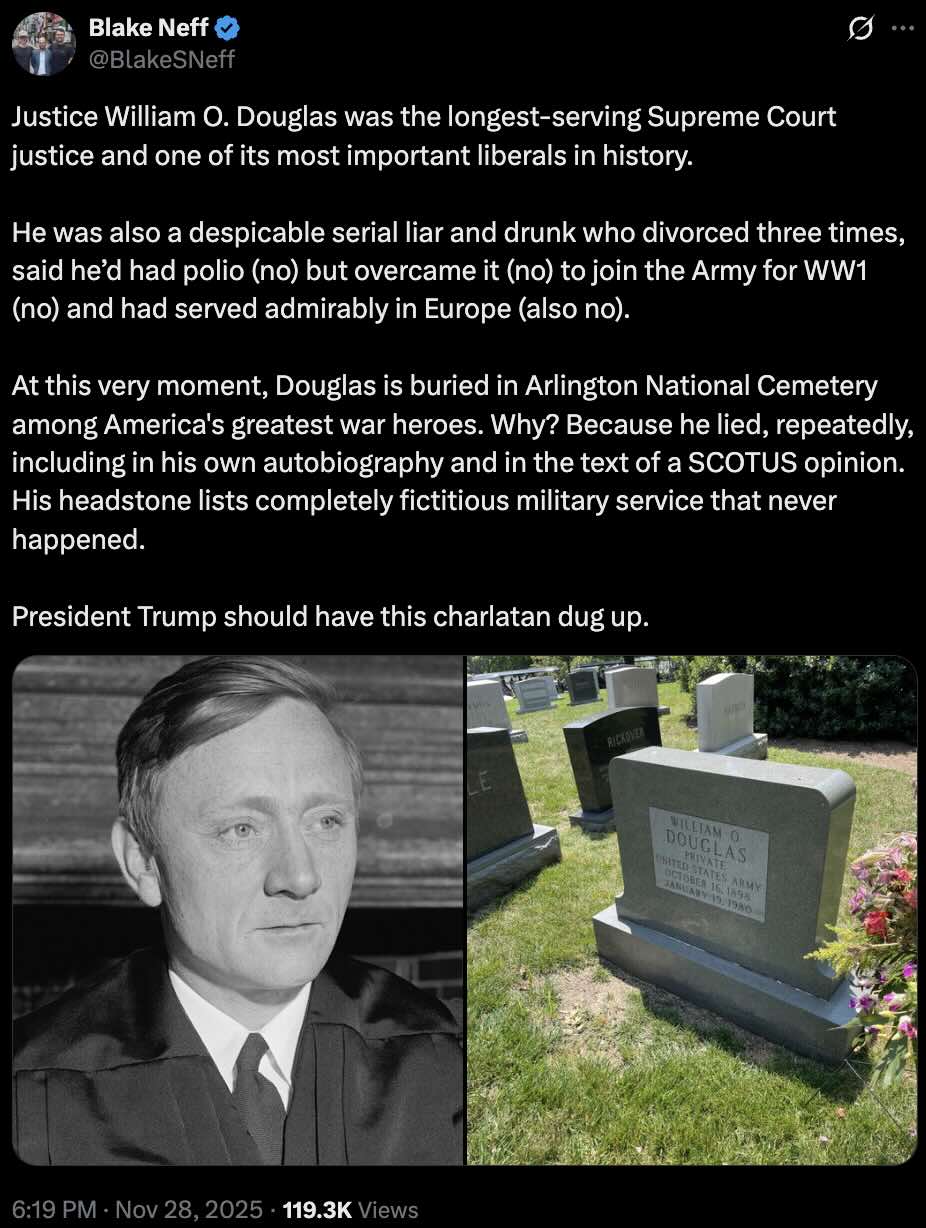
That’s
Blake
Neff,
a
producer
for
the
late
Charlie
Kirk’s
show,
kicking
off
what
would
be
the
#DigUpDouglas
hashtag
if
Twitter
still
used
hashtags.
Neff,
as
you
might
recall,
formerly
served
as
Tucker
Carlson’s
head
writer
before
resigning
from
Fox
News
when
it
came
out
that
he’d
been
posting
racist
content
under
a
pseudonym
that
Fox
News
executives
labeled
“abhorrent.”
Clearly,
a
trustworthy
arbiter
of
moral
character.
For
the
record,
Douglas
absolutely
served
in
the
Army
during
WWI.
Douglas
was
inducted
into
the
Students’
Army
Training
Corps
at
Whitman
College
in
1918,
received
a
federal
service
number,
and
was
honorably
discharged.
His
December
1918
discharge
papers
identify
him
as
“William
O.
Douglas,
Serial
No.
5200182,
Private
S.A.T.C.,
Whitman
College,
U.S.
Army.”
But
how
did
we
get
here…
now?
Well,
the
source
of
the
claim
that
Douglas
lied
about
his
service
gained
notoriety
from
Bruce
Allen
Murphy’s
2003
biography
of
Douglas,
“Wild
Bill.”
How
did
a
biography
from
22
years
ago
end
up
on
the
conservative
front-burner?
This
seems
to
be
the
fault
of
Professor
and
Volokh
Conspiracy
contributor
Orin
Kerr,
who
inadvertently
resurfaced
all
of
this
earlier
last
week
when
he
posted
about
a
book
review
written
by
Judge
Richard
Posner
and
published
in
The
New
Republic.
While
Kerr
never
intended
to
start
a
campaign
to
get
Douglas
exhumed,
conservative
social
media
is
a
giant
raccoon
rummaging
through
America’s
ideological
trash,
so
the
discourse
inevitably
devolved
from
here.
Managing
to
capture
the
quintessence
of
American
conservatism
in
one
sentence,
Professor
Yuan
Yi
Zhu
writes,
“3
days
from
Orin
Kerr
posting
that
Posner
review
for
lolz
to
the
producer
of
the
Charlie
Kirk
Show
calling
for
William
O
Douglas
to
be
dug
out
of
a
cemetery.”
Think
of
the
conservative
intellectual
funnel
like
a
twisted
Easter.
A
libertarian
academic
says
something
on
one
day,
and
on
the
third
day
proto-fascists
demand
to
raise
the
dead
from
his
tomb.
The
path
from
Kerr’s
post
to
Neff
suggesting
The
Great
Dissenter
should
become
The
Great
Disinterred,
ran
through
other
right-wing
accounts
jumping
on
Douglas’s
grave.
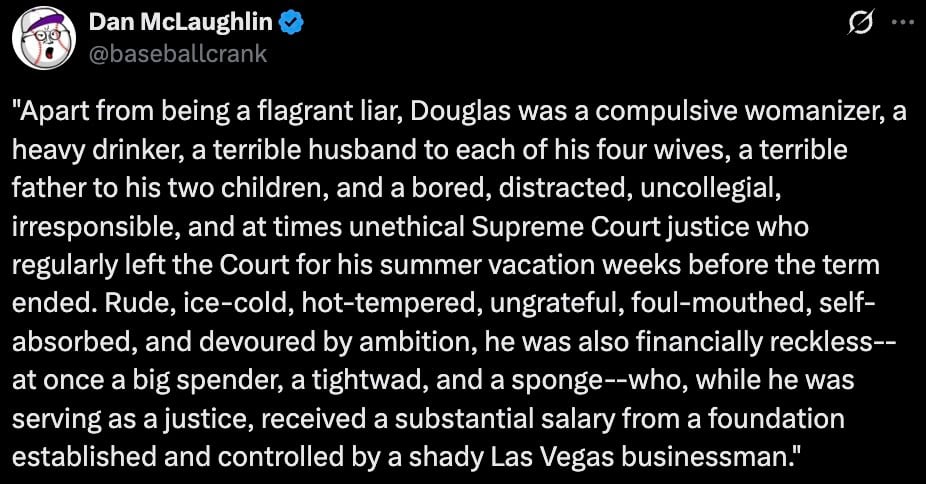
National
Review’s
Dan
McLaughlin
racked
up
nearly
300K
impressions
highlighting
a
passage
from
Posner’s
book
review
that
drips
with
the
sort
of
vitriol
McLaughlin
normally
reserves
for
expanding
the
designated
hitter
rule
or
women
believing
in
bodily
autonomy.
Leaving
for
summer
vacation
before
the
term
ended?
Unforgivable!
Unless
that
vacation
is
financed
by
parties
seeking
favor
from
the
Court…
then
it’s
just
good
business
sense!
Judge
Posner’s
review,
read
holistically,
isn’t
entirely
negative.
That
said,
Posner
also
took
a
detour
to
lambast
Douglas
for
an
opinion
in
a
1960s
case
about
building
dams
on
the
Snake
River
where
the
justice
wrote
that
the
dam
project
“would
harm
the
salmon.”
Fast
forward,
and
the
series
of
dams
at
issue
really
did
drive
multiple
salmon
species
to
the
brink
of
extinction.
Hindsight
is
20/20.
But
Posner
also
describes
Douglas
as
a
man
better
suited
for
the
presidency
that
the
justice
not-at-all-secretly
longed
for.
Douglas’s
skills
far
better
fit
the
political
arena,
which
—
Posner
suggests
—
contributed
to
Douglas’s
disdain
for
the
judicial
post
he
ended
up
stuck
with.
It’s
a
nuanced
argument
that
spins
out
of
Posner’s
stance
that
judges
aren’t
geniuses,
because
geniuses
are
incentivized
to
go
into
just
about
any
field
of
human
endeavor
other
than
the
law.
“With
his
intelligence,
his
toughness,
his
ambition,
his
leadership
skills,
his
wide
acquaintanceship
in
official
Washington,
his
combination
of
Western
homespun
(a
favorite
trick
was
lighting
a
cigarette
by
striking
a
match
on
the
seat
of
his
pants)
and
Eastern
sophistication,
and
his
charisma,”
Posner
writes,
“Douglas
might
have
been
a
fine
Cold
War
president.”
Such
a
complete
view
doesn’t
make
it
on
social
media,
however.
While
Posner
explicitly
noted
that
“One
can
be
a
bad
person
and
a
good
judge,
just
as
one
can
be
a
good
person
and
a
bad
judge,”
his
article
is
getting
chopped
up
to
give
conservatives
an
opportunity
to
denigrate
the
author
of
Griswold
because
he
was
a
womanizing
drunk.
This,
by
the
way,
is
an
actual
ad
hominem
attack.
Conservatives
whine
about
“ad
hominem”
whenever
someone
calls
them
knuckle-dragging
bigots
while
dismantling
their
latest
disinformation
post
about
immigrants
causing
all
murders,
but
that’s
just
colorful
commentary.
Ad
hominem
is
about
substituting
aspersions
about
the
speaker
for
argument…
like
suggesting
the
Constitution
shouldn’t
protect
the
right
to
contraception
because
William
O.
Douglas
hid
mistresses
in
his
chambers
closet.
The
right-wing
enthusiasm
for
Douglas
bashing
is
all
about
feeding
their
trained
audience
of
drooling
MAGA
hats
a
moral
villain
that
can
stand
in
for
the
very
idea
that
the
Warren
Court
is
inherently
suspect.
Which,
as
a
strategy,
would
be
only
slightly
less
objectionable
were
it
not
coming
from
people
whose
moral
compass
points
unerringly
toward
a
thrice-married,
porn-star-fornicating,
adjudicated
digital
rapist.
Say
what
you
will
about
William
O.
Douglas,
the
man
wouldn’t
be
sweating
about
the
Epstein
files.
And
at
least
he
didn’t
spend
WWI
complaining
about
bone
spurs.
It
also
helps
to
remember
why
Douglas
rests
eternally
in
both
Arlington
National
Cemetery
and
rent-free
in
conservative
minds.
In
the
Church
of
Eternal
Grievance
Farming,
Douglas
occupies
a
seat
of
honor.
Not
just
as
the
author
of
Griswold,
but
as
an
architect
that
brought
environmental
plaintiffs
into
court,
creating
no
end
of
inconvenience
for
the
donors
who
fund
right-wing
summer
camps
for
conservative
legal
luminaries
to
attend.
Douglas’s
free
speech
opinions
recognized
the
government
as
something
to
be
restrained,
not
an
authority
to
force
private
actors
to
protect
bigots
from
being
canceled.
And
he’s
the
securities
law
expert
who
is
spinning
in
that
grave
at
50
terahashes
per
second
that
we
have
a
fake
currency
economy
driven
by
a
president
with
a
meme
coin.
Of
course
they
hate
him.
Conservatives
aren’t
trying
to
exhume
Douglas
because
they
care
about
moral
uprightness.
They’re
relitigating
William
O.
Douglas
because
they
need
a
culture
war
villain
who
can
allow
them
to
cut
the
corner
on
making
a
coherent
argument
why
the
Constitution
should
allow
governments
to
police
your
bedrooms.
It’s
the
same
reason
why
people
who
point
out
that
Hugo
Black
once
belonged
to
the
Klan
(he
later
resigned
and
publicly
rejected
the
group),
are
the
same
people
currently
gleefully
retweeting
white
supremacist
accounts.
The
issue
doesn’t
matter,
poisoning
the
well
does.
Black
was
racist,
Douglas
was
a
scoundrel…
therefore
all
liberal
jurisprudence
is
permanently
compromised.
Q.E.Dumbassery.
Back
in
the
1970s,
rumors
of
cognitive
decline
forced
Douglas
from
the
bench.
In
2025,
Douglas’s
detractors
watch
Trump’s
daily
and
public
displays
of
dementia
and
demand
a
third
term.
And,
of
course,
there’s
a
non-zero
chance
that
the
nation’s
chief
executive
ran
across
this
while
scrolling
Twitter
and
is
already
sending
backhoes
to
Douglas’s
plot.