Farmers
say
the
disease,
caused
by
the
parasite Theileria
parva and
spread
by
ticks,
has
persisted
for
months
despite
their
efforts
to
control
it.
Many
discovered
the
outbreak
too
late,
with
several
animals
already
weakened
or
dead
before
treatment
could
be
administered.
“We
are
losing
our
cattle
every
week,
and
it
is
painful
to
watch,”
said
farmer
Bulelani
Kona.
“At
first,
we
thought
it
was
just
an
ordinary
illness,
but
soon
we
realised
it
was
something
much
worse.
By
the
time
we
found
out
it
was
theileriosis,
the
damage
had
already
been
done.
We
had
many
cattle
before,
but
now
most
are
gone.
This
disease
is
still
killing,
and
we
feel
powerless
because
we
don’t
have
enough
medicines
or
dipping
chemicals
to
fight
it.”
Theileriosis
is
a
tick-borne
disease
that
causes
severe
illness
in
cattle
and
can
lead
to
death
if
not
treated
quickly.
Its
symptoms
include
lethargy,
swollen
lymph
nodes,
loss
of
appetite
and,
in
many
cases,
sudden
death.
Another
farmer,
Dalumuzi
Gumede,
said
panic
and
desperation
had
driven
some
villagers
to
sell
their
cattle
at
throwaway
prices.
“We
sold
our
cattle
in
a
hurry
because
we
were
afraid
they
would
all
die,”
he
said.
“Some
people
sold
for
half
the
normal
price,
just
to
avoid
total
loss.
In
some
cases,
the
animals
collapsed
and
died
on
the
trucks
before
reaching
buyers.
Gadade
used
to
be
full
of
cattle,
but
now
you
can
count
the
herds
on
one
hand.”
Residents
say
the
outbreak
has
stripped
many
families
of
their
main
source
of
income,
draught
power
and
food
security.
They
are
now
appealing
for
urgent
support
from
veterinary
authorities.
“We
really
need
more
help
from
veterinary
officers,”
said
Nkosilathi
Ndlovu,
another
local
farmer.
“Theileriosis
has
not
stopped,
it’s
still
here,
and
every
farmer
is
scared
of
losing
the
few
cattle
they
have
left.
We
also
need
awareness
campaigns
so
people
can
recognise
the
disease
early.”
Veterinary
practitioner
Dr
Gwinyai
Zhandire
confirmed
that
theileriosis
remains
a
serious
threat
across
Zimbabwe,
particularly
during
the
rainy
season
when
tick
activity
peaks.
“Theileriosis
or
January
Disease
is
a
fatal
tick-borne
disease
of
cattle,”
Dr
Zhandire
said.
“The
name
comes
from
its
tendency
to
cause
major
outbreaks
in
January
due
to
high
tick
activity.
It
spreads
from
animal
to
animal
through
tick
bites.”
He
said
post-mortem
examinations
often
reveal
internal
bleeding,
swollen
livers
and
spleens,
and
excess
fluid
in
the
lungs,
which
causes
most
cattle
deaths.
Laboratory
tests
also
show
that
theileriosis
is
often
accompanied
by Anaplasmosis (commonly
known
as
Gall
Sickness).
To
prevent
the
disease,
Dr
Zhandire
stressed
the
importance
of
tick
control
through
regular
dipping.
“Prevention
is
based
on
tick
control,”
he
said.
“Farmers
must
use
effective
acaricides
and
apply
them
correctly
and
consistently.
Dipping
should
be
done
at
least
once
a
week,
and
in
outbreak
areas,
every
four
to
five
days.
During
the
rainy
season,
dipping
frequency
should
increase
to
protect
cattle
even
after
they
are
rained
on.”
Dr
Zhandire
added
that
early
treatment
combining
Oxytetracycline
and
Buparvaquone,
along
with
supportive
care,
can
save
infected
animals.
However,
he
warned
that
prevention
is
far
cheaper
than
cure.
“The
cost
of
prevention
through
dipping
is
about
US$2
per
animal
per
year
under
the
government
programme,
compared
to
over
US$20
per
animal
for
treatment.
As
always,
prevention
is
better
than
cure,”
he
said.
My
father
was
an
amazing
lawyer.
Everyone
knew
that
when
Larry
the
lawyer
walked
into
a
room,
he
was
the
smartest
guy
there.
Years
after
he
retired,
he
was
walking
down
LaSalle
Street
in
Chicago
when
a
former
client
spotted
him,
ran
across
traffic,
and
asked
if
he
was
still
practicing.
My
dad
said
no,
he
was
just
in
the
city
helping
with
an
arbitration.
The
client
smiled
and
said,
“You
were
the
best
lawyer
I
ever
had.
And
God,
were
you
cheap.”
That
moment
stuck
with
my
father.
He’d
always
believed
he
was
fair
with
his
billing,
but
that
exchange
made
him
realize
he
may
have
confused
fairness
with
undercharging.
Like
many
lawyers,
he
never
saw
himself
as
a
businessperson
—
he
was
focused
on
service,
not
pricing
strategy.
But
the
truth
is,
the
business
of
law
requires
both.
Too
many
lawyers
undervalue
themselves,
write
down
or
write
off
time,
and
justify
it
in
the
name
of
client
care.
In
this
article,
let’s
explore
why
that
happens
and
how
to
fix
it.
The
Mindset
Behind
Discounts
When
a
lawyer
discounts
a
bill
before
the
client
even
asks,
it’s
rarely
about
the
client,
it’s
mostly
“head
trash”
that
the
lawyer
is
experiencing.
Fear
of
confrontation,
discomfort
around
money,
and
a
desire
to
be
liked
all
play
a
role.
But
clients
don’t
respect
discounts;
they
respect
value.
Do
you
think
your
dentist
is
concerned
with
the
price
you’re
paying
for
a
filling?
Professional
services
should
be
treated
the
same
way.
Client
relationships
built
on
value,
not
price,
will
help
get
your
mind
on
the
right
track.
Discounting
tells
clients
your
time
is
negotiable.
Over
time,
that
erodes
the
perceived
value
of
your
expertise.
Let’s
look
at
how
we
can
approach
this
sensitive
topic
with
confidence,
starting
with
understanding
that
basic
quality
and
service
are
not
merely
table
stakes
in
the
long-term
loyalty
with
your
clients.
Three
Keys
to
Delivering
Value
The
antidote
to
pricing
pressure
is
building
the
relationship
and
delivering
clear,
undeniable
value.
That
happens
through
these
three
essential
habits:
1.
Set
clear
expectations. Internally,
make
sure
associates
and
paralegals
know
how
long
a
task
should
take
and
what
“done”
looks
like.
Externally,
talk
to
clients
early
about
budgets
and
timelines.
Establishing
expectations
avoids
the
disconnect
that
often
leads
to
billing
disputes.
2.
Be
responsive
and
provide
quality. Clients
define
value
through
responsiveness
and
results.
Return
calls
quickly,
communicate
status
updates
before
they
ask,
and
connect
the
dots
between
your
work
and
their
business
outcomes.
It’s
not
enough
to
win,
they
need
to
understand
your
value
is
undeniable.
3.
Be
more
than
their
lawyer. Trusted
advisors
go
beyond
legal
tasks.
Ask
about
the
client’s
goals,
challenges,
and
even
personal
milestones.
Celebrate
their
successes.
Get
as
much
facetime
as
possible
with
them.
Help
them
solve
business
problems
that
may
not
require
a
lawyer
but
do
require
your
perspective
or
strategic
introductions.
When
you
care
about
the
person
behind
the
client,
deeper
relationships
and
loyalty
naturally
follows.
What
about
if
they
see
a
bigger
bill
and
ask
you
to
lower
it?
When
a
client
expresses
concern
about
a
bill,
resist
the
urge
to
cave.
Instead,
handle
the
conversation
with
confidence
and
empathy.
Try
this
four-part
approach:
Acknowledge
their
point
of
view:
“I
can
see
how
this
bill
might
seem
higher
than
you
anticipated.”
Reaffirm
your
value:
“Let’s
review
what
was
done
and
how
it
directly
impacted
the
outcome
we
achieved.”
Clarify
the
details:
“Here’s
a
breakdown
of
the
work
completed,
the
time
invested,
and
the
results
delivered.”
Reestablish
expectations:
“My
commitment
is
to
transparency
and
fairness.
Let’s
align
on
what
success
looks
like
going
forward
so
everything
stays
clear.”
These
statements
project
professionalism,
empathy,
and
control,
without
giving
away
your
worth.
The
Ultimate
Goal:
Confidence,
Communication,
and
Connection
The
best
firms
aren’t
discounting,
they’re
deepening
relationships.
They’re
setting
expectations
early,
communicating
value
clearly,
and
showing
clients
that
working
with
them
isn’t
just
a
transaction,
it’s
a
partnership.
When
your
clients
see
you
as
indispensable,
they
stop
negotiating
and
start
appreciating.
That’s
when
loyalty
becomes
automatic,
and
your
value
—
psychological
and
financial
—
finally
aligns
with
your
worth.
To
continuing
getting
articles
like
this
and
more,
go
to
www.bethatlawyer.com
or
email
[email protected]
for
direct
advice
in
growing
your
book
of
business.
Steve
Fretzin
is
a
bestselling
author,
host
of
the
“Be
That
Lawyer”
podcast,
and
business
development
coach
exclusively
for
attorneys.
Steve
has
committed
his
career
to
helping
lawyers
learn
key
growth
skills
not
currently
taught
in
law
school.
His
clients
soon
become
top
rainmakers
and
credit
Steve’s
program
and
coaching
for
their
success.
He
can
be
reached
directly
by
email
at [email protected].
Or
you
can
easily
find
him
on
his
website
at www.fretzin.com or
LinkedIn
at https://www.linkedin.com/in/stevefretzin.
As
you
may
have
heard,
Kim
Kardashian
failed
the
California
bar
exam.
She
took
a
very
unusual
(and
in
my
opinion,
very
underutilized)
path
to
being
an
attorney,
through
a
four-year
apprenticeship
program
working
under
a
licensed
attorney.
According
to
the
State
Bar
of
California’s
most
recent
statistics,
only
12%
of
repeat
takers
passed
the
bar
exam.
For
most
lawyers,
this
may
sound
very
low
because
they
anecdotally
know
a
number
of
people
who
failed
the
bar
exam
but
all
of
them
eventually
passed.
But
if
those
who
didn’t
make
the
cut
want
to
be
part
of
the
12%
that
pass
next
time,
they
will
need
to
properly
evaluate
their
score
and
set
up
a
study
plan.
First,
if
you
need
to,
take
some
time
off
to
detox
and
spend
time
with
your
loved
ones
over
the
Thanksgiving
holiday.
If
you
are
understandably
upset,
it
may
not
be
the
best
time
to
analyze
your
score.
Next,
once
you
are
ready,
closely
and
honestly
assess
your
test
score
because
that
will
determine
how
you
will
study
for
the
next
exam.
If
you
missed
the
cut
by
a
small
margin
by
scoring
slightly
below
average
on
every
section,
you
will
probably
need
to
review
everything
again
although
you
can
skip
or
skim
the
subjects
you
are
proficient
in.
If
you
scored
very
poorly
on
a
few
sections
or
subjects,
then
you
will
need
to
spend
a
majority
of
your
study
time
on
these
areas.
If
you
scored
poorly
on
every
section,
then
you
will
need
to
completely
overhaul
how
you
study
for
the
exam.
After
your
self-assessment,
set
up
a
study
plan.
Whether
you
need
10
hours
per
week
or
40
hours
per
week
depends
on
your
other
obligations,
and
your
study
goals.
If
you
missed
the
passing
score
by
a
small
amount,
you
probably
don’t
need
to
devote
five
days
per
week
to
study.
If
you
received
very
low
scores,
you
will
need
to
spend
some
time
figuring
out
how
you
best
retain
information.
Maybe
sitting
in
a
classroom
listening
to
a
lecturer
is
not
the
optimal
study
environment.
You
will
have
to
do
something
different.
Maybe
focus
more
on
flash
cards.
Or
listen
to
recordings
of
lectures
while
walking
around
the
park.
If
you
have
the
means,
you
may
want
to
try
hiring
a
private
tutor
or
reaching
out
to
your
law
school
to
see
if
any
professors
or
former
bar
graders
are
available
to
review
your
exams.
And
to
be
honest,
some
people
just
lack
discipline.
I’ve
been
there.
While
you
are
studying,
stop
internet
surfing,
posting
or
scrolling
through
social
media.
For
some,
this
may
mean
turning
the
phone
off.
It
takes
some
time
to
adjust
but
it
can
be
done.
During
the
initial
months,
do
as
many
practice
questions
and
essays
as
possible.
But
do
not
focus
on
speed.
Review
your
answers,
particularly
the
ones
you
got
wrong.
As
for
reviewing
essay
questions,
check
the
model
answers
and
see
if
you
spotted
all
of
the
issues.
Then
check
to
see
if
you
knew
the
rule,
correctly
applied
the
rule
to
the
facts,
and
then
came
to
a
conclusion.
I
highly
recommend
the
two
volumes
of
“Bar
Breaker”
by
the
late
Jeff
Adachi.
They
explain
how
to
write
essay
answers
in
a
manner
that
bar
graders
can
understand.
Unfortunately,
prices
are
ridiculous
online,
so
check
your
school’s
law
library
to
see
if
they
have
a
copy.
As
the
exam
date
gets
closer,
you
will
need
to
block
out
several
hours
to
simulate
exam
conditions.
This
means
no
smartphone
and
no
internet.
Put
your
phone
and
laptop
on
airplane
mode
while
you
are
taking
your
practice
exam.
At
this
point
—
hopefully
—
you
will
be
proficient
in
all
of
the
tested
subjects.
The
goal
of
the
simulated
exam
is
to
complete
all
of
the
questions
within
the
allotted
time.
Finally,
take
care
of
yourself
mentally
and
physically
during
the
process.
Stay
away
from
negative
news
and
people.
Stop
reading
the
news
about
who
canceled
whom.
And
don’t
complain
about
how
the
bar
exam
is
a
hazing
ritual
or
a
gatekeeping
scam.
The
time
you
spend
pondering
over
these
things
can
be
used
instead
to
study.
Be
mindful
of
what
you
eat.
You
should
eat
foods
that
will
satisfy
your
hunger,
help
you
concentrate,
and
provide
you
with
energy
throughout
the
day.
Eating
the
wrong
foods
or
overeating
could
make
you
feel
sleepy
or
hyperactive.
Exercise
is
generally
a
good
idea
but
overdoing
it
could
lead
to
soreness
or
injury,
which
is
not
good
for
studying.
Ideally,
you
should
listen
to
a
bar
exam
lecture
while
taking
a
long
walk.
As
for
getting
support
from
others,
that
is
up
to
you.
Some
people
can
benefit
from
study
groups,
therapy,
or
counseling.
Others
take
the
edge
off
by
committing
every
crime
and
intentional
tort
in
“Grand
Theft
Auto.”
Hopefully,
Kim
Kardashian
and
others
in
her
situation
will
one
day
pass
the
bar
exam.
While
she
seems
to
have
the
right
attitude,
she
will
also
need
to
see
where
she
can
improve
and
devote
her
full
attention
to
it.
Steven
Chung
is
a
tax
attorney
in
Los
Angeles,
California.
He
helps
people
with
basic
tax
planning
and
resolve
tax
disputes.
He
is
also
sympathetic
to
people
with
large
student
loans.
He
can
be
reached
via
email
at [email protected].
Or
you
can
connect
with
him
on
Twitter
(@stevenchung)
and
connect
with
him
on LinkedIn.
Secretary
of
Defense
Pete
Hegseth
delivered
a
long,
surprisingly
uncontroversial
speech
to
industry
on
Friday
detailing
how
he’d
like
to
work
with
defense
firms
big
and
small
going
forward.
Editor-in-Chief
Aaron
Mehta
and
Land
Warfare
Reporter
Carley
Welch
run
through
the
highlights
of
that
speech,
including
how
the
Pentagon
is
reorganizing
and
reforming
its
acquisition
process.
Then,
the
two
talk
about
an
ambitious
drone
plan
for
the
Army.
The
service
is
looking
to
purchase
one
million
drones
in
the
next
two
to
three
years.
While
not
much
is
known
yet
about
how
this
is
going
to
work,
the
acquisition
will
take
place
through
the
SkyFoundry
program.
*
Trump
claims
he
has
an
obligation
to
sue
the
BBC
for
showing
an
edited
version
of
his
January
6
speech,
and
not
the
full,
contextual
“very
calming
speech”
that
didn’t
immediately
lead
into
a
riot.
[BBC]
*
Visa
and
Mastercard
ink
massive
settlement
with
merchants
over
swipe
fees.
[NPR]
*
Kim
Davis
faces
steep
fees
after
Supreme
Court
bid
failed.
[Newsweek]
*
Trump
asks
Supreme
Court
to
throw
out
E.
Jean
Carroll
jury
verdict,
an
important
executive
duty
not
so
much
for
himself
but
to
protect
the
institution
of
the
presidency
in
case
any
future
president
rapes
a
woman
and
then
defames
her
over
it.
[National
Law
Journal]
*
Former
Polsinelli
attorney
ending
sexual
harassment
suit
against
firm.
[ABA
Journal]
Kim
K’s
Psychic
Promised
That
She’d
Pass
The
Bar:
She
better
get
a
spiritual
refund!
First
They
Came
For
The
Trans
Students…:
Universities
set
themselves
up
for
the
chopping
block
if
they
don’t
protect
their
vulnerable.
Who
You
Pick
Matters:
Judges
replace
themselves
with
their
clerks
and
so
on.
Prepare
For
More
Office
Time:
Firms
are
swinging
toward
more
mandated
office
time.
Among
a
president’s
most enduring
legacies are
the
federal
judges
they
appoint—particularly
Supreme
Court
justices.
This
permanence
stems
from
life
tenure,
a
constitutional
provision
that
ensures
judicial
independence
but
also
transforms
each
appointment
into
a
generational
bet
on
the
nation’s
legal
future.
Yet
history
is
littered
with
presidential
miscalculations.
President
Eisenhower
famously
called
his
appointment
of
Earl
Warren
to
Chief
Justice
one
of
his
“biggest
mistakes,”
as
Warren
became
a
liberal
stalwart
for
over
a
decade.
Justices
Stevens
and
Souter,
both
nominated
by
Republican
presidents,
evolved
into
some
of
the
Court’s
most
liberal
members.
Had
Republican
presidents
consistently
installed
reliably
conservative
justices
since
the
mid-20th
century,
the
Court
would
have
been
exponentially
more
conservative
than
it
actually
was.
But
presidential
legacy
is
only
part
of
the
story.
The
judges
themselves
have
developed
their
own
succession
strategies.
In
recent
years,
a
striking
pattern
has
emerged:
Supreme
Court
justices
now
appear
ready
to
retire
only
with
tacit—or
perhaps
explicit—assurances
that
they
will
be
replaced
by
someone
they
helped
shape,
typically
a
former
clerk.
Since
Justice
Kennedy
retired
after
the
2017
term,
this
has
become
the
norm
rather
than
the
exception.
Kennedy’s
retirement
exemplified
this
new
dynamic.
He
secured
not
one
but
two
former
clerks
in
succession:
Justice
Gorsuch
filled
Justice
Scalia’s
seat,
which
had
remained
vacant
longer
than
any
in
Court
history,
and
Kennedy’s
own
seat
went
to
Justice
Kavanaugh.
These
consecutive
Kennedy-clerk
appointments
represented
a carefully
orchestrated
transition,
a
carrot
from
President
Trump
to
convince
Kennedy
to
step
down
with
his
legacy
intact.
For
Trump,
the
bargain
was
equally
advantageous:
he
could
install
more
consistently
conservative
justices
than
Kennedy,
who
had
occasionally
sided
with
liberals
on
consequential
civil
liberties
cases
like
the
same-sex
marriage
decision
in
Obergefell
v.
Hodges.
The
pattern
continued
with
Justice
Barrett,
a
Scalia
clerk,
replacing
Justice
Ginsburg
after
her
death,
and
Justice
Ketanji
Brown
Jackson,
a
Breyer
clerk,
succeeding
her
former
mentor.
Based
on
this
emerging
template,
I previously
wrote
about how
I
anticipate
that
President
Trump
might
appoint
Judge
Ho
or
Judge
Rao—both
Thomas
clerks—to
fill
Justice
Thomas’s
seat,
and
Judge
Oldham,
an
Alito
clerk,
to
succeed
Justice
Alito
should
either
retire
during
Trump’s
tenure.
This
pattern
of
legacy-based
decisions
augments
the
theory
of
strategic
retirement,
where
federal
judges
retire
under
likeminded
presidents
to
ensure
the
balance
of
each
court
does
not
shift
in
the
opposing
ideological
direction. I
wrote
about
the
possibility
of
this
occurring and
how
the
consequence
of
Justice
Barrett
potentially
filling
this
seat
prior
to
Justice
Ginsburg’s
death.
Many
others
also contemporaneously, previously,
and after
me wrote
about
the
potential
and
actual
downstream
effects
of
Justice
Ginsburg’s
decision.
At
the
bottom
of
it
all,
this
highlights
the
importance
of
federal
judgeships,
not
only
the
president,
but
more
importantly
to
future
generations
and
to
the
embedding
of
particular
values
and
preferences
within
the
federal
judiciary
for
decades
to
come.
Consequences
and
Methodology
The
importance
of
federal
judge
replacements
reaches
beyond
presidential
legacy.
This
analysis
examines
which
current
and
former
federal
judges
have
placed
the
most
former
clerks
on
the
federal
bench,
using
data
from
the
Biographical
Directory
of
Federal
Judges
maintained
by
the
Federal
Judicial
Center.
Building
on
previous
analysis
of
federal
judges
appointed
from
Reagan
through
the
current
Trump
administration,
this
examination
focuses
specifically
on
judicial
legacy
through
clerk
placement.
After
correcting
for
inconsistencies
in
how
the
Biographical
Directory
formatted
clerkship
entries
(First
Liberty’s
Hiram
Sasser
noted
in
a
comment
some
of
the
missing
entries
in
a previous
post which
I
now
corrected
and made
freely
accessible),
the
data
reveals
a
clear
hierarchy
of
influence
across
district,
appeals,
and
Supreme
Court
levels.
Presidential
Appointments:
The
Foundation
of
Judicial
Legacy
If
presidents’
legacies
are
bound
to
their
judicial
appointments—especially
Supreme
Court
justices—then
the
number
of
justices
each
president
installs
becomes
a
meaningful
measure
of
lasting
influence.
While
not
every
appointment
produces
the
jurisprudence
a
president
envisions,
each
represents
an
attempt
to
implant
their
vision
of
constitutional
interpretation.
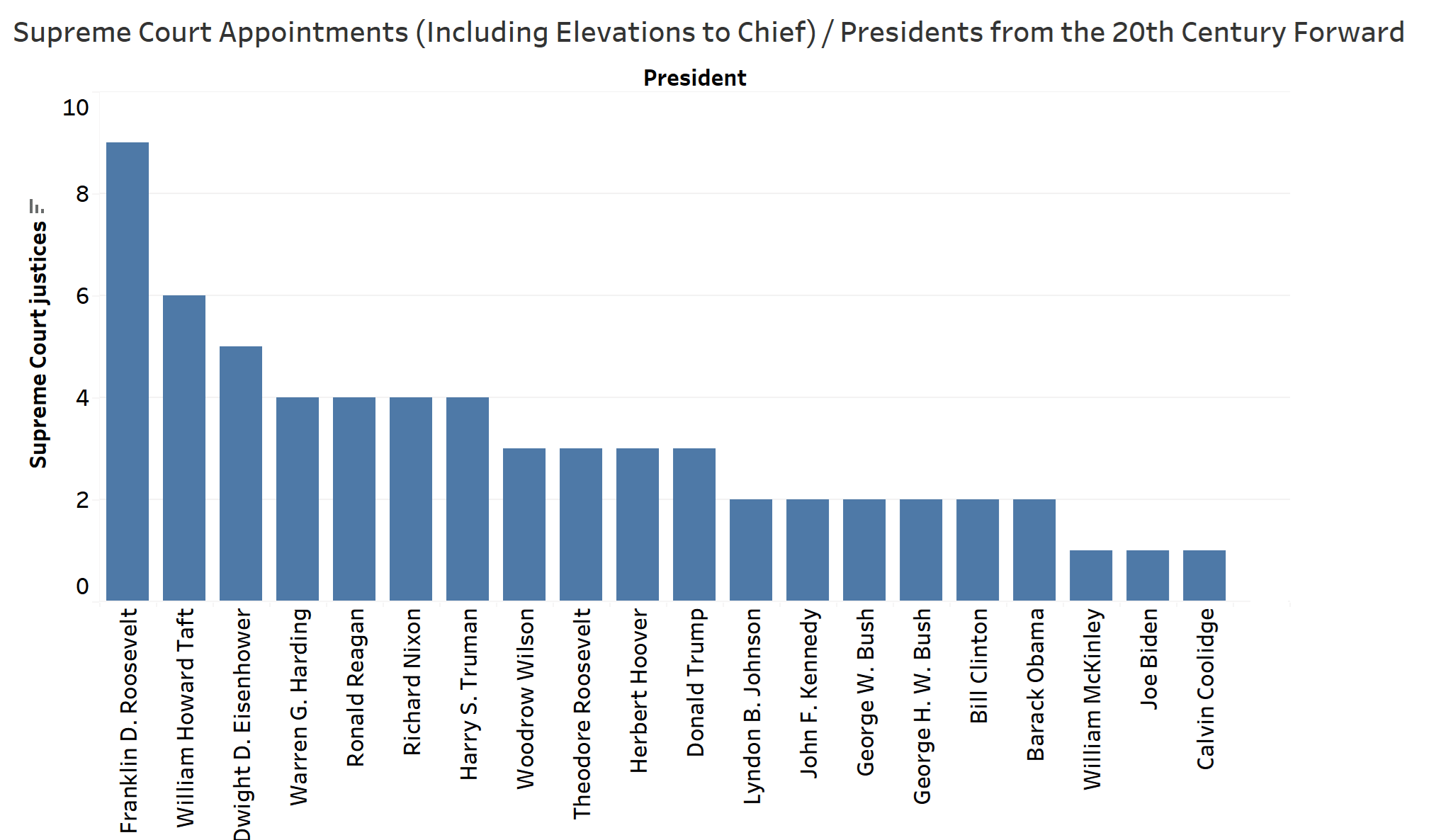
Among
20th
and
21st-century
presidents,
Franklin
D.
Roosevelt
stands
as
the
overwhelming
leader,
appointing
nine
Supreme
Court
justices
during
his
unprecedented
four
terms.
Taft
follows
with
six
appointments,
while
Eisenhower
made
five.
More
recent
presidents
show
markedly
fewer
opportunities
although
Trump
with
three
in
his
first
term
was
a
clear
outlier.
These
numbers
reflect
not
just
presidential
priorities
but
the
vagaries
of
timing—how
long
justices
serve,
when
they
choose
to
retire,
and
the
unpredictability
of
death.
Roosevelt’s
nine
appointments
came
during
the
constitutional
crisis
of
the
New
Deal,
while
recent
presidents
have
faced
a
Court
where
justices
increasingly
time
their
retirements
strategically,
often
waiting
for
a
president
of
their
preferred
ideology.
Supreme
Court:
Where
Judicial
Dynasties
Begin
The
downstream
effects
of
Supreme
Court
clerkships
can
reshape
American
law
across
generations.
Consider
the
lineage
from
Justice
Robert
Jackson
to
William
Rehnquist,
who
clerked
for
Jackson,
to
John
Roberts,
who
clerked
for
Rehnquist
and
now
serves
as
Chief
Justice.
This
chain
of
influence
spans
more
than
half
a
century,
with
each
generation
of
jurists
passing
their
interpretive
methods
to
the
next.
Supreme
Court
clerkships
represent
a
relatively
modern
phenomenon,
emerging
primarily
as
the
Court
evolved
through
the
20th
century.
The
number
of
clerks
per
justice
has
steadily
increased,
expanding
the
pool
of
potential
judicial
heirs.
The
data
reveals
which
justices
have
been
most
successful
at
placing
their
clerks
throughout
the
federal
judiciary.
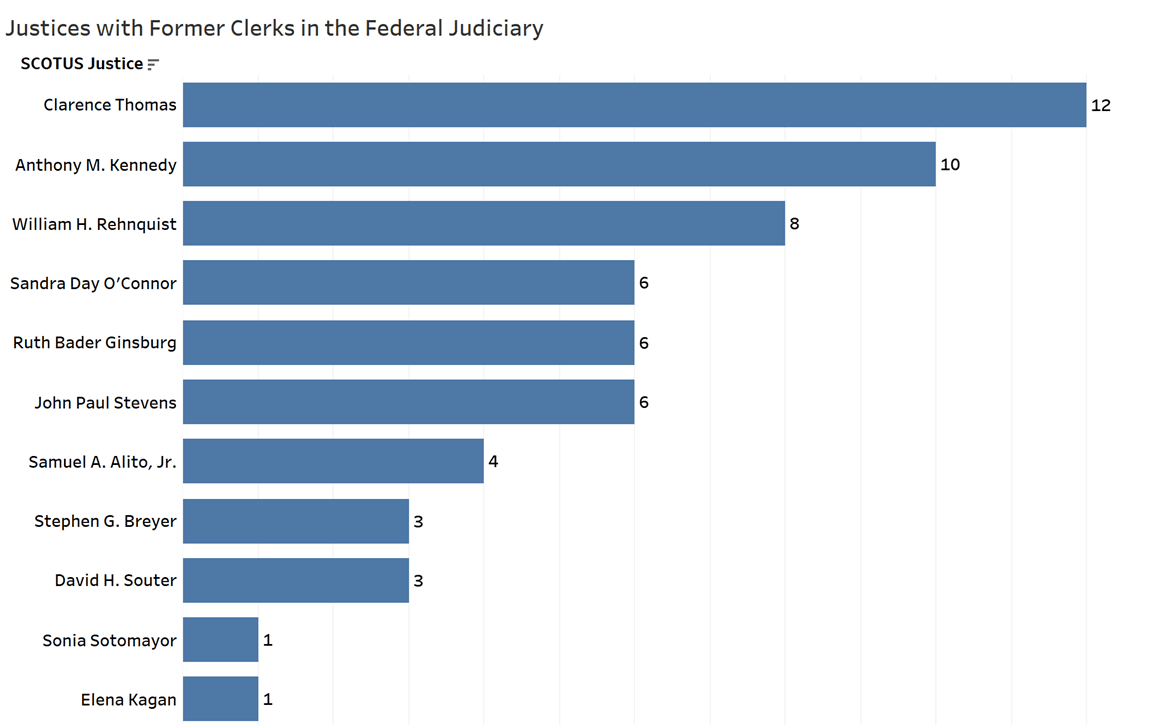
Justice
Clarence
Thomas
leads
by
a
substantial
margin,
with
twelve
former
clerks
now
serving
as
federal
judges—a
testament
both
to
his
long
tenure
and
his
deliberate
cultivation
of
conservative
judicial
talent.
Justice
Anthony
Kennedy
follows
with
ten
clerk-judges,
including
the
two
Supreme
Court
justices
mentioned
earlier.
Justice
Rehnquist
placed
eight
former
clerks,
continuing
his
influence
even
after
his
2005
death.
Justices
O’Connor
and
Ginsburg
each
count
six
former
clerks
in
the
federal
judiciary,
while
Justice
Stevens
also
placed
six.
Justice
Alito
has
four
clerk-judges,
while
Justices
Breyer
and
Souter
each
have
three.
Perhaps
most
surprisingly,
given
his
position
as
Chief
Justice,
John
Roberts
has
not
yet
seen
a
former
clerk
become
a
federal
judge
according
to
Federal
Judicial
Center
data.
Originalism
Across
Generations:
Scalia
to
Barrett
The
transmission
of
judicial
philosophy
from
justice
to
clerk-turned-justice
reveals
itself
most
clearly
in
interpretive
methodology.
Justice
Scalia’s
originalist
approach
in McDonald
v.
City
of
Chicago exemplified
his
commitment
to
understanding
constitutional
provisions
through
their
historical
meaning.
Writing
about
the
Second
Amendment’s
application
to
the
states,
Scalia
emphasized
the
settled
understanding
that
the
Bill
of
Rights
originally
constrained
only
the
federal
government.
His
opinion
methodically
traced
the
historical
record,
citing
Chief
Justice
Marshall’s
1833
opinion
in Barron
v.
Baltimore and
noting
that
the
question
was
“of
great
importance”
but
“not
of
much
difficulty.”
Scalia’s
analysis
embodied
his
conviction
that
constitutional
interpretation
must
begin
with
original
public
meaning,
regardless
of
whether
that
meaning
comports
with
modern
sensibilities.
Justice
Barrett,
who
clerked
for
Scalia,
has
inherited
this
originalist
framework
but
applies
it
with
a
notably
different
rhetorical
style
and,
at
times,
different
conclusions.
In Haaland
v.
Brackeen,
her
majority
opinion
defending
the
Indian
Child
Welfare
Act
demonstrated
both
continuity
and
evolution
in
originalist
methodology.
When
petitioners
challenged
ICWA
by
arguing
it
was
inconsistent
with
the
Constitution’s
original
meaning,
Barrett’s
response
revealed
a
more
institutionally
cautious
approach
than
her
mentor
might
have
taken.
She
wrote
that
petitioners
“offer
no
account
of
how
their
argument
fits
within
the
landscape
of
our
case
law”
and
noted
they
“neither
ask
us
to
overrule
the
precedent
they
criticize
nor
try
to
reconcile
their
approach
with
it.”
This
represents
a
subtle
but
significant
shift
from
Scalia’s
more
aggressive
originalism.
Where
Scalia
often
championed
overturning
precedents
he
viewed
as
wrongly
decided,
Barrett
demanded
that
litigants
reckon
with
existing
doctrine
and
explain
the
broader
implications
of
their
originalist
claims.
Her
question—”Would
it
undermine
established
cases
and
statutes?
If
so,
which
ones?”—reflects
an
originalism
tempered
by
concerns
about
legal
stability
and
institutional
legitimacy.
The
clerk
has
inherited
the
mentor’s
interpretive
framework
but
adapted
it
to
a
Court
increasingly
conscious
of
its
public
standing.
Courts
of
Appeals:
The
Proving
Ground
Circuit
judges
occupy
a
unique
position
in
the
federal
judiciary.
While
they
lack
the
Supreme
Court’s
ultimate
authority,
they
effectively
have
the
final
word
in
the
vast
majority
of
federal
cases.
Their
opinions
shape
entire
areas
of
law
within
their
circuits,
making
them
powerful
vectors
for
transmitting
judicial
philosophy.
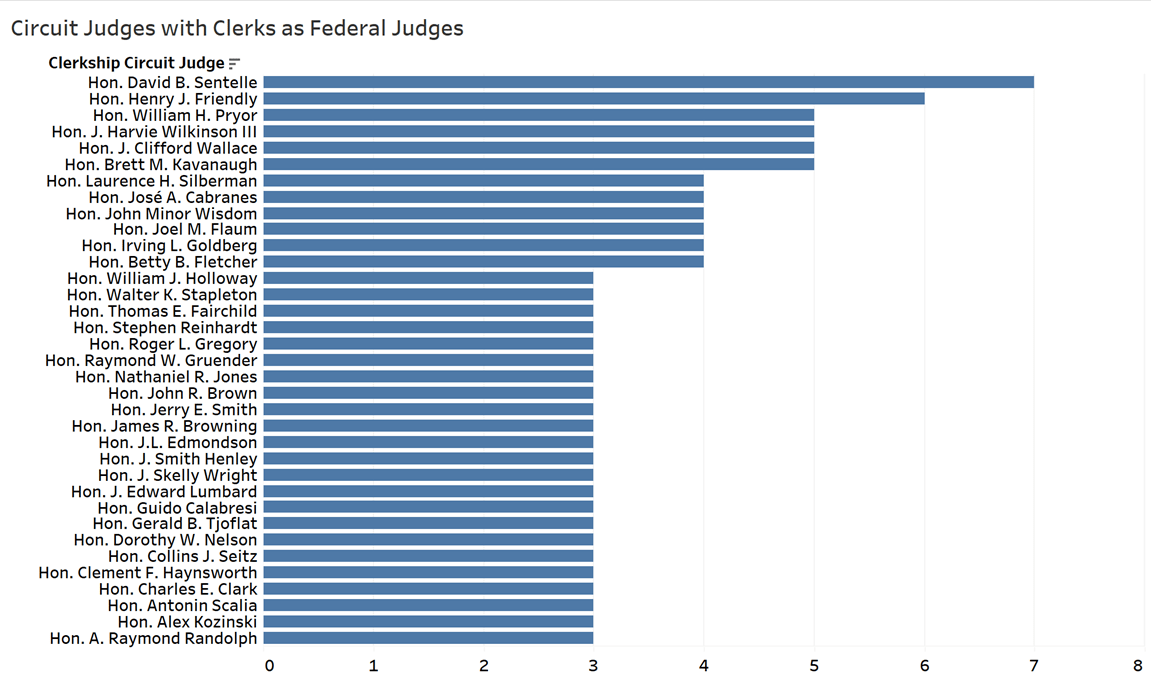
The
data
on
circuit
judges
with
three
or
more
former
clerks
now
serving
as
federal
judges
reveals
who
has
been
most
effective
at
extending
their
influence.
Judge
David
B.
Sentelle
of
the
D.C.
Circuit
leads
all
circuit
judges
with
seven
former
clerks
in
the
federal
judiciary—an
extraordinary
record
that
reflects
both
his
long
service
and
his
role
in
shaping
conservative
legal
thought.
Judge
Henry
J.
Friendly
of
the
Second
Circuit
and
Judge
William
H.
Pryor
of
the
Eleventh
Circuit
follow
with
six
clerk-judges
each.
Several
other
prominent
circuit
judges,
including
J.
Harvie
Wilkinson
III,
J.
Clifford
Wallace,
and
Brett
Kavanaugh
(before
his
Supreme
Court
appointment),
have
placed
five
former
clerks.
The
concentration
at
the
top
of
this
list
is
striking.
While
thirty-five
circuit
judges
have
placed
at
least
three
former
clerks,
the
gap
between
Sentelle’s
seven
and
the
next
tier
reflects
his
particular
success
at
cultivating
judicial
talent.
Many
of
these
judges
served
or
continue
to
serve
on
influential
circuits—the
D.C.,
Fourth,
and
Ninth
Circuits
appear
frequently—where
high-profile
cases
and
proximity
to
political
power
create
natural
pipelines
to
future
judicial
appointments.
The
Textualist
Thread:
Sentelle
to
Gorsuch
The
connection
between
Judge
Sentelle
and
Justice
Gorsuch
illuminates
how
circuit
court
judges
transmit
interpretive
approaches
that
later
appear
in
Supreme
Court
jurisprudence.
In NLRB
v.
Canning,
Judge
Sentelle’s
opinion
for
the
D.C.
Circuit
panel
exemplified
his
textualist
methodology.
Interpreting
the
Recess
Appointments
Clause,
Sentelle
focused
on
the
plain
meaning
of
“happen,”
construing
it
to
mean
“arise”
and
emphasizing
textual
consistency
across
constitutional
provisions.
He
wrote
that
“inconsistency
[within
the
Constitution]
is
to
be
implied
only
where
the
context
clearly
requires
it,”
citing
a
1949
precedent.
For
Sentelle,
the
clause’s
text
demanded
that
a
qualifying
vacancy
must
have
“come
to
pass
or
arisen
‘during
the
Recess’”—a
reading
he
found
consistent
with
the
Senate
Vacancies
Clause
while
the
Board’s
interpretation
was
not.
Justice
Gorsuch’s
approach
in Bostock
v.
Clayton
County echoes
his
former
mentor’s
commitment
to
text
over
expected
applications.
Writing
for
the
Court
in
the
landmark
Title
VII
case,
Gorsuch
rejected
the
employers’
argument
that
Congress
could
not
have
intended
the
statute
to
cover
sexual
orientation
and
gender
identity
discrimination.
He
acknowledged
the
employers
“take
pains
to
couch
their
argument
in
terms
of
seeking
to
honor
the
statute’s
‘expected
applications’
rather
than
vindicate
its
‘legislative
intent,’”
but
insisted
“the
concepts
are
closely
related.”
Gorsuch’s
retort—”However
framed,
the
employer’s
logic
impermissibly
seeks
to
displace
the
plain
meaning
of
the
law
in
favor
of
something
lying
beyond
it”—could
have
been
written
by
Sentelle
himself.
Yet
Gorsuch’s
opinion
in Bostock also
reveals
how
judicial
philosophy
evolves
across
generations.
While
Sentelle’s
textualism
in Canning served
conservative
ends
(limiting
executive
power
under
a
Democratic
president),
Gorsuch’s
textualism
in Bostock produced
a
liberal
outcome
that
many
conservatives
opposed.
Both
judges
prioritized
text
over
expected
applications,
but
Gorsuch
demonstrated
a
willingness
to
follow
the
text
even
when
it
led
somewhere
his
mentor’s
ideological
allies
found
uncomfortable.
The
methodology
remains
consistent;
the
outcomes
can
surprise.
District
Courts:
Building
From
the
Ground
Up
District
court
judges
handle
the
vast
bulk
of
federal
litigation,
conducting
trials,
managing
discovery,
and
making
the
factual
findings
that
appellate
courts
later
review.
While
individual
district
judges
may
lack
the
precedential
authority
of
their
appellate
colleagues,
collectively
they
shape
how
federal
law
operates
on
the
ground.
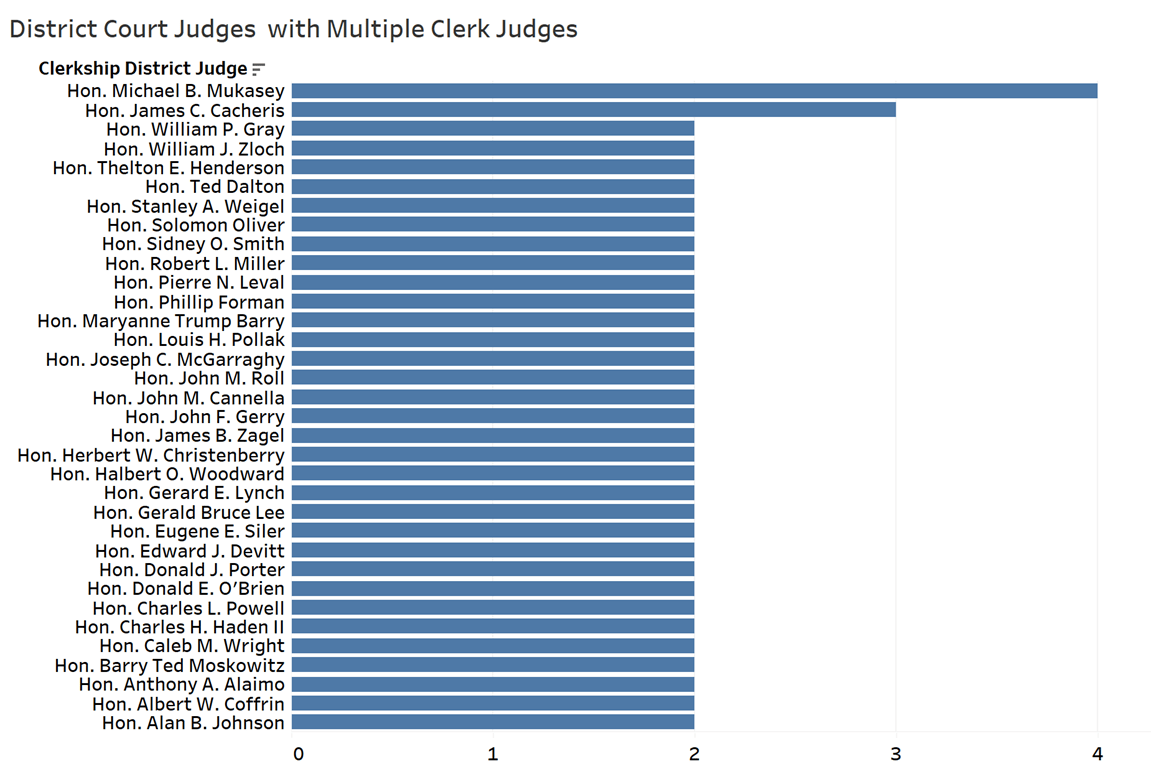
The
judges
who
have
placed
multiple
former
clerks
on
the
federal
bench
represent
an
often-overlooked
tier
of
judicial
influence.
The
data
reveals
a
more
dispersed
pattern
than
at
the
circuit
or
Supreme
Court
levels.
Judge
Michael
B.
Mukasey
of
the
Southern
District
of
New
York
leads
with
four
former
clerks
in
the
federal
judiciary—an
impressive
figure
given
that
district
judges
typically
have
fewer
clerks
and
less
name
recognition
than
their
appellate
counterparts.
Judge
James
C.
Cacheris
of
the
Eastern
District
of
Virginia
follows
with
three
clerk-judges,
while
numerous
other
district
judges
have
placed
two
former
clerks.
The
geographic
concentration
is
notable.
Many
judges
on
this
list
served
in
high-profile
districts—the
Southern
District
of
New
York,
the
Eastern
District
of
Virginia,
and
the
District
of
Columbia—where
challenging
cases
and
visibility
create
opportunities
for
clerks
to
distinguish
themselves.
Judges
in
these
districts
often
handle
national
security
cases,
complex
white-collar
prosecutions,
and
politically
sensitive
litigation,
providing
clerks
with
experience
that
later
recommends
them
for
judicial
appointments.
First
Amendment
Doctrine:
From
Mukasey
to
Pan
The
judicial
lineage
from
Judge
Mukasey
to
Judge
Patricia
Millett
Pan
of
the
D.C.
Circuit
demonstrates
how
district
court
approaches
to
constitutional
doctrine
can
influence
appellate
jurisprudence.
In Nonnenmann
v.
City
of
New
York,
Judge
Mukasey
granted
summary
judgment
on
First
Amendment
claims
with
a
terse
analysis
that
exemplified
his
pragmatic
approach.
He
concluded
that
the
plaintiff’s
speech
“did
not
address
a
constitutionally
protected
issue
of
public
concern,”
disposing
of
the
claim
in
a
single
sentence
within
a
broader
opinion
rejecting
multiple
theories
of
liability.
Mukasey’s
treatment
reflected
the
district
court’s
role:
apply
established
doctrine
efficiently,
manage
complex
dockets,
and
move
cases
toward
resolution.
Judge
Pan’s
opinion
in Ateba
v.
Leavitt reveals
a
more
elaborate
First
Amendment
framework,
though
one
that
reaches
a
similarly
government-friendly
conclusion.
The
case
involved
a
journalist’s
challenge
to
the
White
House
hard
pass
policy.
Pan
acknowledged
the
First
Amendment
concerns
but
applied
the
established
reasonableness
standard,
concluding
that
conditioning
fuller
access
on
Senate
Daily
Press
Gallery
accreditation
was
“both
reasonable
and
viewpoint
neutral.”
Her
analysis
engaged
more
deeply
with
the
constitutional
doctrine,
addressing
arguments
about
unbridled
discretion
and
procedural
protections
while
ultimately
deferring
to
the
government’s
access
policy.
Much
of
the
difference
in
depth
of
analysis
may
relate
to
the
objectives
and
extent
of
constitutional
interpretation
of
district
court
versus
appeals
court
judge.
The
comparison
reveals
both
continuity
and
evolution.
Both
judges
applied
First
Amendment
doctrine
to
uphold
government
restrictions,
and
both
wrote
with
relative
brevity.
Yet
Pan’s
opinion
shows
the
more
elaborate
reasoning
expected
at
the
appellate
level,
engaging
with
constitutional
standards
and
potential
objections
while
Mukasey’s
district
court
opinion
moved
quickly
to
disposition.
The
student
has
learned
to
elaborate
on
the
framework
while
reaching
conclusions
that
likely
would
satisfy
her
mentor.
Implications:
The
Self-Replicating
Judiciary
These
patterns
of
clerk
succession
point
toward
a
fundamental
transformation
in
how
the
federal
judiciary
perpetuates
itself.
What
began
as
an
informal
preference
for
continuity
has
evolved
into
something
approaching
a
self-replicating
system,
where
judicial
philosophies
pass
from
one
generation
to
the
next
through
carefully
cultivated
mentor-clerk
relationships.
The
implications
extend
far
beyond
individual
careers
or
even
the
ideological
balance
of
particular
courts.
First,
the
clerk
pipeline
is
creating
unprecedented
ideological
coherence
within
judicial
camps.
When
Justice
Scalia’s
originalism
passes
to
Justice
Barrett,
or
Judge
Sentelle’s
textualism
appears
in
Justice
Gorsuch’s
opinions,
or
Judge
Mukasey’s
First
Amendment
skepticism
echoes
in
Judge
Pan’s
rulings,
we
see
not
just
individual
judges
but
schools
of
thought
reproducing
themselves
across
levels
of
the
federal
judiciary.
This
coherence
increases
predictability—probably
a
good
thing
for
the
rule
of
law—but
also
reduces
the
kind
of
creative
tension
that
historically
produced
judicial
evolution.
Second,
the
emphasis
on
clerk
credentials
may
be
narrowing
the
diversity
of
judicial
backgrounds
and
experiences.
When
Supreme
Court
seats
increasingly
go
to
former
clerks
of
previous
justices,
and
circuit
judgeships
follow
similar
patterns,
the
federal
judiciary
risks
becoming
a
closed
system
that
prizes
insider
credentials
over
other
forms
of
distinction.
A
lawyer
who
built
a
successful
trial
practice,
or
led
a
civil
rights
organization,
or
served
as
a
state
judge
may
find
themselves
disadvantaged
compared
to
someone
who
clerked
for
the
right
justice
at
the
right
time.
Third,
strategic
retirement
is
likely
to
become
even
more
entrenched
as
justices
and
judges
see
their
former
clerks
successfully
ascend
to
higher
courts.
Why
risk
having
your
seat
filled
by
someone
who
will
dismantle
your
life’s
work
when
you
can
time
your
retirement
to
ensure
a
former
clerk
succeeds
you?
This
calculus
transforms
judicial
service
from
a
commitment
to
decide
cases
until
incapacity
into
a
more
strategic
career
management
decision.
The
Court
becomes
less
independent
of
politics,
not
more,
as
retirements
increasingly
align
with
electoral
cycles.
Fourth,
the
concentration
visible
in
these
numbers—particularly
Justice
Thomas’s
twelve
clerk-judges
and
Judge
Sentelle’s
seven—suggests
that
a
relatively
small
number
of
judges
are
having
outsized
influence
on
the
composition
of
the
federal
bench.
This
has
the
effect
of
concentrating
enormous
power
in
the
hands
of
a
few
individuals
to
shape
the
judiciary’s
future
direction,
particularly
when
combined
with
ideologically
motivated
appointment
processes.
Looking
forward,
several
questions
demand
attention.
Will
this
trend
continue
to
accelerate?
Will
judges
who
lack
Supreme
Court
or
prominent
circuit
clerkships
find
their
paths
to
the
bench
increasingly
blocked?
Will
the
public’s
perception
of
judicial
independence
suffer?
Perhaps
most
intriguingly,
will
the
next
generation
of
judges—those
who
clerked
for
justices
who
themselves
were
clerks—develop
distinctive
approaches
that
break
from
their
mentors’
methods?
Justice
Gorsuch’s
surprising
Bostock
opinion
suggests
that
judicial
philosophy,
even
when
transmitted
through
close
mentorship,
remains
more
dynamic
and
unpredictable
than
a
simple
model
of
replication
would
suggest.
The
clerks
may
learn
their
mentors’
methods,
but
they
apply
those
methods
in
new
contexts,
facing
new
questions,
and
sometimes
reach
conclusions
that
would
have
shocked
their
teachers.
The
data
presented
here
captures
a
moment
in
the
evolution
of
the
federal
judiciary—a
moment
when
the
clerk
pipeline
has
become
visible
enough
to
analyze
but
perhaps
not
yet
so
entrenched
that
it
cannot
be
questioned
or
redirected.
As
President
Trump’s
second
administration
considers
judicial
appointments,
and
as
sitting
justices
contemplate
their
retirement
timing,
these
patterns
of
succession
will
likely
intensify.
Whether
that
produces
a
judiciary
that
is
more
coherent
and
predictable,
or
one
that
is
closed
and
self-referential,
remains
to
be
seen.
What
seems
certain
is
that
the
era
of
unpredictable
judicial
appointments—when
Republican
presidents
might
appoint
liberal
justices
or
when
judges
might
dramatically
evolve
on
the
bench—is
largely
over.
The
clerk
pipeline,
combined
with
more
sophisticated
vetting
processes
and
strategic
retirement
decisions,
has
made
judicial
appointments
far
more
predictable.
We
know
not
just
what
ideology
a
nominee
holds,
but
where
they
learned
it,
from
whom,
and
how
they
are
likely
to
apply
it.
The
federal
judiciary
is
becoming,
for
better
or
worse,
a
self-perpetuating
institution
where
each
generation
of
judges
carefully
selects
and
trains
the
next.
Adam
Feldman
runs
the
litigation
consulting
company
Optimized
Legal
Solutions
LLC.
Check
out
more
of
his
writing
at Legalytics and Empirical
SCOTUS.
For
more
information,
write
Adam
at [email protected]. Find
him
on
Twitter: @AdamSFeldman.
The
United
Kingdom
is
set
to
become
Zimbabwe’s
largest
source
of
remittances
this
year,
surpassing
South
Africa
for
the
first
time,
according
to
Finance
Minister
Mthuli
Ncube.
Zimbabwe’s
remittance
inflows
have
surged
over
the
past
five
years,
a
sign
of
the
growing
influence
of
its
diaspora
on
the
national
economy.
New
data
shows
that
the
United
Kingdom
has
now
overtaken
South
Africa
as
the
country’s
top
source
of
remittances,
stressing
shifting
migration
and
income
patterns
among
Zimbabweans
abroad.
According
to
official
figures,
diaspora
remittances
rose
sharply
from
US$922
million
in
2019
to
US$2.58
billion
in
2024,
a
195%
increase.
This
trend
is
expected
to
continue,
with
inflows
projected
to
reach
US$2.72
billion
in
2025
and
exceed
US$2.75
billion
by
2026.
Data
for
the
first
quarter
of
2025
places
the
United
Kingdom
and
South
Africa
as
the
two
largest
contributors.
The
UK
accounted
for
28.6%
of
total
inflows,
about
US$779
million,
while
South
Africa
followed
closely
with
27.5%,
or
US$748
million.
Shifting
migration
patterns
Zimbabwe’s
recurring
economic
crises,
marked
by
hyperinflation,
currency
instability,
and
declining
job
opportunities,
have
driven
a
steady
wave
of
emigration
in
recent
years.
A
growing
number
of
professionals
have
relocated
to
the
United
Kingdom,
a
shift
that
has
significantly
boosted
remittance
inflows
from
the
diaspora.
Although
four
out
of
five
Zimbabweans
abroad
still
live
in
neighbouring
South
Africa,
changing
migration
patterns
and
income
levels
are
reshaping
the
flow
of
funds
back
home.
South
Africa’s
share
of
Zimbabwe’s
remittance
inflows
has
gradually
declined,
falling
from
38.3%
in
2021
to
27.5%
in
2025,
while
the
UK’s
contribution
has
steadily
grown
from
24.7%
to
28.6%
over
the
same
period.
Meanwhile,
inflows
from
the
US
and
Australia
have
seen
consistent
growth,
mirroring
changing
migration
destinations
and
the
expanding
economic
participation
of
Zimbabweans
abroad.
The
United
States
contributed
11.2%
(around
US$305
million),
while
Australia
made
up
5.5%
(roughly
US$150
million).
Smaller
but
notable
shares
came
from
Canada
(2.1%,
or
US$57
million)
and
Botswana
(2.0%,
or
US$54
million).
The
Rest
of
the
World
segment,
encompassing
multiple
smaller
contributors,
collectively
added
23.1%,
or
US$627
million.
Zenzo
Nkomo,
from
the
National
Democratic
Working
Group
(NDWG)
led
by
Sikhala,
claimed
a
sequence
of
events,
including
a
disrupted
book
tour,
a
house
bombing
and
the
bombing
of
a
conference
venue,
points
to
a
systematic
effort
to
silence
the
prominent
opposition
figure.
Nkomo’s
comments
were
made
during
a
solidarity
speech
at
the
“Red
October”
event,
organised
by
the
Zimbabwe
Communist
Party
(ZCP)
in
Bulawayo
over
the
weekend.
His
comments
come
as
53-year-old
Sikhala
reportedly
remains
in
custody
at
a
Pretoria
police
station
following
his
arrest
last
week
after
South
African
police
allegedly
found
explosives
in
his
vehicle.
“Police
received
a
tip
off
that
in
Sikhala’s
car
they
were
carrying
explosives.
Some
of
you
might
have
seen
that
on
social
media,
it
is
all
over,”
Nkomo
told
the
gathering.
“We
don’t
know
what
kind
of
explosives
those
are,
whether
industrial
or
military
explosives.
We
don’t
know
how
those
explosives
were
in
the
car.
All
those
are
million
dollar
questions
that
we
are
asking
ourselves.”
Nkomo
urged
the
audience
to
view
the
arrest
not
as
an
isolated
incident,
but
as
the
culmination
of
a
deliberate
pattern
of
intimidation
and
detailed
a
series
of
prior
events
that
he
believes
form
a
clear
sequence
of
targeting.
“But
before
this
latest
event,
there
is
a
sequence
of
events
that
have
been
developing.
One
of
them
is
we
start
with
the
book
launch,”
Nkomo
stated.
“Job
produced
his
biography
and
we
have
been
going
to
the
country
launching
that
book.
In
Masvingo,
our
launch
was
interrupted
by
agents
of
Zanu
PF
and
it
was
cancelled.”
The
campaign
of
disruption,
Nkomo
alleged,
then
extended
beyond
Zimbabwe’s
borders.
“After
that
disruption,
we
went
to
Johannesburg,
again
we
found
a
CIO
agent
or
whether
it
was
a
security
agent
amongst
us,
who
was
also
sent
by
the
system.
Our
security
managed
to
apprehend
him,”
he
said.
The
situation
escalated
dramatically
on
the
same
day
as
the
Johannesburg
incident.
“On
that
very
same
day
in
Harare,
Job’s
house
in
Harare
was
bombed,”
Nkomo
said.
He
further
connected
Sikhala’s
targeting
to
the
broader
political
context,
specifically
the
opposition
to
Zanu
PF’s
proposed
2030
presidential
term
extension.
Nkomo
cited
the
petrol
bombing
of
the
Southern
Africa
Political
Economy
Series
(SAPES)
Trust
in
Harare
on
October
28,
which
was
intended
to
host
a
press
conference
against
the
“2030
agenda.”
“Here
in
Bulawayo,
we
were
prevented
from
having
the
press
conference,”
Nkomo
added.
“You
can
see
that
there
is
a
campaign
by
the
system
comrades,
and
this
is
an
indictment
to
all
of
us
as
democratic
and
progressive
forces
in
this
country
that
how
do
we
respond,
tackle
and
organise
ourselves
to
face
this
onslaught
by
the
system
on
the
democratic
forces
and
forces
of
change
in
this
country
as
we
are
under
siege.”
Concluding
his
speech,
Nkomo
called
for
unity
among
opposition
forces.
“We
wish
the
communists
the
best,
we
are
all
looking
for
change,
the
communists
are
known
for
their
commitment
and
fighting
that’s
what
they
are
known
for
across
the
world.
Let’s
work
together
and
at
the
end
of
day,
we
must
bring
change
in
our
country
and
make
it
a
better
Zimbabwe
for
future
generations.”
According
to
reports,
friends
of
Sikhala
believe
he
was
the
victim
of
a
set-up,
possibly
involving
Zimbabwean
intelligence
operatives.
It
is
reported
that
Sikhala
received
a
call
from
individuals
presenting
themselves
as
members
of
former
DRC
President
Joseph
Kabila’s
party,
who
offered
financial
support
for
his
pro-democracy
efforts.
The
explosives
allegedly
found
in
Job
Sikhala’s
vehicle
by
South
African
police
Sikhala
was
arrested
after
leaving
a
meeting
with
these
individuals.
Pictures
circulating
online
show
Sikhala
handcuffed
and
sitting
by
the
roadside
next
to
an
elderly
man
believed
to
have
been
in
the
vehicle,
alongside
an
image
of
what
appears
to
be
explosives
in
a
yellow
plastic
bag.