OpenAI Dealt Copyright Loss In German Music Case – Above the Law

There
have
been
myriad
global
responses
to
the
intellectual
IP
scrape
and
combine
known
general
as
AI.
Artists
of
all
kinds
have
called
for
bans
on
AI
for
stealing
their
work
without
compensation
while
industry
giants
in
AI
have
gone
so
far
as
to
call
for

getting
rid
of
IP
altogether
.
Our
homegrown
response
is
overwhelmingly
on
the
side
of
AI

if
Peter
Thiel
and
Elon
Musk’s
close
associations
with
everyone
in
power
isn’t
enough,
at
one
point
there
were
murmurs
of
passing
a

moratorium
preventing
ANY
regulation
of
AI
for
a
10-year
period
.
If
that
weren’t
enough,
Sarah
Friar
soft
launching
(for
Sam
Altman
to
then
walk
back
)
the
government

bailing
out
OpenAI
if
they
don’t
turn
a
profit

makes
it
seem
like
America
is
squarely
pro-AI.
Despite
the
general
stronghold
AI
has
on
the
US,
there’s
been
some
local
pushback
when
it
comes
to
large
language
models
used
for
musical
purposes.
Big
names
have
tried
to
limit
what
AI
can
do,

Jay-Z
took
legal
action
over
AI
making
use
of
his
musical
likeness

for
example,
but
the
balance
still
looks
to
be
in
AI’s
favor:

Xania
Monet’s
recent
success
as
a
Billboard-placing
“AI
musician”

and

“Walk
My
Walk”
being
at
the
top
of
the
Country
charts

suggests
that
consumers
think
AI
music
is
fair
game.
It
also
doesn’t
hurt
that
the
usual
and
popular
propaganda
venues
are
pushing
for
the
normality
of
AI
music:

Things
have
been
a
little
different
across
the
pond.
Sir
Elton
John
has
been

spearheading
the
artistic
push
back
against
the
theft

required
for
musical
AI
to
flourish
and
has
asked
the
government
to
set
limits
on
how
AI
can
be
used
musically
in
order
to
save
the
future
for
artists.
And
while
his
focus
has
been
on
his
government,
he
has
enough
sense
to
know
that
a
fight
to
prevent
AI
from
replacing
musicians
has
to
be
a
united
front:
even
if
the
UK
comes
down
strong
with
laws
protecting
artist
IP,
what
good
does
it
do
if
Americans
can
feed
those
songs
to
an
LLM
and
get
the
same
results?

It
looks
like
Germany
is
one
of
the
first
countries
to
answer
the
call.
An
artist
sued
OpenAI
over
the
use
of
their
song
lyrics
and
they
actually
won
the
case!

Reuters

has
coverage:

OpenAI’s
chatbot
ChatGPT
violated
German
copyright
laws
by
reproducing
lyrics
from
songs
by
best-selling
musician
Herbert
Groenemeyer
and
others,
a
court
ruled
on
Tuesday,
in
a
closely
watched
case
against
the
U.S.
firm
over
its
use
of
lyrics
to
train
its
language
models.

The
regional
court
in
Munich
found
that
the
company
trained
its
AI
on
protected
content
from
nine
German
songs,
including
Groenemeyer’s
hits
“Maenner”
and
“Bochum”.

GEMA
legal
advisor
Kai
Welp
said
GEMA
hoped
discussions
could
now
take
place
with
OpenAI
on
how
copyright
holders
can
be
remunerated.

This
is
a
huge
outcome
for
both
sides.
For
European
artists,
this
case
could
be
a
template
to
be
compensated
when
AI
infringes
on
their
rights.
For
OpenAI,
it
acts
as
a
reminder
that
there
can
be
consequences
for
their
actions
so
long
as
robust
IP
protects
creators.
In
short,
this
is
the
sort
of
outcome
you’d
know
OpenAI
would
want
to
appeal
even
if
they
didn’t
tell
you
directly.
After
a
company
spokesperson
told
Reuters
that
they
were
considering
next
steps,
they
made
sure
to
frame
the
loss
as
a
limited
setback
that
doesn’t
threaten
their
business
model
too
much.
Let’s
see
how
well
that
characterization
ages.


OpenAI
Used
Song
Lyrics
In
Violation
Of
Copyright
Laws,
German
Court
Says

[Reuters]


Earlier
:

Elton
John
Calls
Government
‘Losers’
For
Letting
Tech
Firms
Skirt
Copyright
Laws



Chris
Williams
became
a
social
media
manager
and
assistant
editor
for
Above
the
Law
in
June
2021.
Prior
to
joining
the
staff,
he
moonlighted
as
a
minor
Memelord™
in
the
Facebook
group Law
School
Memes
for
Edgy
T14s
.
 He
endured
Missouri
long
enough
to
graduate
from
Washington
University
in
St.
Louis
School
of
Law.
He
is
a
former
boatbuilder
who
is
learning
to
swim, is
interested
in
critical
race
theory,
philosophy,
and
humor,
and
has
a
love
for
cycling
that
occasionally
annoys
his
peers.
You
can
reach
him
by
email
at [email protected]
and
by
tweet
at @WritesForRent.

Lindsey Halligan’s Day In Court – Above the Law

Lindsey
Halligan
(Photo
by
Al
Drago/Getty
Images)

On
Thursday,
Donald
Trump’s
insurance
lawyer,
Lindsey
Halligan,
will
defend
her
right
to
lead
the
US
Attorney’s
Office
in
the
Eastern
District
of
Virginia.
It
will
likely
be
one
of
her
last
acts
on
the
job.
The
only
real
question
is
whether
she’ll
take
the
James
Comey
and
Letitia
James
indictments
with
her,
or
whether
they’ll
limp
on
a
bit
longer
under
some
other
prosecutorial
authority.

The
Three
Hat
Dance

Attorney
General
Pam
Bondi
certainly
knows

how

to
hand
a
US
Attorney’s
Office
over
to
one
of
Trump’s
cronies.
Since
July,
she’s
been
using
the
same
maneuver
to
install
unconfirmable
MAGA
dolts
to
the
top
prosecutor’s
job:

  • Step
    1:
    Appoint
    crony
    as
    interim
    US
    Attorney
    for
    120
    days
    under

    28
    USC
    §
    546
    .
  • Step
    2:
    When
    it
    becomes
    clear
    that
    no
    Senate
    confirmation
    is
    coming,
    appoint
    said
    crony
    as
    first
    assistant
    US
    Attorney,
    and
    then
    claim
    that
    crony
    is
    automatically
    promoted
    to
    acting
    US
    Attorney
    by
    operation
    of
    the
    Federal
    Vacancies
    Reform
    Act.
  • Step
    3:
    Simultaneously
    appoint
    crony
    as
    a
    special
    attorney
    under
    28
    USC
    §
    509,
    510,
    and
    515.

It’s
a
little
rickety,
but
it’s
more
or
less
worked,
so
far
— at
least
to
the
extent
that
the
cronies
have
still
been
able
to
charge
cases.
Three
federal
courts
ruled
that
Steps
1
and
2
aren’t
legal,
since
they
would
effectively
eliminate
Senate
confirmation
for
US
Attorneys.

Why
would
any
president
bother
nominating
someone
when
he
can
string
together
an
endless
string
of
interim
appointments,
potentially
of
the
same
crony?

But
no
judge
has
dismissed
a
case
based
on
the
US
Attorney’s
unlawful
appointment,
since
Assistant
US
Attorneys
who
do
the
actual
work
of
charging
cases
have
the
power
to
indict
and
prosecute
as
well.

But
on
September
22,
Pam
Bondi
only
slapped
the
first
hat
on
Lindsey
Halligan,
appointing
her
interim
US
Attorney

under
§
546
.
That
was
tempting
fate,
since
a
federal
judge
in
Pennsylvania
had
already
ruled
that
§
546
only
allows
for

one

120-day
interim
appointment,
after
which
only
the
district’s
judges
may
appoint
an
interim
lead
prosecutor
until
the
Senate
confirms
a
pending
nominee.
And
it
was
doubly
tempting
fate
since
Halligan
was
the
only
lawyer
at
EDVA
who
would
get
anywhere
near
the
Comey
and
James
cases.

Halligan
was
the
sole
lawyer
to
present
those
indictments
to
a
grand
jury,
and
she’s
the
only
one
who
signed
them.
So
if
she
wasn’t
legally
appointed,
those
cases
would
appear
to
be
DOA.

Hot
Tub
Time
Machine
DOJ

Pam
Bondi
is
currently
trying
to
do
the
three-hat
dance
in
reverse.
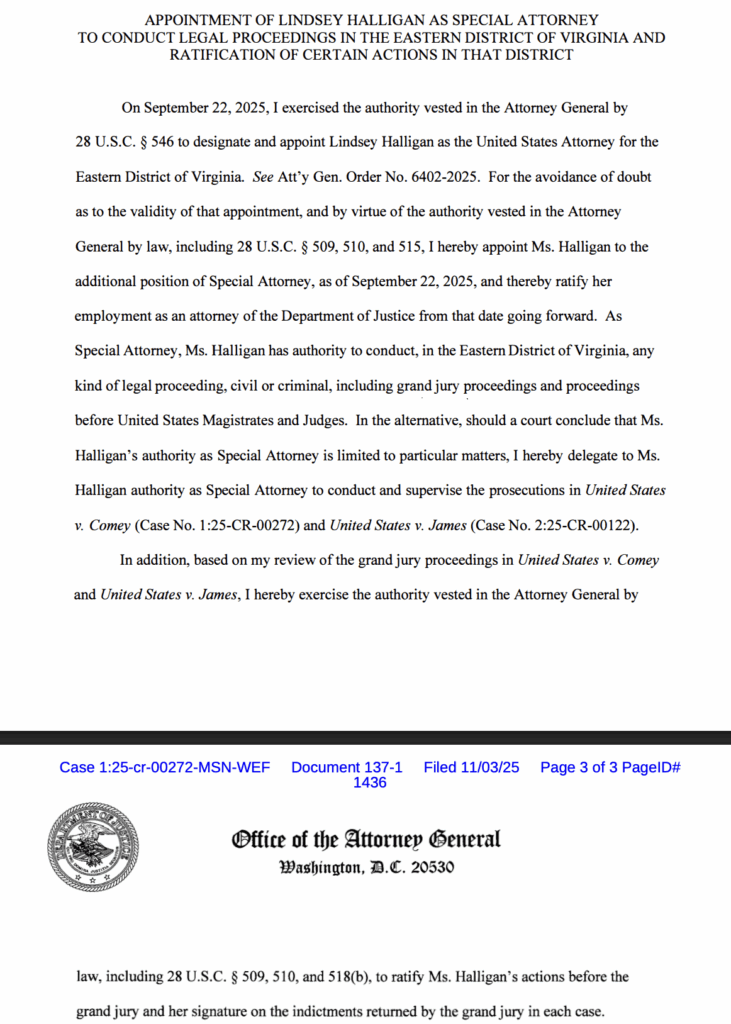
After
Comey
and
James
filed
motions
to
dismiss
noting
that
three
courts
have
found
that
the
president

cannot

make
successive
interim
appointments,
Bondi
signed
a

new
order

purporting
to
retroactively
designate
Halligan
as
a
special
attorney
under
§§ 509,
510,
and
515
“as
of
September
22”

effectively
traveling
back
in
time
six
weeks
and
sticking
the
third
hat
on
Halligan

before

she
secured
the
indictments.

Alternatively,
Bondi
claimed
to
have
“ratified”
the
indictments,
blessing
them

post
facto

and
curing
any
defect
arising
from
the
unfortunate
technicality
that
Halligan
had
no
right
to
be
in
the
grand
jury
room.

After
Pat
Fitzgerald
and
Abbe
Lowell
spent
ten
solid
minutes
laughing
their
asses
off

PRESUMABLY!

they
filed
their
replies.

Lipstick
on
a
pig

“Attorney
General
Bondi
does
not
have
a
time
machine,”
James’s
lawyers

jeered
,
adding
that
“Just
as
President
Trump
could
not
announce
tomorrow
that
he
is
‘appointing’
Attorney
General
Bondi
as
the
acting
Administrator
of
NASA
from
January
2025
to
March
2025,
Attorney
General
Bondi
lacked
the
power
announce
an
appointment
of
Ms.
Halligan
that
bent
space
and
time.”

They
were
similarly
derisive
about
the
government’s
claim
that
Halligan
was
functionally
an
AUSA
in
September,
rather
than
a
White
House
aide
tasked
with
de-woke-ing
the
Smithsonian:
“The
problem
is
that
Ms.
Halligan
brought
this
indictment
as
a
private
citizen
with
no
authority
to
litigate
on
behalf
of
the
United
States.
No
amount
of
ex-post
maneuvering
can
rescue
this
unlawful
indictment
from
dismissal.”

James
calls
dismissal
with
prejudice
“the
only
remedy
that
will
promote
the
interests
protected
by
the
Appointments
Clause
and
deter
the
government
from
deploying
unlawful
appointments
to
effectuate
retaliation
against
perceived
political
opponents”
— essentially
tying
it
into
her
motion
to
dismiss
for
selective
and
vindictive
prosecution.

Comey’s

reply

echoes
James’s,
scoffing
at
Bondi’s
reliance
on
a
theory
of
§
546
that
has
already
been
rejected
by
three
courts.
But
his
argument

against

Bondi’s
“ratification”
and

for

dismissal
with
prejudice
is
even
stronger
than
James’s,
since
the
statute
of
limitations
on
his
“crimes”
has
now
expired.

Comey
quotes
the
Supreme
Court’s
holding
in


FEC
v.
NRA
Political
Victory
Fund
,
finding
it
“essential
that
the
party
ratifying
should
be
able
not
merely
to
do
the
act
ratified
at
the
time
the
act
was
done,
but
also
at
the
time
the
ratification
was
made.”
Bondi
could
not
indict
him
today
because
the
statute
of
limitations
has
run,
and
so
she
can’t
retroactively
ratify
an
indictment
that
was
improperly
obtained
six
weeks
ago.

Something
to
remember
you
by

This
morning
Judge
Cameron
McGowan
Currie
will
consider
the
motions
to
disqualify
Halligan
and
dismiss
the
indictments.
We
may
also
get
an
indication
of
how
egregiously
inappropriate
Halligan’s
grand
jury
presentations
were,
since
the
court
has
been
mulling
them
over
for
more
than
a
week.

Judge
Currie,
who
was
seconded
from
the
District
Court
of
South
Carolina
to
hear
the
disqualification
motion,
ordered
the
government
to
turn
grand
jury
transcripts
in
both
cases
for

in
camera

review.
In
the
Comey
case,
she
later
filed
a

second
order

noting
that
the
government’s
production
“fails
to
include
remarks
made
by
the
indictment
signer
both
before
and
after
the
testimony
of
the
sole
witness,
which
remarks
were
referenced
by
the
indictment
signer
during
the
witness’s
testimony.”
Halligan
also
forgot
to
include
information
on
the
first
indictment,
for
which
she
got
no-billed.

So,
things
are
not
looking
great
for
the
“indictment
signer.”
And
that’s
before
she
has
to
defend
these
fakakta
cases
on
the
merits!
But,
even
if
she

does

get
get
tossed
off
this
case
tomorrow
or
next
week,
Halligan
will
take
a
souvenir
with
her

something
to
remember
this
day
by.
And
that
something
is

a

bar
complaint
.

On
Tuesday,
the
Campaign
for
Accountability

notified

the
Florida
and
Virginia
bars
of
potential
violations
of
their
respective
rules
of
professional
conduct.
The
nonprofit
suggests
that
Halligan:
violated
her
obligations
of
candor
and
competence;
made
extrajudicial
statements;
brought
a
prosecution
she
knows
is
not
supported
by
probable
cause;
and
engaged
in
conduct
involving
dishonesty,
deceit,
misrepresentation,
or
conduct
prejudicial
to
the
administration
of
justice.

So,
whatever
happens,
she’s
got

that

to
look
forward
to.


Subscribe
to
read
more
at
Law
and
Chaos….


Liz
Dye
 produces
the
Law
and
Chaos Substack and podcast.
 You
can
subscribe
by
clicking
the
logo:


Robert Mugabe Jnr fined $300 after conviction for drug possession

HARARE

Robert
Tinotenda
Mugabe,
the
33-year-old
son
of
the
late
former
president
Robert
Mugabe,
was
fined
US$300
by
a
Harare
court
on
Thursday
after
admitting
to
possession
of
cannabis.

Harare
magistrate
Lisa
Mutendereki
ordered
Mugabe
to
pay
the
fine
or
serve
four
months
in
prison
in
default.

Mugabe,
who
pleaded
guilty,
asked
the
court
for
leniency,
saying
he
is
a
single
father
caring
for
two
young
children.

A
warrant
for
his
arrest
had
been
issued
on
November
6
after
he
failed
to
appear
for
trial,
but
it
was
later
cancelled
when
he
presented
himself
in
court
a
day
later,
accompanied
by
his
lawyer
Arshiel
Mugiya.

Mugabe
was
arrested
on
October
1
after
police
stopped
his
silver
Honda
Fit
for
driving
against
traffic
on
a
one-way
street
along
2nd
Street
Extension
in
Harare.

Police
said
a
search
of
his
sling
bag
uncovered
two
sachets
of
cannabis,
a
pack
of
Rizla
papers,
and
a
cannabis
grinder.
The
seized
drugs,
weighing
two
grams
and
valued
at
US$30,
were
confirmed
by
forensic
experts.

Mugabe
reportedly
refused
to
sign
the
police
seizure
receipt
during
the
arrest.

Nigeria’s Dangote plans $1 billion investments in Zimbabwe

HARARE

Africa’s
richest
man,
Aliko
Dangote,
was
in
Harare
on
Wednesday
for
exploratory
talks
with
the
Zimbabwean
government
on
investments
worth
more
than
US$1
billion,
saying
he
was
encouraged
by
economic
reforms
under
President
Emmerson
Mnangagwa.

Dangote,
whose
fortune
is
estimated
at
about
US$30
billion,
met
Mnangagwa
and
signed
a
framework
investment
agreement
with
the
government.

He
previously
visited
Zimbabwe
in
2015
and
2018,
expressing
interest
in
cement
production
and
energy
projects,
but
nothing
materialised
from
those
trips.

“There
are
quite
a
lot
of
changes,”
Dangote
told
reporters.
“Now
the
government
is
solid.
There
is
a
lot
of
transparency.
Also,
when
you
look
at
what
His
Excellency
(President
Mnangagwa)
has
done
in
terms
of
turning
the
economy
around,
that
really
gave
us
the
confidence
that
this
is
the
right
time
for
us
to
come
and
invest.


“We
have
signed
an
agreement
between
Zimbabwe
and
Dangote
Group
to
do
various
investments
in
various
sectors,
some
of
which
are
in
cement,
some
in
power
generation,
some
in
a
pipeline
to
bring
petroleum
products.

“We
are
in
the
business
of
producing
oil.
We
have
the
largest
refinery
in
the
world
and
a
couple
of
other
investments
which
we
are
looking
at.
It
is
a
broad
investment,
really,
in
hundreds
of
millions
of
dollars,
maybe
even
up
to
a
billion.
But
really,
it
will
be
over
a
billion
because
of
the
pipeline.”

Presidential
spokesman
George
Charamba
said
the
discussions
were
exploratory
and
no
specific
project
deals
were
concluded
on
Wednesday.

“What
was
signed
was
a
global
agreement
which
may
pave
the
way
to
investments
of
about
US$1
billion;
no
agreement
on
any
specific
deal
was
signed
today,”
Charamba
said.

He
described
Dangote’s
engagement
as
“inspiring,”
highlighting
his
strong
belief
in
African-led
industrialisation
and
continental
self-reliance.

“He
was
particularly
insistent
that
African
capital
is
key
to
the
development
of
the
continent,”
Charamba
said.
“He
debunked
the
myth
of
smallness,
citing
Singapore
as
an
example,
and
argued
that
a
country
is
as
big
as
its
trade
hinterland.
Small
economies
like
Zimbabwe
can
be
cheaper
sites
of
production
if
they
think
beyond
national
markets.”

The
Dangote
Petroleum
Refinery,
the
world’s
largest
single-train
refinery,
is
currently
constructing
storage
tanks
in
Namibia
to
hold
at
least
1.6
million
barrels
of
petrol
and
diesel
for
distribution
across
southern
Africa.

The
tanks
are
expected
to
supply
fuel
to
Botswana,
Namibia,
Zambia
and
Zimbabwe,
with
plans
also
under
consideration
to
serve
southern
Democratic
Republic
of
Congo.

Senziwani
Sikhosana,
the
CEO
of
Bard
Santner,
which
is
structuring
the
investments,
and
journalist-cum-business
adviser
Josephine
Mahachi
accompanied
Dangote
to
his
meeting
with
Mnangagwa.

Dangote
left
Zimbabwe
for
Zambia
after
his
meetings
in
Harare.

How Much Do Lawyers In Small And Midsize Practices Make? – Above the Law

Every
year,
Above
the
Law
surveys
solo
practitioners
and
small
firm
lawyers
about
their
compensation
for
an
annual

compensation
report
.
This
year,
we
are
asking
attorneys
who
work
in
midsize
law
firms
to
participate
as
well. 

If 
you
are
a
lawyer
at
a
firm
with
fewer
than
250
attorneys,
please


click
here

to
take
this
brief,


completely
confidential
survey
.

Feel
free
to
share
the
survey
with
colleagues
and
peers;
the
more
responses
we
receive,
the
more
comprehensive
the
information
we’ll
have
to
share.


Solo And Small Firm Practice In The AI Agent Age – Above the Law

On
its
face,
Amazon’s
recent

lawsuit

to
block
Perplexity’s
AI
agents
from
shopping
on
Amazon’s
site
seems
like
just
another
turf
war
between
two
tech
giants
with
little
relevance
for
solo
and
small
law
firms. 

By
way
of
background
,
Amazon
says
that
Perplexity’s
Comet
browser
unlawfully
accessed
Amazon’s
website
and
customer
accounts
by
disguising
autonomous
AI
agents
as
human
users
to
make
purchases
without
authorization,
while
Perplexity
responds
that 
it
simply
enables
users
to
employ
digital
assistants
to
act
on
their
behalf.
As
such,
the
case
raises
the
knotty
problem
of how
to
regulate
AI
agents
acting
on
someone’s
behalf

an
issue
that
will
reach
the
legal
profession
sooner
than
most
lawyers
expect.

Let’s
take
a
step
back.
According
to

Claude.AI
,
an
AI
agent
is
a
software
system
that
autonomously
performs
tasks
and
makes
decisions
to
achieve
specific
goals,
using
tools
and
adapting
its
approach
without
constant
human
oversight.
AI
agents
don’t
just
assist;
they
act.
And
while
agents

are
currently
in
beta
or
experimental
mode
,
it’s
not
difficult
to
envision
how
they
could
be
deployed
in
legal
and
the
attendant
repercussions.

For
example,
just
as
consumers
now
deploy
AI
agents
to
find
products,
clients
will
soon
send
AI
agents
to
find
lawyers.
And
these
agents
won’t
necessarily
evaluate
a
firm
the
way
a
human
would.
They’ll
scrape
your
website,
LinkedIn
posts,
and
online
reviews,
scanning
for
objective
signals
of
competence,
responsiveness,
pricing,
and
availability,
and
assess
how
you
match
up
against
your
competitors.

And
that
witty,
human-sounding
blog
post
that
you
hoped
would
persuade
prospects
that
you’re
relatable?
An
AI
agent
might
ignore
it
entirely
in
favor
of
structured
data
like
published
case
results,
flat-fee
pricing
tables,
or
keyword
clarity.
In
short,
we’re
moving
into
a
world
where
your
marketing
must
persuade
machines
before
it
persuades
people.

Solo
and
small-firm
lawyers
who
rely
on
personal
voice
and
storytelling
will
need
to
start
optimizing
for
machine
readability.
That
doesn’t
mean
abandoning
human
tone,
but
it
does
mean:

  • Structuring
    your
    website
    content
    with
    clear
    metadata
    and
    FAQ
    sections
    that
    make
    it
    easy
    for
    agents
    to
    extract
    key
    information.
  • Offering
    standardized
    descriptions
    of
    practice
    areas
    (“contested
    guardianship
    litigation,
    fixed-fee
    estate
    plans,
    mediation
    services”)
    rather
    than
    narrative-style
    prose.
  • Using
    clean
    data
    formats
    so
    AI
    crawlers
    can
    correctly
    interpret
    your
    credentials
    and
    offerings.

Helping
consumers
find
lawyers
isn’t
the
only
way
that
AI
agents
may
manifest
themselves
in
the
legal
profession.
A
savvy
adversary
could
weaponize
agent
capability.
Picture
a
scenario
where
a
divorce
client
dispatched
an
army
of
AI
agents
to
schedule
“intake
calls”
with
every
family
lawyer
in
town

thereby
creating
conflicts
that
prevent
any
of
them
from
representing
the
opposing
spouse.
Today,
that
kind
of
behavior
would
require
dozens
of
phone
calls
and
forged
signatures.
Tomorrow,
it
could
happen
in
seconds,
triggered
by
a
single
prompt:

“Conflict
out
every
lawyer
within
10
miles
of
my
ex.”

Law
firms
will
need
to
develop
clear
policies
to
protect
against
such
misuse.
Just
as
websites
now
post
disclaimers
about
automated
scraping,
firms
may
soon
need
to
adopt
AI-agent
access
policies
stating
whether
automated
agents
are
permitted
to
fill
out
forms
or
schedule
consultations.
Firms
could
also
employ
verification
gates
to
detect
when
submissions
come
from
bots
rather
than
humans
and
software
capable
of
recognizing
duplicate
or
mass-generated
inquiries.

Finally,
don’t
overlook
the
rise
of
“recording
agents.” Clients
may
use
AI-powered
note-takers
to
record
calls
and
then
feed
entire
consultations
into
large
language
models
for
follow-up
analysis.
I’ve
written
about
the

ethics
of
lawyers
recording
conversations
with
clients
,
but
when
client
agents
record
without
permission,
it
raises
both
privacy
and
privilege
issues.
Lawyers
should
update
engagement
letters
to
specify
that
no
client
(or
client’s
agent)
may
record
or
transmit
conversations
without
consent.
Meeting-scheduling
systems
should
include
a
disclosure
requiring
human
participation,
not
just
digital
intermediaries.

In
the
coming
years,
AI
agents
will
undoubtedly
become
as
ubiquitous
as
email
or
the
cloud,
quietly
handling
research,
scheduling,
shopping,
and
legal
intake.
Those
solo
and
small
firms
who
deploy
agents
while
structuring
their
online
presence
for
agent
discovery,
setting
boundaries
for
AI-agent
interactions,
and
ensuring
client
data
is
secure
will
thrive
in
the
AI
agent
age.


Carolyn
Elefant
is
one
of
the
country’s
most
recognized
advocates
for
solo
and
small
firm
lawyers.
She
founded
MyShingle.com
in
2002,
the
longest-running
blog
for
solo
practitioners,
where
she
has
published
thousands
of
articles,
resources,
and
guides
on
starting,
running,
and
growing
independent
law
practices.
She
is
the
author
of
Solo
by
Choice,
widely
regarded
as
the
definitive
handbook
for
launching
and
sustaining
a
law
practice,
and
has
spoken
at
countless
bar
events
and
legal
conferences
on
technology,
innovation,
and
regulatory
reform
that
impacts
solos
and
smalls.
Elefant
also
develops
practical
tools
like
the AI
Teach-In
 to
help
small
firms
adopt
AI
and
she
consistently
champions
reforms
to
level
the
playing
field
for
independent
lawyers.
Alongside
this
work,
she
runs
the
Law
Offices
of
Carolyn
Elefant,
a
national
energy
and
regulatory
practice
that
handles
selective
complex,
high-stakes
matters.

Anatomy Of A Modern Merger: The Post-Closing To-Do List – Above the Law

Getty
Images


Editor’s
note:

Second
in
a
three-part
series.

Read
the
first
installment
here

You’ve
gathered
reliable
company
data.
You’ve
determined
the
law
department’s
proper
lane
for
this
transaction.
You’ve
maintained
appropriate
confidentiality
and
applied
sound
organizational
principles. 

Now,
the
ink
is
dry
on
your
merger
agreements

and
your
GC
is
facing
down
a
new
challenge:
guiding
the
integration
of
a
portfolio
of
companies
into
an
existing
structure. 

“Every
company
has
different
internal
dynamics
and
different
ways
of
working,
right?”
says
Kariem
Abdellatif,
the
head
of
Mercator
by
Citco
(Mercator),
a
specialist
entity
management
provider
that
helps
organizations
manage
their
global
entity
portfolios,
including
during
complex
M&A
transactions.  

“So
the
system
you
set
up
has
to
be
able
to
accommodate
those
differences,
and
the
entire
governance
framework
for
managing
entities
needs
to
be
flexible
enough
to
handle
not
just
the
current
complexity,
but
also
future
organizational
changes.”

In
this
series,
we’re
providing
a
step-by-step
guide
for
general
counsel
navigating
a
merger
or
other
corporate
transaction.
In
part
one,
we
explored
best
practices
for
corporate
law
departments
in
the
pre-merger
phase. 

Here,
we’re
sharing
the
initial
to-do
list
for
a
law
department
once
a
transaction
is
closed. 

We’ll
also
be
discussing
these
topics
in
a
webinar
next
month.

You
can
pre-register
here.


Button
Up
Your
Contracts

Law
departments
would
be
well-advised
to
get
a
head
start
on
shoring
up
their
employment
and
intellectual
property
agreements
as
soon
as
a
deal
is
inked. 

This
is
particularly
so
when
a
large
company
buys
a
smaller
entity
in
an
equity
deal,
notes
Scott
Naturman,
an
M&A
partner
with
Hughes
Hubbard
&
Reed
LLP.  

That’s
because
smaller
companies
often
have
deficient
regulatory
and
internal
compliance
programs,
which
can
lead
to
contracting
problems. 

“Almost
every
deal
we
do,
we
find
deficiencies,
and
it’s
not
me
necessarily,
but
it’ll
be
my
HR
and
IP
colleagues
looking
at
employment-related
contracts
and
finding
deficiencies
in
them,”
Naturman
says.
“So
that’s
something
that
often
has
to
be
fixed.”

Problems
can
also
arise
related
to
the
merged
entity’s
commercial
contracts.

Mergers
often
occur
between
companies
in
similar
industries,
of
course.
As
a
result,
the
merged
entity
may
have
contracts
with
the
same
customers
and
suppliers
as
the
acquirer. 

If
multiple
contracts
with
the
same
customer
or
supplier
have
differing
terms,
Naturman
notes,
the
merged
business
will
look
to
maintain
the
best
possible
outcome
while
combining
the
contracts.

Some
items
like
“most
favored
nation”
clauses
will
often
be
vetted
and
mitigated
in
the
due
diligence
process,
but
lawyers
will
still
need
to
think
through
how
to
merge
any
overlapping
agreements
once
the
deal
is
closed.


Maximize
the
Interim
Period

Even
if
they
tend
to
be
billed
as
“mergers
of
equals,”
few
mergers
are
actually
created
equal.

One
key
difference
emerges
around
the
closing
structure

with
delayed
and
simultaneous
closings
presenting
their
own
challenges
and
opportunities.

When
there’s
a
delayed
closing,
law
departments
must
navigate
an
interim
period,
where
you
protect
the
value
of
the
business
while
awaiting
a
condition
to
be
met

regulatory
approval,
for
example,
or
the
greenlight
from
a
lender. 

Naturman
notes
that
law
departments
can
make
progress
on
essential
human
resources
and
intellectual
property
tasks
during
this
period. 

“You
want
the
in-house
folks
as
soon
as
possible
to
be
speaking
with
key
employees
and
trying
to
lock
them
into
agreements
on
their
own
paper,
but
you
can’t
have
anything
become
effective
until
the
deal
closes,
of
course,”
he
says. 

“If
you
have
a
delayed
closing,
you
can
reach
a
wider
audience,
while
if
it’s
simultaneous,
you
don’t
have
that
opportunity.” 


Update

and
Leverage

Your
Org
Chart 

Simply
gathering
accurate
data
poses
another
post-merger
challenge
for
law
departments. 

All
of
the
documents
related
to
the
acquired
company
must
be
uploaded
into
a
merged
system,
for
example,
and
they
must
be
made
available
to
the
appropriate
employees. 

Once
the
information
is
updated,
Mercator’s
Entica
platform
can
create
detailed
and
interactive
corporate
org
charts.
This
allows
users
to
visualize
the
full
organization

which
entity
sits
on
top,
what
happens
if
entities’
locations
are
moved,
what
it
would
mean
if
an
entity
were
liquidated.

Law
departments
at
this
stage
should
consider
their
portfolio
of
companies,
looking
for
entities
that
could
be
merged.
Some
may
see
an
opportunity
for
immediate
savings. 

“If
you
have
two
of
your
own
entities
in,
say,
France,
and
you
just
acquired
a
portfolio
that
has
three
other
entities
in
France,
there’s
a
case
for
rationalization,”
Mercator’s
Abdellatif
says.

“Ask
yourself:
‘Why
do
I
have
five
entities
in
France?
Do
I
actually
need
all
of
these
for
the
activities
I
perform,
and
what
are
the
cost
and
compliance
implications
of
maintaining
them?”

When
companies
neglect
their
org
chart,
it
can
also
create
long-term
problems,
according
to
Naturman. 

“Especially
if
you’re
a
serial
buyer
and
you’re
buying
companies,
you
may
end
up
having
a
web
of
entities,
and
it
just
gets
out
of
control
and
hard
to
manage,”
he
says. 

This
type
of
sprawl
can
create
tax
inefficiencies
and
prevent
organizations
from
minimizing
liabilities
by
housing
them
in
carefully
chosen
entities
within
the
organization’s
structure. 

“I
don’t
think
enough
of
that
planning
happens,”
Naturman
says.
“It’s
often
we’re
brought
in
five
years
later
to
help,
then
they
say:
‘Help
us.
It’s
a
complete
mess.
How
do
we
reorganize
ourselves?
How
do
we
get
this
under
control?’”

Mercator’s
Abdellatif
adds:
“Dormant
entities
often
become
problematic
when
overlooked
during
transitions
or
treated
as
‘out
of
sight,
out
of
mind.’
We
frequently
see
cases
where
incomplete
records
or
unclear
responsibilities
lead
to
surprise
liabilities.”

“The
solution
is
treating
dormant
entities
with
the
same
discipline
as
active
ones,”
he
says,
“maintaining
accurate
inventories,
assigning
clear
ownership,
conducting
regular
reviews,
and
ensuring
professional
oversight.
This
transforms
them
from
hidden
risks
into
manageable
assets.”


Create
an
Impeccable
Calendar

Onboarding
an
entity
also
means
onboarding
its
deadlines. 

Once
a
transaction
is
closed,
detailed
deadline
calendaring
is
a
key
step
for
GCs.
Critically,
this
step
isn’t
limited
to
deadlines
related
to
the
deal
itself. 

Staying
on
top
of
deadlines
means
understanding
when,
say,
a
customer
supplier
contract
will
expire,
Naturman
notes.
Maintaining
this
focus
is
a
key
to
successfully
merging
multiple
entities. 

“One
thing
I’ve
seen
over
the
course
of
my
career
is
less
diligence
being
done,
or
more
targeted
diligence,”
he
says.

Abdellatif
notes
that
Mercator’s
Entica
system
contains
robust
workflow,
calendaring,
and
compliance
capabilities,
among
its
other
features.

Mergers
are
a
logistical
exercise,
he
says,
and
the
right
technology
can
form
the
organizational
backbone
for
a
transaction
to
progress.

“Technology
functions
differently
within
each
corporate
environment

meaning
it
doesn’t
always
get
used
the
same
way,”
he
says.
“To
get
the
most
value
out
of
it,
you
need
to
make
sure
that
its
properly
adapted
to
each
specific
environment.”

He
adds:
“When
implemented
thoughtfully,
technology
becomes
more
than
just
a
system

it
becomes
the
foundation
that
helps
standardize
processes,
maintain
compliance,
and
ultimately
drive
successful
integration.”


Stay
tuned
for
the
next
article
in
this
series,
where
we’ll
be
exploring
steps
to
consider
during
the
negotiation
and
closing
of
a
transaction. You
can
register
for
our
webinar
on
these
topics
here.

Harbor Acquires Legal Tech Training Firm Encoretech in First Deal Since BayPine Investment


Harbor
,
the
Chicago-based
legal
technology
and
consulting
firm,
continues
its
string
of
recent
acquisitions
with
the
addition
of

Encoretech
,
a
specialized
training
and
user
adoption
services
company
focused
on
the
legal
sector.

The
deal
marks
Harbor’s
first
acquisition
since
receiving
a
majority
investment
from
private
equity
firm
BayPine
in
June
and
represents
the
company’s
sixth
acquisition
since
its
formation
in
2023.

The
acquisition
addresses
what
both
companies
characterize
as
a
critical
gap
in
the
legal
industry:
the
persistence
of
outdated
training
methodologies
in
an
era
of
rapidly
evolving
technology
and
artificial
intelligence.


Related: LawNext:
Harbor
Global
CEO
Matt
Sunderman
On
Driving
Digital
Transformation
in
Legal
.

Encoretech
brings
approximately
80
professionals
across
the
United
States
and
Europe
who
specialize
in
helping
law
firms
and
corporate
legal
departments
maximize
their
return
on
technology
investments
through
comprehensive
training
programs.

Training
as
a
Competitive
Advantage

“As
every
aspect
of
legal
services
becomes
more
tech-enabled,
training
and
upskilling
legal
professionals
has
become
mission-critical,”
said
Matt
Sunderman,
CEO
of
Harbor.
“Encoretech
has
a
track
record
of
excellence
as
a
training
services
company
that
offers
agile,
flexible
solutions
for
law
firms
and
corporate
legal
departments
seeking
to
ensure
their
people
make
the
most
of
the
systems
and
tools
available
to
them.”

The
acquisition
reflects
a
broader
recognition
within
the
legal
technology
sector
that
technology
adoption

not
just
technology
acquisition

determines
the
success
or
failure
of
digital
transformation
initiatives.

Despite
law
firms’
substantial
investments
in
practice
management
systems,
document
management
platforms,
AI
tools
and
other
technologies,
many
struggle
to
achieve
meaningful
adoption
among
attorneys
and
staff
who
continue
to
rely
on
familiar,
if
less
efficient,
workflows.

Encoretech’s
flagship
offering,
Training-as-a-Service
(TaaS),
provides
a
fully
managed
solution
that
helps
law
firms
redesign
their
technology
training
programs
from
the
ground
up.
The
service
encompasses
new-hire
onboarding,
continuous
learning
through
live
and
on-demand
training,
custom
content
development,
and
learning
management
system
integration.

Encoretech
works
with
Am
Law
200
firms
as
well
as
corporate
legal
departments.

Aging
Solutions
for
Modern
Challenges

Jeffrey
Roach,
president
of
Encoretech,
said
that
there
is
a
fundamental
mismatch
between
traditional
training
approaches
and
current
technology
realities.

“Technology
training
programs
in
the
legal
sector
are
often
still
rooted
in
the
methodologies
developed
20
years
ago,”
he
said.
“With
the
ubiquity
of
technology
and
the
advent
of
AI,
it’s
clear
that
the
old
way
of
training
users
is
ineffective.”

The
challenge
has
intensified
as
legal
technology
has
moved
beyond
basic
document
production
tools
to
encompass
sophisticated
AI-powered
research
platforms,
predictive
analytics,
automated
workflows
and
cloud-based
collaboration
systems.

Many
of
these
tools
require
not
just
technical
proficiency
but
also
judgment
about
when
and
how
to
apply
them
effectively

a
skill
set
that
traditional
one-time
training
sessions
fail
to
develop.

Encoretech’s
approach
emphasizes
ongoing
skill
development
rather
than
one-off
training
events.
Its
methodology
combines
instructor-led
training,
individual
coaching
and
a
library
of
on-demand
content
designed
for
quick
consumption.

The
model
reflects
research
showing
that
sustained,
incremental
learning
produces
better
retention
and
behavior
change
than
intensive
but
infrequent
training
sessions,
the
company
says.

Building
A
Comprehensive
Platform

The
Encoretech
acquisition
fits
within
Harbor’s
broader
strategy
of
assembling
capabilities
across
what
it
calls
the
“Advise/Implement/Manage
lifecycle.”
The
training
services
will
integrate
with
Harbor’s
Legal
Technology
+
Operations
practice,
which
handles
cloud
migrations,
workflow
automation
and
ongoing
management
of
enterprise
applications.

Encoretech
represents
Harbor’s
sixth
acquisition
since
the
company’s
formation
through
the
2023
merger
of
HBR
Consulting,
LAC
Group
and
Wilson
Allen.
The
company’s
acquisition
timeline
demonstrates
an
aggressive
growth
strategy:

  • October
    2023:
    Acquired
    Stout’s
    legal
    management
    consulting
    practice,
    adding
    e-discovery
    advisory
    and
    corporate
    legal
    operations
    capabilities.
  • February
    2024:
    Acquired
    Pinnacle,
    a
    UK-based
    legal
    technology
    services
    provider,
    establishing
    significant
    presence
    in
    Europe
    and
    Asia
    Pacific.
  • March
    2025:
    Acquired
    CLIENTSFirst
    Consulting,
    adding
    marketing
    technology
    and
    CRM
    data
    quality
    services.
  • October
    2024:
    Acquired
    Ascertus,
    a
    UK-based
    iManage
    implementation
    specialist.
  • November
    2025:
    Acquired
    Encoretech.

This
acquisition
pattern
suggests
that,
rather
than
focusing
exclusively
on
software
selection
and
implementation,
Harbor
is
assembling
services
that
address
the
full
spectrum
of
technology-related
challenges
law
firms
face,
from
strategic
planning
through
long-term
adoption
and
optimization.

First
Deal
Since
BayPine
Investment

Harbor’s
acquisition
of
Encoretech
marks
the
first
deal
completed
since
BayPine’s
majority
investment
closed
in
June
2025.
The
transaction
followed
three
years
of
ownership
by
Renovus
Capital
Partners,
which
remains
a
significant
investor
alongside
BayPine
and
Harbor’s
management
team.

“The
legal
industry
is
undergoing
a
generational
transformation
driven
by
the
rapid
development
and
availability
of
emerging
technologies
and
tools,”
Sunderman
said
at
the
time
of
the
BayPine
investment.

“Applying
advanced
technologies
and
AI
to
business
operations
and
legal
workflows
is
game-changing,
but
the
scope
and
scale
of
the
transformation
required
to
capitalize
on
the
potential
opportunities
is
significant.”

At
the
time
of
that
investment,
Sunderman
said
that
the
company
planned
to
“expand
its
investment
in
the
corporate
legal
market
globally
and
advance
new
capabilities
through
acquisition
or
internal
development.”

The
Encoretech
acquisition
appears
to
demonstrate
that
strategy
in
action,
adding
capabilities
that
Harbor
identified
as
strategic
priorities
rather
than
attempting
to
build
them
itself.

Encoretech
Integration

The
Encoretech
team
will
join
Harbor’s
Legal
Technology
+
Operations
practice,
which
now
encompasses
more
than
900
professionals
globally
serving
over
80
percnet
of
global
200
law
firms
and
500
corporate
legal
departments.

The
integration
positions
Harbor
to
offer
clients
a
more
complete
package:
strategic
technology
planning,
implementation
services,
and
now
comprehensive
training
and
adoption
support.

“Harbor
has
a
strong
reputation
within
the
legal
industry
for
its
expertise
in
legal
technology,
operations
and
innovation,”
said
Stacy
Gittleman,
CEO
of
Encoretech.
“I
am
thrilled
to
see
our
team
start
a
new
chapter
as
part
of
Harbor.”

For
Roach,
the
Encoretech
president
who
will
continue
in
a
leadership
role
at
Harbor,
the
combination
enables
the
company
to
expand
its
impact.

“Our
team
has
made
great
strides
in
helping
the
legal
sector
rethink
its
approach
to
technology
adoption,”
he
said.
“Joining
Harbor
allows
us
to
scale
that
work
and
reach
more
organizations
ready
to
modernize
the
way
their
people
learn
and
work.”

Industry or the military – which will lead on AI?

The
military
is
going
to
use
artificial
intelligence.
But
while
planners
in
the
government
may
have
an
idea
of
the
best
way
forward,
can
they
truly
lead,
or
will
industry
steer
things
forward?

In
a
new

Breaking
Defense
video

on
the
future
of
military
AI,
Breaking
Defense
Editor-in-Chief
Aaron
Mehta
and
our
in-house
AI
expert
Sydney
Freedberg
are
joined
by
Joshua
Wallin
of
the
Center
for
a
New
American
Security
to
tackle
that
very
question.

And
for
more
insights
on
how
AI
will
integrate
into
the
military,
head
to

Part
1
,

Part
2

and

Part
3

of
the
series
for
more.

Morning Docket: 11.13.25 – Above the Law

*
To
keep
the
government’s
extrajudicial
boat
killing
policy
running
full
steam
ahead,
the
DOJ
prepares
an
opinion
to
absolve
anyone
involved.
[Reuters]

*
A
woman
has
married
an
AI
bot
in
Japan.
They’re
going
to
have
so
many
fights
over
whose
turn
it
is
to
take
out
the
trash.
[The
Independent
]

*
Judge
set
to
decide
if
Tom
Goldstein’s
hiring
of
alleged
mistresses
amounted
to
tax
fraud.
[ABA
Journal
]

*
Will
AI
libel
become
the
industry’s
next
legal
headache?
[The
Economist
]

*
Self-taught
jailhouse
lawyer
running
for
Court
Clerk
in
New
Orleans.
[NY
Times
]

*
German
court
rules
that
AI
is
stealing
lyrics
from
musicians.
[Courthouse
News
Service
]

*
“Andrew
Cuomo
Photographed
Kissing
and
Grabbing
Lawyer
Who
Defended
Him
From
Sexual
Harassment
Accusations”
enters
the
“Not
The
Onion”
hall
of
fame.
[Mediaite]