In
this
episode
of
the
“Be
That
Lawyer”
podcast,
I
sit
down
with
Eric
Ritter,
CEO
of
Digital
Neighbor,
to
explore
how
AI,
shifting
search
behavior,
and
smarter
digital
strategy
are
reshaping
marketing
for
law
firms.
Eric
breaks
down
the
practical
steps
firms
must
take
to
stay
visible,
competitive,
and
client-ready
in
an
answer-driven
search
world.
The
Shift
from
SEO
to
Answer
Engine
Optimization
(AEO)
In
this
clip,
Eric
explains
how
Google’s
shift
toward
AI-generated
answers
is
forcing
firms
to
optimize
for
solutions,
not
just
search
terms.
Traditional
SEO
is
no
longer
enough
to
win
online
visibility.
With
AI
now
powering
tools
like
Google’s
Search
Generative
Experience,
law
firms
must
optimize
for
answers,
not
just
keywords.
Known
as
Answer
Engine
Optimization
(AEO),
this
approach
involves
creating
FAQ-style
content
and
properly
tagging
it
with
schema
markup
to
make
it
easily
digestible
by
AI
engines.
Law
firms
that
embrace
AEO
can
appear
directly
in
AI
summaries,
giving
them
a
critical
edge
as
search
behaviors
evolve.
Why
Local
Service
Ads
Beat
Expensive
Clicks
Local
Service
Ads
(LSAs)
offer
a
better
ROI
than
traditional
pay-per-click
advertising
by
charging
only
for
qualified
leads.
For
law
firms,
this
means
spending
money
only
when
someone
calls
or
messages
with
intent—not
just
when
someone
clicks
a
link.
When
paired
with
strong,
well-optimized
service
pages,
LSAs
can
dramatically
increase
lead
quality
without
draining
the
budget.
Instead
of
blogging
endlessly,
firms
should
invest
in
refining
their
website’s
core
service
content
to
convert
traffic
more
effectively.
Why
Reviews
Should
Be
Part
of
Your
Closing
Process
The
best
time
to
collect
a
client
review
is
immediately
after
delivering
a
great
result.
Embedding
review
requests
into
your
closing
process
—
when
satisfaction
is
highest
—
ensures
stronger,
more
consistent
feedback. Whether
you
serve
consumers
or
businesses,
reviews
on
platforms
like
Google
and
LinkedIn
boost
your
credibility
and
visibility.
Lawyers
who
automate
or
systematize
this
process
turn
happy
clients
into
long-term
marketing
assets
that
build
trust
and
drive
referrals.
“SEO
gets
you
seen,
but
that
answer
engine
optimization
gets
you
quoted,”
Eric
says.
To
build
lasting
success
online,
law
firms
need
more
than
blog
posts
and
SEO
—
they
need
systems
that
align
with
AI-driven
search,
consumer
psychology,
and
digital
behavior.
Eric
emphasizes
the
importance
of
topic
clusters,
review
requests,
remarketing
strategies,
and
thoughtful
ad
spend.
The
firms
that
stay
focused,
adapt
early,
and
measure
their
efforts
will
not
only
survive
the
marketing
shifts
—
they’ll
thrive.
Steve
Fretzin
is
a
bestselling
author,
host
of
the
“Be
That
Lawyer”
podcast,
and
business
development
coach
exclusively
for
attorneys.
Steve
has
committed
his
career
to
helping
lawyers
learn
key
growth
skills
not
currently
taught
in
law
school.
His
clients
soon
become
top
rainmakers
and
credit
Steve’s
program
and
coaching
for
their
success.
He
can
be
reached
directly
by
email
at [email protected].
Or
you
can
easily
find
him
on
his
website
at www.fretzin.com or
LinkedIn
at https://www.linkedin.com/in/stevefretzin.
Ed.
Note:
A
weekly
roundup
of
just
a
few
items
from
Howard
Bashman’s
How
Appealing
blog,
the
Web’s
first
blog
devoted
to
appellate
litigation.
Check
out
these
stories
and
more
at
How
Appealing.
“A
Senators-Only
Right
to
Sue
in
Shutdown
Deal;
In
their
legislation
reopening
the
government,
senators
awarded
themselves
a
legal
power
to
sue
the
government
that
should
be
universal”: Anya
Bidwell
and
Patrick
Jaicomo
have this
essay online
at
The
Wall
Street
Journal.
“Judging
The
Justice
System
In
The
Age
Of
Trump:
Nancy
Gertner.” You
can
access
the
new
episode
of
David
Lat’s
“Original
Jurisdiction”
podcast via
this
link.
“Gorsuch
Joins
Sotomayor
as
Supreme
Court
Children’s
Author”: Justin
Wise
of
Bloomberg
Law
has this
report.
“Justice
Dept.
Struggled
to
Find
Lawyers
to
Handle
Maurene
Comey
Suit;
Ms.
Comey,
the
daughter
of
the
former
F.B.I.
director
James
B.
Comey,
sued
the
Trump
administration
after
she
was
abruptly
fired;
Now
the
U.S.
attorney
in
Albany
has
agreed
to
take
the
case”: Jonah
E.
Bromwich
and
William
K.
Rashbaum
of
The
New
York
Times
have this
report.
“Abortion
Has
Remained
Mostly
Accessible.
That
May
Soon
Change.” The
New
York
Times
has
published this
editorial.
“The
Supreme
Court
Just
Took
a
Scary
Voting
Case
That
Has
Trump
Salivating.
He
Might
Be
Disappointed.” Law
professor Richard
L.
Hasen has this
Jurisprudence
essay online
at
Slate.
If
you
thought
the
racist
text
scandal
surrounding
MAGA
attorney
Paul
Ingrassia
meant
we’d
get
a
break
from
hearing
about
him
—
hooboy,
were
you
wrong!
Last
we
heard,
Ingrassia’s
nomination
to
lead
the
Office
of
Special
Counsel
was
yanked
after
key
GOP
senators
decided
he
was
too
racist
for
their
taste.
Yesterday,
POLITICO’s
Daniel
Lippman
broke
news
about
what’s
next
for
Ingrassia.
He’s
leaving
his
role
as
White
House
liaison
to
the
Department
of
Homeland
Security.
No,
he’s
not
going
somewhere
to
lick
his
wounds
—
he’s
getting
a
title
bump:
to
Deputy
General
Counsel
of
the
General
Services
Administration.
That’s
right,
after
his
OSC
nomination
crashed
and
burned,
Ingrassia
isn’t
leaving
the
government
in
disgrace,
like
a
normal
person
would.
Nope.
The
administration
simply
slid
him
over
to
the
GSA
—
and
up
the
ladder.
Seriously,
how
is
this
even
a
career
path?
A
reminder
on
the
scandals
—
plural,
always
plural
–Ingrassia
faced
before
his
elevation
to
Deputy
Fucking
General
Counsel.
He
was
linked
to
antisemitic
extremists,
reportedly
faced
a
sexual
harassment
investigation,
and
then
there
was
the
racist
chat
that
blew
up.
There, Ingrassia
wrote,
“MLK
Jr.
was
the
1960s
George
Floyd
and
his
‘holiday’
should
be
ended
and
tossed
into
the
seventh
circle
of
hell
where
it
belongs.”
And,
“No
moulignon
holidays
…
From
kwanza
[sic]
to
mlk
jr
day
to
black
history
month
to
Juneteenth,”
then
added:
“Every
single
one
needs
to
be
eviscerated.”
And
of
course,
the
admission,
“I
do
have
a
Nazi
streak
in
me
from
time
to
time,
I
will
admit
it.”
Even
apart
from
the
deeply
problematic
baggage
surrounding
Ingrassia,
his
new
role
is
still
eyebrow
raising.
He
graduated
from
Cornell
Law
checks
notes
in
2022,
and
only
joined
the
New
York
Bar
last
year!
So
when
the
White
House
says Ingrassia
“is
a
very
helpful
addition
to
GSA
and
will
successfully
execute
President
Trump’s
America
First
policies,”
you
know
it’s
a
lot
more
about
being
loyal
to
Donald
Trump
and
not
about
any
actual
experience
he
has.
I
guess
we
know
what
qualifications
you
need
to
rise
in
government
right
now:
MAGA
loyalty,
a
law
degree
that
still
has
metaphorical
wet
ink
on
it,
and
scandals?
Well,
those
are
a
bonus.
Because
nothing
says
“merit”
like
a
lawyer
with
a
year
of
experience
and
Nazi
texts.
Kathryn
Rubino
is
a
Senior
Editor
at
Above
the
Law,
host
of
The
Jabot
podcast,
and
co-host
of
Thinking
Like
A
Lawyer.
AtL
tipsters
are
the
best,
so
please
connect
with
her.
Feel
free
to
email
her
with
any
tips,
questions,
or
comments
and
follow
her
on
Twitter
@Kathryn1 or
Mastodon
@[email protected].
When
the
executive
branch
puts
their
fingers
on
the
scales
of
justice
and
says,
‘I’m
going
to
punish
you
for
your
viewpoint,’
everybody
in
the
bar
should
start
heckling.
—
Raymond
J.
Dowd,
a
partner
at
Dunnington
Bartholow
&
Miller,
in
comments
given
to
Bloomberg
Law,
concerning
the
“entirely
spontaneous”
moment
when
he
started
heckling
Brad
Karp,
chair
of
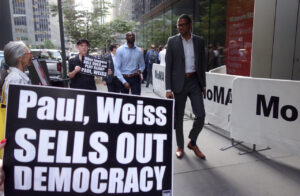
Paul
Weiss,
over
the
firm’s
pro
bono
deal
with
Trump,
at
last
week’s
New
York
Bar
Foundation
gala.
After
the
event,
Karp
called
Dowd
to
discuss
what
happened.
“I
appreciated
him
sharing
his
views,”
Dowd
said.
“He
was
not
expressing
rage
or
anger.
I
just
think
he
felt
quite
blindsided,
and
I
said,
‘I
felt
exactly
the
same
way.’”
Dowd
went
on
to
say
that
it’s
his
“sincere
hope”
that
his
heckling
brings
about
change.
“I
think
having
a
larger
dialogue
on
these
issues
is
very
important
for
the
future
health
of
the
legal
profession,”
he
said.
Staci
Zaretsky is
the
managing
editor
of
Above
the
Law,
where
she’s
worked
since
2011.
She’d
love
to
hear
from
you,
so
please
feel
free
to
email
her
with
any
tips,
questions,
comments,
or
critiques.
You
can
follow
her
on Bluesky, X/Twitter,
and Threads, or
connect
with
her
on LinkedIn.
Last
week,
a
lawyer
attending
the
New
York
Bar
Foundation
gala
spoke
up
to
heckle
Paul
Weiss
chair
Brad
Karp
over
the
firm’s
deal
with
the
Trump
administration.
Afterward,
a
prominent
authority
on
the
business
of
law
mused
to
me
that
we
don’t
level
enough
blame
on
the
rest
of
the
legal
industry
for
failing
to
organize
and
take
collective
action.
Paul
Weiss
and
the
other
capitulating
firms
found
themselves
in
a
classic
Prisoner’s
Dilemma
and
found
that
the
faster
they
made
a
deal,
the
better
the
terms.
But
the
best
outcome
for
the
hypothetical
prisoners
is
actually
to
stick
to
their
principles,
assuming
no
one
rats
them
out.
While
many
lawyers
called
out
the
administration’s
lawlessness,
there
wasn’t
the
unified
sense
of
purpose
across
the
industry
—
especially
across
Biglaw
—
that
a
firm
could
rely
upon.
But
a
number
of
legal
professionals
want
to
change
that,
and
start
making
a
public
demonstration
of
the
legal
community
coming
together
to
defend
the
rule
of
law
—
since
lawyers
should
consider
themselves
the
rightful
guardians
of
that
principle
anyway.
Tomorrow
offers
something
of
a
second
bite
at
the
apple
for
lawyers.
“Lawyers
March
for
Democracy”
kicks
off
tomorrow
at
1
p.m.
outside
the
Supreme
Court.
The
People’s
Parity
Project
organized
the
event,
backed
by
Alliance
for
Justice,
the
American
Constitution
Society,
Lambda
Legal,
and
a
coalition
of
other
progressive
legal
organizations
to
“call
out
the
Trump
administration’s
lawlessness
and
the
Supreme
Court’s
complicity
in
Trump’s
authoritarianism.”
Through
all
of
the
upheavals
of
the
early
months
of
Trump’s
second
term,
the
Supreme
Court
has
not
only
been
complicit
but
has
actively
participated
in
Trump’s
authoritarian
project,
siding
with
the
administration
over
and
over
again
and
allowing
him
to
continue
blatantly
unconstitutional
actions
without
any
public
legal
justification.
Why
start
at
the
Supreme
Court?
Remember
the
humble
ask
of
the
anonymous
federal
judges
who
asked
the
Supreme
Court
to
please
say
something
about
the
Trump
administration
telling
the
January
6
people
to
go
to
“war”
with
us?
At
least
try
—
they
asked
the
Court
—
to
explain
shadow
docket
opinions
so
the
administration
can’t
use
its
media
outlets
to
recast
those
empty
orders
as
indictments
of
lower
court
judges
just
following
existing
precedent.
Hearing
the
plea
and
understanding
the
gravity
of
the
violent
threats
mounting
against
federal
judges,
the
Supreme
Court
said:
nah.
The
Supreme
Court
makes
a
lot
of
sense
as
a
starting
point.
The
New
Republic
ran
a
wonderful
piece
this
week
drawing
parallels
between
tomorrow’s
march
and
successful
lawyer-led
resistance
movements
around
the
world.
In
Pakistan
in
2007,
lawyers
marched
—
through
tear
gas
and
arrests
—
after
President
Musharraf
suspended
the
chief
justice.
They
wore
their
black
coats
as
symbols
that
the
law
itself
was
under
siege.
Eventually,
they
prevailed.
Lawyers
love
their
image
as
the
guardians
of
democracy.
Quoting
A
Man
For
All
Seasons
to
proclaim
themselves
the
last
defense
against
tyranny
is
practically
the
“Oh,
The
Places
You’ll
Go”
of
a
law
school
graduation.
But
when
tyranny
actually
knocks,
the
incentives
are
set
up
to
make
it
easier
to
invite
it
in
for
tea.
At
the
highest
levels,
law
firms
run
on
access
to
government
actors,
expensive
staff,
and…
well,
yeah,
also
big
personal
paychecks.
When
an
administration
launches
an
existential
threat
to
the
business
model
—
and
the
current
Supreme
Court
gives
few
guarantees
that
it
would
block
those
illegal
threats
if
called
upon
—
it’s
hard
to
convince
individual
firms
to
push
back
if
they
don’t
feel
like
the
rest
of
the
industry
has
their
back.
And
they
didn’t.
The
rest
of
Biglaw
failed
to
publicly
back
them
up
and
Karp
claims
rival
firms
actively
used
the
Executive
Order
threat
to
try
to
steal
talent
and
business
from
the
firm.
At
the
time
when
a
firm
needed
industry
support
the
most,
at
least
some
of
its
competitors
just
saw
a
chance
to
throw
them
under
the
bus.
That
those
same
firms
are
probably
now
using
the
fact
that
a
firm
DID
make
a
deal
to
try
to
steal
talent
and
business
may
involve
a
different
ethical
positioning,
but
the
underlying
problem
remains
that
the
industry
is
so
atomized
that
it
presents
a
custom-built
divide
and
conquer
opportunity.
Which
is
why
marches
like
the
one
tomorrow
are
so
important.
And
conferences
like
the
Rule
of
Law
Society
recently
held.
And
initiatives
defending
bar
associations
and
other
legal
groups
that
preach
profession
over
employer.
Lawyers
need
to
get
back
to
a
little
of
that
corny
law
school
idealism
and
get
together.
Britain’s
national
broadcaster
will
not
be
cutting
a
check
to
America’s
president,
thankyouverymuch.
Auntie
Beeb
has
closed
the
cupboard
and
will
not
be
doling
out
biscuits
to
the
naughty
tyke
in
chief.
After
reading
his
lawyer’s
bumptious
demand
letter
that
it
fork
over
English
taxpayer
dollars,
the
BBC
told
Trump
to
do
one.
The
kerfuffle
is
the
result
of
a
documentary
aired
more
than
a
year
ago
entitled
“Trump:
A
Second
Chance?”
in
which
footage
of
Trump’s
infamous
January
6
speech
was
edited
to
make
it
appear
that
he
told
his
supporters
to
walk
down
to
the
Capitol
and
fight.
Which
they
did!
But
in
fact
the
12-second
clip
was
a
pastiche
of
two
parts
of
the
speech
more
than
50
minutes
apart.
The
clip
was
surfaced
by
a
conservative
critic
of
the
BBC
as
part
of
a
memo
listing
several
culture
war
grievances,
including
bias
in
favor
of
trans
people
and
immigrants
and
against
Israel.
It
ignited
a
feeding
frenzy
of
right-wing
attack
dogs
which
has
already
claimed
the
scalps
of
the
BBC’s
two
top
officers.
It
also
summoned
the
American
president,
like
Beetlejuice
crossed
with
Paulie
Walnuts.
Trump’s
lawyer
lightly
edited
his
standard
presidential
shakedown
letter
and
fired
off
a
nastygram
(h/t
Politico)
to
BBC
Chair
Samir
Shah
demanding
that
he
“immediately
retract
the
false,
defamatory,
disparaging,
and
inflammatory
statements
made
about
President
Trump”
or
face
litigation
over
the
“overwhelming
financial
and
reputational
harm
that
the
BBC
has
caused
him
to
suffer.”
“If
the
BBC
does
not
comply
with
the
above
by
November
14,
2025,
at
5:00
p.m.
EST,
President
Trump
will
be
left
with
no
alternative
but
to
enforce
his
legal
and
equitable
rights,
all
of
which
are
expressly
reserved
and
are
not
waived,
including
by
filing
legal
action
for
no
less
than
$1,000,000,000
(One
Billion
Dollars)
in
damages,”
he
blustered.
“The
BBC
is
on
notice.
PLEASE
GOVERN
YOURSELF
ACCORDINGLY.”
How
Brito
calculated
the
damages
figure
for
a
broadcast
Trump
never
heard
about
until
a
week
ago
is
left
as
an
exercise
for
the
reader.
The
BBC
reports
that
Shah
sent
a
personal
apology
to
the
president
and
a
letter
to
Brito’s
declining
his
invitation
to
pay
tribute
to
America’s
King
George.
The
letter
laid
out
a
non-exhaustive
list
of
reasons
the
lawsuit
is
DOA,
even
if
the
president’s
home
state
of
Florida
has
a
two-year
statute
of
limitations
on
defamation:
First
it
says
the
BBC
did
not
have
the
rights
to,
and
did
not,
distribute
the
Panorama
episode
on
its
US
channels.
When
the
documentary
was
available
on
BBC
iPlayer,
it
was
restricted
to
viewers
in
the
UK.
Secondly,
it
says
the
documentary
did
not
cause
Trump
harm,
as
he
was
re-elected
shortly
after.
Thirdly,
it
says
the
clip
was
not
designed
to
mislead,
but
just
to
shorten
a
long
speech,
and
that
the
edit
was
not
done
with
malice.
Fourthly,
it
says
the
clip
was
never
meant
to
be
considered
in
isolation.
Rather,
it
was
12
seconds
within
an
hour-long
programme,
which
also
contained
lots
of
voices
in
support
of
Trump.
Finally,
an
opinion
on
a
matter
of
public
concern
and
political
speech
is
heavily
protected
under
defamation
laws
in
the
US.
In
this
episode,
I
chat
with
Victoria
Inoyo,
director
of
advising
at
Juris
Education.
Dive
into
the
world
of
law
school
applications
with
insights
on
choosing
the
right
path,
weighing
the
cost,
and
finding
a
career
that
fits
you.
Victoria
shares
personal
experiences,
highlighting
how
exposure
to
diverse
perspectives
can
enhance
your
law
school
journey.
A
must-listen
for
prospective
law
students!
Episode
Highlights
Curiosity’s
Role
in
Choosing
Law.
Importance
of
Talking
to
Lawyers
Pre-Law
School.
Rising
Law
School
Costs
and
Job
Decisions.
Law
School
Rankings
vs.
Personal
Goals.
Location’s
Impact
on
Law
Career.
Dispelling
Misconceptions:
GPA
&
Test
Scores.
Beyond
Law:
Alternative
Careers
with
a
JD.
Importance
of
Exposure
to
Diverse
Perspectives.
Encouraging
Exploration
of
Law
Paths.
Kathryn
Rubino
is
a
Senior
Editor
at
Above
the
Law,
host
of
The
Jabot
podcast,
and
co-host
of
Thinking
Like
A
Lawyer.
AtL
tipsters
are
the
best,
so
please
connect
with
her.
Feel
free
to
email
her
with
any
tips,
questions,
or
comments
and
follow
her
on
Twitter
@Kathryn1 or
Mastodon
@[email protected].
Traditional
in-house
IP
functions
often
rely
on
ingrained,
inertia-driven
systems
and
legacy
processes.
Inventors
hit
frequent
bottlenecks,
stifling
innovation
and
frustrating
organizational
goals.
Internal
customers
and
other
stakeholders
see
legal
as
gatekeepers
rather
than
collaborators.
This
white
paper
challenges
that
status
quo,
offering
a
framework
to
rethink
how
IP
teams
engage
with
the
business
by
aligning
around
customer
centricity.
We
outline
a
modern
approach
to
IP
function,
putting
people,
processes,
and
technology
at
the
center
of
a
modern,
innovation-ready
system.
This
paper
invites
you
to
reimagine
disclosure
workflows,
enhance
business
fluency,
and
adopt
tech
solutions
that
serve
the
entire
organization,
not
just
legal.
✔️Customer-Centric
IP
Starts
With
People A
high-performing
IP
team
prioritizes
cross-functional
relationships
and
alignment
with
business
goals
to
build
trust
and
engagement
into
every
interaction.
✔️Rethink
Processes
with
Stakeholders
in
Mind Friction-filled
invention
disclosures
and
ad
hoc
workflows
slow
innovation
and
create
bottlenecks.
Process
mapping
can
reveal
where
inventors
drop
off–and
how
to
bring
them
back.
✔️Tech
Should
Serve
Everyone,
Not
Just
Legal From
dynamic
disclosure
tools
to
real-time
dashboards,
the
right
tech
improves
visibility,
synergy,
and
stakeholder
engagement.
Ed.
note:
The
Rainmaker
is
a
new
Above
the
Law
series
highlighting
attorneys
who
have
built
distinguished
practices
by
excelling
not
only
in
the
courtroom
and
at
the
negotiating
table,
but
also
in
business
development,
mentorship,
and
leadership.
Each
installment
will
feature
candid
reflections
on
what
it
takes
to
succeed
as
a
rainmaker
in
today’s
legal
industry.
Today’s
featured
rainmaker
is
Roberta
Kaplan.
As
a
young
associate
in
what
my
son
likes
to
call
“the
last
Century,”
every
time
I
would
walk
into
a
courtroom
with
the
great
litigator
(and
one
of
my
mentors)
Marty
London,
the
presiding
judge
would
ask
Marty
a
bunch
of
questions
about
his
boat
and
how
the
fishing
had
been
lately.
(Marty
was
an
avid
deep-sea
fisherman.)
I
have
to
admit
that
it
seemed
kind
of
unfair
to
me
at
the
time
–
I
didn’t
think
that
any
judge
would
ever
know
me
well
enough
to
greet
me
with
those
kinds
of
questions.
Back
then,
a
“rainmaker”
brought
to
mind
images
of
smoke-filled
men’s
clubs,
leather
lounge
chairs
at
cigar
or
whiskey
bars,
front
row
seats
to
the
Super
Bowl,
and
every
single
golf
course
on
the
planet.
True
confessions:
Even
the
smell
of
Scotch
gives
me
a
migraine.
The
one
time
I
tried
to
smoke
a
cigar
(on
a
big
case
in
Tokyo)
was
very
unpleasant.
My
father
has
spent
years
obsessing
about
golf
so
I’ll
do
anything
to
avoid
it.
And
I
obviously
can’t
join
a
men’s
club.
While
much
has
changed
since
my
time
as
a
junior
associate,
much
has
stayed
the
same,
especially
today,
when
the
word
“diversity”
is
now
perceived
by
many
as
provocative.
The
reality
is
that
there
are
still
far
fewer
venues
for
women
attorneys
to
network
and
build
their
books
of
business
as
compared
to
men,
who
still
dominate
law
firm
partnerships
and
general
counsel
offices.
As
with
many
things
for
women,
becoming
a
successful
“rainmaker”
requires
thinking
creatively
about
finding
your
own
path.
In
2013,
I
had
the
honor
to
argue
United
States
v.
Windsor
before
the
United
States
Supreme
Court.
Not
only
was
Windsor
the
case
that
broke
open
my
career,
it
also
may
have
been
the
one
that
involved
the
most
creativity.
One
of
the
things
that
was
unusual
about
Windsor
in
connection
with
rainmaking
is
that
it
was
a
pro
bono
matter.
It’s
hardly
the
norm
to
build
your
book
of
business
by
doing
public
interest
cases
pro
bono.
But
it
was
definitely
more
rewarding
than
playing
endless
rounds
of
golf.
To
be
clear,
I
was
not
a
member
of
the
established
SCOTUS
bar.
I
didn’t
work
for
the
Solicitor
General’s
office.
And
I
never
clerked
for
the
Supreme
Court.
I
was
just
Robbie,
a
Jewish
girl
from
Cleveland
who
worked
her
tush
off
to
get
into
Harvard
College
and
Columbia
Law
School,
and
then
worked
even
harder
to
become
a
litigation
partner
at
Paul,
Weiss.
It
was
as
astonishing
to
me
as
it
was
to
everyone
else
at
the
time
that
I
was
the
person
who
would
be
standing
before
the
Supreme
Court
arguing
Windsor.
If
you
had
told
me
back
when
I
was
Marty’s
junior
associate
that
that
would
happen,
I
would
have
told
you
that
you
needed
to
get
more
sleep.
So
how
did
I
get
a
winning
case
to
the
Supreme
Court
in
the
first
place?
The
key
to
our
success
in
Windsor
was
to
take
the
abstract
question
of
marriage
equality
off
the
table.
Most
LGBTQ
civil
rights
cases
that
had
been
brought
up
to
that
point
had
gone
broad,
using
a
large
number
of
lesbian
and
gay
couples
of
different
ages,
races,
backgrounds,
with
and
without
children,
who
were
married
in
every
sense
of
the
word
but
the
legal
one.
That
was
certainly
understandable
–
the
point
was
to
show
the
broad
diversity
of
lesbians
and
gay
men
who
were
negatively
impacted
by
their
inability
to
marry.
In
fact,
that
was
the
strategy
that
I
myself
had
used
when
we
lost
the
state
court
case
for
marriage
equality
in
New
York
in
2006.
In
Windsor,
we
decided
to
take
the
opposite
approach.
Rather
than
have
multiple
plaintiffs
presenting
a
wide
variety
of
different
statutes
and
factual
scenarios,
we
had
only
one.
In
other
words,
we
deliberately
narrowed
our
case
to
focus
on
one
couple
(Edie
and
Thea)
who
had
been
together
for
decades
when
Thea
died
and
Edie
was
forced
to
pay
a
huge
inheritance
tax
because
their
marriage
wasn’t
recognized
under
federal
law.
We
thought
that
while
the
Justices
weren’t
ready
to
rule
that
gay
and
lesbian
couples
had
the
constitutional
right
to
marry,
a
majority
might
agree
that
the
federal
government
could
not
discriminate
against
an
already
married
lesbian
couple
when
it
came
to
taxes.
It
worked.
We
won
Windsor
because
of
DOMA’s
discriminatory
impact
on
the
federal
inheritance
tax.
A
scintillating
area
of
tax
law?
No.
But
creative?
Very.
In
fact,
my
current
client,
the
writer
and
journalist
E.
Jean
Carroll,
has
compared
the
Windsor
case
to
the
Boston
Tea
Party:
a
local
fight
over
paying
taxes
that
ultimately
led
to
revolutionary
advances
for
the
whole
country.
I
would
never
describe
myself
as
“creative”
in
the
conventional
sense
of
the
word.
I
have
no
artistic
talent.
I
can’t
draw
anything
recognizable.
I
sing
so
far
out
of
key
that
my
son
can’t
stand
to
be
in
the
car
with
me
when
a
Chappell
Roan
song
comes
on.
(Believe
it
or
not,
I
recently
dressed
up
as
Chappell
Roan
for
a
Halloween
party
hosted
by
one
of
our
clients).
My
high
school
art
teacher
once
claimed
that
every
piece
of
pottery
I
made
somehow
turned
out
to
look
like
a
hookah.
When
I
argued
that
that
was
not
my
intent,
his
response
was
that
I
should
never
take
another
art
class
again,
but
that
I
probably
would
make
a
good
lawyer.
He
was
right
on
both
counts.
Not
only
did
I
never
take
another
art
class,
but
in
the
law,
I
found
an
outlet
for
my
own
unique
form
of
creativity.
It
may
look
easy,
but
it
actually
takes
a
lot
of
creativity
to
come
up
with
ways
to
describe
complex
facts
and
ideas
in
ways
that
a
judge
or
jury
will
find
most
persuasive.
After
many
years
in
Biglaw
and
with
the
Windsor
decision
behind
me,
I
decided
to
repeat
our
strategy
in
Windsor
–
rather
than
going
big,
it
was
time
to
go
small.
It
seemed
to
me
that
it
was
becoming
increasingly
difficult
to
have
a
cutting-edge
litigation
practice
at
a
big
firm
—
clients
were
growing
concerned
about
what
litigators
were
doing
not
just
for
them,
but
for
other
clients
as
well.
Just
months
after
leaving
Paul,
Weiss,
when
I
came
up
with
the
crazy,
albeit
creative
idea
of
using
the
KKK
Act
of
1871
to
sue
more
than
a
dozen
white
nationalists
who
planned
for
the
violence
that
occurred
at
the
Unite
the
Right
rally
in
Charlottesville,
I
knew
that
the
costs
in
terms
of
e-discovery
and
security
alone
were
going
to
be
astronomical.
At
large
firms,
pro
bono
cases
are
largely
funded
by
paying
cases.
If
a
small
firm’s
attorneys
are
only
working
on
pro
bono
cases,
that
can
make
it
hard
to
pay
salaries.
Unfortunately,
the
righteousness
of
the
cause
won’t
pay
the
rent.
So
we
decided
to
get
creative.
Inspired
by
what
Chad
Griffin
had
done
in
establishing
the
non-profit
advocacy
group
the
American
Foundation
for
Equal
Rights
to
support
David
Boies’
and
Ted
Olson’s
California’s
Prop
8
litigation
(argued
at
the
Supreme
Court
the
day
before
Windsor),
we
decided
to
establish
a
non-profit
group
to
raise
money
for
our
expenses.
Being
a
smaller
firm
means
that
you
don’t
have
the
luxury
of
just
throwing
bodies
at
a
problem;
you’re
forced
to
solve
it
in
the
most
efficient
and
creative
way
possible.
Not
enough
partners
to
handle
all
the
witnesses
in
a
four-week
jury
trial?
No
problem
–
hire
the
most
talented
associates
and
give
them
the
opportunity
to
put
witnesses
on
the
stand
themselves.
(In
Charlottesville,
I
had
two
different
junior
colleagues
put
on
and
cross
examine
some
of
the
most
important
witnesses
in
the
case.)
While
our
firm,
Kaplan
Martin,
is
small
by
design,
we
punch
far
above
our
weight
in
large
part
because
we
love
what
we
do.
We
practice
at
the
same
level
as
Biglaw
—
we
still
sweat
every
detail
because
that
is
the
only
way
to
win.
We
just
do
it
with
fewer
people
and
more
creativity.
And
although
we
are
committed
to
being
generalists,
we
do
have
one
specialty
—
we
like
to
take
on
bullies.
We’ve
twice
beaten
the
biggest
bully
in
the
world
in
jury
trials
for
E.
Jean
Carroll
and
in
the
dispute
over
congestion
pricing
for
the
MTA.
Sadly,
since
there
seem
to
be
a
lot
more
bullies
with
a
lot
more
power
in
the
world
today,
when
potential
clients
see
us
willing
to
go
up
against
the
likes
of
Donald
Trump
or
the
neo-Nazis
in
Charlottesville,
they
know
that
we
won’t
be
afraid
to
take
on
the
toughest
fights
for
them.
The
law
is
not
for
everyone
and
practicing
law
the
way
I
do
(obsessively)
isn’t
either.
I
can’t
think
of
anything
that
gives
me
a
greater
sense
of
satisfaction
than
writing
a
brief,
arguing
in
court,
or
trying
a
case
–
except
maybe
fly
fishing
when
the
trout
are
biting.
If
you
love
what
you
do,
you’ll
never
be
bored.
Surround
yourself
with
colleagues
who
you
respect
and
trust,
who
love
to
litigate,
and
with
whom
you
can
come
up
with
the
most
creative
ways
to
win.
At
least
in
my
opinion,
that’s
not
a
bad
way
to
pass
the
time,
beat
bullies,
and
become
a
“rainmaker.”
Described
by The
Washington
Post as
“a
brash
and
original
strategist,
with
neither
a
gift
for
patience
nor
silence,
a
crusader
for
underdogs
who
has
won
almost
every
legal
accolade
imaginable,”
Robbie
Kaplan
is
a
renowned
and
celebrated
litigator
and
co-founder
of
Kaplan
Martin
LLP.
Robbie
began
her
legal
career
at
Paul,
Weiss,
where
she
catapulted
herself
to
partner
in
just
seven
years.
Along
with
securing
federal
recognition
of
same-sex
marriage
through
the
historic
Supreme
Court
case United
States
v.
Windsor and
defeating
the
neo-Nazis
in
Charlottesville,
Robbie
also
has
defeated
President
Trump
twice
in
trials
on
behalf
of
her
client
E.
Jean
Carroll
and
represents
the
New
York
City
Metropolitan
Transportation
Authority
in
its
matters
related
to
congestion
pricing.
Robbie
is
a
long-time
lecturer
at
Columbia
University
Law
School
and
has
won,
among
many
other
awards,
the
Lifetime
Achievement
Award
from
the New
York
Law
Journal and
Most
Innovative
Lawyer
of
the
Year
from
the Financial
Times.
A
federal
magistrate
judge
just
ordered
that
the
private
ChatGPT
conversations
of
20
million
users
be
handed
over
to
the
lawyers
for
dozens
of
plaintiffs,
including
news
organizations.
Those
20
million
people
weren’t
asked.
They
weren’t
notified.
They
have
no
say
in
the
matter.
Last
week,
Magistrate
Judge
Ona
Wang ordered
OpenAI
to
turn
over
a
sample
of
20
million
chat
logs as
part
of
the
sprawling
multidistrict
litigation
where
publishers
are
suing
AI
companies—a
mess
of
consolidated
cases
that
kicked
off
with
the NY
Times’
lawsuit
against
OpenAI.
Judge
Wang
dismissed
OpenAI’s
privacy
concerns,
apparently
convinced
that
“anonymization”
solves
everything.
Even
if
you
hate
OpenAI
and
everything
it
stands
for,
and
hope
that
the
news
orgs
bring
it
to
its
knees,
this
should
scare
you.
A
lot.
OpenAI
had
pointed
out
to
the
judge
a
week
earlier
that
this
demands
from
the
news
orgs would
represent
a
massive
privacy
violation
for
ChatGPT’s
users.
News
Plaintiffs
demand
that
OpenAI
hand
over
the
entire
20M
log
sample
“in
readily
searchable
format”
via
a
“hard
drive
or
[]
dedicated
private
cloud.”
ECF
656
at
3.
That
would
include
logs
that
are
neither
relevant
nor
responsive—indeed,
News
Plaintiffs
concede
that
at
least
99.99%
of
the
logs
are
irrelevant
to
their
claims.
OpenAI
has
never
agreed
to
such
a
process,
which
is
wildly
disproportionate
to
the
needs
of
the
case
and
exposes
private
user
chats
for
no
reasonable
litigation
purpose.
In
a
display
of
striking
hypocrisy,
News
Plaintiffs
disregard
those
users’
privacy
interests
while
claiming
that
their
own
chat
logs
are
immune
from
production
because
“it
is
possible”
that
their
employees
“entered
sensitive
information
into
their
prompts.”
ECF
475
at
4.
Unlike
News
Plaintiffs,
OpenAI’s
users
have
no
stake
in
this
case
and
no
opportunity
to
defend
their
information
from
disclosure.
It
makes
no
sense
to
order
OpenAI
to
hand
over
millions
of
irrelevant
and
private
conversation
logs
belonging
to
those
absent
third
parties
while
allowing
News
Plaintiffs
to
shield
their
own
logs
from
disclosure.
OpenAI
offered
a
much
more
privacy-protective
alternative:
hand
over
only
a
targeted
set
of
logs
actually
relevant
to
the
case,
rather
than
dumping
20
million
records
wholesale.
The
news
orgs
fought
back,
but
their
reply
brief
is
sealed—so
we
don’t
get
to
see
their
argument.
The
judge
bought
it
anyway,
dismissing
the
privacy
concerns
on
the
theory
that
OpenAI
can
simply
“anonymize”
the
chat
logs:
Whether
or
not
the
parties
had
reached
agreement
to
produce
the
20
million
Consumer
ChatGPT
Logs
in
whole—which
the
parties
vehemently
dispute—such
production
here
is
appropriate.
OpenAI
has
failed
to
explain
how
its
consumers’
privacy
rights
are
not
adequately
protected
by:
(1)
the
existing
protective
order
in
this
multidistrict
litigation
or
(2)
OpenAI’s
exhaustive
de-identification
of
all
of
the
20
million
Consumer
ChatGPT
Logs.
The
judge
then
quotes
the
news
orgs’
filing,
noting
that
OpenAI
has
already
put
in
this
effort
to
“deidentify”
the
chat
logs.
Both
of
those
supposed
protections—the
protective
order
and
“exhaustive
de-identification”—are
nonsense.
Let’s
start
with
the
anonymization
problem,
because
it
shows
a stunning lack
of
understanding
about
what
it
means
to
anonymize
data
sets,
especially
AI
chatlogs.
We’ve
spent
years
warning
people
that
“anonymized
data”
is
a gibberish
term,
used
by
companies
to pretend
large
collections
of
data
can
be
kept
private,
when
that’s just
not
true.
Almost
any
large
dataset
of
“anonymized”
data
can
have
significant
portions
of
the
data
connected
back
to
individuals
with
just
a
little
work.
Researchers
re-identified
individuals
from
“anonymized”
AOL
search
queries,
from
NYC
taxi
records,
from
Netflix
viewing
histories—the
list
goes
on.
Every
time
someone
shows
up
with
an
“anonymized”
dataset,
researchers
show
ways
to
re-identify
people
in
the
dataset.
And
that’s
even
worse
when
it
comes
to
ChatGPT
chat
logs,
which
are
likely
to
be way more
revealing
that
previous
data
sets
where
the
inability
to
anonymize
data
were
called
out.
There
have
been
plenty
of
reports
of just
how
much
people
“overshare” with
ChatGPT,
often
including
incredibly
private
information.
Back
in
August,
researchers
got
their
hands
on
just
1,000
leaked
ChatGPT
conversations
and
talked
about how
much
sensitive
information they
were
able
to
glean
from
just
that
small
number
of
chats.
Researchers
downloaded
and
analyzed
1,000
of
theleaked
conversations,spanning
over
43
million
words.
Among
them,
they
discovered
multiple
chats
that
explicitly
mentioned
personally
identifiable
information
(PII),
such
as
full
names,
addresses,
and
ID
numbers.
With
that
level
of
PII
and
sensitive
information,
connecting
chats
back
to
individuals
is
likely
way
easier
than
in
previous
cases
of
connecting
“anonymized”
data
back
to
individuals.
And
that
was
with
just
1,000
records.
Then,
yesterday
as
I
was
writing
this,
the
Washington
Post
revealed
that they
had
combed
through
47,000
ChatGPT
chat
logs,
many
of
which
were
“accidentally”
revealed
via
ChatGPT’s
“share”
feature.
Many
of
them
reveal
deeply
personal
and
intimate
information.
Users
often
shared
highly
personal
information
with
ChatGPT
in
the
conversations
analyzed
by
The
Post,
including
details
generally
not
typed
into
conventional
search
engines.
People
sent
ChatGPT
more
than
550
unique
email
addresses
and
76
phone
numbers
in
the
conversations.
Some
are
public,
but
others
appear
to
be
private,
like
those
one
user
shared
for
administrators
at
a
religious
school
in
Minnesota.
Users
asking
the
chatbot
to
draft
letters
or
lawsuits
on
workplace
or
family
disputes
sent
the
chatbot
detailed
private
information
about
the
incidents.
There
are
examples
where,
even
if
the
user’s
official
details
are
redacted,
it
would
be
trivial
to
figure
out
who
was
actually
doing
the
chats:
If
you
can’t
see
that,
it’s
a
chat
with
ChatGPT,
redacted
by
the
Washington
post
saying:
User my
name
is
[name
redacted]
my
husband
name
[name
redacted]
is
threatning
me
to
kill
and
not
taking
my
responsibities
and
trying
to
go
abroad
[…]
he
is
not
caring
us
and
he
is
going
to
kuwait
and
he
will
give
me
divorce
from
abroad
please
i
want
to
complaint
to
higher
authgorities
and
immigrition
office
to
stop
him
to
go
abroad
and
i
want
justice
please
help
ChatGPT Below
is
a
formal
draft
complaint
you
can
submit
to
the
Deputy
Commissioner
of
Police
in
[redacted]
addressing
your
concerns
and
seeking
immediate
action:
That
seems
like
even
if
you
“anonymized”
the
chat
by
taking
off
the
user
account
details,
it
wouldn’t
take
long
to
figure
out
whose
chat
it
was,
revealing
some
pretty
personal
info,
including
the
names
of
their
children
(according
to
the
Post).
And
WaPo
reporters
found
that
by
starting
with
93,000
chats,
then
using
tools
do
an
analysis
of
the
47,000
in
English,
followed
by
human
review
of
just
500
chats
in
a
“random
sample.”
Now
imagine 20
million
records.
With
many,
many
times
more
data,
the
ability
to
cross-reference
information
across
chats,
identify
patterns,
and
connect
seemingly
disconnected
pieces
of
information
becomes
exponentially
easier.
This
isn’t
just
“more
of
the
same”—it’s
a
qualitatively
different
threat
level.
Even
worse,
the
judge’s
order
contains
a
fundamental
contradiction:
she
demands
that
OpenAI
share
these
chatlogs
“in
whole”
while
simultaneously
insisting
they
undergo
“exhaustive
de-identification.”
Those
two
requirements
are
incompatible.
Real
de-identification
would
require
stripping
far
more
than
just
usernames
and
account
info—it
would
mean
redacting
or
altering
the
actual content of
the
chats,
because
that
content
is
often
what
makes
re-identification
possible.
But
if
you’re
redacting
content
to
protect
privacy,
you’re
no
longer
handing
over
the
logs
“in
whole.”
You
can’t
have
both.
The
judge
doesn’t
grapple
with
this
contradiction
at
all.
Yes,
as
the
judge
notes,
this
data
is
kept
under
the
protective
order
in
the
case,
meaning
that
it
shouldn’t
be
disclosed.
But
protective
orders
are
only
as
strong
as
the
people
bound
by
them,
and
there’s
a
huge
risk
here.
Looking
at
the
docket,
there
are
a ton of
lawyers
who
will
have
access
to
these
files.
The docket
list
of
parties
and
lawyers is
45
pages
long
if
you
try
to
print
it
out.
While
there
are
plenty
of
repeats
in
there,
there
have
to
be
at
least
100
lawyers
and
possibly
a
lot
more
(I’m
not
going
to
count
them,
and
while
I
asked
three
different
AI
tools
to
count
them,
each
gave
me
a
different
answer).
That’s
a
lot
of
people—many
representing
entities
directly
hostile
to
OpenAI—who
all
need
to
keep
20
million
private
conversations
secret.
That’s
not
even
getting
into
the
fact
that
handling
20
million
chat
logs
is
a
difficult
task
to
do
well.
I
am
quite
sure
that
among
all
the
plaintiffs
and
all
the
lawyers,
even
with
the
very
best
of
intentions,
there’s
still
a
decent
chance
that
some
of
the
content
could
leak
(and
it
could,
in
theory,
leak
to
some
of
the
media
properties
who
are
plaintiffs
in
the
case).
And,
as
OpenAI
properly
points
out,
its
users
whose
data
is
at
risk
here
have
no
say
in
any
of
this.
They
likely
have
no
idea
that
a
ton
of
people
may
be
about
to
get
an
intimate
look
at
what
they
thought
were
their
private
ChatGPT
chats.
OpenAI
is
unaware
of
any
court
ordering
wholesale
production
of
personal
information
at
this
scale.
This
sets
a
dangerous
precedent:
it
suggests
that
anyone
who
files
a
lawsuit
against
an
AI
company
can
demand
production
of
tens
of
millions
of
conversations
without
first
narrowing
for
relevance.
This
is
not
how
discovery
works
in
other
cases:
courts
do
not
allow
plaintiffs
suing
Google
to
dig
through
the
private
emails
of
tens
of
millions
of
Gmail
users
irrespective
of
their
relevance.
And
it
is
not
how
discovery
should
work
for
generative
AI
tools
either.
The
judge
had
cited
a
ruling
in
one
of
Anthropic’s
cases,
but
hadn’t
given
OpenAI
a
chance
to
explain
why
the
ruling
in
that
case
didn’t
apply
here
(in
that
one,
Anthropic
had
agreed
to
hand
over
the
logs
as
part
of
negotiations
with
the
plaintiffs,
and
OpenAI
gets
in
a
little
dig
at
its
competitor,
pointing
out
that
it
appears
Anthropic
made
no
effort
to
protect
the
privacy
of
its
users
in
that
case).
There
have,
as
Daphne
Keller
regularly
points
out,
always
been
challenges
between user
privacy
and
platform
transparency.
But
this
goes
well
beyond
that
familiar
tension.
We’re
not
talking
about
“platform
transparency”
in
the
traditional
sense—publishing
aggregated
statistics
or
clarifying
moderation
policies.
This
is
20
million
complete
chatlogs,
handed
over
“in
whole”
to
dozens
of
adversarial
parties
and
their
lawyers.
The
potential
damage
to
the
privacy
rights
of
those
users
could
be
massive.





 Kathryn