Harmeet
Dhillon
and
Ed
Whelan
Go
At
It:
I’m
not
saying
they
had
nothing
better
to
do
with
their
lives,
but
I’m
also
not
not
saying
it.
Judges
Are
Fed
Up
With
The
DOJ:
If
you’re
going
to
make
a
goofy
argument,
at
least
do
the
work
of
supporting
it.
Regional
Law
Schools
Weighs
Merits
Of
Merging:
Is
making
more
money
worth
leaving
the
community?
Open
Racism
As
Networking
Tool:
The
“I
HATE
BLACK
PEOPLE”
lady
works
for
America
First
Legal
Foundation
now.
Never
Too
Late
To
Gamble:
Tom
Goldstein
called
the
government’s
bluff.
Pocket
Watching
Is
Okay
When
We
Do
It!:
Answer
our
survey,
please
and
thanks.
According
to
the
2026
BigHand
Finance
Report,
which
surveyed
more
than
800
senior
finance
and
legal
professionals
in
large
law
firms,
what
percentage
of
respondents
saw
an
increase
in
client
demand
for
alternative
fee
arrangements
(AFAs)
last
year?
Hint:
BigHand’s
global
legal
market
president
Eric
Wangler
said,
“Which
remains
to
be
seen
is,
are
although
they’re
being
requested
more
often,
are
they
(AFAs)
actually
being
deployed
more
often.
As
firms
become
more
efficient,
start
using
AI
more
effectively,
the
pressure
on
them
to
pass
those
efficiency
savings
on
to
their
clients
will
definitely
be
there.”
From
law
firms
to
in-house
legal
teams,
the
rules
of
value
are
being
rewritten.
The
question
is:
Who’s
ready
to
lead
the
change?
In
the
first
episode
of
2026
for
the
UpLevel
View
podcast,
Stephanie
Corey
and
Ken
Callander
sit
down
with
Rita
Gunther
McGrath,
Columbia
Business
School
professor
and
Wall
Street
Journal
columnist,
to
talk
about
how
AI
is
forcing
professional
services
to
price
outcomes
instead
of
hours.
‘SDSS
Times
2’
for
Change
Mangement
A
simple
acronym
can
guide
a
successful
change
program.
Here,
Rita
explains.
Defining
‘Disruption’
It’s
long
been
a
business
buzzword
in
tech,
but
what,
exactly,
do
people
mean
when
they
say
“disruption”?
Here,
Rita
provides
some
detail.
Disruption
in
the
Law
Will
regulation
preserve
the
status
quo
for
legal
services?
Probably
not,
Rita
says.
Here’s
why.
Hear
the
Full
Conversation
Curious
to
learn
more?
Check
out
this
episode
below.
It’s
time
for
an
update
on
Above
the
Law’s
favorite
famous-for-the-wrong-reasons
attorney:
Crystal
Clanton!
Clanton
is,
on
paper,
exactly
the
kind
of
young
lawyer
who
is
supposed
to
represent
the
best
of
the
profession.
She
landed
a
series
of
extraordinarily
prestigious
clerkships:
first
with
Judge
Corey
Maze
of
the
Northern
District
of
Alabama,
then
with
Eleventh
Circuit
Judge
William
Pryor,
and
ultimately
with
Supreme
Court
Justice
Clarence
Thomas.
That’s
a
golden
ticket
path
most
law
students
would
kill
for.
The
only
problem
is,
Clanton
was
very
famously
fired
from
the
far-right
Turning
Point
USA
when
a
racist
text
she
sent
coworkers
became
public.
That’s
right,
Clanton
used
to
work
at
conservative
student
group
Turning
Point
USA.
But
in
2017, reports
surfaced
that
she
texted
coworkers,
“I
HATE
BLACK
PEOPLE.
Like
fuck
them
all
. . .
I
hate
blacks.
End
of
story.”
Despite
this
notoriety,
this
was
far
from
the
end
of
Clanton’s
story.
She
bounced
back
with a
job
with
Ginni
Thomas (Clarence’s
wife),
even
moving
in
with
the
Thomases
for
a
time. She
then
was
admitted
to George
Mason
University’s
ASS
Law,
then
onto
those
clerkships
(and,
of
course,
the
formal
investigation
for
hiring
someone
with
such
a
questionable
reputation,
which
ultimately
found
there
was no
misconduct on
the
part
of
the
judges
who
hired
Clanton).
Now
that
Clanton’s
Supreme
Court
clerkship
with
Justice
Thomas
has
wrapped
up,
curiosity
has
turned
to
the
obvious
question:
where
does
someone
like
this
land
next?
Crystal
Clanton
is
now
an
attorney
at
the
America
First
Legal
Foundation
(AFL),
the
aggressively
partisan
conservative
nonprofit
law
firm
co-founded
in
2021
by
Gene
Hamilton
and
Stephen
Miller
shortly
after
the
end
of
the
first
Trump
administration.
Hamilton
is
back
at
AFL
after
a
six-month
White
House
stint
and
serves
as
its
president.
Miller,
meanwhile,
has
returned
to
the
White
House
(at
least
for
now),
where
he
continues
his
specialty
of
turning
President
Trump’s
worst
impulses
into
reality.
AFL
prides
itself
on
being
combative,
provocative,
and
unapologetically
ideological.
As
Lat
noted,
it’s
an
organization
that
“delights
in
triggering
or
trolling
the
left.”
And
one
of
the
cases
that
Clanton
has
already
appeared
in
on
behalf
of
AFL
is
an
anti-trans
rights
case,
because
of
course.
The
trajectory
here
is
depressingly
coherent.
Fired
for
offensive
texts.
Rehired
into
the
Thomas
orbit.
Ushered
through
elite
clerkships.
Landed
at
an
outfit
built
by
the
architects
of
some
of
the
most
punitive
immigration
and
civil
rights
rollbacks
of
the
Trump
era.
Clanton’s
career
is
a
reminder
that,
in
some
corners
of
the
conservative
legal
movement,
far
from
being
a
dealbreaker,
a
racist
scandal
can
actually
be
a
résumé
enhancer.
Kathryn
Rubino
is
a
Senior
Editor
at
Above
the
Law,
host
of
The
Jabot
podcast,
and
co-host
of
Thinking
Like
A
Lawyer.
AtL
tipsters
are
the
best,
so
please
connect
with
her.
Feel
free
to
email
her
with
any
tips,
questions,
or
comments
and
follow
her
on
Twitter
@Kathryn1 or
Mastodon
@[email protected].
Tom
Goldstein’s
life
was
almost
a
TV
show.
Now,
with
his
wild
trial
is
in
its
second
week,
the
drama
just
unveiled
a
First
Amendment
subplot.
As
Politico’s
Josh
Gerstein
flagged,
the
government
apparently
subpoenaed
Jeffrey
Toobin
and
fact-checker
Rudy
Lee
seeking
testimony
about
their
December
New
York
Times
Magazine
article
about
the
SCOTUSblog
founder-turned-defendant.
Toobin
and
Lee,
through
Ballard
Spahr,
moved
to
quash.
The
motion
makes
the
straightforward
case
that
dragging
journalists
onto
the
stand
accomplishes
nothing
beyond
chilling
future
journalism.
Which,
to
be
fair,
probably
suits
this
Department
of
Justice
just
fine.
The
DOJ
is
already
raiding
reporters’
homes,
so
courtroom
testimony
is
comparatively
mild.
But
it’s
still
unnecessary
and
constitutionally
dubious.
Why
did
Goldstein
sit
down
for
an
on-the-record
interview
while
facing
trial?
It
didn’t
seem
like
a
wise
decision,
but
anyone
who
read
the
original
indictment
knows
wise
decisions
might
not
be
Goldstein’s
strong
suit.
Earlier
this
month,
the
government
tried
to
admit
Toobin’s
article
into
evidence
because
it
contains
statements,
attributed
to
Goldstein,
relevant
to
the
Justice
Department’s
false
statements
charges.
Which,
again,
is
why
it’s
ill-advised
to
give
news
interviews
while
facing
trial.
Goldstein
argued,
correctly,
that
the
quotes
in
the
article
amount
to
inadmissible
hearsay
and
are,
in
any
event,
irrelevant
given
the
government’s
assertion
that
it
already
has
all
the
evidence
it
needs
to
prove
its
case.
When
the
Times
Magazine
piece
dropped
on
December
28,
Goldstein’s
whole
Rounders
II:
Mike’s
Relapse
saga
was
already
a
matter
of
public
record.
And
then
—
unable
to
quit
while
he
was
ahead
—
“Defendant
thus
argued
that,
because
of
these
potential
hearsay
issues
and
the
Confrontation
Clause,
‘[i]f
the
government
wishes
to
present
Mr.
Toobin’s
statements
as
evidence,
it
must
call
Mr.
Toobin
to
the
stand’
so
that
Defendant
could
cross-examine
him.”
The
court
took
Goldstein
up
on
this,
stating
at
the
hearing
“a
fair
question
about
whether
the
reporter
should
simply
be
called,
and
the
government
both
have
the
obligation
of
getting
the
evidence
in
that
way
and
also
giving
Mr.
Goldstein
the
chance
to
cross-examine
that
witness.”
And
the
government
apparently
wasn’t
actually
bluffing,
firing
off
the
requisite
subpoenas.
And
now
Toobin
and
Lee
have
to
litigate
this.
The
motion
to
quash
raises
legitimate
concerns
about
press
freedom.
While
the
law
in
the
Fourth
Circuit
doesn’t
set
up
a
formal
First
Amendment
privilege
for
the
journalists,
the
Circuit
has
recognized
the
need
to
consider
“interests
outside
of
the
scope
of
a
recognized
privilege.”
Judge
Wilkinson
observed
one
such
significant
interest
in
an
earlier
opinion,
noting
that
“reporters
facing
the
prospect
of
becoming
prosecution
witnesses
if
they
report
a
defendant’s
statement
may
think
twice
about
conducting
exclusive
interviews.”
The
Second
Circuit
likewise
noted
that
making
journalists
“appear
to
be
an
investigative
arm
of
the
judicial
system”
undermines
the
press’s
independence.
While
the
free
press
concerns
rightly
take
precedence,
don’t
sleep
on
the
sheer
irrelevance
of
these
requests.
What’s
in
the
article
that
the
government
doesn’t
already
have?
Other
than
Toobin’s
link
to
our
podcast,
of
course.
Indeed,
the
government’s
redacted
version
of
the
Article
includes,
inter
alia,
photographs
of
Defendant,
ECF
No.
327-2
at
4,
11,
15,
Defendant’s
descriptions
of
unnamed
other
poker
players’
demeanor,
id.
at
10
(“They’re
not
chatting.”),
and
a
parenthetical
aside
about
a
celebrity
who
stopped
by
one
of
Defendant’s
poker
games
in
Beverly
Hills,
id.
at
14
(“Al
Pacino
came
by
to
watch,
but
he
didn’t
play.”)
It
is
not
clear
how
any
of
that
material
could
be
relevant
to
the
government’s
case
or
whether
the
government
seeks
to
question
the
Journalists
on
these
points.
This
case
certainly
doesn’t
turn
on
whether
Al
Pacino
showed
up
or
not.
If
anything,
the
motion
notes
that
the
material
the
government
seeks
to
admit
could
undermine
its
case:
As
to
the
mortgage
fraud
counts…
“the
essential
elements
of
[that]
crime…
clearly
requir[e]
the
jury
to
convict
[defendant]
only
if
he
acted
with
the
specific
intent
to
influence
the
bank’s
action
on
his
loan.”…
Yet
the
government
has
sought
to
admit
into
evidence
Defendant’s
statement
in
the
Article
that
he
omitted
information
on
the
mortgage
applications
“because
he
wanted
to
keep
that
debt
secret
from
[his
wife],
as
he
had
kept
her
in
the
dark
about
most
of
his
poker
activity.”…
The
Journalists’
testimony
on
that
point
would
therefore
amount
to
evidence
that
Goldstein
potentially
lacked
the
specific
intent
necessary
to
convict
him
under
18
U.S.C.
§
1014.
Which
seems
stupid
for
a
prosecution,
but
this
DOJ
has
been
playing
on
tilt
since
the
beginning
of
the
administration.
Judge
Roy
Dalton
Jr.
of
the
Middle
District
of
Florida
is
making
it
abundantly
clear
that
lawyers
pretending
inconvenient
law
simply
doesn’t
exist
just
doesn’t
cut
it
in
federal
court.
Dalton
issued
a
snippy
order
warning
U.S.
Attorney
Gregory
Kehoe
and
Assistant
U.S.
Attorney
Joy
Warner
that
sanctions
may
be
coming
their
way.
The
underlying
case
involves
one
of
the
many
habeas
petitions
challenging
the
Trump
administration’s
aggressive
position
that
nearly
all
noncitizens
are
subject
to
mandatory
detention
with
no
bond
hearing.
Dalton
made
clear
that
the
government
is
allowed
to
push
an
unpopular
legal
theory.
What
they
can’t
do
is
wish
away
contrary
authority.
“The
government
is
free
to
advance
an
unpopular
legal
theory,”
Dalton
wrote,
“but
its
lawyers
must
make
those
arguments
in
a
way
that
comports
with
their
professional
obligations.”
“Cite
the
contrary
binding
authority
and
argue
why
it’s
wrong.
Don’t
hide
the
ball.
Don’t
ignore
the
overwhelming
weight
of
persuasive
authority
as
if
it
won’t
be
found,”
he
admonished.
He
continued
with
this
bodyblow
of
a
line,
“And
don’t
send
a
sacrificial
lamb
to
stand
before
this
Court
with
a
fistful
of
cases
that
don’t
apply
and
no
cogent
argument
for
why
they
should.”
That’s…
gotta
smart.
The
government
has
until
by
February
9th
to
explain
why
they
shouldn’t
be
sanctioned,
maybe
they
can
argue
this
scathing
order
was
punishment
enough.
Kathryn
Rubino
is
a
Senior
Editor
at
Above
the
Law,
host
of
The
Jabot
podcast,
and
co-host
of
Thinking
Like
A
Lawyer.
AtL
tipsters
are
the
best,
so
please
connect
with
her.
Feel
free
to
email
her
with
any
tips,
questions,
or
comments
and
follow
her
on
Twitter
@Kathryn1 or
Mastodon
@[email protected].
Law
school
closures
are
a
sad
thing.
Even
when
they
have
low
bar
passage
rates,
seeing
them
close
their
doors
is
a
somber
occasion.
One
way
for
a
struggling
law
school
to
save
face
is
to
merge
with
another
school
to
alleviate
their
need
for
funding,
student
head
counts,
and
the
like.
The
Appalachian
School
of
Law
is
in
a
rough
spot
—
low
enrollment
and
funding
issues
are
pushing
them
to
merge
with
another
school.
There
is
a
small
issue:
the
school
they’re
considering
merging
with
is
about
three
hours
away.
VA
Lawyers
Weekly
has
coverage:
[An]
emergency
meeting
called
into
question
the
future
of
Virginia’s
smallest
law
school,
which
Appalachian
School
of
Law
President
and
Dean
David
Western
told
the
board
has
184
current
students
—
short
of
the
300
he
said
the
school
needs
to
be
“fully
sustainable.”
The
law
school
also
employs
approximately
47
people.
In
a
statement
to
Virginia
Lawyers
Weekly,
Roanoke
College
spokesperson
Alicia
Petska
confirmed
the
college
“has
been
involved
in
confidential
conversations
with
the
Appalachian
School
of
Law.
…
We
believe
in
their
mission,
and
although
there
are
many
details
to
consider,
we
remain
eager
about
what
could
be
possible
together.
At
this
time,
no
formal
agreement
has
been
met.”
Merging
could
help
the
school
remain
open,
but
it
wouldn’t
be
a
fix
all.
The
school
was
founded
in
part
to
help
out
the
area’s
economy.
If
the
school
decides
to
stick
to
its
roots
and
stay
there,
they’d
have
to
figure
out
what
their
income
stream
would
be.
Not
only
is
the
school
short
about
the
120
students
they’d
need
to
be
fully
sustainable,
the
Trump
administration’s
recent
attack
on
grad
school
loans
makes
it
harder
for
the
average
American
to
even
afford
investing
in
a
law
degree.
Not
the
best
time
to
shrink
an
already
small
pool
of
potential
students.
Legal
deserts
in
places
like
Virginia
have
needed
attention
for
a
long
time
now.
Law
school
isn’t
just
the
hazing
entity
you
survive
before
you
get
your
Biglaw
gig.
Places
need
public
defenders
and
other
legal
assistance.
Piggybacking
on
Roanoke
may
keep
the
doors
open,
but
traveling
that
far
away
could
betray
some
of
the
school’s
founding
purposes.
Whatever
the
Appalachian
School
of
Law
decides
on,
I
hope
that
it
meets
their
community’s
legal
and
financial
needs.
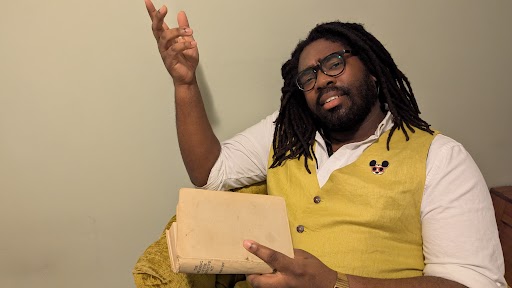
Chris
Williams
became
a
social
media
manager
and
assistant
editor
for
Above
the
Law
in
June
2021.
Prior
to
joining
the
staff,
he
moonlighted
as
a
minor
Memelord™
in
the
Facebook
group Law
School
Memes
for
Edgy
T14s
.
He
endured
Missouri
long
enough
to
graduate
from
Washington
University
in
St.
Louis
School
of
Law.
He
is
a
former
boatbuilder
who
is
learning
to
swim, is
interested
in
critical
race
theory,
philosophy,
and
humor,
and
has
a
love
for
cycling
that
occasionally
annoys
his
peers.
You
can
reach
him
by
email
at [email protected]
and
by
tweet
at @WritesForRent.
(Photo
by
Jane
Tyska/Digital
First
Media/East
Bay
Times
via
Getty
Images)
I
had
a
permit
to
carry
some
years
ago.
I
let
it
expire.
In
this
jurisdiction,
they
are
only
good
for
five
years,
and
I’m
not
the
kind
of
person
who
thinks
armed
thugs
who
want
to
murder
my
family
are
lurking
around
every
corner.
It
seemed
like
an
unnecessary
expense.
However,
I
reconsidered
this
position
when
it
became
apparent
that
Donald
Trump
was
headed
back
to
the
White
House.
As
anyone
who
is
not
a
total
moron
understands,
what
he
did
on
January
6
was
send
a
violent
mob
to
overthrow
democracy
based
on
blatant
lies.
I
was
confident
from
the
outset
that
during
Trump’s
second
term
armed
thugs
would
once
again
create
violent
chaos
under
the
umbrella
of
his
authority.
So,
I
took
the
requisite
class,
submitted
my
paperwork,
and
obtained
my
permit
to
carry
a
pistol.
I
don’t
pack
heat
often,
but
when
I’m
going
somewhere
that
seems
particularly
likely
to
draw
a
mass
shooter,
I
like
to
know
that
I’d
at
least
be
able
to
shoot
back.
I
really
debated
whether
to
bring
my
pistol
to
this
protest.
It
was
totally
legal
for
me
to
bring
it,
of
course,
and
a
protest
against
Trump
administration
policies
definitely
seemed
like
the
kind
of
thing
that
could
attract
dangerous
Kyle
Rittenhouse-esque
bootlickers.
Yet,
I
feared
that
if
the
masked,
badgeless
thugs
masquerading
as
law
enforcement
attacked
we
protesters,
simply
having
a
handgun
on
my
person
would
give
them
more
of
an
excuse
to
kill
me
than
they’d
had
with
Renee
Good.
Then
again,
it
didn’t
seem
like
they
needed
much
of
an
excuse
at
all
with
Good.
I
brought
the
pistol.
Fortunately,
ICE
stayed
away
from
this
particular
protest.
Nobody
even
knew
I
was
armed,
and
I
made
it
home
wholly
intact
at
the
end
of
a
bitterly
cold
Minnesota
day,
First
and
Second
Amendment
rights
thoroughly
exercised.
On
January
24,
I
woke
up
to
a
text
message
from
someone
who
cares
about
me
advising
me
to
stay
off
of
social
media
and
news
sites
for
a
while.
I
did,
just
long
enough
for
human
bedpan
Greg
Bovino
and
a
frozen-faced
Kristi
Noem
to
have
already
carelessly
smeared
Pretti
without
any
evidence
whatsoever,
and
for
their
incendiary
accusations
to
have
already
been
repeatedly
and
definitively
debunked.
Alex
Pretti
died
a
hero.
Not
only
had
he
done
nothing
wrong,
he
put
himself
in
harm’s
way
to
help
another
Minnesotan
who
was
being
needlessly
brutalized
by
an
unaccountable
secret
police
force
sent
to
invade
and
intimidate
Minneapolis.
Of
course,
I
thought
of
my
own
experience,
given
that
a
few
days
earlier
I
had
done
the
exact
same
thing
that
federal
authorities
tried
to
use
as
a
justification
for
murdering
Pretti.
They
lied
that
he’d
been
brandishing
his
legally
carried
weapon.
They
falsely
labeled
him
an
“assassin”
who
wanted
to
“massacre
law
enforcement”
solely
on
the
basis
of
legally
carrying
a
pistol
pursuant
to
his
permit
to
do
so.
They
called
him
a
“domestic
terrorist.”
Had
I
been
shot
by
ICE
that
day
I
went
out
to
protest,
the
only
difference
is
that
I
would
have
been
a
less
sympathetic
victim
because
I’m
a
lawyer
rather
than
an
intensive
care
nurse
at
a
freaking
veterans
hospital,
and
unlike
Pretti
I
have
a
criminal
record
(relax,
it’s
a
relatively
minor
one).
Make
no
mistake:
the
spectacularly
corrupt
officials
of
this
morally
bankrupt
administration
will
do
this
to
anyone
they
think
they
can
get
away
with
doing
it
to.
The
one
silver
lining
in
this
whole
tragic
month
in
Minnesota
is
that
I
do
not
believe
Good
and
Pretti
died
in
vain.
On
the
contrary,
the
two
of
them
made
the
ultimate
sacrifice
in
defense
of
the
civil
rights
of
other
Minneapolitans,
other
Minnesotans,
and,
when
it
comes
right
down
to
it,
all
Americans.
These
two
brave
souls
were
willing
to
put
themselves
in
harm’s
way
to
safeguard
our
freedoms
from
the
tyranny
of
this
debased
and
lawless
federal
government.
It
has
already
had
an
effect.
The
millions
inspired
by
Good
and
Pretti,
the
swelling
masses
enraged
by
their
outrageous
killings
at
the
hands
of
cowards
hiding
behind
masks,
will
carry
their
legacy
forward,
until
the
national
darkness
enveloping
our
people
is
finally
driven
back
by
the
light.
If
doing
the
exact
same
thing
that
Alex
Pretti
did
makes
me
a
domestic
terrorist
too,
count
me
in.
I
couldn’t
be
in
better
company.
Jonathan
Wolf
is
a
civil
litigator
and
author
of Your
Debt-Free
JD (affiliate
link).
He
has
taught
legal
writing,
written
for
a
wide
variety
of
publications,
and
made
it
both
his
business
and
his
pleasure
to
be
financially
and
scientifically
literate.
Any
views
he
expresses
are
probably
pure
gold,
but
are
nonetheless
solely
his
own
and
should
not
be
attributed
to
any
organization
with
which
he
is
affiliated.
He
wouldn’t
want
to
share
the
credit
anyway.
He
can
be
reached
at [email protected].
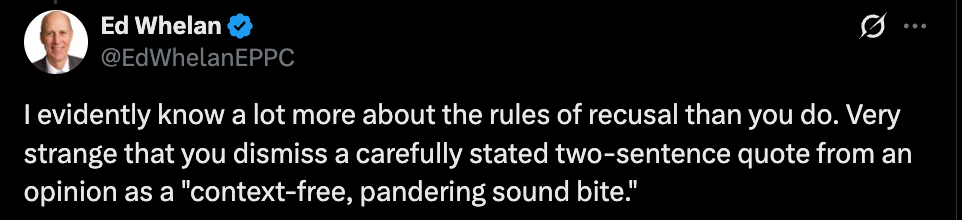
Harmeet
Dhillon
ascended
to
head
the
DOJ’s
Civil
Rights
Division
off
a
career
backing
election
denialism
and
fronting
Trump’s
most
nonsensical
defamation
suits.
Ed
Whelan
is
a
conservative
legal
movement
darling
who
spent
the
Brett
Kavanaugh
confirmation
hearings
peddling
a
bizarre
conspiracy
theory
to
discredit
Kavanaugh’s
accuser
and
pin
the
attempted
sexual
assault
on
someone
else
based
on
real
estate
floorplans,
earning
the
moniker
“Zillow
Ed.”
Last
night,
these
two
leading
lights
of
the
conservative
legal
movement
launched
into
a
bitchy
slapfight
on
Twitter.
Or
X,
if
Dhillon’s
former
client
Elon
insists.
Yesterday,
Chief
Judge
Patrick
Schlitz
of
the
District
of
Minnesota
issued
an
order
demanding
that
Acting
ICE
Director
Todd
Lyons
appear
personally
to
answer
for
the
government’s
delays
and
non-compliance
with
the
court-ordered
releases.
As
the
judge
forcefully
wrote,
“The
Court’s
patience
is
at
an
end,”
and
he
wanted
the
head
of
the
agency
to
show
up
to
face
possible
contempt
charges.
So
ICE
just
went
ahead
and
released
Juan
Tobay
Robles,
the
subject
of
the
specific
caption
in
front
of
Schlitz,
all
to
avoid
having
to
bring
Lyons
to
court.
On
cue,
right-wing
media
began
smearing
Chief
Judge
Schlitz
—
who
had
already
earned
the
ire
of
conservatives
for
refusing
to
take
the
extraordinary
step
of
overturning
a
magistrate
judge’s
denial
of
an
arrest
warrant
for
Don
Lemon
—
trying
to
dig
up
proof
of
the
judge’s
wild-eyed
pinko
lefty
impulses.
It
proved
an
uphill
battle,
given
that
Schlitz
is
a
George
W.
Bush
appointee
who
clerked
for
Antonin
Scalia…
twice.
But
then
Fox
News
had
a
breakthrough,
noting
that
the
Chief
Judge
has
donated
to
organizations
providing
legal
services
for
poor
people,
including
the
Immigrant
Law
Center
of
Minnesota!
Responding
to
the
report,
a
no
doubt
annoyed
Chief
Judge
told
Fox
News,
“I
have
donated
for
many
years
to
the
Immigrant
Law
Center
of
Minnesota.
I
have
also
donated
for
many
years
to
Mid-Minnesota
Legal
Aid. I
believe
that
poor
people
should
be
able
to
get
legal
representation.”
That
should
be
the
end
of
it,
but
it’s
2026
so
it
definitely
wouldn’t
be.
Conservatives
continued
sounding
off
that
Schlitz
was
presumptively
unfit
because
he
donates
to
charities.
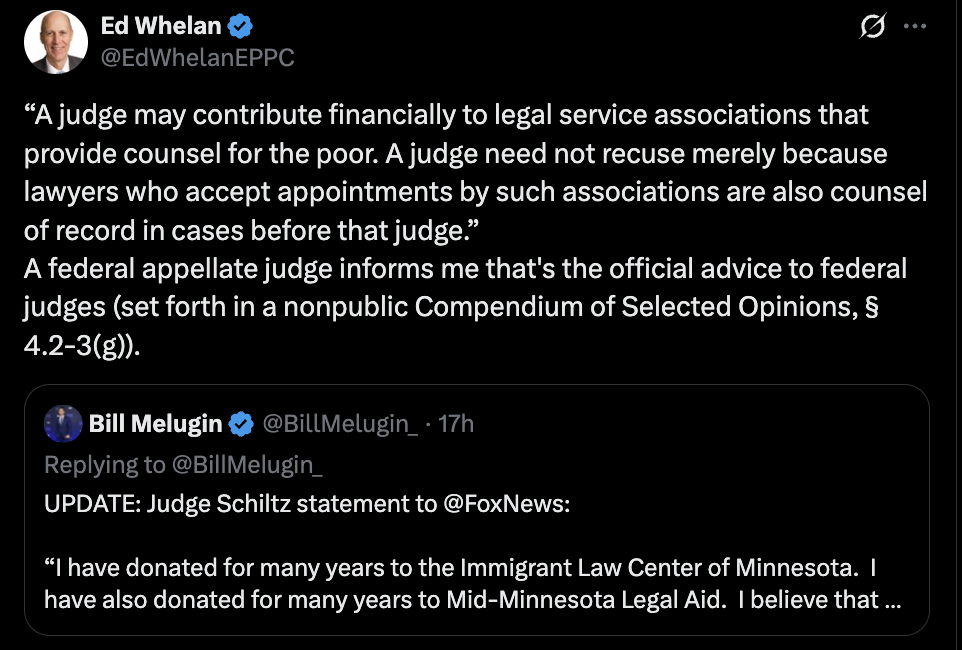
Whelan,
a
fellow
Scalia
clerk,
jumped
in
to
explain
to
the
masses
that
his
insider
sources
tell
him
that
the
federal
judiciary’s
own
rules
would
consider
Schlitz’s
donations
ethically
irrelevant:
Putting
aside
that
federal
judges
probably
shouldn’t
have
a
secret
ethics
code,
Whelan’s
response
missed
the
point.
The
mob
of
right-wing
media
consumers
—
a
mob
that
Whelan
has
gleefully
thrown
red
meat
as
a
long-time
National
Review
blogger
—
doesn’t
care
if
these
donations
were
up
to
ethical
snuff.
The
mob
doesn’t
even
care
if
Schlitz
could
have
or
should
have
recused
himself.
They
think
donating
to
immigrants
is
presumptively
disqualifying
for
a
federal
judge.
Responding
“well,
actually,
all
judges
can
do
this”
only
feeds
their
wingnut
belief
that
the
whole
system
is
corrupt.
So,
yes,
in
a
sane
world,
Whelan’s
post
should
end
the
argument.
But
sanity
packed
up
and
moved
away
a
long
time
ago.
Check
Zillow.
This
is
not,
in
any
obvious
way,
“related
to
this
post.”
But
it
is
a
common
refrain
from
insecure
lawyers
on
social
media.
Whenever
they
disagree
with
a
law
professor,
or
a
legal
journalist,
or,
as
the
case
may
be,
the
voice
of
a
right-wing
think
tank,
they
puff
their
chests
and
declare
“do
you
even
go
to
court,
bro?”
as
though
waiting
through
a
cattle
call
is
the
only
authentic
qualification
to
have
a
legal
opinion.
Whelan
does
not
spend
his
days
in
trial
courts,
but
he
does
have
close
personal
friendships
with
copies
of
the
federal
judge
rulebook
on
their
shelves.
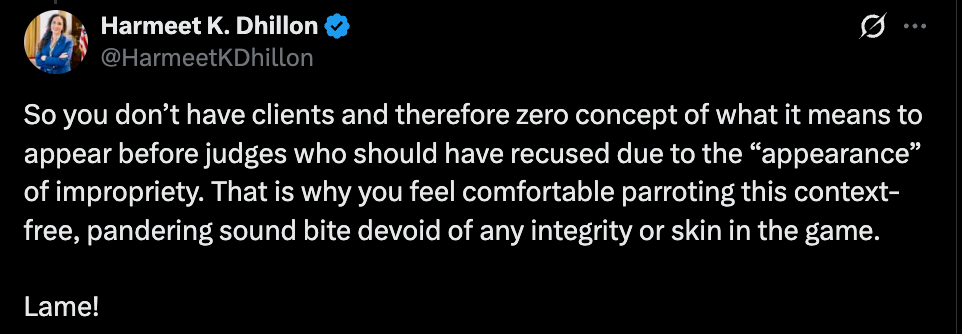
Yes,
her
response
has
no
bearing
on
the
ethical
rule.
That
should
be
the
end
of
the
post.
Having
apparently
never
heard
the
old
saw,
“better
to
remain
silent
and
be
thought
a
fool
than
to
speak
and
remove
all
doubt,”
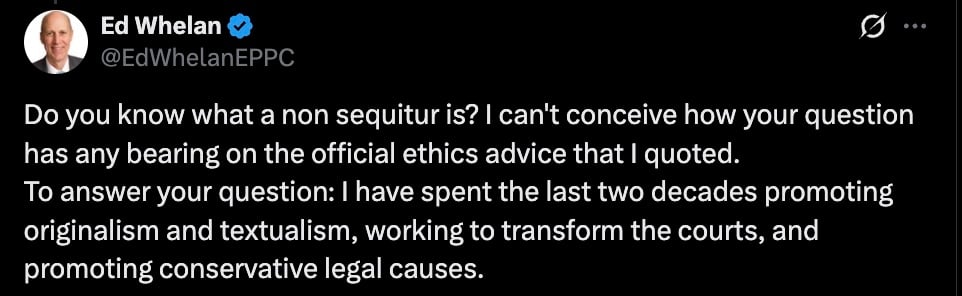
Whelan
continued.
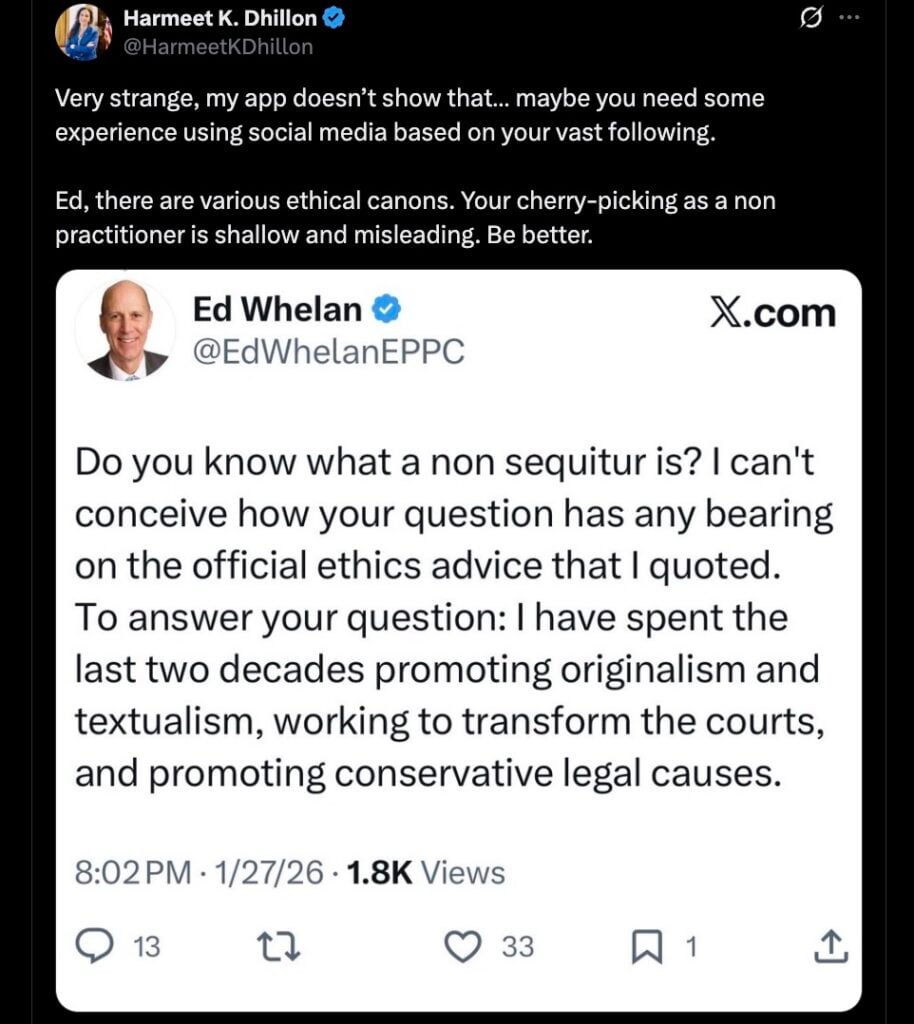
“I
have
spent
the
last
two
decades
promoting
originalism
and
textualism,
working
to
transform
the
courts,
and
promoting
conservative
legal
causes.”
Defying
all
odds,
he
managed
to
make
himself
sound
less
credible.
Dude,
you
worked
for
the
Justice
Department
too.
Just
say
that!
“Well,
I
have
spent
20
years
attending
parties
and
peddling
disingenuous
readings
of
obscure
19th
century
pamphlets”
is
not
getting
the
job
done.
In
any
event,
Whelan
had
asked
a
rhetorical
question.
Does
Dhillon
know
what
a
rhetorical
question
is?
[Rimshot]
Tween
girls
everywhere
are
saying,
“damn,
you
two
need
to
dial
down
the
drama.”
And
successful
too…
at
least
with
the
conservative
audience
for
this
conversation.
The
replies
just
mindlessly
parrot
Dhillon.
“You’re
acting
like
a
grown
up
‘lawyer’
without
actually
having
been
one
in
practice,”
one
writes,
apparently
without
investing
the
10
seconds
required
to
look
Ed
up
on
Wikipedia.
“Ed
failed
Ethics
Class
in
his
on
line
law
school,”
writes
another.
Presumably
a
Yalie.
Whenever
someone
suggests
that
generative
AI
will
replace
writers,
realize
that
a
million
digital
monkeys
at
a
million
digital
typewriters
could
never
string
together
“I
majored
in
two
dead
languages
at
Dartmouth”
and
then
accuse
someone
else
of
being
pretentious.
The
spark
of
human
creativity
cannot
be
dimmed.
I
assume
that’s
a
crack
about
Dartmouth.
Dhillon
does
not
reply
to
this.
Uninterested
in
leaving
well
enough
alone,
Whelan
double
dips:
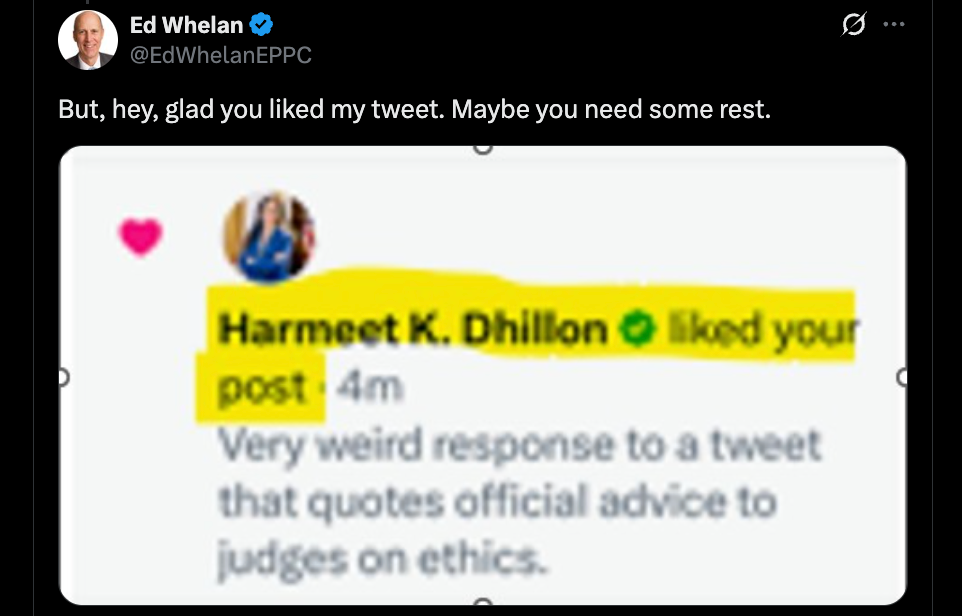
That’s
argumentative
checkmate
right
there!
If
you
accidentally
press
the
heart
icon,
it
forever
bars
all
disagreement.
That’s
from
the
nonpublic
Compendium
of
Twitter
Rules
§4.2-3(g).
Honestly,
starting
to
wonder
if
either
of
them
know
what
a
non
sequitur
is.
This
is
all
very
stupid,
but
I
implore
you
to
note
that
she
disses
him
for
not
understanding
how
Twitter
works
and
then
screencaps
THE
WRONG
TWEET.
You
cannot
make
this
stuff
up.
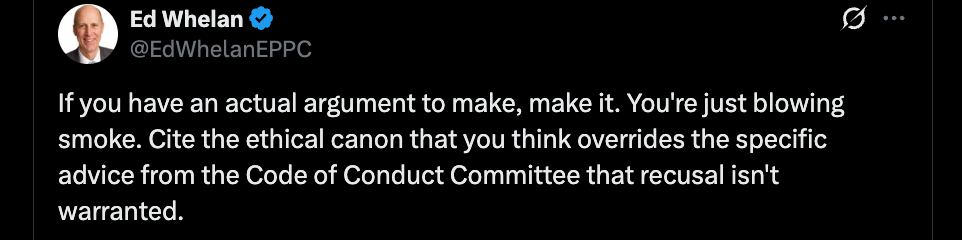
Yes.
You
cannot
say,
“there
are
various
ethical
canons”
and
then
not
cite
any
that
contradict.
But
to
play
devil’s
advocate
for
Dhillon
—
who
finally
stopped
posting
after
this…
or
maybe
passed
out
—
the
official
advice
that
Whelan
cited
only
says
a
judge
need
not
recuse
“merely”
by
virtue
of
making
a
donation.
So,
not
to
get
all
“textualist,”
but
it
is
not
dispositive.
If
a
donation
that
would
otherwise
be
acceptable
reasonably
creates
an
appearance
of
bias,
then
a
judge
may
find
it
more
prudent
to
recuse
themselves
anyway.
Nothing
about
the
quoted
text
directly
contradicts
that.
The
Fox
News
drums
and
the
bleating
in
the
replies
signals
that
there’s
a
sizable
population
out
there
who
think
this
at
least
creates
an
appearance
of
bias.
But
there’s
nothing
reasonable
about
it!
It’s
just
the
dimmest
bulbs
in
law
grasping
at
straws
because
much
smarter
conservative
judges
aren’t
letting
the
administration
perform
an
end
run
around
the
rule
of
law.
The
term
heckler’s
veto
is
consistently
misapplied,
but
the
accurate
definition
of
the
phrase
has
some
similarities
to
this
situation.
You
can’t
silence
free
speech
just
by
claiming
you’re
“protecting”
the
speaker
from
hypothetical
violence,
and
you
can’t
manufacture
an
appearance
of
impropriety
by
ginning
up
a
mob
to
call
it
“improper.”
Giving
money
to
groups
that
provide
legal
counsel
to
poor
people
does
not
bias
a
judge.
If
it
did,
there
would
be
a
lot
more
Legal
Aid
victories
in
this
world.
Making
sure
people
have
counsel
is
not
the
same
as
endorsing
those
clients.
No
reasonable,
objective
observer
thinks
believing
3-year-olds
shouldn’t
represent
themselves
in
court
is
the
same
as
endorsing
open
borders.
Unfortunately,
this
is
another
instance
of
this
administration
actively
promoting
conspiracy
theories
against
federal
judges.
It’s
one
thing
to
flag
a
judge
for
specific
bias,
and
it’s
quite
another
to
recklessly,
without
any
support,
blast
judges
to
an
audience
that
you
are
fully
aware
can
and
has
lashed
out
violently
after
being
baited
with
right-wing
conspiracy
theories.
But
kudos
to
Dhillon
and
Whelan
for
providing
some
late-night
entertainment.
It
was
one
of
those
sporting
matchups
where
you
legitimately
hope
both
teams
lose.
And
they
did
not
disappoint.
The
Litera
Foundation
knowledge
management
platform
doesn’t
just
have
customers.
It
has
innovators
—
law
firms
continually
using
the
system
in
new
ways
to
enhance
client
value.
These
ground-breaking
firms
were
recently
honored
in
Litera’s
inaugural
Foundation
Innovation
Awards,
which
recognized
the
creative
ways
firms
are
using
this
powerful
tool.
Foundation’s
simplicity
and
adaptability
are
at
the
core
of
these
awards,
which
highlight
the
endless
use
cases
Foundation
customers
are
putting
into
practice.
Here,
we
look
at
a
use
case
from
one
finalist
firm.
A
Virtuous
Cycle
If
a
legal
tech
solution
has
a
high
degree
of
adaptability,
customers
can
start
small
and
gradually
secure
buy-in
and
expansion.
Initial
wins
create
a
virtuous
cycle,
where
success
leads
to
growth,
and
this
growth
leads
to
more
success.
A
Cleary
Gottlieb
team
that
includes
members
of
its
Knowledge
Management
and
Business
Development
groups
has
implemented
such
a
cycle
at
that
firm.
“Establishing
oversight
of
our
program
across
the
firm’s
global
footprint
was
our
biggest
hurdle,”
said
Jeannine
Zito,
the
firm’s
Senior
Manager
of
Knowledge
Solutions.
“We
needed
analytics
to
show
us
who
should
be
involved
and
when,
what
strategies
were
working,
and
where
we
had
gaps.
Foundation
helped
us
define
the
right
data
to
measure
our
success,
and
that
visibility
created
momentum
for
expansion.”
The
Cleary
team
launched
Foundation
in
2020
across
five
practice
areas,
establishing
a
core
infrastructure.
From
the
launch
onward,
the
types
of
data
tracked
continued
to
grow,
and
the
firm’s
reporting
concepts
continued
to
evolve.
Soon,
the
team
introduced
data
visualization
and
other
insights.
Then
the
Cleary
team
used
the
system
to
produce
“Health
Reports,”
which
provide
high-level
metrics
for
firm
leadership.
After
the
Health
Reports
were
live
for
a
year,
they
had
sufficient
data
for
longitudinal
comparisons,
revealing
trends
and
further
supporting
data-driven
decision-making.
Now,
the
firm
is
incorporating
user
feedback
and
redesigning
its
reports
to
address
ever-more
sophisticated
strategic
goals.
Establishing
measurable
metrics
to
monitor
program
health
while
identifying
areas
for
improvement
—
along
with
implementing
real-time
tracking
of
profile
completion
and
data
quality
—
were
areas
of
emphasis
throughout
the
initiative
at
Cleary.
The
need
to
track
when
data
was
entered
was
particularly
impactful,
because
it
ensured
that
stakeholders
continually
updated
Foundation.
The
resulting
high-quality
data,
in
turn,
could
be
used
by
firm
leadership
to
guide
decision-making
regarding
firm
operations
and
other
areas.
Today,
the
fruits
of
this
analytics
initiative
are
evident
throughout
the
firm.
The
Foundation
initiative
has
brought
efficient
knowledge
sharing
and
intelligence-focused
business
development,
made
possible
by
improved
access
to
precedents
and
insights
across
practice
areas.
These
insights
also
enable
evidence-based
performance
measurement.
The
framework’s
success
demonstrates
how
technology
can
transform
traditional
legal
operations
into
analytics-based,
strategic
initiatives.
And
by
demonstrating
clear
ROI
to
law
firm
leadership
throughout
the
initiative,
the
Cleary
team
has
ensured
that
this
program
will
continue
to
expand
and
grow
even
more
impactful
and
sophisticated
in
the
years
to
come.
With
so
many
unique
use-cases
for
Foundation,
it’s
no
wonder
to
see
why
it
has
such
innovators.
If
you
would
like
to
learn
more
about
Foundation
and
explore
how
it
might
help
your
firm
transform
your
experience,
pricing,
and
other
precedent
data,
connect
with
the
Litera
team
to
request
a
detailed
analysis
of
your
marketing
tech-stack!
This
and
other
use
cases
will
form
the
basis
of
a
business
of
law
eBook
this
year.
You
can
pre-register
for
your
copy
by
filling
out
the
form
below.








 Kathryn