At
a
time
when
hard-won
discrimination
protections
in
the
U.S.
are
being
steadily
eroded,
we’ve
never
needed
the
passion
and
commitment
of
young
lawyers
aspiring
to
build
careers
in
human
rights
more
than
we
do
today.
The
National
Jurist’s
preLaw
magazine
recently
released
its
ranking
of
the
best
law
schools
for
human
rights
on
its
Human
Rights
Law
Honor
Roll,
highlighting
schools
for
the
strength
of
their
programs.
Here’s
the
methodology
that
was
used:
preLaw
magazine
grades
law
schools
based
on
the
breadth
of
their
curricular
offerings.
Scores
are
weighted
as
follows:
30%
for
a
concentration,
24%
for
a
clinic,
12%
for
a
center,
12%
for
an
externship,
9%
for
a
journal,
8%
for
a
student
group,
5%
for
a
certificate
and
added
value
for
additional
offerings.
Without
further
ado,
according
to
preLaw
Magazine,
these
are
the
law
schools
that
earned
A+
grades
for
their
human
rights
law
programs
(listed
in
alphabetical
order):
Staci
Zaretsky is
the
managing
editor
of
Above
the
Law,
where
she’s
worked
since
2011.
She’d
love
to
hear
from
you,
so
please
feel
free
to
email
her
with
any
tips,
questions,
comments,
or
critiques.
You
can
follow
her
on Bluesky, X/Twitter,
and Threads, or
connect
with
her
on LinkedIn.
It’s
a
new
day
at
8am.
That’s
true
generally,
but
in
this
case,
we’re
talking
about
tech
provider
we
used
to
call
AffiniPay.
Fresh
off
its
name
change,
the
company
hosted
its
inaugural
user
conference
last
week
in
Austin,
Texas.
While
everything
is
usually
bigger
in
Texas
—
the
wide-open
skies,
the
slabs
of
slow-cooked
brisket,
the
scale
of
the
failed
education
system
—
8am’s
Kaleidoscope
conference
clocked
in
on
the
cozier
side.
But
that’s
the
nature
of
first-time
shows.
There
will
always
be
a
slice
of
the
prospective
audience
who
sits
it
out,
keeping
their
powder
dry
until
they
hear
back
that
it’s
really
worth
it.
It
was
worth
it.
One
would
be
hard-pressed
to
point
to
anything
that
betrayed
a
rookie
conference.
A
convenient
venue,
excellent
food,
superb
panels,
and
an
exhibitor
layout
that
maximized
visibility
without
feeling
like
running
a
gauntlet.
In
a
subtle
stroke
of
genius,
the
programming
broke
from
the
customary
cookie-cutter
schedule
and
embraced
breakout
sessions
of
varying
lengths.
Some
subjects
just
don’t
merit
an
hour,
but
that
doesn’t
make
them
less
important.
Kaleidoscope
had
a
“content-first”
approach
to
panel
selection
and
built
a
schedule
to
accommodate
that.
From
ethical
approaches
to
texting
clients
to
using
AI
to
automate
small
firm
legal
marketing,
the
panels
covered
a
wide
range
of
practical
topics.
Even
the
one
mistake
that
anyone
could
point
out
—
a
recurring
typo
on
some
of
the
signage
—
morphed
into
8am’s
opportunity
to
hand
out
more
swag.
They
couldn’t
even
make
a
mistake
without
turning
it
around.
Olympian
Gabby
Thomas
headlined
the
second
day
of
the
show.
Celebrity
speakers
tend
to
lean
into
tortured
metaphors
to
connect
their
careers
back
to
the
legal
industry.
Instead,
Thomas
saw
an
opportunity
to
talk
about
her
own
profession
and…
ran
with
it?
Which,
paradoxically,
made
it
far
more
relevant
to
the
job
of
lawyering
than
any
square-peg-round-hole
analogies.
Describing
the
life
of
an
elite
track
star,
she
stressed
that
the
average
spectator
watching
at
home
doesn’t
understand
that
everyone
in
those
high-profile
races
are
all
nearly
identical
in
ability.
Success
on
that
stage,
Thomas
explained,
comes
down
to
small
adjustments
for
fractional
gains.
And
a
heavy
dose
of
perspective
that
you
can’t
control
the
competition,
but
you
can
control
your
own
process.
That’s…
pretty
good
advice
for
running
a
legal
practice.
And
especially
important
to
lawyers
willing
to
keep
an
open-minded
approach
to
legal
technology.
Securing
that
fractional
improvement
—
either
in
the
substantive
practice
of
law
or
in
taking
some
of
the
administrative
tasks
off
your
plate
—
is
largely
a
function
of
tech
adoption.
Figuring
out
which
tech
is
the
challenge.
Thomas
provided
some
insights
there
too,
explaining
that
she
breaks
down
races
into
micro-moments,
visualizing
everything
from
the
walk
up
to
where
exactly
she
wants
to
be
positioned
on
the
blocks
to
where
she
wants
to
be
at
the
finish
line.
Legal
tech
is
moving
at
a
breakneck
pace,
and
if
Biglaw
firms
with
dedicated
tech
professionals
struggle
to
stay
on
top
of
it,
how
can
solo
practitioners
fit
it
into
the
already
overloaded
schedule?
One
solid
strategy
—
which
I
outlined
on
one
of
the
panels
I
sat
on
at
the
show
—
is
to
stop
trying
to
find
the
one-size
AI
solution
and
begin
researching
products
that
target
specific
use
cases.
To
borrow
from
the
visualization
discussion:
map
out
the
day.
Take
some
time
to
consciously
consider
the
steps
in
all
those
workflows.
Now,
where
do
you
see
opportunities
to
automate
that,
in
a
way
that
you
find
professionally
comfortable?
Thomas
also
talked
about
the
next-level
analytics
she
gets
about
every
running
movement,
but
stressed
that
while
she
considers
it
all,
she
won’t
accept
changes
that
she’s
not
comfortable
with.
The
tasks
you’re
ready
to
turn
over
to
technology
might
not
be
where
everyone
else
is…
and
that’s
fine.
But
figure
it
out.
Silicon
Valley
may
run
on
groupthink
—
and
these
days,
that
groupthink
is
mostly
very
weird
—
but
legal
technology
doesn’t
have
to.
There’s
plenty
of
room
to
disagree,
especially
given
how
quickly
the
landscape
is
evolving.
I
joined
several
other
legal
tech
writers
in
a
live
version
of
our
weekly
webcast
and/or
podcast
on
the
main
stage
and
we
had
several
actual
arguments
about
the
future
of
the
billable
hour
and
whether
or
not
“agentic
AI”
is
an
empty
buzzword
(it
is).
And,
of
course,
there
was
plenty
of
talk
about
the
8am
product
too
(which
Stephen
Embry
covered
in
more
depth
here).
And
partner
demos.
And
all
the
stuff
a
user
would
expect
of
a
conference.
A
user
show
is
a
delicate
balance
between
sales,
in-person
customer
service,
actionable
general
knowledge,
and
entertainment.
8am
—
and,
more
to
the
point,
the
various
companies
who
now
all
live
under
the
8am
banner
—
have
been
in
this
business
a
long
time.
But
with
Kaleidoscope,
the
company
signaled
that
it’s
ready
to
move
into
a
new
vector
of
client
engagement.
Beyond
just
providing
a
quality
suite
of
products,
the
company
wants
to
move
into
becoming
a
staple
appointment
on
their
clients’
calendar.
I
mean,
if
the
conference
was
good
enough
for
John
Steinbeck,
it
should
be
good
enough
to
bring
out
even
more
users
next
year.
Kanye
West
goes
by
many
titles:
producer,
artist,
and
founder
of
Donda
Academy.
Named
after
his
late
mother,
the
now
closed
school
was
a
Christian
private
school
in
Simi
Valley,
California.
It
isn’t
the
easiest
thing
to
know
what
attending
the
school
was
like
considering
the
mandated
NDAs
parents
had
to
sign
to
enroll
their
children,
but
chances
are
the
students
didn’t
make
much
fun
of
each
other’s
clothes
considering
that
the
uniform
code
mandated
Balenciaga
—
sure,
your
shoes
may
be
goofy,
but
so
are
everyone
else’s:
I’m
sorry
to
inform
you
Balenciaga
have
been
making
footwear
again.
I’m
half
convinced
they
are
trolling
to
see
if
there
is
any
limit
to
what
idiots
will
buy.
pic.twitter.com/lcl5OJqjlo
Fashion
choices
aren’t
the
only
thing
that
have
Ye’s
structuring
of
Donda
Academy
under
a
microscope.
Baller
Alert
has
coverage:
According
to
court
documents
obtained
by
TMZ,
a
Los
Angeles
judge
has
given
West
30
days
to
appear
in
person
for
a
deposition.
The
ruling
comes
after
repeated
efforts
by
the
plaintiff
to
secure
the
rapper’s
participation.
The
lawsuit,
filed
in
April
2024
by
Trevor
Phillips,
a
former
employee
of
Donda
Academy,
accuses
West
of
creating
a
hostile
and
discriminatory
work
environment.
Phillips
claims
he
experienced
harassment
while
employed
at
the
school.
In
his
filing,
he
wrote
that
West
“spew
forth
hate,
profess
antisemitic
tropes
and
lies,
threaten
the
LGBTQ+
community,
and
even
on
one
occasion,
almost
sexually
stimulate
himself.”
It
would
be
easy
to
point
to
Ye’s
Heil
Hitler
track
and
accompanying
music
video
or
the
one
he
did
with
Lil
Pump
where
he
declared
that
“I’m
a
sick
f*ck”,
but
I’m
generally
against
the
use
of
song
lyrics
as
evidence
that
a
person
is
a
piece
of
shit.
Thankfully,
you
don’t
have
to
search
hard
to
find
Kanye
West’s
antisemitic
footsteps
on
Twitter
and
YouTube:
How
fucked
up
is
X?
It’s
so
fucked
up
that
Kanye
West
tweeted,
“I
hate
Jews.
I’m
a
Nazi.”
And
got
200K
likes.
Now,
does
this
prove
that
he
was
descriminatory
at
the
school?
No,
but
that
deposition
could
provide
a
hell
of
a
lot
of
leeway!
Ye
has
had
a
longstanding
reputation
for
blurting
out
whatever
is
on
his
mind
when
the
cameras
are
rolling.
Question,
do
you
think
this
link
will
take
you
to
the
infamous
“George
Bush
doesn’t
like
Black
people”
blurt
or
the
Taylor
Swift
snub?
Oddly
enough,
neither!
It
was
the
time
Alex
Jones
had
to
quickly
distance
himself
from
Ye
because
he
was
being
too
Hitler-friendly.
Yeah,
whatever
lawyer
gets
tasked
with
deposing
Yedolf
Yitler
is
about
to
have
the
easiest
job
ever.
Chris
Williams
became
a
social
media
manager
and
assistant
editor
for
Above
the
Law
in
June
2021.
Prior
to
joining
the
staff,
he
moonlighted
as
a
minor
Memelord™
in
the
Facebook
group Law
School
Memes
for
Edgy
T14s
.
He
endured
Missouri
long
enough
to
graduate
from
Washington
University
in
St.
Louis
School
of
Law.
He
is
a
former
boatbuilder
who
is
learning
to
swim, is
interested
in
critical
race
theory,
philosophy,
and
humor,
and
has
a
love
for
cycling
that
occasionally
annoys
his
peers.
You
can
reach
him
by
email
at [email protected]
and
by
tweet
at @WritesForRent.
Amy
Coney
Barrett’s
appearance-palooza
in
support
of
her
new
$2
million
book
just
keeps
on
giving.
Her
particular
version
of
deliberately
obtuse
reactionary
that
diligently
works
toward
the
right-wing
political
goal
of
the
moment
is
garnering
attention
—
even
as
the
dumb
act
enrages.
Last
week,
ACB
took
her
show
on
the
road
—
appearing
at
the
Ronald
Reagan
Presidential
Library
in
Simi
Valley,
California.
Greeted
by
protests,
Barrett
shilled
familiarly
disingenuous
lines
like,
“It’s
my
job
to
do
what
the
law
requires
without
respect
to
what
reaction
it
may
elicit
from
the
outside.
To
do
this
job
you
have
to
be
willing
to
be
unpopular.”
Before
you
strain
your
eyes
rolling
them
so
hard,
let’s
focus
on
ACB’s
thoughts
on
the
buzz
word
of
the
year
—
AI.
As
reported
by
Bloomberg
Law,
Barrett
has
it
on
“‘good
authority’
that
lawyers
preparing
to
argue
before
the
Supreme
Court
have
sought
help
from
AI
to
identify
potential
questions
they’ll
face—and
then,
‘scarily,’
heard
those
queries
repeated
from
the
bench.”
Scary?
Nah.
Entirely
predicable?
Yes.
Artificial
intelligence
is
designed
to
crunch
the
data
and
determine
what
is
most
likely
to
happen.
Using
that
to
prepare
for
what
questions
are
likely
to
appear
during
oral
arguments…
actually
makes
a
ton
of
sense.
Maybe
the
frightening
aspect
is
how
predictable
the
justices
truly
are.
The
scariest
thing
about
AI
in
legal
is
the
potential
for
hallucinating,
creating
facts
or
law
out
of
whole
cloth.
But
the
humans
are
already
doing
that!
By
the
time
cases
—
particularly
on
hot-button
issues
—
make
it
to
the
High
Court,
rather
than
solidify
around
the
(capital
T)
Truth,
the
facts
often
morph.
Like
the
school
prayer
coach
case
where
the
coach
in
question
was
never
actually
fired,
yet
references
to
his
being
fired
were
made
15
times
during
oral
arguments.
Almost
like
that
“fact”
was
hallucinated.
AI:
it’s
just
like
us!
Kathryn
Rubino
is
a
Senior
Editor
at
Above
the
Law,
host
of
The
Jabot
podcast,
and
co-host
of
Thinking
Like
A
Lawyer.
AtL
tipsters
are
the
best,
so
please
connect
with
her.
Feel
free
to
email
her
with
any
tips,
questions,
or
comments
and
follow
her
on
Twitter
@Kathryn1 or
Mastodon
@[email protected].
If
your
firm
is
not
collecting
earned
revenue,
growth
will
slow,
cash
flow
will
tighten,
and
profitability
will
suffer.
Fortunately,
revenue
and
profit
leakage
can
be
minimized
with
awareness,
the
right
tools,
and
disciplined
financial
oversight.
Join
our
expert
panel
on Sept.
25
at
2pm
ET
to
explore
common
sources
of
profit
leakage
and
practical,
actionable
tactics
for
improvement.
The
discussion
will
include:
Concrete
examples
of
how
profit
leakage
can
occur
Red
flags
that
indicate
profit
leakage
at
your
firm
Quick
wins
you
can
implement
right
away
Long-term
strategies
to
sustain
improvements
Speakers: Kelley
Brubaker,
CPA Kelley
is
the
owner
of
Profit
Scale
Thrive—an
Akron,
Ohio-based
accounting
and
advisory
firm,
she
partners
with
law
firm
owners
so
they
achieve
overflowing
profits,
scaled
growth,
and
thriving
lives.
As
a
Fractional
CFO,
Kelley
helps
clients
understand
their
numbers,
focus
on
the
metrics
that
matter,
spot
areas
for
improvement,
celebrate
successes,
and
create
effective
strategies
to
increase
profitability
and
reach
the
firm’s
goals.
Brittany
Hoffmann,
8am Brittany
is
the
Webinar
Program
Specialist
at
8am,
where
she
has
led
the
company’s
webinar
initiatives
for
nearly
two
years.
With
a
background
in
supporting
legal
professionals,
Brittany
is
passionate
about
creating
engaging,
impactful
programs
that
help
law
firms
and
legal
experts
thrive.
Yesterday,
three
former
high-ranking
FBI
officials
sued
the
agency’s
director
Kash
Patel
for
wrongful
termination
and
retaliation.
Brian
Driscoll,
Jr.,
Steven
Jensen,
and
Spencer
Evans
allege
a
revenge
campaign
by
the
White
House
against
Trump’s
enemies
at
the
FBI
that
violated
due
process
and
the
First
Amendment
and
ultimately
led
to
their
dismissal.
Their
complaint
describes
shocking
corruption
of
what
is
supposed
to
be
an
apolitical
law
enforcement
agency.
It’s
also
freakin’
hilarious.
Kash
Patel,
serial
litigant
and
the
illustrious
recipient
of
an
“order
on
ineptitude”
from
a
federal
judge,
is
an
incompetent
hack?
Say
it
ain’t
so!
The
story
begins
the
week
before
Trump’s
second
inauguration.
Patel
called
Driscoll,
a
decorated
agent
known
to
his
pals
as
“Drizz,”
who
was
then
leading
the
FBI’s
Newark
Field
Office
and
asked
him
to
come
to
DC
to
work
at
FBI
headquarters.
The
job
would
require
“vetting”
by
the
White
House,
but
Patel
assured
Driscoll
that
he’d
be
fine
as
long
as
he
“was
not
prolific
on
social
media,
did
not
donate
to
the
Democratic
Party,
and
did
not
vote
for
Kamala
Harris
in
the
2024
election.”
He
was
not
fine.
On
January
17,
the
Trump
transition
team
dispatched
Paul
Ingrassia,
a
rightwing
blogger
who
represented
accused
sex
trafficker
Andrew
Tate
in
2023,
despite
not
being
admitted
to
the
bar
until
2024.
Ingrassia’s
nomination
as
Special
Counsel
stalled
in
July
after
his
long,
public
association
with
Nazis
was
brought
to
the
attention
of
the
Senate.
But
back
in
January
he
was
riding
high
as
White
House
liaison
to
the
DOJ,
demanding
to
know:
who
Driscoll
voted
for;
if
he
agreed
that
the
agents
who
“stormed”
Mar-a-Lago
to
retrieve
all
the
classified
docs
Trump
was
storing
in
the
toilet
should
be
fired;
his
thoughts
on
DEI;
when
he
started
supporting
Trump;
and
whether
he’d
voted
for
a
Democrat
in
the
last
five
elections.
Later
that
night,
Trump’s
personal
lawyer
Emil
Bove
called
to
say
that
Driscoll
got
a
thumbs
down
because
Ingrassia
said
he
was
not
“based
out”
enough.
(OMG,
these
dorks!)
Not
to
worry,
though,
because
Bove
overrode
Ingrassia
and
told
Team
Trump
that
Driscoll
was
BASED
AS
HELL,
BRO.
Bove
persuaded
Driscoll
to
come
to
DC
and
serve
as
interim
deputy
director,
with
his
longtime
colleague
Robert
Kissane
as
the
acting
agency
head.
But
when
they
showed
up,
the
paperwork
said
that
Kissane
was
in
the
number
two
spot.
According
to
the
complaint,
“Bove
told
Kissane
that
it
was
a
clerical
error
but
that
the
White
House
was
unwilling
to
fix
it.”
And
that’s
how
Driscoll
became
acting
director
of
the
FBI!
Driscoll
and
Kissane
spent
the
next
three
weeks
fending
off
Bove,
who
was
by
then
Deputy
Assistant
AG.
Bove
was
under
pressure
from
the
White
House
to
fire
anyone
involved
in
the
January
6
cases,
and
he
demanded
a
list
of
everyone
at
the
FBI
who
was
involved
in
the
investigations.
Driscoll
countered
that
this
would
include
thousands
of
agents,
including
himself.
He
also
pointed
out
that
they
enjoyed
civil
service
protections
that
meant
they
couldn’t
be
summarily
dismissed.
But
Bove
insisted
that
he
had
the
unilateral
power
to
remove
anyone
if
he
felt
a
“loss
of
confidence
in
their
ability
to
carry
out
the
President’s
agenda,”
and
so
he
fired
dozens
of
experienced
agents.
Unsurprisingly,
this
purge
failed
to
endear
him
to
the
rank
and
file,
prompting
a
massive
tantrum
from
the
future
federal
judge:
Bove’s
efforts
did,
however,
create
a
groundswell
of
support
within
the
FBI
for
Driscoll’s
and
Kissane’s
leadership.
Rank-and-file
agents
appeared
to
appreciate
that
the
two
men
were
the
reasons
the
country
had
not
been
catapulted
into
a
national
security
emergency
brought
on
by
suspected
mass
firings
at
the
FBI.
Bove
told
Driscoll
that
he
was
angry
that,
in
parody
videos
apparently
created
by
FBI
employees,
Bove
was
portrayed
as
the
Batman
villain
“Bane,”
while
Driscoll
was
portrayed
as
“Batman.”
Driscoll
responded
that
he
did
not
make
the
video,
nor
could
he
control
unknown
individuals’
feelings
or
expressions
of
said
feelings.
Bove
responded
that
Driscoll
could
have
told
the
FBI’s
workforce
that
Driscoll
trusted
him.
Bove
then
stated
that
he
and
now-confirmed
Attorney
General
Pam
Bondi
were
going
to
have
an
in-person
meeting
with
Patel
later
that
afternoon
to
discuss
“what
they
were
going
to
do
with
Kissane
and
Driscoll.”
Things
did
not
get
better
when
Patel
and
deputy
director
Dan
Bongino
showed
up.
Both
men
left
government
service
to
become
MAGA
influencers,
with
Patel
hawking
everything
from
drug
supplements
to
his
own
brand
of
wine.
In
office,
he
focused
on
swag,
including
a
“challenge
coin”
branded
with
his
signature
“Ka$h”
logo.
For
his
part,
Bongino
continued
his
fixation
with
the
conspiracy
theories
that
filled
his
podcast.
Plaintiff
Steven
Jensen,
whom
they
recruited
from
South
Carolina
to
be
Assistant
Director
in
Charge
of
the
Washington
Field
Office,
“regularly
updated
Bongino
on
investigations
that
Bongino
considered
priorities,
including
into
the
January
6
pipe
bomber,
the
leak
of
the
Supreme
Court’s
decision
in
Dobbs
v.
Jackson
Women’s
Health
Organization,
and
the
discovery
of
cocaine
at
the
White
House
during
the
Biden
Administration,
which
were
three
cases
that
Bongino
frequently
discussed
in
media
interviews
and
on
his
social
media
feed.”
Patel
and
Bongino
were
obsessed
with
social
media,
urging
their
subordinates
to
post
constantly,
to
the
extent
that
Jensen
worried
“it
could
risk
outweighing
more
deliberate
analyses
of
investigations.”
And
in
the
end,
it
was
rightwing
social
media
posters
who
got
Jensen
and
Evans
fired.
Jensen
was
axed
for
his
participation
in
the
January
6
investigations,
and
Evans
was
forced
out
because
of
MAGA
outrage
over
his
enforcement
of
COVID
protocols
in
2021.
Before
firing
Jensen,
Patel
suggested
that
he
sue
some
of
his
online
critics:
“Doing
so,
Patel
explained,
would
help
take
the
political
pressure
off
of
him
for
his
decision
to
promote
Jensen.”
This
is
extremely
on
brand
for
Patel,
who
filed
many,
many
trollsuits,
including
against
the
New
York
Times,
CNN,
Politico,
the
Department
of
Homeland
Security,
the
Defense
Department
and
former
FBI
Director
Chris
Wray.
None
of
these
came
to
anything,
although
Patel
did
manage
to
get
a
default
judgment
against
a
podcaster
who
failed
to
show
up
in
court.
Patel
is
currently
suing
MSNBC
commentator
Frank
Figliuzzi
for
suggesting
that
he
spends
more
time
partying
than
working.
And
Patel’s
girlfriend,
Alexis
Wilkins,
is
suing
Kyle
Seraphin,
a
rightwing
podcaster
and
self-styled
FBI
whistleblower,
who
called
her
“a
former
Mossad
agent”
and
expressed
doubt
that
she
is
genuinely
into
“a
cross-eyed,
you
know,
kind
of
thickish
built,
super
cool
bro
who’s
almost
50
years
old
who’s
Indian
in
America.”
It’s
probably
not
a
coincidence
that
the
Driscoll
complaint
cites
a
tweet
by
Seraphin
with
screenshotted
texts
from
Patel
promising
to
fire
Evans.
Jensen
rebuffed
his
boss’s
suggestions
to
sue.
But
it
appears
to
have
occurred
to
Patel
that
he
was
likely
to
wind
up
on
the
pointy
end
of
at
least
one
lawsuit.
Driscoll
says
that
he
told
Patel
multiple
times
that
illegally
terminating
various
FBI
employees
without
regard
for
process
would
result
in
litigation
against
the
FBI.
Over
and
over
again
the
complaint
alleges
that
“Patel
said
that
he
understood
that
and
he
knew
the
nature
of
the
summary
firings
were
likely
illegal
and
that
he
could
be
sued
and
later
deposed.”
And
now
he
might!
Each
of
the
plaintiffs
received
a
one-page
letter
purporting
to
terminate
them
for
cause.
But
according
to
the
complaint,
Patel
and
Bongino
couldn’t
even
manage
to
do
that
correctly:
As
of
the
date
of
this
filing,
Driscoll
has
not
been
provided
with
an
SF-50.
The
SF50
is
a
government
form
titled
“Notification
of
Personnel
Action”
which
is
provided
to
former
employees
upon
termination.
The
“Nature
of
Action”
on
an
SF-50
would
typically
signify
the
removal
of
an
employee
and
is
completed
by
the
employer.
That
section
has
a
corresponding
section,
“Legal
Authority”
which
is
also
intended
to
be
completed
by
the
employer.
As
of
the
date
of
this
filing,
individuals
within
FBI’s
HRD
are
reportedly
unsure
what
to
enter
under
“Legal
Authority”
and
have
thus
not
yet
completed
the
form
or
issued
it
to
Driscoll.
Driscoll,
Jensen,
and
Evans
sued
Patel,
AG
Bondi,
and
the
FBI
alleging
that
they
were
retaliated
against
for
their
perceived
political
affiliation
in
violation
of
the
First
Amendment
and
that
their
terminations
without
due
process
violated
the
Fifth
Amendment.
They
demand
reinstatement
with
backpay,
plus
a
declaratory
judgment
that
their
termination
was
illegal.
A
phalanx
of
heavy
hitters
signed
the
complaint,
including:
Chris
Mattei,
who
represented
the
Sandy
Hook
parents
against
Alex
Jones;
Mark
Zaid
and
Brad
Moss,
who’ve
represented
everyone
from
Alexander
Vindman
to
Mickey
Dolenz;
and
the
ubiquitous
Abbe
Lowell.
Meanwhile,
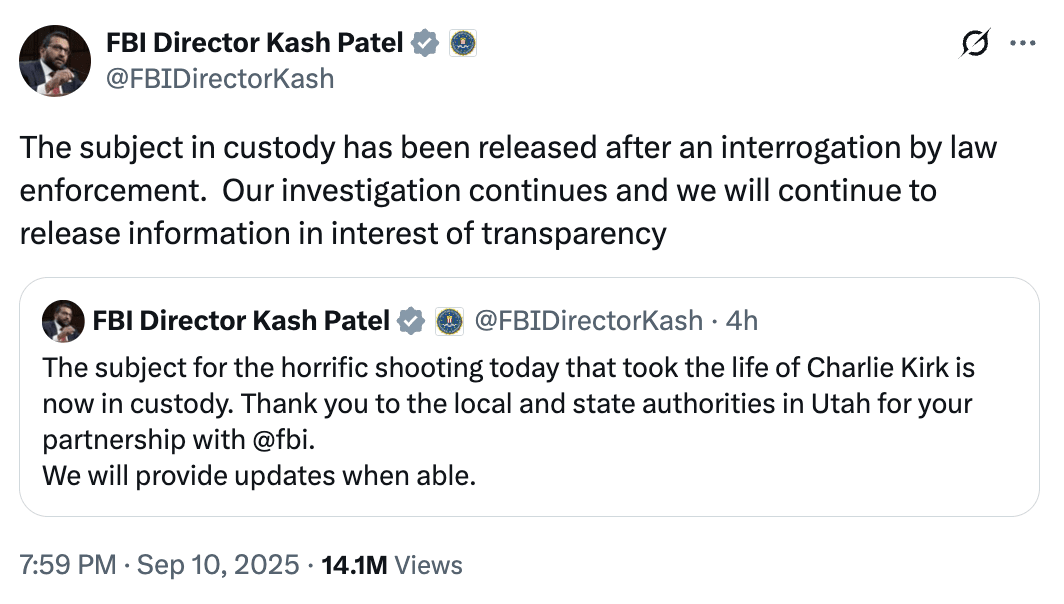
Patel
announced
that
the
FBI
arrested
the
shooter
in
the
Charlie
Kirk
case,
only
to
have
to
walk
it
back.
Good
thing
they
got
rid
of
Driscoll,
Jensen,
Evans,
with
their
collective
70
years
of
experience,
along
with
superstar
agent
Mehtab
Syed,
the
now-former
head
of
the
FBI’s
Salt
Lake
City
Field
Office.
MAGA!
Forbes
is
out
this
week
with
its
10th
annual
Cloud
100
list,
tracking
the
top
companies
in
cloud
computing,
and
four
legal
tech
companies
made
the
list,
while
one
dropped
off
from
last
year.
Two
other
legal
tech
companies
were
highlighted
as
rising
stars
—
“startups
on
track
to
be
some
of
the
best
private
cloud
companies
in
the
future.”
Included
on
this
year’s
list
are
Clio,
which
rose
from
56th
on
the
list
last
year
to
46th
this
year;
DeepL,
an
AI
translator
used
by
legal
professionals
and
in
other
industries,
which
ranked
75th;
Harvey,
the
gen
AI
legal
automation
software,
which
ranked
91st;
and
EvenUp,
the
AI
platform
for
personal
injury
lawyers,
which
ranked
100th.
The
two
legal
tech
companies
that
made
the
list
as
Rising
Stars
are Crosby,
an AI-powered
law
firm,
and InfoDash,
a
knowledge-sharing
platform
for
law
firms.
Of
Clio,
Forbes
said
in
part:
“Over
200,000
legal
experts
use
Clio,
whose
software
is
endorsed
by
more
than
100
law
societies
and
bar
associations
around
the
globe,
including
all
50
state
bar
associations
in
the
United
States.
Clio,
which
has
raised
a
total
of
$1.29
billion
to
date,
announced
in
June
it
would
acquire
vLex—the
company
behind
Vincent
AI,
an
AI-powered
legal
research
assistant—for
$1
billion.”
About
DeepL,
Forbes
said
in
part:
“One
of
Google
Translate’s
top
rivals,
DeepL
was
founded
in
2017
by
Polish
entrepreneur
Jaroslaw
Kutylowski.
Its
AI-powered
software
enables
users
to
translate
text
and
files
into
30
different
languages,
including
Estonian,
Japanese
and
Portuguese,
or
to
make
writing
in
another
language
sound
more
natural.”
Regarding
Harvey,
Forbes
wrote
in
part:
“Lawyers’
desks
are
notoriously
covered
in
paperwork,
but
Harvey
can
make
all
that
clutter
disappear.
The
AI
company
is
built
to
securely
store
thousands
of
sensitive
documents
–
including
court
records
–
and
quickly
allow
lawyers
to
get
answers
to
complex
legal
queries.”
As
for
EvenUp,
the
Forbes’
editors
said
in
part:
“The
$1
billion
company
now
powers
over
1,500
personal
injury
firms,
helping
to
analyze
medical
records
and
generating
over
$7
billion
in
claims
to
date.
Its
expansion
efforts
include
new
headquarters
in
San
Francisco
and
the
launch
of
workflow
tools
to
reduce
delays
in
document
draft
and
review
times.”
Among
the
factors
considered
in
compiling
the
list
are
market
leadership,
company
valuation,
operating
metrics,
and
people
and
culture.
Selections
are
made
by
Forbes
in
collaboration
with
Bessemer
Venture
Partners
and
Salesforce
Ventures.
Note
that
Bessemer
ledClio’s
2014
Series
C
financing
round.
Poor
chess
players
only
think
ahead
one
or
two
moves.
Good
chess
players
think
ahead
five
or
six
moves.
Grandmasters
think
through
every
move
to
checkmate
and
back,
and
to
checkmate
again.
Likewise,
poor
lawyers
only
think
about
the
next
move
or
two,
good
lawyers
think
several
moves
ahead,
and
great
lawyers
think
through
every
move
to
a
win.
The
best
lawyers
think
about
every
action
and
reaction,
not
just
with
opposing
counsel,
but
with
the
opposing
party,
the
judge,
one’s
own
client,
every
witness,
and
every
exhibit.
And
they
think
about
how
they’ll
react,
what
they
will
do
in
turn,
how
these
actions
will
create
new
reactions,
and
so
on.
To
think
through
a
case
to
the
end
and
back,
you
have
to
put
yourself
in
the
shoes
of
everyone
else
in
the
case
and
evaluate
how
they
would
reasonably
and
likely
react
to
your
actions
and
what
actions
of
their
own
they’ll
likely
initiate.
If
you
were
opposing
counsel,
what
would
you
do?
What
themes
would
you
rely
on?
What
would
be
your
legal
theories?
What
discovery
would
you
conduct?
What
experts
would
you
retain?
What
questions
would
you
ask
in
a
deposition?
If
you
were
the
judge,
how
would
you
evaluate
the
facts?
Interpret
the
law?
Rule
on
your
potential
motions?
If
you
were
the
opposing
party,
how
would
you
define
a
win?
What
would
you
resolve
or
settle
the
case
for?
This
exercise
helps
you
figure
out
what
to
expect
and
how
to
direct
your
case
to
consider
these
possible
actions
when
directing
your
case
toward
a
favorable
resolution.
I
often
ask
the
following
questions
when
thinking
through
a
case:
so
we
do
X,
then
what?
What
happens
next?
How
will
the
other
side
likely
respond?
What
actions
will
they
likely
take,
independent
of
what
we
do?
And
how
should
we
react?
And
then?
And
then?
And
so
on.
In
other
words,
you
are
sitting
at
the
edge
of
the
chessboard.
All
the
pieces
are
waiting
to
be
moved.
And
you
think
through
your
initial
moves,
and
theirs,
your
intermediate
moves
and
theirs,
and
your
final
moves
and
theirs.
And
in
doing
this,
you’ll
be
better
able
to
evaluate
the
strengths
and
weaknesses
of
your
case
and
theirs.
Not
defining
a
win
(and
a
loss)
and
failing
to
think
through
to
the
end
of
how
to
achieve
your
goals
often
results
in
mistakes,
overlooking
opportunities,
and
a
shotgun
(rather
than
rifle)
approach.
This
haphazard
approach
may
lead
to
victory,
but
if
it
does,
it’s
mainly
by
luck,
accident,
or
due
to
opposing
counsel
thinking
about
their
case
even
less
than
you.
Strategic
planning
doesn’t
just
apply
to
firms,
companies,
and
one’s
own
life.
This
approach
applies
to
each
of
our
cases,
and
taking
a
strategic
approach
results
in
more
efficient
litigation,
better
work
product,
and
improved
outcomes.
Sit
down
with
your
team
and
brainstorm
each
step
in
your
case.
If
you
don’t
have
a
team,
play
chess
with
yourself
and
think
through
all
the
moves.
Consider
using
an
AI
large
language
model
(LLM)
to
brainstorm
all
the
steps
from
beginning
to
end.
However
you
approach
the
process,
it
is
essential
to
think
through
it
and
constantly
re-evaluate,
because
cases
are
organic
and
surprises
will
occur,
requiring
a
change
of
plans
and
approaches.
This
constant
evaluation
and
reevaluation
will
change
how
you
move
the
pieces
on
the
board
and
help
you
achieve
checkmate.
And
consider
taking
up
chess.
You’ll
appreciate
the
importance
of
thinking
ahead
and
how
to
do
so.
Frank
Ramos
is
a
partner
at
Goldberg
Segalla
in
Miami,
where
he
practices
commercial
litigation,
products,
and
catastrophic
personal
injury. You
can
follow
him
on LinkedIn,
where
he
has
about
80,000
followers.
Over
the
weekend,
a
federal
judge
issued
a
significant
ruling
in
Particle
Health’s
antitrust
lawsuit
against
Epic,
allowing
key
claims
to
proceed
while
dismissing
others.
Judge
Naomi
Buchwald
of
the
Southern
District
of
New
York
permitted
three
of
Particle’s
federal
antitrust
claims
to
move
forward,
as
well
as
a
claim
of
tortious
interference
with
business
contracts.
Data
platform
Particle
filed
the
lawsuit
against
EHR
behemoth
Epic
last
September
following
a
monthslong
dispute.
The
startup’s
complaint
alleged
that
the
EHR
vendor
is
using
its
dominance
in
the
market
to
prevent
competition
in
the
payer
platform
space.
The
payer
platform
space
refers
to
the
emerging
market
for
digital
platforms
that
allow
payers
to
access
and
analyze
patient
data
at
scale
for
a
variety
of
purposes,
including
improving
care
coordination,
designing
population
health
programs
or
streamlining
claims
processing.
Particle’s
complaint
alleges
that
Epic
is
preventing
the
startup
from
competing
in
this
space
by
blocking
Particle
customers
from
retrieving
Epic-held
data.
At
the
center
of
the
dispute
is
Carequality,
a
nationwide
data
exchange
framework
that
Epic
plays
a
dominant
role
in
operating.
Particle
relies
on
Carequality
to
retrieve
patient
records
on
behalf
of
its
customers,
but
the
startup
alleges
that
Epic
has
selectively
restricted
its
access,
therefore
cutting
it
off
from
a
crucial
pipeline
of
clinical
data.
Particle
argues
that
Epic
has
leveraged
its
influence
over
Carequality
to
tilt
the
market
in
its
favor
and
shut
out
the
competition
—
saying
that
this
behavior
amounts
to
an
“unprecedented”
exertion
of
market
power
that
suppresses
innovation
and
controls
payers’
access
to
patient
records.
The
company
alleges
that
Epic’s
tactics
have
driven
customers
to
abandon
their
contracts,
as
well
prevent
new
customer
relationships
from
forming.
In
her
September
5
ruling,
Buchwald
said
that
Particle
had
provided
credible
information
to
back
up
its
claims
that
Epic
engaged
in
anticompetitive
behavior
—
enough
to
avoid
the
case’s
outright
dismissal
at
this
preliminary
stage.
She
did,
however,
dismiss
several
claims
alleging
that
Epic
engaged
in
conspiracy,
defamation
and
trade
libel.
Particle
CEO
Jason
Prestinario
said
he
is
“very
pleased”
about
Buchwald’s
ruling
in
a
LinkedIn
post.
“While
a
few
of
the
claims
didn’t
survive,
Epic’s
motion
to
dismiss
was
DENIED
on
all
3
of
the
core
monopolization
antitrust
claims.
This
is
the
first
time
in
Epic’s
history
that
an
antitrust
case
against
them
has
gotten
to
this
point.
It’s
the
next
step
to
a
bigger
victory
for
better
patient
care
and
more
patient
control
of
their
medical
info,”
he
wrote.
An
Epic
spokesperson
sent
a
statement
to
MedCity
News
noting
that
the
company
is
looking
forward
to
the
next
stage
of
the
legal
process.
“The
Court
dismissed
the
majority
of
Particle’s
claims.
The
ruling
included
the
observation
that
Carequality’s
‘imposition
of
the
corrective
action
plan
[on
Particle]
was
entirely
reasonable.’
Epic
has
worked
and
will
continue
to
work
to
protect
the
privacy
of
patients’
data.
We
look
forward
to
the
opportunity
to
present
evidence
to
prevail
on
the
remaining
claims,”
the
spokesperson
wrote.
The
next
step
for
the
parties
is
the
discovery
phase,
which
could
shed
new
light
on
how
data
sharing
rules
are
enforced
and
what’s
at
stake
for
the
future
of
payer
platforms.
*
Trump
administration
appeals
stay
in
bid
to
fire
Federal
Reserve
governor
in
prelude
to
Supreme
Court
showdown.
[Reuters]
*
Former
FBI
agents
allege
they
were
subjected
to
loyalty
tests.
[NPR]
*
Clients
driving
firms
to
use
more
generative
AI.
Knock
it
all
you
want,
but
hallucinations
are
cheap!
[Bloomberg
Law
News]
*
Bipartisan
ABA
task
force
calls
for
serious
election
reform
to
protect
the
rule
of
law.
[Law.com]
*
D.C.
Circuit
returns
Copyright
chief
to
job.
[Law360]
*
As
authorities
keep
detaining
and
then
releasing
suspects
in
the
Charlie
Kirk
case,
the
local
newspaper
notes
that
Utah
allows
open
carry
everywhere,
making
it
harder
to
just
nab
everyone
leaving
the
scene
with
a
gun.
[Salt
Lake
Tribune]
*
Lynne
Stewart,
the
defense
lawyer
that
the
Bush
administration
accused
of
aiding
terrorists,
has
died.
[ABA
Journal]






 Kathryn