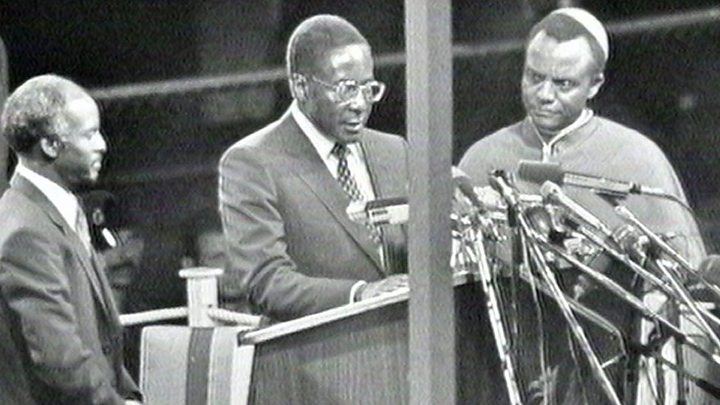
Zimbabwe’s Mugabe to lie in state at 2 different stadiums – The Zimbabwean

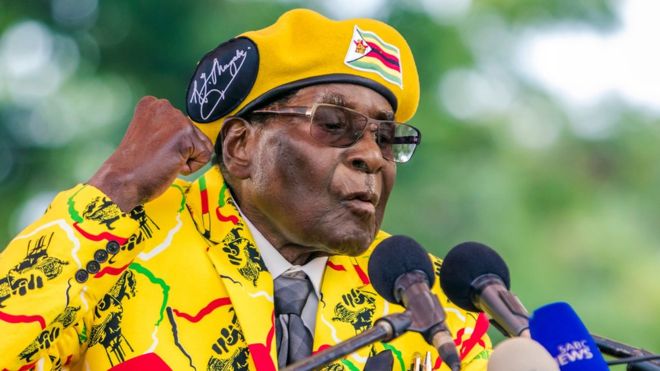
Mugabe, an ex-guerrilla chief who took power in 1980 when the African country shook off white minority rule and ruled for decades, died on Friday at a hospital in Singapore. He was 95.

Information Minister Monica Mutsvangwa said in a statement that the government has dispatched Vice President Kembo Mohadi and other senior officials and family members to Singapore to accompany Mugabe’s body home.

The body will arrive in the country “any time on Wednesday,” she said. The body will lie in state at Harare’s Rufaro Stadium and then at the National Sports Stadium, also in the capital, she said.

Mutsvangwa said Mugabe would be buried on Sunday but she did not say where he will be buried, saying more updates will be provided “as more information on the program trickles in.”

Presidential spokesman George Charamba and deputy information minister Energy Mutodi at the weekend said the former authoritarian ruler would be buried at the National Heroes’ Acre, a monumental burial site reserved for people viewed by the ruling ZANU-PF party as having served the country with distinction during and after the 1970s war of independence. Mugabe’s first wife, Sally, is buried at Heroes’ Acre and a vacant plot reserved for the former president is next to her grave.

However, family spokesman Leo Mugabe, a nephew of the former president, said over the weekend that burial arrangements have not yet been finalized. This has prompted speculation of a rift between the government and members of Mugabe’s family, who want him to be buried at his rural home in Kutama, about 85 kilometers (52 miles) southwest of Harare.

Leo Mugabe told reporters that Mugabe had died “a very bitter man” because he felt betrayed by the former political and military leaders who were his allies for close to four decades before they forced him to resign in November, 2017.

He dismissed reports that Mugabe had refused to be buried at the Heroes’ Acre, but also refused to say where the burial will take place.

Marty Chavez Wants To Sell Ken Griffin An NYC Guest House

Goldman Sachs’ Prince that was Promised lists his West Village crib for $19.95 million.

Robert Mugabe: a complex legacy – The Zimbabwean

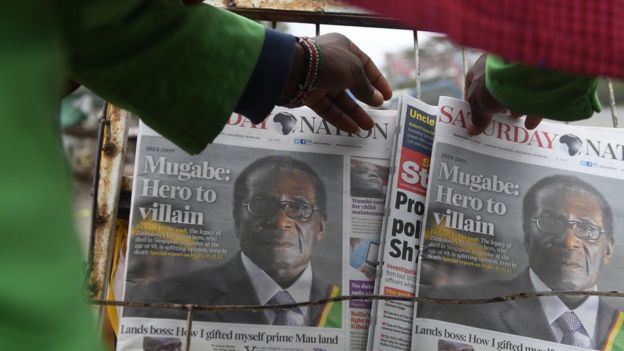
There is a deep fascination with him in the UK. Despite the drama of Brexit, his death was top news across the papers and TV channels. I was taken aback  when I saw his image on a massive news screen at King’s Cross station in London announcing his death. Once feted by the Queen, now almost universally reviled, what is it about the dramatic tragedy in the narrative of a transition from ‘hero’ to ‘villain’ that so captivates people, but also blinds us to the complexities of history?

This complexity, and the importance of a deeper history, comes across in some of the better reflections on his death. There is much that’s already been written, but there are a few articles that have stood out for me. The piece ‘Mugabe: a man of more than one story’, for example, highlights the multiple threads of a complex narrative, as does Alex Magaisa’s BSR piece, which urges us not to forget the victims of Mugabe’s regime. Perhaps surprisingly, but like many Zimbabweans of his age, Tendai Biti, once tortured by the regime, says ‘I don’t feel bitterness. I feel indebtedness’. The missed opportunities of the liberation are reflected on in many pieces, including by Fadzayi Mahere, who argues that he ‘killed the freedoms he had worked so hard for’. Roger Southall, meanwhile, reflects on his legacy alongside other liberation party leaders in the region, pointing out that he is ‘as divisive in death as he was in life’. A typically quirky take comes from Percy Zvomuya focusing on deeper family backgrounds and historical contingencies in the piece, Robert Mugabe: the leader who shouldn’t have been. And my favourite of all is the 2017 article by Everjoice Win, widely recirculated in the past days, which captured the moment around the ‘coup’, but seems even more apposite today, and reflects the feelings of many.

Why has Mugabe’s passing attracted so much attention, particularly internationally? Some while ago, Miles Tendi, a Zimbabwean scholar and professor at Oxford University, pointed to the roots of the media fascination with Mugabe in the UK:

“Mugabe is the British media’s bogeyman for everything that is wrong with Africa and one can never escape the naked reality that the fallout from ZANU-PF’s violent eviction of white farmers in Zimbabwe from 2000 onwards, many of whom were British descendants, continues to attract a disproportionate amount of international focus compared to other more severe crises…”

In a similar vein, back in 2008, the renowned Ugandan scholar, Mahmood Mamdani pointed out in his controversial essay for the London Review of Books:

“It is hard to think of a figure more reviled in the West than Robert Mugabe. Liberal and conservative commentators alike portray him as a brutal dictator…. There is no denying Mugabe’s authoritarianism, or his willingness to tolerate and even encourage the violent behaviour of his supporters…. [but this] gives us little sense of how Mugabe has managed to survive. For he has ruled not only by coercion but by consent, and his land reform measures, however harsh, have won him considerable popularity, not just in Zimbabwe but throughout southern Africa. In any case, the preoccupation with his character does little to illuminate the socio-historical issues involved”.

Mugabe’s death reminded me of the screening of Simon Bright’s film, Robert Mugabe… What Happened? at Sussex some years ago. An earlier blog observed that it is a powerful documentary, using fascinating archival footage, together with interviews with key figures in the opposition movement in Zimbabwe. It tells a sympathetic, historically-informed, but still highly critical, story about the man. With Mugabe gone, it is well worth watching again.

It is considerably more nuanced than much of the mainstream commentary that has emerged following his death. This typically follows the hero-to-villain storyline, often attached to the positive then evil influence of his two wives, Sally and Grace. Land reform in 2000 is often marked as the turning point, with the story of land reform being given the usual, misinformed gloss of disaster, turning Zimbabwe from ‘breadbasket to basket case’, the result of party cronies being given the land, and poorly qualified poor farmers making matters worse. I have largely ceased to engage with these narratives, coming from many who really should know much better by now, and I am not going to rehearse the argument again that these views are grossly misinformed here. There are now 360 blogs on Zimbabweland, and many more research articles besides, which together give a more nuanced story.

Too often in mainstream accounts, the role of the British in the Mugabe story is glossed over. Yet the British government’s complicity – for example in the silence about the massacres by the Fifth Brigade in Matabeleland in the 1980s – was significant. The failure of the British to push a more complete settlement at Lancaster House in 1979, and of course the diplomatic gaffe of the infamous ‘Clare Short letter’ in 1997, are all part of the picture. The resentments and hostility rose to a head in the late 1990s, as Mugabe and Blair locked horns. And, while commentaries are critical of white Rhodesia and Ian Smith’s UDI rule, they often do not explore the failure of a more complete reconciliation and integration of whites in the new Zimbabwe following Independence.

At our film screening panel discussion back in 2012, this was an issue tackled by Denis Norman, who served in Mugabe’s cabinet after Independence, and came from being the head of the white Commercial Farmers’ Union. He conceded that more could have been done back then, especially on land reform. There was an unwritten political contract between white farmers and the new state that whites could farm and make money, but not be involved in opposition politics, and land reform, despite the liberation war rhetoric, was parked. This fell apart with the launch of the MDC, and the support of white farmers of an opposition movement. The failure of the donor-brokered land conference in 1998 was a key moment, as no side was willing to compromise. The land invasions that followed were then perhaps inevitable.

As a number of the more sophisticated commentaries highlight, countering the hero-to-villain narrative means emphasising the continuities in the way politics have been played out in Zimbabwe since Independence, with Mugabe at the centre. A lack of tolerance of alternative views, violence and oppression have all been a consistent pattern, and stretch into the the pre-Independence period and the nationalist struggle (and indeed in particular the ‘struggles within the struggle’). A transition from militarised, violent liberation war struggle to peaceful, democratic governance did not happen.

It is not a question of seeing a golden age of the 1980s to contrast with the period since 2000. While there have been important changes, there are also repeated patterns. This is why the much-hailed 2017 ‘coup’ was doomed to failure, and perhaps no surprise that the Mnangagwa regime has seen much continuity, notably in violent repression of opposition forces. This is of course why a democratic transition, with a strong constitutional base, remains so critical; to shed once and for all this violent history.

In assessing Mugabe’s complex legacy, the positive legacies of massively improved education and health services for all in the 1980s and land redistribution to smallholders, especially post-2000, have to balanced against the persistent use of violence, gross economic mismanagement and the failure to develop a democratic state. As opposition politician, Tendai Biti, noted on his death, Mugabe was a ‘coalition of controversies’.

This post was written by Ian Scoones and first appeared on Zimbabweland

Photo credit: President of Zimbabwe Addresses UN General Assembly, 25 Sep 2009. UN Photo/Marco Castro. www.unmultimedia.org/photo/ via flickr)

Moyo expected Old Mutual to “respect the rule of law”
Robert Mugabe died a ‘very bitter’ man, nephew says

Post published in: Featured

Robert Mugabe died a ‘very bitter’ man, nephew says – The Zimbabwean

Robert Mugabe was ousted by a military coup in 2017 after nearly four decades in power

Robert Mugabe’s nephew has said the former Zimbabwean leader died a “very bitter” man.

Mr Mugabe, who died aged 95 last week, led Zimbabwe for nearly four decades until he was ousted by a coup in 2017.

“Imagine people you trusted – people that were guarding you, looking after you – [turning] against you,” Leo Mugabe said.

“He was very bitter and it dented his legacy,” he told the BBC from his uncle’s rural home.

“It was not an easy thing for him to take,” he added.

Initially praised for broadening access to health and education for the black majority, Mr Mugabe later used violence against his political opponents and presided over Zimbabwe’s economic ruin.

He was removed from office after he fired his deputy, with many fearing he was preparing for his wife, Grace Mugabe, to succeed him.

His former deputy, Emmerson Mnangagwa, then became president after the army intervened and forced Mr Mugabe to step down.

The long-serving president’s legacy has been the subject of fierce debate since he died.

A man buys a daily newspaper at a stand on the streets of Nairobi following Robert Mugabe's deathRobert Mugabe’s legacy has been fiercely debated since his death in Singapore last week

When will the funeral take place?

Mr Mugabe’s death at a hospital in Singapore on Friday followed a long illness. He had been receiving medical care in the city since April.

Close relatives and government officials have travelled to the city and his remains are due to be returned to Zimbabwe on Wednesday.

His body is expected to be taken to his home village, which is about 80km (50 miles) west of the capital Harare, for an overnight wake.

His official funeral will take place on Saturday at the 60,000 capacity National Sports Stadium in Harare, according to government officials.

Zimbabwean and global reaction to Mugabe’s death

But there has reportedly been disagreement over where Mr Mugabe will be buried.

Some of his relatives want him to be buried at his rural homestead in the village of Kutama in Mashonaland West province. But government officials have pushed for a burial at a shrine near Harare.

Most of Zimbabwe’s national heroes – those who fought against white-minority rule – are buried at the Heroes’ Acre shrine just outside of the city.

“The [traditional] chiefs will bury him on Sunday, where I don’t know,” Leo Mugabe told AFP news agency on Monday.

If Mr Mugabe is buried at his rural home, it would represent a final snub to the comrades he believed betrayed him, the BBC’s Shingai Nyoka in Harare says.

Who was Robert Mugabe?

He was born on 21 February 1924 in what was then Southern Rhodesia – a British colony, run by its white minority.

After criticising the government of Rhodesia in 1964 he was imprisoned for more than a decade without trial.

Once released, he headed to Mozambique, from where he directed guerrilla raids into Rhodesia but he was also seen as a skilled negotiator.

Political agreements to end the crisis resulted in the new independent Republic of Zimbabwe.

Mugabe: From war hero to resignation

With his high profile in the independence movement, Mr Mugabe secured an overwhelming victory in the republic’s first election in 1980.

But over his decades in power, international perceptions soured. Mr Mugabe assumed the reputation of a “strongman” leader – all-powerful, ruling by threats and violence but with a strong base of support. An increasing number of critics labelled him a dictator.

He famously declared that only God could remove him from office.

He was forced into sharing power in 2009 amid economic collapse, installing rival Morgan Tsvangirai as prime minister.

But in 2017, amid concerns that he was grooming his wife Grace as his successor, the army – his long-time ally – turned against the president and forced him to step down.

Robert Mugabe: a complex legacy
Zimbabwe begins national mourning for hero-turned-despot Mugabe

Post published in: Featured

An Interview With Leadership Speaker And Podcaster Nicole Abboud-Shayan

Nicole Abboud-Shayan (Image via LinkedIn)

After an unplanned two-month hiatus from this column, I am excited to be back with a ton of fresh new content for you (because let’s be honest, there is only so much writing about law school and the bar exam one gal can do). 

I’m particularly pumped about this new “An Interview With” series that will publish at least once a month. In this series, I will connect with people from all parts of the legal profession and at all stages of their legal career.  We will learn more about who really makes up the legal community and what people are actually doing with their legal degrees. 

Now, let’s get this series kicked off with Leadership Speaker and Podcaster, Nicole Abboud-Shayan. Nicole, a 2011 Southwestern Law School grad, is an inclusive leadership speaker and host of The Gen Y Lawyer Podcast. Nicole has spoken at places such as the Clio Cloud Conference and Lawyernomics by Avvo. 

In the following interview, you will learn about Nicole’s journey to becoming a Leadership Speaker and Podcaster and how her law degree and legal career got her there.

Q: Why did you go to law school? 

A: I wanted to help people and I believed that law school would put me in the best position to do that. I knew that understanding the law would provide the power and authority to speak up for others. For whatever reason, I’ve always had an innate ability to determine what’s fair, and I believed that law school would help me hone that character trait to better serve others. 

The more I reflect on why I decided to go to law school, the more I realize the following truth (and listen up because not many people share this): I wanted to become a lawyer all of my life, but I never stopped to honestly evaluate if that’s what I truly wanted. I didn’t know any lawyers when I was growing up so I never actually spoke to a real one to find out what their lives and work entailed. Although I’m not sure my 20-year-old self would have considered anything other than attending law school, sometimes I wonder how different my life would be had I just taken a few years off after college to explore other interests and gain real-world experience. Taking time off to find yourself isn’t exactly encouraged when you’re in college. But alas, everything happens the way it’s supposed to. Aside from my massive student loan debt, I don’t regret attending law school whatsoever. I’m smarter, stronger, and more capable because of what I learned and the skills I gained. 

Q: Describe your legal from graduation to what you are currently doing today

A: I don’t want to bore everyone with the minutiae of how I went from a totally unhappy lawyer to quitting the law, growing a business, and transitioning to where I am today. So I’ll share the CliffsNotes version (please tell me you remember CliffsNotes and my Millennial references aren’t completely lost on today’s generation?).

It took a whole three months for me to realize that being a lawyer is not what I wanted to do for the rest of my life. I can’t exactly explain what it was but I had a feeling in my stomach that there was something more, something else out there for me to do. Five years and several different practice areas later, I finally made the leap out of the practice of law and into entrepreneurship. I launched my business, Abboud Media, and focused my efforts on helping lawyers and law firms amplify their thought leadership and market their practices using videos and podcasts. We became a full-production agency. Now, two years later, my company continues to evolve as I grow into my role as a public speaker and podcaster. 

Q: Describe what your typical workday looks like

A: I don’t really have typical workdays, but I do tend to have typical work weeks. I like to establish three major goals for each week. So I spend Sundays thinking about the upcoming week and jotting down my “To-Do” List. Some weeks are busier than others, but for the most part, I typically have several podcast interviews to conduct. For that, I schedule time to research my guests and prepare for each interview. I allot time for editing and preparing the show for its Monday publication. 

When I wake up every day, I try my hardest to start the day with 10 minutes of meditation but that doesn’t always work out (it’s a work in progress). 

I usually have one or two major conferences that I speak at every couple of months so I schedule time to prepare for my presentations and keynote addresses. When I’m not prepping, I’m usually working on outreach and development and trying to secure future speaking engagements.  I try to attend one or two networking events each week, whether it’s bar association mixers or one-on-one lunch meetings with new or old connections.

I also serve on several boards so I attend any meetings scheduled that week. I listen to personal development podcasts while I drive and check in with my mastermind group each week. When I’ve completed my major projects for the week, I treat myself to some good ‘ol fashioned Netflix binging. And of course I try to exercise about three-four times per week, and I spend all other times with my husband.

Q: What challenges did you face in your decision to go a non-traditional path with your law degree (i.e., mental/emotional/ financial/ outside pressure from family friends/ know-how, etc.)?

A: There were many. The first was my own personal struggle with my professional identity. I lived with the dream of wanting to become a lawyer all of my life and then held on to that identity when I finally became a practicing attorney for five years. So it was difficult to learn how to shed that part of my identity when I decided to part ways with the practice of law. There was certainly a huge element of pride and ego wrapped up in being a lawyer. That was difficult to work through. Thankfully, that tight grip that I had on my lawyer-identity loosened over the years and I learned that being a lawyer will always be a part of me even if I’m not practicing. I had to release that part of me that was not working in order to find my true, whole self. 

Another less unexpected challenge was my financial journey following shutting down my law practice. Although there are many jobs lawyers can obtain that provide whatever desired salary they wish to make, I chose to jump into entrepreneurship. If there’s one thing you should know about entrepreneurship, it’s that it will rarely provide the type of financial security you need or desire. At least not at first. So when I first launched my business, my challenge was figuring out how to make money and allocate whatever money I did make appropriately until my business was up and running. 

Q: Do you think you’ll ever go back to practicing law? 

A: If I’ve learned anything over the years, it’s to never say “never.” It’s impossible to predict the future, so even though I don’t foresee myself ever going back to practicing law, it’s always uncertain what the future holds for me. I’m self-aware enough to know that practicing law wasn’t the right path for me and didn’t suit my strengths. So barring any crazy change in personality in the future, I highly doubt I’ll return to the practice of law.

Q: What advice do you have for someone who is interested in doing something non-traditional with their law career (whether a law student or someone looking to make a career change)?

A: I think the first step is to stop thinking that not practicing law is “non-traditional” since people who obtain their JDs are able to use their degrees in various unique and interesting ways outside the legal profession. This is  becoming the new “traditional.” Not committing to practicing law for your entire career is becoming more common and acceptable as more lawyers are finding non-legal positions that allow them to still use their legal knowledge and skills. 

Second, my advice would be: just go for it. If you have an interest in something, you owe it to your future self to explore that interest. That doesn’t mean completely dropping out of law school or quitting the law just yet, but it does warrant some research. I’m all about exploring your curiosities. Take some time either on the weekends, at the end of your workday, or when you have some free time to research your interests. Reach out to people who are already occupying the space you wish to be in and chat with them. Ask them how they like it and why. Find out why you’re attracted to another career. There are too many free resources available for you to not arm yourself with as much knowledge as you can before making a life-changing decision. 

You can learn more about Nicole here.

Know someone who would be great to profile in this series? Send an email to info@vincoprep.com with “An Interview With” in the subject line. 


Kerriann Stout is a millennial law school professor and founder of Vinco (a bar exam coaching company) who is generationally trapped between her students and colleagues. Kerriann has helped hundreds of students survive law school and the bar exam with less stress and more confidence. She lives, works, and writes in the northeast. You can reach her by email at info@vincoprep.com.

Nailing The Competition? Trademark Infringement, Keyword Advertising, And A New Take On An Old Problem

The internet has transformed everything from information access and communication (email, social media, etc.) to shopping, but in the process, it has also pushed the boundaries of trademark law as well. One of the ways this has occurred involves what is known as keyword advertising — a form of online advertising whereby the advertiser pays to have an advertisement appear in a search results listing when specific words or phrases are used in the search. It makes sense that advertisers would want to use such a mechanism — it gets their brand in front of consumers who are searching for such goods or services right then and there.  When the search terms bid on by advertisers involve the trademarks of another party (especially a competitor), however, things get a bit harder to nail down, and trademark owners have been none too happy about it.

As you can appreciate, trademark owners did not take too kindly to the use of their trademarks by search engine programs in keyword advertising, and they have sued not only the search engines selling search terms incorporating their trademarks but the advertisers who have purchased such keywords as well.  The problem is that the courts have not really sided with the trademark owners in such keyword cases.  Why?  It really comes down to likelihood of confusion — whether an ordinary consumer shopping online would be likely to be confused as to the source of origin of the goods from the keyword-served advertisement. From trademarks involving contact lenses to software, the circuit courts have generally held no likelihood of confusion over ads generated from keyword advertising based on another’s trademarks.  That said, likelihood of confusion can occur under certain circumstances where trademarks are used in other contexts as well as in keywords, such as in advertisement text or domain names. I fully realize that this scratches the surface as a summary of the law in the area, but the point is that trademark infringement involving keyword advertising is not an easy nail to drive so to speak, which make the most recent case all the more intriguing.

Many of you have seen ads for personal injury lawyers, but if any of you have spent any time in Texas whatsoever, you have probably seen the ads for Texas personal injury attorney Jim Adler.  Advertising himself as “The Texas Hammer,” as well as “The Hammer” and “El Martillo Tejano,” his ads for personal injury legal services are legend in Texas, and he has become quite well known as a personal injury attorney as a result.   He owns federal trademark registrations for the trademarks “The Texas Hammer,” Reg. No. 3,503,851 and its Spanish translation “El Martillo Tejano,” Reg. No. 3,503,852, both alleging use since 2002, and “The Hammer,” Reg. No. 3,730,395, alleging use since March 2009.  He also has a federal trademark application pending based upon intent-to-use for “The Hammer Lawyer,” Ser. No. 8,8572,196 (collectively, these trademarks are referred to in this article as the “Adler Marks”).  Needless to say, Mr. Adler has spent a great deal of time and money to establish his unique legal services brand under the Adler Marks, so it should come as no surprise to see lawsuits filed on behalf of his law firm and himself in the U.S. District Court for the Northern District of Texas against four different defendants alleging trademark infringement for use of his trademarks in keyword advertising on mobile devices.

Unlike other cases, the facts underlying these near-identical complaints appear to go beyond mere comparative advertising.  Here is an excerpt from the Statement of the Case in one of the cases, Jim S. Adler, P.C. and Jim Adler v. Alliance Industry Group, et als., Civil Action No. 3:19-cv-2023, that outlines the allegations succinctly:

This lawsuit arises out of Defendants’ intentional use of Plaintiffs’ registered trademarks to knowingly deceive and confuse consumers who are searching specifically for Plaintiffs using a mobile device. Defendants’ fraudulent scheme involves buying keyword ads using Plaintiffs’ registered marks for Google searches made from mobile devices, and using them in conjunction with confusingly similar or generic “click-to-call” ads. “Click-to-call” ads are a relatively new tool for search engine advertising. The “click-to-call” ads target mobile devices and users, and instead of linking to a website, once tapped by a consumer, the ad causes the device to call a predetermined phone number.

The complaint goes into greater detail involving the allegations, but the gist is that the defendants operate legal referral services that use call centers to refer cases called in to the call center to law firms/lawyers with whom they have a legal relationship (such as a referral agreement).  By purchasing keywords including the Adler Marks, the complaints allege that the competing “click-to-call” ads on mobile devices can cause confusion to the consumer doing the search, not realizing that the number they are clicking to call on their mobile device is not Mr. Adler’s law firm. In essence, the complaints allege that the defendants are trading upon the goodwill behind the Adler Marks (as well as Mr. Adler’s reputation) to ostensibly induce calls to their call centers.  In addition, the complaints allege that the defendants’ practice is bidding-up the cost for the Adler Marks’ fun keyword advertising, resulting in Mr. Adler’s law firm apparently getting “hammered” itself by increased costs for its own internet advertising.  Ouch.

As you can see, these cases involve more than just simple keyword ad servicing — they are specific to the use of trademarks in keyword advertising on mobile devices to allegedly confuse consumers seeking a personal injury lawyer into calling a competing lawyer on their mobile device. It will be interesting to see how the plaintiffs overcome the hurdles presented by existing caselaw on likelihood of confusion, given that the ads generated by the defendants appear general to personal injury legal services for vehicle accidents and do not use the Adler Marks within them.  How these cases will turn out is anyone’s guess, but existing caselaw is not necessarily on Mr. Adler’s side.  That said, the facts alleged involve more than your typical trademark infringement/keyword advertising case, and the nature of the “click-to-call” ads may be enough to tilt the issues presented in his favor.  These cases are definitely worth watching.  You never know — when it comes to evolving the law regarding trademark infringement in keyword advertising on mobile devices, these cases may just hit the nail on the head.


Tom Kulik is an Intellectual Property & Information Technology Partner at the Dallas-based law firm of Scheef & Stone, LLP. In private practice for over 20 years, Tom is a sought-after technology lawyer who uses his industry experience as a former computer systems engineer to creatively counsel and help his clients navigate the complexities of law and technology in their business. News outlets reach out to Tom for his insight, and he has been quoted by national media organizations. Get in touch with Tom on Twitter (@LegalIntangibls) or Facebook (www.facebook.com/technologylawyer), or contact him directly at tom.kulik@solidcounsel.com.

Zimbabwe begins national mourning for hero-turned-despot Mugabe – The Zimbabwean

Zimbabwe was on Saturday due to begin a period of national mourning following the death of Robert Mugabe, the former guerrilla hero turned despot who ruled Zimbabwe for 37 years.

As Zimbabweans expressed sharply divided opinions about Mugabe, President Emmerson Mnangagwa said his predecessor had been declared a “national hero” and that Zimbabwe would mourn him until the burial.

“The late departed icon will be eternally remembered and honoured for the bold and historic land reform programme which he undertook,” said Mnangagwa during a national address broadcast on television.

Mugabe, 95, passed away on Friday at 0240 GMT in Singapore, where he had been hospitalised in April.

First heralded as a liberator who rid the former British colony Rhodesia of white minority rule, Mugabe used repression and fear to govern until he was finally ousted by his previously loyal generals in November 2017.

His increasingly tyrannical leadership and economic mismanagement prompted millions to leave the country.

He had been battling ill health, and after a humiliating fall from office, his stamina seeped away rapidly.

Some Zimbabweans hailed him as a “true African” and a “revolutionary icon”. For others, however, his named evoked only “evil”, “destruction” and “suffering”.

“Mugabe was an educated man but he used his education for evil,” said Baster Magwizi, a war veteran in the southwestern city of Bulawayo.

“He manipulated everyone around him and fooled the world, only Zimbabweans can testify to this as we lived in hell under his leadership,” he said.

But Harare schoolteacher Tatenda Musoni was forgiving.

“To be honest I thought I would celebrate when he died but… I’m actually sad because he was an embodiment of what a true African should be.

“He had his flaws but he did a lot of positive things for us which I doubt we will ever see again in this country.”

Adam Molai, Mugabe’s nephew, said the former president died of old age “surrounded by family”.

Zimbabwe Puts Another Nail In An Increasingly Crowded Keynesian Coffin – The Zimbabwean

Riot police arrest and forcibly apprehend protestors during protests in Harare, Friday, Aug. 16, 2019. The main opposition Movement For Democratic Change party is holding protests over deteriorating economic conditions in the country as well as to try and force Zimbabwean President Emmerson Mnangagwa to set up a transitional authority to address the crisis and organize credible elections. (AP Photo/Tsvangirayi Mukwazhi)

ASSOCIATED PRESS

Where are the Zimbabweans? According to Financial Times reporter Joseph Cotterill, millions can be found in neighboring South Africa, along with other more economically vibrant locales. Cotterill notes that the Zimbabwean “diaspora” is the result of “decades of turmoil” within the formerly prosperous country.

That more and more Zimbabweans exit their country in order to work rates discussion in consideration of how all too many economists and politicians think of economic growth. According to those with a Keynesian orientation, it’s consumption that powers growth. Others, of the monetarist persuasion, believe that growth in so-called “money supply” is what keeps the economy moving. Neither religion acknowledges that both consumption and money aren’t instigators of growth as much as they’re a consequence of it.

If consumption and soaring money supply were certain growth ingredients, prosperity would be simple. Politicians could demand that the citizenry consume more, and to enable the buying, they would instruct a central monetary authority to boost money in circulation. Of course to anyone with a pulse, such a scenario would fail with blinding speed. Most of us intuitively know that our ability to consume is a function of our ability to produce. To pretend otherwise is the equivalent of assuming the only difference between Lake Forest and Cabrini Green is that government-engineered money supply increases in the former enable greater consumption than takes place in the latter. No, money supply is abundant in Lake Forest, and so is consumption, precisely because the residents of Lake Forest are rather productive. Zimbabwe instructs on the matter.

According to Cotterill, remittances from Zimbabwean expats account for at least $1.9 billion worth of GDP, or 9.6 percent. Zimbabweans are able to consume more and more thanks to production of Zimbabweans not working in Zimbabwe. This is an important distinction to make. Paul Krugman argues endlessly for increased government spending to boost economic growth, but does so without acknowledging that the growth already occurred. Governments can only spend insofar as economic growth showers them with revenues to spend. Production first, then the spending.

To Keynesians like Krugman, the answer is always more outlays from politicians. If there’s consumption, prosperity will ensue. Zimbabwe is a reminder of how unrealistic such a belief is. No doubt Zimbabweans are able to consume wealth to a greater degree than they produce wealth, but this ability to buy in greater amounts isn’t thanks to magic; rather it’s a consequence of the productivity of Zimbabweans toiling outside of the country. To be clear, there’s no such thing as consuming. Behind every act of consumption, whether it’s government enabled or enabled through remittances, is an act of production first.

Readers might consider the above the next time they witness some economist or politician on TV talking about boosting the economy through more government spending. They’re confused, or they’re lying. They can do no such thing. The consumption they aim to generate through government largesse is only possible insofar as private actors produced the wealth first. Government spending can’t stimulate growth as much as government can arrogate to itself the right to allocate wealth already created; usually at the expense of entrepreneurs and businesses. Never forget that entrepreneurs compete with consumers (private individuals, along with governments that confiscate wealth in order to shift consumption to others) for always limited resources.

Considering money, it too has no use absent production. Money can’t be eaten, or slept with; instead money is just an agreement about value among producers, along with those empowered to consume as producers do thanks to shifts of money. In Zimbabwe’s case, money has use there to a high degree because of production that doesn’t take place there. As Florence Ncube explained it to Cotterill, there “is no food that side,” as in little food produced in Zimbabwe. Groceries are purchased in South Africa, and then sent to Zimbabwe. Money supply can be found in Zimbabwe not because some central bank decreed it, but once again because of production that didn’t place in Zimbabwe. Money earned outside of Zimbabwe, and goods and services produced outside of the country, give money a purpose in Zimbabwe.  Production first, then money supply. Monetarists, like Keynesians, get the drivers of economic growth backwards.

Readers might remember this the next time some wise pundit or economist in a developed country laments impossibilities like “money shortages” or “insufficient money supply” in countries they don’t live in. The reality is that money, like consumption, is a consequence of production. Where there’s production there will always be abundant money to facilitate exchange of it, and where there’s little production is where money will always be scarce. Politicians and central bankers can’t alter economic reality through magic despite what we’re told.

Bringing it back to Zimbabwe, it has neither a problem of insufficient demand nor insufficient money supply as the twin ideologies that are Keynesianism and Monetarism would contend. What really ails Zimbabwe is a lack of production; the latter increasingly being made up for by enterprising Zimbabweans living and working outside their home country.

Zimbabwe begins national mourning for hero-turned-despot Mugabe
Mugabe’s death can be the start of Zimbabwe’s healing process

Post published in: Business