Leave
The
Trick
Or
Treating
For
Halloween:
Firm
tries
to
teach
the
importance
of
cybersecurity
by
tricking
their
associates.
Florida
Newest
State
To
Break
From
ABA:
Only
48
states
remain
under
the
weight
of
the
ABA’s
unenforced
diversity
requirements.
Welcome,
Dean!
Goodbye,
Dean!:
The
culture
war
claims
the
University
of
Arkansas
at
Fayetteville’s
newest
dean
hire’s
job.
United
States
Threatens
UK
Over
Investigating
America’s
CSAM
Bot:
We’re
the
only
ones
that
can
ban
foreign
apps!
Beveridge
&
Diamond
Mourns
The
Loss
Of
Albert
Beveridge
III:
We
send
our
condolences
to
the
firm,
family
and
friends.
I
have
previously
written
about
how
lawyers
should
be
respectful
to
adversaries
since
they
can
make
good
references
and
provide
other
advantages
to
practicing
attorneys. In
addition
to
these
benefits,
having
a
good
working
relationship
with
adversaries
can
make
it
easier
to
achieve
positive
results
for
clients.
In
some
instances,
adversaries
can
also
make
solid
referral
sources
for
lawyers,
but
attorneys
should
keep
a
few
things
in
mind
to
ensure
that
accepting
referrals
does
not
impact
an
ongoing
representation.
Earlier
in
my
career,
I
handled
a
very
heated
matter
with
an
adversary
that
needlessly
escalated
the
matter
at
every
turn. This
adversary
made
threats,
exaggerated
claims,
and
employed
other
tactics
that
were
not
pleasant
to
me
and
the
other
stakeholders
to
the
matter
we
handled. I
did
not
have
the
best
relationship
with
this
adversary. Although
I
try
to
maintain
solid
connections
with
adversaries
since
it
is
the
right
thing
to
do
and
can
make
my
job
easier,
the
escalations
undertaken
by
this
adversary
took
a
toll
on
our
working
relationship.
To
my
surprise,
toward
the
end
of
my
representation,
the
adversary
reached
out
to
me
and
inquired
if
I
knew
a
lawyer
in
a
different
jurisdiction
that
could
handle
a
given
matter. I
related
that
I
was
familiar
with
these
types
of
cases,
and
I
was
licensed
in
the
given
jurisdiction,
and
after
the
instant
matter
fully
concluded,
I
could
take
a
look
at
the
case
for
which
this
other
lawyer
needed
to
refer.
Once
the
prior
representation
ended,
I
researched
this
new
matter,
and
I
handled
that
matter
for
a
few
years. With
the
client’s
permission,
I
reported
updates
back
to
the
lawyer
who
referred
the
matter
to
me,
and
this
contact
definitely
improved
our
relationship. To
this
day,
years
later,
I
receive
holiday
emails
and
the
like
from
this
adversary,
and
I
would
definitely
consider
him
if
I
had
a
matter
in
his
area
of
expertise.
To
a
certain
extent,
it
makes
sense
that
adversaries
would
be
solid
referral
sources. Adversaries
know
the
abilities
and
temperament
of
lawyers
much
better
than
other
stakeholders
to
the
legal
profession,
since
they
can
evaluate
the
abilities
of
a
lawyer
as
it
relates
to
an
actual
representation. Also,
even
though
lawyers
usually
know
tons
of
other
attorneys,
lawyers
might
not
keep
in
regular
contact
with
other
practitioners,
so
adversaries
might
be
readily
available
attorneys
who
might
be
accessible
for
a
referral.
Of
course,
there
can
be
ethical
issues
with
accepting
referrals
from
an
adversary.
Perhaps
most
importantly,
a
lawyer
cannot
allow
a
referral
to
interfere
with
their
work
on
an
existing
representation. Lawyers
might
reasonably
believe
that
they
cannot
advance
a
client’s
interests
against
an
adversary
who
is
doing
them
a
favor
by
providing
a
referral. As
a
result,
it
is
best
to
wait
until
a
representation
ends
before
accepting
a
referral
from
an
adversary. In
a
best-case
scenario,
such
a
referral
from
an
adversary
would
come
months
or
years
after
the
representation
that
involved
the
adversary
concluded.
In
any
case,
lawyers
should
be
cognizant
that
attorneys
have
long
memories,
and
adversaries
might
remember
them
if
they
need
to
refer
a
matter
to
a
different
lawyer. This
is
yet
another
reason
why
lawyers
should
practice
in
a
civil
manner
and
should
attempt
to
maintain
connections
to
other
stakeholders
legal
matters.
Jordan
Rothman
is
a
partner
of The
Rothman
Law
Firm,
a
full-service
New
York
and
New
Jersey
law
firm.
He
is
also
the
founder
of Student
Debt
Diaries,
a
website
discussing
how
he
paid
off
his
student
loans.
You
can
reach
Jordan
through
email
at jordan@rothman.law.
In
the
Name
That
Firm
quiz,
we
provided
a
selection
of
comments
from
in-house
attorneys
about
law
firms
featured
in
the
Top
Tier
of
the
2025
Outside
Counsel
Rankings.
Readers
were
asked
to
match
the
firm
to
the
feedback.
More
than
300
readers
took
part.
Here
are
their
top
guesses
along
with
the
correct
answers.
Participants
were
most
on
the
mark
in
matching
the
first
seven
comments
listed
below,
where
the
top
guess
was
also
the
correct
answer
for
Cooley,
Quinn
Emanuel,
Akin
Gump,
Arnold
&
Porter,
Jones
Day,
Cravath,
and
Wachtell.
No
one
at
all
guessed
that
the
remarks
“Good
for
SME
guidance;
Regulatory
work,
litigation”
actually
referred
to
Debevoise
&
Plimpton.
The
last
four
sets
of
comments
—
which
were
in-house
attorneys’
descriptions
of
Skadden;
Paul,
Weiss;
Gibson
Dunn;
and
Kirkland
&
Ellis;
respectively
—
were
much
more
frequently
attributed
to
peer
firms.
Law
firm
“What
are
the
firm’s
particular
strengths
(or
weaknesses)?
Would
you
recommend
hiring
the
firm
to
peers?”
%
with
correct
answer
Top
guess
Cooley
Good
combination
of
skill
and
breadth,
an
excellent
choice
for
emerging
companies;
Venture
capital
financing,
small
M&A
46%
Cooley 46%
Quinn
Emanuel
Always
win;
litigation
powerhouse
but
ego
to
match
47%
Quinn
Emanuel 47%
Akin
Gump
Good
lobbying
department;
Solid
corporate
governance
practice
30%
Akin
Gump 30%
Arnold
&
Porter
Very
sophisticated
healthcare
regulatory
and
corporate
work
18%
Arnold
&
Porter;
Ropes
&
Gray 18%
Jones
Day
Global
reach
and
customized
care;
Transactional
matters,
litigation
16%
Jones
Day 16%
Cravath
All
around
excellence;
Technically
excellent
but
extremely
expensive
14%
Cravath 14%
Wachtell
Corporate
governance;
They
are
our
go-to
law
firm
11%
Wachtell;
Debevoise;
Skadden 11%
S&C
Excellent
corporate
and
M&A
work;
Was
happy
with
litigation
group
but
no
longer
use
in
light
of
their
affiliation
with
President
Trump
16%
Paul,
Weiss 28%
Simpson
Deep
knowledge
of
private
equity
fundraising
and
M&A
and
deep
bench
even
at
the
associate
level;
Expensive
but
superb
14%
Kirkland 25%
WilmerHale
Really
strong
counselors
and
great
connections
with
the
government;
Rock
stars
9%
Williams
&
Connolly 19%
Sidley
Supreme
expertise
in
healthcare
regulatory,
transactional,
and
litigation
matters;
High
stakes
work
requiring
all
hands
on
deck
7%
Arnold
&
Porter;
Jones
Day 12%
Williams
&
Connolly
Best
litigators
I
have
ever
worked
with;
Best
of
the
best
IP
litigation
team
5%
WilmerHale 16%
Jenner
Strong
in
AI
and
litigation;
Great
litigators,
can
handle
highly
complex
matters
5%
Cooley 19%
Latham
Litigation,
compliance,
healthcare;
Terrific
litigators
and
enforcement
partners
4%
Mayer
Brown 13%
Mayer
Brown
CFIUS;
Strong
litigators
2%
WilmerHale 13%
Ropes
&
Gray
Compliance;
Top-tier
support
across
the
board
4%
Debevoise 13%
Davis
Polk
Best
of
the
best.
But
super
billing
heavy;
Good
for
larger
matters
4%
Cravath;
Kirkland 20%
Debevoise
Good
for
SME
guidance;
Regulatory
work,
litigation
0%
Arnold
&
Porter 18%
Skadden
Highest
quality
top
to
bottom;
the
go-to
firm
for
big
ticket
M&A
and
existential
litigation
for
us
9%
Kirkland 32%
Paul,
Weiss
Outstanding,
top-notch
white
collar
defense
team
4%
Williams
&
Connolly 31%
Gibson
Dunn
My
go-to
firm
for
M&A
and
key
transactions;
would
trust
them
with
any
deal
where
it
makes
financial
sense;
Most
matters
are
not
worth
the
price
point,
but
when
you
have
a
matter
that
is,
they
won’t
let
you
down.
3%
Wachtell 33%
Kirkland
Excellent
litigators
on
big
case
matters;
I
value
their
investment
funds
practice
group
and
their
strong
knowledge
base
and
expertise.
But
I
am
moving
work
away
from
them
due
to
their
capitulation
to
the
Trump
administration.
There
is
growing
agreement
across
the
legal
industry
that
artificial
intelligence
may
mark
the
end
of
the
billable
hour.
When
intelligent
systems
can
complete
discrete
legal
tasks
faster,
more
consistently,
and
at
lower
cost,
time
stops
working
as
a
credible
proxy
for
value.
For
in-house
legal
teams,
this
shift
should
feel
overdue.
The
billable
hour
has
long
ignored
outcomes,
rewarded
inefficiency,
and
complicated
efforts
to
align
legal
spend
with
deliverables
and
results.
Many
corporate
legal
departments
have
long
pushed
for
alternative
fee
arrangements,
though
not
all
such
arrangements
represent
true
value-based
pricing.
Capped
fees,
blended
rates,
and
tiered
discounts
remain
hourly-based
and
carry
the
same
fundamental
problems.
True
value-based
(VBP)
pricing
requires
fixed
fees
and
other
non-hourly
fee
structures
for
defined
scopes
of
work.
As
AI
accelerates
this
transition,
the
more
complex
question
is
not
whether
time-based
pricing
will
survive.
The
better
question
is
what
replaces
it,
and
who
is
actually
ready
for
that
change.
Over
the
past
year,
this
question
has
surfaced
repeatedly
in
conversations
with
general
counsel
and
Legal
Operations
leaders.
Many
agree
that
the
billable
hour
is
losing
its
prominence.
Far
fewer
feel
confident
that
their
organizations
are
operationally
prepared
for
what
comes
next.
As
Rita
McGrath,
a
Columbia
Business
School
professor
and
leading
authority
on
strategic
inflection
points
has
written
in
some
of
her
publications,
that
disruption
rarely
arrives
as
a
sudden
break.
In
her
book
Seeing
Around
Corners,
McGrath
explains
that
major
shifts
typically
emerge
first
as
subtle
signals,
early
indications
that
long-held
assumptions
are
starting
to
fail,
well
before
the
change
becomes
impossible
to
ignore.
In
the
January
2026
episode
of
the
UpLevel
View
podcast,
McGrath
described
disruption
this
way:
“It
occurs
when
something
that
used
to
be
really
hard
and
complicated
becomes
easy,
and
when
something
that
used
to
be
really
expensive
and
inaccessible
becomes
less
expensive
and
accessible.”
In
a
recent
Wall
Street
Journal
essay,
she
applied
that
same
lens
to
artificial
intelligence,
arguing
that
AI
accelerates
the
decline
of
the
billable
hour
by
making
time
an
increasingly
meaningless
measure
of
value.
The
billable
hour
persisted
not
because
it
reflected
value,
but
because
it
absorbed
uncertainty.
When
scope
was
unclear,
workflows
varied,
and
outcomes
were
difficult
to
define,
time
functioned
as
a
hedge.
It
shifted
risk
away
from
firms
and
onto
clients,
masking
inefficiency
and
variability
rather
than
resolving
it.
The
outcome
was
that
clients
absorbed
all
the
risk
of
the
matter,
not
only
for
the
hours
billed,
but
also
for
a
bad
result.
AI
removes
that
hedge.
As
intelligent
systems
potentially
reduce
costs
in
individual
tasks,
they
expose
weaknesses
elsewhere.
Intake
processes
that
were
never
standardized.
Workflows
that
differ
from
matter
to
matter.
Metrics
that
track
activity
but
fail
to
explain
impact.
Governance
structures
that
rely
on
informal
judgment
rather
than
clear
accountability.
These
gaps
were
manageable
when
time
absorbed
the
risk.
They
are
not
in
an
AI-driven
model.
When
time
is
no
longer
the
buffer,
operations
have
to
be
explicit.
This
includes
clarity
about
scope
(what
is
and
is
not
included),
assumptions
(the
conditions
under
which
pricing
holds),
and
deliverables
(what
the
client
receives
at
each
stage).
It
benefits
both
parties:
clients
gain
budget
predictability,
while
firms
can
price
work
with
confidence
and
without
building
in
excessive
contingencies.
The
erosion
of
the
billable
hour
is
one
of
those
early
disruption
signals
as
described
by
Professor
McGrath,
and
one
that
legal
leaders
can
no
longer
afford
to
ignore.
It
is
showing
up
gradually,
through
persistent
questions
about
predictability,
increased
scrutiny
of
spend,
and
growing
discomfort
with
operating
models
built
for
a
different
era.
AI
accelerates
this
erosion,
but
the
signal
itself
is
structural,
not
technological.
Value-based
pricing
does
not
fail
because
legal
leaders
lack
imagination
or
conviction.
It
fails
when
fee
arrangements
lack
proper
structure,
when
scopes
are
too
broad,
assumptions
are
undefined,
and
pricing
is
negotiated
rather
than
competitively
bid.
The
good
news
is
that
a
well-designed
RFP
process
with
granular
task-level
pricing
can
succeed
even
without
perfect
internal
operation
processes.
In
fact,
the
discipline
of
scoping
work
for
VBP
often
creates
the
internal
focus
and
clarity
that
organizations
believe
must
come
first.
This
is
especially
true
for
in-house
teams.
Moving
beyond
the
billable
hour
requires
more
than
negotiating
new
fee
structures
with
outside
counsel;
it
requires
a
focus
on
operations
metrics
besides
dollars
per
hour
worked.
These
might
be
units
of
value
such
as
dollars
per
contract
or
dollars
per
bond
offering.
One
immediate
and
often
overlooked
benefit
of
properly
structured
fixed-fee
arrangements
is
the
elimination
of
invoice
review
altogether.
Across
value-based
pricing
engagements,
in-house
teams
consistently
report
spending
10–20%
of
their
time
reviewing
line-item
bills.
That
administrative
burden
disappears
when
fees
are
fixed
to
defined
scopes
and
paid
on
predetermined
schedules.
For
legal
leaders,
the
pricing
debate
is
revealing
something
deeper
than
the
fate
of
the
billable
hour:
how
much
of
Legal’s
value
still
depends
on
legacy
operating
structures.
The
teams
that
navigate
this
transition
successfully
will
be
the
ones
that
recognize
this
signal
early.
It
is
worth
noting
that
well-structured
VBP
arrangements
can
also
benefit
law
firms.
Firms
that
invest
in
efficiency
and
matter
management
can
earn
margins
that
exceed
what
hourly
billing
would
provide.
The
goal
is
not
to
squeeze
firms
but
to
create
alignment
where
both
parties
benefit
from
efficiency
and
successful
outcomes.
AI
may
be
the
death
knell
for
time-based
pricing.
Readiness
(operational,
financial,
and
organizational)
will
determine
what
comes
next,
and
which
legal
teams
are
positioned
to
lead
when
it
arrives.
Stephanie
Corey is
the
co-founder
and
CEO
of
UpLevel
Ops.
She
also
serves
as
the
Global
Chair
of LINK
x
L
Suite
—
a
premier
community
of
General
Counsel
and
Legal
Operations
leaders
united
to
transform
the
legal
industry
through
collaboration,
innovation,
and
strategic
insight. Stephanie co-founded LINK
(Legal
Innovators
Network),
a
legal
ops
organization
exclusively
for
experienced
in-house
professionals,
and
previously
founded
the Corporate
Legal
Operations
Consortium
(CLOC),
where
she
served
as
an
executive
board
member.
She
is
a
recognized
leader
in
legal
operations
and
a
frequent
advisor
to
corporate
legal
departments
on
scaling
operational
excellence. Please
feel
free
to
connect
with
her
on
LinkedIn.
The
technology
is
there.
It’s
usable
now.
You
have
to
guard
against
hallucinations,
but
it
has
made
any
one
lawyer
immensely
more
powerful
and
productive.
You
can
generate
drafts
of
stuff
that
would
have
taken
hours,
in
minutes.
— A
Supreme
Court
practitioner,
in
anonymous
comments
given
to
the
National
Law
Journal,
concerning
the
use
of
generative
artificial
intelligence
tools
in
their
legal
practice.
The
SCOTUS
advocate
went
on
to
note
that
AI
can
now
perform
most
tasks
that
are
typically
assigned
to
associates,
but
cautioned,
“It’s
like
having
a
brilliant
associate
who’s
also
a
schizophrenic.
It’s
bad
for
the
associates
because
we
will
need
fewer
of
them.”
Staci
Zaretsky is
the
managing
editor
of
Above
the
Law,
where
she’s
worked
since
2011.
She’d
love
to
hear
from
you,
so
please
feel
free
to email her
with
any
tips,
questions,
comments,
or
critiques.
You
can
follow
her
on Bluesky, X/Twitter,
and Threads, or
connect
with
her
on LinkedIn.
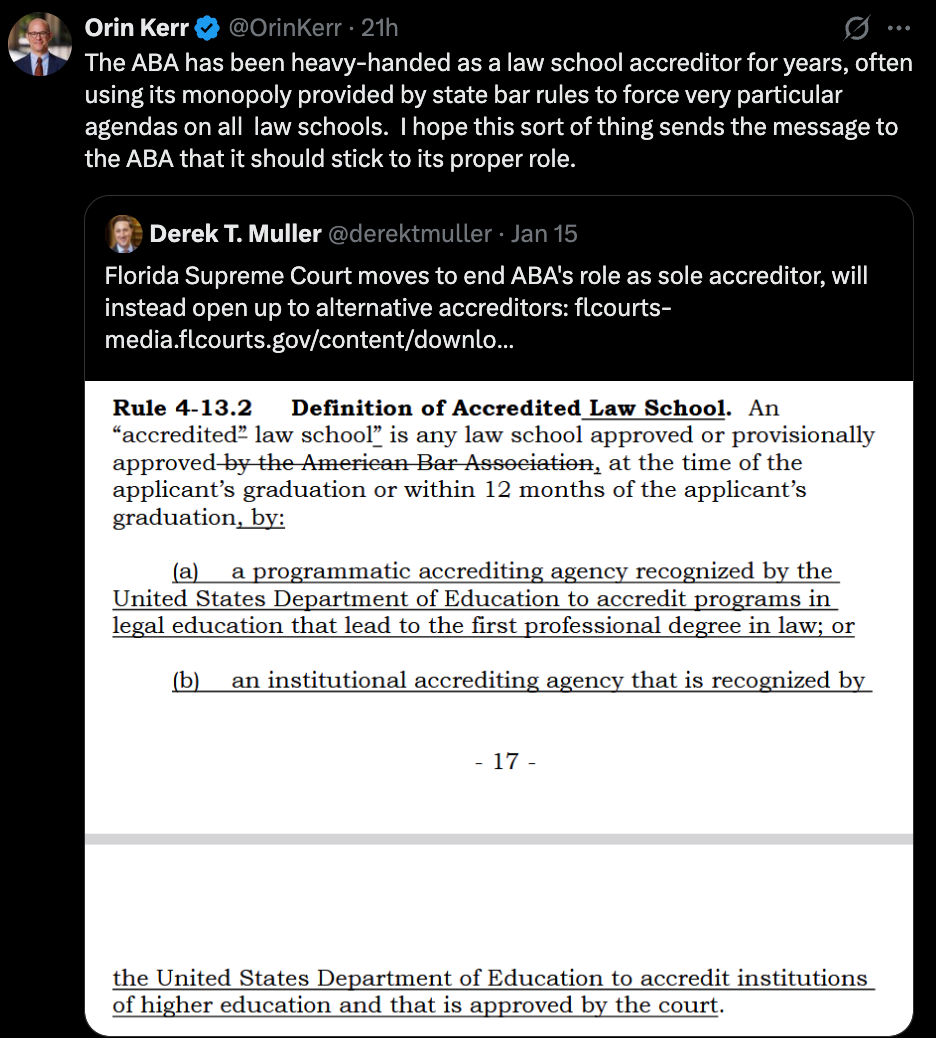
Florida
has
decided
that
the
American
Bar
Association
is
just
too
much.
Yesterday,
the
Florida
Supreme
Court
graciously
opened
the
door
to
alternative
law
school
accreditors
by
cutting
off
the
ABA
as
its
sole
accepted
accreditor
for
law
schools.
The
court
framed
this
as
a
bold
strike
for
institutional
freedom
and
not,
say,
an
effort
to
turn
public
legal
education
into
a
Heritage
Foundation
book
club.
According
to
the
court,
“The
Court’s
goal
is
to
promote
access
to
high-quality,
affordable
legal
education
in
law
schools
that
are
committed
to
the
free
exchange
of
ideas
and
to
the
principle
of
nondiscrimination.”
For
the
record,
the
GOP
interpretation
of
“free
exchange
of
ideas
and
to
the
principle
of
nondiscrimination”
in
law
schools
just
got
the
new
dean
of
Arkansas
fired
before
she
even
started,
so
take
this
per
curiam
pronouncement
from
a
collection
of
Republican
appointees
with
appropriate
levels
of
salt.
This
move
comes
hot
on
the
heels
of
Texas
pulling
the
same
stunt,
because
nothing
conveys
careful,
evidence-based
educational
policymaking
like
red
states
passing
around
the
anti-wokeness
bong
and
taking
rips.
In
a
Tweet,
Professor
Orin
Kerr
offered
a
much
more
charitable
reading
of
the
Florida
decision:
The
“particular
agendas”
that
the
ABA
pushed
—
which
at
this
point
are
all
but
abandoned
—
were
diversity
commitments.
Obviously,
there
are
people
who
think
diversity
training
is
an
objectionable
agenda.
We
call
those
people
“white
supremacists.”
But
the
ABA
recognized
a
diverse
legal
workforce
as
advantageous,
both
within
the
workplace
and
to
the
reality
of
a
diverse
client
base,
and
determined
that
credible
law
schools
should
operate
accordingly.
It’s
why
comments
like
“stick
to
its
proper
role”
miss
the
mark.
The
“proper
role”
of
an
accreditor
in
professional
education
is
to
make
sure
a
school’s
graduates
meet
the
demands
of
the
profession.
If
a
school
is
graduating
attorneys
unable
to
even
consider
unconscious
biases
doing
active
harm
to
their
clients,
that’s
a
professional
education
issue.
Were
the
specific
requirements
imposed
by
the
ABA
the
best
way
to
promote
diversity?
That’s
arguable.
But
Texas
and
Florida
aren’t
interested
in
that
debate,
they
object
to
the
idea
that
diversity
should
be
promoted
at
all.
If
anyone
thinks
this
break
will
lead
to
Texas
and
Florida
law
schools
becoming
more
committed
to
the
“free
exchange
of
ideas
and
to
the
principle
of
nondiscrimination,”
they
should
promptly
remove
their
heads
from
their
asses
before
causing
serious
colon
damage.
We
actually
know
the
trajectory
of
these
decisions
because
they’re
already
playing
out
in
these
states’
undergraduate
institutions.
Texas
A&M
just
canceled
a
philosophy
course
because
the
school
decided
Plato
was
too
woke.
“[T]he
Board
of
Regents
has
clarified
that
core
curriculum
courses,
which
includes
PHIL
111
Contemporary
Moral
Issues,
cannot
include
issues
related
to
race
ideology,
gender
ideology,
or
topics
related
to
sexual
orientation
or
gender
identity,”
the
professor
was
told.
They
banned
a
2400-year-old
text
because
they
felt
PLATO’s
views
on
gender
were
too
dangerously
contemporary.
Florida’s
future
isn’t
much
different.
The
New
College
of
Florida
became
that
state’s
guinea
pig
for
reworking
higher
education
along
the
sort
of
“free
exchange”
principles
its
supreme
court
writes
about
in
the
ABA
decision.
In
January
2023,
Governor
Ron
DeSantis
stuffed
the
board
with
conservative
politicians
and
right-wing
influencers
like
Christopher
Rufo
and
set
out
to
remake
the
curriculum.
Three
years
later,
spending
has
skyrocketed
and
rankings
have
plummeted.
The
school
has
dropped
nearly
60
spots
in
the
U.S.
News
rankings
—
from
76th
to
135th
—
while
spending
roughly
$134,000
per
student.
Retention
is
down.
Graduation
rates
are
down.
One
faculty
member
described
the
enrollment
situation
as
“kind
of
like
a
Ponzi
scheme:
Students
keep
leaving,
so
they
have
to
recruit
bigger
and
bigger
cohorts.”
Another
former
New
College
official
said
of
school
president
Richard
Corcoran’s
administration,
“academically,
Richard’s
running
a
Motel
6
on
a
Ritz-Carlton
budget.”
That’s
what
we’re
looking
at
as
these
states
break
from
the
ABA
and
seek
an
“alternative”
that
we
all
know
will
end
up
being
PragerU.
Just
like
the
Trump
Bible,
they’re
just
going
to
leave
the
Fourteenth
Amendment
section
out
of
Con
Law.
For
what
it’s
worth,
Florida
Justice
Jorge
Labarga
filed
a
dissenting
opinion,
noting
that
“the
ABA
has
developed
incomparable
expertise
in
the
accreditation
process,”
recognizing
that
ABA
standards
“provide
consumer
protections,
public
accountability
and
institutional
transparency
.
.
.
protecting
against
predatory
admissions
and
poor
programs
outcomes.”
He’s
the
lone
member
of
the
Florida
Supreme
Court
not
appointed
by
Ron
DeSantis.
It’s
tragic
for
the
talented
in-state
students
who
want
to
attend
a
quality
public
institution,
but
we
need
to
consider
how
other
states
respond
to
this.
At
what
point
do
degrees
from
these
ideologically
captured
institutions
stop
being
professionally
valid
for
licensing
purposes?
That
might
sound
extreme,
but
we’re
talking
about
an
accreditation
regime
that’s
hostile
to
Plato.
A
law
school
operating
under
restrictions
like
that
simply
isn’t
producing
graduates
that
should
fill
jurisdictions
with
a
lot
of
trust.
When
California
experimented
with
moving
away
from
the
bar
exam
monopoly,
people
kicked
and
screamed
about
it.
And
it
was
a
disaster,
imposed
upon
applicants
far
too
quickly.
Texas
and
Florida
have
embarked
into
much,
much
more
problematic
uncharted
waters
and
the
outcry
needs
to
be
a
lot
more
robust.
The
Justice
Department’s
hamfisted
effort
to
seize
control
of
state
voter
rolls
got
slapped
down
hard
this
week.
Twice.
The
DOJ’s
Civil
Rights
Division
demanded
extensive
voter
data
and
sued
23
states,
along
with
the
District
of
Columbia,
for
refusing
to
hand
it
over.
The
government’s
theory
is
that
allowing
ineligible
voters
to
cast
ballots
disenfranchises
eligible
voters
by
diluting
the
value
of
their
ballots.
And
the
only
solution
to
this
nonexistent
problem
is
for
states
to
hand
over
their
complete
voter
rolls,
let
the
federal
government
scrutinize
the
data,
and
tell
them
which
voters
to
delete.
Citing
state
privacy
laws,
most
states
agreed
to
provide
redacted
lists
only,
withholding
drivers
license
and
social
security
numbers.
But
this
was
insufficient
for
the
DOJ,
which
plans
to
build
a
nationwide
database
maintained
by
the
federal
government.
The
lawsuits
cite
the
National
Voter
Registration
Act,
which
orders
states
to
make
“a
reasonable
effort
to
remove
the
names
of
ineligible
voters
from
the
official
lists
of
eligible
voters”
and
“make
available
for
public
inspection
…
all
records
concerning
the
implementation
of
programs
conducted
for
the
purpose
of
ensuring
the
accuracy
and
currency
of
official
lists
of
eligible
voters.”
The
feds
read
this
as
requiring
disclosure
of
“the
current
electronic
copy
of
California’s
computerized
statewide
voter
registration
list,”
including
“all
fields
contained
within
the
list.”
Secondarily,
the
feds
rely
on
the
Civil
Rights
Act
of
1960
—
not
1964
—
in
which
Congress
ordered
registrars
to
keep
“all
records
and
papers
which
come
into
[their]
possession
relating
to
any
application,
registration,
payment
of
poll
tax,
or
other
act
requisite
to
voting”
and
make
them
available
for
“inspection,
reproduction,
and
copying”
by
the
Attorney
General
upon
presentation
of
a
demand
stating
the
basis
for
the
request.
Using
a
law
specifically
designed
to
stop
states
from
disenfranchising
Black
citizens
to
carry
out
a
nationwide
voter
purge
might
make
some
lawyers
a
bit
queasy.
But
not
Harmeet
Dhillon!
The
president’s
former
personal
attorney
is
currently
suing
multiple
states
for
“violating”
Title
IX
by
letting
trans
girls
play
sports.
Dhillon
actually
told
the
Wall
Street
Journal
that
she
“begins
her
workday
scrolling
through
X,
searching
for
claims
of
discrimination,”
after
which
“I
text
my
deputies,
and
we
assign
cases,
and
we
get
cranking.”
This
woman
will
not
be
shamed!
The
first
court
to
rule
was
the
District
of
Oregon,
where
Judge
Mustafa
Kasubhai
said
on
the
bench
Wednesday
that
he
will
almost
certainly
dismiss
the
DOJ’s
claim
for
exceeding
the
language
of
the
NVRA
and
CRA.
PBS
reports
that
the
DOJ
cited
Oregon’s
high
percentage
of
registered
voters
as
a
potential
sign
of
failure
to
remove
ineligible
voters.
But
the
court
demurred:
“I’m
very
cautious
and
doubtful
that
what
you’re
asking
for,
which
is
an
unredacted
list,
is
actually
going
to
give
you
the
information
that
you
need
to
establish
a
violation.”
Judge
Kasubhai
has
yet
to
issue
a
written
ruling,
but
Judge
David
Carter
of
the
Central
District
of
California
beat
him
to
the
punch.
The
81-year-old
jurist
got
a
Bronze
Star
in
Vietnam,
became
a
state
court
judge
in
1981,
joined
the
federal
bench
in
1998,
and
is
out
of
fucks
to
give.
Warning
that
“democracy
can
be
lost
in
a
generation,”
he
lambasted
the
executive
branch
for
seizing
power
over
local
elections
which
the
Constitution
specifically
vests
in
Congress
and
the
states.
“There
cannot
be
unbridled
consolidation
of
all
elections
power
in
the
Executive
without
action
from
Congress
and
public
debate,”
he
wrote.
“This
is
antithetical
to
the
promise
of
fair
and
free
elections
our
country
promises
and
the
franchise
that
civil
rights
leaders
fought
and
died
for.”
“The
taking
of
democracy
does
not
occur
in
one
fell
swoop;
it
is
chipped
away
piece-by-piece
until
there
is
nothing
left,”
he
concluded
ominously.
“The
case
before
the
Court
is
one
of
these
cuts
that
imperils
all
Americans.”
Judge
Carter
dismissed
the
case
in
its
entirety,
and
two
hours
later
the
DOJ
noticed
its
appeal.
Sure,
the
Civil
Rights
Division
is
bleeding
lawyers
and
hundreds
of
staff
have
been
taken
offline
to
review
the
Epstein
Files.
But
when
it
comes
to
chipping
away
at
democracy,
they’ll
make
the
time.
After
a
two-year
search,
the
University
of
Arkansas
at
Fayetteville
found
its
new
law
school
dean.
Then,
a
week
later,
it
unfound
her.
Emily
Suski,
a
professor
and
associate
dean
at
the
University
of
South
Carolina’s
law
school,
was
announced
as
the
new
dean
of
the
law
school
on
January
9.
By
January
14,
the
university
had
“decided
to
go
a
different
direction
in
filling
the
vacancy”
based
on
“feedback
from
key
external
stakeholders
about
the
fit
between
Professor
Suski
and
the
university’s
vacancy.”
By
“key
external
stakeholders,”
the
school
means
conservative
politicians
seeking
cheap
headlines.
Because
the
professor
signed
onto
an
amici
brief
in
the
Idaho
and
West
Virginia
trans
student
sports
ban
cases
heard
by
the
Supreme
Court
this
week
and
with
that
story
dominating
the
news,
right-wing
lawmakers
saw
an
opportunity
to
score
points
by
torpedoing
the
law
school’s
new
dean.
The
brief
in
question,
prepared
by
Keker,
Van
Nest
&
Peters
and
Suzanne
B.
Goldberg,
the
director
of
Columbia
Law’s
Sexuality
and
Gender
Law
Clinic,
isn’t
particularly
controversial.
It
doesn’t
even
wade
into
the
Equal
Protection
issues
in
these
cases,
limiting
its
inquiry
to
the
West
Virginia
half
of
the
case,
noting
that
Title
IX
—
by
its
text
and
existing
caselaw
—
should
protect
the
student
involved
because
the
record
is
undisputed
that
they
have
not
undergone
puberty
and
are
already
undergoing
female
hormonal
puberty
treatment,
meaning
any
attempt
to
force
them
into
male
sports
puts
the
student
at
a
competitive
disadvantage
on
the
basis
of
sex.
This
involved
too
much
reading
for
the
professional
grievance
industry.
There’s
no
way
the
people
of
Arkansas
want
somebody
running
and
educating
our
next
generation
of
lawyers
and
judges
[to
be]
someone
that
doesn’t
understand
the
difference
between
a
man
and
a
woman.
This
was,
of
course,
not
the
argument
in
the
brief.
But
it
does
play
to
the
Republican
fascination
with
kids’
genitals
that
continues
to
deliver
them
votes
from
the
sort
of
people
asking
Grok
to
strip
pictures
of
teen
actresses.
Alas,
as
the
Trump
administration
has
clarified,
using
AI
to
create
child
sexually
explicit
material
is
a
national
free
speech
concern
and
a
kid
joining
the
“wrong”
bowling
team
is
a
grave
concern.
Hester
also
said
he
was
“surprised
that
this
person
who
has
these
beliefs
made
it
through
the
initial
scanning
processes,”
a
telling
confession
that
Republican
lawmakers
believe
the
hiring
process
should
focus
on
theocratic
wrongthink.
The
amicus
brief
isn’t
about
“beliefs,”
it’s
about
the
legal
significance
of
puberty
in
competitive
sports
and
that,
while
male
puberty
is
the
inflection
point
that
gives
male
athletes
competitive
advantages,
all
the
parties
in
the
case
agree
that
the
student
involved
has
not
and
will
never
undergo
male
puberty.
Look,
I’m
not
going
to
pretend
law
schools
shouldn’t
consider
a
candidate’s
past
work.
If
a
candidate
for
the
job
has
a
long
history
of
posting
racial
slurs
or
something
like
that,
it
matters.
But
it
doesn’t
matter
because
that’s
the
candidate’s
beliefs,
it
matters
because
it
suggests
the
candidate
will
act
in
a
manner
that
bring
illegal
discrimination
and
a
hostile
environment
into
the
institution.
There’s
nothing
about
a
brief
outlining
Title
IX
law
and
puberty
that’s
going
to
impact
the
law
school.
Hester
insisted
he
didn’t
threaten
funding,
but
added
that
“there’s
just
a
basic
understanding
that
the
legislature
controls
the
purse
strings.”
Very
cool.
Very
not
extortion.
Governor
Sarah
Huckabee
Sanders’s
office
took
a
break
from
assuring
us
that
the
children
yearn
for
the
mines
to
praise
the
university
for
“reaching
the
commonsense
decision
on
this
matter
in
the
best
interests
of
students.”
Attorney
General
Tim
Griffin
—
who
definitely
didn’t
request
she
be
fired,
his
office
assures
us
—
“applauds
the
decision
nonetheless.”
He
just
“expressed
his
dismay
at
the
selection
and
his
confidence
that
many
more
qualified
candidates
could
have
been
identified.”
More
qualified
candidates?
They
searched
for
TWO
YEARS!
Arkansas,
this
may
be
tough
to
hear,
but…
maybe
the
problem
is
you.
If
state
officials
can
threaten
to
cut
funding
because
they
dislike
a
professor’s
legal
analysis,
then
no
public
employee
in
Arkansas
is
safe
to
speak
freely.
Under
this
logic,
any
public
worker
could
be
punished
for
expressing
a
belief
unless
it
has
first
been
approved
by
politicians.
That
is
not
governance
—
it
is
ideological
control.
That
is
their
goal.
Conservatives
nab
every
opportunity
to
warn
that
the
woke
mob
would
end
academic
freedom.
Then
they
ended
academic
freedom.
Every
accusation
is
a
confession.
All
that
whining
whenever
a
law
professor
is
chastised
for
using
racial
slurs
or
students
peacefully
protest
a
hate
group,
it’s
just
to
set
the
stage
for
their
more
robust
assault.
Refusing
to
tolerate
illegal
discriminatory
behavior
(at
least
illegal
on
paper
until
this
Supreme
Court
says
otherwise)
is
not
the
same
as
firing
someone
for
making
straightforward
legal
analysis
in
a
brief.
To
use
a
poster
child
of
this
right-wing
whinging,
Amy
Wax
wasn’t
disciplined
for
making
arguments
about
labor
law,
she
was
disciplined
for
bad-mouthing
minority
students.
But
these
folks
spent
years
blurring
the
distinctions
so
they
could
some
day
fire
a
professor
just
for
recognizing
that
anti-discrimination
laws
are
real.
As
State
Representative
Nicole
Clowney
put
it:
“Veiled
threats
and
comments
behind
closed
doors
about
the
political
leanings
of
University
of
Arkansas
faculty
and
staff
are
nothing
new,
sadly.
But
state
elected
officials
threatening
to
withhold
funding
to
the
entire
School
based
on
the
political
beliefs
of
the
newly
hired
Dean
is
a
new,
terrifying
low.”
We
have
some
unfortunate
news
to
report
out
of
Washington,
D.C.,
where
one
of
the
founding
partners
of
well-known
midsize
firm
Beveridge
&
Diamond
recently passed
away.
More
than
50
years
ago,
Albert
Beveridge
III,
90,
founded
the
firm
now
known
as
Beveridge
&
Diamond,
with
two
of
his
childhood
friends
from
Indiana,
the
late
attorneys
William
Ruckelshaus
and
Richard
Fairbanks.
The
trio
later
brought
on
Henry
Diamond,
and
from
then
on,
the
firm
began
to
flourish
into
one
of
the
nation’s
most
prominent
the
environmental
law
and
litigation
practices.
Beveridge
&
Diamond
now
has
more
than
175
lawyers
and
seven
offices
across
the
country.
The
firm
offered
the
following
statement
on
Beveridge’s
passing
to
the
National
Law
Journal:
“Albert
fueled
Beveridge
&
Diamond’s
early
success,
counseling
clients
on
high-stakes
corporate
transactions
and
strategic
matters,
and
nurtured
a
firm
culture
grounded
in
intellectual
curiosity,
collegiality
and
public
service.”
Beveridge,
a
Harvard
Law
graduate,
continued
to
serve
the
firm
as
Senior
Counsel
until
his
death,
and
was
often
called
upon
to
give
historical
lessons
about
environmental
law,
as
well
as
the
firm’s
origins.
We
here
at
Above
the
Law
would
like
to
extend
our
condolences
to
Albert
Beveridge’s
family,
friends,
and
colleagues
during
this
difficult
time.
Staci
Zaretsky is
the
managing
editor
of
Above
the
Law,
where
she’s
worked
since
2011.
She’d
love
to
hear
from
you,
so
please
feel
free
to email her
with
any
tips,
questions,
comments,
or
critiques.
You
can
follow
her
on Bluesky, X/Twitter,
and Threads, or
connect
with
her
on LinkedIn.
It’s
early
2027.
Most
law
firms
and
in-house
legal
departments
are
rapidly
moving
to
OpenAI
Legal
which
launched
in
the
third
quarter
of
2026.
Most
of
them
cite
cost
since
OpenAI
Legal
is
still
just
$20
per
month.
They
are
also
confident
that
OpenAI
has
addressed
privacy
and
confidentiality
concerns,
and
that
its
new
automatic
cite-checking
ability
can
accurately
verify
all
outputs.
What’s
remarkable
about
the
shift
is
not
so
much
that
it
happened
but
the
speed
at
which
the
transition
was
made.
This
Is
Commoditization
The
above
hypothetical
is
what
happens
when
a
product
becomes
commoditized,
which
happens
often.
A
commoditized
product
is
one
that
has
become
so
commonplace
and
interchangeable
that
it
loses
its
uniqueness.
And
when
that
happens,
it
also
loses
its
pricing
power.
Why?
Once
commoditization
occurs,
users
see
little
meaningful
difference
between
the
various
vendor
options
other
than
price.
So,
sellers
can’t
charge
a
premium
for
what
they
provide,
particularly
when
the
lower
cost
option
provides
roughly
the
same
features,
quality,
and
performance.
Some
examples
include
things
like
economy
seats
on
airlines:
most
customers
shop
based
on
price
and
the
difference
in
service
is
relatively
small.
Another
example
is
cloud
storage
which
is
now
an
expected
feature
—
providers
are
interchangeable,
and
the
market
is
price-driven.
Commoditization
shows
up
in
legal
tech
if
tools
that
once
felt
novel
become
expected
infrastructure.
At
that
point,
lawyers
stop
asking
“what
does
this
do?”
and
start
asking
“why
does
this
cost
more
than
the
other
one?”
If
it
happens
to
GenAI,
it
will
have
direct
impact
on
legal
tech
vendors
whose
products
are
based
on
GenAI.
And
their
customers.
Indeed,
a
pretty
big
tech
player
may
be
betting
that
this
may
soon
happen
with
GenAI.
As
Chance
Miller
noted
in
a
recent
episode
of
the
daily
9to5
Daily,
citing
a
report
in
The
Information
by
Aaron
Tilley,
the
potential
for
commoditization
may
be
why
Apple
is
proceeding
cautiously
with
developing
its
own
GenAI
tools
and
it
could
foreshadow
what
may
happen
in
legal.
Tilley
says
(emphasis
added):
Apple
still
has
a
team
working
on
its
own
internal
models
that
it
could
take
advantage
of
in
the
future.
But
some
Apple
leaders
hold
the
view
that
large
language
models
will
become
commodities
in
the
years
to
come
and
that
spending
a
fortune
now
on
its
own
models
doesn’t
make
sense.
Here’s
what
Miller
concludes:
“If
Apple
leadership
truly
does
believe
LLMs
will
become
commodities,
then
the
company’s
AI
success
will
depend
less
on
bespoke
new
models,
and
more
on
its
ability
to
control
the
hardware,
software,
and
services
that
AI
runs
on.”
Commoditization
of
Legal
GenAI
Thus
far,
legal
GenAI
vendors
have
faced
little
competition
from
outside
the
legal
community.
But
what
would
happen
if,
say,
OpenAI
decided
to
target
the
legal
market
and
release
general
tools
offering
the
strong
privacy
protections,
enhanced
accuracy,
and
stronger
security
lawyers
and
legal
professionals
crave?
If
this
were
to
occur,
other
players
like
Google,
Anthropic,
and
Perplexity
might
follow.
The
greater
market
power
of
these
companies
could
shift
the
legal
GenAI
market
towards
commoditization,
where
price
becomes
the
primarily
criterion.
It
was
just
this
kind
of
thing
I
mentioned
in
my
post
about
a
Business
Insider
interview
of
the
founders
of
Harvey,
Winston
Weinberg
and
Gabe
Pereyra,
back
in
October.
At
that
point
I
noted
their
statements
to
the
effect
that
they
were
less
concerned
about
legal
tech
vendors
and
more
about
competition
from
OpenAI
itself.
Somewhat
candidly,
they
admit
that
OpenAI
could
enter
the
legal
tech
space
directly
and
cut
out
the
middleman
legal
tech
vendors.
These
statements
prompted
me
to
observe:
“[Weinberg
and
Pereyra]
admit
that
OpenAI
could
enter
the
legal
tech
space
directly
and
cut
out
the
middleman
legal
tech
vendors.
Moreover,
even
if
OpenAI
never
targets
the
legal
field
directly,
it
very
well
could
release
general
tools
offering
the
strong
privacy
protections,
enhanced
accuracy,
and
stronger
security
lawyers
and
legal
professionals
crave.
In
fact,
OpenAI recently
mentioned a
contract
review
tool
it
developed
and
is
using
internally.”
Today’s
Legal
AI
Marketplace
Today,
there
is
a
plethora
of
vendors
offering
all
sorts
of
GenAI
tools
at
a
fairly
high
price.
Their
argument
is
that
legal
is
a
specialized
market
due
to
a)
the
ethical
and
privacy
concerns
and
b)
the
need
for
accuracy.
They
go
on
to
say
that
only
they
can
offer
the
protections
the
specialized
market
requires
and
that
open
or
public
systems
like
ChatGPT,
Gemini,
Perplexity,
or
Claude
simply
can’t
meet
legal
demands.
Some
even
go
so
far
as
to
say
it’s
malpractice
to
use
the
open
systems.
And
when
it
comes
to
legal
research,
vendors
explain
that
only
they
have
the
data
to
make
the
systems
work
accurately
and
that
this
moat
protects
them.
But
the
moat
is
not
foolproof.
The
vendor
argument
ignores
that
the
moat-protected
legal
research
is
only
part
of
overall
legal
needs.
Moreover,
much
of
the
data
also
exists
within
client
databases
that
are
not
protected.
More
importantly,
big
players
like
Google
and
OpenAI
or
any
of
the
other
large
players
could
simply
license
or
acquire
the
data
themselves,
spreading
those
costs
across
far
more
customers
while
still
undercutting
specialized
vendors
on
price.
Also,
ignoring
for
the
moment
that
their
GenAI
tools
are
also
capable
of
making
mistakes
and
making
stuff
up,
a
characteristic
of
LLMs
that
is
intractable,
legal
tech
vendors
assume
that
just
because
the
open
systems
haven’t
made
the
case
that
their
products
can
meet
legal’s
requirements,
they
won’t.
Indeed,
many
of
the
vendor
products
depend
in
part
on
those
open
systems’
platforms
to
make
their
products
function.
And
OpenAI
at
least
is
an
investor
in
legal
vendors
like
Harvey.
And
as
far
as
the
hallucination
and
inaccuracy
problem
goes,
we
are
already
seeing
vendors
like
Clearbrief
offering
solutions
to
the
hallucination
problem
with
tools
that
automatically
verify
LLM
outputs
primarily
with
non-GenAI
tools.
That
potentially
solves
the
cost
of
verification
problem.
What
if
OpenAI
decided
to
do
the
same?
A
Reality
for
Legal
Could
GenAI
legal
tools
become
commoditized?
The
short
answer
is
yes.
The
open
GenAI
providers
have
vast
resources
and
capabilities.
There
is
little
to
stop
them
from
offering
the
privacy
and
confidentiality
protections
that
lawyers
demand.
There
is
little
to
prevent
them
from
offering
tools
like
that
being
offered
by
Clearbrief.
And
if
they
put
their
minds
to
it,
they
could
provide
many
of
the
same
tools
the
legal
tech
vendors
who
trumpet
their
uniqueness
do
now.
And
if
that
happens,
the
legal
GenAI
vendors
could
lose
their
uniqueness
and
pricing
power.
The
big
GenAI
players
would
be
forced
to
compete
primarily
on
price.
Legal
tech
vendors
may
not
be
able
to
legitimately
compete
on
that
basis:
they
have
neither
the
financial
staying
power
nor
resources.
The
bigger
players
can
spread
costs
across
many
more
customers,
legal
and
non-legal,
can
bundle
features
into
larger
platforms,
and
absorb
margin
pressure
longer
than
the
smaller
legal
vendors.
And
let’s
not
forget
many
lawyers
already
used
the
open
tools
to
do
all
sorts
of
things,
so
transitioning
to
relying
on
them
for
everything
would
be
neither
difficult
nor
time-consuming.
Thus
far,
the
open
GenAI
providers
have
been
content,
like
Microsoft,
to
merely
offer
their
tools
to
the
legal
tech
vendors
as
wrappers.
But
that
doesn’t
mean
the
open
systems
won’t
decide
to
compete
directly.
So,
What’s
Legal
to
Do?
It
would
be
easy
for
law
firms
to
just
throw
up
their
hands
and
just
ignore
the
commoditization
potential.
But
that’s
not
necessarily
correct.
In
fact,
law
firms
and
in-house
departments
can
do
some
things
to
better
prepare
for
what
may
be
the
inevitable
commoditization
of
GenAI
tools.
But
law
firms
typically
ignore
what’s
developing
in
the
tech
market
until
it
already
happens.
By
doing
so,
they
risk
waking
up
one
morning
locked
into
a
bunch
of
overpriced
technology
when
there
are
just
as
good
and
cheaper
products
suddenly
available.
Firms
can
avoid
this
by
paying
attention
to
what
is
going
on
in
the
marketplace
and
what
vendors
are
doing.
Indeed,
the
best
strategy
right
now
may
be
to
keep
their
powder
dry.
To
pay
attention
to
the
marketplace.
To
regularly
review
and
monitor
their
tech
stack
and
tech
contractual
commitments.
To
avoid
long-term
contractual
commitments
that
lock
them
in.
To
look
hard
at
things
like
termination
rights
and
obligations.
And
to
make
sure
they
have
an
exit
strategy
should
things
quickly
change.
Stephen
Embry
is
a
lawyer,
speaker,
blogger,
and
writer.
He
publishes TechLaw
Crossroads,
a
blog
devoted
to
the
examination
of
the
tension
between
technology,
the
law,
and
the
practice
of
law.