Are Judicial Clerkships A Hazard, Or Is There A Clerkship for Everybody? – Above the Law

Soon
after
I
launched

The
Legal
Accountability
Project

(LAP),
I
met
with
a
Washington
University
in
St.
Louis
School
of
Law
(WashU
Law)
professor
to
talk
about
LAP’s
work.
There’s
no
love
lost
between
me
and
my
alma
mater:
after
I
was
harassed
and
fired
from
my
clerkship,
I
learned
WashU
Law
administrators
and
professors
knew
the
judge
who
harassed
me
had
harassed
another
alum
a
few
years
earlier

but
chose
not
to
share
that
with
me
before
I
accepted
the
clerkship.
I
could
have
gotten
over
that,
but
for
the
fact
that
three
separate

deans

subsequently
told
me
they
“don’t
believe”
I
was
mistreated
by
the
judge
I
worked
for.
And
the
law
school
cancelled

four

LAP
events
in
just
three
years,
including
one
with
another
alumnus
who’s
a
federal
judge.
So,
it
was
unsurprising
that
this
professor
said:
“You
seem
to
think
clerkships
are
a
hazard,
whereas
I
think
there’s
a
clerkship
for
everybody.”

That
framing
stuck
with
me
as
LAP
struggled
to
convinced
law
schools
to
subscribe
to
our
Clerkships
Database
(“Glassdoor
for
Judges”).
Some
even

tried
to
bar
students
from
subscribing
.
Before
LAP
launched
the

Clerkships
Database


serving

thousands
of
students
annually
while

collecting
data

on
the
incidence
of
negative
versus
positive
clerkship
experiences

school
administrators
framed
LAP
as

“dissuading”
students

from
clerking.  

Not
exactly.
I
encourage
students
to
be
mindful
of
who
they
clerk
for
and
to
be
empowered
consumers
of
clerkship
information,
in
ways
they
historically
were
not.
I
discourage
applicants
from
clerking
for

abusive
judges
.
It’s
disturbing
that

schools
refuse
to

warn
students
about
abusive
judges,
and
all
but
two
refuse
to
subscribe
to
LAP’s
database

showing
how
little
they
care
about
students’
well-being,
and
forcing
students
to
pay
individually.
Fortunately,
students
no
longer
rely
solely
on
their
schools
for
information,
as
long
as
they
pay
$50

to
subscribe
to
LAP’s
database

Once

LAP
launched
the
Clerkships
Database
in
April
2024
,
applicants
finally
saw
for
themselves
just
how
hazardous
some
clerkships
are,
firsthand
from
clerks.
Our
data
suggest
around

30%

of
clerkship
experiences
are
negative,
based
on
over
2,000
surveys
about
more
than
1,200
judges
and
information
from
every
state,
federal
circuit,
and
U.S.
district
court. 

Our
data
also
indicate
that
around
1
in
17
federal
judges
are
abusive,
which
aligns
with
the

federal
judiciary’s

own
data
:
as
many
as
106
judges
(out
of
around
1,700)
committed
actionable
misconduct
by
mistreating
clerks
in
2023,

according
to
a
climate
survey

released
earlier
this
year.
I
shared
that
statistic
with
around
30
students
at
a
LAP
event:
statistically,

at
least
one
or
two
in
this
room
will
endure
abusive
clerkships
.
Let
that
sink
in. 

It’s
no
surprise
so
many
judges
abuse
their
power:
judicial
chambers
are

particularly
conducive
to
mistreatment
.
There’s
an

enormous

power
disparity
between
young
law
clerks
and
life-tenured
judges.
Importantly,
federal
clerks
are

exempt
from
Title
VII
of
the
Civil
Rights
Act
of
1964

and
all
federal
anti-discrimination
laws:
if
they
are
harassed,
discriminated
against,
unjustly
fired,
or
retaliated
against
(or
all
of
the
above,

in
my
case
),
they
cannot
sue
to
seek
redress.
Law
clerks
basically
have
no
rights,
and
judges
have
legal
immunity
for
harassing
them. 

Title
VII
can
seem
abstract.
Here’s
the
reality:
laws
deter
bad
behavior.
Workers
don’t
harass
their
co-workers
(or,
less
often
than
they
otherwise
might),
if
for
no
other
reason
than

they
don’t
want
to
get
sued
.

Title
VII

puts
the

onus
on
the
employer
,
if
an
employee
complains
about
harassment,
to
investigate,
address
the
problem,
and
discipline
the
offender:
otherwise,
the
wronged
employee
can
sue
for
damages.
Exempting
an
entire
branch
of
government
means
federal
judges
do
not
face
this

deterrent


there’s
literally

nothing

legally
preventing
or
dissuading
them
from
mistreating
staff. 

This
is
compounded
by
the
fact
that
there
are

no
effective
reporting
processes
,
complaint
mechanisms,
or

other
avenues
to
seek
help
.
Clerks
rarely
use
the
formal
or
internal
complaint
processes

the

Judicial
Conduct
&
Disability
(JC&D)
Act

and
the

Employee
Dispute
Resolution
(EDR)
Plan
.

Juxtapose

the
judiciary’s
2023
climate
survey
with

complaint

statistics
from
that
period:


just
three

JC&D
complaints

in
2023,
and


just
seven

EDR
complaints

between
2021
and
2023,
were
filed
by
law
clerks,
due
primarily
to
clerks’
fears
of
retaliation
for
reporting

retaliation
they’re

not
legally
protected
against
,
since
they’re
exempt
from
Title
VII.
This
means
judges
are
rarely
held
accountable
for
misconduct.
Students
should
do

everything
possible

to
avoid
abusive
clerkships,
because
the

outcomes
for
mistreated
clerks
are
bleak
.  

Consider
three
recent
examples
that
made
news

representing
a

miniscule
fraction

of
judicial
misconduct: 


Second
Circuit
Judge

Sarah
Merriam

was

disciplined
and
publicly
reprimanded

in
December
2023
for
creating
an
“overly
harsh
work
environment.”
In
July
2024,
former
Alaska
judge


Joshua
Kindred

resigned
in
scandal
,
after
a
Ninth
Circuit
Judicial
Council
found
that
he
sexually
harassed
and
retaliated
against
clerks.
Kindred
was

recently
disbarred
.
And
former
Minnesota
federal
bankruptcy
judge


Kesha
Tanabe

resigned

in
scandal
in
early
2025
after
bullying
and
retaliating
against
clerks.
That
case
never
would
have
made
news

and
Tanabe
would
have
evaded
accountability,
after
the
Eighth
Circuit
tried
to
protect
her
by
pressuring
a
law
clerk
to
withdraw
their
JC&D
complaint

but
for
my

Above
the
Law
article
.
These
examples

just
a
fraction
of
what
comes
over
my
transom
at
LAP

should
tell
you
how
seriously
the
federal
courts
take
accountability
and
safe
workplaces
(not
at
all);
how
effective
judicial
complaint
processes
and
discipline
are
at
preventing
and
addressing
misconduct
(not
at
all);
and
the
importance
of
selecting
a
clerkship
based
on
the
judge’s
management
style
and
workplace
conduct
(all-important). 

Not
all
clerkships
are
hazardous.
But
as
someone
who

does
this
for
a
living
,
far
more
are
treacherous
than
anyone
else
would
admit.
Even
most
mistreated
clerks
never
tell
anyone
they
were
mistreated:
they’ve
only
shared
in
LAP’s
Clerkships
Database. 

Law
schools
and
legal
industry
leaders
paint
an
overly
rosy
and
one-sided
picture
of
clerking

often

while
knowing
realities
they
won’t
admit


misleading
students
to
believe
clerkships
confer
only
professional
benefits,
and
they’ll
develop
a
lifelong
mentor/mentee
or
“familial”
relationship
with
the
judges
they
clerk
for.
Clerks
refer
to
judges
fondly,
years
later,
as
my
judge

(sometimes
even
after
they
were
mistreated)

a
term
of
affection
that
lionizes
judges
unnecessarily
and
contributes
to
the
dangerous
perception
that
judges’
workplace
conduct
should
not
be
questioned,
no
matter
how
unethical.
But
this
may
be
the

exception
,
not
the
rule.
In
reality,
most
clerkships
are
jobs
like
any
other:
you’ll
work
for
a
year
or
two
to
check
a
box
before
advancing
in
your
career.
Creating
unrealistic
expectations
sets
clerks
up
to
fail.
Clerks
take
desperate
measures
to
force
a
bond,
including
“nonjudicial
tasks”
like
fetching
judges’
dry
cleaning,
tutoring
their
children,
and
walking
their
dogs.
They
self-internalize
failure,
thinking

they

did
something
wrong,
if
those
relationships
don’t
materialize.

I
don’t
believe
there’s
a
clerkship
for

everybody
.
Not
everyone
should
clerk.
If
the
choice
is
between
an
abusive
clerkship
and
no
clerkship
at
all

don’t
clerk.
Ask

why

you
want
to
clerk
and
what
your
goals
are.
At
the
same
time,
no
one
who
wants
to
clerk
should
count
themselves
out.
In
fact,
LAP’s
database
fosters
greater
equity
by
ensuring
any
applicant,
regardless
of
law
school,
can
pay
$50
to
access
the
same
baseline
information
about
clerkships

rather
than
the
pre-LAP
status
quo,
which
restricted
access
to
just
a
handful
of
students
from
top
law
schools. 


What
are
the
right
questions
to
ask
yourself
before
clerking?

  1. Why
    do
    I
    want
    to
    clerk? 
  2. What
    are
    my
    goals
    for
    the
    clerkship? 
  3. Where
    do
    I
    want
    to
    live
    after
    my
    clerkship,
    and
    will
    this
    clerkship
    help
    me
    get
    a
    job
    in
    this
    jurisdiction? 
  4. What
    type
    of
    law
    do
    I
    want
    to
    practice,
    and
    will
    this
    clerkship
    help
    me
    hone
    the
    right
    skills
    and
    get
    a
    job
    in
    my
    chosen
    field?
  5. What
    kind
    of
    work
    environment
    am
    I
    looking
    for? 
  6. How
    do
    I
    like
    to
    be
    supervised
    and
    receive
    feedback?
  7. When
    do
    I
    want
    to
    clerk

    straight
    out
    of
    law
    school,
    or
    can
    I
    wait
    for
    a
    few
    years?
    If
    I
    wait,
    how
    will
    I
    fill
    those
    gap
    year(s)
    before
    my
    clerkship
    begins?
  8. How
    far
    am
    I
    willing
    to
    move
    to
    clerk?
    Where
    am
    I
    willing
    to
    live
    for
    a
    year
    or
    two?

There’s
nothing
wrong
with
clerking
for
the
credential,
rather
than
(or
in
addition
to)
seeking
writing
and
research
experience,
litigation
or
appellate
training,
and
insight
into
judges’
decision-making

as
long
as
you
don’t
accept
an

abusive

clerkship
for
the
prestige.
There
is
a

wrong

question
to
ask:

What
am
I
willing
to
put
up
with
to
clerk?

Given
the
scarcity
of
federal
jobs
right
now,
some
will
still
ask.
If
everyone
applying
for
clerkships
subscribed
to
LAP’s
Clerkships
Database,
far
fewer
would
endure
mistreatment,
because
they’d
truly
understanding
just
how
awful
some
clerkships
are.
Frankly,
knowing
the
trash
law
schools
provide,
I
worry
about
students
who
haven’t
subscribed.

Where
are
they
getting
information,
if
not
from
LAP,
and
how
do
they
verify
it?
 

Sadly,
some
will
say,
“I
can
handle
it,”
or
“It’s
worth
it
for
the
prestige.”
Still
others
think
it
won’t
happen
to
them.
But
I’ve
counseled
hundreds
of
mistreated
clerks:
they
all
said
if
they
knew
how
bad
it
would
be,
they
wouldn’t
have
accepted
the
clerkship.
Frankly,
my
experience
is
not
rare:
it’s
just
one
that’s
rarely
shared
publicly,
due
to
the
culture
of
silence
and
fear
surrounding
the
judiciary

one
of
deifying
judges
and
disbelieving
law
clerks.
To
put
it
bluntly:
if
you’re
applying
for
clerkships
and
you
choose

not

to
take
agency
over
your
career
by

fully
informing
yourself
,
you’re
taking
an

enormous

career
risk,
given
the
outsized
influence
of
clerkships

a
career
you
sacrificed
three
years
and
hundreds
of
thousands
of
dollars
to
build. 

Some
people
misleading
students
to
believe
there’s
a
clerkship
for
everybody
have
misaligned
incentives
and
questionable
motives:

they
want
as
many
students
as
possible
to
clerk
,
for
example.
Others
just
lack
frame
of
reference:
clerks
don’t
regularly
share
negative
experiences
with
them,
or
their
clerkships
were
wonderful
so
they
don’t
understand
how
others’
couldn’t
be.
But
the
judiciary’s
and
LAP’s
data
both
suggest
that
for
every
17
students
applying
for
federal
clerkships,
one
will
be
mistreated.
That’s
a
lot
of
destroyed
lives
and
careers.
Maybe
it’s
time
lawyers
were
honest
about
the
realities
inherent
in

workplaces
exempt

from
workplace
laws. 


Aliza
Shatzman
is
the
President
and
Founder
of 
The
Legal
Accountability
Project
,
a
nonprofit
aimed
at
ensuring
that
law
clerks
have
positive
clerkship
experiences,
while
extending
support
and
resources
to
those
who
do
not.
She
regularly
writes
and
speaks
about
judicial
accountability
and
clerkships.
Reach
out
to
her
via
email
at 
[email protected] and
follow
her
on
Twitter
@AlizaShatzman.

Merged No More: Global Biglaw Firm Set To Split Up Come Spring 2026 – Above the Law


Ed.
note
:
Welcome
to
our
daily
feature,

Quote
of
the
Day
.


This
development
reflects
the
different
strategic
horizons
of
our
firms.
We
thank
the
Australian
firm
for
the
years
of
teamwork
and
partnership.
We
sincerely
appreciate
the
long-term
support
and
trust
shown
by
our
clients.
We
will
continue
to
put
clients
first
while
striving
for
excellence
in
everything
we
do.
We
remain
committed
to
our
international
strategy
and
will
continue
to
expand
our
geographic
coverage
through
both
organic
growth
and
collaboration
with
other
leading
firms
globally.
King
&
Wood’s
Hong
Kong
office,
the
largest
law
firm
in
Hong
Kong
by
number
of
lawyers,
will
continue
to
take
on
a
strategic
role
in
this
effort.
-WJ


We
thank
the
partners
and
colleagues
of
KWM
China
for
their
professionalism,
collegiality
and
friendship
over
the
past
14
years.
Mallesons
is
a
trusted
and
respected
brand
with
nearly
two
centuries
of
legal
excellence
and
50
years
of
international
experience
and
relationships.
We
will
continue
to
build
on
this
proud
legacy
as
we
become
the
only
top
tier
independent
firm
operating
from
Australia
with
the
flexibility
to
collaborate
more
broadly
with
global
elite
firms
to
meet
the
needs
of
our
clients
and
our
people
here,
across
the
region
and
around
the
globe.
-RL


Statements
issued
by
King
&
Wood
Mallesons
leaders

Wang
Junfeng
,
Global
Chairman,
and

Renae
Lattey
,
Chief
Executive
Partner,
Australia,
concerning
the

decision
to
split
up

and
revert
back
to
being
separate
firms,
as
of
March
31,
2026.
King
&
Wood
and
Mallesons
merged
in
2012,
and
now
they’ve
agreed
to
formally
separate.
King
&
Wood
will
control
the
firm’s
offices
in
Mainland
China,
Hong
Kong,
Japan,
and
the
U.S.
A
former
partner
at
the
firm
said
the
separate
will
end
“a
decade
and
a
half
of
strategic
drift”
for
the
firm
.


Staci
Zaretsky
 is
the
managing
editor
of
Above
the
Law,
where
she’s
worked
since
2011.
She’d
love
to
hear
from
you,
so
please
feel
free
to

email

her
with
any
tips,
questions,
comments,
or
critiques.
You
can
follow
her
on BlueskyX/Twitter,
and Threads, or
connect
with
her
on LinkedIn.

Sotomayor Had Trump Administration On The Ropes And Let ‘Em Off The Hook – Above the Law

(Photographer:
Stefani
Reynolds/Bloomberg)

The
oral
argument
in

Trump
v.
Slaughter

lived
up
to
the
hype.
Not
so
much
like
a
sporting
event,
but
a
wrestling
match
where
everyone
knew
the
conservative
majority
would
reverse
engineer
their
way
to
the
result
they
wanted.
The
excitement
is
seeing
how
they
manage
to
do
it.

For

Slaughter
,
those
obstacles
appeared
insurmountable
to
a
good
faith
actor.
The
Constitution,
mirroring
the
English
tradition
of
limited
executive
power
developed
during
the
English
Civil
War,
placed
restrictions
on
the
president
to
“take
Care
that
the
Laws
be
faithfully
executed.”
An
honest
Originalist
would
say
the
Framers
inserted
this
language
to
make
sure
presidents
could

not

ignore
legislative
edicts
by
simply
ignoring
laws.
The
Supreme
Court
justices,
as
it
happens,
are
Originalists
of
a
quite
dishonest
flavor.
And
so
the
stricture
that
presidents
can’t
ignore
Congress
transmogrifies
into
the
power
to
ignore
Congressional
commands.

And,
of
course,
the
Court
has
no
interest
in
allowing
Trump
to
replace
the
Federal
Reserve
with
the
sort
of
idiots
who

think
the
market
buying
Treasuries
at
a
record
clip
is
somehow
a
good
sign
.
That
sort
of
executive
authority
could
crash
the
stock
market
and
the
justices’
healthy
investments.
Gutting
collective
bargaining
rights
or
transforming
antitrust
law
into

a
cudgel
for
Republican
donors
to
buy
media
companies

those
are
acceptable
assaults
on
the
economy
because
who
cares
about
consumers,
am
I
right?
Justice
Keggerator
seemed
most
interested
in
laying
the
faux
academic
groundwork
for
distinguishing
the
Federal
Reserve,
appearing
satisfied
with
Solicitor
General
Sauer’s
response
that
“There’s
two
adjectives
there
or
an
adjective
and
an
adverb,
unique
and
distinct,”
which
is
gibberish
but
sounds
better
after
a
few
beers.

Justice
Kagan
seemed
to
understand
the
majority’s
sensitivity
to
the
Federal
Reserve
issue

she
has

already
humiliated
the
majority

on
this
point
in
a
shadow
docket
opinion
about
substantively
similar
NLRB
firings

and
twisted
the
knife,
running
Sauer
through
a
number
of
hypotheticals
to
demonstrate
the
government’s
complete
lack
of
any
limiting
principle
in
their
argument.
When
Sauer
responded
that
the
administration
isn’t
currently
litigating
any
of
those
cases,
Kagan
responded
with
a
withering,
“I
know
what
you
don’t
challenge.
You’re
missing
the
point.”
The
Chief
Justice
seemed
concerned
about
limits
too…
but
not
enough
for
anyone
to
think
his
sense
of
shame
grew
three
sizes
this
day.

With
Kagan
handling
the
Fed
issue,
Justice
Sotomayor
focused
on
the
absurdity
of
the
effort
to
overturn
a
near
century
of
precedent.
She
actually
had
Sauer
cornered
on
a
question
of
precedent
at
one
point,
but
the
moment
slipped
away.

JUSTICE
SOTOMAYOR:
Ninety
years.
What
other
cases
have
we
overturned
that
have
had
a
pedigree
of
a
hundred
years?
GENERAL
SAUER:
Pennoyer
against
Neff
was
overruled
by
Shaffer
against
Heitner
on
its
hundredth
birthday
by
the

JUSTICE
SOTOMAYOR:
That
was
an
economic
case.
What
other
case?
GENERAL
SAUER:
For
example,
Erie
against

Erie
overruled
Swift
v.
Tyson
96
years
later.
JUSTICE
SOTOMAYOR:
That

that

that

so
too
again

GENERAL
SAUER:
Those
are
two
examples.
There’s
at
least
13
or

Considering
the
eye-rolling
“adjective
and
an
adverb”
conversation,
it’s
particularly
galling
that
we’re
still
engaging
in
the
charade
of
calling
the
Solicitor
General,
“General”
even
though
it’s
an
adjective
modifying
“Solicitor.”
You
went
to
law
school,
you’re
not
Patton.

At
this
point
Sotomayor
focuses
on
the
distinction
that
a
case
fundamentally
changing
the
organization
of
government
makes
this
unique.
Which
is
too
bad,
because
this
is
a
devastating
exchange
from
a
different
perspective.
How
often
do
we
overturn
cases
that
are
almost
a
hundred
years
old?
So
infrequently
that
they’re
super
famous
and
are
taught
as
examples
of
how
the
Court
only
disturbs
precedents
like
these
when
the
passage
of
time
renders
the
original
opinion
fundamentally
nonsensical.

Not
only
has
nothing
changed
about
the
relationship
between
the
president
and
the
concept
of
an
independent
agency
since

Humphrey’s
Executor
,
this
case
is
about
THE
SAME
GODDAMNED
AGENCY.

In
her
defense,
she
has
inside
information
and
knows
the
stooges
she’s
sitting
with
have
no
coherent
intellectual
approach.
They
intend
to
overturn

Humphrey’s
Executor

because
it
appeases
their
patron
in
the
White
House
and
the
only
thing
giving
them
any
pause
is
coming
up
with
some
that
makes
it
easier
to
rule
the
exact
opposite
way
when
a
Democratic
president
starts
firing
everyone
Trump
put
on
these
commissions.

If
they
decide
to
allow
another
real
election,
of
course.

Sotomayor
went
into
these
questions
fully
aware
that
the
majority
had
no
interest
in
respecting
precedent.
She
likely
made
the
calculated
decision
to
ask
about
this
being
such
a
long-standing
precedent
to
set
up
this
“disrupting
the
government”
angle
in
the
hopes
that
it
could
frighten
the
majority
that
their
intended
course
of
action
would
deliver
havoc.

But
sometimes
you’ve
got
to
shift
gears
when
the
answer
is
this
bad.

Predictably,
right-wing
social
media
celebrated
this
as
though
Sauer
dunked
on
Sotomayor
for
coming
up
with
two
examples
and
vaguely
promising
“at
least
13”
total.
Over
the
course
of
235
years…

maybe

13
examples.
That’s
not
the
flex
the
government
thinks
it
is.

Especially
when
you
scratch
the
surface
of
the
two
he
could
actually
think
of,
both
of
which
turn
on
identifiable
and
defensible
historical
changes.
Interstate
commerce
and
corporate
capitalism
rendered

Pennoyer

anachronistic.
That’s
a
story
an
advocate
could
easily
stand
up
and
explain.
What’s
changed
about
the
FTC
in
2025?
Nothing.

Unless
the
Court
wants
to
count
the
president’s
stated
interest
in
using
antitrust
law
arbitrarily
and
capriciously
to
support
consolidation
for
his
cronies.
In
that
case,
the
Take
Care
clause
might
inspire
a
Supreme
Court
to
see
the
original
statutory
protections
on
the
FTC
as

to
pull
two
words
at
random


necessary

and

proper

to
prevent
the
executive
from
circumventing
the
constitutional
duty
to
execute
the
laws
passed
by
Congress.

But
no
one
wanted
to
deal
with
any
of
that
yesterday.

Hypocrisy
wasn’t
going
to
stay
the
majority’s
hand,
but
when
the
lawyer
hands
over
an
answer
like
“two…
I
dunno,
I’m
sure
there
might
be
11
more
over
the
last
couple
centuries,”
it’s
worth
changing
tack
and
asking
them
to
explain
how
a
case
like
this
resembles
Justice
Stone
acknowledging
that
airplanes
were
invented
since

Pennoyer
.
Make
Sauer
explain
what’s
changed,
and
when
he
inevitably
refuses

retreating
to
a
vapid
“well,
we
think
it
was
wrong
for
the
whole
90
years
and
no
one
noticed”

ask
then
how
it
meshes
with
these
cases
he’s
citing
that
infamously
devote
hours
worth
of
law
school
lecture
time
to
understanding
in
proper
historical
context.

Sotomayor’s
strategy
makes
sense
if
she’s
still
hoping
to
influence
this
opinion,
but
that’s
just
not
the
job
description
anymore.
It’s
just
like
Kagan’s
nods
to
conservative
judicial
philosophies,
which
she
pulls
out
from
time
to
time
hoping
the
majority
will
return
the
favor
later
even
though


they
never
will
.
They’re
still
trying
to
stanch
the
Constitutional
bleeding,
but
right
now
the
only
case
worth
making
is
the
case
for
Supreme
Court
reform.

At
the
hearing,
it
played
for
laughs
when
Justice
Kagan
asked
Sauer
to
agree
that
the
Framers
intended
to
create
a
government
of
separated
powers
and
he
responded
with
the
“caveat”
that
“the
one,
you
know,
sort
of
exception
to
all
this
division
was
the
presidency
itself,
where
the
Framers
consciously
adopted
a
unified
and
energetic
executive.”
Kagan
replied
by
noting
that’s
not
what
the
word
“caveat”
means
(or
“codicil,”
which
Sauer
tried
to
pivot
into)
and
is
in
fact
“the
not
X
to
my
X.”

Except
it’s
not
funny.
The
official
representative
of
the
Trump
administration
is
failing
sixth
grade
civics.
This
stuff
can’t
continue
to
be
milked
for
chuckles.
These
are
batshit
claims
and
there’s
no
need
to
be
polite
about
it.

Catching
the
majority
in
hypocrisy
matters
now.
So
does
laying
bare
the
incoherence
of
their
brand
of
“Originalism”
and
their
contempt
for
the
rule
of
law.
The
minority
has
taken
on
a
more
confrontational
role

when
it
comes
to
the
shadow
docket
,
but
there’s
no
reason
to
stop
there.

The
justices
may
want
to
salvage
America’s
faith
in
the
institution
without
watching
the
majority
use
that
good
will
to
burn
the
country
down.
But
it
doesn’t
work
that
way.
Sometimes
restoring
faith
requires
an
honest
assessment
about
the
extent
of
the
rot.


HeadshotJoe
Patrice
 is
a
senior
editor
at
Above
the
Law
and
co-host
of

Thinking
Like
A
Lawyer
.
Feel
free
to email
any
tips,
questions,
or
comments.
Follow
him
on Twitter or

Bluesky

if
you’re
interested
in
law,
politics,
and
a
healthy
dose
of
college
sports
news.
Joe
also
serves
as
a

Managing
Director
at
RPN
Executive
Search
.

AI Summit 2025: Hard Questions Or More Hype? – Above the Law

(Photo
by
ChatGPT)

This
week,
the
10th
annual
AI
Summit
kicks
off
at
the
cavernous
Javits
Center
in
New
York
City.
The
promoters

describe

it
as
an
event
that
“[b]rings
together
visionary
leaders,
innovators
and
technologists
who
are
shaping
the
future
of
artificial
intelligence.”


The
Summit

Last
year,
there
were
over
5,000
attendees,
over
100
exhibitors,
and
350
speakers,
according
to
the

official
website
.
This
year
promises
those
numbers
will
be
exceeded.
The
keynote

speakers

include
such
notables
as:

  • Matthew
    C.
    Fraser,
    Chief
    Technology
    Officer,
    The
    City
    of
    New
    York
  • Cecilia
    Kushner,
    Chief
    Strategy
    Officer,
    NYC
    Economic
    Development
    Corporation
  • Nitzan
    Mekel-Bobrov,
    Chief
    AI
    Officer,
    eBay
  • Anusha
    Dandapani,
    Chief,
    AI
    Hub,
    United
    Nations
    International
    Computing
    Centre
    (UNICC)
  • Jorge
    Reis-Filho,
    Chief
    AI
    and
    Data
    Scientist,
    Oncology
    R&D,
    AstraZeneca
  • Terry
    Doyle,
    Managing
    Partner,
    TELUS
    Global
    Ventures

The
overall
speaker
lineup
reflects
AI’s
extension
from
a
tech
curiosity
10
years
ago
to
being
embedded,
for
better
or
worse,
across
government,
commerce,
finance,
and
healthcare.
Legal
can’t
afford
to
ignore
this
shift
and
its
ramifications
and
risks.

I
will
be
there
covering
for
Above
the
Law
and
reporting
what’s
being
talked
about
and
perhaps
what’s
not.

But
before
we
get
to
that,
it’s
worth
pausing
to
see
how
far
we’ve
come
in
the
decade
since
that
first
Summit
in
2016.


The
Past
10
Years

We’ve
gone
from
AlphaGo
beating
a
grand
master
at
Go
(2016)
to
LLMs
(2022)
to
chatbots
(2023)
to
agentic
AI
(2025)
to
speaking
of
AGI
as
a
realistic
possibility,
all
in
one
decade.

As
for
technology
in
general,
here’s
where
we
were
in
2016:

 
Amazon
released
the
Amazon
Echo
Dot

 
Slack
was
the
hot
new
workplace
tool with
4
million
daily
active
users

 
iPhone
7 was
the
newest
phone
(no
Face
ID,
and
first
haptic
home
button)

 
Windows
10 was
still
a
relativity
new
operating
system

 
Netflix
was
starting
to
compete
seriously
with
cable

The
hottest
play
was
Hamilton.
Uber
was
becoming
a
real
thing.
In
early
2016,
a
bitcoin
was
about
$400
and
WeWork
was
reportedly
valued
at
$16
billion.

And
in
legal,
in
2016:

 
Clio
published
its
first
Legal
Trends
Report

 
Most
Biglaw
firms
were
still
debating
whether
to
allow
lawyers
to
use
things
like
Dropbox for
client
files

 
Document
review
was
still
almost
entirely
human-powered —
predictive
coding
was
“cutting
edge”

 
Legal
project
management
software
was
considered
“experimental” by
most
firms


We’ve
come
a
long
way.

Which
makes
this
year’s
Summit
particularly
interesting:
has
the
AI
industry
matured
along
with
the
technology,
or
are
we
just
experiencing
the
same
hype
cycles
at
higher
and
even
dangerous
volume?


What’s
a
Lawyer
Doing
at
the
AI
Summit

I
attended
and

wrote
about

this
conference
last
year.
First
and
foremost,
it’s
an
opportunity
to
escape
the
legal
tech
conference
bubble
and
see
and
hear
what
people
in
other
businesses
and
professions
are
thinking
about
and
doing.
Like
CES,
which
I’ll
cover
early
next
year,
it
often
provides
fresh
perspectives.

Of
course,
with
a
conference
this
size,
it’s
sometimes
hard
to
get
a
good
handle
on
what’s
really
important.
There
are
11
tracks
(the
Summit
calls
them
stages)
with
sessions
that
overlap.
That
makes
planning
challenging.
Indeed,
as
I
wrote
last
year,
I
have
the
feeling
that
the
conference
sometimes
tries
too
hard
and
to
do
too
much.
That
doesn’t
make
it
a
bad
conference,
just
a
challenging
one.

Also,
like
most
big
conferences,
the
AI
Summit
is
driven
by
vendors
and
exhibitors
and
is
by
design
a
bit
of
a
rah-rah
event
celebrating
AI.
That
also
doesn’t
necessarily
make
it
all
bad,
but
like
CES,
you
have
to
take
some
of
what’s
said
and
exhibited
with
a
grain
of
salt.


The
Sessions

There’s
a
huge
and
daunting
number
of
sessions.
Many
are
highly
technical
and
some
are
vendor
specific.
But
many
are
educational
focusing
on
where
we
are
with
AI
and
how
AI
platforms
can
be
practically
implemented.

Among
other
things,
I’m
approaching
the
Summit
with
three
questions
drawn
from
the

recent
series

I
co-authored
with

Melissa
Rogozinski
:
Will
the
sessions
acknowledge
the
crisis
confronting
the
infrastructure
required
to
support
AI
ambitions?
Will
anyone
confront
the
verification
paradox,
the
reality
that
verifying
AI
outputs
often
costs
more
than
the
efficiency
gained?
And
third,
will
the
conversation
move
beyond
vendor
enthusiasm
to
implementation
reality?
In
that
regard,
there
are
several
sessions
that
look
particularly
interesting
that
I
plan
to
attend:

  • Who
    Owns
    Intelligence
    Wins:
    Escaping
    the
    AI
    “Rent
    Trap”
  • The
    AI
    Backbone:
    How
    Cutting-Edge
    Infrastructure
    is
    Powering
    the
    Next
    Wave
    of
    Innovation
    in
    Science
    and
    Industry
  • Betting
    It
    All
    on
    AI:
    C-Suite
    Confessions
    on
    Risk,
    Reward,
    and
    Reality
  • Venture
    Capitalist
    Matchmaking:
    Finding
    Your
    Perfect
    Fit
  • The
    Investor’s
    Crystal
    Ball:
    What’s
    Next?

I’m
hoping
that
at
least
some
of
these
sessions
will
get
at
the
very
things
we
talked
about
in
our
series:
infrastructure
requirements
that
may
not
be
met
as
AI
platforms
expand,
economic
models
that
don’t
quite
add
up,
and
the
persistent
gap
between
what
vendors
promise
and
what
businesses
can
actually
implement.

The
question
is
whether
presenters
will
confront
these
realities
or
perpetuate
comfortable
fictions.


What
Else
I
May
be
Watching

I
also
plan
to
attend
the
City
of
New
York’s
presentation
on
using
AI
to
improve
access
to
justice.
I

wrote
about

what
the
City
was
doing
last
year
and
its
impact;
it
will
be
interesting
to
see
where
the
City
is
this
year.

There’s
also
a
smattering
of
sessions
on
AI
and
its
impact
on
people
and
cybersecurity.
There
are
sessions
on
determining
ROI
of
AI,
how
it
can
be
used
to
enhance
storytelling
and
creativity,
along
with
more
philosophical
sessions
on
the
role
of
regulation.
Of
course,
agentic
AI
is
front
and
center.

I’ll
also
focus
on
sessions
covering
the
tension
between
innovation
and
regulation,
case
studies
in
real-world
deployment,
cross-industry
comparisons,
training,
and,
perhaps
most
critically,
sessions
addressing
hallucinations
and
the
verification
paradox
we’ve
been
writing
about.


Game
Time

Yes,
if
it
sounds
like
there’s
more
than
I
can
possibly
cover,
you’re
right.
My
conference
plan
isn’t
set
in
stone.
Like
most
of
these
conferences,
I’ll
make
game-time
decisions
based
on
where
the
substance
is
and
what
I’m
hearing.

It
should
be
interesting.
Will
the
Summit
confront
the
questions
about
AI
infrastructure,
verification
costs,
and
implementation
reality?
Or
will
it
be
another
celebration
of
potential
without
accountability?
Will
sessions
examine
AI
for
societal
good?
Or
will
it
be
all
AI
for
AI’s
sake?
 

Stay
tuned.


Stephen
Embry
is
a
lawyer,
speaker,
blogger,
and
writer.
He
publishes TechLaw
Crossroads
,
a
blog
devoted
to
the
examination
of
the
tension
between
technology,
the
law,
and
the
practice
of
law

White Supremacist’s Return To Law School Put On Pause – Above the Law

In
a
surprising
turn
of
events,
class
will
not
be
in
session
for
Preston
Damsky!
For
now,
at
least.
To
recap,
Damsky
was
a
student
at
the
University
of
Florida’s
law
school
that
made
the
most
of
a
Trump-appointed
judge
teaching
a
class
by

rehashing
Klan
constitutionalism


he
CALI’d
the
class,
of
course.
And
while
the
paper
he
wrote
about
killing
Mexicans
and
disenfranchising
non-whites
got
him
some
notoriety,
he
wasn’t
in
trouble
over
it
per
se.
He
got
in
trouble
after
he
took
to
Twitter
to
announce
that
Jews
should
be
abolished
by
any
means
.”
That
tweet
was
read
as
a
threat
by
the
university
and
prompted
them
to
expel
Damsky
to
prevent
the
campus
from
becoming
hostile.
Damsky
pushed
back
and
sued
the
school
for
violating
the
First
Amendment
by
retaliating
against
his
political
beliefs.
That
case
came
out
in
his
favor;
Damsky
won
the
battle
and
the
school
was
told
to
reinstate
him.
But
the
war
isn’t
over!

Tallahassee
Democrat

has
coverage:

A
federal
appeals
court
has
paused
a
self-described
white
nationalist
law
student’s return
to
the
University
of
Florida,
a
week
after
a
lower-court
judge
ordered
the
law
school
to
reinstate Preston
Damsky by
Dec.
1.

The
11th
U.S.
Circuit
Court
of
Appeals
issued
an
administrative
stay
Dec.
3

a
temporary
hold
on
the
judge’s
ruling

until
a
three-judge
appellate
panel
weighs
in.

Preston
will
have
to
put
a
hold
on
any
potential
on-campus
goose-stepping
too.
University
of
Florida
PD
handed
Damsky
a
trespass
warning
in
the
meantime.

It
isn’t
clear
if
the
panel’s
decision
will
change
the
ultimate
outcome,
and
that’s
kind
of
a
big
deal.
I
think
that
answering
the
case’s
central
question

does
political
advocacy
for
removing
(or
abolishing)
a
class
of
people
constitute
an
immediate
enough
threat
to
be
actionable

will
add
some
definition
to
the
blurry
line
that
separates
acceptable
speech
suppression
and
obligations
for
universities
to
safeguard
their
faculty
and
students.
If
the
panel
rules
in
the
school’s
favor,
I
wonder
what
the
spillover
will
look
like.
This
is
Florida,
after
all.
If
some
student
tweets
“ICE
is
on
a
divine
mission
to
relieve
America
of
Mexican
illegals
and
if
they
do
it
by
feeding
them
to
alligators,
so
be
it,”
is
that
grounds
for
expulsion?
If
so,
UoF
students

better
be
cautious
about
retweeting
Laura
Loomer
content

as
they
finish
up
their
degrees.


White
Nationalist’s
Reinstatement
To
UF
Law
School
Now
On
Pause

[Tallahassee
Democrat]


Earlier
:

Trump
Judge
Gives
Nazi-Sympathizing
Law
Student
High
Marks
For
Rehashing
Klan
Legal
Theory
Calling
For
Minority
Disenfranchisement
And
Murdering
Immigrants


Florida
Lawsuit
Will
Determine
If
Law
School
Student
Tweeting
‘Jews
Must
Be
Abolished’
Is
An
Expellable
Offense


White
Supremacist
Law
Student
Reinstated
To
University
of
Florida


Chris
Williams
became
a
social
media
manager
and
assistant
editor
for
Above
the
Law
in
June
2021.
Prior
to
joining
the
staff,
he
moonlighted
as
a
minor
Memelord™
in
the
Facebook
group Law
School
Memes
for
Edgy
T14s
.
 He
endured
Missouri
long
enough
to
graduate
from
Washington
University
in
St.
Louis
School
of
Law.
He
is
a
former
boatbuilder
who
is
learning
to
swim, is
interested
in
critical
race
theory,
philosophy,
and
humor,
and
has
a
love
for
cycling
that
occasionally
annoys
his
peers.
You
can
reach
him
by
email
at [email protected]
and
by
tweet
at @WritesForRent.

This Elite Boutique Is Handing Out Special Bonuses That Would Make Biglaw Blush – Above the Law

Another
day,
another
elite
law
boutique
that’s
offering
bonuses
to
their
associates
that
blow
the
prevailing
market
bonuses
at
Biglaw
firms
out
of
the
water.

Litigation
powerhouse
Kellogg
Hansen
recently
announced
special
bonuses,
and
of
course
they’re
way
above
market.
It
isn’t
much
of
a
surprise;
the
firm’s
base
compensation
ranges
have
been

on
top
of
the
Biglaw
scale

for
years,
and
their
year-end
bonuses
are
huge
too. This
just
lines
Kellogg
associates’
pockets
with
even
more
money.

So
what,
exactly,
does
an
“above
market”
special
bonus
look
like
at
Kellogg
Hansen?
While
Biglaw
associates
are
receiving
$6,000
to
$25,000
associates
at
the
firm
will
be
receiving
much,
much
more.
According
to
an
internal
email
from
Michael
Kellogg,
all
associate
classes
as
well
as
of
counsel
will
be
receiving

big-time

special
bonuses
on
the
following
scale:

Associate
Year
1
(joined
the
firm
in
2024)

$30,000

Associate
Year
2

$35,000

Associate
Year
3

$40,000

Associate
Year
4

$45,000

Associate
Year
5

$50,000

Associate
Year
6

$55,000

Of
Counsel

$60,000

These
bonuses
come
in
addition
to
the
firm’s
year-end
bonuses,
which
are
usually
gigantic
for
almost
every
class
year.
Stay
tuned,
because
those
are
set
to
be
announced
soon.

Congratulations
to
everyone
at
Kellogg
Hansen!

Remember
everyone,
we
depend
on
your
tips
to
stay
on
top
of
compensation
updates,
so
when
your
firm
announces
or
matches,
please
text
us
(646-820-8477)
or email
us
 (subject
line:
“[Firm
Name]
Bonus/Matches”).
Please
include
the
memo
if
available.
You
can
take
a
photo
of
the
memo
and
send
it
via
text
or
email
if
you
don’t
want
to
forward
the
original
PDF
or
Word
file.

And
if
you’d
like
to
sign
up
for
ATL’s
Bonus
Alerts
(which
is
the
alert
list
we
also
use
for
salary
announcements),
please
scroll
down
and
enter
your
email
address
in
the
box
below
this
post.
If
you
previously
signed
up
for
the
bonus
alerts,
you
don’t
need
to
do
anything.
You’ll
receive
an
email
notification
within
minutes
of
each
bonus
announcement
that
we
publish.
Thanks
for
your
help!


Staci
Zaretsky
 is
the
managing
editor
of
Above
the
Law,
where
she’s
worked
since
2011.
She’d
love
to
hear
from
you,
so
please
feel
free
to

email

her
with
any
tips,
questions,
comments,
or
critiques.
You
can
follow
her
on BlueskyX/Twitter,
and Threads, or
connect
with
her
on LinkedIn
.

The 2025 Outside Counsel Rankings: The Top Law Firms According To In-House Counsel – Above the Law

We
are
pleased
to
release
our
eighth
annual
ranking
of
the

Top
Outside
Counsel
,
featuring
the
law
firms
that
clients
depend
on
most.

Every
year
since
2018,
Above
the
Law
has
published
a
list
of
the
top
law
firms
in
the
country,
based
on
the
insights
of
those
who
know
best

the
in-house
attorneys
who
hire
them.
This
year,
approximately
550
in-house
lawyers
participated
in
our
survey,
sharing
their
perspectives
on
the
law
firms
their
organizations
work
with.

Our
survey
takes
a
very
straightforward
approach.
To
determine
participants’
go-to
firms,
we
asked
two
questions:
1)
“Which
law
firms
does
your
company
engage
for
legal
services?”
and
2)
“Please
indicate
the
highest
level
legal
work
for
which
your
company
will
engage
the
particular
firm(s).” 

The
levels
of
work
were
defined
along
a
four-point
scale:

  1. Cost-efficient,
    bulk
    tasks
  2. Routine
    matters
  3. High-value,
    complex
    matters
  4. “Bet-the-company”
    matters

The
ratings
for
each
firm
were
averaged
and
the
law
firms
with
the
highest
average
scores
made
it
into
our
list
of
the
Top
Outside
Counsel.
Check
out
the
results

here
.


Film Studios, News Media and Even Competitor LexisNexis Among the Nine Amicus Briefs Supporting Thomson Reuters’ Copyright Case Against ROSS


The


long-running
copyright
litigation
 between
Thomson
Reuters
and
ROSS
Intelligence
is
now
pending
in
the
3rd
U.S.
Circuit
Court
of
Appeals
for
an
interlocutory
appeal
of
the
trial
judge’s
rulings
in
favor
of
TR.


Recently
here,
I
reported
on
the

10
amicus
curiae
briefs
filed
in
support
of
ROSS
,
all
arguing
that
the
now-defunct
AI
legal
research
startup
did
not
violate
copyright
law. 

Now,
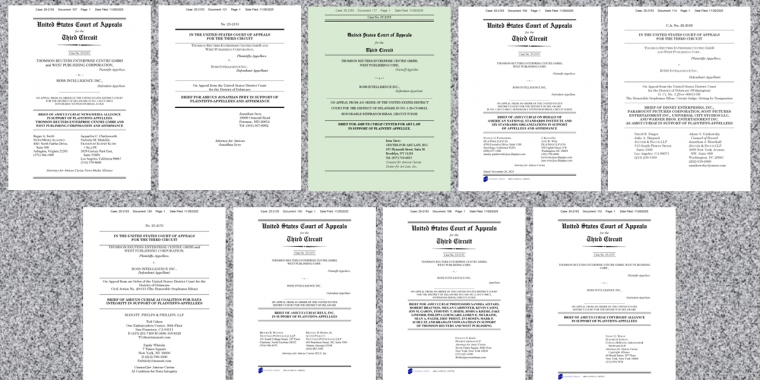
nine
amicus
briefs
have
been
filed
in
support
of
TR.
Those
filing
briefs
range
from
major
movie
studios
such
as
Disney
and
Paramount,
to
news
media
and
copyright
organizations,
to
individual
copyright
law
professors,
and
even
to
TR’s
principal
competitor
LexisNexis.


(Note:
All
of
my
stories
covering
this
case
back
to
2020

can
be
found
here
.)

The
primary
argument
of
all
nine
briefs
is
that
Westlaw’s
headnotes
are
sufficiently
original
to
qualify
for
copyright
and
that
ROSS’s
unauthorized
copying
of
them
to
build
its
AI
legal
research
platform
was
not
fair
use.

This
matter
is
now
before
the
3rd
Circuit
after
the
trial
judge
in
the
case,
U.S.
Circuit
Judge
Stephanos
Bibas,
sitting
by
designation
in
the
U.S.
District
Court
in
Delaware, issued
partial
summary
judgment


last
February

in
favor
of
TR
on
two
key
issues
of
copyright
law.

At
ROSS’s
request,
he
then postponed
the
scheduled
trial
 to
allow
ROSS
to
file
an
interlocutory
appeal
on
those
two
issues.

The
two
issues
Judge
Bibas
certified
for
appeal
to
the
3rd
Circuit
are:

  • Are
    Westlaw’s
    editor-created
    headnotes
    and
    Key
    Number
    system
    sufficiently
    original
    to
    qualify
    for
    copyright
    protection?
    The
    answer
    could
    have
    profound
    implications
    for
    the
    legal
    publishing
    industry.
    Judge
    Bibas
    concluded
    that
    attorney
    editors
    exercise
    enough
    creativity
    when
    they
    choose
    which
    parts
    of
    judicial
    opinions
    to
    highlight
    and
    how
    to
    categorize
    them,
    meeting
    copyright
    law’s
    low
    bar
    for
    originality.
  • Fair
    use.
    Even
    if
    the
    headnotes
    are
    copyrightable,
    did
    ROSS’s
    use
    of
    them
    constitute
    fair
    use
    under
    copyright
    law?
    Judge
    Bibas
    found
    that
    ROSS’s
    use
    was
    not
    “transformative”
    because
    both
    companies
    created
    legal
    research
    tools
    that
    “identify
    the
    important
    parts
    of
    a
    large
    body
    of
    law.”
    He
    concluded
    that
    ROSS
    essentially
    created
    a
    “market
    substitute”
    for
    Westlaw
    rather
    than
    adding
    new
    meaning
    or
    purpose
    to
    the
    original
    work.

Below
are
quick
summaries
of
the
amicus
briefs,
including
a
“nugget”
quote,
with
links
to
the
full
text
of
each.
I
published
the
summaries
of
the
briefs
in
favor
of
ROSS

here
.


Note:
I
used
ChatGPT
to
help
me
extract
information
from
the
briefs
and
create
these
summaries. 


1.
American
National
Standards
Institute
(ANSI)
and
Six
Standards
Organizations


Download
full
text
.


Amici
Identities

  • American
    National
    Standards
    Institute
    (ANSI).
  • ASTM
    International
    (American
    Society
    for
    Testing
    and
    Materials).
  • International
    Association
    of
    Plumbing
    &
    Mechanical
    Officials
    (IAPMO).
  • International
    Code
    Council
    (ICC).
  • National
    Electrical
    Manufacturers
    Association
    (NEMA).
  • National
    Fire
    Protection
    Association
    (NFPA).
  • ULSE
    Inc.
    (UL
    Standards).


Background

These
are
private
standards-development
organizations
(SDOs)
that
create
technical
codes
and
standards
used
across
industry
and
often
incorporated
by
reference
into
law.
They
emphasize
that
standards
are
costly
to
develop
and
funded
largely
through
copyright-based
licensing
and
sales
of
standards
documents.


Supports

Thomson
Reuters.


Principal
Arguments


  • Headnotes
    are
    like
    standards
    :
    TR’s
    headnotes
    are
    privately
    authored,
    creative
    works
    that
    help
    professionals
    navigate
    complex
    legal
    material,
    analogous
    to
    SDO
    technical
    standards
    that
    help
    industry
    navigate
    complex
    technical
    requirements.

  • Government
    edicts
    doctrine
    is
    narrow
    :
    Amicus
    argue
    ROSS
    misreads

    Banks

    and

    Georgia
    v.
    Public.Resource.Org
    ;
    the
    “government
    edicts
    doctrine”
    is
    “a
    straightforward
    rule
    based
    on
    the
    identity
    of
    the
    author,”
    and
    applies
    only
    to
    works
    authored
    by
    judges/legislators
    in
    their
    official
    capacities,
    not
    to
    private
    commentary
    such
    as
    headnotes.

  • Supreme
    Court
    precedent
    already
    answers
    this
    :

    Callaghan
    v.
    Myers

    and

    Georgia

    confirm
    that
    headnotes
    and
    similar
    explanatory
    texts
    created
    by
    private
    parties
    remain
    copyrightable,
    even
    when
    closely
    tracking
    judicial
    text.

  • Policy
    concern
    :
    If
    ROSS’s
    rule
    were
    adopted,
    it
    would
    jeopardize
    the
    business
    model
    of
    SDOs
    whose
    privately
    authored
    standards
    sit
    “side-by-side
    with
    government-authored
    works”
    and
    are
    frequently
    incorporated
    by
    reference
    into
    law.


Counsel
for
Amicus

  • Stanley
    J.
    Panikowski,
    J.
    Kevin
    Fee,
    Jane
    W.
    Wise,
    DLA
    Piper
    LLP,
    San
    Diego
    and
    Washington,
    D.C.


Nugget
Quote

“Like
standards
authored
by
standards
development
organizations,
Thomson
Reuters’
headnotes
are
creative,
privately-authored
works
that
advance
public
knowledge
by
translating
complex
material
into
structured,
comprehensible
guidance.
These
are
precisely
the
kinds
of
expressive
works
that
copyright
protects.”


2.
Copyright
&
IP
Law
Professors


Download
full
text.


Amici
Identities

Fifteen
copyright
and
IP
professors:

  • Sandra
    Aistars,
    Distinguished
    Counselor
    in
    Residence
    &
    Professor
    of
    Law,
    IPPI:
    The
    IP
    Policy
    Institute,
    The
    University
    of
    Akron
    School
    of
    Law.
  • Robert
    Brauneis,
    Michael
    J.
    McKeon
    Professor
    of
    Intellectual
    Property
    Law,
    Co-Director
    of
    the
    Intellectual
    Property
    Program,
    The
    George
    Washington
    University
    Law
    School.
  • Megan
    Carpenter,
    Dean
    and
    Professor
    of
    Law,
    Franklin
    Pierce
    School
    of
    Law,
    University
    of
    New
    Hampshire.
  • Kevin
    Casini,
    Lecturer,
    Quinnipiac
    University
    School
    of
    Law.
  • Jon
    M.
    Garon,
    Associate
    Dean
    for
    Technology
    and
    Innovation,
    Director,
    Goodwin
    Program
    for
    Society,
    Technology,
    and
    the
    Law,
    Shepard
    Broad
    College
    of
    Law,
    Nova
    Southeastern
    University.
  • Timothy
    T.
    Hsieh,
    Associate
    Professor
    of
    Law,
    Oklahoma
    City
    University
    School
    of
    Law.
  • Joshua
    Kresh,
    Research
    Professor
    &
    Executive
    Director,
    The
    IP
    Policy
    Institute,
    the
    University
    of
    Akron
    School
    of
    Law.
  • Jake
    Linford,
    Associate
    Dean
    for
    Academic
    Affairs,
    Loula
    Fuller
    &
    Dan
    Myers
    Professor,
    Florida
    State
    University
    College
    of
    Law.
  • Philippa
    Loengard,
    Executive
    Director
    of
    the
    Kernochan
    Center
    for
    Law,
    Media
    and
    the
    Arts
    and
    Lecturer
    in
    Law,
    Columbia
    Law
    School.
  • Loren
    E.
    Mulraine,
    Professor
    of
    Law,
    Director
    of
    Music
    and
    Entertainment
    Law
    Studies,
    Belmont
    University
    College
    of
    Law.
  • Sean
    A.
    Pager,
    Professor
    of
    Law;
    Associate
    Director,
    Intellectual
    Property,
    Information
    &
    Communications
    Law
    Program
    (IPIC),
    Michigan
    State
    University
    College
    of
    Law.
  • Eric
    Priest,
    Professor
    of
    Law,
    University
    of
    Oregon
    School
    of
    Law.
  • Zvi
    Rosen,
    Associate
    Professor
    of
    Law,
    Franklin
    Pierce
    School
    of
    Law,
    University
    of
    New
    Hampshire.
  • Mark
    F.
    Schultz,
    Goodyear
    Tire
    &
    Rubber
    Company
    Endowed
    Chair
    in
    Intellectual
    Property
    Law,
    Faculty
    Chair,
    IPPI:
    The
    IP
    Policy
    Institute,
    The
    University
    of
    Akron
    School
    of
    Law.
  • Bhamati
    Viswanathan,
    Fellow,
    Columbia
    Law
    School,
    Kernochan
    Center
    for
    Law,
    Media
    and
    the
    Arts,
    Senior
    Visitor,
    University
    of
    Cambridge
    Faculty
    of
    Law.


Background

These
are
academic
copyright
scholars
from
law
schools
across
the
U.S.
who
study
fair
use,
AI,
and
markets
for
expressive
works.


Supports

Thomson
Reuters.


Principal
Arguments


  • Fair
    use
    remains
    holistic
    and
    fact-specific
    :
    Amicus
    stress
    that
    fair
    use
    is
    a
    “case-by-case”
    analysis
    focusing
    on
    substitution,
    and
    that
    ROSS
    bears
    the
    burden
    of
    justifying
    its
    copying.

  • Training
    AI
    to
    perform
    the
    same
    function
    is
    not
    transformative
    :
    When
    AI
    is
    trained
    “to
    perform
    the
    same
    function
    as
    the
    original
    work”

    here,
    directing
    users
    to
    relevant
    portions
    of
    judicial
    opinions

    the
    first
    factor
    favors
    the
    plaintiff.

  • Non-expressive
    /
    intermediate
    use
    arguments
    misstate
    the
    law
    :
    ROSS’s
    claim
    that
    it
    engaged
    only
    in
    “nonexpressive”
    or
    intermediate
    copying
    ignores
    that
    copyright
    protects
    reproduction
    even
    if
    the
    output
    is
    not
    infringing,
    and
    that
    one
    cannot
    justify
    copying
    expressive
    works
    simply
    by
    saying
    the
    goal
    was
    to
    reach
    the
    unprotected
    “facts.”

  • Oracle,
    Sega,
    and
    Sony
    are
    distinguishable
    :
    Those
    cases
    involved
    functional
    computer
    code
    and
    necessary
    interoperability,
    not
    expressive
    editorial
    text,
    and
    do
    not
    create
    an
    AI-specific
    carveout.


Counsel
for
Amicus

  • Felicity
    S.
    Kohn,
    Pryor
    Cashman
    LLP,
    New
    York,
    NY.


Nugget
Quote

“It
makes
no
difference
that
the
headnotes
express
facts
(albeit
creatively);
if
all
defendants
could
excuse
their
unauthorized
copying
by
claiming
to
be
seeking
the
facts
contained
therein,
the
exception
would
swallow
copyright
law
whole.
Nor,
as
Ross
and
its
amici
argue,
is
its
use
fair
because
it
engaged
only
in
‘intermediate
copying,’
creating
no
infringing
output.
The
law
is
clear
that
copyright
holders
have
the
right
to
control
reproduction,
irrespective
of
whether
the
separate
rights
to
distribute
the
work
or
create
derivative
works
therefrom
are
infringed.”


3.
News/Media
Alliance
(N/MA)


Download
full
text.


Amicus
Identity

News/Media
Alliance
(N/MA)

a
nonprofit
trade
group
representing
over
2,200
news
and
magazine
publishers
in
the
U.S.


Background

N/MA
represents
newspapers,
digital-only
outlets,
and
magazines
ranging
from
local
papers
to
national
brands.
Its
members
depend
on
copyright
to
fund
journalism,
especially
as
they
negotiate
AI
and
RAG
(retrieval-augmented
generation)
licensing
deals.


Supports

Thomson
Reuters.


Principal
Arguments


  • Unauthorized
    copying
    to
    build
    a
    competing
    product
    is
    not
    fair
    use
    :
    The
    district
    court
    correctly
    held
    that
    Ross’s
    use
    of
    more
    than
    2,000
    headnotes
    to
    build
    a
    rival
    research
    platform
    was
    not
    fair
    use,
    and
    that
    “one
    may
    not
    copy
    another’s
    copyrighted
    content
    to
    produce
    a
    product
    that
    seeks
    to
    displace
    the
    market
    for
    that
    very
    content.”

  • Parallel
    with
    news
    scraping
    :
    Amicus
    warn
    that
    if
    this
    conduct
    is
    blessed,
    AI
    developers
    could
    treat
    news
    reporting
    the
    same
    way—scraping
    it
    to
    build
    directly
    competing
    AI
    news
    tools
    and
    invoking
    fair
    use.

  • RAG
    and
    live
    news
    :
    Because
    LLMs
    are
    static,
    they
    rely
    on
    RAG
    that
    scrapes
    up-to-date
    publisher
    content.
    Treating
    that
    as
    fair
    use
    would
    divert
    traffic
    and
    revenue
    away
    from
    publishers
    and
    undermine
    a
    rapidly
    growing
    AI
    licensing
    market.

  • Market
    harm
    and
    Warhol
    :
    Amicus
    lean
    heavily
    on

    Warhol
    ’s
    rule
    that
    using
    a
    work
    for
    the
    same
    commercial
    purpose
    as
    the
    original
    is
    incompatible
    with
    fair
    use,
    especially
    where
    it
    usurps
    existing
    or
    potential
    licensing
    markets.


Counsel
for
Amicus

  • Regan
    A.
    Smith,
    News/Media
    Alliance,
    Arlington,
    VA.
  • Jacqueline
    C.
    Charlesworth
    &
    Nicholas
    M.
    Medellin,
    Frankfurt
    Kurnit
    Klein
    +
    Selz
    PC,
    Los
    Angeles,
    CA.


Nugget
Quote

“News
companies
rely
on
revenue
from
the
stories
they
publish
to
pay
the
journalists
who
research
and
write
those
stories.
When
news
reporting
or
other
copyrighted
material
is
taken
and
used
without
permission
to
develop
a
competing
product

as
Ross
Intelligence
Inc.
did
here

it
undermines
the
ability
of
publishers
to
create
and
disseminate
original
content,
including
quality
online
journalism.”


4.
Copyright
Alliance


Download
full
text.


Amicus
Identity

Copyright
Alliance
is
a
nonprofit
public-interest
organization
representing
over
two
million
individual
creators
and
15,000
organizations
across
music,
publishing,
visual
art,
film,
software,
etc.


Background

The
Alliance
advocates
for
strong
copyright
protections
and
enforcement
as
essential
to
the
livelihoods
of
creative
professionals
and
to
the
U.S.
copyright
industries’
contribution
to
the
economy.


Supports

Thomson
Reuters.


Principal
Arguments


  • Headnotes
    easily
    clear
    Feist’s
    originality
    bar
    :
    Amicus
    argue
    the
    West
    headnotes
    are
    independently
    created
    by
    attorney-editors
    who
    select,
    organize,
    and
    phrase
    legal
    points,
    making
    them
    “quintessentially
    copyrightable.”

  • Narrowing
    originality
    would
    harm
    many
    industries
    :
    Weakening
    protection
    for
    selections/arrangements
    of
    factual
    material
    would
    devastate
    creators
    in
    photography,
    fashion,
    databases,
    scientific
    publishing,
    and
    more,
    who
    rely
    on
    compilation-based
    copyright.

  • ROSS’s
    fair-use
    arguments
    misapply
    Google
    Books,
    Arriba,
    and
    Oracle
    :
    Those
    decisions
    involved
    distinct,
    functional
    uses
    (search,
    thumbnails,
    interoperability)
    and
    were
    “boundary-testing”
    cases
    that
    do
    not
    justify
    copying
    to
    build
    a
    direct
    competitor.

  • AI
    licensing
    is
    a
    growing,
    legitimate
    market
    :
    AI
    training
    is
    already
    being
    licensed
    at
    scale
    (e.g.,
    content
    deals
    with
    OpenAI,
    Microsoft,
    and
    others),
    and
    fair
    use
    should
    not
    be
    stretched
    to
    undermine
    this
    emerging
    revenue
    stream
    for
    rightsholders.


Counsel
for
Amicus

  • Nancy
    E.
    Wolff
    and
    Elizabeth
    Safran,
    Cowan,
    DeBaets,
    Abrahams
    &
    Sheppard
    LLP,
    New
    York,
    NY.


Nugget
Quote

“Appellant’s
activity
threatens
wide
swaths
of
creative
industries
and
the
livelihoods
of
authors
and
book
publishers,
as
well
as
many
other
types
of
creative
professionals.
Permitting
Appellant
to
take
and
reproduce
Appellees’
copyrighted
headnotes
without
authorization
for
purposes
of
a
competing
product
would
undermine
existing
licensing
markets
and
strip
creators
and
rightsholders
of
their
statutory
rights
to
control
and
commercialize
their
copyrighted
works.”


5.
Major
Film
Studios
(Disney,
Paramount,
Sony,
Universal,
Warner
Bros.)


Download
full
text.


Amici
Identities

  • Disney
    Enterprises,
    Inc.
  • Paramount
    Pictures
    Corporation
  • Sony
    Pictures
    Entertainment
    Inc.
  • Universal
    City
    Studios
    LLC
  • Warner
    Bros.
    Entertainment
    Inc.


Background

These
are
five
of
the
largest
U.S.
film/television
studios,
each
owning
extensive
libraries
of
copyrighted
works
and
heavily
invested
in
both
content
creation
and
new
technologies.
They
frequently
litigate
and
rely
on
fair
use
but
worry
about
over-expansion
of
the
doctrine
in
the
AI
context.


Supports

Thomson
Reuters.


Principal
Arguments


  • No
    AI-specific
    fair-use
    rule
    :
    Amicus
    urge
    the
    court
    to
    reject
    any
    “AI
    exception,”
    arguing
    that
    fair
    use
    already
    accommodates
    new
    technologies
    and
    should
    not
    be
    rewritten
    to
    make
    AI
    training
    presumptively
    transformative.

  • ROSS’s
    use
    is
    classic
    market
    substitution
    :
    Ross
    used
    the
    headnotes
    as
    a
    “shortcut”
    to
    build
    a
    competing
    legal
    research
    product
    serving
    the
    same
    function
    and
    customers
    as
    Westlaw

    precisely
    the
    kind
    of
    substitution

    Campbell
    ,

    Warhol

    and

    Video
    Pipeline

    disfavor.

  • Intermediate
    copying
    doesn’t
    save
    them
    :
    Amicus
    argue
    that
    “intermediate
    copying”
    cases
    (Sega,
    Sony,
    Oracle)
    involved
    functional
    code
    and
    interoperability,
    not
    expressive
    text,
    and
    required
    necessity.
    Ross
    could
    have
    created
    its
    own
    headnotes
    from
    public
    cases
    but
    chose
    not
    to.

  • Licensing
    and
    potential
    markets
    :
    Fourth-factor
    analysis
    must
    consider
    Westlaw
    as
    the
    copyrighted
    work
    and
    the
    emerging
    derivative
    market
    for
    AI
    training
    on
    editorial
    datasets.
    Ross’s
    refusal
    to
    pay
    for
    a
    license
    and
    subsequent
    copying
    is
    classic
    market
    harm.


Counsel
for
Amicus

  • Adam
    G.
    Unikowsky
    and
    Jonathan
    J.
    Marshall,
    Jenner
    &
    Block
    LLP,
    Washington,
    D.C.
  • David
    R.
    Singer
    &
    Julie
    A.
    Shepard,
    Jenner
    &
    Block
    LLP,
    Los
    Angeles,
    CA.


Nugget
Quote

“[W]hile
Defendant
seeks
shelter
behind
the
fact
that
its
competing
product
involves
purportedly
novel
machine-learning
technology,
that
does
not
alter
the
copyright
principles
in
play.
There
is
no
‘novel
technology’
exception
to
copyright
law,
and
there
is
no
thumb
on
the
fair-use
scale
for
commercially
motivated
copying
just
because
the
competing
product
in
some
sense
incorporates
AI.”


6.
Center
for
Art
Law


Download
full
text.


Amicus
Identity

The
Center
for
Art
Law
is
a
Brooklyn-based
501(c)(3)
nonprofit
focused
on
the
intersection
of
visual
art,
cultural
heritage
and
law.


Background

Founded
in
2009,
the
Center
researches
and
educates
on
artists’
rights,
AI
and
copyright,
restitution,
and
cultural
property.
It
represents
visual
artists’
interests
in
emerging
AI
copyright
issues.


Supports

Thomson
Reuters.


Principal
Arguments


  • Reject
    a
    blanket
    AI
    fair-use
    exemption
    :
    Fair
    use
    is
    an
    “equitable
    rule
    of
    reason,”
    and
    courts
    should
    not
    carve
    out
    a
    categorical
    exemption
    for
    AI
    training;
    each
    use
    must
    be
    analyzed
    under
    the
    four
    factors.

  • AI
    training
    can
    seriously
    harm
    artists
    :
    Unauthorized
    ingestion
    of
    images
    and
    visual
    art
    for
    training
    causes
    concrete
    harm
    to
    creators—loss
    of
    autonomy,
    licensing
    opportunities,
    and
    value
    of
    their
    styles—especially
    when
    outputs
    mimic
    original
    works.

  • All
    four
    factors
    usually
    cut
    against
    training
    on
    creative
    works
    :

    • Factor
      1:
      Mere
      ingestion
      for
      pattern
      recognition
      is
      rarely
      transformative.
    • Factor
      2:
      Visual
      art
      is
      at
      the
      core
      of
      copyright
      protection.
    • Factor
      3:
      Training
      typically
      copies
      entire
      works
      at
      scale.
    • Factor
      4:
      AI
      outputs
      can
      function
      as
      substitutes,
      diluting
      markets
      for
      commissioned
      and
      licensed
      works.

  • Comparative
    perspective
    &
    licensing
    :
    The
    brief
    notes
    EU
    TDM
    rules
    and
    growing
    licensing
    models
    (Adobe
    Firefly,
    Shutterstock,
    Getty,
    News
    Corp–OpenAI)
    as
    proof
    that
    innovation
    and
    rights-respecting
    licensing
    can
    coexist.


Counsel
for
Amicus

  • Irina
    Tarsis,
    Center
    for
    Art
    Law,
    Inc.,
    Brooklyn,
    NY.


Nugget
Quote

“[T]he
unauthorized
use
of
copyrighted
visual
works
in
AI
systems
poses
significant
and
concrete
harm
to
artists.
Illustrators,
photographers,
painters,
and
designers
face
infringement
of
their
creative
autonomy,
threats
to
licensing
and
market
opportunities,
and
loss
of
the
value
of
their
labor
and
distinctive
styles
when
their
works
are
incorporated
into
AI
datasets
without
consent,
attribution,
or
compensation.”


7.
AI
Coalition
for
Data
Integrity
(AICDI)


Download
full
text.


Amicus
Identity

The
AI
Coalition
for
Data
Integrity
is
a
multi-stakeholder
coalition
of
AI
developers,
content
owners,
publishers,
trade
associations
and
others
focused
on
transparency,
attribution,
and
licensing
in
AI
data
practices.


Background

AICDI
promotes
ethical
AI
by
advocating
for
proper
data
stewardship,
including
lawful
licensing
of
training
data.
Several
member
organizations
(writers’
guilds,
SAG-AFTRA,
music
and
image
licensing
groups,
Yelp,
etc.)
are
listed
as
signatories
to
the
brief.


Supports

Thomson
Reuters.


Principal
Arguments


  • Warhol
    and
    factor
    one
    :
    Under

    Warhol
    ,
    commercial
    uses
    serving
    “substantially
    the
    same
    purpose”
    as
    the
    original
    weigh
    sharply
    against
    fair
    use.
    Ross
    used
    headnotes
    to
    build
    an
    AI
    research
    tool
    that
    serves
    the
    same
    legal
    research
    function
    as
    Westlaw.

  • Three-fold
    market
    harm
    under
    factor
    four
    :


    • Direct
      substitution
      :
      Ross’s
      platform
      is
      marketed
      as
      a
      competitor
      to
      Westlaw,
      usurping
      TR’s
      core
      market.

    • Licensing
      &
      derivative
      markets
      :
      Ross’s
      copying
      bypassed
      an
      established
      licensing
      market
      for
      editorial
      datasets
      and
      training
      data;
      Ross
      even
      sought
      a
      license,
      was
      refused,
      then
      used
      the
      data
      anyway.

    • Market
      dilution
      :
      AI
      systems
      can
      flood
      the
      market
      with
      substitutes;
      AICDI
      leans
      on

      Kadrey
      ’s
      acknowledgment
      that
      dilution
      can
      decisively
      defeat
      fair
      use
      when
      evidence
      is
      present.

  • Critique
    of
    Kadrey
    and
    Bartz
    :
    Amicus
    argue
    those
    decisions
    misapplied

    Warhol

    by
    treating
    AI
    training
    as
    inherently
    transformative
    and
    downplaying
    licensing
    and
    dilution
    harms;
    they
    urge
    the
    Third
    Circuit
    not
    to
    follow
    that
    path.

  • Protecting
    the
    AI-licensing
    economy
    :
    Affirming
    the
    district
    court
    will
    reinforce
    copyright’s
    incentive
    structure
    and
    the
    emerging,
    legitimate
    market
    for
    AI-training
    licenses.


Counsel
for
Amicus

  • Tod
    Cohen
    and
    Emily
    Whitely,
    Manatt,
    Phelps
    &
    Phillips,
    LLP
    (San
    Francisco
    &
    New
    York).


Nugget
Quote

“Ross’s
conduct

threatens
the
rapidly
developing
market
for
licensing
copyrighted
works
as
AI-training
data.
By
ignoring
a
refused
license
and
taking
Thomson
Reuters’s
proprietary
content
to
power
a
direct
competitor,
Ross
undermines
existing
licensing
practices
and
accelerates
market
dilution,
which
are
both
core
harms
under
the
Copyright
Act’s
fair
use
fourth
factor.”


8.
Jonathan
Iwry,
Fellow,
Wharton
Accountable
AI
Lab


Download
full
text.


Amicus
Identity

Jonathan
Iwry
is
a
fellow
at
the
Wharton
Accountable
AI
Lab
(University
of
Pennsylvania).


Background

Iwry
researches
AI
governance
and
accountability,
especially
how
AI
intersects
with
foundational
legal
concepts
such
as
copyright,
liability,
and
fair
use.
He
appears
as
an
individual
scholar,
not
on
behalf
of
Wharton.


Supports

Thomson
Reuters.


Principal
Arguments


  • AI
    must
    not
    become
    a
    loophole
    for
    appropriation
    :
    If
    copying
    expressive
    works
    “at
    commercial
    scale”
    and
    diffusing
    them
    into
    model
    weights
    were
    automatically
    insulated
    from
    liability,
    any
    competitor
    could
    ingest
    thousands
    of
    works
    and
    claim
    non-infringement,
    undermining
    copyright’s
    incentives.

  • Headnotes
    are
    expressive,
    not
    mere
    facts
    :
    Editorial
    judgments
    in
    headnotes—selection,
    framing,
    emphasis—are
    expressive
    under

    Feist

    and
    should
    not
    be
    redefined
    as
    “facts”
    simply
    because
    they
    concern
    legal
    holdings.

  • True
    purpose,
    not
    intermediate
    technical
    steps,
    governs
    factor
    one
    :
    Converting
    text
    into
    vectors
    is
    just
    another
    encoding;
    training
    an
    AI
    is
    not
    a
    distinct
    purpose
    when
    the
    ultimate
    goal
    is
    a
    competing
    commercial
    research
    tool.

  • Market
    harm
    and
    AI
    accountability
    :
    Allowing
    this
    sort
    of
    copying
    would
    erode
    incentives
    for
    editors
    and
    researchers
    and
    encourage
    AI
    developers
    to
    “rely
    on
    opacity
    and
    litigation
    risk
    rather
    than
    legitimate
    acquisition
    of
    data.”
    Affirming
    TR
    would
    promote
    accountability
    in
    AI
    development.


Counsel
for
Amicus

  • Jonathan
    Iwry,
    Potomac,
    MD
    (appearing
    pro
    se
    as
    amicus).


Nugget
Quote

“The
internal
processing
of
expressive
content
by
an
AI
system
does
not
thereby
count
as
transforming
that
expressive
content
for
fair
use
purposes.
The
model’s
encoding
of
the
headnotes’
content
might
take
a
numerical
form,
but
what
it
encodes
is
still
the
rightsholder’s
expressive
judgments
and
organization,
which
ROSS
copied
to
provide
a
substitutive
service.”


9.
RELX
Inc.
(LexisNexis)


Download
full
text.


Amicus
Identity

RELX
Inc.,
doing
business
as
LexisNexis,
one
of
the
two
dominant
U.S.
legal
research
platforms.


Background

LexisNexis
is
a
global
legal-information
and
analytics
provider
and
the
principal
competitor
to
Westlaw.
It
creates
and
licenses:

  • Case
    law
    databases
  • Legal
    commentary
  • Topical
    taxonomies
  • LexisNexis
    Headnotes,
    which
    it
    argues
    are
    expressive
    works
    protected
    by
    copyright

LexisNexis
notes
that
it
owns
its
own
copyright
registrations
for
headnotes
and
that
it
uses
a
team
of
attorney-editors
who
synthesize
case
law
and
create
summarizing
annotations.

This
gives
the
company
a
strong
competitive
and
doctrinal
interest
in
the
outcome:
if
Westlaw’s
headnotes
were
declared
uncopyrightable,
LexisNexis’s
competing
headnotes
would
be
equally
jeopardized.


Supports

Thomson
Reuters.


Principal
Arguments


  • Headnotes
    are
    copyrightable
    under
    long-standing
    precedent.

    LexisNexis
    emphasizes
    that

    Callaghan
    v.
    Myers

    and

    Georgia
    v.
    Public.Resource.Org

    confirm
    headnotes
    created
    by
    private
    publishers
    are
    protectable
    expression.
    It
    cites
    a
    long
    history
    of
    courts
    treating
    annotations
    as
    expressive
    works.

  • Editorial
    headnotes
    serve
    essential
    public-facing
    functions.

    Lexis
    describes
    headnotes
    as
    the
    “bridge”
    between
    complex
    case
    law
    and
    the
    public—judges,
    lawyers,
    students,
    journalists,
    and
    pro
    se
    litigants.

  • Headnotes
    require
    sustained
    human
    creativity.

    The
    brief
    outlines
    the
    labor-intensive
    editorial
    process,
    in
    which
    attorneys:
    1.
    read
    full
    opinions,
    2.
    identify
    and
    paraphrase
    key
    legal
    issues,
    draft
    accessible
    summaries,
    apply
    proprietary
    taxonomies,
    and
    cross-link
    to
    citators
    and
    research
    tools.
    Because
    LexisNexis
    and
    Westlaw
    often
    produce
    different
    headnotes
    from
    the
    same
    case,
    the
    brief
    argues,
    this
    proves
    headnotes
    are
    not
    dictated
    by
    convention
    or
    mere
    fact.

  • Eliminating
    protection
    would
    collapse
    the
    market.

    If
    the
    court
    ruled
    headnotes
    uncopyrightable,
    the
    economic
    foundation
    that
    supports
    continuous
    editorial
    creation
    would
    collapse.
    Among
    the
    predicted
    consequences:
    publishers
    would
    stop
    producing
    headnotes;
    research
    platforms
    would
    degrade;
    errors
    and
    doctrinal
    drift
    would
    increase;
    and
    the
    harm
    would
    fall
    hardest
    on
    small
    firms,
    courts,
    legal
    aid
    and
    pro
    se
    litigants.
    LexisNexis
    warns
    this
    outcome
    would
    result
    in
    “fewer,
    lower-quality
    options”
    in
    legal
    research.

  • Fair
    use
    does
    not
    excuse
    ROSS’s
    appropriation.

    Lexis
    argues
    the
    fourth
    factor

    market
    effect

    decisively
    weighs
    against
    ROSS,
    in
    that:
    ROSS’s
    copying
    targeted
    the
    core
    market
    for
    editorial
    annotations,
    it
    deprived
    publishers
    of
    licensing
    revenues
    and
    emerging
    AI-training
    markets,
    and
    allowing
    this
    would
    privilege
    “copyists
    over
    creators”
    and
    remove
    incentives
    for
    legal-editorial
    investment.


Counsel
for
Amicus

All
from
Troutman
Pepper
Locke
LLP:
Michael
D.
Hobbs,
Jr.,
Atlanta,
GA;
Austin
Padgett,
Atlanta,
GA;
and
Brooke
R.
Watson,
Charlotte,
NC.


Nugget
Quote

“Editorial
headnote
annotations
provide
a
public-facing
bridge
between
complex
judicial
opinions
and
the
communities
who
must
understand
and
apply
them:
judges,
practitioners,
students,
journalists,
and
pro
se
litigants.

By
distilling
controlling
holdings,
locating
issues
within
an
established
taxonomy,
and
articulating
rules
in
accessible
prose,
headnotes
reduce
the
time,
cost,
and
error
associated
with
legal
research.
This
lowers
barriers
to
entry
for
smaller
firms
and
self-represented
parties,
promotes
more
uniform
application
of
the
law,
and
enhances
courts’
efficiency
by
directing
them
to
the
precise
passages
that
matter
most.”