Why Can’t Anyone Give Us A Straight Answer About Average Law School Student Loan Debt?

For the last year or so, I’ve been tinkering with a book manuscript about law school, and more specifically, about law school debt. This experience has generally reinforced the perfectly reasonable assumption I came into it with that this noble legal profession of ours maintains a lot of statistics.

I could give you many examples. Thanks to U.S. News and World Report, for instance, I now know that for full-time law programs for the 2018-2019 academic year, the average annual tuition at private law schools was $49,095, at public schools for out-of-state students it was $40,725, and it was a comparative bargain at public schools for in-state students at $27,591. Sadly, I also know that the median private sector starting salary for 2017 law grads was only $72,500, and that the median public sector starting salary for new lawyers was only $54,550. Keep in mind that these median salary figures are only from the 180 or so law schools that U.S. News actually ranks, and if you included ABA-accredited schools which are not ranked and the non-ABA accredited law schools, there would be almost 60 more law schools, many of which, presumably, would be producing graduates with lower average salaries than the accredited and ranked law schools. So, while the U.S. News salary data is far from perfect, it’s a start, at least.

It is not just U.S. News that compiles statistics on the legal profession. The American Bar Association, our very own national representative of the legal profession, curates a lot of helpful stats, including info that, when combined with data from individual schools, tells us that the average sticker price for private law school tuition jumped 273 percent from 1985 to 2018, while public law school tuition over the same time period, also adjusted for inflation, skyrocketed by 582 percent. Very helpful.

But, go to the ABA statistics page on their website, and click on the link for “Average Amount Borrowed,” and you get this: a crappy one-page spreadsheet with the most recently available data from the 2012-2013 academic year.

Not only is the presentation crappy, and the data stale, the gathering method is pretty suspect. For the 2011-2012 year, the average reported amount borrowed to attend a public law school was $84,600, a historic high at that point, while the average reported amount borrowed to attend a private law school was $122,158, second only to the $124,950 incurred for the preceding 2010-2011 academic year, when I myself was still attending a private law school in the doldrums of the Great Recession.

With tuition rates rapidly outpacing inflation, people incurring more and more law school debt is what you’d expect. But then, the following academic year, 2012-2013, the supposed amounts being borrowed dropped by nearly two-thirds, to $32,289 for public schools and $44,094 for private schools. The difference wasn’t a change in reality, but a change in how the questions were asked. Prior to the 2012-2013 academic year, the ABA asked for “The average amount borrowed in law school by J.D. graduates who borrowed at least one education loan in law school.” But for the 2012-2013 academic year, the ABA switched to asking for “The average amount borrowed in law school by J.D. students who borrowed at least one education loan in any amount in the previous academic year.” See the difference? It’s subtle, but obviously pretty meaningful, especially when you realize as someone who actually went to law school that it becomes much easier the second and third years not to take out more student loans because you’re probably actually able to work, and have probably already taken out enough loans to fill the gaps. But isn’t the total amount of debt incurred to go to law school what actually matters, not when exactly you took it out?

Apparently, after the 2012-2013 academic year, the ABA stopped collecting even crappy data on the average amount borrowed by law students to become lawyers, or at least stopped publishing it. Now, it’s nearly impossible to find out how much the average law student has to borrow to become a lawyer. Go ahead and Google “average law school student debt” sometime and see what you come up with.

Right now at least, all you’ll find is marginally helpful information on debt loads at individual schools from U.S. News (with some of the inherent flaws of U.S. News data, including that it misses a quarter of the law schools in existence), an Above the Law piece by Staci Zaretsky (who is a talented and fabulous human being, not to mention my own editor, but was writing back in 2017 and only citing to the best data available at that time), and a couple pieces from student loan debt companies citing back to Above the Law (one of which I think actually does a pretty swell job of calling out the decrepitude of ABA data on the subject).

This, my friends, is pathetic. This data should not be that hard to collect. Law schools have to report all kinds of other data that is ultimately presented in a digestible fashion. People are not being allowed to make an informed decision about something that will affect them, and their families, for the rest of their lives.

It’s almost as if powerful people stand to benefit from not being forthright about how much debt one has to incur to become a lawyer.


Jonathan Wolf is a litigation associate at a midsize, full-service Minnesota firm. He also teaches as an adjunct writing professor at Mitchell Hamline School of Law, has written for a wide variety of publications, and makes it both his business and his pleasure to be financially and scientifically literate. Any views he expresses are probably pure gold, but are nonetheless solely his own and should not be attributed to any organization with which he is affiliated. He wouldn’t want to share the credit anyway. He can be reached at jon_wolf@hotmail.com.

A Reckoning For Mental Health In The Legal Profession

(Image via Getty)

I spend a lot of time ranting (and writing, although the two are probably synonymous) about the fact that we lawyers have not made mental health in our profession a priority. It needs to be one, and I am not the only ATL columnist to say so. Perhaps if we are willing to talk more openly about issues that we confront as lawyers, and not just the legal ones, we’ll make some progress in this area.

Last week, I was invited to join a group of other lawyers to do exactly that, to talk about issues we confront as lawyers, be they substance abuse, isolation, or the myriad of other pressures that we face. It’s not just about marketing and networking; it’s about being unemployed after years of practice, it’s about wanting, needing work-life balance, it’s about managing pie in the sky client expectations with the realities of what can be obtained for the client (any disconnect there? No, of course not.)

We were a big group, 20 or so, more than the host expected, and it is a tribute to him that people battled Los Angeles traffic to join him. It also said that there was a hunger for this kind of group, a group of like-minded people who were and are concerned about our mental health. There were millennial lawyers, Gen X lawyers, and boomers. We had all kinds of practices; we were male and female. Everyone was respectful and listened (to the extent possible given the decibel level) to what others had to say. Not everyone spoke up, not everyone shared thoughts, but there was no “mansplaining,” no patronizing behavior, no “you don’t know what you are talking about.” There was no judging, just understanding where people have come from and where people are at right now.

The host led off the discussion. His story was raw, visceral, and courageous. He had shared his story with me some years ago, but I would guess that most of the people there didn’t know it. He had a drug abuse problem that finally forced him into rehab. His insurance wouldn’t pay for as long as he would have wanted to stay to detox, but he gutted it out. After a few rocky years and therapy along the way, he and his practice are flourishing.

There was talk about issues that we all face: getting clients, rather, getting the right clients who will listen to the advice, will pay our bills, including replenishing the retainer when it’s used up. No one went into the profession to be a de facto lender.

We talked about managing expectations and firing clients who refuse to take advice and then complain when they receive “only” 99 percent of what they wanted. They perseverate about the one percent they didn’t get and blame the lawyer for failing to get that one percent. We’ve all been there.

There were stories about having an awesome résumé and great experience, but having trouble finding a job past a certain age.

People talked about the need for work-life balance, that spending time with family and friends is critical, that coaching Little League games, attending school recitals, and other school events, that just being there for the family is intrinsic to mental health. What about vacations? As one wag once said, and I am paraphrasing here, on your deathbed, no one is going to say that you should have spent more time at the office.

We have all seen the destruction that working to death, either literally or figuratively, has caused,and that it is not the way we want to or should want to live our lives. We have read about the deaths by suicide of lawyers of all ages, not just millennials, not just dinosaurs. We cannot help but be profoundly moved by the tragic unnecessary losses of lives.

One story that will always haunt me is that of a widow whose drug-addicted Biglaw husband was so caught up in his work that his last cell phone call was dialing into a conference call.

Slowly, very slowly, lawyers are starting to speak out about their own struggles with substance abuse and mental health issues. As one lawyer noted at the meeting, practicing law is a lonely profession. And that point is borne out by a study last year not only confirming that but concluding that law is the loneliest profession.

Factors contributing to the loneliness include the solitary nature of research, long hours, and just sheer exhaustion. We can’t afford to isolate ourselves. Loneliness can be even worse for us dinosaurs, also known as the “silver tsunami,” those of us who are reaching or have reached retirement age. One friend of mine isn’t taking any more cases, but still goes into the office very weekday for interaction with colleagues.

I think lawyer support groups are a good idea. It’s not networking, not hustling, not business development. Talk like that should be grounds for tossing the person out. It’s development of a totally different kind: it’s self-development by sharing with other lawyers that you are not alone, that other lawyers share the same or similar frustrations and failures, that we are more than our lawyer identities, that we all have vulnerabilities, try as we might to conceal them. We all need this kind of support. If there’s a support group in your area, then join it. If there isn’t one, why not start one?

So, to my host, keep this one going. My only request is that you find a place that’s not so damned noisy. I am a dinosaur and my hearing is not what it used to be.


old lady lawyer elderly woman grandmother grandma laptop computerJill Switzer has been an active member of the State Bar of California for over 40 years. She remembers practicing law in a kinder, gentler time. She’s had a diverse legal career, including stints as a deputy district attorney, a solo practice, and several senior in-house gigs. She now mediates full-time, which gives her the opportunity to see dinosaurs, millennials, and those in-between interact — it’s not always civil. You can reach her by email at oldladylawyer@gmail.com.
A year after Mnangagwa’s election, old woes haunt Zimbabwe – The Zimbabwean

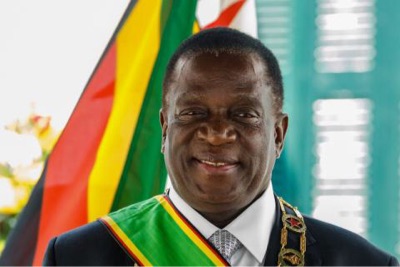
HARARE – Langton Chiwocha chose Emmerson Mnangagwa among 23 candidates in Zimbabwe’s presidential elections a year ago.

Today he says he deeply regrets his choice.

“We had high expectations as many promises were made, but things have turned worse since the elections,” Chiwocha told AFP.

“I wish I could take back my vote, or maybe I shouldn’t have bothered to vote at all.”

Mnangagwa, 76, who took over from long-time autocrat Robert Mugabe, went into the July 30 2018 elections vowing to revive Zimbabwe’s sickly economy, end cash shortages, mend fences with former western allies and lure foreign investors.

Chiwocha, who holds a business studies diploma from a college in the capital Harare, says his hopes have been cruelly dashed.

“I graduated in 2012 and I have not had a job. I thought after winning the elections, Mnangagwa would fix the economy and all who had qualifications would get jobs.”

But within months of Mnangagwa’s election, the ghosts of Zimbabwe’s economic past returned: severe power rationing and shortages of fuel, bread, medicine and other basics.

In June this year, the annual inflation rate hit a decade-high 175 percent. Memories revived of the terrifying hyperinflation that reached 500 billion percent in 2009, wiping out savings and wrecking the economy.

That episode ended when the US dollar became the national currency, replacing the Zimbabwean dollar, which had been proudly introduced upon independence in 1980.

But in June, Zimbabwe in theory ended the use of greenbacks, replacing them with “bond notes” and electronic RTGS dollars, which would combine to become a new Zimbabwe dollar, a currency that has yet to be introduced in paper form.

– Exodus –

Zimbabweans say it is a nightmare to get common documents such as passports, drivers’ licence discs and vehicle registration plates – the government is too poor to import the materials to make them.

Over the past two decades, hundreds of thousands of Zimbabweans have fled abroad seeking work. Many others are now seeking to join the exodus as the economy withers.

“We are sitting in a vehicle whose wheels have fallen off,” Derek Matyszak, a senior researcher at a South African think tank, the Institute of Security Studies, told AFP. “Nothing is moving”.

“Mnangagwa was fully aware that Mugabe had left behind an economic disaster. To get out of it required re-engagement to attract investment from wealthy countries, improved governance and respect for human rights,” he said.

Two days after the election, at least six people were killed when soldiers opened fire on protesters demanding the results of the ballot be published.

In January, at least 17 people were shot dead and scores injured as soldiers were ordered to crush nationwide protests triggered by a doubling of fuel prices.

“The events of August 1 last year and January this year have set back the re-engagement effort and possibility of a bailout,” Matyszak said.

– Pessimism –

Power is usually turned on between 10 pm (2000 GMT) and 5 am (0300 GMT) – at other times, businesses are at at loss to know whether they will get electricity.

“Factories and industries will not open for the duration of the power cuts,” said Matyszak. “That’s hours of production lost. It means Zimbabweans are going to sink deeper into the hole”.

Tony Hawkins, a professor at the University of Zimbabwe’s School of Economics, agreed.

“It’s very difficult to be anything other than pessimistic and negative at the moment,” he told AFP.

Citizens Transitional Dialogue and Mobilization Campaign – The Zimbabwean

The community dialogue series seeks to strengthen citizen agency in driving the reform agenda in Zimbabwe and build national consensus among citizens on key political reforms and allow citizens to envision as the national crisis persists. The initiative is running under the theme: Save Zimbabwe and is targeting citizens who are ordinarily left out of national processes. At its inception, the campaign has reached out to Domboshawa, Epworth, Kuwadzana, Mutasa, Zvishavane and Plumtree. The campaign is informed by the following key developments:

o The abdication of the Social Contract by the state further impovereshing its citizens

o The neoliberal economic thrust, Austerity for Prosperity, which has further removed the limited scope of social protection for ordinary citizens and undermined inclusive economic growth

o The stalled political transition which has seen an increase in rights violations, shrinking democratic space and a regression of the limited scope of democratic gains.

The campaign will see the Coalition focusing on the unpacking to citizens and civil society the human effects of a neoliberal economic policy and mobilising the ordinary citizens, social movements and civil society to advocate for a social market order that protects the interests of both the citizens and capital  while emphasizing on the need for a broader, inclusive national dialogue.

a. Advocating for Social Protection as a government policy and budget and legilsative priority area

b. Amplifying the rights and governance crisis from the local community to the national level with a view of mobilising such communities to:

i. Closely monitor the situation in Zimbabwe

ii. Implore the Government of Zimbabwe to restore the Social Contract  through an array of reforms on the governance and economic front.

iii. Advocate for a broader and inclusive national dialogue that focuses on agreed legislative and practical reforms to the economy, social and political governance.

iv. The decriminalisation of human rights work and opening up of democratic space.

By creating and strengthening a Citizens Movement in Zimbabwe, the campaign taps into the citizens energies, creating a citizens led phenomenon and ensures that the citizen is at the forefront of demanding inclusive political reforms and economic growth from the State. The campaign builds on the historical role of the citizen as instrumetal in the subsequent abandonment in 2000 of the Economic Structural Adjustment Programme of the 1990s, the political dialogue of 2007 – 2009 and the 2013 Constitution.

Eskom to resume power supplies to Zimbabwe after cash-strapped country promises to pay R213m – The Zimbabwean

Picture: REUTERS

Zimbabwe’s government says it has struck a deal to pay R213.3m to Eskom to receive 400MW of power from SA’s power utility.

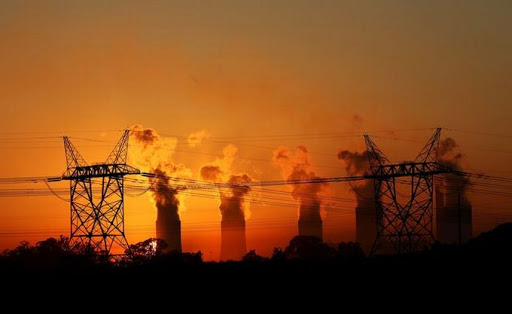
Eskom and Zimbabwe’s government had been locked in talks for weeks to strike a power deal, as Zimbabwe is currently experiencing a severe power shortage with load shedding of up to 18 hours a day.

The power crisis has forced some Zimbabwean companies to shut down, further worsening the country’s economic crisis.

Zimbabwe’s energy minister, Fortune Chasi, has been in SA to plead for urgent power supplies from Eskom.

Addressing journalists after a cabinet meeting, acting energy minister Sekai Nzenza said Eskom had come to Zimbabwe’s rescue.

“On the measures to plug power outages, I can report that the Zimbabwe Electricity and Tariff Distribution Company (ZETDC) has engaged a local bank to the tune of a $15m guarantee to unlock supply of 400MW of power from Eskom.”

Zimbabwe currently owes about R327m to Eskom. It recently paid R140.2m to service its total debt after action was taken to cut the supply.

However, Zimbabwe has a bad record of servicing its debt, and its government was forced to provide a bank guarantee to Eskom for the deal to be done.

Nzenza said: “At the same time, the ZETDC and the RBZ have also agreed with Eskom on a payment plan. These initiatives that have been put in place will enable us to have more power.”

She also revealed that Zimbabwe’s overall power shortfall stands at 582MW, adding that mining companies can pay for electricity in foreign currency to guarantee supplies.

Electricity is critical for Zimbabwe’s mining sector, the nation’s biggest foreign currency earner.

Zimbabwe has previously imported up to 450MW from Eskom, but the SA power utility stopped the arrangement after Harare defaulted on its payments.

Earlier in July, President Cyril Ramaphosa agreed to assist Zimbabwe to solve its power challenges after meeting his counterpart, Emmerson Mnangagwa, on the sidelines of the African Continental Free Trade Area summit in Niger. After the meeting Ramaphosa told journalists he was willing to assist Zimbabwe but would engage Eskom.

Citizens Transitional Dialogue and Mobilization Campaign
Soaring fuel prices and stagnant wages squeeze Zimbabweans

Post published in: Business

Soaring fuel prices and stagnant wages squeeze Zimbabweans – The Zimbabwean

Buses in Harare queue to fill up with diesel, before fuel prices in Zimbabwe rise again [Chris Murzoni/Al Jazeera]

Harare, Zimbabwe – A kilometre-long queue of some 200 commuter buses winds its way around a block of the central business district in Harare, terminating at the forecourt of a petrol station.

Its 11:42am and an imposing steel gate acts as a barricade between the line of customers with near-empty tanks and the petrol that they need.

“I have been in the queue since 7am,” Blessing Mudzonga, a bus driver, tells Al Jazeera.

“I followed the tanker [a petroleum delivery truck] here and my hunch was right,” he says with a smile.
Other bus drivers, seeing their colleagues waiting patiently, arrive to join the queue.

“Diesel is just so expensive,” Mudzonga tells Al Jazeera. “When we buy at seven Zimdollars per litre ($0.78) and charge two Zimdollars ($0.22) per passenger for an 18-kilometre trip, it means all the money we charge ends up covering fuel costs.”

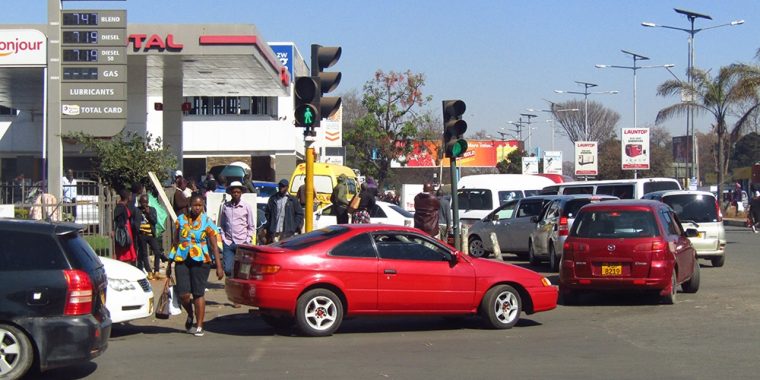
Fuel has been in short supply in Zimbabwe for almost a year. Beyond tight supply, worsening inflation is adding extra urgency to fill up tanks before prices jump again.

Consumer prices in the economically troubled Southern African nation rose 39.9 percent in June compared with 12.54 percent in May, narrowly missing a return to the dreaded hyperinflationary environment that ravaged Zimbabwe’s economy at the end of the last decade.

Diesel and petrol prices have shot up by as much as 522.37 percent since January as the local currency, the Zimdollar, has weakened against the United States dollar.

Last week alone, Zimbabwean authorities hiked fuel prices by more than 22 percent over the previous week. And that was a tiny jump compared with January, when authorities raised fuel prices 150 percent in a week, triggering violent protests.

As fuel prices spiral ever-upward, professional drivers and motorists face increasingly tough decisions.

“Sometimes we spend a whole day in queues and then we work for a day,” says Mudzonga. “The next day we are looking for fuel again. It’s affecting my job in a big way.”

A currency that can’t keep up

Zimbabwean dollars – or Zimdollars- are the only legal tender in the country since June, when the government outlawed the use of US dollars and other foreign currencies in local transactions.

The government initiated the drastic measure to stem speculative attacks on its domestic currency. But that currency continues to lose value.

At official, interbank exchange market rates, roughly 8.9 Zimdollars buys $1. The black market rates value the Zimdollar even lower, at around 10.5 Zimdollars to $1.

Compounding the pain of a weakening currency are wages, which have failed to keep pace with rising prices.

“The fuel price is very expensive given that our salaries are losing value against the US dollar,” Julius Muteiwa, a driver for a Harara publishing company, told Al Jazeera. “In fact, now it’s beyond the reach of many. Prices are just going up, but salaries remain stagnant.”

Until last October, the Zimdollar was pegged to the US dollar, in effect denominating wages and salaries in US greenbacks. But when the US dollar peg was abandoned, wages weren’t adjusted to compensate for the rapid weakening of the Zimdollar.

The discrepancy is a growing source of pain for Zimbabweans.

“One hundred litres of fuel cost close to 800 Zimdollars against the average (monthly) salary of 600 Zimdollars in this country,” said Muteiwa, “and the price of fuel is going to keep rising as the local currency weakens. If I was earning US dollars, then I would be better off.”

For many motorists in Zimbabwe, wages have not kept pace with rising fuel prices [Chris Muronzi/Al Jazeera]

Despite this latest round of fuel-price increases, at roughly 7.47 Zimdollars a litre ($0.99 at the official exchange rate), petrol has become relatively cheap in Zimbabwe compared with neighbouring countries.

Finance minister Mthuli Ncube last week highlighted the regional discrepancy, saying he wanted to see fuel cost around $1 a litre – which is where it’s currently selling.

For those who have US dollars to spend, rising prices don’t hurt as much – especially for people who trade US dollars on the black market, which literally offers more bank for the buck than the managed, interbank exchange market.

But for Zimbabweans who get paid in Zimdollars – and who don’t have foreign currency to trade – the pain of rising prices could become more severe, say economists.

“When we were still using the US dollars, we were paying $1.43 per litre. In light of that, we should expect the fuel price to rise beyond current prices,” economist John Robertson of Robertson Economics told Al Jazeera. “More price increases are definitely coming.”

Robertson added that fuel prices are just a symptom of a much wider problem the government faces with correctly pricing state-subsidized essential goods.

“It’s not just the price of fuel that is not right. Electricity prices are not right. Prices of goods are not right. We have got to get the pricing right,” he said.

But establishing the “right price” would require the official, interbank market exchange rates to converge with black market rates. While that happened briefly in June following the government ban on foreign currencies, the interbank market and black market rates soon diverged again.

“Convergence will come when there is a balance of demand and supply,” said Robertson. “I am not sure that is going to happen soon.”

And while the government tries to restore faith in its embattled Zimdollar, Zimbabweans whose livelihoods rise and fall with the price of fuel have a very precarious journey ahead.

“After the increase of this week, I tried to increase the fare for local trips to 20 Zimdollars from 15, but no one is willing to hire the cab at that price,” Edza Munari, a Harare cab driver, told Al Jazeera. “They would rather walk. As such, I have been forced to revert to my old price, and that price doesn’t make sense.”

Trump Nominates Kavanaugh Defender Who Was Still In Law School During Obama’s Presidency

As soon as this guy can say: ‘Maybe somebody else tried to rape her,” Mitch McConnell will have a job for him. (image via Getty)

Justin Reed Walker is a Donald Trump judicial nominee to fill a seat in the Western District of Kentucky, Mitch McConnell’s home state. His confirmation hearing is scheduled for tomorrow. As I can tell, the man’s only qualification for being a federal judge is that he defended Brett Kavanaugh in the media, a lot.

Walker graduated from Harvard Law School in 2009. After that he clerked for (wait for it) Brett Kavanaugh on the D.C. Circuit Court of Appeals. After that, he clerked for Anthony Kennedy on the U.S. Supreme Court. After that… well there hasn’t really BEEN much after that because Trump and McConnell are nominating a judge who is a mere ten years out of law school.

Does he have a record of judicial opinions? No, he’s never been a judge.

Does he have significant legal scholarship to speak of? No, he’s only been a professor at the University of Louisville for four years.

Does he have significant litigation or practitioner experience? No, but he did summer at Gibson Dunn and went back there for a year after his SCOTUS clerkship, probably just to get his clerkship bonus before he bounced.

What makes this 39-year-old white man deserving a job from which he can never be fired? Well, according to his judicial questionnaire, homeboy was all over the Kavanaugh hearings. He wrote articles, did radio hits, and got on the T.V. to talk about how great of a guy Brett Kavanaugh is and how unfair people were being to the man accused of attempted rape and perjury. Here’s just a glimpse of his Kavanaugh fawning:

Judge Brett Kavanaugh should be the next Supreme Court justice. He has by far the strongest, most consistent, most fearless record of constitutional conservatism of any federal court of appeals judge in the country.

Over 12 years and 300 opinions, he has repeatedly fought for principles of textualism and originalism, reined in regulatory overreach, and ensured that administrative bureaucrats are accountable to the elected president. Nominating Kavanaugh would continue President Trump’s exemplary record of selecting the best-qualified person for the Supreme Court, as he did with his brilliant choice of Justice Neil Gorsuch.

I wouldn’t write such saccharine tripe about my wife, and if I did she’d lose respect for me.

In any event, we know how the Republican game works: defend Brett Kavanaugh, get a law job, for you or your family member. I swear to God, if F.B.I. director Christopher Wray ever retires, they’re going to give the job to Ed Whelan.

But there’s another trend going on here, and that is the Trump/McConnell insistence that new federal judges be as young as possible, so that they may promote the Republican agenda long into a future that will be politically run by Millennials. We saw this with Allison Jones Rushing, who was placed on the Fourth Circuit despite having only seven years of actual legal practice under her belt. And we’re seeing it here with Walker who is only 39 and has done nothing of professional note.

Prince William, Duke of Cambridge is also 39 years old. Even he will have to wait longer than Justin Walker before being allowed to wield unaccountable power for the rest of his natural life.

Undoing what Trump and McConnell have done to the courts will take a generation of work.


Elie Mystal is the Executive Editor of Above the Law and a contributor at The Nation. He can be reached @ElieNYC on Twitter, or at elie@abovethelaw.com. He will resist.

Breaking Down The Mueller Hearings

Robert Mueller (Photo by SAUL LOEB/AFP/Getty Images)

Joe and Elie watched some of these hearings everyone’s talking about and break down some of the key legal issues that got lost in the spectacle. This is just what happens when a careful, conscientious attorney tries to talk to a bunch of local dry cleaner magnates who’ve managed to fall backward into Congress and then it all gets ciphered by talking heads churning a 24-hour news cycle.

Graduates Of This Law School Don’t Have Much Luck Passing The Bar Exam

(Image via Getty)

According to data collected by the Internet Legal Research Group, which law school has the lowest bar passage rate (the data was collected collected for the Class of 2017 and the passage rate reflects first-time test takers for the summer 2017 and winter 2018 administrations of the bar examinations)?

Hint: This law school’s bar passage rate didn’t even crack 30 percent, it was a measly 29.2 percent.

See the answer on the next page.