The Biggest Law Firm Partnership Class Ever – Above the Law

Business
man’s
hand
reaching
for
the
brass
ring


Ed.
Note
:
Welcome
to
our
daily
feature

Trivia
Question
of
the
Day!


According
to
SurePoint
Technologies’s

2025
State
of
the
Legal
Industry
Report
,
how
much
bigger
was
last
year’s
partnership
class
over
the
previous
year?


Hint:
2025
was
the
largest
partnership
class
ever
recorded…
which
probably
has
a
lot
to
do
with
the
increase
of
nonequity
partnership
ranks
across
the
industry.


See
the
answer
on
the
next
page.

The Laws Of Unintended Consequences – Above the Law

(Image
via
Getty)

Do
you
ever
feel
that
sometimes
the
law
uses
a
sledgehammer
to
kill
a
gnat?
Here’s
a
recent
example,
resulting
from,
yes,
another
fallout
from
the
Tom
Girardi
crash
and
burn.
For
those
who
have
fortunately
forgotten,
Girardi
was
the
hotshot
California
plaintiff’s
lawyer
who
stole
client
settlements
from
various
tort
cases
while
living
a
lavish
lifestyle
beyond
the
means
of
many
of
us.
(Apologies
to
my
editor
who
thought
that
a
stake
had
been
driven
through
the
heart
of
that
matter,
once
and
for
all,
but
it’s
the
case
that
keeps
on
giving,
at
least
for
the
California
Legislature,
the
State
Bar,
and
California
lawyers.)

Several
years
back,
there
was
quite
a
bit
of
consternation
that
some
retired
judges,
acting
as
arbitrators
or
mediators,
palsy-walsy
with
Girardi
in
his
heyday,
were

selected
as
arbitrators
or
mediators
for
Girardi’s
cases
.
The
Los
Angeles
Times
did
extensive
(and
cringeworthy)
reporting
on
the
coziness
between
Girardi
and
these
retired
judges,
calling
it
the
“secretive
world
of
private
judges.”
No
one
mentioned
in
the
reporting
came
out
looking
good.
 

The
Legislature,
seizing
any
opportunity
to
stick
it
to
the
State
Bar,
decided
that
it
was
time
to
call
for
the
certification
of
alternative
dispute
resolution
(ADR)
professionals,
whether
retired
judges,
lawyers,
or
nonlawyers,
whether
arbitrators.
mediators,
or
both,
and
to
regulate
ADR
providers.
Effective
January
1,
2025,
new
Business
and
Professions
Code
section
6173
required
the
State
Bar
to
create
a
voluntary
certification
program
for
ADR
firms,
providers,
and
practitioners.
But
just
how
“voluntary”
is
it
really
if
the
State
Bar
bestows
“certified”
on
compliant
ADR
practitioners?
And
how
many
retired
judges
and
longtime
ADR
practitioners
will
be
willing
to
go
through
the
certification
process,
even
if
less
of
a
hassle?
And
what
edge
will
“certification”
provide,
if
any?

The
laudable
goal?
“Promote
adherence
to
ethical
standards
for
ADR
services
and
establish
consumer
protection
mechanisms.”
Will
the
State
Bar
be
able
to
handle
consumer
complaints
as
efficiently
just
as
they
have
done
in
the
past?
Please.
Given
its
record,
I
wonder.

The
State
Bar
established
a
working
group
to
figure
out
what
certification
should
look
like,
the
requirements
for
it,
continuing
education
requirements,
and
so
on.
The
ADR
working
group
has
released
its
proposals
with
comments
accepted
until
the
end
of
April.
Has
anyone
ever
said
that
regulation
begets
more
regulation?
If
not,
let
me
be
the
first.
The
proposals
run

more
than
100
pages
.

The
fallout
from
Girardi
continues
in
proposed
legislation
pending
in
Sacramento.
The
Consumer
Attorneys
Association
of
California,
a
plaintiff’s
bar
trade
group,
favors
two
legislative
proposals.
One
prohibits
attorneys
from

illegally
soliciting
clients

(e.g.,
capping

but
I
learned
about
the
prohibition
against
capping
more
than
50
years
ago). There
are
other
provisions
in
AB
2039,
but
the
one
getting
the
attention
of
the
trade
group
is
the
provision
that
would
revoke
the
bar
license
of
an
attorney
with
a
felony
capping
conviction.
Capping
is
a
“wobbler.”
It
can
either
be
a
misdemeanor
or
a
felony,
depending
on
how
it’s
charged.
How
many
capping
cases
are
criminally
prosecuted
rather
than
in
the
context
of
bar
discipline?
How
many
attorneys
are
convicted
of
felony
capping
every
year? 

This
trade
association
wants
to
help
to
get
rid
of
bad
lawyers.
Don’t
we
all?
Our
reputation
is

pretty
much
a
dumpster
fire
.
The
LA
Times
recently
wrote
about
one
downtown
LA
law
firm
that
is
alleged
to
have
paid
“clients”
to
file
claims
in
LA
County’s
multibillion-dollar
sexual
abuse
settlement.
The
State
Bar,
among
other
agencies, is
now
investigating
the
firm.

The

other
measure

that
the
Consumer
Lawyers
Association
wants
passed
is
a
bill
that
would
preclude
“private
equity
firms
and
hedge
funds
from
dictating
case
strategy
after
giving
money
to
a
law
firm.”
  

How
are
you
going
to
know
that?
Would
that
be
discoverable
or
would
such
a
case
strategy
be
subject
to
the
attorney-client
privilege
or
attorney
work
product?
How
would
you
prove
that
a
funder
was
running
the
case
strategy
and
not
the
lawyer? 

The
claim
is
that
the
intent
of
both
bills
is
to
“crackdown”
on
the
legal
profession’s
bad
actors.
That’s
stating
the
obvious.
Where
have
we
heard
that
before?
Meanwhile,
Tom
Girardi,
now
close
to
90
and
suffering
from
dementia,
who
bears
responsibility
for
the
seemingly
never-ending
cascade
of
consequences,
intended
or
not,
is
currently
serving
more
than
seven
years
in
a
Minnesota
federal
medical
facility.
It’s
left
to
others
(us)
to
clean
up
the
mess
he
made,
not
just
to
his
clients,
but
to
the
profession
he
betrayed.


Jill
Switzer
has
been
an
active
member
of
the
State
Bar
of
California
for
over
40
years.
She
remembers
practicing
law
in
a
kinder,
gentler
time.
She’s
had
a
diverse
legal
career,
including
stints
as
a
deputy
district
attorney,
a
solo
practice,
and
several
senior
in-house
gigs.
She
now
mediates
full-time,
which
gives
her
the
opportunity
to
see
dinosaurs,
millennials,
and
those
in-between
interact

it’s
not
always
civil.
You
can
reach
her
by
email
at 
[email protected].

How Savvy Lawyers Balance AI Innovation With AI Responsibility – Above the Law

From
document
review
to
legal
research,
AI
tools
promise
increased
efficiency
and
reduced
costs. 

But
as
law
firms
rush
to
adopt
these
technologies,
an
important
question
arises:
Are
we
sacrificing
long-term
expertise
for
short-term
gains?

In
a
recent
episode
of Adventures
in
Legal
Tech
,
attorney
Harshita
Ganesh
joins
host
Jared Correia for
a
nuanced
discussion
of
AI
adoption
in
law
firms. 


The
Rise
of
“Shadow
AI”

One
of
the
most
concerning
trends
in
law
firms
today
is
the
rise
of
“shadow
AI.”

Junior
associates,
often
overwhelmed
by
heavy
workloads
and
tight
deadlines,
are
turning
to
unauthorized
AI
tools
to
manage
their
responsibilities.
Here,
Harshita
weighs
in
on
the
problem. 


The
Risk
of
Cognitive
Offloading

AI
excels
at
handling
repetitive
tasks,
but
not
all
tasks
should
be
automated.

Harshita
says
that,
over
time,
this
can
lead
to
a
generation
of
attorneys
who
lack
the
depth
of
understanding
needed
for
high-level
strategy
and
decision-making.


A
Better
Approach
to
AI
Adoption

Instead
of
rushing
into
full-scale
implementation,
Harshita
advocates
for
a
gradual
and
thoughtful
approach.

Importantly,
the
focus
is
not
on
replacing
people

but
on
redefining
roles.
Here,
Harshita
explains
her
approach. 


The
Future
of
Legal
Practice

AI
is
neither
a
threat
nor
a
solution
on
its
own.

Its
impact
will
depend
on
how
law
firms
choose
to
integrate
it
into
their
workflows.
Those
that
prioritize
balance—between
efficiency
and
education,
automation
and
judgment—will
be
best
positioned
to
succeed.

The
future
of
law
is
not
just
about
smarter
tools.
It’s
about
smarter
implementation.


See
the
Full
Discussion

Stop Networking. Start Showing Up. – Above the Law

There’s
a
question
young
lawyers
ask
all
the
time,
usually
a
few
years
into
practice,
when
the
work
is
steady,
but
the
future
starts
to
feel
uncertain:
how
do
I
bring
in
business?
What
they’re
really
asking
is
how
to
take
control
of
their
careers,
how
to
stop
relying
entirely
on
others
for
work,
and
how
to
build
something
that
feels
like
their
own.

They
are
often
hoping
for
something
tactical.
A
script.
A
pitch.
A
formula
they
can
follow
at
a
conference
or
over
lunch
that
will
convert
a
conversation
into
a
client.
They
want
to
know
what
to
say,
how
to
say
it,
and
when
to
say
it.
That
instinct
is
understandable.
Law
school
trains
you
to
look
for
the
right
answer,
the
clean
rule,
the
reliable
framework.
But
business
development
does
not
work
that
way.
There
is
no
single
conversation
that
changes
everything.
There
is
no
magic
line
that
consistently
lands
work.

What
actually
works
is
slower,
less
exciting,
and
far
more
reliable.
Business
development
is
not
an
event.
It
is
a
pattern.
It
is
the
accumulation
of
small
moments,
handled
well,
over
a
long
period
of
time.
Most
lawyers
do
not
fail
at
business
development
because
they
lack
ability
or
intelligence.
They
fail
because
they
are
looking
for
something
immediate
in
a
process
that
only
pays
off
over
time.

Much
of
the
confusion
stems
from
how
lawyers
picture
rainmaking.
They
imagine
a
decisive
moment.
A
meeting
where
everything
clicks.
A
pitch
that
lands
perfectly.
But
meaningful
work
almost
never
comes
from
a
single
interaction.
It
comes
from
familiarity.
It
comes
from
someone
seeing
you
operate
over
time
and
deciding,
often
without
announcing
it,
that
you
are
someone
they
trust.
By
the
time
the
work
comes
your
way,
the
decision
has
already
been
made.
You
are
just
the
last
call
they
make,
not
the
first.

That
is
why
the
idea
of
the
“big
pitch”
is
so
misleading.
Lawyers
spend
time
trying
to
perfect
what
they
will
say
when
the
opportunity
comes,
instead
of
focusing
on
what
actually
creates
the
opportunity.
No
one
hires
a
stranger
based
on
a
polished
introduction.
They
hire
someone
who
has
been
present,
reliable,
and
competent
in
ways
that
feel
consistent.
If
someone
has
seen
you
handle
a
matter
well,
communicate
clearly,
and
make
their
life
easier,
you
do
not
need
a
pitch.
You
have
already
done
the
work
that
matters.

The
part
that
many
lawyers
overlook
is
that
they
are
already
marketing
themselves
every
day.
It
is
not
something
separate
from
the
practice.
It
is
the
practice.
Every
email
you
send,
every
call
you
take,
every
deadline
you
meet
or
miss,
every
interaction
with
a
client,
a
partner,
or
opposing
counsel
contributes
to
your
reputation.
That
reputation
is
not
built
in
large
gestures.
It
is
built
in
small,
repeated
actions
that
signal
how
you
operate.
You
do
not
get
to
turn
that
on
when
you
want
to
focus
on
business
development.
It
is
always
on.

That
means
the
first
place
to
look
is
not
outside
your
firm
or
your
existing
circle.
It
is
right
in
front
of
you.
The
partners
you
work
with
are
watching
how
you
handle
responsibility.
Clients
are
forming
opinions
about
whether
you
make
things
easier
or
harder.
Opposing
counsel
are
noting
whether
you
are
reasonable,
prepared,
and
professional.
These
are
the
people
most
likely
to
send
you
work
down
the
line.
Not
because
you
asked,
but
because
they
have
already
seen
enough
to
make
a
decision
about
you.

If
those
people
do
not
trust
you
yet,
more
networking
will
not
fix
that.
More
events
will
not
fix
that.
A
better
online
presence
will
not
fix
that.
The
foundation
of
business
development
is
competence
and
reliability.
Without
that,
everything
else
is
noise.
With
it,
everything
else
becomes
easier.

Another
common
mistake
is
that
lawyers
try
too
hard
to
sound
impressive.
They
use
more
words
than
necessary.
They
default
to
jargon.
They
try
to
demonstrate
how
much
they
know
rather
than
focus
on
whether
they
are
helpful.
Clients
are
not
looking
to
be
impressed.
They
are
looking
to
solve
problems.
They
want
someone
who
responds,
listens,
gives
clear
answers,
and
reduces
uncertainty.
If
you
can
do
that
consistently,
you
will
stand
out
more
than
the
lawyer
who
delivers
the
most
polished
explanation.

Being
useful
is
not
complicated,
but
it
requires
discipline.
Return
calls.
Answer
the
question
that
was
asked.
Do
not
bury
the
answer
in
a
long
explanation.
Anticipate
the
next
issue
and
address
it
before
it
becomes
a
problem.
Keep
people
informed
so
they
are
not
left
to
guess
what
is
happening
in
their
case.
These
are
not
advanced
skills.
They
are
basic
habits.
But
they
are
rare
enough
that
when
you
do
them
well,
people
notice.

Consistency
matters
more
than
intensity.
Many
lawyers
approach
business
development
in
bursts.
They
attend
a
few
events,
set
up
several
lunches,
post
frequently
for
a
short
period
of
time,
and
then
stop
when
the
work
picks
up
or
the
effort
feels
forced.
That
approach
does
not
build
anything
durable.
Relationships
do
not
form
in
clusters
of
activity
followed
by
long
silence.
They
form
through
regular,
low-pressure
contact
over
time.

A
better
approach
is
quieter
and
more
sustainable.
Stay
in
touch
with
people
you
already
know.
Check
in
without
an
agenda.
Share
something
that
might
be
useful
or
relevant
to
them.
Congratulate
them
when
something
goes
well.
Make
time
for
occasional
conversations
that
are
not
tied
to
immediate
work.
None
of
this
is
dramatic,
but
over
time
it
creates
familiarity.
And
familiarity,
when
paired
with
competence,
leads
to
trust.

There
is
also
a
tendency
to
focus
too
much
on
the
most
senior
people
in
the
room.
Lawyers
often
chase
partners,
general
counsel,
or
executives,
assuming
that
those
relationships
will
lead
directly
to
work.
Sometimes
they
do,
but
more
often
those
efforts
are
premature.
Senior
people
already
have
established
networks.
They
rely
on
people
they
have
known
for
years.
Breaking
into
that
circle
takes
time
and
usually
happens
through
someone
they
already
trust.

The
better
investment
is
in
your
peers.
The
lawyers
and
professionals
at
your
level
are
the
ones
who
will
grow
alongside
you.
They
will
change
jobs,
move
in-house,
take
on
leadership
roles,
and
remember
the
people
who
were
around
them
early
in
their
careers.
Those
relationships
feel
more
natural
because
they
are
not
transactional.
You
are
not
trying
to
extract
something
from
each
other.
You
are
simply
building
a
professional
friendship
that,
over
time,
may
turn
into
something
more.

All
of
this
can
feel
slow,
especially
in
a
profession
that
measures
progress
in
hours
billed
and
results
achieved.
But
business
development
does
not
follow
that
timeline.
It
requires
patience
and
a
willingness
to
invest
in
relationships
without
immediate
return.
That
is
uncomfortable
for
many
lawyers
because
it
feels
uncertain.
There
is
no
clear
metric
that
tells
you
it
is
working.
There
is
no
immediate
feedback
loop.

But
if
you
stay
with
it,
the
pattern
becomes
clear.
People
start
reaching
out
with
small
opportunities.
A
question.
A
referral.
A
matter
that
does
not
quite
fit
someone
else’s
practice.
Those
small
opportunities
are
not
random.
They
are
the
result
of
the
reputation
you
have
been
building
quietly.
If
you
handle
them
well,
they
lead
to
larger
opportunities.
If
you
do
not,
they
stop.

At
some
point,
if
you
have
done
this
long
enough,
you
will
notice
that
the
question
changes.
Instead
of
asking
how
to
bring
in
business,
you
will
be
deciding
which
opportunities
to
pursue.
That
shift
does
not
happen
because
you
learned
a
better
pitch.
It
happens
because
you
became
someone
people
think
of
when
they
need
help.

There
is
no
shortcut
to
that.
There
is
no
substitute
for
time
and
consistency.
The
lawyers
who
succeed
in
business
development
are
not
necessarily
the
most
charismatic
or
the
most
outgoing.
They
are
the
ones
who
show
up,
do
the
work
well,
treat
people
right,
and
stay
connected
over
the
long
term.

If
you
want
to
build
a
practice,
focus
less
on
finding
new
people
and
more
on
becoming
someone
worth
finding.
Do
good
work.
Be
responsive.
Make
things
easier
for
the
people
you
deal
with.
Stay
in
touch
without
always
asking
for
something.
Help
where
you
can.
Let
that
compound
over
time.

It
is
not
complicated.
It
is
just
not
fast.


Frank
Ramos
is
a
partner
at
Goldberg
Segalla
in
Miami,
where
he
practices
commercial
litigation,
products,
and
catastrophic
personal
injury. You
can
follow
him
on LinkedIn,
where
he
has
about
80,000
followers
.

Biglaw’s FOMO Talent Anxiety Now Comes With $50K Signing Bonuses For 1Ls – Above the Law


Ed.
note
:
Welcome
to
our
daily
feature, Quote
of
the
Day
.


I’ve
talked
to
a
few
friends
whose
firms
wanted
to
hold
out,
but
they
felt
like
they
had
to
give
in
because
they
weren’t
getting
the
candidates
they
wanted
and
they
were
afraid
of
losing
out
to
other
firms.
[The
stipends
are]
a
signing
bonus
wrapped
up
in
public
interest.


— 
A
Biglaw
talent
professional,
in
comments
given
to

Law.com

under
the
condition
of
anonymity,
concerning
the

public
interest
stipends

for
1L
students
who
have
been
accepted
into
Biglaw
firms’
2L
summer
associate
programs.
At
least
15
Am
Law
100
firms
have
offered
students
amounts
ranging
from
$25,000
to
$50,000
as
a
way
to
retain
talent.


Staci
Zaretsky
 is
the
managing
editor
of
Above
the
Law,
where
she’s
worked
since
2011.
She’d
love
to
hear
from
you,
so
please
feel
free
to email her
with
any
tips,
questions,
comments,
or
critiques.
You
can
follow
her
on BlueskyX/Twitter,
and Threads, or
connect
with
her
on LinkedIn.

DOJ Agrees To Let Michael Flynn Loot Treasury To The Tune Of $1.25M – Above the Law

(Photo
by
Alex
Wroblewski/Getty
Images)

Two
years
ago,
a
court
in
Florida
threw
out
Michael
Flynn’s
malicious
prosecution
lawsuit
seeking
$50
million
from
the
US
government.
Yesterday,
the
government
agreed
to
settle
it
anyway,
handing
$1.25
million
in
taxpayer
dollars
to
the
former
national
security
advisor.

Clearly
this
is
an
outrageous
abuse
by
the
Trump
DOJ.
It’s
also
a
template
for
the
looting
to
come,
as
everyone
from
Proud
Boy
Enrique
Tarrio
to
Trump
himself
lines
up
to
feed
at
the
government
trough.

During
the
2016
transition,
outgoing
President
Obama

warned

Trump
that
General
Michael
Flynn
was
untrustworthy.
Trump
wrote
this
off
as
sour
grapes
and
changed
history.

If
Flynn
hadn’t
been
on
Trump’s
team,
he
wouldn’t
have
gotten
picked
up
on
a
FBI
wiretap
promising
sanctions
relief
to
Russian
Ambassador
Sergei
Kislyak.
If
he
hadn’t
been
compromised
by
that
communication,
the
FBI
wouldn’t
have
gone
to
ask
him
about
it.
If
he
hadn’t
lied
to
the
FBI,
he
wouldn’t
have
wound
up
in
the
middle
of
the
Crossfire
Hurricane
investigation.
If
Trump
hadn’t
asked
FBI
Director
Comey
to
kill
that
investigation
and
then
fired
him
for
refusing,
there’d
be
no
Special
Counsel
Robert
Mueller.
And
without
Mueller,
Flynn
wouldn’t
have
gotten
indicted
for
lying
to
the
FBI.


But
he
did,
and
here
we
all
are.

Flynn
pleaded
guilty
to
making
false
statements
to
the
FBI
in
December
2017.
Then,
at
a
December
2018
plea
colloquy,
he
did
it
again,
affirming
under
oath
a
second
time
that
he
was
guilty
and
that
his
plea
was
voluntary.
But
Judge
Emmet
Sullivan
refused
to
accept
that
plea,
ordering
him
to
go
back
and
earn
it
by
cooperating

a
whole
lot
more

in
the
prosecution
of
his
former
business
partner
Bijan
Rafiekian
on
charges
of
secretly
lobbying
for
the
Turkish
government.

(There’s
another

what
if

to
add
to
the
pile.)

Instead
Flynn
ditched
his
Covington
lawyers
in
favor
of
a
MAGA
hothead
named
Sidney
Powell.
She
persuaded
him
to
withdraw
his
plea
and
began
lobbying
Attorney
General
Bill
Barr
to
drop
the
case.
In
May
of
2020,
the
DOJ
moved
to
dismiss
pursuant
to
FRCrP
48(g).
A
furious
Judge
Sullivan
balked
and
appointed
an
amicus
to
argue
against
dismissal,
and
the
whole
thing
ultimately
became
moot
when
Trump
pardoned
Flynn
in
November
2020.

In
2023,
Flynn
filed
a
Federal
Tort
Claims
Act
complaint
in
the
Middle
District
of
Florida,
seeking
$50
million
for
malicious
prosecution
and
abuse
of
process.
The
case
was
defective
in
every
conceivable
way:
It
was
time-barred.
It
ignored
sovereign
immunity.
It
was
filed
by
Kraken
lawyer
Jesse
Binnall.

But
Flynn
lucked
out,
because
he
landed
on
the
docket
of
Judge
Mary
Scriven.
Scriven
is
a
Biden
appointee,
and
she
was
never
going
to
let
this
case
go
to
trial.
By
then,
she’d
already
dismissed
a
defamation
lawsuit
filed
by
Flynn’s
sister-in-law
against
CNN.
But
Judge
Scriven
is
no
one’s
idea
of
a
racehorse.
She
moves
slowly,
and
she
bends
over
backward
to
let
litigants
have
their
say.
In
December
of
2024,
she

dismissed

the
case
for
being
hopelessly
defective

although
she
failed
to
reach
the
issue
of
statute
of
limitations

but
allowed
Flynn
to
amend
his
complaint
again.
Which
is
how
Flynn
wound
up
dragging
out
the
process
to
file
a
third
complaint

and
for
Trump
to
get
back
into
the
White
House.

In
September,
the
parties
filed
a

joint
motion

to
extend
time
for
the
government
to
respond,
citing
ongoing
settlement
negotiations.
And
on
March
25,
they
announced
they’d

agreed

to
a
payout.

ABC

was
first
to
report
that
Flynn
will
take
home
$1.25
million
for
his
troubles.

Naturally,
the
DOJ
cast
this
as
a
great
victory
for
Trump
himself.

“Those
who
instigated
the
Russia
Collusion
Hoax
and
Crossfire
Hurricane
abused
their
power
to
mislead
the
American
people
and
tarnish
the
reputations
of
President
Trump
and
his
supporters,”
crowed
a
DOJ
spox
who
would
prefer
to
remain
anonymous,
for
obvious
reasons.
“Today’s
settlement,
secured
by
this
Justice
Department,
is
an
important
step
in
redressing
that
historic
injustice.”

This
looting
of
the
public
fisc
will
likely
continue.
Trump’s
DOJ
has
already
paid
$5
million
to
the
family
of
Ashli
Babbitt,
the
January
6
rioter
shot
while
trying
to
break
into
the
House
Speaker’s
Lobby.
Several
of
the
Proud
Boys
including
their
leader
Enrique
Tarrio,
have
filed
a


Bivens

suit
.
Not
content
with
their
pardon,
they
now
want
a
payout.
And
of
course
Trump
himself
has
filed
a
FTCA
claim,
demanding
$230
million
from
the
Justice
Department
over
the
Mar-a-Lago
search
and
the
special
counsel
investigations.
Trump
acknowledged
the
absurdity
himself,
telling
reporters,
“I’m
sort
of
suing
myself.
I
don’t
know,
how
do
you
settle
the
lawsuit.”

The
Flynn
settlement
is
the
proof
of
concept.
The
answer
to
“how
do
you
settle
the
lawsuit”
is
apparently
“however
the
president
wants.”


Liz
Dye
 produces
the
Law
and
Chaos Substack and podcast.
 You
can
subscribe
by
clicking
the
logo:


Exclusive: Smokeball and Thomson Reuters Partner to Integrate CoCounsel Legal AI with Practice Management Platform


Smokeball
,
the
cloud-based
practice
management
platform
serving
small
to
mid-sized
law
firms,
and

Thomson
Reuters

announced
a
strategic
partnership
today
that
will
embed
Thomson
Reuters’
CoCounsel
Legal
AI
into
Smokeball’s
practice
management
software

a
combination
the
companies
say
brings
together
deep
legal
content
and
advanced
AI
capabilities
with
broad
practice
management
functionality
in
a
way
that
has
not
existed
before
in
the
small
firm
market.

The
partnership
represents
a
significant
move
in
the
convergence
of
practice
management
and
legal
research

something
that
the
industry
first
saw
last
year
with
Clio’s
acquisition
of
vLex.
But
rather
than
acquiring
a
legal
research
provider
outright,
Smokeball
has
opted
for
a
partnership
approach
that
allows
both
companies
to
focus
on
their
core
strengths.

Perhaps
more
importantly,
it
also
represents
another
example
of
legal
technology
providers
striving
to
unite
the
business
and
practice
of
law
within
a
single
platform.
The
integration
will
connect
Smokeball’s
practice
management
tools
with
CoCounsel
Legal,
Thomson
Reuters’
agentic
AI
solution
that
provides
legal
research
through
its
Deep
Research
capability,
document
analysis
and
drafting
functionality.

“No
other
combination
of
technology
in
the
small
to
mid-size
law
firm
market
brings
together
this
depth
of
legal
content
and
AI
capability
with
this
breadth
of
practice
management
functionality,”
Smokeball
said
in
its
announcement.

Goal:
One
Seamless
Interface

In
an
interview
with
LawSites
ahead
of
the
announcement,
Smokeball
U.S.
President

Ruchie
Chadha

said
that
the
partnership
is
significant
for
bringing
together
the
business
and
practice
of
law
into
a
single,
connected
experience
for
small
and
mid-sized
firms.

“Smokeball
provides
the
operational
backbone
of
the
firm,
from
intake
through
billing,
with
Archie
AI
embedded
directly
into
matters
to
surface
insights,
draft
work,
and
answer
questions
based
on
the
firm’s
own
data
(in
a
secure
environment),”
she
said.
“Thomson
Reuters,
through
CoCounsel
Legal,
brings
best-in-class
AI-assisted
legal
research,
analysis,
and
drafting
grounded
in
Westlaw
and
Practical
Law.”

For
law
firms,
the
benefit
is
the
ability
to
leverage
AI
across
both
their
own
matter
data
and
trusted
legal
research
in
one
place,
Chadha
said.

“In
practice,
that
means
moving
seamlessly
from
managing
a
matter
to
researching,
analyzing,
and
producing
legal
work,
without
switching
between
disconnected
systems.”

How
It
Will
Work

The
initial
integration,
Chadha
told
me,
will
feature
a
real-time
data
connector
allowing
Smokeball
users
to
push
documents
into
CoCounsel
Legal
in
bulk
rather
than
uploading
them
individually.

“All
of
our
customers
will
have
the
opportunity
to
have
AI
access
all
of
their
key
matter
details
both
in
Smokeball
and
utilizing
the
legal
research,
analysis
and
drafting
from
CoCounsel,”
Chadha
said.
“It
really
takes
the
ability
to
move
the
workflow
through
and
reason
and
plan
and
execute
on
multi-layer
steps
of
legal
tasks.”

The
integration
with
CoCounsel
Legal
will
include
Westlaw
Advantage
and
Practical
Law
Dynamic
Tool
Set.

Initially,
Thomson
Reuters
will
launch
a
real-time
data
connector
that
syncs
legal
documents
across
platforms,
allowing
Smokeball
users
to
push
documents
into
CoCounsel
Legal
in
bulk
rather
than
uploading
them
one
by
one.
Documents
will
flow
directly
from
Smokeball
into
CoCounsel
Legal,
saving
time
and
reducing
the
risk
of
errors
or
version
mismatches.

The
first
phase
of
this
integration
is
targeted
for
late
spring
or
early
summer,
with
deeper
integration
across
additional
Thomson
Reuters
products
planned
throughout
the
year.

The
ultimate
goal
is
to
provide
an
experience
where
joint
customers
can
access
Thomson
Reuters
legal
content,
AI
and
know-how
tools,
combined
with
up-to-date
matter
facts
and
information
in
one
seamless
interface.

“Over
time,
our
teams
are
working
toward
a
more
deeply
integrated
experience
that
combines
Smokeball’s
practice
management
capabilities
with
Thomson
Reuters’
commanding
legal
research,
document
analysis,
and
drafting,”
Chadha
said.

To
take
advantage
of
the
integration,
users
will
have
to
be
customers
of
both
products.

Complementing,
Not
Replacing,
Archie

Smokeball
has
been
developing
its
own
generative
AI
capabilities
through
Archie,
its
matter
assistant
that
provides
document
summaries,
matter-specific
queries,
file
comparisons
and
document
drafting

all
within
a
ring-fenced
security
environment
where
client
data
is
never
shared
or
used
to
train
external
models.

Chadha
emphasized
that
the
Thomson
Reuters
partnership
complements
rather
than
competes
with
Archie.
The
key
differentiator
is
the
addition
of
CoCounsel’s
authoritative
legal
research
capabilities.

“The
main
difference
is
being
able
to
access
that
back-end
legal
research,
which
is
not
something
that
Archie
does,”
Chadha
explained.
“This
is
authoritative
legal
research
which
Archie
does
not
have.
There
is
some
overlapping
capability,
but
they’re
not
at
odds
with
each
other.
I
would
say
it
more
enhances
each
other.”

A
Partnership
Built
on
Trust

Smokeball
says
that
the
partnership
reflects
its
careful
approach
to
selecting
technology
partners,
particularly
given
the
high-stakes
nature
of
the
legal
work
its
customers
handle.

“We’re
always
very
thoughtful
about
who
we
partner
with,”
Chadha
said.
“Thomson
Reuters
has
150,
160
years
of
trusted
data.
Our
goal
is
always
to
make
sure
that
our
firms
are
able
to
deliver
outcomes
for
their
clients.
When
those
stakes
are
high
and
the
type
of
law
that
most
of
our
law
firms
do,
you
want
to
make
sure
your
answers
are
trusted,
the
research
is
good,
the
data
is
good.
Thomson
would
probably
have
been
one
of
very
few,
if
not
the
only
company
we
would
have
partnered
with
on
this
aspect.”

In
a
statement
announcing
the
partnership,

Hunter
Steele
,
Smokeball’s
CEO,
emphasized
the
operational
angle:
“By
partnering
with
Thomson
Reuters,
we’re
connecting
the
operational
layer
of
running
a
practice
with
trusted
legal
content,
analysis
and
drafting
tools.
Our
clients
will
be
able
to
get,
do,
research
and
bill
their
work
in
one
place 
—powered
by
AI
that
understands
both
the
mechanics
of
running
a
firm
and
the
substance
of
legal
work.”


Aaron
Rademacher
,
general
manager
of
small
law
firms
at
Thomson
Reuters,
framed
the
partnership
as
filling
a
market
gap:
“CoCounsel
Legal
is
an
agentic
AI
solution
purpose-built
for
legal
professionals,
and
we
partnered
with
Smokeball
because
they
provide
a
premium
practice
management
software
that’s
already
an
essential
part
of
the
operating
stack.
Together,
we’re
creating
a
solution
in
the
market
that
combines
a
premium
business-of-law
platform
with
industry-leading
practice-of-law
content
and
solutions

a
combination
that
simply
hasn’t
existed
until
now.”

Addressing
A
Persistent
Challenge

According
to
Chadha,
there
is
already
substantial
overlap
between
the
Smokeball
and
CoCounsel
user
bases,
with
several
hundred

possibly
more

Smokeball
customers
already
subscribing
to
CoCounsel
separately.
The
integration,
she
said,
will
eliminate
the
friction
of
working
across
disconnected
systems
for
these
users.

The
announcement
comes
at
an
interesting
moment
in
legal
technology,
as
the
small
law
market
sees
increased
competition
among
platforms
seeking
to
offer
comprehensive
products.

The
Clio-vLex
deal
last
year
signaled
that
practice
management
vendors
were
looking
to
expand
their
platforms
into
deeper
capabilities
for
AI
and
legal
research.
The
Smokeball-Thomson
Reuters
partnership
gets
there
a
differnt
way,
through
a
partnership
rather
than
through
an
acquisition.

For
small
and
mid-sized
firms,
the
partnership
addresses
a
persistent
challenge
they
face,
that
of
accessing
enterprise-grade
legal
research
and
AI
capabilities
comparable
to
those
at
larger
firms,
while
also
maintaining
the
operational
efficiency
of
a
modern
practice
management
platform.

“We’re
incredibly
excited
about
what
this
represents,”
Chadha
said.
“Thomson
Reuters’
content
has
long
been
the
gold
standard
in
the
industry
and
combining
that
with
Smokeball’s
platform
and
Archie
creates
a
much
more
complete
and
practical
AI
experience
for
our
law
firms.

“It
also
aligns
closely
with
what
we
stand
behind
at
Smokeball:
making
it
easier
for
attorneys
to
deliver
the
best
outcomes
for
their
clients,
while
reducing
the
burden
on
themselves
and
their
staff.”


Another Defendant Gets Caught Lying To A Judge From Behind The Wheel – Above the Law

(Image
via
Getty)

It
would
be
irresponsible
for
me
to
use
my
platform
to
tell
people
to
lie
to
judges
in
court.
But
if
you
are
going
to
lie
directly
to
a
judge,
could
you
at
least
not
be
caught
red
handed
on
Zoom
as
you’re
doing
it?
We’ve
covered
a
guy
attending
traffic
court
over
a
suspended
license
charge

while
he
was
driving
his
damned
car


this
new
story
isn’t
much
better.
Detroit
News
has
coverage:

Kimberly
Carroll
made
a
late
appearance
via
Zoom
in
33rd
District
Court
in
Woodhaven
on
Monday,
where
she
was
the
defendant
in
a
case
involving
allegedly
defaulting
on
consumer
debt.
LVNV
Funding
LLC,
a
debt
buyer
for
charged
off
consumer
debt,
brought
the
case,
claiming
damages
of
$1,788.08.

The
case
started
without
her
and
the
judge
had
already
declared
that
she
had
defaulted,
giving
LVNV
attorney
Brian
L.
Groen
what
he
came
for:
a
judgment
for
the
debt
plus
filing
and
service
fees.

But
then
they
got
a
call.
The
rest
is
comedy:

The
journey
from
the
adamant
“I’m
not
driving,
I’m
a
passenger
in
a
car”
to
the
judge’s
“Which
side
of
the
car
are
you
on?”
and
“Show
us
the
driver,
then”
is
some
of
the
best
impromptu
oral
argument
I’ve
seen
in
a
while.

The
real
question
is
how
she
made
it
through
all
that
lying
without
being
held
in
contempt
of
court!
Children
have
been

handcuffed
for
far
less

after
all.


Watch:
Michigan
Woman
Drives
Judge
To
Declare
Default

[Detroit
News]


Earlier
:

If
You
Have
To
Go
To
Court,
Try
Not
To
Livestream
Proof
Of
Guilt


Chris
Williams
became
a
social
media
manager
and
assistant
editor
for
Above
the
Law
in
June
2021.
Prior
to
joining
the
staff,
he
moonlighted
as
a
minor
Memelord™
in
the
Facebook
group Law
School
Memes
for
Edgy
T14s
.
 He
endured
Missouri
long
enough
to
graduate
from
Washington
University
in
St.
Louis
School
of
Law.
He
is
a
former
boat
builder
who
is
learning
to
swim
and
is
interested
in
rhetoric,
Spinozists
and
humor.
Getting
back
in
to
cycling
wouldn’t
hurt
either.
You
can
reach
him
by
email
at [email protected]
and
by
tweet
at @WritesForRent.

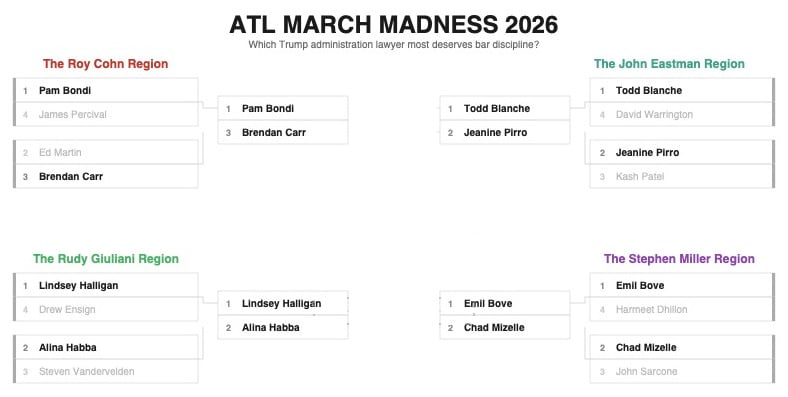
The Ethics 8: Which Trump Administration Lawyer Most Deserves To Lose Their License? – Above the Law

The
first
round
of
our
bracket
challenge
is
in
the
books
and
the
carnage
was…
mostly
non-existent.
It’s
bittersweet
for
someone
setting
up
a
tournament
because
you’re
proud
of
yourself
for
properly
seeding
the
field,
but
you
regret
not
giving
the
audience
more
excitement.
But
pour
one
out
for
Ed
Martin.
He

leaked
grand
jury
material
,

dropped
charges
against
his
own
former
client
,
and

dressed
up
like
Inspector
Gadget
to
intimidate
the
New
York
Attorney
General
,
but
he

still

couldn’t
make
it
out
of
the
first
round.
When
we’re
talking
about
ethical
investigations,
the
competition
among
Trump’s
lawyers
is
just
that
stiff.

But
now
the
field
is
down
to
eight
and
the
matchups
are
getting
serious.
This
is
where
the
tournament
gets
interesting

where
“merely”
defying
court
orders
has
to
compete
with
fabricating
criminal
prosecutions,
where
undisclosed
conflicts
of
interest
square
off
against
telling
federal
judges
to
go
f***
themselves.

Voting
is
open
now
until
Monday
at
7:59
p.m.
Eastern.
Here’s
how
the
regional
championship
round
shakes
out.


ROY
COHN
REGION:
(1)
Pam
Bondi
vs.
(3)
Brendan
Carr

Bondi
cruised
past
DHS
General
Counsel
James
Percival
in
the
first
round.
Carr,
meanwhile,
pulled
off
the
tournament’s
lone
upset,
knocking
off
Ed
Martin
by
fewer
than
a
hundred
votes.

At
first
glance,
this
looks
like
a
mismatch.
Bondi
is
the

Attorney
General
of
the
United
States


the
person
who

fired
a
career
DOJ
lawyer
for
telling
a
federal
judge
the
truth
,
sending
the
unmistakable
message
that
DOJ
lawyers
must
lie
or
lose
their
jobs.
The
whole
point
of
this
tournament
is
to
highlight
the
lawyers
most
in
need
of
state
disciplinary
action,
and
Bondi
is
now

cartoonishly
proposing
a
rule
to
block
state
bars
from
investigating
government
lawyers
altogether
.
If
your
response
to
potential
bar
discipline
is
to
ban
bar
discipline,
you
might
be
telling
on
yourself.

But
don’t
sleep
on
Carr.
The
FCC
Chair
has
turned
broadcast
regulation
into
a
weapon
for
punishing
political
speech
the
president
doesn’t
like.
He
pressured
CBS
into
settling
Trump’s
personal
lawsuit,
tried
to
get
ABC
to
fire
Jimmy
Kimmel,
and
has
now
threatened
to
revoke
broadcast
licenses
over
news
coverage
of
the
Iran
war.
Ted
Cruz
called
Carr’s
conduct
dangerous
and
compared
it
to
a
mafia
extortion
scheme.

One
fun
wrinkle:
a
state
bar
authority
already
declined
to
pursue
Carr’s
misconduct

because
it
was

too
obvious

to
justify
further
action.
That’s
the
ethical
equivalent
of
a
cop
declining
to
write
you
a
ticket
because
you
were
going
so
fast
the
radar
gun
couldn’t
clock
you.


VOTE
HERE


RUDY
GIULIANI
REGION:
(1)
Lindsey
Halligan
vs.
(2)
Alina
Habba

This
is
the
matchup
we’ve
all
been
waiting
for.
The
Battle
of
the
Fake
Prosecutors.
Two
lawyers
with
zero
criminal
law
experience,
both
installed
as
top
federal
prosecutors
by
presidential
fiat,
and
both
told
by
federal
judges
that
their
appointments
were
illegal.

Halligan
earned
the
1
seed
through
sheer
volume
of
incompetence.
She

suggested
James
Comey
had
no
Fifth
Amendment
rights
.
She
submitted
an
indictment
that
the
full
grand
jury
never
voted
on.
A
federal
judge
ruled
she
possessed
no
more
authority
than
any
private
citizen
off
the
street
.”
She
then

continued
using
the
title
anyway

until
another
judge
called
her
out.
Eventually
she

got
benchslapped
out
of
a
job
.

Habba,
though,
is
no
slouch.
Before
her
illegal
appointment
as
New
Jersey’s
top
federal
prosecutor,
she
was
already
famous
for

flopping
so
spectacularly
in
the
E.
Jean
Carroll
trial

that
the
judge
had
to
explain
basic
trial
procedure
to
her.
She
and
her
team
also
earned

$1
million
in
sanctions

for
the
frivolous
RICO
suit
against
Hillary
Clinton.
Her
tenure
as
phony
U.S.
Attorney
ended
when
she

quit
the
job
she
never
legally
held
.

This
is
a
genuinely
tough
call.
Halligan’s
disasters
were
louder;
Habba’s
have
been
more
sustained.
Think
of
it
as
choosing
between
a
spectacular
car
wreck
and
a
slow-motion
demolition
derby.


VOTE
HERE


JOHN
EASTMAN
REGION:
(1)
Todd
Blanche
vs.
(2)
Jeanine
Pirro

Two
very
different
paths
to
professional
disgrace.

Blanche
was
a
Cadwalader
partner
before
becoming
Trump’s
personal
criminal
defense
attorney
and
then
the
number
two
at
the
Justice
Department.
He’s

keeping
Epstein
files
under
wraps

despite
the
explicit
text
of
a
congressional
statute,

declaring
“war”
on
federal
judges
,
and

threatening
Trump’s
hecklers
with
organized
crime
charges
.
Whenever
the
administration
needs
someone
with
actual
legal
credentials
to
say
something
utterly
deranged,
Blanche
steps
up.

Pirro,
meanwhile,
squeaked
past
Kash
Patel
by
fewer
than
20
votes
in
the
first
round,
which
is
impressive
for
someone
whose
primary
professional
skill
appears
to
be
losing
cases
before
they
even
start.
Her
old
bosses
at
Fox
privately
called
her
a
reckless
maniac
,”
which
at
the
time
seemed
harsh
but
seems
like
a
letter
of
recommendation
for
this
bracket.
She’s
been

collecting
no-bills
like
frequent
flyer
miles
,
including
the
botched
effort
to
prosecute
Democratic
lawmakers
for
accurately
describing
the
law.

Your
call.


VOTE
HERE


STEPHEN
MILLER
REGION:
(1)
Emil
Bove
vs.
(2)
Chad
Mizelle

The
man
who
told
government
lawyers
to
say
“f***
you”
to
federal
judges
versus
the
man
who
couldn’t
be
bothered
to
disclose
his
potential
conflicts
until
he
left
the
job.

Bove
is
now
a
Third
Circuit
judge

a
lifetime
appointment!

which
is
an
impressive
bit
of
failing
upward.
Before
ascending
to
the
bench,
he
reportedly
told
senior
DOJ
lawyers
that
deportation
flights
under
the
Alien
Enemies
Act
would
be
leaving
“no
matter
what”
and
if
any
court
tried
to
stop
them,
the
response
should
be…
well,
we
covered
this
already.
He’s
already

earned
bar
complaints

that
amounted
to
a
punt
from
authorities.
And
now
he’s
got
life
tenure.
Cool
system
we’ve
got
here.

Mizelle,
meanwhile,
left
the
DOJ
after
a
stint
as
Chief
of
Staff
marked
by

undisclosed
conflicts
with
companies
the
DOJ
was
actively
suing
,
including
Apple,
Meta,
and
Visa.
He
didn’t
file
his
financial
disclosure
until
after
leaving
government,
which
is
sort
of
like
turning
in
your
marathon
registration
after
the
race.
He
also
tried
to

recruit
AUSAs
over
Twitter
,
which
isn’t
necessarily
cause
for
discipline
but
certainly
undermined
the
public’s
perception
of
the
profession.

Bove
has
to
be
the
heavy
favorite
here.
The
“f***
you”
alone
is
doing
a
lot
of
heavy
lifting,
but
even
without
it,
his
trajectory
from
DOJ
attack
dog
to
federal
appellate
judge
perfectly
encapsulates
the
accountability
vacuum
this
whole
bracket
is
designed
to
highlight.


VOTE
HERE


Polls
are
open
now.
Voting
will
continue
through
Monday
at
7:59
p.m.
Eastern.
Get
in
there
and
vote.


HeadshotJoe
Patrice
 is
a
senior
editor
at
Above
the
Law
and
co-host
of

Thinking
Like
A
Lawyer
.
Feel
free
to email
any
tips,
questions,
or
comments.
Follow
him
on Twitter or

Bluesky

if
you’re
interested
in
law,
politics,
and
a
healthy
dose
of
college
sports
news.
Joe
also
serves
as
a

Managing
Director
at
RPN
Executive
Search
.

The Path To AI Maturity: What Leaders Should Consider In The Coming Year – Above the Law

AI
has
reached
a
tipping
point
in
the
legal 
industry.
What
was
once
experimental
is
now 
shaping
how
legal
teams
operate,
compete,
and 
deliver
results.
But
while
adoption
is 
accelerating,
maturity
levels,
use
cases,
and 
confidence
in
AI
still
vary.

Please
join
us
on

March
31st
at
1
p.m.

and
we’ll
break
down
the
most
important
findings
from
Litify’s
2025
State
of
AI
in
Legal
Report
and
examine
what
they
mean
for
legal
teams.
Moderated
by
Litify
and
featuring
voices
from
across
the
legal
industry,
the
conversation
will
explore
what’s
driving
AI
adoption,
the
challenges
teams
are
facing,
and
what
law
firms
and
legal
teams
should
prioritize
in
the
next
3–12
months.

We’ll
discuss:

>Why
AI
has
become
unavoidable
in
legal
operations
>How
legal
teams
are
progressing
along
the
AI
maturity
curve
>Why
teams
started
using
AI
and
what
their
approach
looks
like
today
>The
biggest
challenges
and
misconceptions
around
AI
adoption
>What
leaders
should
be
doing
now
to
prepare
for
what’s
next

Whether
you’re
early
in
your
AI
journey
or
looking
to
scale
more
advanced
use
cases,
this
session
will
provide
data-backed
insights
and
peer
perspectives
to
help
you
move
forward
with
confidence.

1
hour

CLE
credit

is
available
for
live
attendees.