I Legally Carried A Concealed Handgun At A Minnesota Anti-ICE Protest – Above the Law

(Photo
by
Jane
Tyska/Digital
First
Media/East
Bay
Times
via
Getty
Images)

I
had
a
permit
to
carry
some
years
ago.
I
let
it
expire.
In
this
jurisdiction,
they
are
only
good
for
five
years,
and
I’m
not
the
kind
of
person
who
thinks
armed
thugs
who
want
to
murder
my
family
are
lurking
around
every
corner.
It
seemed
like
an
unnecessary
expense.

However,
I
reconsidered
this
position
when
it
became
apparent
that
Donald
Trump
was
headed
back
to
the
White
House.
As
anyone
who
is
not
a
total
moron
understands,
what
he
did
on
January
6
was
send
a
violent
mob
to
overthrow
democracy
based
on
blatant
lies.
I
was
confident
from
the
outset
that
during
Trump’s
second
term
armed
thugs
would
once
again
create
violent
chaos
under
the
umbrella
of
his
authority.

So,
I
took
the
requisite
class,
submitted
my
paperwork,
and
obtained
my
permit
to
carry
a
pistol.
I
don’t
pack
heat
often,
but
when
I’m
going
somewhere
that
seems
particularly
likely
to
draw
a
mass
shooter,
I
like
to
know
that
I’d
at
least
be
able
to
shoot
back.

Such
was
the
case
earlier
this
month
when
I
attended
an
anti-ICE
protest.
This
was
after

ICE
agent
Jonathan
Ross

murdered
Renee
Good,
but
before

a
gang
of
masked
federal
agents

murdered
Alex
Pretti.

I
really
debated
whether
to
bring
my
pistol
to
this
protest.
It
was
totally
legal
for
me
to
bring
it,
of
course,
and
a
protest
against
Trump
administration
policies
definitely
seemed
like
the
kind
of
thing
that
could
attract
dangerous
Kyle
Rittenhouse-esque
bootlickers.
Yet,
I
feared
that
if
the
masked,
badgeless
thugs
masquerading
as
law
enforcement
attacked
we
protesters,
simply
having
a
handgun
on
my
person
would
give
them
more
of
an
excuse
to
kill
me
than
they’d
had
with
Renee
Good.

Then
again,
it
didn’t
seem
like
they
needed
much
of
an
excuse
at
all
with
Good.
I
brought
the
pistol.

Fortunately,
ICE
stayed
away
from
this
particular
protest.
Nobody
even
knew
I
was
armed,
and
I
made
it
home
wholly
intact
at
the
end
of
a
bitterly
cold
Minnesota
day,
First
and
Second
Amendment
rights
thoroughly
exercised.

On
January
24,
I
woke
up
to
a
text
message
from
someone
who
cares
about
me
advising
me
to
stay
off
of
social
media
and
news
sites
for
a
while.
I
did,
just
long
enough
for

human
bedpan
Greg
Bovino

and
a
frozen-faced
Kristi
Noem
to
have
already
carelessly
smeared
Pretti
without
any
evidence
whatsoever,
and
for
their
incendiary
accusations
to
have
already
been
repeatedly
and
definitively
debunked.

Alex
Pretti
died
a
hero.
Not
only
had
he
done
nothing
wrong,
he
put
himself
in
harm’s
way
to
help
another
Minnesotan
who
was
being
needlessly
brutalized
by
an
unaccountable
secret
police
force
sent
to
invade
and
intimidate
Minneapolis.

Of
course,
I
thought
of
my
own
experience,
given
that
a
few
days
earlier
I
had
done
the
exact
same
thing
that
federal
authorities
tried
to
use
as
a
justification
for
murdering
Pretti.
They

lied
that
he’d
been
brandishing

his
legally
carried
weapon.
They
falsely
labeled
him
an
“assassin”
who
wanted
to
“massacre
law
enforcement”
solely
on
the
basis
of
legally
carrying
a
pistol
pursuant
to
his
permit
to
do
so.
They

called
him
a

“domestic
terrorist.”

Had
I
been
shot
by
ICE
that
day
I
went
out
to
protest,
the
only
difference
is
that
I
would
have
been
a
less
sympathetic
victim
because
I’m
a
lawyer
rather
than
an
intensive
care
nurse
at
a
freaking
veterans
hospital,
and
unlike
Pretti
I
have
a
criminal
record
(relax,
it’s
a
relatively
minor
one).
Make
no
mistake:
the
spectacularly
corrupt
officials
of
this
morally
bankrupt
administration
will
do
this
to
anyone
they
think
they
can
get
away
with
doing
it
to.

The
one
silver
lining
in
this
whole
tragic
month
in
Minnesota
is
that
I
do
not
believe
Good
and
Pretti
died
in
vain.
On
the
contrary,
the
two
of
them
made
the
ultimate
sacrifice
in
defense
of
the
civil
rights
of
other
Minneapolitans,
other
Minnesotans,
and,
when
it
comes
right
down
to
it,
all
Americans.

These
two
brave
souls
were
willing
to
put
themselves
in
harm’s
way
to
safeguard
our
freedoms
from
the
tyranny
of
this
debased
and
lawless
federal
government.
It

has
already
had

an
effect.
The
millions
inspired
by
Good
and
Pretti,
the
swelling
masses
enraged
by
their
outrageous
killings
at
the
hands
of
cowards
hiding
behind
masks,
will
carry
their
legacy
forward,
until
the
national
darkness
enveloping
our
people
is
finally
driven
back
by
the
light.

If
doing
the
exact
same
thing
that
Alex
Pretti
did
makes
me
a
domestic
terrorist
too,
count
me
in.
I
couldn’t
be
in
better
company.


Jonathan
Wolf
is
a
civil
litigator
and
author
of 
Your
Debt-Free
JD
 (affiliate
link).
He
has
taught
legal
writing,
written
for
a
wide
variety
of
publications,
and
made
it
both
his
business
and
his
pleasure
to
be
financially
and
scientifically
literate.
Any
views
he
expresses
are
probably
pure
gold,
but
are
nonetheless
solely
his
own
and
should
not
be
attributed
to
any
organization
with
which
he
is
affiliated.
He
wouldn’t
want
to
share
the
credit
anyway.
He
can
be
reached
at 
[email protected].

Senior DOJ Official And Right-Wing Lawyer Get In Hilariously Bitchy Twitter Slapfight – Above the Law

Harmeet
Dhillon
ascended
to
head
the
DOJ’s
Civil
Rights
Division
off
a
career

backing
election
denialism

and

fronting
Trump’s
most
nonsensical
defamation
suits
.
Ed
Whelan
is
a
conservative
legal
movement
darling
who
spent
the
Brett
Kavanaugh
confirmation
hearings
peddling
a
bizarre
conspiracy
theory
to
discredit
Kavanaugh’s
accuser
and
pin
the
attempted
sexual
assault
on
someone
else

based
on
real
estate
floorplans
,
earning
the
moniker
“Zillow
Ed.”

Last
night,
these
two
leading
lights
of
the
conservative
legal
movement
launched
into
a
bitchy
slapfight
on
Twitter.
Or
X,
if
Dhillon’s
former
client
Elon
insists.

Yesterday,
Chief
Judge
Patrick
Schlitz
of
the
District
of
Minnesota
issued
an
order
demanding
that
Acting
ICE
Director
Todd
Lyons
appear
personally
to
answer
for
the
government’s
delays
and
non-compliance
with
the
court-ordered
releases.
As
the
judge
forcefully
wrote,
“The
Court’s
patience
is
at
an
end,”
and
he
wanted
the
head
of
the
agency
to
show
up
to
face
possible
contempt
charges.
So

ICE
just
went
ahead
and
released
Juan
Tobay
Robles
,
the
subject
of
the
specific
caption
in
front
of
Schlitz,
all
to
avoid
having
to
bring
Lyons
to
court.

On
cue,
right-wing
media
began
smearing
Chief
Judge
Schlitz

who
had
already
earned
the
ire
of
conservatives
for
refusing
to
take
the
extraordinary
step
of
overturning
a
magistrate
judge’s
denial
of
an
arrest
warrant
for
Don
Lemon

trying
to
dig
up
proof
of
the
judge’s
wild-eyed
pinko
lefty
impulses.
It
proved
an
uphill
battle,
given
that
Schlitz
is
a
George
W.
Bush
appointee
who
clerked
for
Antonin
Scalia…

twice
.
But
then

Fox
News
had
a
breakthrough
,
noting
that
the
Chief
Judge
has
donated
to
organizations
providing
legal
services
for
poor
people,
including
the
Immigrant
Law
Center
of
Minnesota!

Responding
to
the
report,
a
no
doubt
annoyed
Chief
Judge

told
Fox
News
,
“I
have
donated
for
many
years
to
the
Immigrant
Law
Center
of
Minnesota.
I
have
also
donated
for
many
years
to
Mid-Minnesota
Legal
Aid. I
believe
that
poor
people
should
be
able
to
get
legal
representation.”

That
should
be
the
end
of
it,
but
it’s
2026
so
it
definitely
wouldn’t
be.
Conservatives
continued
sounding
off
that
Schlitz
was
presumptively
unfit
because
he
donates
to
charities.
Whelan,
a
fellow
Scalia
clerk,
jumped
in
to
explain
to
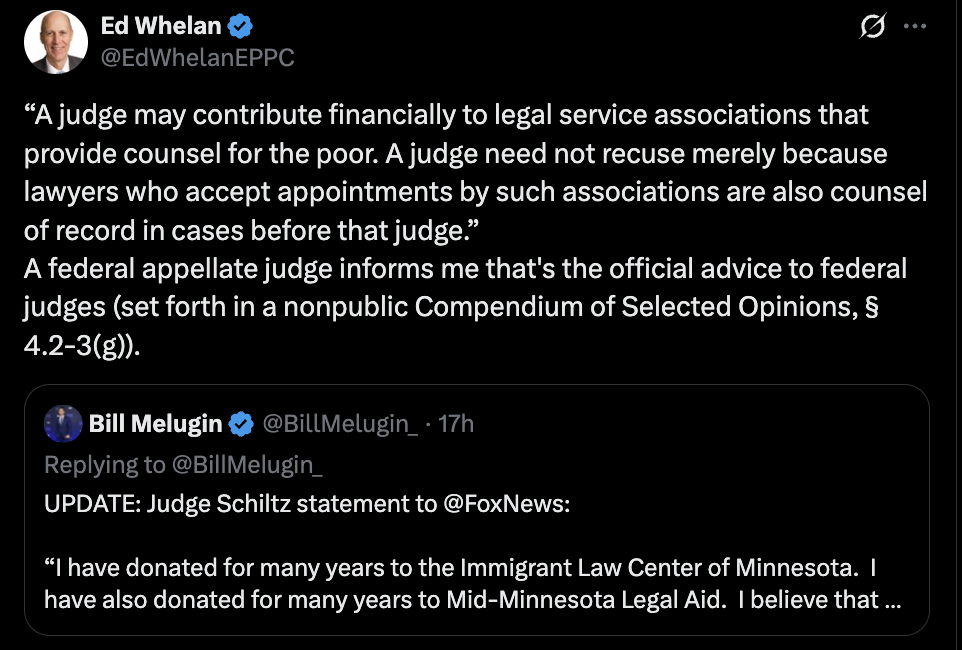
the
masses
that
his
insider
sources
tell
him
that
the
federal
judiciary’s
own
rules
would
consider
Schlitz’s
donations
ethically
irrelevant:


Putting
aside
that
federal
judges
probably
shouldn’t
have
a
secret
ethics
code,
Whelan’s
response
missed
the
point.
The
mob
of
right-wing
media
consumers

a
mob
that
Whelan
has
gleefully
thrown
red
meat
as
a
long-time

National
Review

blogger

doesn’t
care
if
these
donations
were
up
to
ethical
snuff.
The
mob
doesn’t
even
care
if
Schlitz
could
have
or
should
have
recused
himself.
They
think
donating
to
immigrants
is

presumptively

disqualifying
for
a
federal
judge.
Responding
“well,
actually,
all
judges
can
do
this”
only
feeds
their
wingnut
belief
that
the
whole
system
is
corrupt.

So,
yes,
in
a
sane
world,
Whelan’s
post
should
end
the
argument.
But
sanity
packed
up
and
moved
away
a
long
time
ago.
Check
Zillow.


This
is
not,
in
any
obvious
way,
“related
to
this
post.”
But
it
is
a
common
refrain
from
insecure
lawyers
on
social
media.
Whenever
they
disagree
with
a
law
professor,
or
a
legal
journalist,
or,
as
the
case
may
be,
the
voice
of
a
right-wing
think
tank,
they
puff
their
chests
and
declare
“do
you
even

go
to
court
,
bro?”
as
though
waiting
through
a
cattle
call
is
the
only
authentic
qualification
to
have
a
legal
opinion.
Whelan
does
not
spend
his
days
in
trial
courts,
but
he
does
have
close
personal
friendships
with
copies
of
the
federal
judge
rulebook
on
their
shelves.


Yes,
her
response
has
no
bearing
on
the
ethical
rule.
That
should
be
the
end
of
the
post.
Having
apparently
never
heard
the
old
saw,
“better
to
remain
silent
and
be
thought
a
fool
than
to
speak
and
remove
all
doubt,”
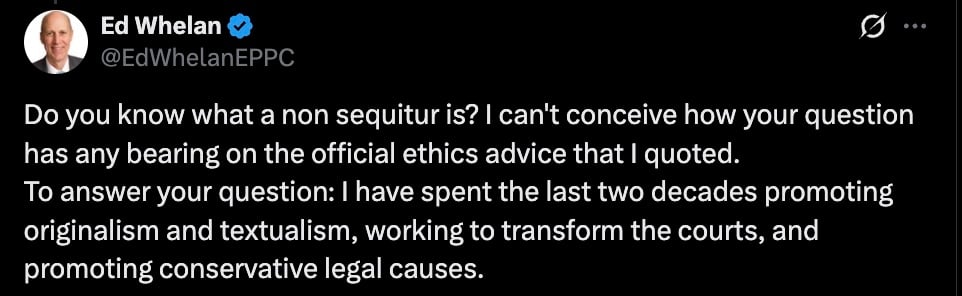
Whelan
continued.
“I
have
spent
the
last
two
decades
promoting
originalism
and
textualism,
working
to
transform
the
courts,
and
promoting
conservative
legal
causes.”
Defying
all
odds,
he
managed
to
make
himself
sound
less
credible.
Dude,
you
worked
for
the
Justice
Department
too.
Just
say
that!
“Well,
I

have

spent
20
years
attending
parties
and
peddling
disingenuous
readings
of
obscure
19th
century
pamphlets”
is
not
getting
the
job
done.

In
any
event,
Whelan
had
asked
a
rhetorical
question.
Does
Dhillon
know
what
a
rhetorical
question
is?

[Rimshot]


Tween
girls
everywhere
are
saying,
“damn,
you
two
need
to
dial
down
the
drama.”

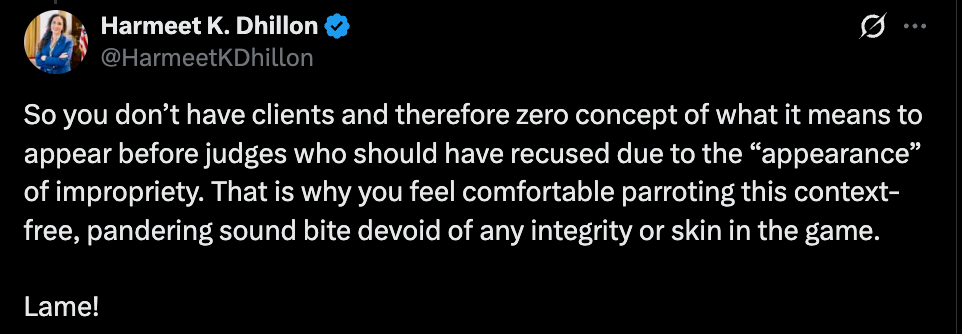
Do
you
need
a
client
to
understand
the
appearance
of
impropriety?
Seems
pretty
straightforward.
Like,

if
you
bring
a
ludicrous
lawsuit
in
a
jurisdiction

for
the
sole
purpose
of

drawing
a
judge
who
owns
a
sizable
chunk
of
a
stock
directly
tied
to
your
client


that

would
be
an
appearance
of
impropriety.
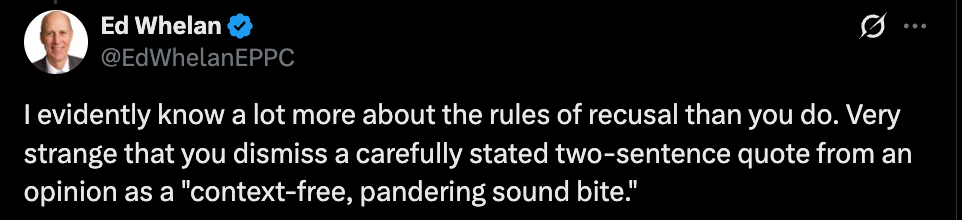
Context-free?!?
He
included
a
citation!


It
is
not
very
strange.
It
is
very
predictable.

And
successful
too…
at
least
with
the
conservative
audience
for
this
conversation.
The
replies
just
mindlessly
parrot
Dhillon.
“You’re
acting
like
a
grown
up
‘lawyer’
without
actually
having
been
one
in
practice,”
one
writes,
apparently
without
investing
the
10
seconds
required
to
look
Ed
up
on
Wikipedia.
“Ed
failed
Ethics
Class
in
his
on
line
law
school,”
writes
another.
Presumably
a
Yalie.


Whenever
someone
suggests
that
generative
AI
will
replace
writers,
realize
that
a
million
digital
monkeys
at
a
million
digital
typewriters
could
never
string
together
“I
majored
in
two
dead
languages
at
Dartmouth”
and
then
accuse
someone

else

of
being
pretentious.
The
spark
of
human
creativity
cannot
be
dimmed.


I
assume
that’s
a
crack
about
Dartmouth.

Dhillon
does
not
reply
to
this.
Uninterested
in
leaving
well
enough
alone,
Whelan
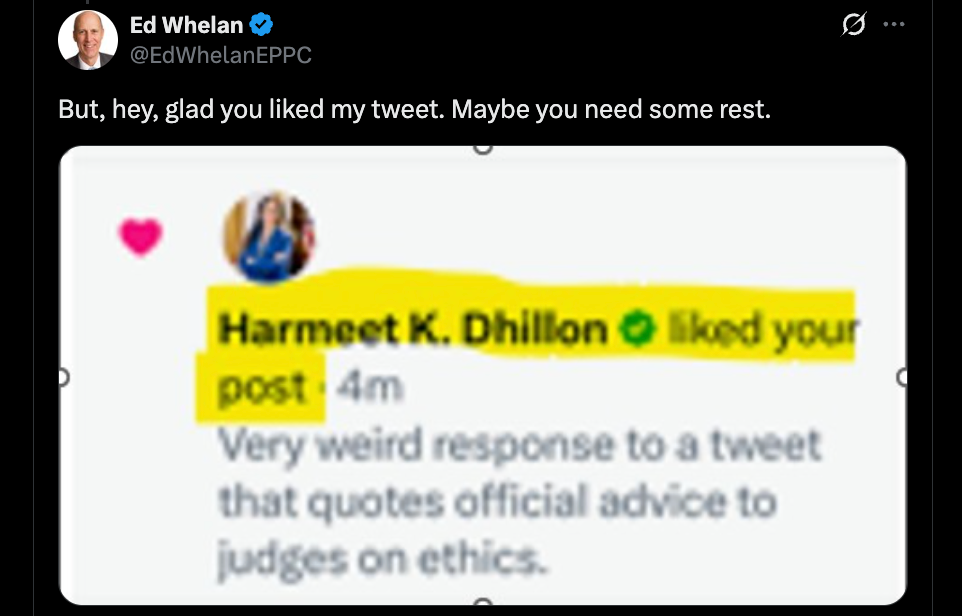
double
dips:


That’s
argumentative
checkmate
right
there!
If
you
accidentally
press
the
heart
icon,
it
forever
bars
all
disagreement.
That’s
from
the
nonpublic
Compendium
of
Twitter
Rules
§4.2-3(g).

Honestly,
starting
to
wonder
if
either
of
them
know
what
a
non
sequitur
is.


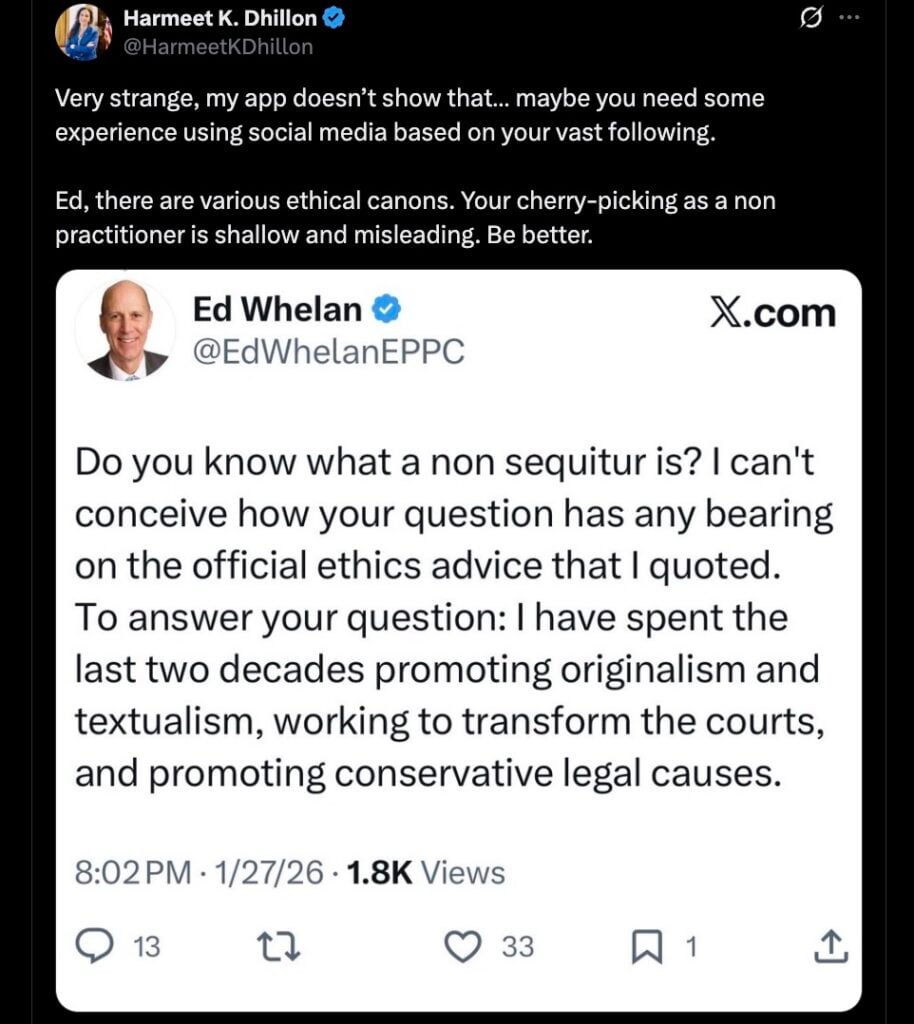
This
is
all
very
stupid,
but
I
implore
you
to
note
that
she
disses
him
for
not
understanding
how
Twitter
works
and
then
screencaps
THE
WRONG
TWEET.
You
cannot
make
this
stuff
up.


Yes.
You
cannot
say,
“there
are
various
ethical
canons”
and
then
not
cite
any
that
contradict.
But
to
play
devil’s
advocate
for
Dhillon

who
finally
stopped
posting
after
this…
or
maybe
passed
out

the
official
advice
that
Whelan
cited
only
says
a
judge
need
not
recuse
“merely”
by
virtue
of
making
a
donation.
So,
not
to
get
all
“textualist,”
but
it
is
not
dispositive.
If
a
donation
that
would
otherwise
be
acceptable
reasonably
creates
an
appearance
of
bias,
then
a
judge
may
find
it
more
prudent
to
recuse
themselves
anyway.
Nothing
about
the
quoted
text
directly
contradicts
that.
The
Fox
News
drums
and
the
bleating
in
the
replies
signals
that
there’s
a
sizable
population
out
there
who
think
this
at
least
creates
an
appearance
of
bias.

But
there’s
nothing

reasonable

about
it!
It’s
just
the
dimmest
bulbs
in
law
grasping
at
straws
because
much
smarter
conservative
judges
aren’t
letting
the
administration
perform
an
end
run
around
the
rule
of
law.
The
term
heckler’s
veto
is

consistently


misapplied
,
but
the
accurate
definition
of
the
phrase
has
some
similarities
to
this
situation.
You
can’t
silence
free
speech
just
by
claiming
you’re
“protecting”
the
speaker
from
hypothetical
violence,
and
you
can’t
manufacture
an
appearance
of
impropriety
by
ginning
up
a
mob
to
call
it
“improper.”

Giving
money
to
groups
that
provide
legal
counsel
to
poor
people
does
not
bias
a
judge.
If
it
did,
there
would
be
a
lot
more
Legal
Aid
victories
in
this
world.
Making
sure
people
have
counsel
is
not
the
same
as
endorsing
those
clients.
No
reasonable,
objective
observer
thinks
believing

3-year-olds
shouldn’t
represent
themselves
in
court

is
the
same
as
endorsing
open
borders.

Unfortunately,
this
is
another
instance
of
this
administration
actively
promoting
conspiracy
theories
against
federal
judges.
It’s
one
thing
to
flag
a
judge
for
specific
bias,
and
it’s
quite
another
to
recklessly,
without
any
support,
blast
judges
to
an
audience
that
you
are
fully
aware
can
and
has
lashed
out
violently
after
being
baited
with
right-wing
conspiracy
theories.

It’s
a
pretty
good
argument
for

disbarring
a
government
attorney
trafficking
in
such
nonsense
.

But
kudos
to
Dhillon
and
Whelan
for
providing
some
late-night
entertainment.
It
was
one
of
those
sporting
matchups
where
you
legitimately
hope
both
teams
lose.
And
they
did
not
disappoint.


HeadshotJoe
Patrice
 is
a
senior
editor
at
Above
the
Law
and
co-host
of

Thinking
Like
A
Lawyer
.
Feel
free
to email
any
tips,
questions,
or
comments.
Follow
him
on Twitter or

Bluesky

if
you’re
interested
in
law,
politics,
and
a
healthy
dose
of
college
sports
news.
Joe
also
serves
as
a

Managing
Director
at
RPN
Executive
Search
.

How Cleary Gottlieb Created A Virtuous Cycle With Tech – Above the Law


Editor’s
note:

First
in
a
series.

The
Litera
Foundation
knowledge
management
platform
doesn’t
just
have
customers.
It
has
innovators

law
firms
continually
using
the
system
in
new
ways
to
enhance
client
value. 

These
ground-breaking
firms
were
recently
honored
in
Litera’s
inaugural

Foundation
Innovation
Awards
,
which
recognized
the
creative
ways
firms
are
using
this
powerful
tool. 

Foundation’s
simplicity
and
adaptability
are
at
the
core
of
these
awards,
which
highlight
the
endless
use
cases
Foundation
customers
are
putting
into
practice. 

Here,
we
look
at
a
use
case
from
one
finalist
firm.


A
Virtuous
Cycle

If
a
legal
tech
solution
has
a
high
degree
of
adaptability,
customers
can
start
small
and
gradually
secure
buy-in
and
expansion.
Initial
wins
create
a
virtuous
cycle,
where
success
leads
to
growth,
and
this
growth
leads
to
more
success. 

A
Cleary
Gottlieb
team
that
includes
members
of
its
Knowledge
Management
and
Business
Development
groups
has
implemented
such
a
cycle
at
that
firm.

“Establishing
oversight
of
our
program
across
the
firm’s
global
footprint
was
our
biggest
hurdle,”
said
Jeannine
Zito,
the
firm’s
Senior
Manager
of
Knowledge
Solutions.
“We
needed
analytics
to
show
us
who
should
be
involved
and
when,
what
strategies
were
working,
and
where
we
had
gaps.
Foundation
helped
us
define
the
right
data
to
measure
our
success,
and
that
visibility
created
momentum
for
expansion.”

The
Cleary
team
launched
Foundation
in
2020
across
five
practice
areas,
establishing
a
core
infrastructure.
From
the
launch
onward,
the
types
of
data
tracked
continued
to
grow,
and
the
firm’s
reporting
concepts
continued
to
evolve.

Soon,
the
team
introduced
data
visualization
and
other
insights.
Then
the
Cleary
team
used
the
system
to
produce
“Health
Reports,”
which
provide
high-level
metrics
for
firm
leadership. 

After
the
Health
Reports
were
live
for
a
year,
they
had
sufficient
data
for
longitudinal
comparisons,
revealing
trends
and
further
supporting
data-driven
decision-making.
Now,
the
firm
is
incorporating
user
feedback
and
redesigning
its
reports
to
address
ever-more
sophisticated
strategic
goals. 

Establishing
measurable
metrics
to
monitor
program
health
while
identifying
areas
for
improvement

along
with
implementing
real-time
tracking
of
profile
completion
and
data
quality

were
areas
of
emphasis
throughout
the
initiative
at
Cleary. 

The
need
to
track
when
data
was
entered
was
particularly
impactful,
because
it
ensured
that
stakeholders
continually
updated
Foundation.
The
resulting
high-quality
data,
in
turn,
could
be
used
by
firm
leadership
to
guide
decision-making
regarding
firm
operations
and
other
areas. 

Today,
the
fruits
of
this
analytics
initiative
are
evident
throughout
the
firm. 

The
Foundation
initiative
has
brought
efficient
knowledge
sharing
and
intelligence-focused
business
development,
made
possible
by
improved
access
to
precedents
and
insights
across
practice
areas.
These
insights
also
enable
evidence-based
performance
measurement.

The
framework’s
success
demonstrates
how
technology
can
transform
traditional
legal
operations
into
analytics-based,
strategic
initiatives.

And
by
demonstrating
clear
ROI
to
law
firm
leadership
throughout
the
initiative,
the
Cleary
team
has
ensured
that
this
program
will
continue
to
expand
and
grow
even
more
impactful
and
sophisticated
in
the
years
to
come.

With
so
many
unique
use-cases
for
Foundation,
it’s
no
wonder
to
see
why
it
has
such
innovators.
If
you
would
like
to
learn
more
about
Foundation
and
explore
how
it
might
help
your
firm
transform
your
experience,
pricing,
and
other
precedent
data,

connect
with
the
Litera
team

to
request
a
detailed
analysis
of
your
marketing
tech-stack!


This
and
other
use
cases
will
form
the
basis
of
a
business
of
law
eBook
this
year.
You
can
pre-register
for
your
copy
by
filling
out
the
form
below.

The End Of An Era: Stroock Dissolves After Nearly 150 Years – Above the Law

(Image
via
Getty)


Ed.
note
:
Welcome
to
our
daily
feature, Quote
of
the
Day
.


I
am
extremely
pleased
by
the
outcome
of
this
process,
which
facilitated
creditor
recoveries
substantially
exceeding
those
usually
achieved
in
a
law
firm
liquidation.
The
dedication
of
Stroock’s
winddown
team,
the
diligence
of
the
Firm’s
former
partners
in
supporting
the
collection
of
accounts
receivable
and
the
good
faith
participation
in
the
process
by
the
overwhelming
majority
of
Stroock’s
creditors
allowed
us
to
complete
the
winddown
and
dissolution
of
a
law
firm
in
only
26
months
and
helped
to
maximize
the
value
ultimately
delivered
to
creditors.


— Gary
Polkowitz,
a
Senior
Managing
Director
at
Teneo,
the
global
CEO
advisory
firm,

commenting

on
the
completion
of
the

winddown
and
formal
dissolution

of
Stroock
&
Stroock
&
Lavan.
Polkowitz
served
as
the
nearly
150-year-old
firm’s
liquidation
manager,
and
as
of
December
31,
2025,
Stroock
agreed
to
settlements
with
creditors
holding
over
99%
of
unsecured
claims.
Final
distributions
have
now
been
made
to
all
creditors,
who
received
55.50%
of
their
agreed
claims.


Staci
Zaretsky
 is
the
managing
editor
of
Above
the
Law,
where
she’s
worked
since
2011.
She’d
love
to
hear
from
you,
so
please
feel
free
to email her
with
any
tips,
questions,
comments,
or
critiques.
You
can
follow
her
on BlueskyX/Twitter,
and Threads, or
connect
with
her
on LinkedIn.

FIFA 2026, Politics, And The Law: What Sepp Blatter’s Warning Really Means For The World Cup In America – Above the Law

(Photo
by
Isabelle
Ouvrard/SEPA.Media
/Getty
Images)

Every
World
Cup
arrives
with
controversy.
That
is
part
of
the
tournament’s
DNA.
Host
nations
worry
about
stadium
readiness.
Fans
argue
about
ticket
prices.
Security
planners
lose
sleep.

What
feels
different
this
time
is
that
the
warning
is
not
coming
from
activists
in
the
stands
or
lawmakers
in
host
cities.
It
is
coming
from
the
top
of
the
sport’s
old
establishment.


Former
FIFA
president
Sepp
Blatter
is
now
publicly
backing
calls
for
fans
to
stay
away
from
matches
in
the
United
States
in
2026
.
He
echoed
comments
from
Swiss
lawyer
and
longtime
FIFA
reform
figure
Mark
Pieth,
who
said
in
a
newspaper
interview
that
supporters
should
consider
watching
from
home
and
that
visitors
might
face
aggressive
immigration
treatment
on
arrival.

Add
in
fresh
criticism
from
officials
within
Germany’s
soccer
federation,
new
travel
bans
affecting
fans
from
several
qualified
countries,
and
outrage
over
nearly
$9,000
list
prices
for
the
final
at
MetLife
Stadium,
and
the
legal
stakes
around
this
tournament
become
impossible
to
ignore.

The
United
States
is
not
just
hosting
a
sporting
event
next
summer.
Along
with
Canada
and
Mexico,
it
is
hosting
one
of
the
largest
temporary
international
migrations
in
modern
history.
Millions
of
people
will
cross
borders
to
attend
matches.
That
turns
immigration
law,
administrative
discretion,
security
policy,
consumer
protection,
and
even
tort
liability
into
part
of
the
tournament
infrastructure.

Let’s
start
with
the
travel
bans,
because
they
cut
closest
to
the
heart
of
fan
access.

Reports
that
supporters
from
Senegal,
Ivory
Coast,
Iran,
and
Haiti
may
be
barred
unless
they
already
hold
visas
raise
immediate
questions
about
how
immigration
policy
intersects
with
mega
events.
Legally,
the
federal
government
has
wide
latitude
to
regulate
entry
into
the
country.
Courts
have
repeatedly
upheld
presidential
authority
in
this
area
when
national
security
rationales
are
asserted.

But
FIFA
tournaments
operate
on
a
different
plane
than
ordinary
tourism.
Host
agreements
typically
include
promises
that
fans,
teams,
and
officials
will
be
able
to
enter
the
country
for
the
event
subject
to
standard
security
screening.
When
whole
categories
of
supporters
are
excluded
based
on
nationality,
that
tension
becomes
acute.

From
FIFA’s
perspective,
this
is
not
simply
a
political
headache.
It
is
potentially
a
contractual
one.
Host
country
agreements
often
commit
governments
to
facilitating
visas
for
accredited
participants
and
visitors.
If
those
commitments
are
perceived
as
hollow,
FIFA
and
its
partners
face
reputational
risk
and
possible
disputes
with
sponsors
and
broadcasters
who
paid
for
a
truly
global
spectacle.

From
the
fan
side,
there
is
another
layer.
Supporters
who
buy
tickets
and
book
travel
only
to
learn
later
that
they
cannot
enter
the
country
may
turn
to
refund
claims,
insurance
disputes,
or
class
actions
against
resellers
and
tour
operators.
The
fine
print
will
matter
enormously.
So
will
disclosures
about
entry
requirements
at
the
time
of
sale.

Which
brings
us
to
pricing.

Dynamic
pricing
has
pushed
the
list
price
for
the
final
toward
levels
that
would
make
Broadway
blush.
FIFA
President
Gianni
Infantino
has
suggested
resale
markets
could
drive
them
higher
still.

There
is
nothing
inherently
illegal
about
charging
premium
prices
for
scarce
tickets.
But
once
numbers
reach
this
scale,
regulators
start
paying
closer
attention.
State
attorneys
general
routinely
police
deceptive
sales
practices,
bait-and-switch
tactics,
and
hidden
fees
in
ticketing
platforms.
Federal
agencies
watch
for
unfair
or
misleading
advertising,
especially
when
international
consumers
are
involved.

If
fans
are
paying
thousands
of
dollars
while
simultaneously
facing
uncertainty
about
entry
into
the
country,
disclosure
becomes
the
legal
pressure
point.
What
did
sellers
promise?
What
risks
were
flagged?
What
refunds
are
available
if
government
policy
changes
after
purchase?

Security
policy
is
the
next
front.

Blatter
and
Pieth’s
comments
suggest
that
arriving
fans
could
face
aggressive
questioning
or
removal
if
they
run
afoul
of
immigration
officials.
That
may
sound
dramatic,
but
large-scale
events
already
involve
enhanced
screening,
coordination
between
federal
agencies,
and
temporary
security
zones
around
venues.

The
legal
responsibility
for
what
happens
to
spectators
inside
and
around
stadiums
will
fall
on
a
complex
web
of
actors.
Federal
authorities
control
borders.
Local
police
departments
manage
crowd
control.
Stadium
operators
and
organizing
committees
oversee
private
security.
If
something
goes
wrong,
plaintiffs’
lawyers
will
be
sorting
through
who
owed
what
duty
to
whom
in
record
time.

We
saw
this
play
out
in
other
mega
events
around
the
world.
When
transportation
collapses,
when
crowd
surges
injure
spectators,
or
when
protest
responses
escalate,
lawsuits
often
follow.
For
U.S.
host
cities,
sovereign
immunity
statutes,
federal
jurisdiction
questions,
and
indemnification
agreements
will
suddenly
move
from
boilerplate
to
battleground.

Then
there
is
the
political
overlay.

Concerns
tied
to
immigration
enforcement
protests,
foreign
policy
rhetoric,
and
domestic
unrest
are
not
issues
FIFA
can
simply
wave
away
with
marketing
slogans.
When
senior
figures
in
the
international
game
float
boycott
talk,
sponsors
take
notice.
So
do
broadcasters.
So
do
host
committees
that
have
issued
bonds,
built
transit
upgrades,
and
promised
economic
windfalls.

If
attendance
dips
because
foreign
supporters
stay
home,
that
has
ripple
effects
across
municipal
budgets
and
private
contracts.
Hotels,
vendors,
and
transportation
operators
rely
on
projections
that
assume
global
participation.
Litigation
over
lost
revenue
is
not
far-fetched
if
those
projections
collapse
under
policy
shifts.

FIFA’s
response
so
far
has
been
predictably
upbeat.
Infantino
insists
that
fans
will
come
and
celebrate
together.
He
may
well
be
right.
World
Cups
have
survived
scandals
before.

But
legally
speaking,
optimism
is
not
a
strategy.

The
2026
tournament
is
testing
whether
a
sport
that
markets
itself
as
borderless
can
function
smoothly
inside
a
world
of
tightening
borders
and
polarized
politics.
Immigration
policy,
consumer
law,
public
safety
planning,
and
international
agreements
are
all
colliding
in
real
time.

For
American
hosts,
the
lesson
is
straightforward.
Transparency
matters.
Coordination
matters
more.
Clear
visa
pathways,
realistic
ticketing
disclosures,
and
visible
security
planning
are
not
public
relations
exercises.
They
are
liability
management.

For
fans,
the
message
is
equally
practical.
Read
the
entry
requirements.
Understand
refund
policies.
Know
what
insurance
actually
covers.
Do
not
assume
that
buying
a
ticket
guarantees
a
seat
in
the
stadium
if
government
rules
shift.

And
for
FIFA,
this
is
the
central
legal
question
behind
the
headlines.
When
former
presidents
and
reform
architects
warn
that
supporters
should
stay
away,
the
issue
is
no
longer
just
optics.
It
is
whether
the
legal
framework
surrounding
the
tournament
can
support
the
world’s
biggest
sporting
event
without
cracking
under
geopolitical
strain.

The
World
Cup
has
always
claimed
to
unite
nations
for
90
minutes
at
a
time.
In
2026,
the
courts,
regulators,
and
border
officials
may
end
up
shaping
that
promise
just
as
much
as
the
players
on
the
pitch.


Michael
J.
Epstein
,
a
Harvard
Law
School
graduate,
is
a
trial
lawyer
and
managing
partner
of 
The
Epstein
Law
Firm,
P.A.,
 a
law
firm
based
in
New
Jersey.

New Year, New Shingle: Why 2026 Is The Year To Bet On Yourself – Above the Law

Has
the
thought
of
starting
a
law
firm
ever
crossed
your
mind? 

There
are
plenty
of
reasons
for
starting
your
own
law
firm,
whether
you
want
to
focus
more
on
one
practice
area
or
you’re
ready
to
be
your
own
boss.

If
you’re
curious
about
going
out
on
your
own,
this
checklist
from
our
friends
at
8am
will
help
you
get
started.


Sign
up
here
to
get
started!


What Does Your Paycheck Look Like? – Above the Law

We’re
collecting
information
for
our

annual
law
firm
compensation
report

and
need
your
help.

If
you
are
a
lawyer
at
a
firm
with
fewer
than
250
attorneys
and
haven’t
yet
taken
our
compensation
survey,
please


click
here

to
do
so
now. 

The
survey
is
open
to
solo
practitioners
as
well
as
attorneys
at
midsize
and
small
law
firms.

The
survey
is

completely
anonymous

and
won’t
take
more
than
a
few
minutes
of
your
time. 


What Does OpenAI and Anthropic’s Healthcare Push Mean for the Industry? – MedCity News

This
month,
two
of
the
hottest
AI
companies
in
San
Francisco
announced
a
major
push
into
healthcare

moves
that
experts
say
were
not
only
inevitable,
but
also
timely
and
high-stakes.

These
AI
rivals
— 

Anthropic

and

OpenAI
,
the
makers
of
the
widely
used
large
language
models
Claude
and
ChatGPT,
respectively

unveiled

new
suites
of
tools

for
healthcare
organizations
and
everyday
consumers.
These
moves
reflect
a
shift
in
how
patients
are
accessing
medical
guidance

one
that
experts
agree
is
simultaneously
expanding
access
to
information
while
raising
new
questions
about
trust
and
control. 


What
these
healthcare
expansions
could
mean
for
startups

Anthropic
and
OpenAI’s
healthcare
buildouts
are
forcing
startups
across
the
health
tech
market
to
reassess
where
they
truly
have
defensible
advantages,
one
investor
pointed
out. 

Kamal
Singh,
senior
vice
president
at

WestBridge
Capital
,
thinks
consumer
wellness
and
nutrition
startups
are
the
most
vulnerable,
saying
that
these
types
of
broad,
chat-based
platforms
are
likely
to
be
commoditized. 

Startups
offering
nutrition
or
wellness
advice
without
deep
specialization
now
face
weakened
value
propositions

given
that
Claude
and
ChatGPT
have
massive
distribution
and
habitual
usage,
he
pointed
out.
Some
examples
include
apps
like

Noom
,

Fay

and

Zoe
.

Others
will
probably
remain
insulated

or
even
strengthened

depending
on
how
robust
their
models
are,
Singh
said.
In
his
view,
companies
focused
on
specialized
clinical
areas,
such
as
chronic
disease
management,
will
be
far
more
resilient
to
large
tech
incumbents
entering
the
space. 

These
types
of
companies
rely
on
deep
patient
data,
longitudinal
insights
and
disease-specific
expertise

capabilities
that
we
still
don’t
know
if
general
purpose
tech
companies
will
be
able
to
replicate
at
scale,
Singh
remarked.

He
also
pointed
to
care
coordination
and
care
management
as
areas
where
startups
can
maintain
an
edge,
particularly
when
they
combine
AI
with
human
clinicians.
Rather
than
competing
directly
with
large
language
models,
Singh
believes
startups
should
differentiate
by
prioritizing
outcomes
and
delivering
end-to-end
care
experiences.

Another
emerging
battleground
is
AI-driven
primary
care.
Singh
said
this
category
sits
between
consumer
wellness
and
specialized
medicine

sophisticated
enough
to
resist
full
commoditization,
but
still
vulnerable
to
pressure
from
popular
AI
platforms. 

“On
the
startup
side,
you
don’t
really
have
any
winners
yet

there
are
a
couple
of
companies
like
Counsel
Health,
who
are
kind
of
inching
towards
that
goal,
but
these
announcements
make
it
a
very
interesting
dynamic
there,”
he
declared.


Counsel
Health

is
a
virtual
care
company
that
combines
AI
with
human
physicians
to
give
users
quick,
personalized
medical
advice.

To
survive,
Singh
said
startups
in
this
space
will
need
creative
business
models,
including
hybrid
approaches
that
integrate
real
clinicians
with
AI-powered
guidance.


The
inevitable
rise
of
AI
as
healthcare’s
front
door

It
was
inevitable
that
OpenAI
and
Anthropic
would
deepen
their
presence
in
healthcare.
Trends
in
user
activity
made
this
unavoidable


hundreds
of
millions

of
people
per
week
were
turning
to
their
chatbots
to
answer
their
health-related
inquiries.

“Almost
5%
of
their
traffic
is
healthcare-related.
There
are
about
40
million
unique
healthcare
questions
asked
by
users
in
a
day.
Given
that,
it
really
does
seem
that
they’re
in
the
healthcare
business,
and
so
if
they’re
seeing
that
much
traffic
to
their
sites
related
to
healthcare,
they
had
to
increase
their
capabilities
in
that
space,”
explained
healthcare
AI
expert
Saurabh
Gombar.

So
what
did
the
Anthropic
and
OpenAI
actually
roll
out?

OpenA
launched
two
new
offerings.
One
is

ChatGPT
Health
,
a
dedicated
health
experience
within
ChatGPT
that
combines
a
user’s
personal
health
information
with
the
company’s
AI,
with
the
promise
of
helping
people
better
manage
their
health
and
wellness.
The
other
is

OpenAI
for
Healthcare
,
a
suite
of
AI
tools
designed
to
help
healthcare
providers
reduce
administrative
burnout
and
improve
care
planning. 

OpenAI
also
announced
its
acquisition
of
medical
records
startup
Torch
this
month

a
deal
that
is

reportedly
worth
$100
million
.

Anthropic
followed
with
a
healthcare
splash
of
its
own,
unveiling
a

new
suite
of
Claude
tools
.
The
company
is
releasing
new
agent
capabilities
for
tasks
like
prior
authorization,
healthcare
billing
and
clinical
trial
workflows,
as
well
as
letting
its
paid
users
connect
and
query
their
personal
medical
records
to
get
summaries,
explanations
and
guidance
for
doctor
visits.

Gombar,
the
AI
expert
mentioned
above,
believes
that
large
language
models
are
becoming
the
new
“front
door”
to
healthcare.

“The
LLMS
are
now
becoming
the
front
door
for
medical
advice
and
treatment
options,
and
the
actual
provider
is
becoming
the
second
opinion.
Because
chatbots
are
easier
to
interact
with,
and
they’re
free,
and
you
don’t
have
to
schedule
around
them,”
Gombar
stated.

Gombar
is
a
clinical
instructor
at

Stanford
Health
Care

and
chief
medical
officer
and
co-founder
of

Atropos
Health
,
a
healthcare
AI
startup
that
generates
real-world
evidence
at
the
bedside.
In
his
eyes,
tech
companies
developing
public-facing
chatbots
are
already
in
the
healthcare
business,
whether
they
formally
acknowledge
it
or
not.

This
could
fundamentally
alter
the
physician-patient
relationship.
Gombar
noted
that
clinicians
are
already
beginning
to
see
more
and
more
patients
who
arrive
already
convinced
they
need
specific
tests
or
treatments
based
on
chatbot
advice.

He
thinks
traditional
providers
have
limited
control
over
this
shift,
given
consumer
behavior
is
clearly
changing
at
a
rapid
pace.
Not
only
has
the
use
of
chatbots
like
ChatGPT
and
Claude

skyrocketed

in
the
past
couple
of
years,
but
Americans
are
also
finding
it
more
difficult
to
access
healthcare
amid

sweeping
Medicaid
cuts

and
a

worsening
labor
shortage
.


The
risks
of
chatbots
in
medicine

The
rise
of
large
language
models
in
healthcare
is
already
well
underway,
but
that
doesn’t
mean
there
aren’t
risks
involved.
Asking
for
medical
guidance
from
an
intelligent
software
program
is
very
different
than
asking
for
a
recipe

wrong
answers
can

cause
real
harm
.

Traditional
healthcare
providers
have
accountability
mechanisms

such
as
medical
malpractice
rules,
audit
trails
and
liability
protocols

while
chatbots
rely
heavily
on
disclaimers
that
say
their
outputs
should
not
be
considered
medical
advice,
Gombar
pointed
out.


However,
in
practice,
many
users
treat
chatbot
responses
as
actual
medical
advice,
often
without
cross-checking
with
other
sources
or
their
providers,
he
added.

Gombar
hopes
companies
like
Anthropic
and
OpenAI
move
beyond
disclaimers
and
take
greater
responsibility
for
how
their
tools
handle
medical
information.
In
the
future,
he
would
like
to
see
them
be
more
transparent
about
the
limitations
of
their
systems

including
how
often
they
hallucinate,
when
answers
are
not
grounded
in
strong
evidence
and
when
medical
evidence
itself
is
uncertain
or
incomplete.

He
also
suggested
that
large
language
models
be
designed
to
more
clearly
communicate
uncertainty
and
gaps
in
knowledge,
rather
than
presenting
speculative
answers
with
unwarranted
confidence,
he
said. 

Aside
from
accuracy,
there
are
also
concerns
related
to
data
privacy,
as

consumers’
growing
distrust

of
Big
Tech
companies
and
their
data
privacy
practices
remains
an
ongoing
issue.

Anthropic
said
that
its
new
health
products
are
designed
with
strict
safeguards
around
user
consent
and
data
protection.

“Users
give
express
consent
to
integrate
their
data
with
full
information
about
how
Anthropic
protects
that
data
in
our
consumer
health
data
privacy
policy.
Anthropic
does
not
train
on
user
health
data.
Period.
We
also
protect
sensitive
health
data
from
inadvertent
sharing
to
other
integrated
model
context
protocols
by
requiring
user
consent
to
each
integration
in
conversations
where
integrated
health
data
is
being
discussed.
Users
can
disconnect
the
integration
any
time
in
settings,”
an
Anthropic
spokesperson
explained
in
an
emailed
statement.

Even
before
it
rolled
out
ChatGPT
Health,
OpenAI
had
been
building
user
data
protections
across
ChatGPT,
including
permanent
deletion
of
chats
from
OpenAI’s
systems
within
30
days
and
training
its
models
not
to
retain
personal
information
from
user
chats,
a
company
spokesperson
said
in
a
statement.

For
its
new
consumer
health
offering,
OpenAI
has
added
more
encryption
protections,
as
well
as
isolated
the
chats
to
keep
health
conversations
and
memory
protected
and
compartmentalized.
Conversations
in
ChatGPT
Health
are
not
used
to
train
its
foundation
models,
the
spokesperson
said.

As
for
OpenAI’s
new
platform
for
healthcare
providers,
customers
will
have
full
control
over
their
data.
When
clinicians
enter
patient
information,
for
example,
it
will
stay
within
the
organization’s
secure
workspace
and
will
not
be
used
for
model
training. 


Making
AI
work
for
clinicians
and
patients

By
releasing
tools
for
consumers
as
well
as
for
healthcare
providers,
OpenAI
is
signaling
that
it
understands
consumers
have
different
needs
and
goals
than
hospitals.
Patients
want
general
guidance
and
convenience,
while
providers
need
accurate,
actionable
information
that
can
be
safely
integrated
into
the
clinical
record,
noted
Kevin
Erdal,
senior
vice
president
of
transformation
and
innovation
services
at

Nordic
,
a
health
and
technology
consultancy.

When
deploying
new
large
language
models,
he
recommended
hospitals
watch
out
for
shadow
workflows. 

“Clinicians
may
start
informally
relying
on
patient-generated
summaries
or
AI-assisted
interpretations
without
clear
standards
for
validation
or
documentation.
If
no
one
validates
where
patient-reported
information
came
from,
or
oversees
how
that
information
is
reviewed,
incorporated
or
rejected,
risk
quietly
accumulates,”
Erdal
said.

When
it
comes
to
Anthropic
and
OpenAI’s
consumer-facing
healthcare
tools,
the
biggest
risk
isn’t
misinformation
so
much
as
missing
context,
he
remarked.

“Context,
intent
and
reasoning
can
live
in
a
chat
while
the
clinical
record
captures
only
the
outcome,
weakening
care
continuity
and
the
trust
between
patient
and
provider,”
Erdal
stated.

This
gap
in
context
underscores
why
consumer-facing
chatbots
are
ill-suited
for
clinician
use.

For
hospitals
and
other
providers,
Erdal
thinks
the
right
response
to
the
rise
of
consumer-facing
healthcare
AI
is
integration.

“It
will
look
like
health
systems
accepting
that
these
tools
already
exist,
and
designing
responsible
ways
to
absorb
their
output
without
fragmenting
care.
The
bar
is
continuity,
and
the
patient/provider
relationship
is
what’s
at
stake,”
he
declared.

If
consumer-facing
AI
models
help
patients
walk
into
healthcare
interactions
more
informed
and
better
prepared,
but
then
their
providers
are
unprepared
to
integrate
that
into
the
healthcare
conversation
in
a
thoughtful
or
deliberate
way,
access
to
healthcare
information
improves
while
trust
drops
off,
Erdal
explained.

At
a
deeper
level,
OpenAI
and
Anthropic’s
healthcare
push
reflects
a
broader
shift
in
the
healthcare
industry.

The
question
is
no
longer
whether
AI
will
become
part
of
the
patient
journey

it’s
clear
that
the
shift
is
already
underway.
The
real
question
is
who
will
control
it,
who
will
be
accountable
for
it,
and
how
much
influence
it
will
have
over
decisions
that
were
once
firmly
in
the
hands
of
clinicians.

Experts
agree
that
the
companies
that
adapt

by
integrating
AI
thoughtfully,
strengthening
trust
and
clarifying
responsibility

may
help
build
a
more
accessible
healthcare
system.
Those
that
don’t
may
find
themselves
left
behind.


Photo:
Pakorn
Supajitsoontorn,
Getty
Images

Morning Docket: 01.28.26 – Above the Law

*
Kirkland
drama
reveals
that
when
the
bell
rings,
private
equity
clients
trump
litigation
clients.
[Financial
Times
]

*
Lawyer
representing
the
agent
who
killed
Renee
Good
drops
out
of
GOP
race
for
governor,
says
ICE
has
gone
too
far.
[WSJ]

*
ABA
convenes
with
a
hefty
agenda.
[ABA
Journal
]

*
A
look
at
how
Minnesota
firms
are
dealing
with
the
disruption
brought
on
by
ICE’s
operation.
[American
Lawyer
]

*
As
Minnesota
situation
worsens,
congresswoman
attacked
at
town
hall
meeting,
sprayed
with
unknown
substance.
[CSPAN]

*
State
lawmakers
look
for
avenues
to
bring
local
charges
against
federal
agents
who
commit
crimes.
[Reuters]

*
New
York
considers
legalizing
dancing.
[Lowering
the
Bar
]

Maine Plane Crash Claims Lives – See Also – Above the Law

An
Attempted
Take-Off
Turns
Tragic:
We
send
our
condolences
to
their
family
and
friends.
Trump
Administration
Leaves
Transportation
Regulation
Up
To
AI:
No
way
this
will
pan
out
well.
Bush-Appointed
Judge
Benchslaps
ICE:
He
got
so
fed
up
that
ICE
followed
the
court
order!
Torts
Professor
Doesn’t
Let
History
Of
Being
Wrong
Stop
Him:
Nor
will
he
let
history
get
in
the
way
of
his
trash
birthright
citizenship
take.
Judge
Tells
Government
To
“Be
Serious”
About
West
Wing
Demolition
Justification:
And
it
was
seriously
funny!
Mind
Your
Parents:
Everyone
benefits
when
parental
leave

actually

supports
working
parents!