According
to
a
survey
by
Am
Law,
the
high
end
of
equity
partner
contributions
at
one
Am
Law
100
firm
is
what
percentage
of
a
new
equity
partners’
annual
compensation?
Hint:
There
is
a
big
range
of
partner
contributions
across
Biglaw,
but
the
norm
is
between
25-35%
of
compensation.
Who
could
have
predicted
what
2025
would
bring?
As
the
legal
profession
kicked
off
last
year,
we
expected
another
tour
de
force
of
Biglaw
standing
up
for
those
targeted
by
the
Trump
administration
like
the
firms
did
in
2017,
we
figured
that
AI
hallucinations
would
become
a
thing
of
the
past
as
lawyers
learned
from
others,
and
we
felt
confident
that
at
least
we
wouldn’t
be
talking
about
summer
associates
biting
people
at
elite
law
firms.
We
flopped
on
all
of
those.
In
fact,
this
year
managed
to
throw
doubt
on
the
Third,
Fourteenth,
and
Twenty-Second
Amendments,
foiling
many
a
2025
Bingo
card.
But
2026
is
a
new
year!
With
hours
to
go
on
this
steaming
dumpster
fire
of
a
year
in
legal,
let
us
usher
in
the
next
year
with
a
bolus
of
positivity
and
gaze
into
our
crystal
balls
to
predict
the
many
ways
the
legal
profession
will
make
the
world
better
over
the
coming
year.
Though
to
avoid
the
graveyard
of
whiffed
predictions
we’ll
discuss
this
time
next
year,
let’s
focus
exclusively
on
the
predictions
that
in
any
rational
profession
would
come
true
in
2026,
with
the
full
understanding
that
—
as
lawyers
—
absolutely
none
of
this
will
actually
happen.
The
Death
Of
The
Billable
Hour
Rumors
of
the
billable
hour’s
demise
have
been
greatly
exaggerated
for
decades.
Forecasting
the
end
of
hourly
billing
is
a
cheap
way
to
spice
up
a
prediction
roundup.
The
thousand,
“well,
actually,
the
billable
hour
isn’t
going
anywhere”
takes
this
item
will
trigger
generates
enough
smug
self-satisfaction
to
keep
offices
warm
for
weeks.
But
there’s
something
different
about
it
this
time,
right?
Famous
last
words
in
the
prediction
racket…
but
that’s
why
we’re
focused
on
predictions
that
aren’t
going
to
come
true.
Billing
by
the
hour
remained
strong
in
2025,
and
probably
will
into
2026.
But
it
has
shown
some
cracks
and
the
chisel
is
the
growing
adoption
of
artificial
intelligence.
Every
previous
death
sentence
for
time-based
billing
rested
upon
client
pressure
and
firm
competition,
two
factors
that
grossly
underestimate
the
legal
profession’s
fear
and
laziness.
Or
“caution”
or
“commitment
to
tradition”
or
whatever
kinder
euphemism
you
want.
Clients
might
have
thought
alternative
fee
arrangements
made
more
sense,
but
it’s
daunting
work
to
go
to
the
Board
and
justify
handing
over
lump
sums
of
money
when
hourly
billing
is
a
tried
and
true
methodology.
And
firms
might
have
wanted
to
seek
some
advantage
over
their
rivals
by
offering
less
burdensome
pricing,
but
it’s
scary
to
commit
to
a
fixed
price
that
could
leave
the
firm
underpaid
on
an
assignment.
Artificial
intelligence
provides
an
exogenous
kick
in
the
ass.
According
to
the
Harbor
Law
Department
Survey,
clients
spent
2025
jumping
on
the
AI
bandwagon.
Some
85
percent
of
corporate
legal
teams
now
have
dedicated
AI
resources,
and
they’re
using
that
newfound
capacity
as
leverage
to
demand
alternative
fee
arrangements,
consolidate
their
panels,
and
pull
work
in-house.
Outside
counsel
spending
projections
cratered
from
58
percent
expecting
increases
to
just
37
percent.
At
the
same
time,
law
firms
have
watched
AI
eat
into
many
of
the
time-consuming
tasks
that
used
to
be
the
bread
and
butter
of
law
firm
leverage.
A
DISCO
white
paper
found
that
even
as
law
firms
embrace
AI
tools,
there’s
one
lingering
fear:
“the
premise
that
speed
will
reduce
revenue
remains
a
challenge.”
Ethics
rules
prevent
law
firms
from
billing
for
the
time
that
might
have
been
in
an
alternate
universe
without
an
AI
tool
crunching
deposition
transcripts.
While
clients
would
love
to
see
the
firm’s
300
hour
bill
drop
to
30,
law
firms
aren’t
in
the
business
of
giving
away
money
like
that.
Law
firms
finally
face
genuine
pressure
to
work
out
the
value
of
the
output
instead
of
charging
clients
for
inputs.
But
instead,
they’ll
probably
just
adopt
a
$10,000
billable
hour.
Because
if
lawyers
invented
the
internal
combustion
engine,
we’d
be
driving
mechanical
horses
instead
of
cars.
Law
Schools
End
The
Accelerated
Recruiting
Pipeline
Remember
when
law
school
grades
mattered?
Maybe
not
for
the
Yalies
out
there,
but
for
the
rest
of
us.
Back
in
the
day,
employers
actually
waited
to
see
how
students
performed
before
hiring
them.
“OK
Boomer,”
say
current
law
students.
But
it’s
true!
We
used
to
wait
for
a
whole
year’s
worth
of
grades
before
getting
an
offer
for
the
summer
before
3L
year.
The
current
law
school
recruiting
timeline
now
begins
roughly
fifteen
minutes
after
orientation.
Biglaw
has
started
handing
out
offers
before
students
finish
their
first
final,
replacing
grades
with
vibe
recruiting
—
complete
with
firms
handing
out
walking
around
money
to
students
that
they’ve
already
worked
with,
asking
these
older
students
to
identify
and
recruit
promising
potential
summers.
The
weird
part
is
that
nobody
wants
this.
The
law
schools
hate
it.
The
law
firms
aren’t
enthusiastic
about
it.
The
students
are
overwhelmed.
And
yet
no
one
can
do
anything
about
it.
Any
solution
would
involve
collective
action
—
from
either
the
law
schools,
the
law
firms,
or
both
—
and
no
one
appears
willing
to
risk
being
accused
of
collusion.
Without
action
from
the
participants
in
this
catastrophe,
the
only
alternative
would
be
the
regulators.
If
state
licensing
authorities
created
some
sort
of
minimum
check
on
law
clerk
qualifications
it
could
put
the
brakes
on
the
accelerated
cycle,
but
the
pressure
on
licensing
is
currently
arrayed
toward
reducing
obstacles
to
practice
rather
than
imposing
more.
In
a
sane
2026,
the
law
schools
manage
to
get
together
and
impose
a
requirement
that
firms
can’t
recruit
students
until
the
first
semester
grades
arrive.
The
Supreme
Court
Will
Go
Back
To
Writing
Actual
Opinions
Instead
Of
Post-It
Notes
In
a
probably
apocryphal
story,
Andrew
Jackson
said
of
the
Supreme
Court,
“John
Marshall
has
made
his
decision;
now
let
him
enforce
it.”
And
that
was
before
a
bunch
of
late-1970s,
early-1980s
law
review
articles
invented
“unitary
executive
theory.”
Even
if
the
Jackson
quote
never
actually
happened,
the
point
remains
sound:
the
Supreme
Court’s
authority
derives
entirely
from
the
persuasive
power
of
its
written
opinions.
That’s
it.
Nine
unelected
people
in
robes
reshape
American
life
because
we
collectively
accept
that
they’ve
issued
reasoned
opinions.
Faced
with
the
daunting
task
of
imposing
ideas
like
the
unitary
executive
theory
—
concepts
divorced
from
any
reasonable
textual
or
historical
reading
—
the
current
Court
simply
dispensed
with
the
“persuasive
power
of
written
opinions”
thing
and
decided
to
just
issue
rulings
under
the
doctrine
of
“because
we
said
so.”
The
shadow
docket
became
the
primary
vehicle
for
reshaping
American
law
this
year,
with
terse
orders
issued
without
briefing,
argument,
or
explanation.
Once
upon
a
time,
these
orders
were
understood
to
be
glorified
preliminary
injunctions,
but
this
year
the
Supreme
Court
majority
voiced
its
frustration
when
lower
courts
kept
applying
actual
written
precedent
instead
of
divining
the
vibes
from
unsigned
orders.
Calvinball
par
excellence.
It
probably
doesn’t
hurt
that
issuing
all
their
rulings
this
way
affords
them
flexibility
to
run
it
all
back
under
a
future
Democratic
president
and
say,
“hold
on,
we
didn’t
actually
RULE
on
any
of
this
stuff.”
The
Supreme
Court
majority’s
embrace
of
legislating
by
post-it
note
carries
dangerous
consequences.
Several
federal
judges
called
bullshit,
placing
the
rise
in
violent
threats
aimed
at
lower
court
justices
in
part
on
the
Supreme
Court’s
unwillingness
to
articulate
its
decisions.
When
SCOTUS
overturns
lower
courts
without
explaining
itself,
it
allows
the
administration
free
rein
to
drag
judges
as
wild-eyed
activists
worthy
of
going
to
“war”
against.
As
one
judge
told
NBC
News:
“They
don’t
have
our
backs.”
As
the
threats
mount
and
the
administration
places
the
Supreme
Court
in
increasingly
uncomfortable
positions
with
its
loony
requests,
2026
should
bring
out
the
latent
pride
of
the
Court’s
conservatives.
The
majority
made
its
decision;
now
let
them
explain
it.
But
they
won’t.
More
States
Will
Consider
Sidelining
The
Bar
Exam
The
bar
exam
is
a
flaming
sack
of
Scantron-bubbled
garbage.
We’ve
known
this
for
decades.
It’s
a
generalist
exam
in
an
era
of
specialists.
It’s
a
doctrinal
memory
test
in
a
profession
that
—
rightly
—
considers
practicing
off
the
dome
as
malpractice.
The
bar
exam
exists
to
limit
the
supply
of
attorneys
and
protect
incumbents
from
competition.
This
year,
Utah
went
ahead
and
created
an
actually
sensible
alternative
licensing
path.
Imagine
an
exam
based
on
the
principle
that
an
experienced,
competent
attorney
should
be
able
to
pass
it
without
studying…
because
that’s
what
minimum
competence
would
suggest.
What
a
concept!
Utah’s
proposal
allows
prospective
lawyers
to
replace
the
bar
exam
with
a
combination
of
formal
education,
supervised
professional
experience,
and
this
real
minimum
competence
exam.
Other
states
should
follow.
But
then
we
wouldn’t
have
as
many
Rule
Against
Perpetuities
jokes.
Biglaw
Firms
Realize
That
Cooperation
With
Authoritarianism
Isn’t
Sustainable
Throughout
2025,
Biglaw
firms
mostly
operated
between
the
art
of
strategic
quiet
and
active
collaboration.
When
it
all
shakes
out,
the
firms
will
likely
end
the
year
no
worse
for
the
ordeal.
The
legal
profession
is
supposed
to
be
the
last
line
of
defense
for
the
rule
of
law.
Lawyers
in
other
countries
have
marched
through
tear
gas
to
defend
judicial
independence.
Many
of
America’s
most
elite
legal
institutions
could
barely
muster
a
strongly
worded
op-ed.
But
the
thing
about
Faustian
bargains
is
that
they’re
rarely
one-time
transactions.
As
we
warned
when
these
deals
were
announced,
dealing
with
a
bad
faith
actor
means
they
own
you.
Even
if
they
don’t
alter
the
deal
further,
the
fear
guides
the
relationship.
Perhaps
the
administration
has
moved
on
from
harassing
law
firms.
Probably
not
though.
In
2026,
we
should
see
firms
start
pushing
back
against
the
White
House.
However,
given
the
expected
financials
from
the
surrendering
firms,
it’s
more
likely
other
firms
decide
complicity
has
its
perks.
Lawyers
Will
Stop
Falling
For
AI
Hallucinations
Honestly,
one
would’ve
thought
lawyers
could’ve
cleared
this
one
in
2025,
but
apparently
not.
When
the
first
AI
hallucination
story
broke
in
2023,
the
intense
public
ridicule
led
many
to
believe
the
whole
profession
had
been
duly
chastened.
Some
700
hallucination
filings
later,
that
didn’t
pan
out.
This
should
not
be
hard.
The
rule
is
simple:
if
you
cite
a
case,
verify
that
the
case
exists.
This
was
true
before
AI.
It’s
true
after
AI.
The
existence
of
a
technology
that
confidently
fabricates
sources
does
not
relieve
you
of
the
obligation
to
check
your
work.
This
should
end
in
2026.
Between
technological
advances
to
reduce
hallucinations
and
lawyers
rightfully
worried
about
their
reputations,
this
should
end.
But
I
said
that
of
2025
too.
Kim
Kardashian
Will
Finally
Give
Up
On
The
Bar
Exam
Kim
Kardashian’s
ongoing
quest
to
become
a
lawyer
through
California’s
apprenticeship
program
hasn’t
worked
out
so
far.
She
failed
the
bar
exam.
The
bar
exam
is
a
problematic
professional
gatekeeper,
but
Kardashian
is
the
best
argument
for
the
existence
of
an
exam
of
some
form.
Not
the
stupid
one
we
have,
but
if
the
system
is
going
to
allow
a
path
to
licensure
that
doesn’t
run
through
law
school
there
has
to
be
a
test
of
genuine
minimum
competence.
Perhaps
she
could
try
her
hand
at
Utah’s
new
system?
But
assuming
California
isn’t
junking
the
bar
exam
—
and
they’ve
already
disastrously
tried
to
fix
the
bar
exam
and
then
committed
to
the
worst
of
all
possible
outcomes
by
going
BACK
to
the
old
bar
exam
—
could
2026
be
the
year
that
Kardashian
refuses
to
keep
investing
her
energy
in
this
busted
system?
Kardashian
wants
to
help
the
wrongfully
convicted
and
excessively
sentenced,
and
the
best
way
for
her
to
do
that
is
to
keep
being
a
billionaire
and
funding
the
lawyers
who
are
already
out
there
doing
this
important
work.
There
should
be
no
shame
in
becoming
the
deep
pocketed
philanthropist
behind
a
noble
cause.
The
Kim
Kardashian
Center
For
Justice
has
a
nice
ring
to
it.
The
Point
Of
All
This
The
legal
profession
has
a
remarkable
capacity
to
identify
problems
and
then
do
absolutely
nothing
about
them.
But
we
can
hope.
Hey,
sometimes,
if
people
keep
pointing
out
the
right
path
loudly
and
repeatedly,
things
can
change.
As
we
close
out
2025,
we’ve
compiled
some
highlights
from
the
data
collected
through
our
surveys
and
other
research
over
the
last
year:
No.
of
participants
in
ATL
surveys:
7,591
No.
of
surveys
conducted:
13
No.
of
times
someone
cursed
at
us
in
a
survey
response:
16
(15
times
by
the
same
respondent)
Number
of
readers
who
responded
to
our
Biglaw
Intimidation
Survey
in
April
regarding
the
Trump
administration’s
efforts
to
retaliate
against
law
firms
based
on
association
with
the
president’s
perceived
enemies:
857
Percentage
of
those
readers
who
agreed
that
law
firms
who
make
deals
with
the
administration
are
“giving
in
to
extortion:”
91%
Percentage
of
law
firm
partners
who
read
Above
the
Law
during
the
workday:
56%
Percentage
of
in-house
counsel
who
do:
70%
The
most
significant
trend
reshaping
the
legal
industry
over
the
next
five
years,
according
to
lawyers
and
legal
professionals:
Increased
use
of
AI
and
automation
Ratio
of
readers
who
want
“more
snark”
on
ATL
to
those
who
want
less:
3
to
2
What
do
associates
at
major
law
firms
care
about
more
than
money?
Prestige. But
in
times
like
these,
when
Biglaw
firms
are signing
away
their
very
legacies to
appease
Donald
Trump’s
unconstitutional
whims,
being
a
leader
when
it
comes
to
compensation
may
not
be
enough
to
rescue
a
firm’s
floundering
prestige.
Except,
of
course,
when
the
surveys
for
the
most
consequential
ranking
on
prestige,
the
Vault
100,
were
due
a
single
day
after
the
first
major
firm
kissed
Trump’s
ring
on
March
20.
As
luck
would
have
it,
lawyers
sending
in
their
responses
were
blissfully
unaware
of
what
was
yet
to
come.
So,
while
the
closely
watched
Vault
rankings
are
here,
they
seem
to
reflect
a
time
gone
by,
before
some
of
the
so-called
most
prestigious
firms
in
the
nation
started
flushing
their
reputations
down
a
golden
toilet.
While
we
predicted
that
at
least
several
of
the
firms
that
signed
deals
with
Trump
could
be
negatively
impacted
in
the
Vault
rankings,
we
suppose
they’ll
have
to
wait
until
next
year
to
face
the
consequences
of
their
actions.
For
now,
travel
with
us
through
another
dimension
and
suspend
your
disbelief
as
we
examine
a
set
of
law
firm
rankings
straight
out
of
the
Twilight
Zone.
In
last
year’s
Vault
100
rankings,
Cravath
—
the
firm
that
brought
the
associate
salary
scale
all
the
way up
to
$415,000 back
in
February
2022
—
managed
to
retain
its
number
1
spot,
while
Wachtell
Lipton
held
steady
in
second
place.
Was
Cravath
able
to
keep
its
cachet
as
the
most
prestigious
Biglaw
firm
in
the
country
in
this
year’s
Vault
rankings?
Obviously.
Cravath
has
now
claimed
a
decade
in
the
top
spot
in
the
Vault
100,
which
is
a
remarkable
milestone.
There
was
some
movement
when
it
came
to
the
most
elite
firms
in
the
rankings
—
including
one
major
firm
entering
the
Top
10
for
the
first
time
ever.
Here
are
the
Top
10
Most
Prestigious
Law
Firms,
based
on
Vault’s
Annual
Associate
Survey
for
2026.
Cravath
Swaine
&
Moore
Wachtell
Lipton
Rosen
&
Katz
Skadden
Latham
&
Watkins
Kirkland
&
Ellis
Sullivan
&
Cromwell
Davis
Polk
&
Wardwell
Paul
Weiss
Rifkind
Wharton
&
Garrison
Milbank
Simpson
Thacher
This
is
the
eighth
year
in
a
row
that
the
majority
of
these
firms
have
been
in
the
Top
10.
As
you
can
see,
however,
there
were
not
only
some
fluctuations
in
rank
among
them,
but
one
firm
is
also
missing
from
the
usual
suspects,
while
a
new
one
has
entered
to
take
its
place.
Kirkland
switched
places
with
SullCrom,
and
Gibson
Dunn
lost
its
place
in
the
Top
10
to
Milbank,
debuting
at
No.
9
after
introducing
special
bonuses
to
Biglaw
in
2024
that
eventually
caught
on
like
wildfire.
Yes,
more
than
half
of
the
firms
in
the
Top
10
inked
deals
with
Trump,
but
we
will
again
note
that
Vault’s
survey
was
conducted
from January
28,
2025
to
March
21,
2025,
which
left
the
platform
unable
to
capture
the
battle
for
the
rule
of
law
in
America.
We
still
love
Vault,
but
we
will
have
to
wait
until
next
year
to
see
how
the
response
to
Trump’s
revenge
tour
against
lawyers
and
law
firms
impacts
Biglaw
associates’
assessment
of
law
firms.
Click here to
see
the
rest
of
Vault’s
prestige
rankings.
Congratulations
to
all
of
the
Biglaw
firms
that
made
the
latest
edition
of
the
Vault
100
rankings.
How
did
your
firm
do
this
time
around? Email
us,
text
us
at
(646)
820-8477,
or
tweet
us @atlblog to
let
us
know
how
you
feel.
Staci
Zaretsky is
a
senior
editor
at
Above
the
Law,
where
she’s
worked
since
2011.
She’d
love
to
hear
from
you,
so
please
feel
free
to
email
her
with
any
tips,
questions,
comments,
or
critiques.
You
can
follow
her
on Bluesky, X/Twitter,
and Threads, or
connect
with
her
on LinkedIn.
Using
the
federal
government’s
hiring
power
to
punish
alumni
(with
no
power
over
law
school
policies
or
procedure)
for
the
sins
of
their
alma
maters
is
an
established
play
by
the
right.
And
with
donations
from
said
alumni
an
integral
part
of
high
ed
funding,
it
has
the
potential
to
be
a
powerful
tool
to
force
institutions
to
do
the
bidding
of
conservatives.
And
as
a
common
response
to
Trump
administration
threats
has
been
to
obey
in
advance,
Martin
had
good
reason
to
believe
Treanor
would
fold.
My
friends,
he
did
nothing
of
the
sort.
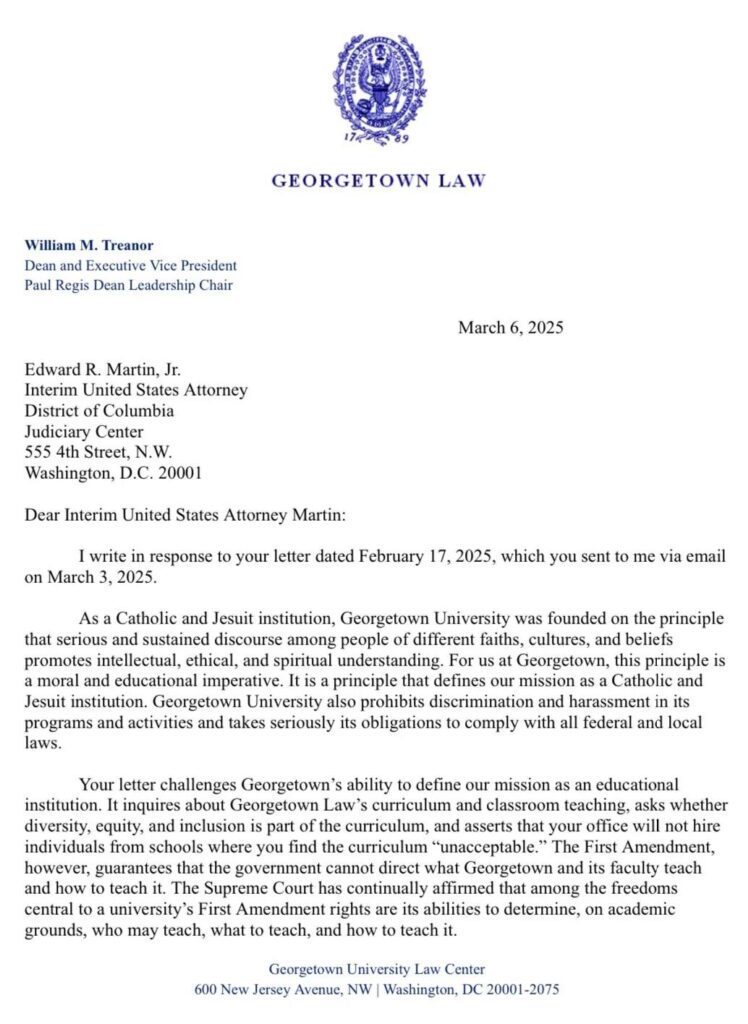
You
should
absolutely
read
the
letter
from
Treanor,
available
below,
in
its
entirety,
as
it
deserves
all
the
snaps.
But
the
letter
is
constructed
in
a
way
to
be
unique
Kryptonite
to
conservatives,
by
leaning
into
the
religious
institution’s
First
Amendment
protections.
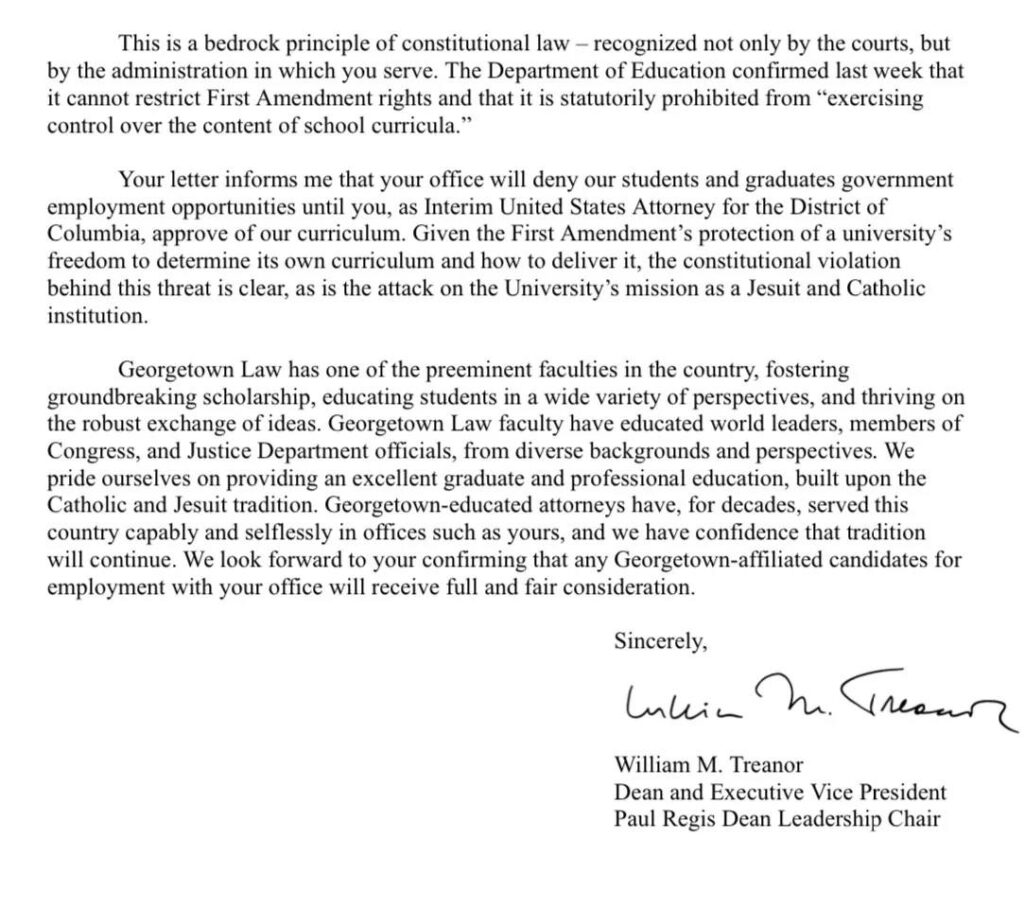
Your
letter
informs
me
that
your
office
will
deny
our
students
and
graduates
government
employment
opportunities
until
you,
as
Interim
United
States
Attorney
for
the
District
of
Columbia,
approve
of
our
curriculum.
Given
the
First
Amendment’s
protection
of
a
university’s
freedom
to
determine
its
own
curriculum
and
how
to
deliver
it,
the
constitutional
violation
behind
this
threat
is
clear,
as
is
the
attack
on
the
University’s
mission
as
a
Jesuit
and
Catholic institution.
Treanor
goes
hard
for
all
the
things
that
make
Jesuit
Catholicism
good.
Jesuits’
beliefs
include
global
justice,
peace,
and
dialogue
and
the
order
has
a
storied
tradition
of
educational
excellence.
Georgetown
has
a
prominent
role
in
that
tradition,
and
Treanor
will
not
be
selling
that
out
over
some
bullying.
As
a
Catholic
and
Jesuit
institution,
Georgetown
University
was
founded
on
the
principle
that
serious
and
sustained
discourse
among
people
of
different
faiths,
cultures,
and
beliefs
promotes
intellectual,
ethical,
and
spiritual
understanding.
For
us
at
Georgetown,
this
principle
is
a
moral
and
educational
imperative.
It
is
a
principle
that
defines
our
mission
as
a
Catholic
and
Jesuit
institution.
But
for
my
money,
the
closing
shot
Treanor
lobs
over
the
bow
is
the
piece
de
resistance
for
its
sheer
self-assurance:
Georgetown
Law
faculty
have
educated
world
leaders,
members
of
Congress,
and
Justice
Department
officials,
from
diverse
backgrounds
and
perspectives.
We
pride
ourselves
on
providing
an
excellent
graduate
and
professional
education,
built
upon
the
Catholic
and
Jesuit
tradition.
Georgetown-educated
attorneys
have,
for
decades,
served
this
country
capably
and
selflessly
in
offices
such
as
yours,
and
we
have
confidence
that
tradition
will
continue.
We
look
forward
to
your
confirming
that
any
Georgetown-affiliated
candidates
for
employment
with
your
office
will
receive
full
and
fair
consideration.
Seriously,
so
many
institutions
are
just
trying
to
survive
this
iteration
of
the
Trump
administration,
and
saying
and
doing
whatever
they
have
to
in
order
to
get
by.
But
Treanor
knows
that
surviving
by
betraying
the
principles
you
hold
near
and
dear
is
no
victory.
There’s
not
a
ton
of
good
news
out
there,
but
Georgetown
Law’s
willingness
to
step
into
the
fray
is
a
great
moment.
Kathryn
Rubino
is
a
Senior
Editor
at
Above
the
Law,
host
of
The
Jabot
podcast,
and
co-host
of
Thinking
Like
A
Lawyer.
AtL
tipsters
are
the
best,
so
please
connect
with
her.
Feel
free
to
email
her
with
any
tips,
questions,
or
comments
and
follow
her
on
Twitter
@Kathryn1 or
Mastodon
@[email protected].
Six
years
ago,
I
was
hard
at
work
polishing
up
the
manuscript
for
Your
Debt-Free
JD (affiliate
link).
It
was
a
labor
of
love.
I
couldn’t
be
prouder
every
time
I
hear
of
the
advice
it
contains
working
out.
Even
more
so,
I’m
proud
of
the
people
who’ve
used
it
to
help
them
make
one
of
the
most
important
decisions
of
their
lives.
Alas,
as
Marcus
Aurelius
put
it
nearly
two
millennia
ago,
the
universe
loves
nothing
so
much
as
to
change
the
things
which
are.
Six
years
out,
some
of
the
information
in
“Your
Debt-Free
JD”
is
not
as
useful
as
it
once
was.
A
few
portions
are
even
downright
obsolete.
Probably
the
most
important
example
has
to
do
with
the
U.S.
News
&
World
Report
law
school
rankings.
While
these
rankings
were
never
a
sacred
cow
to
me
personally,
as
the
2020s
dawned
they
were
extremely
important
to
individual
law
schools
as
well
as
to
individuals
at
those
law
schools
making
decisions
about
whom
to
admit
—
and
maybe
even
more
importantly,
about
which
applicants
merited
a
generous
scholarship
offer.
Today,
as
criteria
modifications
and
the
lack
of
opt-in
from
certain
institutions
make
the
U.S.
News
law
school
rankings
increasingly
ridiculous,
fewer
schools
care
about
them.
Not
only
does
this
make
the
U.S.
News
law
school
rankings
even
less
useful
as
a
standalone
tool
for
law
school
applicants
than
they
once
were,
it
also
obviates
some
—
though
not
all
—
of
the
strategies
outlined
in
my
book
to
(let’s
use
the
right
word
for
it,
don’t
feel
bad,
this
is
the
evil
law
school
industrial
complex
we’re
talking
about)
manipulate
law
schools
into
offering
you
a
full
scholarship.
That’s
a
big
one,
although
there
are
several
others.
For
instance,
one
paragraph
is
about
buying
nice
suits
at
thrift
stores,
because
it’s
dumb
to
pay
$1,000
for
a
new
suit
when
you’re
in
law
school,
and
it
continues
to
be
dumb
to
pay
$1,000
for
a
suit
even
once
you’ve
become
a
millionaire.
It’s
still
sound
advice
not
to
throw
your
money
away
on
needlessly
expensive
clothing,
but
it’s
harder
advice
to
follow
these
days
as
thrifting
has
really
hit
the
mainstream.
Despite
all
the
changes
in
reality
that
have
caused
some
of
the
words
I
wrote
six
years
ago
to
become
less
relevant,
I
am
not
doing
a
revised
edition.
The
idea
was
never
to
make
a
ton
of
money,
it
being
such
a
niche
target
audience
and
me
wanting
to
keep
the
book
accessible
to
the
poorest
potential
lawyers.
That
being
said,
the
sum
I’ve
made
off
of
“Your
Debt-Free
JD”
amounts
to
something
in
the
neighborhood
of
a
dollar
an
hour
for
all
the
time
I’ve
put
into
it,
so
I
don’t
have
much
interest
in
revisiting
the
text.
I’ll
tell
you
what
I
will
do,
however.
If
you’re
in
the
process
of
applying
to
law
schools,
or
are
considering
going
to
law
school
in
the
future,
feel
free
to
send
me
an
email
(you
can
find
my
email
address
at
the
bottom
of
the
article),
and
we’ll
set
up
a
time
for
a
phone
call.
We
can
talk
about
whatever
you’d
like
(within
reason),
be
it
the
financial
calculus
of
going
to
law
school,
how
to
best
set
yourself
up
for
the
career
you
want
while
you
are
there
(or
how
to
figure
out
what
career
it
is
you
want
in
the
first
place),
or,
if
you’ve
read
the
book,
what
has
changed
since
it
was
written
and
what
that
means
for
you
now.
This
is
free.
I
don’t
expect
or
want
anything
from
you
in
return
for
a
few
minutes
of
advice.
Of
course,
I
always
appreciate
it
whenever
someone
buys
the
book
(most
of
the
information
in
it
remains
valuable)
and
am
especially
pleased
when
folks
leave
an
honest
five-star
review
of
it.
But
that’s
not
a
requirement
to
take
me
up
on
my
offer
by
any
means.
I
do
probably
need
to
put
a
couple
caveats
on
this.
According
to
the
ABA,
42,817
students
began
JD
studies
at
accredited
American
law
schools
last
fall.
I
have
no
idea
what
the
demand
is
out
there,
but
if
even
1%
of
those
of
you
who
end
up
going
to
law
school
next
fall
want
to
talk
to
me
about
it,
that
is
going
to
be
overwhelming.
So,
I
may
have
to
cut
it
off
at
whatever
point
I
deem
reasonable.
Additionally,
if
you
consider
yourself
MAGA,
don’t
bother
emailing
me
because
in
that
case
I
do
not
want
to
help
you
achieve
your
goals.
Well,
thank
you
to
everyone
who
bought
a
copy
of
the
book
over
the
past
six
years.
I
look
forward
to
speaking
with
some
of
you
in
2026.
Jonathan
Wolf
is
a
civil
litigator
and
author
of Your
Debt-Free
JD (affiliate
link).
He
has
taught
legal
writing,
written
for
a
wide
variety
of
publications,
and
made
it
both
his
business
and
his
pleasure
to
be
financially
and
scientifically
literate.
Any
views
he
expresses
are
probably
pure
gold,
but
are
nonetheless
solely
his
own
and
should
not
be
attributed
to
any
organization
with
which
he
is
affiliated.
He
wouldn’t
want
to
share
the
credit
anyway.
He
can
be
reached
at [email protected].
*
Trump
administation
aims
to
circumvent
asylum
obligations
by
immediately
deporting
anyone
requesting
asylum
to
“safe”
countries
like
*checks
notes*
Uganda.
[Politico]
*
Possible
answer
to
AI
hallucinations:
mandatory
hyperlinks.
[National
Law
Review]
It
is
alleged
that
a
soldier
was
stabbed
and
needed
urgent
medical
care
after
some
of
the
illegal
immigrants
became
aggressive
when
intercepted.
One
video
shows
a
large
group,
including
women
carrying
babies
on
their
backs,
being
stopped
as
they
attempted
to
cross.
The
footage
captures
the
group
being
instructed
to
walk
in
single
file
across
land
partly
covered
in
muddy
water.
The
arrests
were
carried
out
over
the
past
week
as
part
of
ongoing
border
security
operations
during
the
festive
season.
The
SANDF
said:
“This
marks
the
first
time
our
members
have
had
to
manage
such
a
massive
influx
during
this
period
of
the
festive
season.”
Officials
said
the
group
was
trying
to
enter
South
Africa
through
illegal
border
points.
The
border
jumpers
were
processed
according
to
immigration
laws
and
handed
over
to
the
relevant
authorities.
The
SANDF
warned
that
border
security
operations
will
continue
and
that
illegal
crossings
will
not
be
tolerated.
Bulawayo
Provincial
police
spokesperson,
Inspector
Nomalanga
Msebele,
said
the
incident
followed
an
interaction
on
a
WhatsApp
group
called Idale
labomama,
which
the
26-year-old
mother
had
joined
about
four
months
earlier.
The
group
advertised
that
mothers
in
need
of
children’s
clothing
could
contact
a
supplied
number
for
assistance.
“The
complainant
contacted
the
number
via
WhatsApp
and
communicated
with
an
unknown
suspect
who
identified
herself
only
as
MaNdlovu
of
Cowdray
Park.
The
suspect
offered
to
deliver
the
clothes
to
the
complainant’s
residence,
and
directions
were
provided,”
said
Inspector
Msebele.
On
December
29,
at
around
6am,
the
suspect
informed
the
mother
that
she
would
deliver
the
clothes
later
that
day.
At
about
1pm,
the
suspect
instructed
the
mother
to
wait
at
the
corner
of
Harare
Road
and
Cecil
Avenue
in
Parklands
to
collect
the
items.
Inspector
Msebele
said
the
mother
left
home
with
one
of
her
four-month-old
twins
and
went
to
the
meeting
point,
leaving
the
other
twin
asleep
in
the
bedroom
and
her
four-year-old
daughter
playing
outside.
The
mother
waited
for
about
15
minutes
before
receiving
a
message
from
the
suspect
saying
she
had
sent
someone
known
only
as
‘Lo’
who
did
not
arrive,
prompting
the
complainant
to
return
home.
“Upon
arrival,
she
discovered
that
her
four-month-old
baby
girl
was
missing,”
Inspector
Msebele
added,
noting
that
the
matter
was
immediately
reported
to
the
police.
Police
have
appealed
to
members
of
the
public
with
information
that
may
lead
to
the
arrest
of
the
suspect
or
the
recovery
of
the
baby
to
report
at
the
nearest
police
station.
“We
also
urge
mothers
and
caregivers
to
exercise
extreme
caution
when
dealing
with
strangers
on
social
media
and
to
avoid
oversharing
personal
or
sensitive
information,
as
this
exposes
them
and
their
children
to
serious
risk,”
said
Inspector
Msebele.













 Kathryn