Your Honor, May The Record Reflect… Dicks v. Kuntz – See Generally – Above the Law

Serious
Case,
Extremely
Not-Serious
Caption:
Get
ready
to
giggle
like
you’re
12-years
old
again.
“Shrug”
Is
Not
Really
The
Response
Anyone
Who
Cares
About
The
Rule
Of
Law
Wanted
To
Hear:
The
disciplinary
(non)
case
against
Lindsay
Halligan.
Say
What
You
Want
About
Kim
Kardashian’s
Quest
To
Become
An
Esquire:
But
it
sure
isn’t
a
reason
to
get
*rid*
of
the
bar
exam.
Quite
the
opposite,
actually.
USC
Law
Drama:
The
divorce
that
launched
a
Title
IX
investigation,
a
federal
lawsuit,
and
lots
of
intrigue.
2025
Is
Weird,
But
I
Didn’t
Have
Digging
Up
A
Supreme
Court
Justice’s
Bones
On
My
Bingo
Card:
Conservative
legal
analysts
may
have
lost
the
plot.
Todd
Blanche
Chilling
Warning
To
White-Collar
Lawyers:
Shut
up
or
else.
Trial
Lawyer.
Fact
Witness:
Alex
Spiro
can
do
it
all.
All
The
Latest
Biglaw
Bonus
Info:
In
one
convenient
place.

Zimbabwe urged to defer proposed customs duty hike on specific fabrics

The
Ministry
of
Industry
and
Commerce
has
directed
the
Competition
and
Tariff
Commission
(CTC)
and
the
National
Competitiveness
Commission
(NCC)
to
conduct
a
study
to
better
understand
capacities
across
the
value
chain
and
problems
limiting
linkages
between
its
various
stages.

The
government
has
proposed
to
raise
by
300
per
cent
the
customs
duty
on
selected
imported
PSF
with
dyed
woven
fabrics
of
cotton
to
support
domestic
production
and
strengthen
the
cotton-to-clothing
value
chain.

The
proposal
was
announced
by
Finance,
Economic
Development
and
Investment
Promotion
Minister
Mthuli
Ncube
while
presenting
the
budget
recently.
“I,
further
propose
to
review
materials
benefitting
from
the
clothing
manufacturers
rebate
to
exclude
the
above-mentioned
fabrics,
subject
to
quality
and
competitive
pricing
from
local
manufacturers.
These
measures
take
effect
from
January
1,
2026,”
he
said.

According
to
the
Zimbabwe
Clothing
Manufacturers
Association
(ZCMA)
chairman
Jeremy
Youmans,
it
is
too
early
to
implement
these
measures
as
the
study
results
are
yet
to
be
released.

“The
intended
duty
of
40
per
cent
should
only
apply
to
finished
goods,
not
fabric,
which
is
a
raw
material
for
the
clothing
industry
and
an
intermediate
goods
for
home
textile
manufacturers,”
Youmans
was
quoted
as
saying
by
domestic
media
reports.

“The
additional
$2.50
per
kg
can
make
the
duty
rate
rise
to
between
60
and
90
per
cent
depending
on
the
weight
of
the
fabric,”
he
added.

Meanwhile,
the
Zimbabwe
Textile
Manufacturers
Association
(ZITMA)
hailed
the
government’s
proposal,
saying
more
needs
to
be
done.
The
issue
of
second-hand
clothing
must
be
decisively
dealt
with
as
it
continues
to
play
havoc
with
the
market,
ZITMA
said.

Source:


Zimbabwe
urged
to
defer
proposed
customs
duty
hike
on
specific
fabrics


AlchemPro

Zimbabwe Economic Update 2025: Fostering a Business-Enabling Regulatory Environment for Private Sector Growth


Zimbabwe’s
economy
is
projected
to
rebound
strongly
in
2025
with
an
estimated
6.6%GDP
growth
due
to
robust
growth
in
agriculture,
services,
and
continued
investments
in
mining
and
steel,
according
to
the
new Zimbabwe
Economic
Update: Fostering
a
Business-Enabling
Regulatory
Environment
for
Private
Sector
Growth
,
published
on
December
2,
2025.
This
growth
outpaces
many
peers
in
the
Sub-Saharan
Africa
region.The
medium‑term
growth
also
remains
positive,
anticipated
to
remain
elevated
at
5%
in
2026,
though
fiscal
slippages,
external
shocks,
and
climate-related
disasters
such
as
droughts
still
pose
significant
threats
to
the
current
stability.

Zimbabwe’s
tight
monetary
policy
since
late
2024
has
helped
improve
inflation
dynamics
and
stabilize
the
Zimbabwe
Gold
(ZiG)
currency.
Therefore,
inflation
is
expected
to
moderate
to
single
digits
in
2026
and
decrease
further
to
5%
over
the
medium-term.
Poverty
is
expected
to
decline
gradually
as
growth
recovers,
but
remains
sensitive
to
weather
shocks
and
inflation,
with
rural
households
particularly
exposed
due
to
the
dependence
on
rain-fed
agriculture,
slow
off-farm
jobs,
and
inadequate
social
protection.


“Now
that
the
macroeconomy
is
improving,
the
Government’s
position
in
re-prioritizing
efforts
to
improve
the
ease
of
doing
business
to
improve
Zimbabwe’s
private
sector
growth
and
competitiveness
are
more
than
necessary
to
enhance
the
overall
growth
and
eventually
translate
economic
growth
into
lasting
economic
benefits,” 
says Victor
Steenbergen,
Senior
Country
Economist
for
Zimbabwe.

To
sustain
a
strong
economic
growth
momentum
for
Zimbabwe,
the
ZEU
recommends
the
following:

  • Implementation
    of
    the
    policies
    set
    out
    in
    the
    Economic
    Reforms
    Matrix
    of
    the
    Structured
    Dialogue
    Platform
    (SDP)
    for
    Arrears
    Clearance
    and
    Debt
    Resolution.
    This
    will
    help
    to
    continue
    macroeconomic
    stability
    and
    enhance
    growth.
    Progress
    on
    the
    SDP
    also
    provides
    opportunities
    to
    help
    unlock
    affordable
    external
    credit
    lines
    and
    stimulate
    much-needed
    public
    and
    private
    sector
    investment
    to
    boost
    growth.
  • Continued
    efforts
    to
    anchor
    the
    existing
    price
    and
    exchange
    rate
    stability,
    which
    will
    support
    economic
    growth
    and
    job
    creation
    while
    avoiding
    reversing
    the
    prevailing
    stability
    gains.
  • Sustained
    implementation
    of
    the
    Presidential
    Ease
    of
    Doing
    Business
    Initiative,
    to
    improve
    the
    business
    environment,
    stimulate
    investment,
    and
    promote
    private
    sector-led
    growth
    thereby
    reinforcing
    the
    recent
    gains,
    boosting
    competitiveness,
    and
    translating
    economic
    growth
    into
    lasting
    economic
    benefits.

The
ZEU
special
topic
“Fostering
a
Business-Enabling
Regulatory
Environment
for
Private
Sector
Growth”
analyzes
the
current
business
environment.
Case
studies
of
compliance
requirements
from
several
sub-sectors
show
significant
regulatory
burdens.
Analysis
in
agriculture,
agro-processing,
and
tourism
reveal
that
some
sub-sectors
face
up
to
28
different
legal
and
regulatory
requirements,
often
involving
multiple
government
ministries
and
agencies.
The
mapping
of
sectoral
business
regulations
provides
three
main
findings:


  1. High
    and
    regressive
    fee
    burdens
    :
    Compliance-related
    fees
    and
    levies
    often
    generate
    significant
    monetary
    costs
    for
    firms,
    with
    formal
    requirements
    in
    certain
    sectors
    even
    exceeding
    annual
    revenues
    for
    some
    subsectors.

  2. Inadequate
    transparency
    and
    reliance
    on
    manual
    processes
    :
    Several
    requirements
    continue
    to
    rely
    on
    paper-based
    processes
    that
    also
    require
    physical
    visits
    to
    the
    offices
    of
    relevant
    Ministries,
    Departments,
    and
    Agencies
    (MDAs)
    due
    to
    lack
    of
    readily
    available
    information
    online
    on
    regulatory
    requirements.

  3. Overlapping
    mandates
    :
    Multiple
    MDAs
    often
    issue
    requirements
    and
    conduct
    inspections
    targeting
    the
    same
    public
    policy
    goal,
    creating
    additional
    procedural
    and
    cost
    burdens
    for
    minimal
    public
    policy
    gain.

The
ZEU
recognizes
the
notable
progress
on
the
recent
regulatory
reforms
by
the
Government
of
Zimbabwe
under
the
Presidential
Ease
of
Doing
Business
initiative,
which
among
others
is
addressing
the
current
complex
and
burdensome
regulatory
environment
especially
for
Small
and
Medium
Enterprises
(SMEs).
The
first
phase,
finalized
in
September
2025
with
analytical
support
from
the
World
Bank
Group,
focused
on
the
beef,
dairy,
stockfeed,
and
tourism
sectors,
leading
to
the
reduction
or
elimination
of
several
levies
and
fees.

To
further
support
the
Presidential
Ease
of
Doing
Business,
the
Government
of
Zimbabwe
should
complete
the
regulatory
stocktaking
and
regulatory
simplification
for
the
12
priority
sectors
in
the
next
12
months.
There
is
also
a
need
for
a
more
ambitious
medium-term
agenda
to
foster
Zimbabwe’s
business-enabling
environment,
which
focus
on
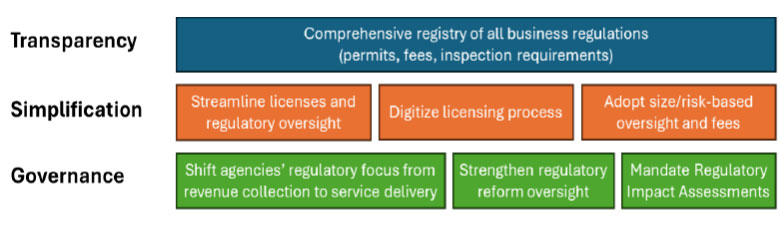
three
broad
pillars
of
transparency,
simplification,
and
governance
(Figure
1):


  • Regulatory
    Transparency:
     Create
    a
    comprehensive
    public
    registry
    of
    licenses,
    fees,
    and
    inspection
    requirements
    to
    reduce
    uncertainty
    and
    discretion
    while
    ensuring
    that
    all
    this
    information
    is
    regularly
    updated,
    and
    accessible
    to
    firms
    and
    citizens.

  • Regulatory
    Simplification:
     Consolidate
    overlapping
    procedures
    and
    inspections
    and
    adopt
    risk‑based
    and
    size‑appropriate
    compliance
    regimes
    to
    lower
    burdens
    on
    SMEs.
    This
    streamlining
    will
    help
    lower
    costs
    for
    firms,
    while
    allowing
    regulators
    to
    allocate
    resources
    more
    efficiently.

  • Regulatory
    governance:
     Strengthen
    central
    oversight
    of
    regulatory
    reforms
    and
    shift
    agencies
    towards
    a
    service‑delivery
    mindset.
    These
    reforms
    also
    require
    clarifying
    institutional
    mandates,
    reviewing
    agency
    fee
    structures,
    and
    ensuring
    regulations
    serve
    the
    public
    interest
    rather
    than
    institutional
    revenue
    needs.


Figure
1.
Key
policy
areas
to
foster
a
business-enabling
regulatory
environment

Effective
implementation
of
these
reforms—anchored
on
strong
institutional
leadership
and
improved
administrative
efficiency—can
lower
compliance
costs,
stimulate
firm
growth,
and
lay
the
foundation
for
a
more
competitive
and
inclusive
economy.


Source:


Zimbabwe
Economic
Update:
Strengthening
Macroeconomic
Stability
and
Undertaking
Reforms
to
Unlock
Private
Investment
and
Jobs

Church leaders in Kenya and Zimbabwe unveil disability rights action plans

The
meeting,
organized
by
the
World
Council
of
Churches
(WCC)
Ecumenical
Disability
Advocates
Network,
gathered
25
leaders
from
the
Anglican
Church
of
Kenya,
the
Presbyterian
Church
of
East
Africa,
and
the
Reformed
Church
in
Zimbabwe.


This
has
been
a
very
crucial
training
for
the
church
leaders
who
often
interact
daily
and
engage
with
persons
with
disabilities.
We
hope
that
after
this,
they
will
help
their
churches
and
congregations
ensure
inclusion
of
persons
with
disabilities,” said
Anjeline
Okola,
WCC
Ecumenical
Disability
Advocates
Network
coordinator.


Adequate
engagement
with
the
churches
and
faith
actors,
who
remain
critical
partners
in
reaching
grassroots
communities,
is
very
important
and
at
the
core
of
work.” 

From
25-27
November,
the
leaders
engaged
in
Bible
studies
and
theological
reflections,
assembled
in
groups,
and
explored
African
churches’
case
studies.
The
aim
was
to
give
them
a
theological,
legal,
and
practical
tool
to
enable
them
to
champion
for
disability
rights
in
work,
employment,
and
climate
change
adaptation.

Dr
Samuel
Kabue,
former
executive
secretary
of
the
WCC
Ecumenical
Disability
Advocates
Network,
told
the
training
that
the
UN
Convention,
adopted
in
2006,
has
since
received
a
lot
of
attention,
nearing
universal
ratification
by
the
UN
member
states.

At
the
same
time,
he
cautioned
that
the
convention
does
not
create
new
rights
but
provides
a
framework
for
persons
with
disabilities
to
enjoy
the
same
rights
as
other
people.


Its
purpose
is
to
elaborate
in
detail
the
rights
of
persons
with
disabilities
and
set
out
a
code
of
implementation,” said
Kabue.


To
ensure
that
the
convention
is
implemented,
there
is
a
need
for
continuous
oversight.
This
oversight
requires
the
involvement
of
all
stakeholders,
including
the
church
and
other
faith-based
organisations.

He
encouraged
churches,
the
civil
society,
and
faith-based
organisations
to
join
organisations
of
persons
with
disabilities
in
the
preparation
of
the
parallel
report
or
even
to
have
their
own
reports,
alongside
those
of
states
that
have
ratified
the
convention.

In
the
action
plans
unveiled,
the
Anglican
Church
of
Kenya
plans
to
hold
sensitization
and
training
workshops
on
inclusion
and
awareness
creation,
assemble
disability
inclusion
committees
at
provincial,
diocese,
and
parish
levels,
and
develop
a
manual
on
disability
inclusion
policy.

The
Reformed
Church
in
Zimbabwe’s
action
plans
include
clergy
and
laity
orientation
and
training
on
the
conventions
provisions,
developing
an
inclusion
policy,
and
adopting
a
disability
inclusive
climate
change
strategy,
among
others.

Part
of
the
Presbyterian
Church
of
East
Africa
action
plan
includes
explaining
theological
statements,
including A
Church
of
all
and
for
all
and “
The
Gift
of
being
and
the
UN
Convention
on
the
Rights
of
Persons
with
Disabilities.” It
will
also
focus
on
sustainable
agriculture
and
food
security,
and
disability,
among
other
issues.

Rev.
Zadock
Oluoch,
vicar
at
St
Augustine
Madaraka,
a
parish
of
the
Anglican
Churchs
All
Saints
Cathedral
Diocese,
said
that
after
years,
the
church
has
taken
a
turn
to
think
more
deeply
about
how
to
engage
persons
with
disabilities.


Having
listened
to
different
denominations,
churches
present
here,
and
organizations
and
hearing
the
things
they
are
doing,
I
realize
there
is
a
need for
partnerships,” said
the
cleric. We
are
beginning
to
think
about
how
we
can
partner
so
that
we
avoid
duplication.” 

Joyce
Matara,
acting
director
of
the
National
Association
of
Societies
for
Care
of
the
Handicapped,
Zimbabwe,
said
churches
needed
to
act
quickly
to
ensure
that
persons
with
disabilities
get
education
to
move
them
out
of
poverty,
enable
formal
employment,
and
empower
them
to
contest
for
leadership.


The
organization
of
persons
with
disabilities
can
play
a
key
role
in
ensuring
churches
are
inclusive.
There
is
also
a
need
for
awareness
of
the
Convention
on
the
Rights
of
Persons
with
Disabilities
provision
and
other
conventions
like
the
African
disability
protocol,” said
Matara.


Source:


Church
leaders
in
Kenya
and
Zimbabwe
unveil
disability
rights
action
plans
|

World
Council
of
Churches

We Notice If You Notice – See Also – Above the Law

White-Collar
Crime
Matters
If
You
Disrespect
Trump:
It’s
a
very
clear
“We
go
after
our
political
enemies”
message.
The
Art
Of
Saying
Goodbye:
Here
are
some
easy
guidelines
for
telling
the
firm
adios.
Tish
James
Is
Unscratched:
No
luck
on
that
indictment.
Sorry
Trump!
NYT
Sues
DOD
And
Pete
Hegseth:
They’re
fighting
to
ask
the
questions
the
public
needs
answered.
Spread
The
Holiday
Spirit!:
Send
in
your
holiday
themed
cards
for
our
17th
Holiday
Card
Contest!

Debunked Episode 22: With ACA Subsidies Set to Expire and the Open Enrollment Window Closing, Members of Congress Brainstorm Alternatives – MedCity News

The
deadline
for
extending
the
Affordable
Care
Act
subsidies
is
approaching
this
month.
This
is
happening
even
as
consumers
who
depend
on
the
ACA
Marketplace
are
faced
with
the
tough
decision.
Should
they
forego
health
plans
that
will
no
longer
be
affordable
for
them
once
the
subsidies
expire
or
hope
that
Congress
will
reach
a
bipartisan
agreement
to
extend
the
subsidies
until
workable
alternatives
can
be
hashed
out
and
approved?
This
issue
was
the
primary
focus
for
the
latest
episode
of
the
Debunked
podcast,
hosted
by
MedCity
News
Editor-in-Chief
Arundhati
Parmar
and
Samir
Batra,
managing
partner
of
Health
Innovation
Pitch.

With
93%
of
ACA
Marketplace
plan
members
(22
million
people
)
relying
on
tax
credits
set
to
expire
at
the
end
of
the
year
and
open
enrollment
scheduled
to
close
December
15,
“We’re
between
a
rock
and
a
hard
place,”
as
Arundhati
aptly
put
it.
At
the
time
of
recording,
the
Senate
was
expected
to
vote
December
9
on
whether
to
extend
the
subsidies.

Members
of
Congress,
especially
those
up
for
re-election
in
2026,
understand
the
risks
of
rejecting
subsidy
extensions.
Republican
Senators

Rick
Scott

of
Florida,
who

led
a
company
responsible
for
what
was
once
considered
the
largest
Medicare
fraud
in
U.S.
history
,
and

Bill
Cassidy

of
Louisiana
have
come
up
with
proposals
focused
on
making
more
use
of
healthcare
savings
accounts.

The
conversation
also
focused
on
the
latest
efforts
to
make
drugs
more
affordable,
particularly
GLP-1
drugs.
Discounting
these
costly
drugs
could
pave
the
way
for
a
big
reduction
in
the
prevalence
of
chronic
diseases
associated
with
obesity,
which
lines
up
with
the
MAHA
initiative
led
by
HHS
Secretary
Robert
Kennedy
Jr.
But
these
efforts
also
raise
questions.
The
drugs
are
only
effective
for
keeping
weight
off
if
the
people
taking
them
also
change
their
lifestyles
to
include
more
exercise
and
healthier
diet
options.
There
is
also
the
question
of
whether
drug
development
supply
chains
can
match
the
demand.

This
episode
of
Debunked
closes
out
2025.
The
next
episode
will
air
in
February.

You
can
access
the
podcast
here:

Micro-Video Funnels: How To Drive Consults From 15-Second Clips – Above the Law

Short-form
videos
at
varying
lengths
have
been
popularized
across
a
variety
of
digital
surfaces
over
the
past
few
years.
The
shortest
of
these
videos,
hovering
in
the
15-second
range,
present
a
particularly
compelling
option
for
law
firm
marketing
funnels
because
they
have
the
potential
to
grab
potential
customers’
attention
quickly
and
convey
an
impression
of
value
founded
in
legal
acumen
within
a
comparably
short
period
of
time.
Video
content
posted
to
social
media
spaces
additionally
tends
to
have
a
cumulative
effect
(thanks
to
the
frustrating-yet-fascinating
properties
of
the
algorithms
that
drive
these
ecosystems)
in
which
discovering
any
one
video
tends
to
increase
that
chances
that
a
user
who
pauses
to
view
that
video
will
see
more
from
the
same
law
firm.
When
used
as
the
basis
for
a
marketing
funnel,
15-second
“micro-videos”
can
function
as
efficient
tools
for
prompting
potential
clients
to
reach
out
and
book
their
consultations.

How
Do
Marketing
Funnels
Work?

The
digital
marketing
industry
is
full
of
“jargon”
terms
that
serve
a
genuine
function
as
a
type
of
shorthand
for
those
working
in
marketing
and
adjacent
fields,
but
can
easily
seem
opaque
to
individuals
in
other
professions.
Even
if
you
already
know
you
want
to
work
with
a
digital
marketing
agency
to
develop
your
law
firm
content
strategy
and
prepare
most
or
all
of
the
materials
for
distribution,
knowing
what
these
industry
insiders
mean
by
terms
like
“marketing
funnel”
puts
you
in
position
to
ask
important
questions
and
take
an
active
role
in
determining
your
law
firm’s
voice
and
overall
marketing
vision.

What
Is
a
Marketing
Funnel,
Anyway?

marketing
funnel
 is
a
thought
construct
marketers
use
to
conceptualize
the
“stages”
customers
go
through
on
their
way
to
making
a
purchase.
The
funnel
represents
an
idealized
version
of
this
process,
with
the
customer’s
level
of
interest
and
intentionality
increasing
as
they
are
guided
through
a
series
of
progressively
more
and
more
focused
steps,
created
by
the
marketing
team
(thus
mimicking
the
narrowing
of
a
funnel,
guiding
potential
customers
toward
a
transaction
in
a
way
that
is
intended
to
imitate
the
way
a
funnel
ensures
that
liquids
can
be
poured
through
the
mouth
of
a
container
without
spilling
out
over
the
edges).

Reality
is
of
course
much
messier
than
this
stylized
representation,
but
many
digital
marketing
professionals
find
the
funnel
construct
a
useful
touchpoint
as
they
are
designing
content
and
making
strategic
user
experience
(UX)
decisions
to
encourage
progression
through
the
stages.
The
goal
is
to
meet
potential
customers
“where
they
are”
at
varying
stages
of
their
decision-making
process,
in
order
to
more
effectively
engage
them
through
targeted
content.
While
they
can
be
labor-intensive
to
produce,
15-second
micro-video
clips
can
often
be
a
compelling
tool
for
attracting
interest
and
communicating
value
at
key
stages
in
this
process.

Marketing
Funnel
Structure

That
the
funnel
is
a
conceptual
tool
used
for
marketers’
convenience,
more
than
a
realistic
description
of
any
individual’s
actual
experience
of
gathering
information
and
deciding
to
conduct
a
“transaction,”
is
demonstrated
by
the
wide
variability
in
the
number
of
stages
digital
marketing
professionals
specify
for
their
funnels.
If
you
spend
any
significant
time
browsing
content
related
to
marketing
funnels,
you
will
see
that
leaders
in
the
industry
may
identify
as
few
as
three
stages,
or
as
many
as
seven.

Generally,
the
greater
the
number
of
stages
specified,
the
more
precise
the
granularity
of
the
conceptual
model.
How
much
precision
is
needed
may
depend
on
your
overall
marketing
goal
for
a
particular
project
or
campaign.
As
a
rule
of
thumb,
in
digital
marketing
funnel
stages
are
understood
to
run
in
tandem
with
customers’
“intent,”
often
inferred
from
their
search
queries.
The
collation
of
funnel
to
search
intent
is
imperfect
because
not
all
potential
customers
enter
the
funnel
through
search,
but
to
a
significant
extent
marketing
professionals
prefer
more
detailed
funnel
stages
as
a
reference
when
it
is
strategically
important
to
understand
the
stage
of
the
funnel
suggested
by
a
particular
degree
of
intent,
or
to
understand
the
level
of
intent
that
can
be
expected
of
a
potential
customer
engaging
at
a
particular
stage
of
the
funnel.
In
other
words:
Starting
with
either
model
enables
you
to
make
some
projections
for
the
other.

Advantages
of
Micro-Video
Content
for
Conversions

One
reason
to
consider
integrating
micro-videos
into
a law
firm
marketing
 funnel
is
that
short-form
video
content
is
both
familiar
to
audiences
and
generally
appreciated
by
them.
These
factors,
taken
together,
position
15-second
video
clips
to
attract
attention
and
positive
engagement
across
multiple
stages
of
a
marketing
funnel,
so
in
many
cases
it
may
be
helpful
to
intersperse
these
clips
throughout
the
distinct
conceptual stages
of
the
customer
journey
.
Keep
in
mind
that
potential
clients
are
more
apt
to
think
of
their
own
browsing
and
decision-making
more
as
wandering
exploration
than
as
steps
in
a
specific
journey;
it
is
the
job
of
the
marketing
team
to
entice
their
exploration
in
the
law
firm’s
direction
by
creating
a
trail
of
“bread
crumbs,”
in
the
form
of
engaging
content.

Micro-Video
Functions
in
a
Marketing
Funnel

Micro-videos
support
the
“funnel”
effect
by:

  • Creating
    initial
    brand
    awareness
  • Providing
    valuable
    information
  • Building
    trust
  • Communicating
    value

There
are,
obviously,
non-video
options
for
addressing
each
of
these
goals,
but
the
way
social
media
platforms
have
habituated
users
to
short-form
video
content
tends
to
work
in
a
marketing
funnel’s
favor,
as
15-second
clips
encourage
a
familiar
and
therefore
low-friction
progression
at
each
stage.

Thinking
Small:
Micro-Videos
Meet
Micro-Conversions

Many
content
marketing
strategists
use
the
concept
of
“micro-conversions”
to
track
the
minute
details
of
customers’
behavior
as
they
engage
with
content
at
each
stage
of
a
marketing
funnel.
Obviously
the
“big”
conversion
that
affects
your
law
firm’s
bottom
line
will
be
the
decision
to
book
a
consultation,
by
calling
your
office
phone
number
(ideally
in
the
same
page
they
are
browsing)
or
filling
in
a
scheduling
link
(also
preferentially
positioned
to
minimize
navigational
steps).
Realistically,
however,
many
people
are
not
going
to
skip
straight
from
an
initial
encounter
with
your
law
firm’s
content,
regardless
of
format,
to
booking
an
appointment
with
one
of
the
firm’s
associates.
Thinking
about
the
marketing
funnel
in
terms
of
micro-conversions
gives
marketers
a
way
to
account
for,
and
address,
the
myriad
smaller
decisions
an
individual
makes
at
each
stage
of
their
own
journeys.

Getting
on
the
Radar

Very
short
videos
(often
as
little
as
15
seconds)
can
be
an
ideal
tool
for
making
your
law
firm’s
initial
impression
on
a
potential
client’s
awareness.
YouTube
Shorts
and
TikTok
videos
both
show
occasional
“pull”
in
Google’s
search
engine
results
pages
(SERPs),
particularly
for
searches
that
are
looking
not
just
for
“informational”
content
but
more
specifically
for
process
demonstrations.
With
a
marketing
funnel,
however,
you
may
not
necessarily
want
to
rely
on
someone
actively
searching
for
what
you
have
to
offer.

Micro-Videos
on
Social
Media

One
important
advantage
of
micro-video
content
is
that
it
can
easily
be
integrated
into
your
content
strategy
across
a
variety
of
platforms,
and
on
all
of
the
major
social
media
platforms
it
is
typical
eligible
to
be
shown
to
users
you
might
not
even
have
known
to
target,
based
not
on
characteristics
you
selected
but
on
the
interests
demonstrated
by
those
users.
Social
media
integration
of
your
micro-video
funnel
content
means
that
your
law
firm
does
not
have
to
rely
exclusively
on
potential
clients’
active
legal
queries.

Getting
Customers
on
the
“Hook”

The
versatility
of
micro-videos
for
driving
conversions
at
both
macro
and
micro
levels
through
multiple
stages
of
a
funnel
means
that
marketing
funnels
centered
on
video
content
will
often
emphasize
social
media
distribution
for
an
initial
“hook”
video
that
serves
as
an
enticement
to
explore
the
law
firm’s
content
further.
This
“hook”
can
come
in
several
forms,
but
some
of
the
most
common
include:

  • “How-to”
    guides:
    Identify
    a
    common
    process
    that
    often
    frustrates
    lay
    people,
    and
    give
    a
    rapid
    breakdown
    of
    the
    key
    steps.
  • Illuminating
    updates:
    Point
    out
    a
    recent
    change
    in
    law
    or
    court
    decision
    whose
    effects
    are
    likely
    to
    have
    implications
    for
    your
    law
    firm’s
    ideal
    clients;
    give
    an
    “elevator
    speech”
    explanation.
  • “Meet
    the
    attorney”
    or
    “behind
    the
    scenes”:
    Address
    some
    aspect
    of
    the
    practice
    of
    law
    that
    is
    typically
    invisible
    to
    people
    outside
    the
    profession;
    aim
    to
    make
    the
    reveal
    informative,
    yet
    entertaining.

Each
of
these
videos
would
need
to
be
accompanied
by
a
CTA
inviting
viewers
to
click
through
to
additional
content/information,
thereby
nudging
them
through
a
micro-conversion
and
into
the
next
stage
of
the
marketing
funnel.
Often
these
CTAs
include
the
offer
of
a
free
resource,
such
as
a
downloadable
e-book
or
an
educational
video
series
on
the
same
topic
as
the
short
clip.

Building
Trust

In
a
few
lucky
cases,
you
may
actually
net
a
conversion
straight
to
your
scheduling
link
from
one
of
your
awareness-building
videos
aimed
at
the
wide
mouth
of
the
funnel.
Generally,
however,
one
of
the
main
functions
of
micro-video
content
at
those
early
stages
is
simply
to
get
the
potential
client
off
the
social
media
platform
(where
distractions
abound)
and
into
a
digital
environment
where
they
will
be
engaged
with
your
content
exclusively
(typically
your
law
firm
website
or
a
dedicated
marketing
funnel
landing
page).
Often
there
will
be
multiple
pathways
to
this
point,
both
as
“mouths”
for
the
funnel
and
to
capture
people
who
enter
the
funnel
already
well
along
their
customer
journeys.

Because
trust
is
often
one
of
the
crucial
factors
in
the
micro-conversions
that
move
prospective
clients
from
general
awareness
and
interest
toward
a
more
particular
curiosity
about
a
specific
law
firm
or
attorney’s
approach,
an
important
role
of
micro-video
content
at
the
middle
stages
of
a
marketing
funnel
is
to
emphasize
knowledge
and
authority.
The
content
needs
to
position
you
as
a
reliable
source
of
information
in
your
practice
area,
while
remaining
accessible
to
the
general
public.
You
only
have
a
few
seconds
to
capture
attention,
so
make
them
count.
Five-point
steps
for
preparing
your
finances
for
a
divorce,
identification
of
the
specific
statute
behind
a
recent
court
decision,
the
legal
definition
of
a
term
that
is
more
loosely
used
in
casual
conversation
than
in
law:
These
all
help
to
cement
the
initial
impression
of
expertise,
while
demonstrating
a
genuine
interest
in
connecting
with
clients
and
making
complex
legal
issues
easier
for
the
non-specialist
to
grasp.

The
“Big”
Conversion:
From
Curiosity
to
Consult

Depending
on
how
finely
the
stages
of
your
marketing
funnel
are
divided,
you
may
have
numerous
trust-building
videos,
each
designed
to
foster
increased
trust
in
your
legal
expertise
and
professional
commitment
to
serving
clients,
while
also
nudging
visitors
toward
additional
micro-conversions
and
progressively
tightening
the
association
between
your
law
firm
and
the
topic
that
initially
drew
their
interest.
If
the
micro-videos
have
been
effective
through
all
these
precursor
stages,
then
at
the
narrow
end
of
the
funnel
you
have
an
opportunity
to
present
them
with
a
compelling
opportunity
to
consult
with
you
personally.

The
twin
goals
of
content
this
end
of
the
funnel
are:

  • Eliminate
    as
    many
    sources
    of
    friction
    between
    the
    customer
    and
    the
    consult
    as
    possible
  • Underscore
    the
    urgency
    of
    taking
    action

This
end
of
the
funnel
is
an
excellent
place
to
emphasize
the
law
firm’s
approachability,
reducing
the
disincentives
to
make
the
call.
At
the
same
time,
often
short-form
videos
at
this
stage
are
tailored
to
create
a
sense
of
urgency
centered
on
the
advantages
of
legal
advice
that
could
directly
address
customers’
personal
circumstances.
If
your
law
firm
offers
no-cost
consultations
or
specific
scheduling
accommodations,
often
CTAs
that
underscore
those
options
can
be
highly
effective
at
this
stage.
Maximize
your
conversions
by
using
the
tools
of
each
platform
where
your
content
is
delivered
to
integrate
“call
now”
buttons
or
scheduling
links.

Be
Ready
To
Take
Those
Potential
Client
Calls!

Because
online
videos
can
generate
leads
at
any
time,
day
or
night,
make
it
a
point
to
ensure
that
your
answering
system
is
set
up
to
handle
calls
that
come
through
after
normal
business
hours,
or
while
staff
are
already
occupied.
Take
steps
to
confirm
that
online
contact
forms
and
scheduling
links
are
automatically
transmitting
contact
information
to
your
law
firm’s
CRM
system
and
forwarding
information
about
each
query
to
the
appropriate
personnel.
Assign
a
staff
member
the
responsibility
of
checking
digital
accounts
daily
to
capture
any
messages
that
may
have
been
missed
(or
assign
each
potential
contact
method
to
a
specific,
separate
individual
on
your
team).
Micro-videos
can
create
momentum
driving
potential
clients
to
make
contact;
you
want
to
ensure
that
your
law
firm
lives
up
to
the
impression
your
clips
have
created.


Annette
Choti,
Esq.
is
the
founder
of 
Law
Quill
,
a
legal
digital
marketing
agency
that
helps
growth-minded
law
firms
increase
their
online
visibility
and
convert
more
clients.
She
is
also
the
author
of
“Click
Magnet:
The
Ultimate
Digital
Marketing
Guide
for
Law
Firms”
and
Click
Magnet
Academy.
Annette
used
to
do
professional
comedy,
which
is
not
so
far
from
the
law
if
we
are
all
being
honest. 

Like Lawyers In Pompeii: Is Legal Ignoring The Coming AI Crisis? (Part II) – Above the Law

We
read
about
it
every
day.
A
lawyer
uses
a
large
language
model
(LLM)
to
do
some
research.
They
copy
that
research
into
a
brief,
but
the
research
contains
cases
that
don’t
exist.
The
lawyer
is
busted,
the
judge
furious,
and
the
client
starts
looking
for
a
better
lawyer.

It
has
everyone
scratching
their
heads.
I
mean,
everyone
knows
the
AI
systems
will
do
this,
so
why
does
it
keep
happening?
A
new Cornell
University study
and
paper
 sheds
some
light
on
this,
the
problem
of
overreliance,
and
why
the
volcano
of
serious
AI
flaws
may
be
about
to
erupt.
Quite
simply,
the
cost
of
verifying
the
results
of
the
AI
tools
exceeds
any
savings
from
their
use.
It’s
a
paradox.

In
Part
I
of
an
examination
of
the why
a
volcano
of
AI
problems
may
be
about
to
erupt, I
looked
at
the
dangers
of
overreliance
on
AI
given
the
gaps
in
the
underlying
infrastructure.
But
there’s
more
to
the
story. The
simple
fact
is
that
AI tools
have
fundamental
reality
and
transparency
flaws
is
risky
and
downright
foolhardy.
Given
the
profound
and
breadth
of
the
impact
of
these
flaws
and
the
corresponding cost to
verify
outputs,
the
use and role
of
AI
in
legal
may end
up being more
limited
than
many
think.


The
Assumptions

As
pointed out
in
the
study,
the
assumption
fueling
the
explosion
of
AI
use
in
legal
is
that
will
save
gobs
of
time.
This
savings
will
inure
to
the
benefit
of
lawyers
and
clients,
will
lead
to
fairer
methods
of
billing
like
alternative
fee
structures,
will
get
better
results,
improve
access
to
justice,
and
lead
to
world
peace.
Well, maybe
even
the
vendors
would
not
go
so
far
as
to
guarantee
the
last
one.
But
vendors
do
seem
to
be
guaranteeing
everything
but
that. And
pundits
talk
as
if
AI
will
transform
legal
from
the
ground
up. Law
firms
are
buying
into
the
hype,
investing
in
expensive
systems
that
do
things
they
barely
understand. 

But
not
so
fast.
All
this
hinges
on
the
assumption
that
the
time
saved
will
vastly
exceed
the
additional
steps
needed
to
verify
the
output
and
that
any
issues
of
AI
with
things
like
accuracy
will
soon
be
solved. 

The
Cornell
study
throws
some
cold
water
on
all
these
assumptions and
challenges
them
head
on.


The
Cornell
Study

The
study
identifies
two fundamental
LLM flaws.
The
first
we
all
know
about:
the
propensity
of
the
systems
to
hallucinate
and
provide
inaccurate
information.
The
study
refers
to
this
flaw
as
a
reality
flaw.
It’s
a
big
problem
in
a
profession
like
law
where
being
wrong
can
have
severe
consequences.
The
second
flaw
identified by
the
study
it
calls a transparency one.
We
don’t
really
know
how
these
systems
work.

The
reality
flaw, says
the
study, stems
from
the
fact
that
generative
systems
“are
not
structurally
linked
to
reality:
namely
factual
accuracy…a
machine
learning
model
does
not
learn
the
facts
underlying
the
training
data
but
reduces
that
data
to
patterns
which
it
then
ingests
and
seeks
to
reproduce.”
And
the
study
notes
that
it’s
not
just
the
public
systems
like
ChatGPT
that
demonstrate
this
flaw,
it’s
also
the
ones
built
for
legal
as
well.

So,
the
study
concludes,
“any
output
generated
by
AI
must
be
verified
if
the
user
wishes
to
satisfy
themselves
as
to
the
accuracy
and
connection
to
reality,
of
that
output—especially
in
legal
practice.”
In
other
words,
check your cites.

The
second
flaw, one
of
transparency,
is the
black
box
problem.
It in
turn
creates
a trust issue, says
the
study.
If
you
don’t
know
how
a
decision
is
made
or
a
conclusion
is
reached,
how
can
you
trust
it? 

For a
legal system that
depends
on
reasoning
and
logic, that’s a
big
issue. I
would
phrase
it
this
way: how
can
you
rely
on
something
when
you
don’t
know
how
it
works,
how
it
reached
the
decision
it
reached,
and
you
get
different
answers
to
the
same
questions.

Use
of AI in
legal
hinges
on
the
need to be
able
to
explain
how
a
decision
was
reached.
That’s
a
cornerstone
of
how
legal
processes
and
even
the
rule
of
law
is
based.

The
study
further
concludes
that
neither
of
these
flaws
will
be
overcome
anytime
soon.


What
Does
This
Mean?

The
study
goes
on
to
talk
about
what
this
means.
It
suggests
that
the
plethora
of
cases
where
lawyers have failed to
check
cites
and
end
up
having
a
hallucinated or
inaccurate case
or
facts
recited in
filings
means
lawyers are underestimating the
flaws.
Or have
been convinced
by
providers
that
the
risks
are
negligible. 

These
lawyers have
simply
overrelied
on
a
tool
they
believed
or
were
led
or
lulled into believing was
more
accurate
than
what
it
is. The
result
so
far
has
been
a great
hue
and
cry
by
everyone
that
you have
to check
cites.
Usually
this
is
delivered
with
a
wry
grin
that
says
it’s
just
dumb
and
lazy
lawyers
to
blame. But
the
fact
is
the
problem
is
not
going
away.
In fact, it
seems
to
be
getting
worse.

It
may
be
that
the
guilty
lawyers
are
dumb
or
lazy, although
as
I
have written
before
,
that’s
not
the
whole
story. But
what’s
left unsaid is
something
the
study
points
out:
“the
net
value
of
an
AI
model
in
legal
practice
can
only
be
assessed
once
the
efficiency
gain
(savings
on
time,
salary
costs,
firm
resource
costs,
etc.)
is
offset
by
the
corresponding
verification
cost
(cost
to
manually
verify
AI
outputs
for
accuracy,
completeness,
relevance,
etc.). Those
caught
with
hallucinated
cases
in
their
papers
simply
didn’t
take
the
time
to
verify
relying
on
the
AI
tool.

Because
the
demand
for
accuracy
in
legal
is
so
high,
the
study
notes,
the
verification
cost
for
many
actions
in
legal
is
too
high
to
offset
the
savings. The
study
also
concludes
that
this
cost
is
not
ameliorated
by
automated
systems
since
the
reality
and
transparency
risks
may
still
exist.
Hence what the study
calls
a verification
paradox.

And
we
see the
impact
of
this
paradox already
with
fines
imposed
by
courts
for
hallucinated
cases.
We
will
no
doubt
see
malpractice
and
ethical
violation
claims.
The
cost
of
being
wrong
in
law
is
just
too
great
to
not
verify
and
verify
thoroughly. 

Granted,
AI
can
do
lots
of
things
well
where
the
risks
of
being
wrong
are
not
that
great.
It
will
have
an
enormous
impact
in
business
and
maybe
other
professions.
But
for
law,
not
so
much:
“The
more
important
the
output,
the
more
important
it
is
to
verify
its
accuracy.”

The
study
concludes:

The
verification-value
paradox
suggests
the
net
value
of
AI
to
legal
practice
is
grossly overestimated,
due
to
an
underestimation
of
the
verification
cost.
A
proper
understanding of the costly
and
essential
nature
of
verification
leads
to
the
conclusion
that
AI’s
net
value will
often
be negligible
in
legal
practice:
that
is,
in
most
cases,
the
value
added
will
not
be
sufficient
to
justify the
corresponding
verification
cost.


The
Reality

It’s
easy
to
see
the
economic
impact
of
the
verification
paradox
when
you
compare
the
cost
of
getting
a
piece
of
work
done
by
an
LLM
with
that
done
by
a
human.
Let’s
assume
you
ask
an
LLM
to
do
some
legal
research
that
would
normally
take
you
10
hours.
You
get
the
result,
but
it’s
got
some
25
case
citations.
Now
you
have
to
a)
check
to
make
sure
every
case
exists
and
b)
make
sure
that
the
case
stands
for
the
proposition
the
LLM
says
it
does.
By
the
time
you
do
that,
you
could
very
well
spend
the
eight
hours,
if
not
more.


Volcano
About
to
Erupt
?

It
may
be
too
late
to
completely
put AI back
in
the
bottle.
But
where
it
takes
just
as
long
if
not
longer
to
verify
the
results
of
an
AI
tool
you’ve
spent
thousands
of
dollars
on,
you’re
not
going
be
predisposed
to
buy
more.
Certainly,
your
clients
aren’t
going
to
be
wild
about
your
use
of
a
tool
that
not
only
fails
to
save
them
money
but
costs
them
more
and
exposes
them
to
risk.

It’s
easy
to
envision
the
fundamental
conclusion
that
using
AI
for
many
things
is
not
worth
the
risk
and
the
cost
of
validating
its
result.
It’s
easy
to see
how this
fact will temper the enthusiasm
and
reliance
on
AI. 

We may
rapidly
conclude the
costs
and
risks
of
doing
so
are
too
high and
simply
not
worth
it
in
the
long-
and
perhaps
even
the
short-run.
When
that
happens,
a
lot
of
lawyers
are
going
to
be
caught
with
expensive
systems
that
they
don’t
need.
A
lot
of
vendors
may
have
to
go
in
other
directions.
A
lot
of
venture
capital
may
go
down
the
drain.
The
proverbial
volcano
may
be
about
to
erupt.

That’s
something
worth
considering
before
you
buy
the
next
shiny
new
AI
toy and before
you
use
AI
shortcuts
to do the
hard
work,
before
you
blindly
expect
people
you
supervise
to
do
the
right
thing
and
before
you
accept
without
question
their
work.

In
the
meantime,
check
your
citations.
Please.


Stephen
Embry
is
a
lawyer,
speaker,
blogger,
and
writer.
He
publishes TechLaw
Crossroads
,
a
blog
devoted
to
the
examination
of
the
tension
between
technology,
the
law,
and
the
practice
of
law


Melissa
Rogozinski
 is
CEO
of
the
RPC
Round
Table
and
RPC
Strategies,
LLC,
a
marketing
and
advertising
firm
in
Miami,
FL. 

Stat(s) Of The Week: The Firm That Salvaged Biglaw’s Rep – Above the Law

Last
month,

Forbes

released
its
second
annual
ranking
of

America’s
Best
Companies
.
Five
hundred
businesses
are
on
the
list.
Just
one
is
a
law
firm.

That
firm
is
Maynard
Nexsen,
ranked
No.
99.
Since
the

2023
merger

between
Maynard
Cooper
&
Gale
and
Nexsen
Pruet,
the
Alabama-based
firm
has

joined
the
Am
Law
200
,
earned

accolades
for
client
service
,
and
now
made
it
on
to
a
list
of
the
nation’s
top
companies.

To
come
up
with
its
ranking,

Forbes

says
it
partnered
with
a
half-dozen
data
firms,
evaluating
“millions
of
data
points
for
thousands
of
companies
to
produce
a
final
list
of
500
top-quality
businesses.” 

Some
of
the
100+
metrics
include
employee
sentiment,
customer
sentiment,
media
sentiment,
financial
performance,
business
trajectory,
company
size,
workforce
stability,
workforce
diversity,
cybersecurity,
and
sustainability. 


Forbes
America’s
Best
Companies
2026

[Forbes]