Remember
was
it
was
an
anathema
to
conservative
values
to
interfere
with
business?
Oh,
my
kingdom
for
the
halcyon
days
of
Reagan’s
“limited
government.”
Now
we
have
a
Republican
president
committed
to
micromanaging
the
nation
based
on
his
own
personal
vendettas.
And
it’s
not
just
the
once
independent
Department
of
Justice
that
must
adhere
to
his
whims,
but
private
industry
as
well.
While
Donald
Trump’s
role
in
the
sidelining
of
Jimmy
Kimmel
(until
Disney
adults
came
to
the
rescue)
has
garnered
a
ton
of
attention,
he’s
making
other
moves
to
leave
his
indelible
mark
on
the
free
market.
Like
demanding
Microsoft
fire
one
of
its
attorneys.
Last
week,
the
president
took
to
social
media
(because
of
course
that’s
how
he
does
it)
to
demand
that
Microsoft
fire
its
President
of
Global
Affairs
Lisa
Monaco.
So
what
has
Monaco
done
to
spark
Trump’s
ire?
Well,
she
worked
for
the
Department
of
Justice
under
the
Biden
administration.
And
you
can
tell
from
the
way
Trump
uses
the
current
DOJ
as
his
own
personal
law
firm
that
he
doesn’t
understand
the
notion
of
public
service
and
the
value
of
a
Justice
Department
that
works
separately
from
the
president’s
late-night
demands.
Monaco
was
the
deputy
attorney
general
and
coordinated
the
DOJ’s
prosecution
of
the
January
6th
perpetrators.
Because
pardoning
those
responsible
for
the
attack
on
the
Capitol
isn’t
enough
to
undo
the
Trumpian
slight,
the
president
is
also
going
after
those,
like
Monaco,
who
attempted
to
uphold
the
rule
of
law.
In
March,
in
one
of
his
executive
orders
aimed
at
attorneys
and
the
rule
of
law,
Trump
revoked
Monaco’s
security
clearance.
And
last
week,
Trump
wrote
on
Truth
Social
that
Monaco
should
be
fired
and
is
“a
menace
to
U.S.
National
Security,
especially
given
the
major
contracts
that
Microsoft
has
with
the
United
States
Government.”
Microsoft
has
not
commented
on
the
campaign
of
presidential
pressure.
But,
as
reported
by
Law.com,
Microsoft
has
billions
of
dollars
in
federal
government
contracts
that
could
be
leveraged
to
bend
to
Trump’s
demands.
Just
another
thing
that’s
perfectly
emblematic
of
2025
that
would
have
been
downright
shocking
30
years
ago.
Kathryn
Rubino
is
a
Senior
Editor
at
Above
the
Law,
host
of
The
Jabot
podcast,
and
co-host
of
Thinking
Like
A
Lawyer.
AtL
tipsters
are
the
best,
so
please
connect
with
her.
Feel
free
to
email
her
with
any
tips,
questions,
or
comments
and
follow
her
on
Twitter
@Kathryn1 or
Mastodon
@[email protected].
Ed.
note:
This
is
the
latest
in
the
article
series, Cybersecurity:
Tips
From
the
Trenches, by
our
friends
at Sensei
Enterprises,
a
boutique
provider
of
IT,
cybersecurity,
and
digital
forensics
services.
Ransomware
used
to
be
a
high-stakes
game
requiring
specialized
skills.
You
needed
serious
coding
chops,
a
custom
exploit,
and
weeks
of
preparation.
Now?
All
you
need
is
a
malicious
idea,
a
large
language
model,
and
an
internet
connection.
Attackers
are
turning
to
generative
AI
to
write
malware,
craft
ransom
notes,
and
automate
campaigns.
What
used
to
require
an
experienced
hacker
team
can
increasingly
be
done
with
a
few
well-engineered
prompts.
That
shift
isn’t
theoretical
—
and
for
law
firms
and
their
clients,
it’s
a
legal,
operational,
and
reputational
powder
keg.
AI
Lowers
the
Barrier
to
Entry
Criminal
groups
are
using
generative
AI
to
develop
ransomware
tools
—
even
without
deep
technical
expertise.
Meanwhile,
researchers
have
demonstrated
proof-of-concept
malware
capable
of
dynamically
generating
attack
code,
adapting
to
defenses,
and
hiding
its
tracks
in
real
time.
Translation:
the
entry
barrier
for
ransomware
is
collapsing.
What
once
took
months
of
work
can
soon
be
launched
in
hours
by
someone
with
more
ambition
than
expertise.
Why
Lawyers
Should
Care
This
isn’t
just
an
IT
problem.
It’s
a
legal
headache
waiting
to
happen:
Attribution
gets
fuzzy.
If
an
attack
is
partially
AI-generated,
was
the
“actor”
the
hacker
or
the
model
itself?
Blame
will
get
murky
fast.
Regulation
lags.
Many
cyber
laws
assume
human-driven
attacks;
AI
complicates
breach
notification,
liability,
and
compliance
obligations.
Contracts
will
be
tested.
Indemnities,
force
majeure
clauses,
and
“malicious
acts”
exclusions
weren’t
drafted
with
autonomous
code
in
mind.
Expect
disputes.
Duty
to
foresee
risk
expands.
If
firms
know
AI
ransomware
is
coming,
regulators
and
plaintiffs
may
argue
they
had
a
duty
to
prepare
for
it.
Lawyers
advising
on
risk,
contracts,
or
governance
can’t
treat
AI
ransomware
as
tomorrow’s
problem.
It’s
already
here.
What
Counsel
Should
Tell
Clients
—
Now
If
you
have
clients
with
any
meaningful
digital
footprint,
this
is
your
checklist:
Stress-test
incident
response
plans:
Assume
an
attacker
can
regenerate
malware
instantly
if
the
first
attempt
fails.
Update
playbooks
for
adaptive,
AI-driven
threats.
Audit
contracts
and
indemnities:
Push
clients
to
revisit
liability
provisions
in
tech
agreements.
Define
“malicious
acts”
broadly
enough
to
include
AI-generated
attacks
—
or
risk
ambiguity
later.
Add
AI
scenarios
to
tabletop
exercises:
Ransomware
plans
often
assume
static
attacks.
Add
scenarios
where
the
payload
evolves
mid-incident
or
uses
generative
tools
to
craft
spear-phishing
campaigns
on
the
fly.
Require
transparency
from
vendors:
If
third-party
vendors
use
AI
in
their
systems,
demand
to
know
how
they
monitor,
secure,
and
update
these
tools.
Silence
in
contracts
here
could
lead
to
future
lawsuits.
Monitor
evolving
regulations:
As
AI
threats
grow,
lawmakers
will
respond.
Clients
should
anticipate
tighter
reporting
requirements,
shifts
in
liability,
and
sector-specific
dates.
We’re
Not
at
the
Apocalypse
—
Yet
AI-generated
ransomware
is
still
developing,
but
it
is
not
yet
the
next
WannaCry.
However,
it
indicates
the
direction
in
which
things
are
heading.
Criminal
groups
are
already
experimenting
with
AI
to
reduce
costs,
increase
scale,
and
automate
extortion.
For
lawyers,
the
message
is
clear:
update
your
risk
perspective
before
reality
catches
up.
When
the
first
AI-generated
ransom
note
arrives,
you
don’t
want
to
explain
to
your
client
—
or
a
regulator
—
why
no
one
prepared
for
it.
Because
the
era
of
AI
ransomware
isn’t
on
its
way,
it
has
already
arrived.
Michael
C.
Maschke
is
the
President
and
Chief
Executive
Officer
of
Sensei
Enterprises,
Inc.
Mr.
Maschke
is
an
EnCase
Certified
Examiner
(EnCE),
a
Certified
Computer
Examiner
(CCE
#744),
an
AccessData
Certified
Examiner
(ACE),
a
Certified
Ethical
Hacker
(CEH),
and
a
Certified
Information
Systems
Security
Professional
(CISSP).
He
is
a
frequent
speaker
on
IT,
cybersecurity,
and
digital
forensics,
and
he
has
co-authored
14
books
published
by
the
American
Bar
Association.
He
can
be
reached
at [email protected].
Sharon
D.
Nelson
is
the
co-founder
of
and
consultant
to
Sensei
Enterprises,
Inc.
She
is
a
past
president
of
the
Virginia
State
Bar,
the
Fairfax
Bar
Association,
and
the
Fairfax
Law
Foundation.
She
is
a
co-author
of
18
books
published
by
the
ABA.
She
can
be
reached
at [email protected].
John
W.
Simek
is
the
co-founder
of
and
consultant
to
Sensei
Enterprises,
Inc.
He
holds
multiple
technical
certifications
and
is
a
nationally
known
digital
forensics
expert.
He
is
a
co-author
of
18
books
published
by
the
American
Bar
Association.
He
can
be
reached
at [email protected].
Ed.
note:
The
Rainmaker
is
a
new
Above
the
Law
series
highlighting
attorneys
who
have
built
distinguished
practices
by
excelling
not
only
in
the
courtroom
and
at
the
negotiating
table,
but
also
in
business
development,
mentorship,
and
leadership.
Each
installment
will
feature
candid
reflections
on
what
it
takes
to
succeed
as
a
rainmaker
in
today’s
legal
industry.
Our
first
featured
rainmaker
is
Neal
Katyal.
About
20
years
ago,
I
wrote
a
piece
for
Legal
Times
arguing
that
law
schools
fail
to
teach
what
matters
most:
how
to
work
in
groups.
Fresh
from
the
Justice
Department,
I
had
learned
the
hard
way
that
brilliant
legal
arguments
mean
nothing
if
you
can’t
bring
people
along
with
you.
I
thought
I
understood
that
lesson.
I
was
wrong.
Understanding
it
intellectually
and
living
it
daily
are
entirely
different
things.
Here’s
the
paradox
of
building
a
thriving
Supreme
Court
practice:
you
succeed
not
by
being
the
smartest
person
in
the
room,
but
by
making
everyone
else
in
the
room
smarter.
Supreme
Court
lawyers
aren’t
exactly
known
for
their
humility—we’ve
built
our
reputations
arguing
before
nine
justices
who
can
eviscerate
your
reasoning
with
a
single
question.
Yet
the
rainmakers
I’ve
observed,
and
the
practice
I’ve
tried
to
build,
succeeds
precisely
because
it
inverts
that
stereotype.
The
Improv
Principle
For
years,
I’ve
been
studying
improv
comedy,
and
it’s
transformed
how
I
think
about
legal
practice.
The
cardinal
rule
of
improv
is
“yes,
and”—you
accept
what
your
scene
partners
offer
and
build
on
it.
You
don’t
say
“no”
or
shut
down
their
contribution.
You
make
your
partners
look
good,
and
in
turn
they
make
you
look
good.
This
sounds
soft.
It’s
not.
It’s
the
hardest
discipline
I
know.
In
a
meeting,
when
an
associate
offers
an
idea
that
seems
off-base,
the
instinct
is
to
correct
them,
to
show
why
you’re
the
experienced
lead
counsel.
The
improv
instinct
is
different:
find
what’s
valuable
in
their
contribution
and
build
on
it.
“Yes,
and
we
could
take
that
framework
and
apply
it
to
the
jurisdictional
question.”
Suddenly,
the
associate
isn’t
embarrassed—they’re
energized.
They’ve
contributed
something
real.
They’ll
work
twice
as
hard
for
you,
and
next
time,
their
idea
might
be
the
one
that
wins
the
case.
This
isn’t
artificial,
it’s
definitely
not
about
giving
false
praise.
A
smart
associate,
after
all,
will
see
through
that
in
a
second.
It’s
rather
about
trying
to
find
the
diamond
in
the
rough,
the
insight
that
the
associate
has
and
that
can
be
built
upon.
I
kind
of
stumbled
upon
that
idea
when
I
did
my
first
case,
challenging
Guantanamo.
At
my
side
were
a
dozen
law
students
–
and
they
would
all
have
various
writing
assignments
and
my
duty
was
to
sort
through
all
their
insights
and
build
a
coherent
product
out
of
it.
Many
were
off-the-wall,
to
be
sure,
but
many
were
brilliant,
too. It
just
took
work
to
find
those
flashes
of
brilliance
and
to
build
upon
them.
That
kind
of
“bottom-up”
strategy
is
one
I
have
taken
to
heart
–
so
much
so
that
today
I
routinely
take
advice
on
crafting
arguments
from
my
Researcher
at
Milbank.
My
Researcher
is
someone
who
has
graduated
from
college
and
yet
has
not
attended
law
school.
This
isn’t
just
about
associates
or
your
internal
team,
it’s
just
as
much
about
clients.
When
a
client
pushes
back
on
your
strategy,
you
could
dig
in
and
explain
why
you’re
right.
Or
you
could
listen—really
listen—to
what’s
driving
their
concern.
Usually,
they’re
telling
you
something
important
about
their
business
reality,
their
risk
tolerance,
or
their
board
dynamics.
“Yes,
and
given
that
constraint,
what
if
we
structured
the
argument
this
way?”
Now
you’re
not
just
their
lawyer;
you’re
their
partner.
Why
Clients
Return
Twenty-three
years
ago
when
I
wrote
that
piece,
I
thought
clients
hired
you
for
your
legal
brilliance.
They
don’t.
They
hire
you
because
you
make
their
problems
smaller,
not
bigger.
I’ve
represented
the
same
clients
through
multiple
Supreme
Court
cases,
not
because
I
won
every
time
(I
haven’t),
but
because
they
trust
that
I’ll
listen
to
what
they
actually
need.
Sometimes
what
they
need
is
an
aggressive
cert
petition.
Sometimes
what
they
need
is
someone
to
tell
them
that
the
case
isn’t
worth
the
institutional
risk
of
taking
to
the
Court.
The
clients
who
keep
coming
back
are
the
ones
who
know
you’ll
give
them
the
second
answer
when
it’s
true,
even
though
it
costs
you
a
major
case
and
significant
fees.
This
requires
a
specific
kind
of
humility:
the
humility
to
know
that
the
client
understands
their
business
better
than
you
do,
and
that
your
legal
judgment
is
in
service
of
their
goals,
not
the
other
way
around.
Supreme
Court
lawyers
can
struggle
with
this
because
we’re
trained
to
think
about
doctrinal
purity
and
legal
architecture.
But
clients
don’t
care
about
your
elegant
theory
of
administrative
law.
They
care
about
whether
they
can
build
the
project,
launch
the
product,
or
avoid
the
devastating
liability.
The
best
piece
of
advice
I
ever
received
came
from
Eric
Holder,
who
mentored
me
at
the
Justice
Department
in
my
first
stint
there,
right
after
my
clerkships.
He
watched
me
fail
to
persuade
senior
officials
of
a
position
that
I
was
absolutely
certain
was
right.
Afterward,
he
pulled
me
aside.
“Your
analysis
was
perfect,”
he
said.
“But
you
didn’t
listen
to
their
concerns.
You
tried
to
convince
them
you
were
right
instead
of
understanding
why
they
were
worried.
Next
time,
start
by
understanding
their
perspective.”
That
lesson
echoes
through
every
client
relationship,
every
oral
argument,
every
brief.
Start
by
understanding
their
perspective.
Building
a
Team
The
legal
market
is
full
of
brilliant
lawyers.
What’s
scarce
is
brilliant
lawyers
who
other
brilliant
lawyers
want
to
work
with.
I’ve
been
fortunate
to
attract
extraordinary
talent
to
our
practice
at
Milbank,
and
I’ve
spent
a
lot
of
time
thinking
about
why.
It’s
not
compensation—plenty
of
firms
pay
well.
It’s
not
just
interesting
cases,
though
we’ve
had
our
share.
It’s
that
people
want
to
work
in
an
environment
where
their
contributions
matter,
where
they’re
not
just
executing
someone
else’s
vision
but
actively
shaping
the
strategy.
This
means
involving
associates
and
junior
partners
in
client
conversations
earlier
than
might
be
traditional.
It
means
crediting
their
ideas
explicitly
in
meetings
and
briefs.
It
means
creating
an
environment
where
someone
can
say
“I
think
we’re
missing
something”
without
fear.
The
best
legal
work
happens
when
smart
people
feel
safe
being
honest
about
uncertainty,
about
gaps
in
the
argument,
about
weaknesses
in
the
case.
That
safety
only
exists
when
egos
are
checked
at
the
door.
In
my
2002
piece,
I
argued
that
law
schools,
which
focus
on
solitary
exam
writing,
send
the
message
that
“to
succeed
I
had
to
work
as
an
island
unto
myself.”
The
most
successful
practices
do
the
opposite.
They’re
archipelagos—distinct
talents
connected
by
shared
purpose
and
mutual
respect.
Other
Firms
Here’s
what
surprised
me
most
about
building
a
practice:
some
of
our
best
work
comes
from
other
law
firms
bringing
us
in
on
their
cases.
This
seems
counterintuitive.
Why
would
a
major
firm
want
to
split
fees
and
credit
with
us?
Because
we’re
not
a
threat.
When
you
build
a
reputation
for
collaboration
rather
than
competition,
for
making
others
look
good
rather
than
claiming
all
the
credit,
firms
trust
that
you’ll
enhance
their
client
relationship
rather
than
trying
to
steal
it.
We’ve
been
brought
in
on
dozens
of
cases
where
the
referring
firm
maintains
the
client
relationship,
handles
most
of
the
case,
and
brings
us
in
specifically
for
the
appellate-like
stage,
which
is
most
often
at
the
trial
court.
Everything
from
dispositive
motions
like
motions
to
dismiss
to
issue
preservation.
We
do
the
work,
share
the
credit,
and
strengthen
their
relationship
with
their
client.
This
only
works
if
you
genuinely
believe
that
there’s
enough
success
to
go
around.
The
scarcity
mindset—that
every
case
is
a
zero-sum
competition
for
prestige
and
credit—is
poison
to
a
sustainable
practice.
The
abundance
mindset—that
by
helping
others
succeed,
you
create
more
opportunities
for
everyone—is
what
builds
a
practice
that
lasts.
The
Long
Game
None
of
this
is
fast.
You
don’t
build
trust
with
clients,
teams,
and
co-counsel
through
a
single
brilliant
performance.
You
build
it
through
hundreds
of
small
interactions
where
you
consistently
choose
collaboration
over
ego,
listening
over
talking,
“yes,
and”
over
“no,
but.”
The
paradox
of
rainmaking
is
that
you
succeed
by
focusing
on
something
other
than
success.
You
focus
on
making
others
successful—your
clients,
your
team,
your
co-counsel.
You
build
a
practice
where
people
want
to
return
not
because
you
won
(though
winning
helps),
but
because
working
with
you
made
them
better
at
what
they
do.
Is
this
the
only
way
to
build
a
successful
practice?
Of
course
not.
Plenty
of
rainmakers
succeed
through
sheer
force
of
will
and
brilliance.
But
I’ve
found
that
the
practices
built
on
collaboration
tend
to
last
longer,
weather
storms
better,
and—ironically—attract
more
business
than
those
built
on
individual
genius.
The
real
world
works
in
groups.
Twenty
years
after
writing
that,
I’m
still
learning
what
it
means.
Neal
Katyal
is
one
of
the
nation’s
foremost
attorneys
and
former
Acting
Solicitor
General
of
the
United
States.
He
is
a
partner
at
Milbank’s
Washington,
DC
office,
and
serves
as
the
Paul
Saunders
Professor
of
Law
at
Georgetown
University,
where
he
was
one
of
the
youngest
professors
to
have
received
tenure
and
a
chaired
professorship
in
the
university’s
history.
He
has
argued
52
cases
at
the
Supreme
Court,
including
landmark
cases
on
gene
patents,
Guantanamo,
the
Voting
Rights
Act,
and
corporate
law.
He
received
the
highest
honor
the
Justice
Department
can
bestow
on
a
civilian,
the
Edmund
Randolph
Award,
and
has
won
all
sorts
of
other
awards,
including
being
named
one
of
GQ’s
Men
of
the
Year.
He
has
performed
in
both
Netflix’s
House
of
Cards
and
Showtime’s
Billions
(both
times
playing
himself).
The
shadow
docket
used
to
be
the
sleepy
part
of
the
Court’s
work.
The
ramifications
for
the
individual
litigants
were
still
tremendous,
of
course,
but
the
Court’s
unexplained
rulings
on
half-argued
cases
remained
confined
to
the
caption
itself.
These
days,
it’s
the
Supreme
Court’s
main
stage,
an
opportunity
to
rewrite
long-standing
precedent
through
a
process
barely
a
notch
removed
from
advisory
opinions.
While
once
limited
to
glorified
preliminary
injunctions,
the
Supreme
Court’s
conservative
majority
has
recast
the
shadow
docket
as
an
avenue
to
upset
the
status
quo
and
award
the
administration
victories
that
plaintiffs
have
no
hope
of
seeing
repaired.
Unlike
keeping
some
middle
manager
sidelined,
the
result
of
shadow
docket
decisions
over
independent
agency
leadership,
the
Court’s
order
renders
the
legal
landscape
impossible
to
later
untangle.
And,
on
top
of
this,
the
Court
began
demanding
that
lower
courts
take
the
“vibe
precedent”
of
its
shadow
docket
opinions
as
superseding
existing
precedent.
Justice
Gorsuch
went
so
far
as
to
claim
that
lower
courts
“defy”
the
Supreme
Court
when
they
don’t
apply
the
hinted
at
justifications
in
these
unexplained
emergency
orders
as
controlling
over
existing
caselaw.
Justice
Jackson
referred
to
this
as
Calvinball
jurisprudence
with
a
twist.
More
recently
Justice
Kagan
explained
that
“our
emergency
docket
should
never
be
used,
as
it
has
been
this
year,
to
permit
what
our
own
precedent
bars.”
“In
a
nutshell,
the
trilogy
appears
to
stand
for
the
(new)
proposition
that
courts
not
only
may,
but
must,
consider
the
possibility
that
a
party
is
likely
to
prevail
even
if
the
governing
precedent
is
squarely
to
the
contrary—if
it’s
a
case
in
which
the
Supreme
Court
is
likely
to
overrule
that
precedent.
In
other
words,
courts
are
now
under
an
obligation
to
issue
equitable
relief
even
in
contexts
in
which
they’re
not
allowed
to
rule
for
the
party
on
the
merits—where,
at
the
Supreme
Court’s
own
insistence,
they’re
unquestionably
bound
to
follow
the
relevant
precedent
until
it
is
overruled.”
But
why
are
the
Republican
justices
so
gassed
up
about
using
the
shadow
docket
to
backdoor
overrule
long-standing
precedent?
They
have
the
votes
to
do
it
“the
right
way,”
of
course.
Why
undermine
the
Court’s
long-term
legitimacy?
Speedrunning
is
definitely
a
factor.
By
issuing
emergency
orders,
the
Court
can
jump
the
line
and
give
the
administration
the
result
it
wants
without
having
to
wait
for
the
slow
wheels
of
the
judiciary
to
run
their
course.
And
a
lack
of
integrity
plays
into
it
as
well,
as
the
GOP
justices
have
expressed
their
understanding
that
precedent
and
the
usual
trappings
of
the
rule
of
law
are
subservient
to
their
new
superlegislature
status.
But
the
news
that
the
Supreme
Court
is
fast-tracking
an
opportunity
to
formally
overrule
Humphrey’s
Executor,
the
near
century
old
precedent
governing
agency
independence
that
the
Court
has
undermined
over
and
over
this
year
without
expressly
addressing,
suggests
an
even
more
cynical
reason
for
its
embrace
of
the
shadow
docket.
They
never
really
wanted
to
overrule
the
case.
This
may
sound
ridiculous
considering
the
open
hostility
the
Court
has
shown
that
precedent,
but
the
evidence
is
there.
Earlier
this
year,
while
authorizing
the
administration
to
keep
NLRB
members
off
the
job
after
Trump
illegally
fired
them
(at
least
according
to
existing
caselaw),
the
Court
went
out
of
its
way
to
invent
a
new
standard
suggesting
that
the
executive
can
fire
independent
agency
leaders…
except
for
the
Federal
Reserve.
With
this
gratuitous
caveat,
the
Court
hoped
to
have
it
both
ways,
allowing
the
administration
to
fire
the
leaders
of
agencies
that
protect
consumers
or
labor
while
keeping
guardrails
up
around
the
agency
that
prevents
the
justices’
own
stock
portfolios
from
suffering.
It’s
a
carveout
that,
as
Justice
Kagan
noted
at
the
time,
wouldn’t
stand
up
to
scrutiny.
But,
coupled
with
their
newfound
stance
that
lower
courts
had
to
apply
their
best
guess
at
the
justifications
of
shadow
docket
rulings,
the
majority
seems
to
have
hoped
that
this
would
force
lower
courts
to
rubberstamp
Trump’s
firings
—
save
any
Federal
Reserve
dismissals
—
and
keep
the
Supreme
Court
out
of
it.
This
strategy
crashed
into
reality
when
the
Trump
administration
went
ahead
with
the
first
baby
steps
in
his
Federal
Reserve
purge.
Now
that
it’s
clear
that
the
administration
isn’t
going
to
leave
the
Fed
out
of
it,
it’s
forced
the
Supreme
Court’s
hand
on
all
of
these
firings,
and
the
justices
had
to
grant
certiorari
to
resolve
the
continuing
validity
of
Humphrey’s
Executor.
They
hoped
to
temporarily
underrule
the
case.
Strong
arm
lower
courts
into
agreeing
that
the
Trump
administration
could
fire
the
Democrats
off
bipartisan
independent
agencies
based
on
the
Court’s
facially
temporary
orders,
while
preserving
Humphrey’s
Executor
so
they
could
block
a
future
Democratic
president
from
removing
Trump’s
cronies
from
these
agencies
in
a
few
years.
Allow
“likely
to
succeed
on
the
merits”
to
guide
lower
courts
for
now,
while
allowing
a
future
conservative
majority
to
respond
“well,
we
never
technically
overruled
that
precedent!”
down
the
road.
And,
to
borrow
from
Scooby-Doo,
they
would’ve
gotten
away
with
it
if
it
weren’t
for
those
pesky,
incompetent
administration
officials.
Rather
than
leave
well
enough
alone
and
let
the
Fed
continue
to
buttress
the
economy
against
the
1970s-style
stagflation
brought
on
by
Trump’s
economic
policy,
they
had
to
force
the
Supreme
Court’s
hand.
That
half-assed
Fed
carveout
didn’t
deter
the
administration
and
now
they’ll
have
to
address
the
case
head
on.
Whatever
they
decide,
they’re
going
to
put
it
on
the
books
and
be
forced
to
deal
with
it
when
Democrats
take
advantage
of
the
new
precedent.
Make
no
mistake,
this
majority
is
more
than
comfortable
with
naked
hypocrisy,
but
they
resent
having
to
make
it
so
obvious.
In
recent
years,
AI
has
moved
beyond
speculation
in
the
legal
industry.
What
used
to
be
hypothetical
is
now
very
real.
Litigation
and
other
legal
teams
at
forward-thinking
law
firms
are
adopting
AI-enhanced
tools
for
case
strategy,
preparation,
and
management
and
seeing
measurable
benefits.
This
article
explores
what’s
working
now—how
firms
are
gaining
buy-in,
improving
client
relations,
and
using
technology
to
win
business.
Gaining
Adoption:
From
Small
Wins
to
Broad
Trust
One
of
the
first
hurdles
for
many
law
firms
is
simply
getting
people
to
trust
and
use
AI
tools.
The
approach
that’s
proving
effective
is
starting
small.
Targeted
workflows:
Rather
than
full-scale
tech
overhauls,
many
firms
begin
by
applying
AI
to
specific,
well-defined
tasks
like
summarizing
documents,
extracting
entities
(names,
dates),
analyzing
transcripts
or
depositions.
These
smaller
wins
help
build
confidence.
Fit-for-purpose
solutions:
General-purpose
AI
tools
tend
to
fall
short
when
it
comes
to
the
detailed
demands
of
litigation.
Features
tailored
for
litigation,
such
as
issue
tracking,
chronologies,
and
witness
profiling,
are
much
more
readily
adopted.
When
users
can
test
tools
that
align
closely
with
their
workflow,
enthusiasm
increases.
User-driven
evangelism:
When
users
(lawyers,
case
teams)
participate
in
selecting,
testing,
or
improving
tools,
they
become
champions.
Having
people
on
the
ground
who
believe
in
the
value,
and
who
help
train
others,
makes
adoption
smoother.
Training
that
respects
time
and
attention:
Long
sessions
disrupt
busy
legal
schedules,
so
the
most
effective
training
tends
to
be
lightweight—short
demos,
focused
modules,
just
enough
to
get
people
comfortable.
These
leaner
approaches
build
confidence
without
becoming
burdensome.
Enhancing
Client
Service
Through
Transparency
and
AI
Workflows
As
AI
and
innovative
technology
applications
get
integrated
into
legal
workflows,
firms
are
doing
more
than
saving
time.
They’re
changing
how
firms
relate
to
clients.
Collaboration
portals:
Firms
are
using
client-facing
dashboards/portals
that
pull
together
case
documents,
summaries
of
expert-witness
or
deposition
content,
and
more.
When
clients
can
see
progress,
key
summaries,
and
core
data
in
one
place,
it
builds
trust
and
clarity.
Customizable
deliverables:
Some
tools
start
off
solving
a
specific
urgent
need,
but
evolve
into
platforms
that
support
recurring
compliance,
training,
and
reporting
obligations.
That
means
firms
are
better
able
to
deliver
bespoke
solutions,
rather
than
one-off
fixes.
Digital
“situation
rooms:”
Litigation
can
involve
huge
volumes
of
documents,
evidentiary
materials,
transcripts,
and
so
on.
Creating
a
focused,
organized
virtual
workspace
where
all
the
hot
and
relevant
evidence
exists,
which
is
separate
from
a
massive
eDiscovery
“file
room,”
helps
everyone
on
a
legal
team
manage
complexity,
collaborate
more
effectively,
and
stay
strategic
rather
than
reactive.
Using
AI
as
a
Competitive
Differentiator
Beyond
operational
efficiencies
and
client
satisfaction,
AI
is
now
also
a
way
to
win
new
business
and
generate
revenue.
Showcase
tech
in
proposals:
Some
law
firms
are
incorporating
AI
features
demonstrably
when
pitching
to
clients,
for
example,
live
demos
of
AI-enabled
data
rooms,
or
showing
how
a
portal
will
deliver
transparency,
turnaround
speed,
and
better
organization.
These
go
beyond
static
promises
and
seeing
it
in
action
can
tip
a
prospective
client’s
decision.
Solving
client
problems
pre-emptively:
AI
tools
aren’t
just
for
reacting
to
litigation,
they’re
being
used
to
build
solutions
that
anticipate
client
needs,
such
as
reporting,
monitoring,
compliance,
and
more.
When
firms
can
share
how
technology
will
help
manage
risk
or
keep
things
orderly,
clients
often
see
more
value.
Long-term
value
and
trust:
When
AI
isn’t
treated
as
a
“nice
to
have,”
but
as
part
of
a
core
service
offering
(case
preparation,
communication,
collaboration),
it
strengthens
the
relationship
with
clients
over
time.
Firms
that
deliver
reliably
through
these
platforms
tend
to
build
deeper
loyalty.
Key
Takeaways
and
Advice
Based
on
what’s
working
in
the
field,
here
are
some
distilled
lessons
for
firms
considering
or
currently
adopting
AI
in
litigation:
Start
small
but
with
intention:
Pick
one
or
two
high-impact
workflows
to
test
AI.
Let
early
wins
drive
broader
buy-in.
Choose
tools
built
for
purpose:
Each
practice
area
has
its
own
structure,
demands,
and
risk.
Tools
that
understand
those
nuances
and
can
enhance
existing
workflows
tend
to
be
more
useful
than
general
tools
that
try
to
cover
everything.
Get
input
early:
Include
case
teams,
paralegals,
lawyers,
and
support
professionals
in
tool
selection
and
testing.
They’ll
help
identify
useful
features,
realistic
pain
points,
and
become
internal
champions.
Train
smartly:
Go
for
short,
focused
segments
rather
than
long
seminars.
Use
real-world
examples
during
training
to
show
how
the
tool
helps
with
specific
tasks.
Build
client-centric
transparency:
Use
custom
portals,
dashboards,
or
summary
reports
to
keep
clients
informed.
The
clarity
and
access
can
differentiate
a
firm.
Use
tech
as
part
of
the
value
proposition:
Don’t
treat
AI
as
just
a
backend
improvement.
Make
it
visible
in
pitches,
proposals,
and
client
interactions
to
show
how
your
firm
can
bring
intelligence,
insights,
clarity,
and
efficiency.
Next
Steps
As
litigation
and
other
legal
workflows
become
more
complex,
there’s
increasing
pressure
on
law
firms
to
find
better
ways
to
stay
organized,
aligned,
and
efficient.
AI-enhanced
case
strategy,
preparation,
and
management
tools
are
proving
to
be
more
than
software
categories—they’re
practical
levers
for
improving
processes,
strengthening
client
trust,
and
winning
business.
If
your
firm
is
exploring
AI-enabled
technology,
you’ll
want
to
read
this
article
that
provides
deeper
examples,
concrete
use
cases,
and
keen
insights
from
leading
practitioners
who
are
doing
this
right
now.
One
of
my
favorite
movies
of
all
time
is
The
Rainmaker,
starring
Matt
Damon
and
Jon
Voight.
Most
people
don’t
realize
it
was
written
and
directed
by
Francis
Ford
Coppola.
The
film
has
everything:
David
versus
Goliath,
love,
suspense,
courtroom
drama,
the
total
package.
And
of
course,
it
comes
from
a
John
Grisham
novel,
which
makes
it
even
better.
Recently,
I
caught
the
new
streaming
version
of
The
Rainmaker.
Not
as
good,
but
still
a
decent
watch.
The
standout
villain
is
Leo
Drummond,
who
explains
to
a
new
hire
the
three
types
of
lawyers:
finders,
minders,
and
grinders.
It
is
a
classic
breakdown
you
may
have
heard
before.
Finders
are
the
rainmakers,
the
ones
who
bring
in
business.
Minders
are
the
managers,
overseeing
relationships
and
teams.
Grinders
are
the
workhorses,
billing
the
hours
and
producing
the
legal
work.
That
framework
is
useful,
but
my
take
is
different.
Why
You
Can’t
Just
Grind
Every
lawyer
should
start
as
a
grinder.
You
learn
the
craft,
hone
your
skills,
and
stack
wins.
Those
wins
build
your
reputation,
both
inside
your
firm
and
in
the
industry.
Being
excellent
at
the
work
is
table
stakes.
It
is
how
you
establish
credibility
and
show
that
you
belong.
But
staying
in
grinder
mode
forever
is
a
career
trap.
You
can
be
the
hardest
worker
in
the
room
and
still
have
no
control
over
your
future
if
you
cannot
generate
business.
Minders
Keep
Things
Moving
To
grow,
you
also
need
to
develop
the
minder
skill
set.
Managing
a
team,
handling
client
relationships,
and
knowing
when
to
delegate
are
all
essential.
If
you
cannot
push
work
down
to
others,
you
will
never
free
yourself
to
step
into
the
role
of
finder.
Finders
Rule
the
Game
This
is
where
the
magic
happens.
Finders
bring
in
the
clients,
create
opportunities,
and
ultimately
build
independence.
Business
development
is
not
an
innate
gift.
It
is
a
learned
skill.
With
the
right
systems,
processes,
and
language,
you
can
become
a
rainmaker.
That
means
learning
how
to
build
relationships,
create
thought
leadership,
and
use
marketing
channels
to
make
yourself
known
and
respected
in
your
space.
The
best
way
to
accomplish
the
“finder”
piece
of
this
puzzle
is
to
start
today.
Not
tomorrow
or
next
week.
Start
reading
more
about
business
development,
listen
to
podcasts
or
watch
some
videos.
The
content
is
out
there,
not
just
mine,
but
from
hundreds
of
experts
who
can
show
you
the
way.
Speak
with
a
rainmaker
you
know
for
advice.
Whether
you’re
looking
to
bring
in
your
first
client
or
get
to
your
first
million,
there’s
always
more
to
learn.
Here
is
the
truth:
if
your
firm
gets
acquired,
if
your
boss
is
difficult,
or
if
you
are
buried
under
layers
of
managers
who
treat
you
like
a
billing
machine,
the
only
real
insurance
policy
is
your
ability
to
bring
in
business.
Being
a
finder
is
how
you
protect
your
career
and
your
freedom.
The
Real
Formula
You
need
all
three
roles.
Grinders
build
the
foundation.
Minders
make
the
machine
run.
But
finders
create
sustainability.
The
earlier
you
start
working
on
these
skills,
ideally
by
your
third
or
fourth
year,
the
stronger
your
career
will
be.
If
you
are
tired
of
being
just
the
grinder
in
your
firm
and
want
to
start
building
the
finder
skill
set,
that
is
where
I
come
in.
Business
development
coaching
is
about
turning
capable
lawyers
into
rainmakers.
Reach
me
at
[email protected]
or
send
me
a
DM
on
LinkedIn.
Every
lawyer
has
the
opportunity
to
build
the
law
practice
of
their
dreams,
not
just
survive
with
the
one
they
have
now.
Steve
Fretzin
is
a
bestselling
author,
host
of
the
“Be
That
Lawyer”
podcast,
and
business
development
coach
exclusively
for
attorneys.
Steve
has
committed
his
career
to
helping
lawyers
learn
key
growth
skills
not
currently
taught
in
law
school.
His
clients
soon
become
top
rainmakers
and
credit
Steve’s
program
and
coaching
for
their
success.
He
can
be
reached
directly
by
email
at [email protected].
Or
you
can
easily
find
him
on
his
website
at www.fretzin.com or
LinkedIn
at https://www.linkedin.com/in/stevefretzin.
The
summer
of
2025
was
pretty
exciting
for
summer
associates
—
after
all,
summer
programs
are
now
back
to
the
days
of
yore,
sparing
no
expense
to
impress
would-be
associates
with
fun
times
and
fun
work,
too.
From
luxurious
boat
trips
to
Beyonce
box
seats,
this
year’s
summer
associate
experience
did
not
disappoint.
Unlike
the
days
of
yore,
however,
summer
associates
are
now
worried
about
the
rise
of
artificial
intelligence
and
Donald
Trump’s
affect
on
the
legal
profession
and
the
practice
of
law.
Given
that
backdrop,
what
mattered
most
to
summer
associates,
and
which
firms
did
they
like
best?
With
firm
reputation
at
top
of
mind,
this
year’s
crop
of
summers
had
more
to
think
about
than
extravagant
outings,
like
their
firms’
AI
adoption
and
integration
(or
lack
thereof)
and
how
their
firms
handled
(or
mishandled)
the
Trump
administration’s
assault
on
Biglaw.
Here
are
some
of
the
details
from
the American
Lawyer:
Firms’
varied
progress
on
adopting
and
integrating
AI
into
their
workflows
directly
impacted
summer
associates’
experiences:
Some
firms
encouraged
frequent
AI
use
while
others
appeared
to
shun
it
altogether.
Summer
associates
were
also
split
on
how
they
viewed
AI,
with
a
majority
feeling
equal
parts
hopeful
about
the
technology’s
potential
to
make
lawyers
more
efficient
and
concerned
about
it
eliminating
entry-level
roles.
…
And
in
the
background,
law
firms’
handling
of
scrutiny
from
the
Trump
administration
earlier
this
year
remains
imprinted
in
the
minds
of
summer
associates.
Asked
to
what
extent
a
firm’s
response
to
political
and
social
pressures
influenced
a
summer’s
ultimate
employment
decision,
31%
of
summers
said
it
would
“moderately”
impact
their
decision,
21%
said
they’d
weigh
firms’
actions
“significantly,”
and
13%
said
it
would
factor
in
“extensively.”
By
comparison,
35%
of
associates
rated
firms’
actions
as
not
influential
or
slightly
influential
in
their
employment
decision.
Regardless
of
how
they
felt
about
their
firms’
actions
concerning
Trump,
the
vast
majority
(92%)
had
no
plans
to
interview
with
other
firms,
and
91%
had
already
received
an
offer
of
full-time
employment
or
planned
to
receive
one
in
the
future.
With
an
average
weekly
pay
of
$4,350,
money
sure
does
talk
to
summer
associates.
That
having
been
said,
without
further
ado,
here
are
the
Top
10
firms:
Staci
Zaretsky is
the
managing
editor
of
Above
the
Law,
where
she’s
worked
since
2011.
She’d
love
to
hear
from
you,
so
please
feel
free
to
email
her
with
any
tips,
questions,
comments,
or
critiques.
You
can
follow
her
on Bluesky, X/Twitter,
and Threads, or
connect
with
her
on LinkedIn.
A
study
examining
artificial
intelligence
adoption
in
legal
aid
organizations
has
revealed
that
these
resource-constrained
nonprofits
are
embracing
AI
technology
at
nearly
double
the
rate
of
the
broader
legal
profession,
driven
by
the
urgent
need
to
serve
millions
of
underserved
Americans.
It
found
that
74%
of
legal
aid
organizations
are
already
using
AI
in
their
work
–
significantly
higher
than
the
37%
adoption
rate
recently
reported
across
the
wider
legal
profession
for
generative
AI
tools.
AI
As
Justice
Gap
Solution
The
study’s
most
striking
finding
centers
on
legal
aid
professionals’
optimism
about
AI’s
potential
impact:
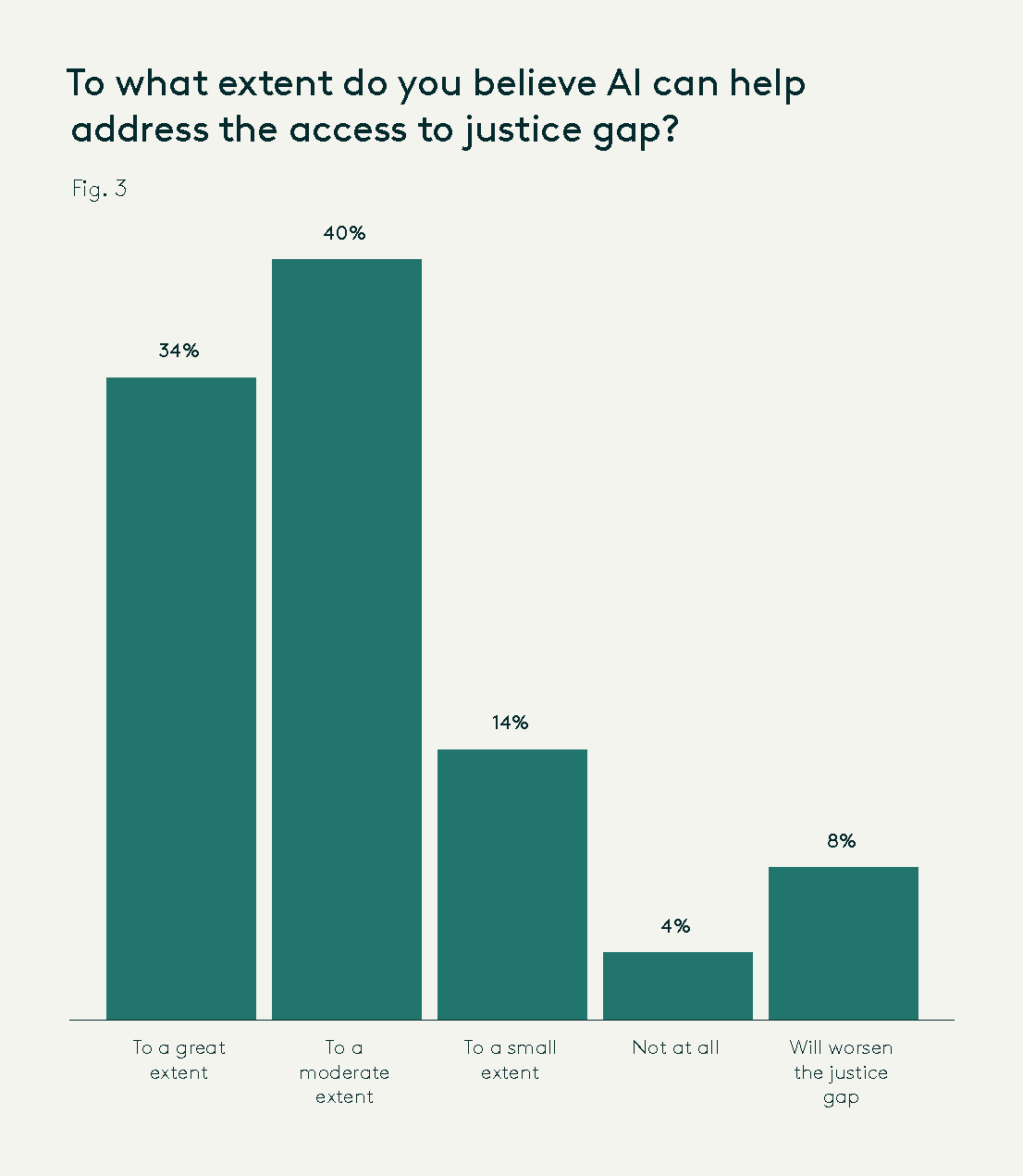
88%
of
respondents
believe
AI
can
help
address
the
access
to
justice
gap
to
some
extent,
with
34%
saying
it
can
help
“to
a
great
extent.”
This
widespread
belief
in
AI’s
transformative
potential
comes
against
the
backdrop
of
a
stark
justice
crisis
in
America.
According
to
the
study,
92%
of
civil
legal
problems
encountered
by
low-income
Americans
receive
no
or
inadequate
legal
help,
and
the
United
States
ranks
just
107th
out
of
142
countries
in
affordability
and
accessibility
of
civil
justice.
As
I
am
quoted
in
the
study
as
saying:
“This
survey
reveals
that
AI
adoption
is
not
just
happening
in
well-funded
BigLaw
firms
–
it
is
being
driven
by
organizations
serving
our
most
vulnerable
populations
When
88%
of
legal
aid
professionals
see
AI
as
a
tool
to
address
the
justice
gap,
that
underscores
its
potential
to
fundamentally
democratize
access
to
legal
services.”
Regular
Use
of
AI
The
survey
revealed
significant
integration
of
AI
into
the
daily
operations
of
legal
aid
organizations.
Among
the
112
legal
aid
professionals
surveyed
in
May
2025:
40%
reported
using
AI
at
least
weekly.
26%
use
it
daily.
12%
use
it
multiple
times
per
day.
Common
applications
include
document
summarization,
legal
research,
analysis,
translations,
and
development
work
–
showing
AI’s
versatility
across
different
aspects
of
legal
aid
practice.
Increasing
Client
Capacity
The
Legal
Services
Corporation
estimates
that
nearly
one
of
every
two
people
who
qualify
for
legal
aid
are
turned
away
due
to
lack
of
resources.
For
these
legal
aid
organizations
struggling
with
overwhelming
caseloads,
perhaps
one
of
the
survey’s
most
compelling
findings
is
that
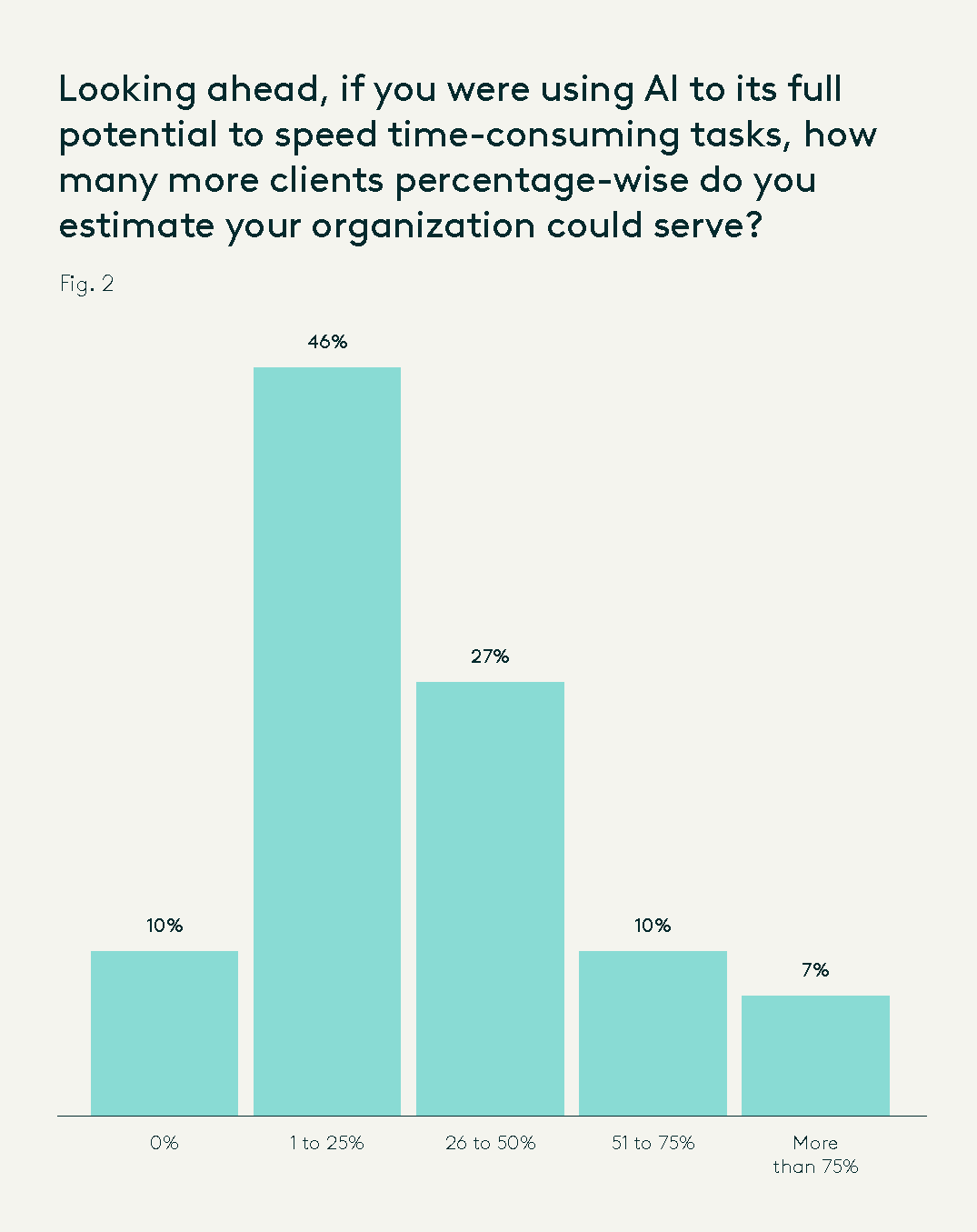
90%
of
respondents
said
using
AI
to
its
full
potential
would
enable
them
to
serve
more
clients.
When
asked
to
quantify
potential
impact,
respondents
provided
specific
projections:
46%
estimated
they
could
serve
1-25%
more
clients.
27%
believed
they
could
serve
26-50%
more
clients.
17%
projected
capacity
increases
of
over
50%.
“AI
presents
a
generational
opportunity
to
fundamentally
expand
who
has
access
to
justice,
but
it’s
not
a
foregone
conclusion,”
said
Joanne
Sprague,
head
of
Everlaw
for
Good.
“By
empowering
these
critical
legal
organizations
with
AI
tools,
we
can
make
a
real
difference
in
the
lives
of
millions.”
Implementation
Challenges
Remain
Despite
widespread
optimism,
the
survey
identified
significant
obstacles
to
full
AI
implementation.
The
top
areas
of
concern,
ranked
by
severity,
include:
Data
privacy
and
confidentiality
(5.8
out
of
10
on
concern
scale).
Hallucinations
and
AI
quality
(5.6
out
of
10).
Ethical
and
professional
responsibility
(5.0
out
of
10).
Prohibitive
cost
(3.6
out
of
10).
Lack
of
technical
resources
(3.2
out
of
10).
These
challenges
highlight
the
complex
considerations
legal
aid
organizations
face
when
implementing
AI,
particularly
given
their
ethical
obligations
to
vulnerable
client
populations
and
limited
financial
resources.
Spotlight
on
North
Carolina
The
report
spotlights
Legal
Aid
of
North
Carolina
(LANC)
as
an
example
of
innovative
AI
implementation.
The
state’s
largest
nonprofit
law
firm
serves
300,000
people
annually
seeking
help
with
issues
such
as
domestic
violence
and
unlawful
eviction.
LANC
is
testing
an
AI-powered
voice
agent
for
initial
intake
that
operates
24/7
in
multiple
languages,
addressing
accessibility
challenges
for
clients
in
rural
areas
or
those
with
transportation
issues.
By
automating
this
foundational
step,
LANC’s
200
statewide
attorneys
can
focus
on
high-value
work
such
as
court
appearances
and
client
advocacy,
the
survey
notes.
“We
will
never
be
able
to
‘lawyer
ourselves’
out
of
this
access-to-justice
crisis,”
said
LANC’s
Chief
Innovation
Officer
Scheree
Gilchrist
in
the
survey
report.
“AI
is
a
force
multiplier
to
scale
our
services.”
A
Powerful
Tool
for
Legal
Aid
According
to
experts
cited
in
the
report,
the
study’s
findings
align
with
broader
observations
about
AI’s
democratizing
potential
in
legal
services.
“Generative
AI
offers
a
rare
chance
to
address
this
crisis,”
said
Kristen
Sonday,
cofounder
and
CEO
of
Paladin.
“It
can
democratize
legal
information,
simplify
processes,
and
offer
meaningful
legal
tools
at
scale.”
The
survey
results
suggest
that
legal
aid
organizations
view
AI
not
as
a
threat
to
legal
employment,
but
as
a
crucial
tool
for
expanding
access
to
justice.
The
technology
appears
to
be
enabling
these
organizations
to
stretch
limited
resources
further
while
maintaining
quality
representation
for
vulnerable
populations.
“Professionals
across
the
access
to
justice
community
are
embracing
this
technology
as
a
crucial
ally
in
the
long-term
fight
to
close
the
persistent
justice
gap,”
the
report
concludes.
“This
isn’t
about
automating
jobs
or
taking
work
away
from
lawyers;
it’s
about
equipping
advocates
with
a
powerful
new
instrument
to
manage
complex
caseloads,
streamline
tasks,
and
supercharge
their
capacity
to
serve
more
clients
more
effectively.”
Methodology
and
Participants
The
survey
was
conducted
in
May
2025
by
Everlaw
in
partnership
with
NLADA,
Paladin
and
LawSites.
It
surveyed
112
legal
aid
society
professionals,
examining
their
AI
usage
patterns,
perceptions
of
AI’s
potential
to
support
access
to
justice,
and
views
on
how
AI
might
help
their
organizations
better
serve
people
facing
housing,
family,
employment,
and
other
critical
legal
issues.
*
DLA
Piper
must
face
pregnancy
bias
case.
[Reuters]
*
Google
will
give
Trump
$24.5
million
for
having
kicked
him
off
YouTube
after
January
6.
[Bloomberg
Law
News]
*
Government
lawyers
who
raised
concerns
over
the
Trump
administration
breaching
the
Fair
Housing
Act
were
fired.
[New
York
Times]
*
A
billion
dollar
valuation
for
another
AI-to-lawyers
startup.
[Bloomberg]
*
California
enacts
law
requiring
more
AI
safety
and
transparency.
[Law360]
*
A
deep
dive
into
allegations
that
the
Trump
administration
used
diplomatic
efforts
to
protect
El
Salvador’s
president
from
law
enforcement.
[ProPublica]
Travelers
stranded across Cape
Verde, Botswana,
and South
Africa are
facing
significant
disruption
as TACV, Air
Zimbabwe,
and South
African
Airlinkabort
11
flights.
These
cancellations
have
severely
affected
key airports including Praia, OR
Tambo, Harare
International,
and Maun.
Passengers
scheduled
to
travel
from Praia
International (Cape
Verde)
to OR
Tambo
International (South
Africa)
and
from Harare
International (Zimbabwe)
to Maun (Botswana)
are
among
the
worst
hit.
The
disruption,
caused
by
unforeseen
operational
issues,
has
left
many
travelers
uncertain
about
their
next
steps.
As TACV, Air
Zimbabwe,
and South
African
Airlink deal
with
these
cancellations,
affected
passengers
are
being
advised
to
reach
out
to
their
respective
airlines
for rebooking and compensation options.
The
airlines
are
working
to
accommodate
the
passengers
on
the
next
available
flights.
However,
the delays continue
to
cause
widespread
inconvenience
across
these
major
travel
hubs.
Affected
Airlines
TACV,
the
national
carrier
of
Cape
Verde,
has
been
the
most
affected,
with 8
cancellations (24%)
and 2
delays (6%)
in
its
flights.
This
has
resulted
in
a
number
of disruptions between
Cape
Verde
and
South
Africa,
causing
frustration
for
travelers
expecting
smooth
connections.
Meanwhile, Air
Zimbabwe has
faced 2
cancellations (20%)
but
no
delays.
While
the
number
of
cancellations
is
comparatively
lower,
this
still
represents
a
significant
disruption
for
passengers
traveling
between
Zimbabwe
and
South
Africa.
On
the
other
hand, South
African
Airlink has
faced
one cancellation,
but
the
airline
has
been
notably
impacted
by 83
delays (28%).
This
indicates
a
large
number
of
passengers
who
were
forced
to
wait
longer
than
expected,
often
disrupting
their
travel
schedules.
Airports,
Cities,
and
Countries
Affected
The
disruptions
have
affected
key
airports
across
Southern
Africa
and
beyond.
Flights
operated
by
TACV,
Air
Zimbabwe,
and
South
African
Airlink
have
been
disrupted
at
various
major
airports.
Advertisement
For TACV,
passengers
flying
from
Praia
International
Airport
(RAI
/
GVNP)
in
Cape
Verde
to OR
Tambo
International
Airport (JNB
/
FAOR)
in
Johannesburg,
South
Africa,
faced
significant
delays
and
cancellations.
Similarly,
flights
from
Rabil
(BVC
/
GVBA)
to
Amilcar
Cabral
International
Airport
(SID
/
GVAC)
were
also
affected,
with
multiple
cancellations
and
delays.
Air
Zimbabwe passengers
traveling
from Harare
International
Airport (HRE
/
FVRG)
to
Johannesburg
were
also
impacted
by
the
cancellations,
which
left
many
passengers
stranded
or
seeking
alternative
arrangements.
South
African
Airlink flights
from
Maun
(MUB
/
FBMN)
in
Botswana
to
Johannesburg
(JNB
/
FAOR)
experienced
widespread
delays.
This
left
passengers
waiting
for
extended
periods,
causing
significant
disruptions
to
their
travel
plans.
Total
Delays
and
Cancellations
Across
the
three
airlines,
a
significant
number
of
flights
have
been
disrupted.
TACV
saw 8
cancellations and 2
delays,
while
Air
Zimbabwe
faced 2
cancellations with
no
delays.
South
African
Airlink,
however,
experienced 1
cancellation and
a
staggering 83
delays,
reflecting
the
scale
of
disruption
and
the
impact
on
a
large
number
of
travelers.
This
large
proportion
of
delays
with
South
African
Airlink
indicates
that
many
passengers
were
not
only
affected
by
cancellations
but
also
had
to
contend
with
long
waiting
times
at
airports.
With
28%
of
their
flights
delayed,
passengers
could
face
considerable
inconvenience.
What
Affected
Passengers
Can
Do
Now
For
those
affected
by
the
cancellations
and
delays,
it’s
important
to
stay
informed
and
take
appropriate
steps
to
minimize
the
disruption.
First
and
foremost,
passengers
should
reach
out
to
their
airlines
directly
to
inquire
about
their
specific
flight’s
status.
Many
airlines,
including
TACV,
Air
Zimbabwe,
and
South
African
Airlink,
offer
rebooking
services,
and
they
may
be
able
to
accommodate
passengers
on
the
next
available
flight.
Additionally,
staying
updated
on
flight
statuses
is
crucial,
as
delays
and
cancellations
can
often
change
rapidly.
Passengers
should
monitor
airport
information
screens
and
check
with
the
airline
via
their
website
or
customer
service
numbers.
Passengers
who
experience
delays
or
cancellations
may
also
be
entitled
to
compensation,
depending
on
the
airline’s
policy
and
the
nature
of
the
disruption.
Compensation
may
include
meal
vouchers,
hotel
accommodations,
or
even
a
full
refund
in
some
cases.
For
longer
delays,
passengers
are
encouraged
to
ask
about
alternative
routes
or
connecting
flights,
especially
if
their
initial
departure
time
has
been
significantly
altered.
If
passengers
have
travel
insurance,
it’s
advisable
to
check
the
policy
for
any
coverage
related
to
flight
disruptions.
Many
travel
insurance
policies
offer
compensation
for
delays,
cancellations,
and
other
related
inconveniences.
Conclusion
These
travel
disruptions
have
impacted
many
passengers,
particularly
those
traveling
on
international
routes
between
Southern
Africa
and
Cape
Verde.
While
some
airlines
have
been
hit
harder
than
others,
the
disruptions
serve
as
a
reminder
of
the
challenges
travelers
may
face
due
to
unforeseen
circumstances.
Passengers
are
urged
to
stay
updated
on
their
flight
status
and
communicate
with
their
airline
to
explore
rebooking
options
or
compensation
opportunities.


 Kathryn