Anatomy Of A Modern Merger: A Step-By-Step Guide For GCs – Above the Law


Editor’s
note
:
First
in
a
three-part
series.  

Although
the
deals
market
has
shown
a
modest
rebound
in
early
2025,
a
recent
report
by
Deloitte
notes
that
today’s
dealmakers
must
“navigate
perpetual
uncertainty.”

This
uncertainty
is
driven
by
numerous
factors:
economic
changes,
evolving
risk
management,
and
emerging
technologies,
for
example. 

As
a
result,

Deloitte
says
,
“pivoting
has
emerged
as
a
core
competency”
for
dealmakers. 

The
same
goes
for
law
departments
involved
with
a
corporate
transaction

or
even
the
possibility
of
a
future
transaction.

“‘Logistics’
is
an
important
word
here,
because
the
whole
M&A
process
is
also
a
process
of
logistics,”
says
Kariem
Abdellatif,
the
head
of
Mercator
by
Citco
(Mercator),
a
specialist
entity
management
provider
that
helps
organizations
manage
their
global
entity
portfolios,
including
during
complex
M&A
transactions.  

Having
the
right
partner
in
place
to
oversee
a
transaction’s
numerous
and
intricate
details
will
allow
the
lawyers
to
focus
on
high-level
work
like
pricing
and
negotiation,
he
notes.
This,
in
turn,
enables
the
flexibility
that
today’s
dealmakers
must
cultivate.  

In
this
series
presented
by
our
friends
at
Mercator,
we’ll
be
providing
a
step-by-step
guide
for
general
counsel
navigating
a
merger
or
other
corporate
transaction.
To
start,
we’re
exploring
best
practices
for
corporate
law
departments
in
the
pre-merger
phase. 

Stay
tuned
for
our
upcoming
articles
detailing
how
GCs
can
help
negotiate
and
close
a
deal,
as
well
as
how
the
law
department
can
help
integrate
organizations
post-merger. 

We’ll
also
be
discussing
these
topics
in
a
webinar.

You
can
pre-register
here.


Get
Good
Data
(and
Know
What
to
Do
With
It) 

A
first
step
for
any
legal
department
involved
in
a
corporate
transaction
is
to
understand
the
portfolio
of
companies
involved.
The
only
way
to
do
this
is
by
gathering
trustworthy
data. 
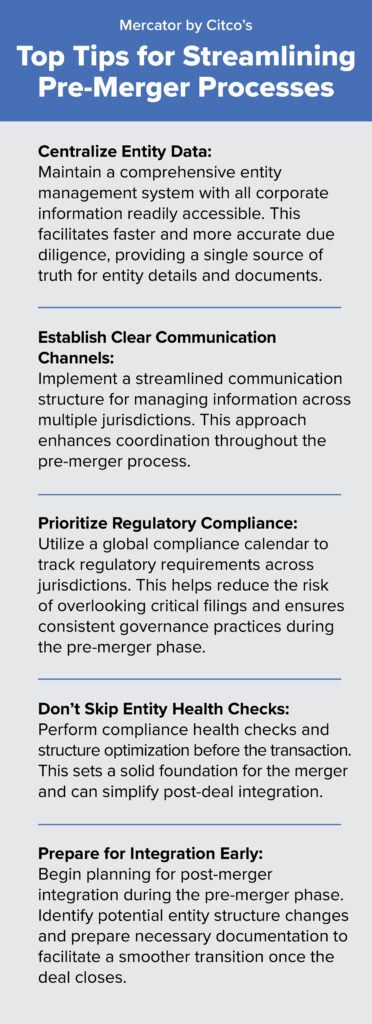
“When
it
comes
to
data,
there
are
several
critical
questions
that
need
answering,”
Abdellatif
says.
“What
information
do
we
need?
Where
is
it
stored?
Who
maintains
it?
How
can
we
verify
its
accuracy?
Is
it
up
to
date?
Getting
clear
answers
to
these
questions
early
on
is
essential
for
making
informed
decisions
and
planning
effective
integration.”

A
platform
like
Mercator’s
Entica
can
take
this
a
step
further
by
applying
that
data
to
create
detailed
and
interactive
corporate
org
charts.
The
platform
can
also
generate
hypothetical
charts
to
model
potential
acquisitions. 

These
charts
map
out
the
“family
tree”
of
an
organization

showing
which
entity
sits
on
top,
what
happens
if
entities’
locations
are
moved,
what
it
would
mean
if
an
entity
were
liquidated.

“Our
technology
enables
legal
teams
to
visualize
the
entire
org
chart,”
Abdellatif
says.
“From
there
they
can
toy
around
with
it
to
see
how
changes
might
affect
the
overall
corporate
structure.
This
is
particularly
valuable
during
M&A
discussions,
where
understanding
complex
entity
relationship
is
key.” 


Determine
Your
Lane

While
gathering
corporate
data
is
critical,
knowledge
of
a
potential
deal
must
typically
be
kept
confidential
outside
of
a
few
key
stakeholders. 

When
the
GC
is
brought
under
the
umbrella,
their
first
step
is
to
determine
their
role. 

Will
the
GC
be
engaging
outside
counsel?
Will
they
be
managing
these
lawyers?
Will
the
GC
be
the
primary
point
of
contact
for
the
transaction?  

The
scope
of
these
potential
roles
varies
widely,
notes
Josh
Hollingsworth,
an
M&A
partner
with
Barnes
&
Thornburg
LLP.

The
GC
of
a
company
being
acquired,
for
example,
might
be
limited
to
assisting
the
buyer
in
conducting
due
diligence.
In
other
circumstances,
the
GC
might
be
expected
to
lead
the
entire
deal.

“Navigating
where
they
fit
in
and
asking
affirmative
questions
so
that
there
aren’t
any
assumptions

it’s
important
for
a
GC
to
just
figure
out
what
their
role
is
in
some
cases,”
Hollingsworth
says.


Master
Organizational
Psychology

When
a
GC
is
involved
in
advancing
a
transaction,
they
must
draw
on
their
soft
skills
as
much
as
their
legal
training
in
the
pre-merger
phase. 

Thinking
strategically
about
the
organization
and
the
stakeholders
involved
is
a
key
to
success.

“I
don’t
think
there’s
a
specific
playbook
for
each
circumstance,”
Hollingsworth
says.
“I
think
it’s
just
a
matter
of
being
aware
of
everyone
who’s
involved
and
making
sure
that
you
understand
the
universe
of
how
this
transaction’s
going
to
affect
everybody.” 

An
initial
step
is
to
determine
who
will
be
brought
into
the
deal,
and
who
will
not
be
informed. 

This
requires
thinking
through
who
in
the
organization
will
be
important

the
IT,
HR,
and
risk
management
teams,
for
example. 

“If
nobody
in
HR
knows,
it’s
going
to
be
hard
to
get
through
employee
and
benefits
diligence,”
Hollingsworth
says.
“If
nobody
in
IT
knows
about
a
transaction,
and
an
IT
issue
comes
up,
similarly,
that
will
be
challenging.”

Abdellatif
notes
that
technology
like
Mercator’s
Entica
system
can
play
a
role
in
ensuring
the
knowledge
of
the
deal
sits
only
with
the
stakeholders
who
are
looped
in.

“What
we
want
to
make
certain
is
that
data
access
is
available
to
those
who
need
it,
but
not
beyond
that,”
Abdellatif
says.
“That
data
is
only
accessible
to
those
who
actually
require
it,
and
you
don’t
have
people
rummaging
through
information
they
shouldn’t.” 


Understand
Your
Team

It’s
also
important
to
gauge
the
likely
motivations
of
each
stakeholder
with
a
role
in
the
transaction. 

Hollingsworth
notes
that
anyone
informed
of
a
potential
deal
will
first
ask
themself
a
simple
question. 

“Literally,
‘What
does
this
mean
for
me?’
is
going
to
be
the
first
question
that
everybody
who’s
brought
under
the
tent
is
going
to
think
about,
and
that’s
just
human
nature,”
Hollingsworth
says.
“So
just
being
prepared
to
work
through
those
dynamics
is
important
for
a
GC.” 

If
a
company
is
being
acquired,
for
example,
that
could
be
seen
as
a
threat
to
many
stakeholders,
who
may
work
to
undermine
the
deal. 

It’s
true
of
acquiror
companies
as
well,
Hollingsworth
notes.
Some
may
see
someone
in
the
acquired
organization
as
a
threat
to
their
position.
Some
may
simply
think
it’s
too
much
work
to
go
through
with
the
deal.

Will
a
stakeholder
be
gaining
or
losing
in
job
title
and
status?
Are
there
financial
incentives,
like
parachute
payments
to
a
departing
CEO,
involved? 

“I
think
a
lot
of
people
take
it
for
granted
that
if
the
CEO
or
the
board
says,
‘We’re
gonna
do
something,’
that
we’re
gonna
do
it,”
Hollingsworth
says.
“What
ends
up
happening
in
any
group
dynamic
is
there
are
various
levels
of
resistance.”

For
a
company
potentially
being
acquired,
maintaining
impeccable
data
and
compliance
can
help
thwart
resistance
to
a
deal.
These
practices
can
even
provide
bargaining
leverage,
according
to
Abdellatif.

“Having
this
level
of
organization
builds
confidence
with
potential
acquirers
and
can
positively
influence
their
approach
to
the
transaction”
he
says. 

If
a
company
doesn’t
seem
to
have
well-maintained
regulatory
compliance,
by
contrast,
an
acquiring
company
will
likely
become
more
critical.

Technology
can
also
help.
Mercator’s
Entica,
for
example,
features
a
corporate
compliance
calendar
that
tracks
all
requirements
a
year
in
advance
and
ensures
a
company
maintains
proper
structures
around
compliance.

Abdellatif
has
seen
acquired
companies
impressing
acquirors
with
the
thoroughness
of
their
regulatory
compliance,
and
the
acquiring
companies
in
turn
seeking
to
adopt
their
systems.

This
thoroughness
can
also
help
stave
off
any
internal
resistance
to
a
deal.

“The
best
defense
is
making
sure
that
you
have
your
ducks
in
a
row,
that
your
information
and
data
is
properly
set
up,
and
that
you
can
demonstrate
just
how
effectively
you
run
your
department,”
he
says. 


Don’t
Forget
About
Your
JD

In
addition
to
organizational
management,
of
course,
a
GC
must
also
consider
legal
risks
at
this
stage.

One
top
risk
in
a
pre-merger
environment
is
confidentiality.
For
publicly
traded
companies,
insider
trading
laws
will
kick
in,
and
for
nonpublicly
traded
companies,
there
can
be
issues
with
employees
or
vendors
knowing
of
the
deal
at
the
early
stages.

A
GC
must
ensure
there
are
robust
nondisclosure
agreements

and
serious
consideration
around
which
internal
and
external
stakeholders
are
informed
to
begin
with. 

“Confidentiality
will
be
at
the
very
top
of
your
legal
risk
in
the
pre-transaction
phase,”
Hollingsworth
says.
“Similarly,
antitrust
considerations
go
hand-in-hand.”

Corporate
transactions
will
often
take
place
between
competing
companies,
which
must
make
a
pre-merger
filing
with
the
Federal
Trade
Commission
under
the
Hart-Scott-Rodino
Act.
If
there
are
foreign
operations,
a
variety
of
other
regulations
apply
as
well. 

Competing
companies
that
are
exploring
a
merger
must
also
be
careful
about
the
level
of
cooperation
during
this
stage
because
of
antitrust
concerns
known
as
“gun-jumping.” 

“The
expectation
is
that
you’re
going
to
operate
the
business
independently
all
the
way
up
through
closing,”
Hollingsworth
says. 


Leverage
Your
Tech

As
with
all
things
in
the
corporate
world,
AI-enabled
technology
is
playing
an
increasing
role
in
mergers
and
acquisitions. 

In
the
pre-merger
phase,
generative
AI
will
come
into
play
for
in-house
lawyers

particularly
when
drafting
pre-merger
documents
like
nondisclosure
agreements. 

New
technology
can
also
immediately
inform
counsel
of
“what’s
market,”
giving
negotiators
detailed
knowledge
of
precedent
regarding
every
aspect
of
a
transaction. 

The
Entica
platform
combines
workflows
with
data
management,
ensuring
actions
as
varied
as
filing
financial
statements,
appointing
directors
and
auditors,
and
executing
documents
are
all
tracked
and
accounted
for. 

It
allows
quick
access
to
this
data
throughout
a
company’s
full
portfolio,
and
segments
it
to
ensure
it’s
only
accessible
to
stakeholders
who
require
it. 

“When
you
come
back
to
logistics,
it
really
serves
as
the
backbone
in
many
ways,”
Abdellatif
says. 

Seasoned
practitioners
like
Hollingsworth
remember
the
due
diligence
process
of
decades
ago,
where
there
was
a
physical
data
room
that
contained
banker
boxes
full
of
documents
related
to
the
transaction.

These,
of
course,
have
been
replaced
by
online
data
rooms
that
can
be
accessed
24/7.
Similarly
to
due
diligence,
closings
and
negotiations
have
moved
from
in-person
to
virtual. 

For
negotiators,
though,
this
convenience
may
create
a
new
pitfall
to
avoid. 

If
you’ve
flown
across
the
country
for
an
in-person
meeting,
the
expectation
is
that
items
will
be
resolved
in
that
meeting,
Hollingsworth
notes.

“Allowing
virtual
negotiations
leads
to
more
iterations
of
the
document,”
he
says,
“and
it
may
actually
lead
to
the
negotiations
taking
longer.”


Stay
tuned
for
the
next
article
in
this
series,
where
we’ll
be
exploring
steps
to
consider
during
the
negotiation
and
closing
of
a
transaction. You
can
register
for
our
webinar
on
these
topics
here.

Forced Resignations And A Government Shutdown: Will This Lead To Efficiency Or Bureaucratic Chaos? – Above the Law

(Photo
by
DON
EMMERT/AFP
via
Getty
Images)

Last
night
at
12:01
a.m.,
the
federal
government
shut
down
due
to
a
partisan
impasse.
This
means
that
thousands
of
government
employees
will
be
furloughed
and
many
government
services
will
be
unavailable
until
a
funding
bill
is
passed.
If
that
wasn’t
bad
enough,
a
few
days
earlier,
up
to
150,000
federal
employees
submitted
their
resignations
as
part
of
a
large-scale
reduction
in
force
program.
What
will
this
mean
for
the
federal
government?

The
federal
government
shut
down
last
night
because
it
failed
to
pass
an
appropriation
bill
that
would
fund
the
government.
While
the
Senate
is
controlled
by
the
Republicans,
the
bill
requires
60
votes,
which
means
seven
Democratic
senators
must
vote
along
with
the
Republicans.
Only
three
Democratic
senators
support
the
Republican
bill.
Democrats
are
demanding
an
enhancement
and
extension
of
health
care
subsidies
under
the
Affordable
Care
Act.
Otherwise,
Americans
receiving
subsidies
could
see
their
health
insurance
premiums
rise
substantially.

How
long
the
shutdown
will
last
is
uncertain.
Shutdowns
have
been
threatened
but
most
were
resolved
at
the
last
minute.
Since
1976,
the
government
has
shut
down

20
times
.
Most
of
the
time,
it
only
lasted
a
few
days.
The
last
government
shutdown
happened
in
2018-2019
and
lasted
a
record
35
days.

Also,
around
this
time,
between
100,000
to
150,000
federal
employees
have
resigned
under
the
Deferred
Resignation
Program.
Soon
after
the
results
of
the
2024
election,
President
Trump
teamed
up
with
Elon
Musk
to
establish
the
Department
of
Government
Efficiency
(DOGE).
Musk’s
goal
with
DOGE
was
to
identify
and
cut
unnecessary
government
staff,
similar
to
how
he
cut
the
number
of
Twitter’s
staff
soon
after
he
acquired
that
company.

Federal
employees
who
signed
on
to
the
Deferred
Resignation
Program
would
continue
to
receive
pay
and
benefits
until
the
end
of
September.
Otherwise,
they
could
be
subject
to
layoffs
in
the
future.

People
with
jobs
that
are
considered
essential
will
continue
to
work,
although
in
some
cases
will
not
be
paid
until
a
spending
bill
is
passed,
at
which
point
back
pay
will
be
disbursed.
Essential
positions
generally
involve
the
military,
aviation,
and
courts,
to
name
a
few.
This
means
that
ICE
agents
will
still
be
around
to
conduct
immigration
raids
and
antagonize
protestors
even
though
they
will
not
be
paid
during
the
shutdown.
Hopefully
they
got
their
$50,000
sign-up
bonuses
up
front.

One
interesting

note

is
that
the
Office
of
Personnel
Management
has
clarified
that
agencies
can
let
employees
working
on
“reduction-in-force”
(RIF)
activities
continue
doing
their
jobs,
with
no
lapses,
throughout
a
government
shutdown.
RIF
activities
are
basically
plans
for
large-scale
layoffs

something
that
was
planned
when
DOGE
was
initially
set
up.
Courts
have
invalidated
some
of
the
mass
terminations.
Also,
Musk
and
Trump
apparently
had
a
falling
out
which
led
to
Musk
leaving
DOGE
and
later

disparaging
Trump
on
Twitter/X
,
including
an
accusation
that
he
is
in
the
Epstein
files.

Some
agencies
may
have
contingency
plans
in
case
of
a
shutdown.
For
example,
at
the
IRS,
funding
has
been
reserved
to
pay
for
an

additional
five
business
days
.
What
happens
after
is
uncertain.
But
in
2023
when
a
government
shutdown
was
likely,

the
IRS
plan

was
to
furlough
two-thirds
of
its
staff.

The
short
term
effects
of
the
shutdown
and
resignations
are
likely
to
be
profound.
A
shutdown
can
mean
temporarily
stopping
unnecessary
government
services.
According
to

Rep.
Ami
Bera
,
during
the
2018-2019
partial
shutdown,
the
Food
and
Drug
Administration
suspended
routine
inspections,
increasing
public
health
risks.
The
National
Park
Service
stopped
trash
collection
and
road
repairs,
creating
unsanitary
conditions
and
unsafe
roads,
while
some
national
parks
and
museums
closed
entirely.

Resignations
could
increase
the
unemployment
rate.
It
could
also
result
in
a
brain
drain
as
some
of
them
could
get
a
job
in
the
private
sector.
Unfortunately,
some
may
turn
to
working
for
rogue
countries.

Sadly,
in
the
future,
shutdowns
may
be
more
frequent
due
to
stubborn
politicians,
and
escalation
in
rhetoric.
Perhaps
a
bipartisan
task
force
should
be
established
to
discuss
procedures
that
would
encourage
negotiations
and
penalize
shutdowns.
This
can
include
withholding
pay
for
legislators
with
no
reimbursement,
eliminating
fringe
benefits,
stiff
campaign
finance
limitations,
or
possibly
even
denial
of
security
personnel.

Chances
are
the
shutdown
will
not
last
long
based
on
history.
But
the
resignations
will
stick
unless
a
court
invalidates
the
Deferred
Resignation
Program
or
the
president
rescinds
it.
But
the
large
drop
in
federal
employees
from
various
sectors
will
have
a
negative
effect
on
the
federal
government’s
operations
in
the
short
term.
Whether
the
government
will
act
more
efficiently
in
the
long
run
is
anyone’s
guess.


Steven
Chung
is
a
tax
attorney
in
Los
Angeles,
California.
He
helps
people
with
basic
tax
planning
and
resolve
tax
disputes.
He
is
also
sympathetic
to
people
with
large
student
loans.
He
can
be
reached
via
email
at


[email protected]
.
Or
you
can
connect
with
him
on
Twitter
(
@stevenchung)
and
connect
with
him
on 
LinkedIn.

Pfizer Reaches Deal on Most-Favored Nation Drug Pricing; Other Pharmas Expected to Follow – MedCity News

Pfizer
is
the
first
big
pharmaceutical
company
to

reach
an
agreement

with
the
Trump
administration
over
most-favored
nation
drug
pricing,
a
deal
that
lowers
U.S.
prices
of
certain
medications
and
makes
them
available
directly
to
patients
through
new
online
channels.
The
agreement
announced
Tuesday
also
gives
Pfizer
a
grace
period
before
facing
potential
tariffs
on
its
drugs.

With
most-favored
nation
pricing,
the
prices
of
a
drug
in
the
U.S.
will
be
matched
to
the
lowest
price
of
the
same
drug
in
a
comparable
developed
nation.

President
Trump
revived
the
policy
in
a
May
executive
order
.
In
July,
he

sent
letters

to
CEOs
of
17
big
pharma
companies
outlining
ways
he
wanted
them
to
comply
with
the
order.
That
letter
gave
companies
until
Sept.
29
to
respond.

In
a
Tuesday
news
conference
with
the
Trump
administration,
Pfizer
executives
said
the
company
will
participate
in
TrumpRx.gov,
a
new
purchasing
platform
that
will
allow
Americans
to
purchase
most
primary
care
treatments
and
certain
specialty
drugs
from
Pfizer
“at
a
significant
discount.”
A
White
House

fact
sheet

listed
some
examples
of
existing
Pfizer
products:
an
80%
discount
for
atopic
dermatitis
drug
Eucrisa;
a
40%
discount
for
immunology
drug
Xeljanz;
and
a
50%
discount
for
migraine
drug
Zavpret.

Specific
terms
of
the
agreement
remain
confidential.
But
the
White
House
said
the
agreement
means
every
state
Medicaid
program
in
the
country
will
have
access
to
most-favored
nation
drug
prices
on
Pfizer
products.
Furthermore,
the
agreement
secures
most-favored
nation
pricing
on
all
new
drugs
Pfizer
brings
to
the
market.

As
the
deadline
for
a
response
to
Trump’s
most-favored
nation
proposal
approached,
pharma
companies
rolled
out
initiatives
that
could
help
them
meet
the
goals
outlined
in
the
executive
order.
That
order
specified
that
selling
directly
to
patients
would
be
one
way
to
comply,
as
long
as
the
prices
offered
through
these
channels
was
no
higher
than
the
best
prices
in
other
developed
nations.
Last
week,

Bristol
Myers
Squibb
announced
a
new
direct-to-patient
website
will
launch
in
January

with
the
plaque
psoriasis
drug
Sotyktu
as
the
first
product
offered
at
a
steep
discount.

AstraZeneca
,

Novartis
,
and

Boehringer
Ingelheim

have
since
unveiled
their
own
direct-to-consumer
online
plans.
Industry
trade
group
PhRMA
also
announced
a

new
website

that
will
connect
U.S.
consumers
with
the
direct-purchase
programs
of
drug
manufacturers.

Another
move
taken
by
some
companies
is
raising
prices
on
drugs
sold
overseas.
Earlier
this
month,
BMS
said
schizophrenia
drug
Cobenfy
will
launch
in
the
United
Kingdom
at
a

price
equal

to
the
drug’s
U.S.
list
price.
That
followed
Eli
Lilly’s
August
announcement
it
had
reached
an
agreement
with
the
U.K.
to

raise
the
price

of
type
2
diabetes
drug
Mounjaro.
Lee
Brown,
global
sector
lead,
health
care,
at
consultancy
Third
Bridge,
said
this
strategy
addresses
a
Trump
argument
that
other
nations
are
“freeloading
on
American
pharmaceutical
innovation,”
as
stated
on
White
House
fact
sheets.
This
strategy
also
gives
pharma
companies
a
way
to
protect
their
revenue
in
the
U.S.,
their
biggest
market.

“I
think
[pharma
companies]
raise
some
prices
to
offset
some
price
reductions
in
the
U.S..,
and
they
do
that
for
a
selected
number
of
drugs,
and
they
deliver
those
as
wins
to
the
Trump
administration,”
Brown
said
in
an
interview.
“Trump
will
take
that
as
a
win.
That’s
the
way
he
works.
He’s
not
really
looking
for
everything.
He’s
looking
for
some
things
that
he
wouldn’t
have
gotten.”

In
a
note
sent
to
investors,
Leerink
Partners
analyst
David
Risinger
said
there
is
now
a
framework
for
other
countries
to
absorb
higher
prices
than
they
have
in
the
past
for
new
drugs.
He
added
that
Pfizer
anticipates
this
opens
up
a
way
of
introducing
new
drugs
at
list
prices
overseas
consistent
with
U.S.
list
prices.
But
Leerink
does
not
expect
the
prices
of
existing
drugs
to
be
raised
outside
of
the
U.S.
because
of
the
economic
challenges
of
doing
so.


Trump
has
also
threatened
to
impose
tariffs
on
pharmaceuticals
.
Section
232
of
the
Trade
Expansion
Act
permits
tariffs
if
a
U.S.
Department
of
Commerce
investigation
finds
they
are
necessary
for
national
security.
That
rationale
has
already
been
used
to
justify
tariffs
on
aluminum
and
steel
imports.
The
investigation
on
pharmaceuticals
is
ongoing.
But
Pfizer
said
its
products
under
a
Section
232
inquiry
won’t
face
tariffs
for
three
years
as
long
as
the
company
invests
in
its
U.S.
manufacturing.
In
the
past
year,
big
pharma
companies
have
unveiled
multi-billion-dollar
capital
investment
plans
for
the
U.S.,
the
most
recent
one

GSK’s
plan
to
spend
$30
billion
on
U.S.
manufacturing
and
R&D
sites
over
the
next
five
years
.
That
announcement
was
made
while
Trump
was
in
the
U.K.
on
a
state
visit.

William
Blair
analyst
Matt
Phipps
said
in
a
research
note
that
it
remains
to
be
seen
whether
companies
will
need
to
provide
drugs
directly
to
patients
via
TrumpRx.gov
or
through
their
own
programs.
It’s
also
unclear
how
these
new
options
will
affect
prices
of
drugs
for
the
Department
of
Veterans
Affairs
or
Medicaid.

“The
majority
of
large
biopharma
companies
have
already
announced
large
commitments
to
invest
in
manufacturing
and
R&D
facilities
in
the
United
States,”
Phipps
said.
“Following
today’s
announcement,
we
expect
more
companies
will
announce
direct-to-consumer
channels
to
further
appease
the
Trump
administration
and
largely
remove
threats
of
100%
tariffs
and
1,000%
price
reductions.”


Photo:
Mandel
Ngan/AFP,
via
Getty
Images

Morning Docket: 10.01.25 – Above the Law

*
Hackers
with
links
to
China
target
U.S.
law
firms.
[Law.com
International
]

*
Another
Trump
acting
U.S.
Attorney
determined
to
be
squatting
in
the
job
illegally.
This
time
in
Nevada.
[NY
Times
]

*
SEC
opens
the
door
to
more
crypto
because
if
there’s
one
thing
this
administration
is
committed
to,
it’s
fake
money
that
can
only
be
used
for
online
heroin
sales
as
long
as
the
president
gets
a
cut.
[Bloomberg
Law
News
]

*
Apple
and
OpenAI
move
to
toss
Elon’s
sour
grapes
competition
suit.
[Reuters]

*
FTC
says
Zillow
and
Redfin
collaborating
to
eliminate
genuine
competition.
[CNN]

*
Diddy
lost
his
effort
to
get
out
of
his
conviction.
[Law360]

*
Administration
reverses
legal
guidance
supporting
tribal
sovereignty
in
Alaska.
[Alaska
Beacon
]

2025 Trafficking in Persons Report: Zimbabwe


The
Government
of
Zimbabwe
does
not
fully
meet
the
minimum
standards
for
the
elimination
of
trafficking.
Despite
making
significant
efforts
to
do
so,
it
did
not
demonstrate
overall
increasing
efforts
compared
with
the
previous
reporting
period;
therefore,
Zimbabwe
remained
on
Tier
2
Watch
List
for
the
second
consecutive
year.
Significant
efforts
included
identifying
more
trafficking
victims,
investigating
officials
allegedly
complicit
in
trafficking
crimes,
and
signing
an
MOU
with
an
NGO
to
conduct
anti-trafficking
training
for
officials.
However,
the
government
did
not
amend
its
anti-trafficking
law
to
criminalize
all
forms
of
trafficking.
Reports
of
low-level
official
complicity
in
trafficking
crimes
persisted.
The
government
decreased
anti-trafficking
funding,
closed
one
shelter,
and
disbanded
its
six
provincial
task
forces
that
investigated
trafficking
and
coordinated
victim
services,
hindering
overall
efforts.

PRIORITIZED
RECOMMENDATIONS:

  • Amend
    the
    anti-trafficking
    law
    to
    criminalize
    all
    forms
    of
    trafficking
    in
    line
    with
    the
    2000
    UN
    TIP
    Protocol.
  • Dedicate
    resources
    to
    the
    Anti-Trafficking
    Inter-Ministerial
    Committee
    (ATIMC)
    and
    implement
    the
    National
    Plan
    of
    Action.
  • Using
    the
    SOPs
    and
    NRM
    for
    Vulnerable
    Migrants
    in
    Zimbabwe
    for
    victim
    identification
    and
    referral
    to
    care,
    proactively
    identify
    and
    refer
    to
    care
    trafficking
    victims
    among
    vulnerable
    populations,
    including
    orphaned
    and
    unaccompanied
    children,
    migrant
    workers,
    domestic
    trafficking
    victims,
    and
    Cuban
    regime-affiliated
    medical
    professionals,
    and
    train
    stakeholders
    on
    the
    SOPs.
  • Increase
    the
    availability
    of
    protection
    services,
    including
    shelters,
    for
    all
    trafficking
    victims,
    including
    by
    collaborating
    with
    civil
    society
    service
    providers.
  • Increase
    efforts
    to
    investigate
    and
    prosecute
    trafficking
    crimes,
    including
    of
    complicit
    officials,
    and
    seek
    adequate
    penalties
    for
    convicted
    traffickers,
    which
    should
    involve
    significant
    prison
    terms.
  • Consistently
    enforce
    regulations
    of
    labor
    recruitment
    companies,
    including
    by
    eliminating
    worker-paid
    recruitment
    fees,
    holding
    fraudulent
    labor
    recruiters
    criminally
    accountable,
    screening
    for
    trafficking
    during
    inspections,
    and
    implementing
    SOPs
    for
    ethical
    recruitment.
  • Expedite
    trafficking
    court
    cases
    to
    eliminate
    the
    backlog.
  • Adequately
    fund
    and
    provide
    specialized
    training
    to
    law
    enforcement,
    prosecutors,
    and
    judges
    to
    conduct
    trafficking
    investigations
    and
    prosecutions,
    using
    a
    victim-centered
    approach.
  • Develop
    mutual
    legal
    assistance
    treaties
    and
    other
    agreements
    with
    foreign
    governments
    to
    facilitate
    information-sharing.
  • Collect
    data
    on
    human
    trafficking
    trends
    within
    Zimbabwe
    to
    better
    inform
    government
    anti-trafficking
    efforts.

PROSECUTION

The
government
maintained
law
enforcement
efforts.

Zimbabwean
law
criminalized
some
forms
of
sex
trafficking
and
labor
trafficking.
Inconsistent
with
international
law,
the
2014
Trafficking
in
Persons
Act
defined
trafficking
in
persons
as
a
movement-based
crime
and
did
not
adequately
define
“exploitation.”
The
act
criminalized
the
involuntary
transport
of
a
person
and
the
voluntary
transport
for
an
unlawful
purpose
into,
outside,
or
within
Zimbabwe.
The
focus
on
transport
and
the
inadequate
definition
of
“exploitation”
left
Zimbabwe
without
comprehensive
prohibitions
of
trafficking
crimes.
The
law
prescribed
penalties
of
10
years
to
life
imprisonment,
which
were
sufficiently
stringent
and,
with
respect
to
sex
trafficking
crimes,
commensurate
with
penalties
for
other
grave
crimes,
such
as
rape.
Zimbabwe’s
Labor
Relations
Amendment
Act
criminalized
forced
labor
and
prescribed
penalties
of
up
to
10
years’
imprisonment,
a
fine,
or
both,
which
were
sufficiently
stringent.
The
Criminal
Law
(Codification
and
Reform)
Act
criminalized
procuring
a
person
for
unlawful
sexual
conduct,
inside
or
outside
of
Zimbabwe,
and
prescribed
penalties
of
up
to
two
years’
imprisonment;
these
penalties
were
not
sufficiently
stringent
when
applied
to
cases
of
sex
trafficking.
The
act
also
criminalized
coercing
or
inducing
anyone
to
engage
in
unlawful
sexual
conduct
with
another
person
by
threat
or
intimidation,
prescribing
sufficiently
stringent
penalties
of
one
to
five
years’
imprisonment.
With
support
from
an
international
organization,
the
government
previously
drafted
a
Trafficking
in
Persons
Amendment
Bill,
which
was
pending
at
the
end
of
the
reporting
period.

In
2024,
the
government
initiated
one
investigation,
compared
with
10
in
2023.
The
government
initiated
prosecutions
of
two
suspects
and
continued
prosecutions
of
four
suspects
from
previous
years;
this
compared
with
initiating
eight
prosecutions
involving
an
unknown
number
of
suspects
in
2023.
The
government
convicted
four
traffickers,
imposing
sentences
of
10-30
years’
imprisonment;
this
compared
with
convicting
five
traffickers
in
2023.
A
lack
of
judicial
capacity
hindered
the
ability
to
address
court
backlogs,
including
trafficking
cases.
The
Zimbabwe
Republic
Police’s
(ZRP)
Criminal
Investigation
Department
(CID)
had
responsibility
to
investigate
grave
crimes,
including
trafficking.
government
did
not
report
collaborating
with
foreign
governments
on
trafficking
investigations.

The
government
reportedly
investigated
officials
allegedly
complicit
in
trafficking
crimes;
however,
official
complicity
in
trafficking
crimes
remained
a
significant
concern.
The
government
arrested
20
Ministry
of
Home
Affairs
officials
for
issuing
Cameroonians
fraudulent
passports,
which
potentially
involved
trafficking
crimes.
Some
officials
accepted
bribes
to
not
inspect
farms
or
businesses
using
exploitative
labor
practices.
Immigration
officials
reportedly
accepted
bribes
to
facilitate
unauthorized
entry
for
criminal
groups
involved
in
trafficking
crimes.
Violent
gangs
allegedly
bribed
police
and
politicians
to
operate
artisanal
and
defunct
gold
mines
in
which
they
used
forced
labor.

The
National
Prosecuting
Authority
and
the
ATIMC
signed
MOUs
with
an
NGO
to
conduct
anti-trafficking
training
for
government
officials,
although
no
training
occurred
due
to
no
funding.
ZRP
recruit
training
included
an
anti-trafficking
module,
but
the
government
did
not
report
training
any
officers
in
the
reporting
period.
Observers
noted
a
need
for
better
coordination
with
foreign
governments
on
investigations.
Observers
reported
the
government
lacked
systematic
procedures
and
the
capacity
to
effectively
investigate
cases.
Insufficient
training
on
victim
identification
resulted
in
front-line
officials
not
detecting
trafficking
crimes;
insufficient
investigative
training
resulted
in
police
filing
charges
as
crimes
other
than
trafficking.

PROTECTION

The
government
made
mixed
victim
identification
and
protection
efforts.

The
government
reported
identifying
and
referring
to
services
14
trafficking
victims,
compared
with
four
in
the
previous
reporting
period.
In
collaboration
with
an
international
organization,
the
government
supported
the
repatriation
of
some
Zimbabwean
victims
from
Sierra
Leone.
The
government
relied
on
NGOs
and
foreign
donors
to
fund
most
trafficking
victim
services;
however,
organizations
struggled
to
operate
without
adequate
and
consistent
financial
support,
and
some
could
only
provide
short-term
care.
Observers
reported
underfunded
and
understaffed
service
providers.
The
government
operated
two
shelters
for
victims
of
trafficking
and
violence
against
women
and
girls
in
Harare
and
Bulawayo;
however,
during
the
reporting
period,
the
government
closed
its
Mutare
shelter.
The
government
reported
a
need
for
shelters
in
the
other
eight
provinces.
The
government
operated
24
vulnerable
children’s
homes
that
could
serve
child
trafficking
victims
but
did
not
report
if
they
did.
In
collaboration
with
NGOs
and
international
organizations,
the
government
provided
trafficking
survivors
with
shelter;
food;
medical
treatment;
counseling;
and
family
reunification,
reintegration,
and
income-generating
assistance;
government
social
workers
facilitated
access
to
government
benefits.
Shelters
and
services
for
trafficking
victims
were
available
to
Zimbabwean
and
foreign
national
men
and
women,
irrespective
of
victims’
participation
in
legal
proceedings.
The
2014
Trafficking
in
Persons
Act
required
the
government
to
establish
counseling
and
reintegration
service
centers
in
all
provinces,
but
the
government
had
not
done
so
by
the
end
of
the
reporting
period.
The
government
did
not
report
providing
victims
with
reintegration
allowances
in
the
reporting
period.

The
government
continued
to
use
its
NRM
and
SOPs,
which
outlined
procedures
for
victim
identification,
referral,
and
assistance.
Some
NGOs
reported
inconsistent
NRM
and
SOP
implementation.
Due
to
lack
of
funding
the
government
disbanded
its
six
provincial
task
forces
that
investigated
trafficking
cases
and
coordinated
victim
services.

The
government
reported
it
could
provide
victim-witness
assistance
during
the
criminal
justice
process
but
did
not
do
so
in
the
reporting
period.
Experts
noted
police
unfamiliarity
with
trafficking
crimes
often
re-traumatized
trafficking
victims.
The
government
did
not
report
if
any
trafficking
victims
participated
in
criminal
justice
proceedings
in
the
reporting
period.
Twenty-two
dedicated
courts
had
designated
rooms
for
victims
to
testify
separately
from
their
alleged
perpetrators,
and
victims
could
choose
to
testify
via
video
or
written
testimony;
however,
the
government
did
not
report
if
victims
used
these
services.
Observers
reported
limited
access
to
equipment
necessary
for
video
testimony
in
some
courts,
especially
in
rural
areas.
The
law
allowed
judges
to
order
traffickers
to
pay
victim
restitution,
but
the
government
did
not
report
any
restitution
awarded
in
the
reporting
period.
The
government
maintained
a
victim
compensation
fund
but
did
not
provide
any
compensation
to
trafficking
victims
in
the
reporting
period.
The
government
did
not
have
legal
alternatives
to
removing
foreign
victims
to
countries
where
they
would
face
retribution
or
hardship.
Due
to
inadequate
screening,
the
government
did
not
take
effective
measures
to
prevent
the
inappropriate
penalization
of
potential
victims
solely
for
unlawful
acts
committed
as
a
direct
result
of
being
trafficked,
including
among
foreign
nationals
and
children
exploited
in
forced
criminality.

PREVENTION

The
government
maintained
efforts
to
prevent
trafficking.

The
ATIMC
coordinated
the
government’s
anti-trafficking
activities
and
met
once
during
the
reporting
period.
The
government
did
not
fund
the
ATIMC
in
the
reporting
period,
hindering
overall
prevention
efforts.
The
government
had
in
place
its
2023-2028
NAP.
The
government
conducted
anti-trafficking
awareness
campaigns,
including
through
exhibitions
at
a
trade
fair,
at
an
agricultural
fair,
and
with
church
organizations.
The
government
continued
to
use
a
hotline
for
violence
against
women
and
girls
to
identify
and
refer
trafficking
victims.

The
government
did
not
demonstrate
political
will
to
decrease
child
and
forced
labor,
particularly
in
agriculture
and
mining.
The
government
did
not
train
labor
inspectors
on
identifying
trafficking.
Fuel
and
vehicle
shortages
limited
inspectors’
effectiveness.
Observers
reported
inspectors
did
not
inspect
informal
mines.

The
government
did
not
prohibit
worker-paid
recruitment
fees
or
effectively
enforce
its
labor
recruitment
regulations.
In
collaboration
with
an
international
organization,
the
government
took
steps
toward
establishing
a
labor
migration
agreement
with
Qatar
to
improve
migrant
workers’
protections.
The
government
reported
providing
anti-trafficking
training
to
diplomats.
The
government
did
not
report
making
efforts
to
reduce
the
demand
for
commercial
sex
acts.

TRAFFICKING
PROFILE:

Trafficking
affects
all
communities.
This
section
summarizes
government
and
civil
society
reporting
on
the
nature
and
scope
of
trafficking
over
the
past
five
years.
Human
traffickers
exploit
domestic
and
foreign
victims
in
Zimbabwe,
and
traffickers
exploit
victims
from
Zimbabwe
abroad.
Internal
trafficking
is
prevalent
and
underreported.
Traffickers
exploit
Zimbabwean
adults
and
children
in
sex
trafficking
and
forced
labor,
including
in
cattle
herding,
domestic
service,
and
mining.
Child
labor
occurs
in
agriculture,
including
on
tobacco,
sugarcane,
and
cotton
farms,
and
on
small,
unregulated
farms,
as
well
as
in
forestry
and
fishing.
Observers
reported
unaccompanied
children
are
at
risk
of
exploitation.
Traffickers
force
into
domestic
servitude
women
and
girls
from
rural
areas
who
move
to
cities
for
work.
Economic
hardship
increased
child
sex
trafficking
and
child
labor,
particularly
in
agriculture,
domestic
service,
informal
trading,
begging,
and
artisanal
mining.
Observers
reported
traffickers
exploit
children,
including
those
with
disabilities,
in
forced
begging.
Some
traditional
practices
make
girls
vulnerable
to
forced
labor
and
sex
trafficking,
including
trading
daughters
for
food
or
money
and
for ngozi,
a
reconciliation
process
in
which
a
family
gives
a
relative
to
another
family
to
make
amends
for
a
murdered
relative.

Traffickers
may
exploit
in
forced
labor
children
working
as
panners
and
ore
couriers
in
gold
and
diamond
mines.
Illegal
mining
syndicates
exploit
Zimbabweans
in
forced
labor.
Some
syndicates
target
vulnerable
populations,
including
illiterate
individuals,
and
transport
them
to
the
mines
at
night
to
disorient
them
and
prevent
their
escape.
Traffickers
also
exploit
women
and
children
in
sex
trafficking
around
mines,
sometimes
in
exchange
for
money
or
food.
Sex
traffickers
exploit
some
children
who
sell
goods
or
offer
cooking
and
cleaning
services
to
miners.
Traffickers
exploit
women
and
girls
in
towns
bordering
South
Africa,
Mozambique,
and
Zambia
in
forced
labor,
including
domestic
servitude,
and
in
sex
trafficking
in
brothels
catering
to
truck
drivers.
Sex
traffickers
recruit
girls
as
young
as
11
from
areas
surrounding
Chiredzi.

Traffickers
and
fraudulent
recruiters
use
false
promises
of
scholarships
or
employment,
particularly
in
nursing
and
teaching,
including
through
social
media,
to
lure
Zimbabweans
into
sex
trafficking,
domestic
servitude,
forced
labor,
and
forced
marriage
in
neighboring
countries,
particularly
South
Africa,
and
Kenya,
Uganda,
China,
and
the
Middle
East.
In
South
Africa,
traffickers
exploit
Zimbabweans
in
forced
labor
in
agriculture,
construction,
factories,
mines,
information
technology,
domestic
work,
and
the
hospitality
industry.
Zimbabweans
abroad,
particularly
in
the
United
Kingdom
and
Ireland,
trick
some
Zimbabweans
into
traveling
abroad
under
the
pretenses
of
tourism
or
legitimate
employment
then
force
them
into
domestic
servitude.
Traffickers
recruit
Zimbabwean
girls
for
marriage
then
once
married
force
them
into
domestic
work.

Zimbabwe
is
a
transit
country
for
trafficking
victims
and
migrants
vulnerable
to
exploitation,
including
from
Somalia,
Ethiopia,
Malawi,
and
Zambia,
en
route
to
South
Africa.
Zimbabwe
is
also
a
destination
country
for
forced
labor
and
sex
trafficking.
Traffickers
subject
some
Mozambican
children
to
forced
labor
in
street
vending,
including
in
Mbare,
Harare’s
largest
informal
market.
Mozambican
and
Malawian
children
working
on
relatives’
farms
in
Zimbabwe
who
cannot
enroll
in
school
are
vulnerable
to
trafficking.
Refugees
and
asylum-seekers
experience
difficulty
accessing
banking
and
obtaining
identification,
which
limits
employment
opportunities
and
increases
their
vulnerability
to
trafficking.

Traffickers
force
some
Chinese
nationals
to
work
in
restaurants
in
Zimbabwe.
Construction
and
mining
companies
owned
by
Chinese
nationals
or
Chinese
parastatal
entities
in
Zimbabwe
reportedly
employ
practices
indicative
of
forced
labor,
including
verbal,
physical,
and
sexual
abuse,
as
well
as
coercion
to
induce
work
in
unsafe
or
otherwise
undesirable
conditions.
Chinese
parastatal
tobacco
enterprises
exerted
political
influence
to
exempt
themselves
from
labor
laws
and
regulation,
including
mandates
pertaining
to
child
and
forced
labor.
Media
and
NGOs
report
unscrupulous
actors,
including
Russian
officials
and
illicit
recruiters,
fraudulently
recruited
women
ages
18-22
from
Africa

including
Zimbabwe

South
Asia,
and
South
America
for
vocational
training
programs
and
subsequently
placed
them
in
military
drone
production
sites.
Media
report
workers
at
these
sites
are
subjected
to
hazardous
conditions,
surveillance,
hour
and
wage
violations,
contract
switching,
and
worker-paid
recruitment
fees,
all
of
which
are
indicators
of
human
trafficking.
North
Koreans
working
in
Zimbabwe
displayed
indicators
of
forced
labor;
they
may
have
worked
under
exploitative
conditions.
The
Cuban
regime
may
force
the
17
Cuban
regime-affiliated
medical
professionals
in
Zimbabwe
to
work.

Source:


Zimbabwe

United
States
Department
of
State

The Force Of Law With None Of The Explanation – See Also – Above the Law

Lower
Courts
Pushed
To
Conform
Their
Rulings
With
Shadow
Dockets:
They
have
the
majority,
but
actual
cases
would
take
too
long.
Here’s
Where
To
Summer:
A
Biglaw
tier
list
ranked
by
summer
associates!
Lessons
To
Learn
From
Arguing
Supreme
Court
Cases:
Neal
Katyal
shares
what
he
learned.
Trump
Goes
Hard
On
Microsoft:
He
wants
an
in-house
attorney
fired
over
her
work
experience.
DLA
Piper
Prepares
For
Court:
It’ll
be
up
to
a
jury
to
decide
if
they
fired
an
attorney
for
taking
maternity
leave.

Working On Behalf Of Jeffrey Epstein Can Make You Millions – Above the Law

(Photo
by
John
Lamparski/Getty
Images
for
Hulu)


Ed.
Note:

Welcome
to
our
daily
feature

Trivia
Question
of
the
Day!


How
much
did
Alan
Dershowitz
admit
he
was
paid
for
his
legal
work
on
behalf
of
Jeffrey
Epstein,
which
included
negotiating
a
sweetheart
deal
for
the
human
trafficker
which
featured
an
unprecedented
non-prosecution
deal
on
federal
charges
in
exchange
for
Epstein’s
guilty
plea
on
Florida
state
charges?


Hint:
There
was
also
an
additional
~$1
million
paid
that
Dershowitz
says
went
to
research
and
other
attorneys
working
at
his
direction.


See
the
answer
on
the
next
page.

Pentagon readies contingency plans for government shutdown – Breaking Defense

WASHINGTON

With
less
than
two
days
left
before
the
US
government
potentially
shuts
down,
the
Department
of
Defense
has
issued
contingency
guidance
to
the
force
outlining
six
priorities
and
contracting
plans.

“Activities
that
are
determined
not
to
be
excepted,
and
which
cannot
be
performed
by
utilizing
military
personnel
in
place
of
furloughed
civilian
personnel,
will
be
suspended
when
appropriated
funds
are
no
longer
available,”

the
document

said.
The
secretary
of
defense
“may,
at
any
time,
determine
that
additional
activities
shall
be
treated
as
excepted,”
it
added.

Fiscal
2025
is
sunsetting
when
the
clock
strikes
midnight
Wednesday.
Congress
has
not
yet
approved
FY26
spending
bills,
and
Democrats
and
Republicans
have
not
reached
an
agreement
on
a
continuing
resolution
to
keep
the
government
open.
If
a
stopgap
measure
is
not
approved
by
both
chambers
and
signed
by
President
Donald
Trump,
the
federal
government
will
shut
down.

For
DoD,
that
means
that
military
personnel
on
active
duty

including
reserve
component
personnel
on
federal
active
duty

will
continue
reporting
for
duty
and
may
be
asked
to
carry
out
non-excepted
activities
normally
done
by
civilian
personnel
that
have
been
furloughed.

“Civilian
personnel,
including
military
technicians,
who
are
not
necessary
to
carry
out
or
support
excepted
activities,
are
to
be
furloughed
using
lapse
in
appropriations
(often
referred
to
as
‘shutdown’)
procedures
and
guidance
provided
by
the
Office
of
Personnel
Management,”
the
Pentagon
guidance
said.
“Only
the
minimum
number
of
civilian
employees
necessary
to
carry
out
excepted
activities
will
be
excepted
from
furlough.”

The
department’s
“highest
priorities,”
according
to
the
guidance,
will
revolve
around operations
securing
the
US
Southern
border,
operations
in
the
Middle
East,
designing
Golden
Dome, depot
maintenance,
shipbuilding
and
critical
munitions.

“As
in
every
case,
efforts
supporting
these
activities
may
occur
during
a
lapse
when
resourced
with
funds
that
remain
available,”
the
planning
guidance
said.

“Where
costs
for
such
efforts
must
be
charged
against
a
lapsed
appropriation,
Component
and
subordinate
leaders
will
closely
evaluate
individual
activities
to
determine
whether
they
are
‘excepted’
consistent
with
this
planning
guidance
and
continue
or
initiate
them,
as
appropriate,
when
supported
by
the
facts,”
the
document
later
added. 

When
it
comes
to
work
on
big-ticket
weapons
programs,
contractors
are
able
to
continue
working
on
previously
awarded
deals.
However,
the
department
is
not
allowed
to
execute
new
contracts.

“The
expiration
of
an
appropriation
does
not
require
the
termination
of
contracts
(or
issuance
of
stop
work
orders)
funded
by
that
appropriation
unless
a
new
obligation
of
funds
is
required
under
the
contract
and
the
contract
is
not
required
to
support
an
excepted
activity,”
the
guidance
continues.

Summer Associates Really Expected Better From Biglaw Firms That Capitulated To Trump – Above the Law


Ed.
note
:
Welcome
to
our
daily
feature,

Quote
of
the
Day
.


If
the
[Biglaw]
firms
had
just
stuck
together
no
one
would
be
in
this
tough
place
of
having
to
capitulate
or
suffer
consequences.
Super
disappointed
in
Paul
Weiss,
Latham,
Kirkland,
etc.
and
they
were
all
immediately
taken
off
my
list
of
places
to
work.


A
summer
associate
from
Fish
&
Richardson,
in
response
to
a
question
posed
in
the
American
Lawyer’s
annual

Summer
Associate
Satisfaction
Survey
.


A
summer
associate
from
Cahill
Gordon
echoed
these
sentiments,
saying,
“It’s
embarrassing
and
disheartening
when
pitbull
law
firms
cower.
Clients
should
demand
more
from
their
firms.


When
asked
how
much
they
agreed
with
the
sentiment
that
the
legal
profession’s
independence
was
being
challenged
by
the
Trump
administration,
about
two-thirds
of
respondents
said
“agreed”
or
“strongly
agreed.”


Staci Zaretsky


Staci
Zaretsky
 is
the
managing
editor
of
Above
the
Law,
where
she’s
worked
since
2011.
She’d
love
to
hear
from
you,
so
please
feel
free
to

email

her
with
any
tips,
questions,
comments,
or
critiques.
You
can
follow
her
on BlueskyX/Twitter,
and Threads, or
connect
with
her
on LinkedIn.

DLA Piper Sued Over Alleged Pregnancy Bias – Above the Law

When
it
comes
to
work-life
balance,
some
firms
do
a
good
job
of
recognizing
that
their
employees
are
also
people.
DLA
Piper
came
under
fire
for

slashing
their
parental
leave
by
six
weeks
last
year


shows
you
where
they
stand
on
that.
The
year
before,
the
firm
was
sued
by
Anisha
Mehta.
She
claimed
that
the
firm
fired
her,
a
seventh-year
associate,
for
requesting
to
take
maternity
leave

they
showed
her
the
door
six
days
after
she
made
her
request.
She’s
still
going
toe-to-toe
with
the
firm
over
the
firing,
and
the
case
is
heading
to
trial.

Reuters

has
coverage:

U.S.
District
Judge
Analisa
Torres
said
that
Anisha
Mehta,
a
former
senior
associate
in
the
firm’s
intellectual
property
group
in
San
Francisco
and
New
York,
“presented
evidence
that
could
reasonably
cast
doubt
on
DLA’s
purported
reason
for
firing
her.”

It
is
worth
remembering
that
when
DLA
Piper
claimed
that
they
fired
her
over
a
series
of
increasingly
catastrophic
blunders
,”
they
pointed
to
typos
that
were
caught
before
the
documents
left
the
firm
and
the
rather
subjective
“sloppy
work
product.”
As
silly
as
it
would
be
to
fire
someone
for
those
reasons,
it
is
only
fair
game
if
the
justification
isn’t
actually
a
pretext
for
firing
someone
over
something
you
can’t
fire
them
for.
After
seeing
the
evidence,
the
presiding
judge
has
some
doubts:

[Judge
Torres]

said
DLA
Piper’s
performance-based
rationale
for
firing
Mehta
is
“at
best,
in
tension
with
other
evidence
in
the
record
or,
at
worst,
plainly
contradicted
by
it,”
citing
raises
and
bonuses
she
earned
during
her
time
at
the
firm,
as
well
as
Mehta’s
work
with
an
important
client.

Really
bad
business
move
to
put
someone
you
think
has
sloppy
work
product
on
an
important
client’s
matter.
A
jury
will
ultimately
decide
if
DLA
Piper
was
cutting
their
losses
after
making
a
poor
personnel
assignment
on
a
high-value
case
or
cut
a
valued
employee
who
was
with
them
for
nearly
a
decade
because
she
was
going
to
give
birth.
Not
really
sure
which
outcome
is
better
for
the
firm’s
reputation.


Law
Firm
DLA
Piper
Must
Face
Lawsuit
Over
Pregnancy
Bias,
Judge
Rules

[Reuters]


Chris
Williams
became
a
social
media
manager
and
assistant
editor
for
Above
the
Law
in
June
2021.
Prior
to
joining
the
staff,
he
moonlighted
as
a
minor
Memelord™
in
the
Facebook
group Law
School
Memes
for
Edgy
T14s
.
 He
endured
Missouri
long
enough
to
graduate
from
Washington
University
in
St.
Louis
School
of
Law.
He
is
a
former
boatbuilder
who
is
learning
to
swim, is
interested
in
critical
race
theory,
philosophy,
and
humor,
and
has
a
love
for
cycling
that
occasionally
annoys
his
peers.
You
can
reach
him
by
email
at [email protected]
and
by
tweet
at @WritesForRent.