Even
though
ILTACON
ended
more
than
a
week
ago
now,
I
am
still
digging
out
from
the
deluge
of
briefings
and
meetings
I
attended
there.
One
of
particular
note
was
a
media
briefing
with
LexisNexis
executives
in
which
they
provided
further
information
on
the
company’s
AI
strategy.
Just
ahead
of
ILTACON,
LexisNexis
had
announced
the
launch
of
Protégé
General
AI,
as
I
reported
at
the
time.
This
launch
expanded
its
Protégé
artificial
intelligence
platform
to
include
secure
access
to
multiple
general-purpose
AI
models
alongside
its
existing
legal-specific
AI
tools.
At
the
ILTACON
media
briefing,
LexisNexis
executives
detailed
new
features
of
its
Protégé
AI
platform,
provided
more
details
on
the
rollout
of
the
new
General
AI
tool,
and
discussed
the
company’s
broader
vision
of
delivering
what
it
calls
“courtroom-grade
AI”
to
the
legal
profession.
Sean
Fitzpatrick,
CEO
of
LexisNexis
North
America,
UK
and
Ireland,
opened
the
session
by
describing
the
moment
as
unprecedented
in
terms
of
both
technological
change
and
financial
investment.
“The
amount
of
investment
that’s
going
into
these
foundational
models
is
hundreds
of
billions
of
dollars,
and
we’ve
never
seen
anything
like
this,”
Fitzpatrick
said.
“This
is
the
biggest
technology
spending
cycle
in
the
history
of
business.”
With
costs
for
large
language
models
dropping
by
more
than
99%
since
2022,
he
added,
the
economics
now
make
it
possible
to
operate
these
systems
at
scale.
To
that
end,
Fitzpatrick
described
his
company’s
vision
of
making
AI
assistants
widely
available.
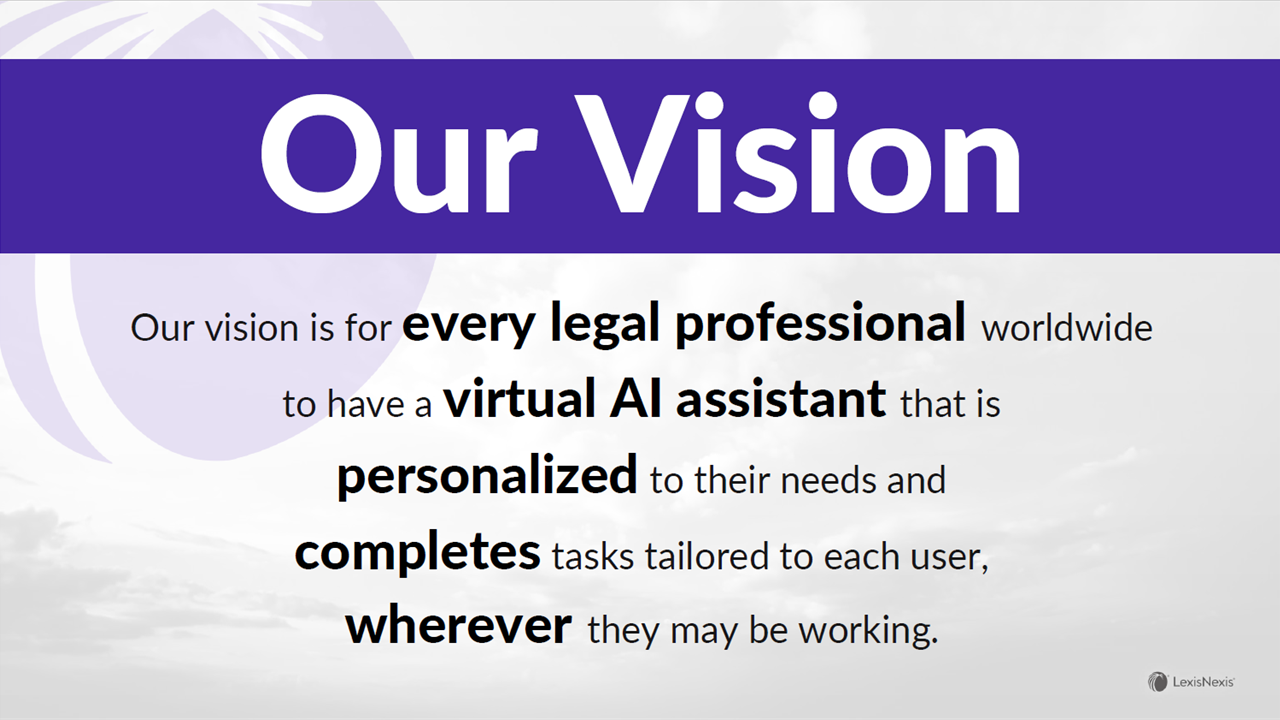
“Our
vision
is
that
every
lawyer
is
going
to
have
their
own
digital
AI
assistant,
and
it’s
going
to
be
personalized
to
them,”
he
said.
“It’s
going
to
understand
their
practice
area,
it’s
going
to
understand
their
jurisdiction,
it’s
going
to
understand
their
style,
their
preferences,
it’s
going
to
have
access
to
our
authoritative
legal
materials,
and
it’s
going
to
have
access
to
their
own
internal
work
product.”
Building
‘Courtroom-Grade
AI’
Fitzpatrick
said
that
while
consumer-grade
AI
tools
are
widely
used
among
legal
professionals,
they
lack
the
privacy,
citation
rigor,
and
reliability
necessary
for
legal
practice.
LexisNexis,
he
emphasized,
is
committed
to
creating
“courtroom-grade
AI,”
which
it
defines
by
six
principles:
-
Grounding
in
authoritative
legal
content.
“LexisNexis
has
160
billion
documents
and
records
in
our
system,”
Fitzpatrick
said,
“and
so
that’s
what
we
use
as
grounding
data
when
we
do
our
AI.” -
Verifiable
source
citations.
Shepard’s
provides
the
ability
to
verify
that
citations
are
accurate
and
up
to
date,
he
said. -
Continuous
updates
with
no
knowledge
cutoffs.
Fitzpatrick
noted
that
GPT-4o
had
a
knowledge
cutoff
of
2023.
“We
add
2.5
million
documents
and
records
to
the
system
every
single
day
from
50,000
different
sources.” -
This
has
two
aspects,
Fitzpatrick
said:
One
is
transparency
back
to
the
authority,
so
you
can
verify
for
yourself.
The
second
is
knowing
what’s
going
on
inside
the
black
box
–
what
is
the
reasoning
and
logic. -
Bias
mitigation.
Gold-standard
security
and
privacy. -
Security
and
privacy.
It
has
to
be
disconnected
from
the
foundational
models
so
the
data
is
not
being
used
for
learning
or
training.
“This
is
about
building
AI
that
lawyers
can
trust
in
a
courtroom
setting,”
Fitzpatrick
said.
Protégé
at
the
Center
Central
to
that
effort
is
Protégé,
the
company’s
AI
assistant.
By
2028,
he
said,
Protégé
will
automate
15-20%
of
what
lawyers
do
today.
But
he
added
that
LexisNexis
is
not
waiting
until
2028
to
deliver
on
that
vision.
Protégé
already
automates
many
of
the
tasks
lawyers
routinely
perform,
and
it
will
continue
to
add
more
capabilities.
“Think
of
all
of
the
different
things
that
all
of
the
different
types
of
attorneys
do,
there
are
tens
of
thousands
of
tasks
that
need
to
be
automated,”
he
said.
“We’re
going
to
continue
to
automate
different
tasks
along
those
workflows,
so
Protégé
will
get
more
and
more
powerful
over
time.”
Protégé
is
expanding
on
several
fronts,
Fitzpatrick
said:
-
Geographically:
It
is
already
live
in
the
U.S.,
U.K.,
Canada,
Australia,
Hong
Kong
and
New
Zealand,
with
additional
rollouts
coming
to
South
Africa,
France,
and
Austria. -
Across
products:
It
has
been
integrated
into
Lexis+,
Lex
Machina,
Intelligize,
and
other
tools. -
Within
the
ecosystem:
LexisNexis
has
added
integrations
with
Microsoft
Word,
Outlook,
Teams,
and
Copilot,
as
well
as
a
new
connection
with
Harvey
that
allows
Harvey
users
to
query
Lexis
AI
directly.
Agentic
Workflows
Demonstrated
During
the
media
briefing,
Serena
Wellen,
vice
president
of
product
management,
demonstrated
Protégé’s
agentic
workflows,
which
she
said
have
been
designed
to
increase
transparency
into
the
process
and
give
lawyers
more
control
over
research
and
drafting.
In
one
example,
Wellen
showed
how
Protégé
can
break
down
a
complex
query
involving
an
airline’s
duty
to
an
unaccompanied
minor
into
sub-prompts
that
the
user
can
review
and
edit
before
the
system
delivers
results.
“Lawyers
can
review
every
citation,
remove
irrelevant
ones,
and
ensure
the
final
response
reflects
their
judgment,”
Wellen
said.
She
also
gave
a
preview
of
a
judicial
workflow
currently
in
development,
which
allows
judges
to
upload
case
files
and
receive
draft
bench
memos
or
opinions.
Judges
who
have
tested
it,
she
said,
compared
the
drafts
to
the
work
of
“a
really
good
law
clerk”
and
praised
the
time
savings
of
reducing
weeks
of
work
to
minutes.
“Some
of
them
even
told
us
that
some
parts
of
the
drafts
were
more
thorough
than
what
they
usually
saw.”
Protégé
for
General
AI
As
noted
above,
a
major
recent
announcement
from
LexisNexis
was
Protégé
General
AI,
a
secure
workspace
that
lets
users
access
popular
consumer
AI
models
such
as
GPT-5,
Claude
Sonnet
4,
and
OpenAI’s
O3
reasoning
models
from
within
the
LexisNexis
environment.
David
Ganote,
vice
president
of
product
planning,
said
the
move
responds
to
the
fact
that
two-thirds
of
lawyers
already
use
consumer
AI
tools
such
as
ChatGPT
or
Claude,
often
for
research,
brainstorming
or
drafting.
“But
they’re
putting
privileged
data
into
open
models
that
aren’t
designed
to
protect
it,”
Ganote
said.
Protégé
General
AI,
by
contrast,
offers
enterprise-grade
security
and
incorporates
LexisNexis’s
Shepard’s
citation
agent,
which
flags
unverified
or
hallucinated
citations.
It
also
allows
users
to
toggle
clearly
between
Legal
AI,
grounded
in
Lexis
content,
and
general
AI,
better
suited
for
exploratory
or
creative
tasks.
“There
are
lots
of
things
that
general
AI
does
really
well
that
don’t
require
legal
authorities,”
Ganote
said,
pointing
to
examples
such
as
explaining
concepts
to
a
jury
or
drafting
marketing
content.
Selective
Approach
to
Models
Jeff
Reihl,
executive
vice
president
and
chief
technology
officer,
said
that
the
company’s
development
of
agents
is
not
just
a
PR
ploy.
“We
do
not
build
agents
just
so
that
you
guys
can
write
about
us
building
agents,”
he
said.
“Agents
are
extraordinarily
powerful
technology
and
we
will
use
those
to
serve
a
purpose
for
our
customers.”
Reihl
also
explained
the
strategy
behind
the
company’s
choice
of
AI
models,
saying
that
it
maintains
a
multimodal
strategy,
choosing
the
best
generative
AI
model
for
each
use
case
rather
than
chasing
the
newest
release.
Although
the
company
had
early
access
to
GPT-5,
he
said,
it
had
not
yet
been
deployed
in
Lexis
products
(at
least
as
of
the
press
briefing).
“As
of
right
now,
the
performance
is
not
better,
so
we
won’t
use
it,”
Reihl
said.
“We
don’t
put
a
new
model
into
our
product
just
because
it’s
the
latest
and
greatest.”
LexisNexis
has
direct
partnerships
with
Anthropic,
OpenAI,
AWS,
Microsoft,
and
Mistral,
giving
it
early
access
to
models
and
input
into
their
development
roadmaps.
Competitive
Landscape
As
the
briefing
concluded,
Fitzpatrick
was
asked
about
the
broader
competitive
landscape,
and
whether
Microsoft
or
Google
could
eventually
come
to
dominate
legal
AI.
He
argued
that
LexisNexis’
combination
of
authoritative
content,
secure
AI,
and
workflow
integration
gives
it
an
edge.
“It’s
a
lot
of
work
to
try
to
pull
together
the
collection
of
assets
that
we
have,”
he
said.
“You
could
give
somebody
a
billion
dollars
and
they
wouldn’t
be
able
to
do
it.”
He
also
gave
an
update
on
the
partnership
between
LexisNexis
and
Harvey,
which
in
part
involved
the
co-development
of
AI
workflows
for
lawyers.
I
asked
him
if
there
had
been
update
on
that
since
I
spoke
to
him
in
July
for
my
podcast.
“It’s
evolved
since
we
talked
about
it,”
he
replied.
“It’s
really
coming
together.”
He
said
customers
have
been
testing
it
and
they
are
building
on
the
feedback
from
those
customers.
“Really,
really
amazing
feedback
on
it,
so
we’re
very
excited.”
Fitzpatrick
closed
the
briefing
expressing
confidence
in
LexisNexis’s
continuing
leadership
in
developing
AI
for
lawyers.
“There’s
a
lot
of
room
for
people
to
innovate
around
these
things,
but
I
do
think
that
major
players
like
LexisNexis
that
have
the
content
…
do
have
an
advantage.
“From
a
technology
standpoint,
it’s
really
hard
to
maintain
a
competitive
advantage
if
it’s
just
technology.
And
so
that’s
why
we
try
to
take
our
content,
embed
it
in
our
technology
solutions,
and
then
embed
those
technology
solutions
into
the
workflows
of
our
customers.”

 Kathryn