If
you
asked
me
to
name
one
thing
that
seems
politically
feasible
and
would
help
fix
what
ails
America,
I’d
tell
you
that
it’s
solving
the
problem
of
gerrymandered
Congressional
districts.
In
a
gerrymandered
district,
the
general
election
is
deliberately
made
noncompetitive. The
district
is
gerrymandered
so
far
to
the
left
or
right
that
the
Democratic
or
Republican
candidate
will
win
the
general
election,
no
matter
the
candidate
from
the
opposing
party.
Politicians
know
this
and
act
accordingly. Republicans
govern
from
the
hard
right
to
avoid
a
primary
challenge
that
could
cost
them
their
seat;
Democrats
govern
from
the
hard
left
for
the
same
reason.
There’s
also
no
reason
to
compromise
in
a
gerrymandered
world. In
a
fair
general
election,
being
known
for
compromise
might
win
you
a
few
votes
from
moderates
in
the
opposing
party,
but
those
votes
are
irrelevant
in
today’s
world. Elected
officials
stake
out
radical
positions
and
refuse
to
compromise
(thus
avoiding
primary
challenges)
and
then
win
their
general
elections
in
gerrymandered
districts.
We,
the
unfortunate
public,
suffer
the
result. We
live
in
a
world
without
compromise
or
sanity.
This
is
what
makes
particularly
galling
Texas
Republicans’
recent
decision
to
engage
in
midcycle
redistricting
—
gerrymandering
districts
in
between
the
customary
once
in
a
decade
(corresponding
to
a
decennial
census). Republicans
want
to
create
more
safe
Republican
seats,
increasing
the
odds
that
Republicans
will
maintain
control
of
the
House
of
Representatives
in
2026. Democrats
are
of
course
threatening
to
respond
in
kind,
proposing
to
engage
in
midcycle
redistricting
of
their
own
to
create
more
Democratic
seats
to
offset
the
new
Republican
ones.
If
you
want
to
improve
the
American
political
system,
let
nonpartisan
bodies
design
Congressional
districts
with
a
mandate
to
create
as
many
competitive
districts
as
reasonably
possible. More
competitive
races
would
punish
the
loonies
of
both
the
right
and
left
and
would
encourage
legislative
compromises. That
would
be
a
step
in
the
right
direction.
(I
know
that
crafting
Congressional
districts
is
tricky,
and
creating
competitive
districts
is
hard. That’s
fine. Don’t
let
the
perfect
be
the
enemy
of
the
good. Strive
for
more
competitive
districts. Let’s
at
least
head
the
right
way.)
Texas
Republicans
are
running
straight
in
the
other
direction.
Shame
on
them. Shame
on
the
Democrats,
too,
although
one
can
at
least
understand
that,
if
one
party
is
going
to
gerrymander
to
keep
control
of
Congress,
the
other
party
feels
compelled
to
do
its
own
gerrymandering
to
avoid
ceding
ground
to
its
opponent.
Fixing
gerrymandering
is
one
thing
that
we
should
be
able
to
do,
and
that
would
begin
to
cure
American
politics.
But
we
seemingly
won’t
do
it.
If
you
asked
me
to
name
one
thing
that
would
improve
the
legislative
process
a
little
bit,
and
shouldn’t
be
too
hard
to
implement,
it
would
be
to
ban
trading
of
individual
securities
by
members
of
Congress.
Certain members
of
Congress seem
to
have
made
a
killing
by
buying
or
selling
securities
just
before
Congress
took
legislative
action
that
benefited
(or
harmed)
a
particular
industry. This
stinks;
it
shouldn’t
be
allowed. All
members
of
Congress
should
be
required
to
invest
only
through
mutual
funds
or
blind
trusts
to
avoid
unfair
and
unseemly
trading
based
on
nonpublic
information.
But
Congress
won’t
pass
that
law.
Why
not?
Senator Rick
Scott objects
to
the
idea
that
lawmakers
should
be
required
to
put
their
holdings
in
mutual
funds,
implying
this
would
diminish
rich
legislators’
investment
returns,
which
just
isn’t
fair.
Cry
me
a
river,
you
sanctimonious
jerk.
Who
says
we
need
Rick
Scott,
or
anyone
vaguely
like
him,
in
Congress?
There
are
plenty
of
people
with
fewer
investments
than
Scott
who
would
be
glad
to
serve
in
Congress
even
if
stock
trading
by
members
of
Congress
were
completely
banned. Let’s
elect
one
of
those
people
instead
of
self-righteous
assholes
like
Scott.
In
fact,
there
are
probably
even
a
few
rich
people
in
this
country
who
are
able
to
think: “I’m
going
to
serve
in
Congress
for
a
short
while.
The
interest
of
America
matters
more
than
my
own
personal
self-interest,
and
I’m
perfectly
happy
to
sacrifice
a
portion
of
my
investment
returns
for
the
brief
time
when
I’m
serving
in
Congress. America
comes
first;
where
do
I
sign
up
for
a
mutual
fund
or
a
blind
trust?”
But
Rick
Scott
doesn’t
think
that
way.
That
thought
has
apparently
never
entered
his
smug
little
brain.
I
don’t
know
who’ll
run
against
Scott
when
he’s
next
up
for
re-election,
but
if
I
were
a
Floridian,
the
choice
is
clear:
Vote
for
the
other
guy.
Harvard
has
been
dealt
a
rough
hand
by
the
Trump
administration.
Not
only
are
billions
of
dollars
of
federal
funding
and
the
ability
to
host
foreign
students
in
the
balance,
one
of
their
graduates
is
throwing
the
cards
at
them!
The
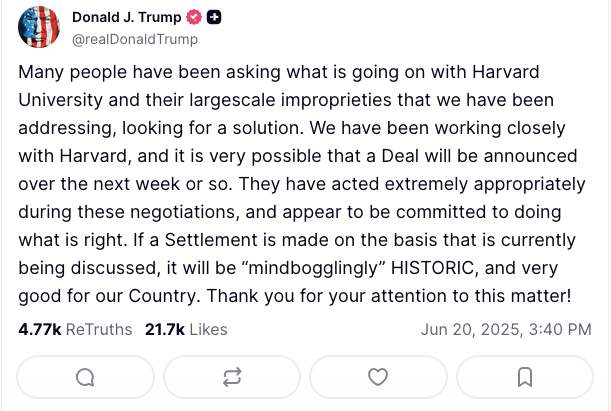
“negotiations”
between
Harvard
and
Trump
appeared
to
be
coming
to
a
close
based
on
one
of
the
President’s
Truth
Social
posts:
Two
things.
First,
that
deal
that
might
have
been
announced
in
the
next
week
was
just
wishful
thinking.
Second,
Harvard’s
“extremely
appropriate”
responses
to
the
strong-arming
may
have
changed
too
—
because
the
administration
is
now
looking
to
take
even
more
from
the
school.
Law360
has
coverage:
The
U.S.
Department
of
Commerce
on
Friday
threatened
to
invoke
the
government’s
so-called
march-in
rights
to
take
control
of
patents
owned
by
Harvard
University,
accusing
the
Ivy
League
institution
of
not
meeting
its
obligations
tied
to
federally
funded
research.
Taxpayers
deserve
the
benefit
of
the
bargain.
If
Harvard
won’t
honor
the
Bayh-Dole
Act,
then
we
will
find
someone
who
will.
pic.twitter.com/8U7yJtYacS
You
don’t
have
to
look
far
beyond
the
legalese
to
see
this
for
what
it
is:
a
“negotiation
tool”
meant
to
force
Harvard
to
bend
the
knee.
If
the
administration
really
wanted
to
go
after
people
that
“failed
to
live
up
to
[their]
obligations
to
the
American
taxpayer,”
they’d
be
putting
whoever
told
Trump
tariffs
were
a
good
idea
in
a
Times
Square
pillory.
For
what
it’s
worth,
Harvard
was
quick
to
respond.
Here’s
what
they
told
Law360:
“This
unprecedented
action
is
yet
another
retaliatory
effort
targeting
Harvard
for
defending
its
rights
and
freedom.”
“Technologies
and
patents
developed
at
Harvard
are
life-saving
and
industry-redefining…[w]e
are
fully
committed
to
complying
with
the
Bayh-Dole
Act
and
ensuring
that
the
public
is
able
to
access
and
benefit
from
the
many
innovations
that
arise
out
of
federally
funded
research
at
Harvard.”
Very
collegiate
way
of
saying,
“We’ll
deal
with
your
bullshit
paperwork,
go
kick
rocks.”
I’d
expect
nothing
less
from
Harvard.
Chris
Williams
became
a
social
media
manager
and
assistant
editor
for
Above
the
Law
in
June
2021.
Prior
to
joining
the
staff,
he
moonlighted
as
a
minor
Memelord™
in
the
Facebook
group Law
School
Memes
for
Edgy
T14s
.
He
endured
Missouri
long
enough
to
graduate
from
Washington
University
in
St.
Louis
School
of
Law.
He
is
a
former
boatbuilder
who
is
learning
to
swim, is
interested
in
critical
race
theory,
philosophy,
and
humor,
and
has
a
love
for
cycling
that
occasionally
annoys
his
peers.
You
can
reach
him
by
email
at [email protected]
and
by
tweet
at @WritesForRent.
In-house
legal
teams
are
under
pressure
like
never
before.
Budgets
are
tight.
Headcount
is
frozen.
Business
partners
expect
faster
turnaround.
And
leadership
wants
Legal
to
deliver
all
of
this
while
“doing
more
with
less.”
So,
where
do
many
teams
look
for
relief?
Legal
tech.
Generative
AI.
Automation.
But
here’s
the
catch:
most
legal
tech
rollouts
stall.
Not
because
the
tools
don’t
work,
but
because
the
people
implementing
them
are
underwater,
and
the
systems
they’re
trying
to
fix
weren’t
designed
for
clarity
in
the
first
place.
As
Maryam
Salehijam
explained
in
a
recent
episode
of
“Notes
to
My
(Legal)
Self,”
“You
really
cannot
talk
about
AI
and
legal
technology
to
an
in-house
legal
team
that’s
already
burning
out.”
She’s
right.
And
one
of
the
biggest
sources
of
that
burnout?
Contracting.
Watch
the
full
interview
here:
The
Real
Blocker
Isn’t
The
Tech
—
It’s
The
Contracts
If
you’ve
ever
tried
to
implement
CLM,
launch
a
new
playbook,
or
standardize
templates,
you
know
this
firsthand.
Contracts
aren’t
just
legal
documents.
They’re
systems.
And
most
of
those
systems
are
messy,
over-customized,
and
inconsistent.
You
can’t
fix
that
with
software
alone.
In
fact,
trying
to
automate
a
broken
contract
process
is
like
paving
over
a
pothole-ridden
road.
It
looks
good
at
first,
but
it
doesn’t
hold
up.
“Start
small,”
Maryam
advised
in
the
interview.
“Most
legal
teams
don’t
even
have
the
basic
operational
functions
optimized.”
Before
adding
tech,
you
have
to
understand
what’s
broken
and
whether
your
people
even
have
the
bandwidth
to
address
it.
The
Case
For
An
Alliance:
ALSPs,
Legal
Ops,
And
Tech
Here’s
where
things
get
interesting.
Maryam
doesn’t
just
advocate
for
legal
technology.
She
champions
the
power
of
ALSPs
(alternative
legal
service
providers)
as
a
strategic
bridge.
Not
just
to
reduce
cost,
but
to
enable
progress.
“ALSPs
and
legal
tech
should
be
best
friends,”
she
said.
“We
can
come
in,
take
over
the
work
that’s
keeping
lawyers
really
busy,
so
they
can
learn
to
use
the
tools
and
really
optimize
themselves.”
This
is
a
perspective
we
don’t
hear
enough.
Tech
is
not
the
hero;
alignment
is.
When
ALSPs
provide
capacity,
legal
ops
lead
process
design,
and
legal
tech
powers
automation,
that’s
when
change
takes
root.
But
this
kind
of
collaboration
doesn’t
happen
by
accident.
It
starts
with
intentional
planning
and
brutally
honest
scoping.
Who
is
doing
what?
Where
does
human
judgment
still
matter?
How
will
success
be
measured?
Without
that
clarity,
change
efforts
collapse
under
their
own
weight.
What
In-House
Teams
Can
Do
Right
Now
If
you’re
staring
down
a
contract
transformation
or
trying
to
recover
from
one
that’s
gone
sideways,
there’s
a
better
path
forward.
Start
with
your
team’s
current
capacity.
Who
is
doing
contract
work
today?
What
kind
of
work
is
it?
Is
it
negotiable?
Is
it
repetitive?
Is
it
aligned
to
risk?
From
there,
look
at
where
the
work
is
getting
stuck.
Is
it
a
legal
review?
Redlines?
Business
confusion?
Each
of
these
pain
points
suggests
a
different
solution
and
a
different
role
for
tech,
ops,
or
external
support.
Then,
talk
to
your
ALSPs.
Not
when
you’re
in
panic
mode,
but
before.
“Have
coffee
chats,”
Maryam
suggested.
“Say,
I
have
no
needs,
I
just
want
to
learn.”
These
conversations
build
trust,
surface
new
solutions,
and
help
legal
leaders
see
what’s
working
for
others.
Lastly,
set
your
team
up
for
quick
wins.
If
your
contracts
are
full
of
inconsistencies,
don’t
roll
out
a
contract
AI
tool
on
Day
One.
Start
by
simplifying
templates.
Clarify
fallback
positions.
Create
a
process
that
works
for
humans,
not
just
for
software.
As
Maryam
put
it,
“Think
big.
Start
small.”
The
Bottom
Line
Legal
teams
don’t
fail
because
they
resist
change.
They
fail
because
the
support
they
get
is
fragmented.
Tech
wants
adoption.
ALSPs
want
projects.
Ops
wants
scalability.
But
the
contracting
process
needs
all
three:
aligned,
honest,
and
focused
on
outcomes.
The
good
news?
That
alliance
is
already
forming.
And
legal
departments
that
embrace
it
are
discovering
something
powerful:
clarity
is
a
competitive
advantage.
Contracting
doesn’t
have
to
be
the
bottleneck.
With
the
right
partners,
it
becomes
a
catalyst.
Olga
V.
Mack is
the
CEO
of TermScout,
an
AI-powered
contract
certification
platform
that
accelerates
revenue
and
eliminates
friction
by
certifying
contracts
as
fair,
balanced,
and
market-ready.
A
serial
CEO
and
legal
tech
executive,
she
previously
led
a
company
through
a
successful
acquisition
by
LexisNexis.
Olga
is
also
a Fellow
at
CodeX,
The
Stanford
Center
for
Legal
Informatics,
and
the
Generative
AI
Editor
at
law.MIT.
She
is
a
visionary
executive
reshaping
how
we
law—how
legal
systems
are
built,
experienced,
and
trusted.
Olga teaches
at
Berkeley
Law,
lectures
widely,
and
advises
companies
of
all
sizes,
as
well
as
boards
and
institutions.
An
award-winning
general
counsel
turned
builder,
she
also
leads
early-stage
ventures
including Virtual
Gabby
(Better
Parenting
Plan), Product
Law
Hub, ESI
Flow,
and Notes
to
My
(Legal)
Self,
each
rethinking
the
practice
and
business
of
law
through
technology,
data,
and
human-centered
design.
She
has
authored The
Rise
of
Product
Lawyers, Legal
Operations
in
the
Age
of
AI
and
Data, Blockchain
Value,
and Get
on
Board,
with Visual
IQ
for
Lawyers (ABA)
forthcoming.
Olga
is
a
6x
TEDx
speaker
and
has
been
recognized
as
a
Silicon
Valley
Woman
of
Influence
and
an
ABA
Woman
in
Legal
Tech.
Her
work
reimagines
people’s
relationship
with
law—making
it
more
accessible,
inclusive,
data-driven,
and
aligned
with
how
the
world
actually
works.
She
is
also
the
host
of
the
Notes
to
My
(Legal)
Self
podcast
(streaming
on Spotify, Apple
Podcasts,
and YouTube),
and
her
insights
regularly
appear
in
Forbes,
Bloomberg
Law,
Newsweek,
VentureBeat,
ACC
Docket,
and
Above
the
Law.
She
earned
her
B.A.
and
J.D.
from
UC
Berkeley.
Follow
her
on LinkedIn and
X
@olgavmack.
The
statistics
show
both
domestic
and
international
flights
fell
in
February
before
recovering
in
March.
International
flights
rose
from
2 200
in
February
to
2 522
in
March,
while
domestic
flights
increased
from
1 221
to
1 762
over
the
same
period.
The
drop
in
flight
activity
saw
total
passenger
numbers
fall
19,5%,
from
622 727
in
the
last
quarter
of
2024
to
501 275
in
the
first
three
months
of
2025.
All
airports
reported
reductions
in
flight
volumes.
Air
cargo
traffic
also
took
a
hit,
with
freight
volumes
down
38,8%
to
2 968
tonnes
from
4 851
tonnes
in
the
previous
quarter.
Inbound
freight
plunged
58,1%,
while
outbound
freight
dropped
17,3%.
ZimStat
also
reported
a
35,9%
fall
in
goods
transported
by
rail.
Agricultural
freight
volumes
fell
steeply
by
86,7%,
industrial
sector
freight
dropped
1,7%,
and
energy
and
mining
sector
volumes
decreased
5,8%.
Rail
accidents
fell
by
half,
from
120
in
the
fourth
quarter
of
2024
to
58
in
early
2025,
but
mainline
accidents
rose
sharply
by
66,7%,
from
21
to
35.
Finance,
Economic
Development
and
Investment
Promotion
Minister
Professor
Mthuli
Ncube
has
since
downgraded
Zimbabwe’s
2025
tourism
growth
forecast
to
2,9%,
down
from
the
initial
4,3%,
citing
poor
performance
in
late
2024
and
early
2025.
International
tourist
arrivals
fell
9%
to
336 369
in
the
first
quarter
of
2025
compared
to
the
same
period
last
year,
while
average
hotel
room
occupancy
declined
by
2%.
All
major
tourist
regions
recorded
drops
in
occupancy
except
Bulawayo,
Midlands,
and
Harare.
“This
trend
could
slow
our
recovery
to
pre-Covid
arrival
levels
of
2
million
visitors
a
year,”
Ncube
said
while
presenting
the
2025
Mid-Term
Budget
and
Economic
Review
on
Thursday.
HARARE
—
Tubes
snaked
across
3-year-old
Gracious
Chikova’s
bandaged
chest
in
the
intensive
care
unit
of
a
government
hospital
in
Zimbabwe’s
capital,
Harare.
Just
a
day
earlier,
surgeons
had
opened
her
tiny
heart
to
repair
a
defect
that
threatened
her
life.
Now
she
sipped
a
drink
from
a
syringe,
her
mother
anxiously
watching
her
every
breath.
“I
had
given
up.
Those
with
money
have
been
taking
their
children
to
India
for
surgery,
but
I
simply
couldn’t
afford
it,”
said
Vimbainashe
Chakanungwa
as
she
helped
her
daughter
sip
her
meal.
Chakanungwa’s
monthly
salary
as
a
teacher
is
about
$300,
barely
enough
for
household
basics,
let
alone
surgery.
Gracious
is
one
of
10
children
who
received
free
open-heart
surgery
in
July
at
Parirenyatwa
Hospital
from
a
visiting
team
of
Egyptian
surgeons
working
alongside
Zimbabwean
doctors.
In
a
country
with
just
a
handful
of
cardiothoracic
specialists
and
chronic
shortages
of
functioning
equipment
in
public
hospitals,
the
“heart
camp”
offered
hope
to
families
who
can’t
imagine
raising
the
$15,000
needed
for
surgery
abroad.
Zimbabwe
has
only
five
cardiothoracic
surgeons,
including
Dr.
Kudzai
Kanyepi,
the
country’s
first
and
only
female
heart
surgeon.
“There
is
no
medication
that
can
replace
surgery.
The
burden
of
disease
remains,
and
unfortunately
some
of
the
children
pass
away
without
getting
the
help
they
desperately
need,”
Kanyepi
said.
“It
is
the
reason
why
we
continue
to
work
in
our
country.
There
is
nothing
greater
than
helping
your
own
people.”
Zimbabwe
resumed
open-heart
operations
in
2023
after
they
were
paused
in
2018
due
to
economic
turmoil.
Since
then,
local
surgeons
have
operated
on
55
children.
Another
19
have
benefited
from
two
surgical
camps
last
year
and
in
July
with
Egyptian
assistance
and
supported
by
nongovernmental
organisations
such
as
Gift
of
Life
International.
Globally,
about
one
in
every
100
children
is
born
with
congenital
heart
disease,
making
it
the
world’s
most
common
birth
defect,
according
to
the
U.S.
Centers
for
Disease
Control
and
Prevention.
In
Zimbabwe,
an
estimated
4,500
children
are
born
with
heart
disease
each
year,
with
many
unable
to
access
surgery,
said
Dr.
Simukayi
Machawira,
head
of
cardiology
at
the
hospital.
Of
those,
30
percent
—
or
around
1,200
infants
—
are
likely
to
die
in
their
first
year
if
untreated,
he
said.
“You
can
imagine,
it’s
quite
a
lot
of
children,”
he
said.
Dr.
Hesham
Shawky,
the
Egyptian
team
leader,
has
organised
similar
camps
in
Kenya
and
Uganda.
“This
is
the
only
solution
for
many
people
in
Africa
because
they
can’t
afford
private
care,”
he
said.
On
the
ward
in
Zimbabwe,
mothers
hovered
over
their
children,
relief
etched
on
their
faces.
Machines
beeped
softly
as
nurses
adjusted
tubes.
One
baby
slept
beside
a
balloon
scrawled
with
a
smiley
face.
For
Chakanungwa,
the
joy
over
her
child
was
hard
to
measure.
“I
had
resorted
to
prayer,
just
hoping
for
a
miracle,”
Chakanungwa
said,
smiling.
“It’s
impossible
to
open
my
heart
to
show
my
gratitude
and
happiness.
I
was
afraid
that
I
could
lose
my
baby,
but
here
is
the
baby.
She’s
back
to
life.”
–
AP
HARARE
–
The
High
Court
has
ruled
that
Chief
Seke,
Stanley
Chimanikire,
violated
the
Constitution
by
chanting
Zanu
PF
slogans
while
addressing
a
gathering,
and
ordered
him
to
publish
a
retraction
within
seven
days.
Justice
Samuel
Deme
delivered
the
judgement
in
a
case
brought
by
citizen
Esther
Vongai
Zimudzi,
who
argued
that
the
chief’s
remarks
breached
her
political
rights
under
Section
67
of
the
constitution.
She
said
Chimanikire’s
actions
also
contravened
Section
281(2),
which
bars
traditional
leaders
from
engaging
in
partisan
politics.
The
court
heard
that
the
chief
was
recorded
telling
attendees:
“2030
VaMnangagwa
vanenge
vachitonga;
Pamberi
ne
Zanu
PF;
Pasi
nemhandu”
(“Mnangagwa
will
still
be
ruling
in
2030,
forward
with
Zanu
PF,
down
with
the
enemies”).
Chimanikire
admitted
making
the
remarks
but
insisted
they
were
delivered
at
a
private
gathering,
not
a
political
rally,
and
were
meant
as
patriotic
praise
for
President
Emmerson
Mnangagwa
rather
than
partisan
endorsement.
Justice
Deme
rejected
that
defence,
saying
Section
281(2)(c)
makes
it
unconstitutional
for
traditional
leaders
to
further
the
interests
of
any
political
party,
regardless
of
the
setting
or
whether
it
is
election
season.
“The
fact
that
the
remarks
were
made
at
a
private
gathering
does
not
absolve
Chief
Seke
from
the
constitutional
obligation
imposed
upon
him
as
a
traditional
leader,”
Justice
Deme
said.
The
court
ordered
Chimanikire
to
publish
a
written
retraction
in
a
newspaper
with
national
circulation
and
share
it
with
public
and
private
media
within
seven
days.
He
mudt
also
have
the
ruling
circulated
through
the
National
Council
of
Chiefs
and
provincial
assemblies.
A
request
to
compel
the
minister
of
local
government
to
institute
disciplinary
proceedings
was
dismissed
because
the
minister
is
not
the
appointing
authority
for
chiefs.
The
judge
also
declined
to
grant
punitive
legal
costs,
saying
parties
have
a
right
to
defend
themselves.
The
latest
row
over
a
chief
chanting
political
slogans
in
support
of
Zanu
PF
will
raise
new
questions
over
the
neutrality
of
traditional
leaders,
an
issue
that
has
been
raised
repeatedly
by
opposition
parties
and
civil
society.
On
the
heels
of
five
new
product
announcements
this
summer,
Litera
is
poised
to
make
a
major
splash
at
ILTACON
2025.
To
learn
about
these
exciting
developments
at
the
event,
attendees
can
say
hello
to
Adam
Ryan,
the
company’s
Chief
Product
Officer,
or
book
a
demo
with
the
on-site
Litera
team
in
advance.
In
the
runup
to
the
conference,
we
sat
down
with
Adam,
who
shared
his
thoughts
on
the
direction
of
legal
technology
and
detailed
the
latest
updates
from
Litera.
(The
conversation
has
been
edited
for
length
and
clarity.)
ATL:
I
understand
that
Litera’s
been
very
busy.
To
start,
can
you
give
us
a
quick
overview
of
what
you’ve
been
rolling
out
in
advance
of
ILTACON?
AR:
The
first
release
that
we’re
unveiling
is
our
game-changing
new
AI
legal
agent,
a
virtual
team
member
spanning
both
the
practice
and
business
of
law.
We’re
calling
it
“Lito.”
The
name
“Lito”
is
short
for
“Litera
One.”
Designed
for
the
legal
industry,
Lito
is
integrated
into
the
unified,
AI-powered
Litera
One
interface.
It
is
built
to
support
legal
workflows
by
aligning
relevant
capabilities
with
user
intent,
helping
deliver
informed
outcomes
through
timely
access
to
the
right
data
in
the
right
context.
It
has
all
of
the
LLM
architecture
associated
with
it,
but
we’ve
paired
it
with
our
legal,
rules-based
engines
that
we’ve
been
developing
over
the
last
30
years
to
deliver
tangible
value
for
our
customers.
It
is
designed
to
help
lawyers
reduce
context-switching,
improve
turnaround
time,
and
make
smarter
decisions.
It
can
do
things
like
compare
how
commercial
deal
points
have
changed
from
one
version
of
a
contract
to
another,
and
identify
the
risk
of
the
changes
while
suggesting
mitigation
strategies.
We’re
also
incorporating
Lito
with
all
of
our
capabilities
in
the
business
of
law
side,
and,
for
example,
it
can
automate
complex
tasks
and
surface
immediate
insights
with
Foundation
and
Foundation
365.
The
second
announcement
is
in
relation
to
Kira,
the
legal
industry’s
trusted,
proven,
and
future-ready
choice
for
due
diligence
and
contract
review.
We’re
re-engineering
Kira
with
GenAI
services
powered
by
Litera
AI+
to
support
greater
productivity
and
more
informed
decision-making
for
legal
professionals.
So
if
you
think
of
Lito
for
ad
hoc
contract
reviews,
what
you’re
able
to
do
with
Kira
is
take
that
same
kind
of
technology
but
apply
it
to
large
document
sets,
which
require
collaboration
and
structured
workflows.
The
re-engineering
of
Kira
with
GenAI
represents
a
transformative
leap
forward
for
legal
teams
everywhere
—
accelerating
contract
analysis
across
languages
and
jurisdictions.
By
empowering
our
users
with
instant,
smarter
contract
analysis
and
seamless
compliance
tools,
we
are
redefining
what’s
possible
in
legal
technology
and
ensuring
our
clients
are
always
ahead
of
the
curve.
By
helping
streamline
workflows,
highlight
potential
risks
and
trends,
and
reduce
time
spent
on
document
review,
these
enhancements
assist
legal
teams
in
aligning
with
client
requirements
and
uncovering
valuable
insights
across
a
range
of
document
types.
These
features
will
be
available
for
all
new
and
existing
Kira
customers
without
needing
to
provide
an
Azure
OpenAI
key.
The
third
big
update
is
a
whole
series
of
enhancements
to
what
we’re
doing
for
the
drafting
workflow,
predominantly
in
Litera
One
Word
and
Outlook.
This
includes
things
like
uniting
the
cloud
version
of
Litera
Create-Content
and
Foundation
Insights
in
Litera
One
for
Word.
With
these
new
workflows,
Knowledge
Management
teams
and
lawyers
leverage
context-aware
AI
to
discover
better
precedent
language
and
relevant
deal
point
insights
to
strengthen
document
quality,
and
lead
negotiations
with
data-driven
authority.
We’re
also
introducing
what
we’re
calling
Precedent,
which
enables
legal
professionals
to
efficiently
search
for
and
retrieve
relevant
precedent
language
directly
from
a
curated
content
library
in
Microsoft
Word.
Additionally,
lawyers
can
now
access
matter,
client,
and
contact
insights
directly
within
their
inbox,
turning
Outlook
into
a
true
legal
productivity
hub.
The
new
deep
integrations
with
Litera
Foundation
and
Peppermint
CRM
improve
responsiveness
and
client
service
by
removing
toggling
and
context-switching.
With
Litera
One
now
delivering
Foundation
and
Peppermint
data
at
their
fingertips,
lawyers
have
the
information
they
need
in
seconds
to
better
serve
their
clients.
Furthermore,
with
competition
for
new
client
business
more
intense
than
ever,
the
fastest
partner
to
reply
with
the
most
relevant
information
can
mean
the
difference
between
winning
and
losing
business.
Our
next
announcement
unveils
massive
updates
and
enhancements
to
our
Foundation
Platform
firm
intelligence
suite,
which
now
enables
partners,
lawyers,
and
business
services
professionals
to
access
consolidated
client,
matter,
contact,
firm
people,
relationship,
and
experience
data
through
a
new
Outlook
interface.
With
this
latest
update,
Litera
has
combined
both
critical
client
information
from
its
CRM
with
unparalleled
matter
insights
from
its
experience
management
platform
to
deliver
a
365-degree
firm
view,
right
where
legal
professionals
work
today.
Litera
One
allows
firms
to
leverage
this
critical
firm
intelligence
throughout
the
Microsoft
stack,
in
a
truly
integrated
manner.
Previously
siloed
in
standalone
systems
and
often
out
of
reach
from
partners
and
lawyers,
Foundation’s
powerful
new
feature
in
Outlook
unlocks
how
firms
can
better
leverage
firm
experience
to
grow
their
business
and
deliver
exceptional
client
service.
On
average,
knowing
how
to
answer
the
question
“what
is
our
experience
with
this
type
of
matter?”
could
take
multiple
hours
and
a
team
of
people.
Today,
that
answer
is
available
in
seconds
at
the
lawyer’s
fingertips
in
Outlook.
Finally,
our
last
announcement
before
ILTACON
is
a
strategic
investment
in
Postilize
to
accelerate
innovation
in
business
development
with
the
launch
of
Foundation
Proactive,
Powered
by
Postilize.
This
partnership
marks
a
significant
step
toward
delivering
a
next-generation,
integrated
“growth-tech”
stack
within
Litera
One
that
transforms
legal
work
by
placing
the
right
data
in
the
right
place
at
the
right
time
—
combining
relationship
intelligence,
marketing
automation,
and
AI-powered
personalization.
This
transformative
technology
enables
lawyers
to
engage
clients
at
precisely
the
right
moment
with
highly
relevant,
personalized
communications
—
what
we
call
Proactive
Relationship
Management.
By
leveraging
our
integrated
Litera
One
platform,
firms
can
identify
and
capitalize
on
new
business
opportunities
that
would
otherwise
remain
hidden.
Those
are
the
five
main
headlines,
but
we
have
a
slew
of
other
enhancements
at
our
company
update
at
ILTACON
(Monday,
August
11
at
4
p.m.
in
Cherry
Blossom).
It’s
our
biggest
ILTA
ever
in
terms
of
new
products
and
feature
delivery!
ATL:
That’s
certainly
a
lot.
It
seems
like
the
pace
of
new
features
is
accelerating,
certainly
at
Litera,
but
also
generally
in
legal
technology.
Do
you
see
that
as
a
trend
in
the
industry?
What’s
driving
this
if
so?
AR:
Yes,
seeing
that
across
the
board
is
truly
exciting.
I
think
there
is
an
increased
demand
coming
from
our
buyer
base
that
is
driving
innovation.
Customers
are
hungry
for
new
workflows
and
capabilities
—
a
lot
of
them
brought
about
by
large
language
models
and
generative
AI
capabilities.
They’re
keen
to
get
the
benefits
of
this
for
their
own
practice.
I
think
that’s
driving
an
exciting
pace
of
innovation
from
legal
tech
vendors
to
push
the
boundaries
of
what
we
can
do
and
how
far
we
can
take
this
innovation.
I’ve
been
in
the
legal
industry
a
long
time.
I
am
a
practicing
lawyer.
I
was
the
former
Chief
Legal
Innovation
Officer
at
Freshfields,
and
now
I’m
the
Head
of
Product
at
Litera.
I
haven’t
seen
this
rate
of
change
in
adoption
in
the
legal
tech
industry
in
all
my
career.
What
we
are
hearing
from
our
customers,
though,
is
that
they
want
connecting
experiences,
and
that’s
why
we’re
really
excited
with
what
we’re
doing
with
Litera
One.
Lito
is
part
of
Litera
One
because
it’s
connecting
all
of
those
capabilities
and
experiences
across
that
end-to-end
workflow,
meeting
lawyers
where
they
work
today,
which
is
in
Microsoft
Word
and
Outlook.
ATL:
That’s
a
good
segue
into
what
I
was
going
to
ask
about
next,
although
you’ve
touched
on
it
already.
Can
you
provide
a
little
more
detail
on
these
developments
from
the
end-user
perspective?
AR:
Yes,
absolutely!
One
overall
pain
point
for
the
legal
industry
is
around
the
massive
inefficiencies
in
routine,
time-consuming
tasks
that
lawyers
spend
countless
hours
on.
And
that’s
really
the
key
problem
that
we’re
looking
to
solve
with
the
advancements
that
we’re
bringing
to
ILTA
this
year.
So
how
do
we
kind
of
attack
those
bottlenecks
around
things
like
contract
analysis,
research, synthesis,
first
draft
creation?
We’re
looking
to
turn
high-volume
and
low-value
hours
into
near-instant
outputs,
all
while
reducing
risk
and
cost.
That’s
the
overall
value
proposition
that
we’re
really
looking
to
drive,
and
the
kind
of
response
that
we’re
seeing
in
the
market
has
been
incredible.
ATL:
At
the
company
update
at
Legalweek
this
year,
Litera
CEO
Avaneesh
Marwaha
talked
about
a
shift
in
focus
from
legal
technology
streamlining
the
work
typically
performed
by
junior
associates
to
helping
the
rainmakers
and
partners.
How
are
Litera’s
new
releases
at
ILTA
related
to
that
idea?
AR:
That’s
part
of
the
key
innovation
driven
by
what
we’re
calling
our
growth
tech
platform.
Partners
are
looking
for
areas
to
cross-sell
and
at
areas
where
they
can
grow
their
business,
and
that’s
where
being
able
to
access
this
data
—
which
was
previously
siloed
in
individual
systems
that
they
don’t
have
access
to
—
comes
in.
Now
they’re
able
to
leverage
that
data
for
the
power
of
going
out
and
finding
that
new
business
and
serving
their
clients
and
identifying
areas
of
cross-selling.
So,
yes,
100%.
Avaneesh
mentioned
at
that
company
update,
though,
that
what
we’re
really
focusing
on
is
getting
people
the
right
data,
at
the
right
time,
and
in
the
right
place.
So
when
we
talk
about
data,
sometimes
you
need
that
kind
of
information
around
billings
or
clients
or
contracts
or
matter
experience.
We
have
access
to
all
of
that
information.
Sometimes
you
need
firm
precedent
data,
sometimes
you
need
clauses,
sometimes
you
need
proofreading
results,
sometimes
you
need
comparisons.
The
proactive
skills
in
Lito
are
key
to
being
able
to
get
that
right
data
at
the
right
time.
For
example,
Lito
recognizes
when
you
need
a
document
comparison,
and
we’re
automatically
giving
you
that.
Lito
recognizes
when
you’re
getting
a
question
about
firm
experience,
and
we’re
automatically
providing
that
to
you
as
well.
So
we’re
delivering
that
data
when
they
need
it,
in
the
interface
that
they’re
already
working
with.
That’s
where
I’m
most
excited
around
the
kind
of
potential
for
us
to
help
those
rainmakers
grow
and
develop
the
business
further.
ATL:
So
ILTACON
is
around
the
corner.
What
do
you
hope
attendees
take
away
from
Litera’s
offerings
there
this
year?
AR:
What
I
really
would
like
them
to
take
away
is
seeing
what
we’re
able
to
provide
across
the
whole
product
portfolio
that
we
have.
One
of
the
things
that
I
constantly
hear
from
our
customers
is:
How
are
you
investing
in
the
core
solutions
that
they
use
and
love
today?
How
are
you
integrating
those
solutions
together?
And
how
are
you
investing
in
what
you
are
trying
to
achieve
going
forward?
I
really
want
them
to
take
away
those
three
things
—
to
be
able
to
see
how
we’re
investing
in
the
solutions
that
they’ve
been
customers
for,
and
bringing
really
cutting-edge
advancements
to
each
of
those
kind
of
product
lines,
along
with
how
we’re
integrating
that
product
portfolio
together
and
how
Litera
One
is
able
to
bring
those
workflows
into
end-to-end
solutions.
There
are
a
number
of
things
that
we’re
releasing,
which,
if
I
had
them
when
I
was
a
practicing
lawyer,
it
would’ve
made
me
very
happy.
Being
able
to
see
that
come
to
life
is
really
the
best
part
of
my
job.
In
an
effort
to
expand
their
footprints
across
the
United
States,
Biglaw
firms
have
been
raiding
midsize
firms
in
the
Southeast
to
open
new
offices
and
fortify
specific
practice
groups.
Morris
Manning
&
Martin
—
a
well-regarded
Am
Law
200
firm
that
brought
in
$157,946,000
gross
revenue
last
year
— was
so
hard
hit
by
these
practices
that
it
lost
more
than
one
third
of
its
attorneys
(about
60)
to
firms
like
Fox
Rothschild,
Clark
Hill,
Reed
Smith,
Bradley
Arant,
and
Gunderson
Dettmer,
and
Seyfarth
Shaw.
Earlier
this
summer,
the
firm
had
entered
into
merger
talks
with
an
Am
Law
100
firm,
and
now,
its
previously
unnamed
merger
partner
has
been
revealed.
As
noted
by
the
American
Lawyer,
Morris
Manning
is
planning
to
merge
with
Taft
Stettinius
&
Hollister
—
a
firm
that
brought
in
$701,000,000 gross
revenue in
2024,
putting
it
at
No.
79
on
the
Am
Law
100
—
one
of
the
fastest-growing
firms
in
the
country.
Taft’s
merger
with
Morris
Manning
will
be
its
third
of
2025.
The
tie-up,
projected
to
close
by
the
end
of
the
year,
will
create
a
firm
that’s
1,200
lawyers
strong
with
gross
revenue
approaching
$1
billion.
Am
Law
has
some
addition
details
on
how
the
firms’
plans
came
together:
As
firm
leaders
evaluated
the
possible
deal,
[Taft
managing
partner
Robert]
Hicks
said
that
“because
of
the
departures
we
were
concerned”
if
Taft
would
be
“getting
the
best”
talent
that
remained
at
Morris
Manning.
“Frankly,
there’s
like
zero
doubt
in
our
minds,”
Hicks
said.
“Frankly,
every
time
we
met
with
Morris
Manning
just
got
better
and
better,
and
we
felt
more
and
more
solid
about
it.”
…
Hicks
said
he
believed
Morris
Manning
was
a
“victim
of
its
own
success”
because
large
firms
typically
seek
out
the
highest-performing
partners
at
the
top
local
firms
when
moving
into
any
new
market.
“We
actually
saw
this
as
a
positive,”
he
said
of
the
departures.
“We
looked
at
their
client
base
and
were
highly
impressed.
We
looked
at
the
talented
lawyers
[and]
were
highly
impressed.”
Simon
Malko,
Morris
Manning’s
managing
partner,
went
on
to
say
that
while
they’d
been
approached
with
mergers
“many
times”
before,
Taft
seemed
the
most
promising
“We’ve
never
said
we’re
going
to
merge
for
merger’s
sake,”
he
said.
“None
of
the
conversations
before
Taft
were
compelling
opportunities.”
Congratulations
to
Morris
Manning
and
Taft
on
what
seems
like
a
merger
decision
that
was
made
just
in
the
nick
of
time.
Let’s
see
how
far
the
combination
will
move
Taft
up
in
the
Am
Law
100
rankings.
Staci
Zaretsky is
the
managing
editor
of
Above
the
Law,
where
she’s
worked
since
2011.
She’d
love
to
hear
from
you,
so
please
feel
free
to
email
her
with
any
tips,
questions,
comments,
or
critiques.
You
can
follow
her
on Bluesky, X/Twitter,
and Threads, or
connect
with
her
on LinkedIn.
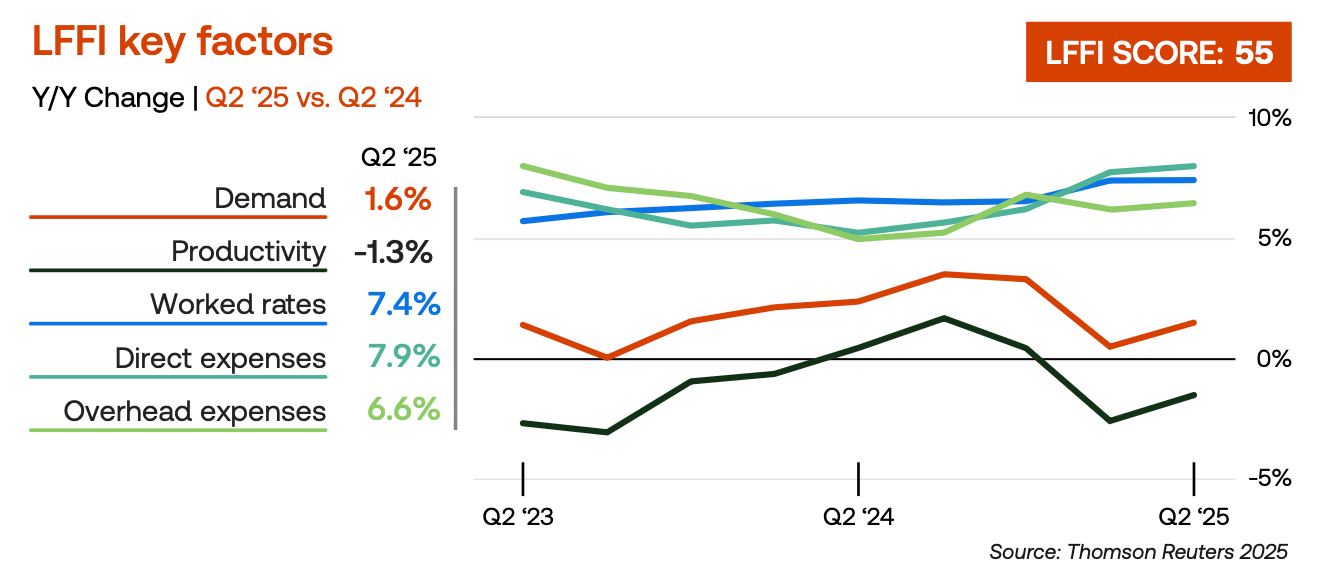
In
its
latest
Law
Firm
Financial
Index,
Thomson
Reuters
compares
the
legal
market
to
the
eye
of
a
storm.
Perhaps.
Though
the
thing
about
the
eye
of
a
storm
is
you
know
you’re
halfway
to
the
other
side,
and
there’s
not
much
to
suggest
the
looming
danger
will
let
up
any
time
soon.
There’s
an
eerie
calm
before
someone
releases
a
family
of
rabid
opossums
in
your
house
too,
but
it’s
a
lot
harder
to
soothe
yourself
knowing
“this
too
shall
pass”
in
that
scenario.
For
law
firms,
Q2
came
and
went
without
much
drama.
Demand
was
up
—
slightly
—
and
remarkably
stable,
showing
the
least
volatility
since
2020
and
some
of
the
lowest
volatility
since
the
Great
Recession.
But
the
headline
for
this
report
might
as
well
read:
“Everything’s
Fine,
Which
Is
Exactly
Why
You
Should
Panic.”
The
report
paints
Q2
2025
as
the
legal
market’s
equivalent
of
that
awkward
silence
in
a
horror
movie
when
the
dog
stops
barking.
Clients
sought
out
more
advice,
but
that’s
more
indicative
of
the
uncertain
economic
environment.
More
alarming,
the
report
suggests
that
realization
rates
dipped
last
Q2,
which
could
signal
clients
taking
a
turn
for
the
stingy.
This
could
be
the
round
of
polite
ghosting
that
precedes
an
eventual
collections
bloodbath.
The
fact
that
the
best
growth
came
from
notoriously
countercyclical
litigation
and
M&A
sputtered
after
starting
the
year
on
a
high
and
you
can
see
why
this
“calm”
worries
people.
Meanwhile
the
costs
just
keep
adding
up
and,
in
true
2025
form,
a
large
part
of
that
is
the
AI
arms
race.
Interestingly,
after
years
of
the
Biglaw
elite
driving
the
business
numbers
for
the
industry,
it’s
the
midsized
and
Second
Hundred
firms
enjoying
a
lot
of
the
benefits
from
last
quarter.
The
picture
becomes
even
more
complicated
when
we
look
at
each
law
firm
segment.
Am
Law
100
firms
saw
a
decline
in
demand
growth
in
Q2,
especially
in
their
corporate
practices.
At
the
same
time,
the
Am
Law
1-50
firms
continued
to
sharply
limit
their
lawyer
head-count
growth.
Midsize
and
Second
Hundred
firms,
by
contrast,
greatly
accelerated
their
demand
performance
across
most
practices.
This
surge
in
demand
was
enough
to
elevate
these
firms’
fees
worked
growth
above
that
of
the
Am
Law
100,
offsetting
Am
Law
100
firms’
advantage
in
worked
rate
growth.
If
we
must
stick
with
the
meteorological
references
—
as
we
should
in
honor
of
the
federal
government
putting
out
a
mass
call
to
hire
weather
professionals
at
a
premium
after
Elon
fired
everyone
with
no
plan
—
is
this
an
“eye”
or
the
“calm
before
the
storm”?
The
latter
at
least
conveys
that
there’s
no
way
of
knowing
when
this
is
going
to
end.
As
greater
scrutiny
envelops
the
largest
pharmacy
benefit
management
companies,
one
thing
is
clear:
They
are
not
going
to
give
up
without
a
fight.
And
in
that
existential
battle,
they
just
notched
a
major
win.
Last
week,
U.S.
District
Judge
Brian
Miller
blocked
an
Arkansas
law
(Act
624)
that
would
have
banned
PBMs
from
owning
and
operating
pharmacies
in
the
state.
Arkansas
Governor
Sarah
Huckabee
Sanders
signed
Act
624
into
law
in
April,
arguing
that
PBMs
have
increasingly
bought
pharmacies,
allowing
them
to
increase
drug
prices
and
put
competitors
out
of
business.
Miller
issued
a
preliminary
injunction
against
the
law,
stating
that
it
violates
the
Commerce
Clause,
which
says
that
states
cannot
pass
laws
that
unfairly
hurt
or
discriminate
against
businesses
from
other
states.
In
response
to
the
decision,
Sanders
said
in
a
statement
that
“Arkansas
was
the
first
state
to
force
big
drug
middlemen
called
PBMs
to
stop
inflating
drug
prices
and
manipulating
the
market.
The
PBMs
sued
Arkansas
and
a
judge
let
them
get
away
with
it.
But
we’ll
appeal,
win
in
higher
court,
and
set
a
new
standard
for
the
country.”
While
the
state
plans
to
appeal,
at
least
one
healthcare
expert
isn’t
so
sure
that
this
law
has
a
future.
“I
could
be
wrong,
but
I
don’t
think,
as
it
is
drafted
today,
that
there’s
any
possibility
that
it
gets
around
the
constitutional
challenges
that
it
faces,”
said
Chris
Deacon,
principal
and
founder
of
VerSan
Consulting.
That
said,
Arkansas’
efforts
still
sent
a
powerful
message.
“If
anything,
what
I
think
this
does
is
it
very
clearly
sends
a
signal
to
Congress
that
the
states
are
trying
[and
that]
this
is
a
problem,”
Deacon
stated.
“They
are
trying
to
deal
with
it
head
on.
‘We
cannot
do
this
alone.
…
We
need
Congress
to
act
because
the
holding
is
very
clear:
Congress
has
the
authority
to
regulate
interstate
commerce.
The
states
do
not.’”
The
judge’s
decision
The
judge
granted
the
plaintiffs’
motions
for
a
preliminary
injunction
for
a
few
reasons.
That
includes
his
conclusion
that
they
are
likely
to
“prevail”
on
their
Commerce
Clause
and
TRICARE
preemption
claims.
The
Commerce
Clause
gives
Congress
the
power
to
regulate
interstate
commerce,
while
the
negative
implication
of
this
authority
—
the
dormant
Commerce
Clause
—
bars
states
from
discriminating
against
interstate
commerce.
“Act
624
appears
to
overtly
discriminate
against
plaintiffs
as
out
of
state
companies
and
the
state
has
failed
to
show
that
it
has
no
other
means
to
advance
its
interests,”
the
judge
stated.
“This
is
true
because
section
one
of
Act
624
specifically
states
that
its
purpose
is
to
eliminate
plaintiffs’
‘business
tactics
that
have
driven
locally-operated
pharmacies
out
of
business.’”
Moreover,
the
judge
found
that
Act
624
conflicts
with
the
federal
TRICARE
program,
which
is
a
healthcare
program
for
active
duty
service
members.
TRICARE
includes
a
preemption
clause,
meaning
it
overrides
state
laws
that
are
inconsistent
with
TRICARE.
“Act
624
is
explicitly
preempted
by
TRICARE’s
‘health
care
delivery’
provision
because
Act
624
prohibits
PBM-owned
pharmacies
from
delivering
healthcare
to
Arkansas
patients.
This
prohibition
is
inconsistent
with
the
TRICARE
program
that
has
existing
contracts
with
some
of
the
plaintiffs,”
Miller
said.
The
judge
also
wrote
that
the
plaintiffs
would
“suffer
irreparable
harm”
from
the
Arkansas
law,
including
great
financial
consequences.
CVS
previously
told
MedCity
News
that
it
would
be
forced
to
close
23
community
pharmacies
in
Arkansas
and
fire
more
than
500
local
healthcare
workers.
Express
Scripts
doesn’t
operate
brick
&
mortar
pharmacies
in
Arkansas,
but
it
does
have
25
non-resident
pharmacy
licenses
in
Arkansas
that
would
be
affected
by
the
law.
The
ruling
was
warmly
greeted
by
plaintiffs
whose
response
was
framed
in
the
context
of
how
Arkansas’s
law
would
harm
patients
with
no
mention
of
how
it
harmed
their
business
prospects
in
the
state.
David
Whitrap,
vice
president
of
external
affairs
at
CVS
Health,
said
the
company
is
“pleased
with
the
Court’s
decision
to
grant
a
preliminary
injunction
to
stop
the
implementation
of
Act
624.
We
continue
to
be
focused
on
serving
people
in
Arkansas
and
are
actively
looking
to
work
together
with
the
state
to
reduce
drug
prices
and
ensure
access
to
pharmacies.”
A
representative
for
Express
Scripts
echoed
this.
“We
appreciate
the
Court
acting
to
protect
Arkansans’
access
to
their
pharmacies,”
said
Andrea
Nelson,
chief
legal
officer
of
The
Cigna
Group,
which
owns
Express
Scripts.
“Every
day,
our
nurses,
pharmacists
and
other
dedicated
team
members
provide
care
to
Arkansas
patients
that
can’t
be
easily
replaced,
and
we
will
continue
doing
everything
we
can
to
protect
Arkansas
patients’
access
to
care
and
affordable
medicines.”
What’s
ahead?
It
will
be
interesting
to
see
how
the
battle
between
a
Republican
governor
of
a
conservative
state
and
the
PBMs
plays
out
if
Sanders
formally
appeals.
Deacon
of
VerSan
Consulting
believes
there
isn’t
any
hope
left
for
Arkansas’
PBM
law,
given this
decision
from
the
lower
court
was
expected
as
it’s
a
“clear
violation
of
the
Commerce
Clause.”
She
speculated
that
whoever
reviewed
the
legality
of
the
law
likely
knew
that
it
would
be
challenged.
However,
passing
the
law
brought
great
awareness
to
the
issue
of
PBMs,
she
said.
“I
think
when
the
law
was
passed,
it
was
by
far,
one
of
the
most
radical
PBM
state
bills
out
there,”
she
said.
“It
was
definitely
the
talk
of
the
town.
I
think
for
the
state
of
Arkansas,
it
really
showed
that
they
were
ready
to
move
on
this
and
act
against
some
of
these
big
industries’
corporate
interests,
which
made
a
big
statement.”
Not
all
are
swayed
by
this
bleak
prospect
for
the
law.
The
National
Community
Pharmacists
Association
(NCPA),
meanwhile,
believes
Arkansas’
law
is
going
to
prevail.
“I
do
feel
like
it
was
the
wrong
decision
because
if
you
look
at
the
way
the
law
was
written,
you
get
away
from
all
of
the
extraneous
information
that
was
brought
into
the
record
by
the
PBMs
to
sort
of
place
a
fog
over
the
overall
purpose
and
meaning
of
this
law.
I
think
reasonable
minds
will
agree
that
this
does
not
violate
the
Commerce
Clause
because
there’s
not
a
regulation
of
out-of-state
entities,
as
the
PBMs
have
claimed,”
declared
Matthew
Seiler,
general
counsel
at
the
NCPA,
in
an
interview.
He
noted
that
it
is
actually
a
regulation
of
the
corporate
structure
of
PBMs,
“regardless
of
where
they
are
located.”
Whatever
the
legal
future
of
the
Arkansas
law
is,
meaningful
PBM
reform
needs
to
come
from
a
national
level
instead
of
a
patchwork
of
states,
Deacon
said.
And
currently,
PBM
reform
is
at
the
top
of
a
lot
of
lawmakers’
minds.
Numerous
bills
have
been
introduced
targeting
PBMs,
including
efforts
to
delink
PBM
compensation
from
list
prices
and
banning
spread
pricing,
in
which
PBMs
charge
payers
more
than
they
pay
the
pharmacy
for
a
medication
and
then
keep
the
difference.
Deacon
is
particularly
in
favor
of
the
Patients
Deserve
Price
Tags
Act,
which
goes
beyond
PBM
reform
by
requiring
providers
to
publish
the
costs
of
services
so
Americans
can
compare
prices.
It
ensures
employer
access
to
claims
data
and
PBM
information
as
well.
Seiler
also
called
out
the
PBM
Reform
Act,
which
would
ban
spread
pricing
in
Medicaid
and
delink
PBM
compensation
from
the
cost
of
medications
under
Medicare
Part
D.
In
December,
a
bill
in
Congress
similar
to
the
Arkansas
law
was
also
introduced.
It’s
called
the
Patients
Before
Monopolies
Act
and
would
ban
the
joint
ownership
of
PBMs
and
pharmacies.
However,
this
bill
may
be
a
“bridge
too
far”
from
what
the
federal
government
can
achieve
at
this
point,
but
it
is
indicative
of
where
lawmakers
want
to
go
in
the
future,
Deacon
said.
In
the
absence
of
Congressional
action,
the
states
will
likely
continue
to
try
and
regulate
PBMs.
For
example,
California
recently
proposed
a
bill
that
would
delink
PBM
compensation
from
the
list
price
of
a
drug,
which
Paul
Markovich,
CEO
of
Ascendiun,
noted
in
a
recent
episode
of
MedCity
Debunked.
Ascendiun
is
the
nonprofit
parent
company
of
Blue
Shield
of
California.
He
argued
that
the
role
of
PBMs
has
absolutely
nothing
to
do
with
the
price
of
the
drug.
“It’s
not
as
if
Amazon
charges
you
for
the
cost
of
the
contents
of
the
box,”
he
said.
But
Deacon
hopes
that
with
states
stepping
up,
that
Congress
won’t
slow
its
roll.
“What
I
would
hate
to
see
is
Congress
lose
their
energy
and
impetus
to
do
something
on
a
federal
level
[thinking]
the
states
have
this,”
she
said.
“That
would
be
a
real
lost
opportunity.”
She
added
that
states
likely
aren’t
cracking
down
on
PBMs
because
they
simply
want
to,
but
because
they’ve
become
a
serious
problem.
Most
states
would
probably
be
in
favor
of
federal
action
against
PBMs.