The
government
has
allocated
US$2
million
this
year
to
speed
up
the
final
stage
of
demining.
Speaking
at
the
2025
Defence
Day
celebrations
on
12
August,
ZNA
Commander
Engineers
Colonel
Simbarashe
Zhou
explained
that
most
of
the
minefields
were
inherited
when
Zimbabwe
gained
independence
in
1980.
He
said:
“In
1980,
we
inherited
landmines
which
were
laid
by
the
Rhodesian
Forces
along
our
borders.
“From
the
Victoria
Falls
down
to
Mulibizi,
which
was
220
kilometers.
“We
also
had
landmines
stretching
from
Chidodo
in
Mt
Darwin,
up
to
Wenya
River.
“We
also
had
minefields
in
Chipinge,
Chiredzi
South,
and
the
Sango
Border
Post.
Those
were
the
areas
that
were
mined.”
Explosives
were
planted
not
only
along
borders
but
also
inland
in
protected
areas
like
Lusulu
and
Kariba
South
Power
Station.
Colonel
Zhou
said
95%
of
the
minefields
have
been
cleared,
with
5%
remaining
in
Mashonaland
Central
and
Mashonaland
East.
ZNA
teams
are
working
with
partners
like
Hallow
Trust
in
Rushinga
and
Norwegian
People’s
Aid
in
Muzarabani.
The
Mine
Advisory
Group
helps
with
demining,
and
the
National
Mine
Clearing
Squadron
is
focused
on
the
Sango
Border
Post.
Despite
progress,
funding
remains
a
challenge.
This
year,
the
government
allocated
US$2
million
for
the
work,
but
it
is
not
enough
to
cover
equipment,
training,
and
transport.
Colonel
Zhou
called
for
more
support
to
buy
modern
equipment
and
improve
operations.
He
urged
communities
to
report
any
unexploded
bombs,
warning
that
curious
children
might
handle
these
dangerous
items.
People
should
notify
the
nearest
police
or
army
station
to
prevent
accidents,
said
Colonel
Zhou.
Zimbabwe is
a
landlocked
country
in
Southern
Africa,
bordering
Botswana,
Mozambique,
South
Africa
and
Zambia.
Despite
its
high
literacy
rates
and
abundant
natural
resources,
Zimbabwe
continues
to
grapple
with
chronic
poverty,
hyperinflation,
unemployment
and
food
insecurity.
The
2024
El
Niño-induced
drought
further
pushed
the
country
into
a
dire
humanitarian
crisis.
However,
a
favorable
2025
harvest
has
offered
some
respite,
improving
livelihoods
and
food
security
for
millions.
Despite
these
recent
positive
developments,
underlying
issues
remain,
underscoring
the
need
for
sustained
support
and
long-term
solutions.
Facts
About
Poverty
in
Zimbabwe
Extreme
Poverty. As
of
April
2025,
approximately
60%
of
Zimbabwe’s
population lived
on
less than
$3.65
a
day,
placing
the
country
among
the
most
impoverished
in
Southern
Africa.
Food
Insecurity. Poverty
in
Zimbabwe
is
closely
intertwined
with
food
instability,
as
most
households
depend
on
agriculture.
Zimbabwe’s
fragile
economy,
marked
by
hyperinflation
and
reduced
purchasing
power,
coupled
with
the
El
Niño
drought,
left
more
than
seven
million
people facing
food
shortages during
the
2024-2025
lean
season.
Despite
improved
harvests
in
mid-2025,
food
security
remains
fragile,
underscoring
the
vulnerability
of
Zimbabwe
to
economic
and
climate
shocks.
Food
Price
Inflation. Persistent
currency
instability
has
made
necessities
unaffordable
for
many
households.
By
July
2025,
the
year-on-year
rate
soared
to
a
staggering
120.70%.
Severe
Child
Malnutrition. About
24%
of
children
aged
less
than
5
suffer
from
chronic
malnutrition,
with
merely
10%
of
babies
aged
6
to
23
months
receiving
an
adequate
minimum
diet.
Rising
waste
rates
in
both
rural
and
urban
areas
highlight
the
widespread
nature
of
Zimbabwe’s
poverty.
Rural
Poverty. Rural
communities, containing
about
67% of
Zimbabwe’s
population,
are
the
most
vulnerable
to
drought
and
food
insecurity,
as
their
livelihoods
depend
mainly
on
rain-fed
agriculture.
However,
economic
shocks
in
recent
years
have
started
to
narrow
the
rural-urban
gap,
with
poverty
also
affecting
urban
areas.
Water
Scarcity
and
Disease. More
than
four
million
people
lack
access
to
safe
water,
a
critical
situation
exacerbated
by
the
El
Niño
drought.
Dependence
on
unsafe
sources
has
led
to
outbreaks
of
waterborne
diseases,
including
cholera.
Children
aged
5
and
below
are
the
most
vulnerable.
A
Fragile
Health
Care
System. Zimbabwe’s
public
health
care
system
faces
critical
challenges.
About
87%
of
Zimbabweans lack
medical
aid coverage.
The
sector
struggles
with
shortages
of
medicines,
medical
personnel,
high
costs
and
a
significant
“brain
drain”
of
health
professionals.
Limited
Social
Safety
Nets. While
the
government
provides
some
grain
and
cash
transfers,
social
protection
coverage
remains
low.
This
leaves
the
most
vulnerable
citizens
dependent
on
humanitarian
aid
from
NGOs
and
international
organizations.
The
halt
in
U.S.
funding
for
HIV/AIDS
programs,
including
the
President’s
Emergency
Plan
for
AIDS
Relief,
has
disrupted
the
provision
of
life-saving
antiretroviral
medication
to
more
than
a
million
Zimbabweans
dependent
on
it.
This
disruption
has
raised
fears
of
a
potential
resurgence
of
the
HIV/AIDS
epidemic
in
the
future.
Unsustainable
Public
Debt. Zimbabwe’s public
debt
reached $21.2
billion
in
2023,
representing
96,6%
of
its
gross
domestic
product
(GDP).
This
high
debt
burden
limits
the
country’s
access
to
international
financing,
further
hampering
economic
recovery.
Women’s
Increased
Vulnerability. Women
bear
the
hardest
consequences
of
poverty
and
climate
shocks.
Many
work
in
the
informal
sector,
lack
social
protection
and
live
in
precarious
conditions.
The
drought
has
exacerbated
their
vulnerability,
leading
to
a
surge
in
child
and
school
dropouts
among
girls.
Dependence
on
their
husbands
for
subsistence
increases
the
risk
of
women
becoming
victims
of
gender-based
violence.
Organizations
Providing
Aid
Despite
these
challenges,
organizations
like
Action
Against
Hunger
(ACF)
and
the
World
Food
Program
(WFP)
are
stepping
up
their
efforts
to
meet
the
urgent
needs
of
vulnerable
Zimbabweans.
ACF provides
cash
transfers to
farmers
and
households
with
malnourished
children,
while
ensuring
these
children
receive
the
necessary
medical
referrals.
Its
actions
benefited
a
total
of
8,000
people.
The
organization
has
also
prioritized
access
to
clean
water,
constructing
and
refurbishing
boreholes
and
mini
water
systems
that
now
serve
water
to
more
than
19,000
individuals.
Meanwhile,
WFP
strengthens
rural
farming
communities
by
training
farmers
on
climate-smart
farming
techniques,
encouraging
traditional
small
grain
cultivation,
diverse
horticulture
and
animal
farming.
WFP
also
introduces
agricultural
risk
insurance,
alongside
savings
and
credit
products.
Final
Remarks
While
the
successful
2025
harvest
has
provided
a
temporary
relief,
it
highlights
Zimbabwe’s
acute
vulnerability
to
climate
shocks.
Continued
funding
and
collaboration
between
the
government
and
international
partners
are
critical
for
building
long-term
resilience,
ensuring
sustainable
development
and
preparing
for
future
crises
linked
to
climate
instability.
–
Juliette
Delbarre
Juliette
is
based
in
London,
UK
and
focuses
on
Global
Health
and
Politics
for
The
Borgen
Project.
Yesterday,
and
the
American
Bar
Association
amped
up
their
beef
with
President
Donald
Trump,
adopting
a
resolution
condemning
his
attempts
to
retaliate
against “lawyers,
law
firms,
or
other
organizations
for
representing
or
having
represented
any
particular
client
or
cause
disfavored
by
the
government.”
The
ABA’s
resolution
also
criticizes
threats
to
impeach
judges
“based
solely
on
disagreement
with
the
merits
of
the
rulings
made
by
those
judges.”
In
almost
any
other
era,
these
are
uncontroversial
statements
that
do
the
bare
minimum
to
defend
the
rule
of
law.
But
of
course,
we
live
in
the
hellscape
of
2025,
and
the
Trump
administration
has
done
those
exact
things.
One
mission
of
the
Trump
II
reign
is
to
undermine
the
rule
of
law,
with
this
resolution
the
ABA
is
(again)
signaling
they’ll
do
their
best
to
stand
in
the
way
of
the
authoritarian
push.
Kathryn
Rubino
is
a
Senior
Editor
at
Above
the
Law,
host
of
The
Jabot
podcast,
and
co-host
of
Thinking
Like
A
Lawyer.
AtL
tipsters
are
the
best,
so
please
connect
with
her.
Feel
free
to
email
her
with
any
tips,
questions,
or
comments
and
follow
her
on
Twitter
@Kathryn1 or
Mastodon
@[email protected].
Next
Vigil
meeting
outside
the
Zimbabwe
Embassy. Saturday
16th August
from
2
–
5
pm.
We
meet
on
the
first
and
third
Saturdays
of
every
month.
On
other
Saturdays
the
virtual
Vigil
will
run.
The
Restoration
of
Human
Rights
in
Zimbabwe
(ROHR) is
the
Vigil’s
partner
organisation
based
in
Zimbabwe.
ROHR
grew
out
of
the
need
for
the
Vigil
to
have
an
organisation
on
the
ground
in
Zimbabwe
which
reflected
the
Vigil’s
mission
statement
in
a
practical
way.
ROHR
in
the
UK
actively
fundraises
through
membership
subscriptions,
events,
sales
etc
to
support
the
activities
of
ROHR
in
Zimbabwe.
The
Vigil’s
book
‘Zimbabwe
Emergency’ is
based
on
our
weekly
diaries.
It
records
how
events
in
Zimbabwe
have
unfolded
as
seen
by
the
diaspora
in
the
UK.
It
chronicles
the
economic
disintegration,
violence,
growing
oppression
and
political
manoeuvring
–
and
the
tragic
human
cost
involved. It
is
available
at
the
Vigil.
All
proceeds
go
to
the
Vigil
and
our
sister
organisation
the
Restoration
of
Human
Rights
in
Zimbabwe’s
work
in
Zimbabwe.
The
book
is
also
available
from
Amazon.
The
Vigil,
outside
the
Zimbabwe
Embassy,
429
Strand,
London
meets
regularly
on
Saturdays
from
14.00
to
17.00
to
protest
against
gross
violations
of
human
rights
in
Zimbabwe.
The
Vigil
which started
in
October
2002
will
continue
until
internationally-monitored,
free
and
fair
elections
are
held
in
Zimbabwe.
Justice
too
long
delayed
is
justice
denied.
—
Dr.
Martin
Luther
King
It’s
axiomatic
that
if
a
litigant
has
to
wait
years
for
a
ruling,
or
for
wrongs
to
be
remedied,
the
delay
can
cause
ongoing
harm,
loss
of
evidence,
financial
hardship,
and
emotional
toll.
The
delays
also
increase
costs
for
litigants,
often
with
no
clear
end
in
sight.
Moreover,
our
market
economy
thrives
on
trust
that
disputes
will
be
resolved
quickly
and
fairly
under
the
rule
of
law.
When
litigation
drags
on
for
years,
that
trust
erodes
and
public
respect
for
the
justice
system
gives
way
to
cynicism
and
self-help.
Indeed,
according
to
a
2024
study
by
the
United
States
Courts,
the
average
time
between
filing
a
civil
case
and
trial
is
a
little
over
two
years.
In
many
of
these
overworked
courts,
the
average
time
between
filing
and
trial
is
much
longer,
often
three
to
four
years.
So,
there
are
lots
of
reasons
we
need
to
look
for
ways
to
assist
our
judiciary
to
resolve
disputes
expeditiously
and
reduce
backlogs.
Judicial
Workflow
Against
this
backdrop,
one
of
the
more
interesting
vendor
discussions
I
had
at
this
year’s
ILTA
conference
was
with
LexisNexis
representatives
about
a
product
in
the
works
to
assist
judges
in
drafting
opinions.
The
platform,
which
assures
privacy
and
security
of
the
work
product,
allows
judges
to
upload
case
files
into
the
system.
The
system
will
then
prepare
a
list
of
the
key
facts
and
the
legal
issues
for
the
judge
to
review.
Based
on
the
judge’s
input,
the
“drafting
agent
goes
to
work
on
a
full
draft
opinion
that’s
based
on
the
legal
issues
and
the
relevant
facts
and
authoritative
LexisNexis
content,”
says
Serena
Wellen,
LexisNexis’
Vice
President
of
Product
Management.
The
judge
does
have
the
option
of
adding
or
editing
the
facts
and
legal
issues.
The
result
is
a
first
draft
in
a
matter
of
minutes
instead
of
days
and
weeks.
According
to
Wellen,
the
“workflow
is
built
to
adapt
to
the
judges’
thinking,
their
analysis,
their
voice
on
the
bench.”
The
product
is
called
Judicial
Workflow,
and
it
will
be
housed
with
the
Protégé
platform.
LexisNexis
believes
it
will
be
ready
for
distribution
this
fall.
According
to
LexisNexis
representatives,
judges
report
the
drafts
are
typically
as
good
as
their
clerks’
work,
sometimes
better.
If
it
works
and
is
implemented,
Judicial
Workflow
could
potentially
transform
those
two-to-four-year
case
timelines
into
something
far
more
reasonable.
Why
It’s
Important
The
importance
of
the
tool,
if
it
works
as
represented,
is
obvious.
Many
of
our
judges,
both
state
and
federal,
are
quite
simply
overworked
and
overstressed.
Too
many
cases.
Too
many
motions
in
every
case.
Too
many
issues
briefed
by
very
knowledgeable
lawyers
on
subjects
the
judges
know
little
about.
The
result
is
motions
and
matters
that
aren’t
timely
decided,
leaving
the
parties
in
limbo.
And
it’s
a
confounding
impact.
Delay
in
deciding
one
motion
means
delay
in
deciding
the
next
one
and
on
and
on.
Cases
that
should
be
resolved
in
months
take
years,
again
leaving
the
parties
in
a
no
man’s
land.
On
the
state
court
level,
the
problem
can
be
even
worse.
State
court
judges
often
don’t
have
the
luxury
of
law
clerks
to
help
them
decide
matters
leaving
them,
like
the
litigants,
adrift
in
a
no
man’s
land
while
trying
to
live
up
to
standards
in
some
jurisdictions
to
timely
move
cases.
The
situation
inevitably
leads
to
a
reduced
quality
of
decisions
which
can
lead
to
more
appeals,
further
lengthening
the
process.
And
as
I
have
written
before,
we
may
be
on
the
cusp
of
even
more
cases
being
brought
due
to
AI
and
automation
tools
which
make
filing
easier
and
justifiable
from
a
cost
benefit
analysis.
Add
to
this
the
always
constant
funding
crisis
that
impact
many
judicial
systems,
and
you
have
a
perfect
storm
for
increased
dissatisfaction
with
and
lack
of
respect
for
our
courts
and
the
rule
of
law.
It’s
critical
that
we
find
some
solutions.
But
Wait
The
problem
with
adoption
of
tools
like
Judicial
Workflow,
of
course,
is
multi-fold.
First,
legislatures
have
to
be
convinced
to
fund
this
technology
for
the
judges.
That
could
be
a
tall
order
since
it
means
convincing
legislators
of
the
benefits
of
an
AI
tool.
That
may
be
harder
than
convincing
a
room
full
of
lawyers.
Second,
even
if
funded,
the
judges
must
be
convinced
to
use
the
tools.
That
means
the
tool
must
be
intuitive
and
easy
to
use.
It
also
means
companies
like
LexisNexis
need
to
commit
to
offer
the
training
and
support
systems
to
help
judges
effectively
use
the
platform.
The
final
problem
is
the
lawyers.
I
can
easily
picture
a
dissatisfied
litigant
appealing
a
decision
on
the
basis
that
a
judge
used
an
AI
tool
in
making
the
decision.
Given
the
number
and
publicity
of
lawyers
and
even
judges
not
reading
cases
that
other
tools
have
hallucinated,
that’s
a
real
possibility.
They
will
argue
judicial
decision
making
is
too
important
to
be
left
to
AI.
So,
What
Can
We
Do?
As
a
profession,
we
need
to
realize
that
our
judicial
system,
our
rule
of
law,
and
even
our
professional
way
of
life
is
under
threat.
It’s
under
threat
in
a
number
of
ways,
but
not
the
least
of
which
is
the
proliferation
of
litigation,
and
the
backlog
judges
are
facing.
It’s
under
threat
when
our
judges
on
which
we
depend
are
overworked
and
overstressed,
often
leading
to
the
best
and
the
brightest
leaving
the
judiciary.
So,
we
need
to
ensure
that
judges
have
access
to
and
use
tools
like
Judicial
Workflow
and
other
AI
opportunities
to
move
and
decide
cases
and
enable
our
system
to
properly
function
for
everyone’s
benefit.
It’s
All
About
Education
Again,
it’s
all
about
education.
Companies
like
LexisNexis
and
others
if
they
want
to
be
in
this
space
have
to
educate
judges,
legislatures,
bar
associations,
and
lawyers
of
the
problem
and
the
validity
of
their
offering.
They
must
demonstrate
that
the
tool
works
and
that
the
number
of
hallucinations
and
inaccuracies
can
be
managed
given
that
the
tool
works
on
the
LexisNexis
legal
data
base.
They
have
to
show
that
the
tools
have
built-in
protections
to
reduce
errors
by
checking
the
citations
against
the
Shepard
data
base.
And
when
the
tool
is
used,
judges
need
to
be
transparent
with
litigants
about
use.
Perhaps
judges
even
need
to
provide
options
to
litigants:
I
can
use
the
Workflow
and
have
you
a
decision
next
week.
Or
I
can
do
it
without
the
tool
and
have
you
a
decision
next
year.
Appellate
judges
too
need
to
be
educated
so
that
there
is
not
a
knee-jerk
reaction
of
a
decision
made
by
using
the
tool.
Bar
associations
also
need
to
play
a
role
in
championing
tools
like
these
and
educating
attorneys
accurately
about
the
tools,
the
benefits,
and
the
risks.
A
Final
Responsibility
And
it
also
goes
without
saying
that
companies
like
LexisNexis
who
get
into
this
space
have
a
significant
responsibility
to
make
sure
the
products
work,
that
judges
use
them,
and
that
all
are
educated
both
as
to
the
merits
and
the
perils
of
not
doing
something.
It’s
not
just
making
products
to
sell,
it’s
about
making
sure
you
help
protect
the
system
within
which
the
products
are
expected
to
work.
It’s
Up
to
All
of
Us
Tools
like
the
Judicial
Workflow
can
address
some
of
these
issues.
It’s
up
to
all
of
us
to
see
that
tools
can
be
and
are
put
to
use.
It’s
up
to
all
of
us
to
do
everything
we
can
to
help
our
judges
and
protect
the
rule
of
law.
Our
livelihood
and
our
system
depend
on
it.
We
need
to
show
that
justice
is
enhanced
through
the
use
of
AI,
not
diminished.
Justice
delayed
is
not
only
justice
denied.
It’s
no
justice
at
all.
Stephen
Embry
is
a
lawyer,
speaker,
blogger,
and
writer.
He
publishes TechLaw
Crossroads,
a
blog
devoted
to
the
examination
of
the
tension
between
technology,
the
law,
and
the
practice
of
law.
Summertime,
and
the
livin’
is
easy
—
for
law
firm
associates
on
the
receiving
end
of
bonuses,
that
is.
In
case
you
haven’t
been
keeping
track,
the
following
firms
have
already
awarded
summer
bonuses
to
their
associates:
Vartabedian
Hester
&
Haynes ($5,000); Otterbourg ($15,000);
Milbank
($6,000
to
$25,000,
based
on
class
year);
and Hueston
Hennigan ($10,000
to
$30,000,
based
on
hours).
We’re
pleased
to
say
that
we
can
now
add
a
fifth
firm
to
the
list.
Last
week,
Bell
Nunnally
&
Martin
—
a
Texas-based
firm
found
on
Vault’s
Top
150
Under
150
ranking
—
announced
that
it
would
be
issuing
bonuses
of
up
to
$15,000
to
associates.
As
noted
in
the
firm’s
memo,
the
average
bonuses
was
$8,000,
and
associates
were
evaluated
bases
on
their
billable
hours,
the
quality
of
their
work,
and
their
contributions
to
the
firm’s
success.
In
a
statement
noted
by
Law360,
Christopher
B.
Trowbridge,
the
firm’s
managing
partner,
said,
“Response
to
our
midyear
bonuses
in
2024
was
outstanding,
and
2025
is
shaping
up
to
be
yet
another
record-breaking
year
for
Bell
Nunnally.
We
certainly
couldn’t
do
it
without
the
top-notch
work
of
our
associates,
and
we
hope
this
demonstration
of
our
appreciation
helps
us
all
look
forward
to
closing
out
2025
on
a
strong
note.”
Congratulations
to
everyone
at
Bell
Nunnally
&
Martin!
Remember
everyone,
we
depend
on
your
tips
to
stay
on
top
of
this
stuff.
So
when
your
firm
matches,
please
text
us
(646-820-8477)
or email
us (subject
line:
“[Firm
Name]
Summer
Bonuses”).
Please
include
the
memo
if
available.
You
can
take
a
photo
of
the
memo
and
send
it
via
text
or
email
if
you
don’t
want
to
forward
the
original
PDF
or
Word
file.
And
if
you’d
like
to
sign
up
for
ATL’s
Bonus
Alerts
(which
is
the
alert
list
we’ll
also
use
for
salary
announcements),
please
scroll
down
and
enter
your
email
address
in
the
box
below
this
post.
If
you
previously
signed
up
for
the
bonus
alerts,
you
don’t
need
to
do
anything.
You’ll
receive
an
email
notification
within
minutes
of
each
bonus
announcement
that
we
publish.
Staci
Zaretsky is
the
managing
editor
of
Above
the
Law,
where
she’s
worked
since
2011.
She’d
love
to
hear
from
you,
so
please
feel
free
to
email
her
with
any
tips,
questions,
comments,
or
critiques.
You
can
follow
her
on Bluesky, X/Twitter,
and Threads, or
connect
with
her
on LinkedIn.
In
a
profession
that
never
sleeps,
taking
a
break
can
feel
like
a
luxury.
But
in
reality,
it’s
a
necessity.
As
summer
rolls
on,
it’s
more
than
just
vacation
season
—
it’s
an
invitation
to
reset,
reflect,
and
return
better.
Whether
you
run
a
solo
practice
or
manage
a
midsize
firm,
intentional
rest
is
not
only
possible,
it’s
a
strategic
move
that
fuels
sustainability
and
leadership.
The
Myth
of
the
“Always-On”
Lawyer
For
years,
many
lawyers
have
worn
overwork
like
a
badge
of
honor.
But
burnout
isn’t
a
requirement
for
success.
In
fact,
it
erodes
it.
Prolonged
stress
leads
to
poor
decision-making,
lower
productivity,
and
eventual
disengagement
—
not
just
for
you,
but
for
your
team.
You
didn’t
become
a
lawyer
to
run
yourself
into
the
ground.
You
became
a
lawyer
to
help,
to
lead,
to
build.
And
none
of
that
is
possible
without
consistent,
intentional
self-care.
Time
off
doesn’t
weaken
your
leadership
—
it
enhances
it.
Rest
as
a
Leadership
Discipline
The
best
time
to
unplug
is
when
you’re
at
your
busiest.
Why?
Because
that’s
when
your
systems
are
tested
most.
Preparing
for
a
real
break
forces
you
to
delegate,
document,
and
trust
your
team
—
skills
that
are
foundational
to
sustainable
firm
growth.
In
our
firm,
planning
a
vacation
becomes
a
team
exercise:
Delegation
charts
are
created
Clear
timelines
are
outlined
Automated
client
updates
are
activated
Staff
are
empowered
to
own
responsibilities
in
your
absence
The
result?
You
leave
without
panic
and
return
without
chaos.
That’s
the
mark
of
strong
operations
—
and
strong
leadership.
Time
Off
Can
Spark
Innovation
When
your
mind
gets
space
to
breathe,
creativity
returns.
Many
of
our
best
ideas
—
from
revising
our
hiring
process
to
adjusting
our
tech
stack
—
have
emerged
poolside,
not
at
our
desks.
Distance
gives
you
perspective.
It
lets
you
step
outside
the
daily
whirlwind
and
re-evaluate
what’s
working,
what’s
not,
and
what’s
next.
So,
instead
of
dreading
the
emails
waiting
upon
your
return,
prepare
your
firm
to
operate
smoothly
while
you’re
gone.
Use
that
space
to
think
bigger.
What
problem
have
you
been
too
busy
to
solve?
What
system
needs
an
upgrade?
Jot
down
the
insights
that
come
up
when
you’re
not
reacting
to
notifications.
Let
rest
become
a
strategic
tool,
not
a
break
from
strategy.
Preparing
Your
Team
to
Thrive
in
Your
Absence
Empowering
your
team
to
step
up
in
your
absence
is
a
growth
opportunity
—
for
them
and
for
your
firm.
A
well-structured
“while-I’m-away”
plan
does
more
than
fill
the
gap.
It:
Reveals
where
your
systems
need
strengthening
Tests
your
trust
in
delegation
Highlights
rising
leaders
on
your
team
Use
this
time
to
document
recurring
tasks.
Assign
responsibility
clearly.
Give
your
team
authority
within
boundaries.
When
you
return,
debrief:
what
went
well?
What
didn’t?
Use
that
data
to
refine
your
internal
processes.
Let
Your
Systems
Work
While
You
Rest
One
of
the
most
common
reasons
lawyers
don’t
take
time
off
is
because
they’re
“too
busy.”
But
what
if
the
real
issue
is
that
your
systems
aren’t
optimized?
Before
planning
your
next
break,
consider:
Do
you
have
a
clear
intake
process?
Use
a
CRM
like
Lawmatics,
HubSpot,
or
Zoho
to
automate
follow-ups
and
track
leads.
Are
you
using
project
and
task
management
tools
like
ClickUp,
Asana,
or
Trello
to
help
your
team
stay
on
track
in
your
absence?
Is
your
case
management
software
utilized
to
its
full
potential
to
manage
timelines,
client
communication,
and
team
task
flows?
Have
you
empowered
your
team
with
templates
for
communication,
documents,
and
client
updates?
All
of
these
reduce
reliance
on
you
and
promote
autonomy
and
consistency.
While
You
Recharge,
Your
Team
Can
Refocus
Vacations
don’t
have
to
slow
your
firm
down
—
they
can
be
an
ideal
moment
for
your
team
to
catch
up
or
take
on
internal
projects.
During
your
time
off,
staff
can:
Refresh
standard
operating
procedures
(SOPs)
Update
outdated
workflows
Clean
up
the
CRM
and
digitize
client
records
Tackle
the
“someday”
projects
that
always
fall
behind
urgent
matters
It’s
a
win-win.
You
return
recharged,
and
your
team
gains
momentum
and
clarity.
Small
Firm?
You
Can
Still
Take
Time
Off
Yes,
solo
and
small
firm
attorneys
can
(and
should)
take
real
vacations.
It
just
takes
intentional
planning.
Start
by
identifying
what
truly
requires
your
input
Schedule
breaks
during
slower
periods
Leverage
automation
to
handle
the
basics
Train
a
point
person
to
triage
in
your
absence
Even
a
long
weekend
can
help
reset
your
energy
and
give
you
new
perspective.
Consistent
mini-breaks
are
more
sustainable
than
waiting
for
the
elusive
“perfect”
time
to
rest.
Self-Care
Is
Strategy
Leadership
doesn’t
mean
doing
it
all.
It
means
building
a
firm
that
thrives
beyond
your
direct
input.
And
the
foundation
of
that
is
trust
—
trust
in
your
systems,
your
team,
and
yourself.
Burnout
is
not
inevitable.
It’s
preventable
with
preparation,
boundaries,
and
rest.
As
you
look
at
your
calendar
this
summer,
don’t
just
block
time
for
clients.
Block
time
for
yourself.
Treat
rest
as
a
pillar
of
practice
management.
In
our
firm,
we’ve
found
that
when
the
leader
rests,
the
team
performs
better,
not
worse.
Expectations
are
clarified.
Roles
are
reinforced.
Initiative
rises.
And
as
for
the
leader?
You
return
clearer,
more
focused,
and
better
equipped
to
lead.
Take
the
break.
Your
firm
—
and
your
future
—
depends
on
it.
Ruby
L.
Powers is
a
Board
Certified
immigration
attorney
and
founder
of
Powers
Law
Group,
P.C.,
a
full-service
immigration
law
firm
in
Houston,
TX.
She
has
over
16
years
of
experience
in
law
practice
management.
She
is
the
author
of Power
Up
Your
Practice and
AILA’s Build
and
Manage
Your
Successful
Immigration
Law
Practice.
Through
Powers
Strategy
Group,
she
provides
consulting
and
hosts
the Power
Up
Your
Practice podcast.
She
serves
on
various
boards including
the
ABA
TECHSHOW
and
Mobile
Pathways. Ruby
empowers
attorneys
with
strategies
in
legal
innovation
and
business
growth—helping
them
build
client-focused,
efficient,
and
thriving
law
firms.
Rapid
advances
in
generative
AI
are
reshaping
the
professional
world,
and
this
trend
appears
only
to
be
accelerating.
A
new
Thomson
Reuters
survey
of
2,275
global
professionals
in
the
law
and
related
fields,
for
example,
reveals
that
55%
say
AI
has
changed
their
work
in
the
past
year,
while
88%
want
profession-specific
AI
assistants.
When
it
comes
to
bringing
this
technology
into
the
courts
in
particular,
ethical
questions
arise
that
require
a
delicate
balance
between
realizing
the
benefits
of
the
technology
and
adhering
to
legal
obligations.
In
this
webinar
presented
by
our
friends
at
Thomson
Reuters,
our
panel
will
explore
how
courts
are
adopting
generative
AI
ethically
and
securely,
along
with
the
best
practices
they’ve
found
to
realize
the
greatest
efficiency
gains.
Join
us
on
August
20th
to
explore:
•
The
factors
guiding
the
scope
of
the
use
of
generative
AI •
The
biggest
myths
or
misconceptions
about
generative
AI •
How
it’s
used
in
the
day-to-day
and
the
best
practices
our
panelists
have
uncovered •
How
AI
is
likely
to
evolve
in
the
courts
and
the
practice
of
law
more
broadly
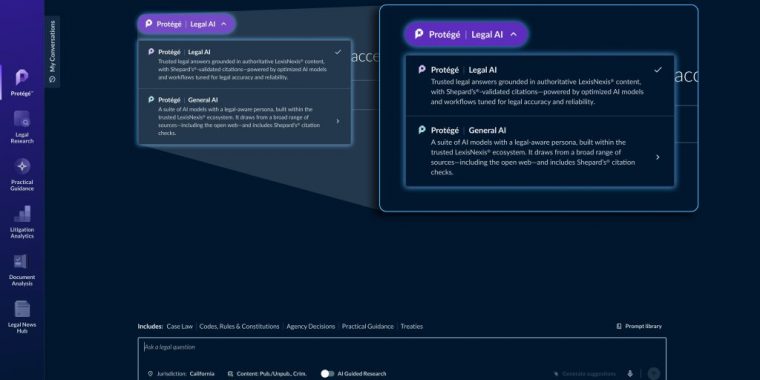
LexisNexis
Legal
&
Professional
today
introduced
Protégé
General
AI,
expanding
its
artificial
intelligence
platform
to
include
secure
access
to
multiple
general-purpose
AI
models
alongside
its
existing
legal-specific
AI
tools.
This
eliminates
the
need
to
switch
contexts
between
legal-specific
and
general-purpose
AI
tools
and
provides
a
higher
degree
of
security
when
using
the
general
tools.
Launched
as
a
preview
version
for
U.S.
customers,
it
allows
legal
professionals
to
access
models
including
OpenAI’s
GPT-5,
GPT-4o,
and
o3,
as
well
as
Anthropic’s
Claude
Sonnet
4,
all
within
the
company’s
existing
Lexis+
AI
workflow.
Users
can
switch
between
general-purpose
and
legal-specific
AI
with
a
toggle
function.
The
new
general
AI
capability
works
alongside
Protégé
Legal
AI,
which
uses
multiple
legal-tuned
models
including
GPT-4o,
GPT-4.1,
Claude
3.7,
Claude
4,
fine-tuned
GPT-4o-mini,
and
fine-tuned
Mistral.
The
legal
AI
version
grounds
responses
in
LexisNexis
legal
content
and
validates
citations
through
Shepard’s
citation
service.
Protégé
General
AI
draws
from
open-web
sources
and
is
designed
for
tasks
including
research,
drafting
communications
for
both
legal
and
non-legal
audiences,
and
breaking
down
complex
problems.
The
system
includes
a
Shepard’s
Citation
Agent
that
checks
legal
sources
included
in
general
AI
responses.
Different
Models,
Different
Strengths
According
to
LexisNexis,
each
general
AI
model
offers
specific
strengths
when
used
for
legal
work:
GPT-5
combines
general
and
domain
knowledge
with
reasoning
and
non-reasoning
capabilities.
Claude
Sonnet
4
offers
a
natural
fluency
that
provides
well-structured
responses
for
everyday
tasks,
communications
and
brainstorming.
GPT-4o
is
good
for
everyday
tasks
such
as
general
exploration,
brainstorming,
and
web-based
information
integration.
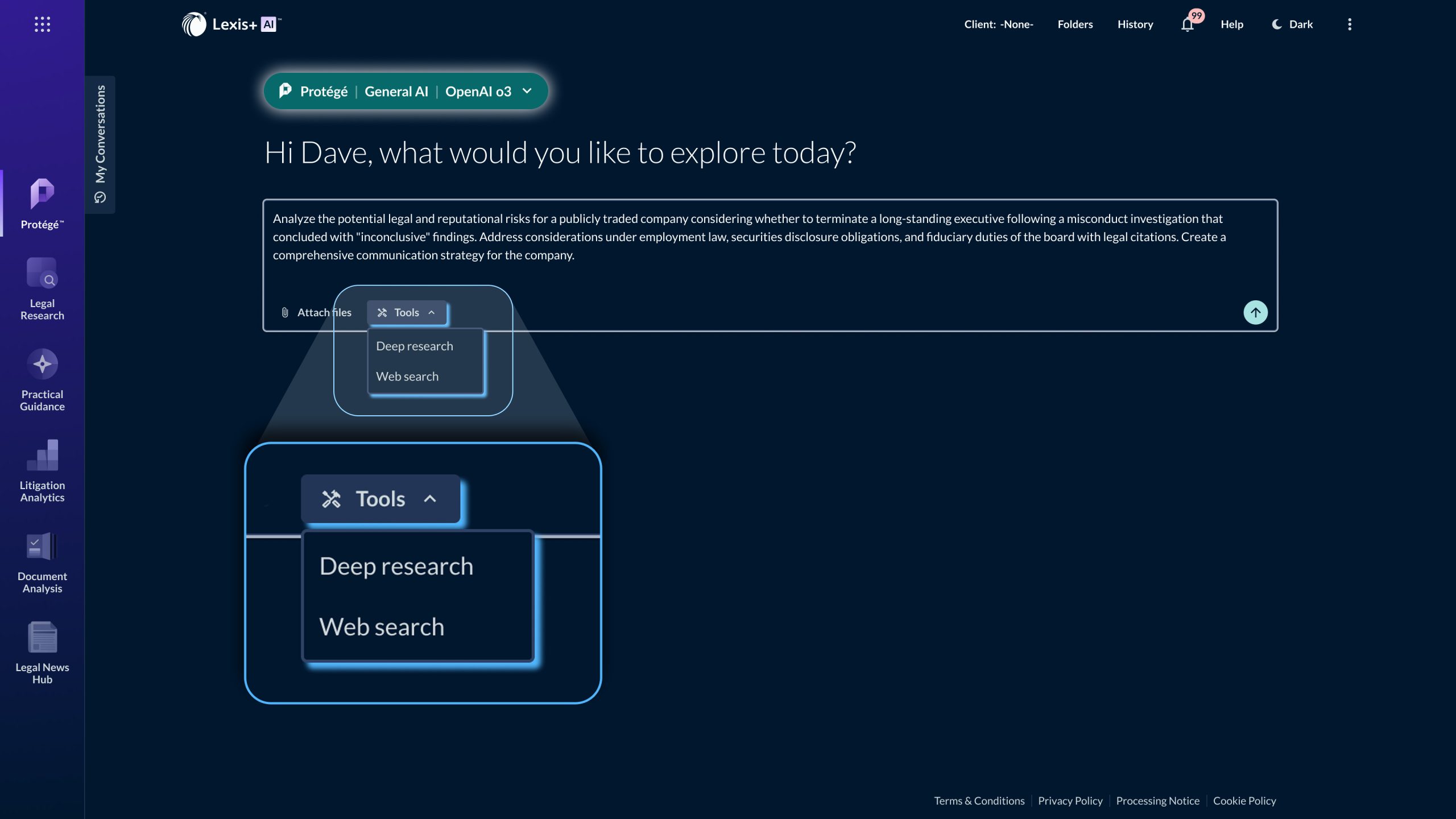
OpenAI
o3
optimizes
for
deep
research,
strategic
decision-making,
and
complex
problem-solving.
Agentic
AI
Framework
Meanwhile,
Protégé
Legal
AI,
built
on
the
proprietary
LexisNexis
agentic
AI
framework,
provides
agentic
workflows
specifically
developed
for
legal
work.
One
of
these,
the
AI
Guided
Research
Workflow,
includes
an
Orchestrator
Agent
that
breaks
down
complex
queries,
a
Legal
Research
Agent
that
allows
real-time
user
guidance,
and
a
Reflection
Agent
that
reviews
final
responses.
Some
agents
function
as
generalists
for
research
and
legal
questions,
while
others
specialize
in
specific
tasks
like
contract
review
and
citation
checking.
The
system
operates
within
LexisNexis’s
encrypted
environment,
which
the
company
says
provides
enhanced
privacy
protections
compared
to
consumer
AI
tools.
Organizations
can
disable
general
AI
access
entirely
for
users,
and
individual
users
can
toggle
the
feature
on
or
off.
Sean
Fitzpatrick,
CEO
of
LexisNexis
North
America,
UK,
&
Ireland,
said
the
development
responds
to
customer
requests
for
secure
access
to
general-purpose
models
while
maintaining
control
over
AI
behavior
within
legal
workflows.
“Our
goal
is
to
support
legal
professionals
with
a
personalized
AI
assistant
that
enables
uninterrupted
workflows
and
access
to
the
full
range
of
LexisNexis
AI
capabilities
in
one
secure
place,”
he
said.
Preview
Program
Approximately
200
law
firms,
corporate
legal
departments,
and
law
schools
are
participating
in
the
customer
preview
program,
which
has
already
begun.
General
availability
is
expected
later
this
year.
The
development
represents
LexisNexis’s
continued
expansion
of
AI
capabilities,
building
on
agentic
AI
innovation
the
company
has
been
developing
since
2024.
The
company
says
that
it
employs
over
2,000
technologists,
data
scientists,
and
legal
experts
in
its
AI
development
efforts.
LexisNexis
partners
with
AWS,
Anthropic,
Microsoft,
Mistral,
and
OpenAI
for
its
multi-model
approach,
which
selects
different
AI
models
based
on
specific
use
cases.
Ed.
note:
Please
welcome
Vivia
Chen
back
to
the
pages
of
Above
the
Law.
Subscribe
to
her
Substack,
“The
Ex-Careerist,”here.
CONTRARY
TO
WHAT
YOU’VE
BEEN
FORCED-FED
by
the
likes
of
JD
Vance,
it’s
not
those career-obsessed
cat
ladies who
are
the
culprits
behind
America’s
decline
in
birthrates.
The
truth
is
that
women
simply
are
having
fewer
children,
and
there’s
not
much
that
will
change
that
trend,
short
of
enforced
childbearing.
(Let’s
not
think
about
that
–
yet.)
It’s
happening
not
just
in
the
U.S.
but
throughout
the
world.
According
to
recent research
from
the
United
Nations,
the
average
woman
had
five
children
in
1960;
today
that
figure
is
2.2
–
the
lowest
number
recorded
thus
far.
And
in
the
U.S.,
that
number
is
even
lower
–
1.6
–
and
we
probably
haven’t
hit
bottom.
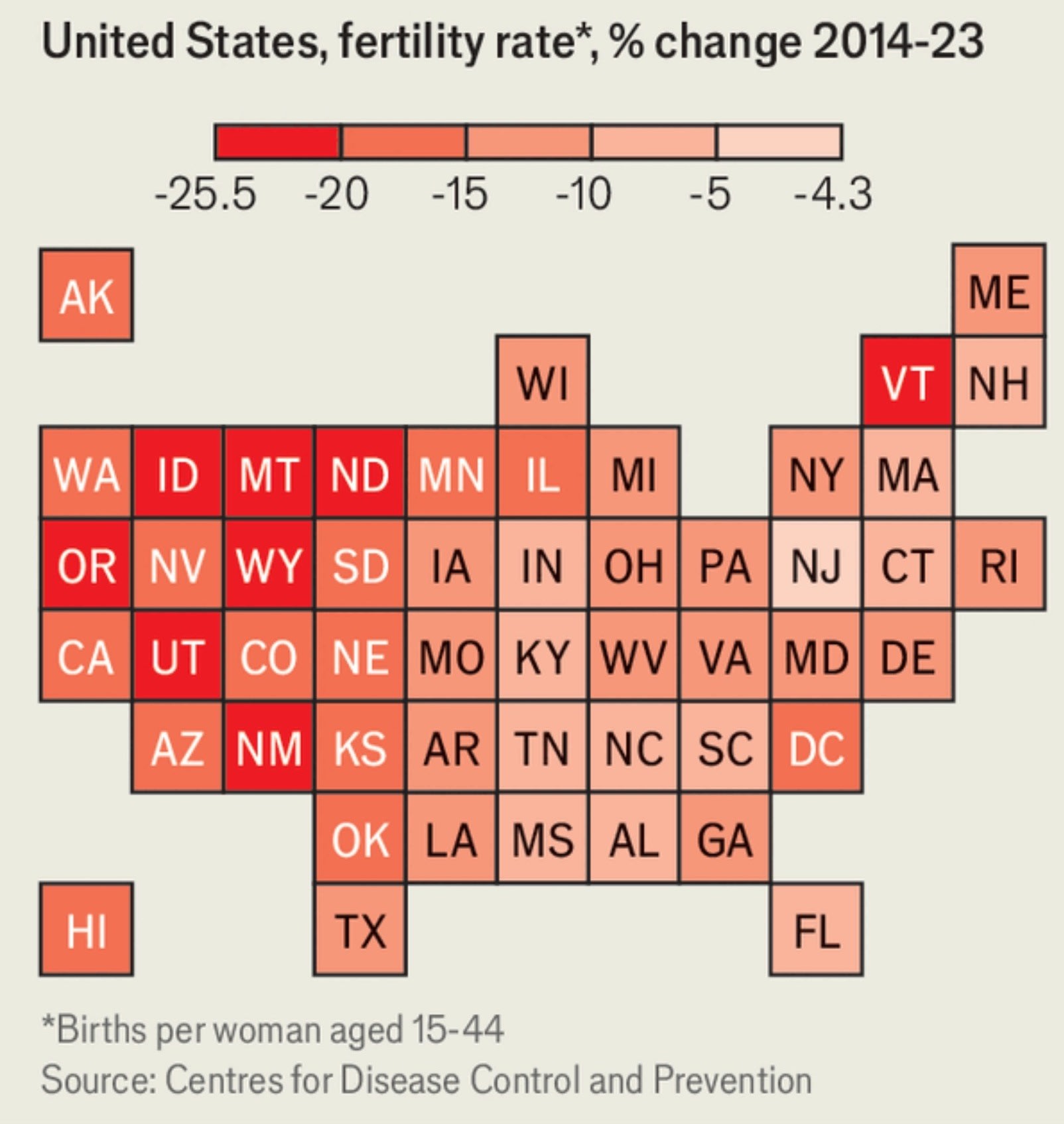
In
every
state
the
birthrate
is
falling,
though
New
Jersey
stands
out
for
having
the
smallest
decline.
(Is
New
Jersey
more
conducive
to
baby-making?)
Note
how
New
Jersey
stands
out
for
having
the
smallest
decline
in
birth
rate.
(chart:
The
Economist)
But
what
should
really
alarm
American
pro-natalists,
reports
The
Economist,
is
where
the
birthrate
is
falling
most
sharply:
Alaska,
North
Dakota,
and
Utah
–
states
that
have
been
historically
the
most
fertile.
“All
told,
states
that
had
above
average
fertility
rates
in
2014
are
responsible
for
more
than
80%
of
the
collapse
in
American
birth
rates
over
the
past
decade,”
notes
The
Economist.
That
means
you
can’t
rely
on
women
in
the
red
states to
pump
out
more
babies.
“Troublingly
for
such
policymakers,
the
recent
fall
in
birth
rates
is
concentrated
in
rural
parts
of
the
country
and
places
where
people
tend
to
have
less
education,”
says
The
Economist.
Even
in
a
place
like
religious
Utah,
women
aren’t
producing
babies
like
they
used
to.
“Whereas
in
2005
most
women
in
Utah
had
their
first
child
before
the
age
of
25,
today
fewer
than
one
in
four
do.”
So
what’s
causing
this
trend?
The
right
will
blame
bad
morals
(again,
cue
the
miserable,
selfish
career
gal),
while
the
left
will
point
to
the
lack
of
government
support
for
working
parents.
What
the
U.S.
offers
in
family
support
is
paltry (woefully
so,
compared
to
other
wealthy
countries),
but
will
better
benefits
fix
the
problem?
It’s
questionable.
Even
in
countries
with
generous
parental
leave,
subsidized
child
care,
and
free
education
and
health
care,
birthrates
remain
stubbornly
low.
Finland,
for
example,
offers
all
of
the
above,
yet
its
birthrate
hovers
around
1.3.
There’s
no
single
reason
for
this
trend
but
I
suspect
women’s
access
to
birth
control,
being
active
in
the
workforce
(also
connected
to
birth
control,
I
think)
and
just
having
more
autonomy
than
their
mothers
have
a
lot
to
do
with
it.
So
JD
Vance
can
issue
edicts
until
he
turns
purple
(“I
want
more
babies
in
the
United
States
of
America!”
he
hollered
at
an
anti-abortion
rally),
but
women
will
do
what
they
want.
Frankly,
I
don’t
see
anything
wrong
with
that.
Do
you?
Odds
and
Ends:
Americans
strongly
condemn
adultery
–
in
theory.According
to
Gallup,
a
whopping 89%
say
adultery is
“morally
wrong.”
(Only
8%
said
it
was
OK,
while
the
remainder
weren’t
sure.)
But
that
doesn’t
mean
Americans
aren’t
sinning.
According
to Techopedia,
16%
of
married
individuals
admit
to
cheating,
though
other
sources
put
that
figure
at
20%
to
40%.
(There’s
apparently
no
reliable
figure,
because,
well,
people
lie
about
cheating.)
But
the
real
kicker
is
that
Americans
top
the
league
table
of
countries
with
the
most
cheaters,
followed
by
Germany,
the
UK,
Brazil,
and
France.
How
is
it
possible
that
Italy
didn’t
make
that
list?
This
94-year
old
won’t
be
pushed
around
by
Trump. Remember
how
Trump
insisted
that
Rupert
Murdoch
be
deposed
ASAP
because
he
could
drop
dead
any
minute?
(The
prez
is
suing
Murdoch
for
defamation
for
publishing
a
recent
article
in
the
Wall
Street
Journal
that
alleged
Trump
had
sent
Epstein
a
raunchy
birthday
card
in
2003.)
Well,
Murdoch
won’t
be
sitting
for
any
deposition
unless
he’s
good
and
ready.
He
just
struck
a deal to
give
Trump
“a
sworn
declaration
describing
his
current
health
condition,”
plus
“regularly
scheduled
updates”
about
his
health,
that
postpones
his
deposition
until
goodness
knows
when.
A
personal
coda. Cameron
Stracher’s
recent
op-ed
in
New
York
Times,
“I
Helped
Bury
Stories
About
Trump.
I
Regret
It,”
stopped
me
in
my
tracks.
I
worked
with
Stracher
at
The
American
Lawyer
in
the
early
2000s
and
liked
him.
But
in
2018,
I
learned
that
he
was
part
of
the
legal
machinery
that
buried
unfavorable
stories
about
Trump’s
various
sexual
liaisons.
At
the
time,
he
was
general
counsel
of
American
Media,
the
owner
of
The
National
Enquirer.
So
I
wrote
a
critical
post
(“The
Lawyer
as
Pimp”)
about
lawyers
who
cleaned
up
after
Trump,
and
I
mentioned
Stracher’s
role.
He
didn’t
take
kindly
to
my
post
and
threatened
to
sue
me.
But
apparently,
he
had
doubts
all
along.
That’s
a
relief.
Vivia
Chen writes “The
Ex-Careerist” column
on
Substack
where
she
unleashes
her
unvarnished
views
about
the
intersection
of
work,
life,
and
politics.
A
former
lawyer,
she
was
an
opinion
columnist
at
Bloomberg
Law
and
The
American
Lawyer.
Subscribe
to
her
Substack
by
clicking
here:




 Kathryn