Law School Admission Council Accused Of Running A $30 Million ‘Pay-To-Play’ Racket – Above the Law

Most
people
think
of
the
Law
School
Admission
Council
as
the
nerds
who
write
the
LSAT.
The
folks
that
had
to
be
dragged
kicking
and
screaming
from

forcing
another
generation

to
answer
questions
like
“if
Peter
is
taller
than
Nancy
but
shorter
than
Steve,
what
color
is
Sally’s
shirt?”
But
a
newly
filed
antitrust
class
action,
looks
beyond
the
LSAT
and
accuses
the
organization
of
skimming
fees
like
it’s
running
the
only
ATM
in
Vegas.

Back
in
the
day,
prospective
law
students
took
the
LSAT
and
then
bundled
up
their
own
law
school
applications.
These
days,
LSAC
isn’t
just
running
the
test,
it’s
helpfully
operating
as
the
clearinghouse
for
everyone’s
applications.
Send
in
your
materials
and
pick
your
schools
and
LSAC
tackles
the
rest.

Except
that
process
is
expensive
and,
according
the
the
complaint
filed
in
the
Eastern
District
of
Pennsylvania,
a
rent-seeking
affair
extracting
cash
from
prospective
law
students
by
virtue
of
being
the
only
game
in
town.

“In
2025,
more
than
60,000
aspiring
law
students
submitted
more
than
500,000
applications
to
law
schools,”
the
complaint
begins.
“Most
paid
application
fees
to
schools
that
cost
up
to
$105
per
school.”
But
wait!
This
does
not
include
the
“Credential
Assembly
Service,”
LSAC’s
application
clearinghouse.
Before
the
student
even
gets
to
the
$105

for
the
school
,
they
have
to
shell
out
“a
$215
mandatory
subscription
fee
and
a
$45
per
report
fee”

to
LSAC
.

Which
seems
like
a
lot
for
something
branded
as
mere
“Assembly.”
For
a
typical
applicant
applying
to
10
schools,
that’s
over
$600
straight
to
LSAC,
before
a
single
admissions
dean
has
the
chance
to
passive-aggressively
reject
you.
At
least
the
school
is
theoretically
charging
so
they
can
pay
those
admissions
deans
several
multiples
more
than
the
actual
faculty.
By
contrast,
$600
feels
extreme
for
a
glorified
“forward
email”
button.
In
fact,
undergraduate
admissions
run
on
a
similar
clearinghouse
system
that
charges
schools
a
$2,500
flat
fee
per
year,
about
4
bucks
per
application
and
a
$2.00
payment
processing
fee

the
applicants
only
pay
the
school’s
own
fee.

That’s
the
sort
of
apples
to
apples
comparison
that
raises
at
least
a
few
competitiveness
questions.
On
the
other
side
of
equation,
business
schools
have
no
clearinghouse
at
all
and
while
that
increases
the
costs
associated
with
each
individual
school,
the
most
competitive
schools
are
still
only
charging
around
$250
with
most
coming
in
far,
far
lower.

According
to
its
public
tax
filings,
LSAC

collected
$93
million
in
Credential
Assembly
Service
fees

over
just
the
last
three
reported
years.
LSAC
boasts
around
$250
million
in
net
assets
and
a
CEO
making
over
$1
million
a
year.
It
seems
bold
to
pay
hedge-fund
money
to
forward
a
resume.

LSAC
is
a
separate
legal
entity
from
the
Member
Law
Schools.
LSAC
has
conspired
along
with
the
Member
Law
Schools
to
fix
the
price
of
these
fees
for
its
Law
School
Application
Platform.
LSAC
benefits
from
the
supracompetitive
profits
it
earns
from
the
price-fixed
fees,
using
that
to
build
up
more
than
$250
million
in
net
assets,
pay
its
executives
lavishly
for
a
nonprofit,
and
kickback
money
to
the
Member
Law
Schools.

Applicants
have
little
choice
because
LSAC
runs
everything.
And
since
the
schools
get
LSAC’s
back-end
“Unite”
admissions
platform
for
free,
they
have
no
incentive
to
shop
around
or
pass
on
savings.
Everyone
wins!

Except,
the
complaint
argues,
the
applicants.


(Complaint
on
the
next
page…)



HeadshotJoe
Patrice
 is
a
senior
editor
at
Above
the
Law
and
co-host
of

Thinking
Like
A
Lawyer
.
Feel
free
to email
any
tips,
questions,
or
comments.
Follow
him
on Twitter or

Bluesky

if
you’re
interested
in
law,
politics,
and
a
healthy
dose
of
college
sports
news.
Joe
also
serves
as
a

Managing
Director
at
RPN
Executive
Search
.

Partner At Top Biglaw Firm Reportedly Dies By Suicide – Above the Law

(Image
via
Getty)

We
have
some
tragic
news
to
report
from
China,
where
an
accomplished
Biglaw
partner
is
suspected
to
have
died
by
suicide.

According
to

Law.com
International
,
Brian
Schwarzwalder,
54,
a
corporate
partner
in
Gibson
Dunn’s
Hong
Kong
office,
reportedly
took
his
own
life
earlier
this
week.
As
noted
by
the
South
China
Morning
Post,
police
have
classified
as
the
death
as
“person
fallen
from
a
height.”
Law.com
has
additional
information
on
his
untimely
death:

Schwarzwalder’s
body
was
reportedly
found
in
the
early
hours
of
August
5,
2025,
during
a
severe
rainstorm
on
Kennedy
Road
in
the
Mid-Levels—an
affluent
residential
area
in
the
city.
He
was
certified
dead
by
paramedics
at
the
scene,
the
reports
said.

His
body
was
identified
by
his
domestic
helper,
following
which
a
suicide
note
was
also
found,
local
reports
said.

A
memoriam
passage
on

Schwarzwalder’s
firm
bio

now
reads
as
follows:
“Brian
was
a
beloved
member
of
the
Gibson
Dunn
community.
At
this
difficult
time,
our
thoughts
are
with
his
family,
as
well
as
with
the
many
colleagues
who
worked
with
Brian
over
the
years.
He
will
be
greatly
missed.”

If
you
or
someone
you
know
is
depressed
and
in
need
help,
please
call
the
National
Suicide
Prevention
Lifeline
(1-800-273-8255)
or
lawyer
assistance
program
 in
your
state
(don’t
be
fooled
by
the
name;
these
programs
also
provide
services
to
law
students).
Remember
that
you
are
loved,
so
please
reach
out
if
you
need
assistance.

We
here
at
Above
the
Law
extend
our
condolences
to
Brian
Schwarzwalder’s
family,
friends,
and
colleagues
during
this
extremely
challenging
time.


Gibson
Dunn
Hong
Kong
Corporate
Partner
Dies
in
Suspected
Suicide

[Law.com
International]


Staci Zaretsky


Staci
Zaretsky
 is
the
managing
editor
of
Above
the
Law,
where
she’s
worked
since
2011.
She’d
love
to
hear
from
you,
so
please
feel
free
to

email

her
with
any
tips,
questions,
comments,
or
critiques.
You
can
follow
her
on BlueskyX/Twitter,
and Threads, or
connect
with
her
on LinkedIn.

Regional Differences In Practicing Law – Above the Law

Many
attorneys
practice
law
in
multiple
states,
since
clients
often
like
to
use
the
same
lawyers
to
handle
as
many
matters
as
possible.
Today,
it
is
relatively
easy
to
begin
practicing
law
in
different
jurisdictions
since
many
states
have
reciprocity
and
do
not
require
bar
candidates
to
sit
for
an
additional
bar
exam.
Once
a
lawyer
is
admitted
to
practice
in
a
new
jurisdiction,
there
may
be
a
learning
curve
before
that
attorney
learns
all
of
the
local
customs
and
practices
particular
to
legal
professionals
of
that
jurisdiction. Although
there
are
many
differences
in
practicing
law
between
jurisdictions,
I
have
seen
a
few
interesting
differences
in
my
own
practice.


Names
For
Lawyers

I
started
my
legal
career
handling
mostly
litigation
matters
filed
in
New
York. In
that
state,
some
lawyers
call
each
other
“counselor,”
but
most
lawyers
and
paralegals
do
not
use
any
kind
of
honorific. While
working
on
a
few
matters,
I
needed
to
work
with
lawyers
who
were
admitted
to
practice
in
some
New
England
states. Legal
professionals
in
such
jurisdictions
may
refer
to
a
lawyer
as
“Attorney
____”
so
I
would
be
referred
to
as
“Attorney
Rothman”
which
would
be
weird
to
say
in
New
York,
New
Jersey,
and
I’m
betting
a
number
of
other
jurisdictions. Ultimately,
the
greeting
makes
sense,
and
I
call
coaches,
members
of
the
clergy,
and
other
professionals
by
their
job
followed
by
their
last
name.
I
just
was
not
used
to
this
practice
being
applied
to
lawyers.

In
many
jurisdictions,
it
is
common
to
affix
“Esq.”
(short
for
“Esquire”)
after
someone’s
name
if
they
are
licensed
to
practice
law. 
Interestingly,
legal
professionals
in
some
states,
such
as
Pennsylvania,
are
more
apt
to
spell
out
the
entire
title
of
“Esquire”
rather
than
abbreviate.
Ultimately,
this
is
a
small
difference,
but
it
is
something
to
keep
in
mind
if
a
lawyer
wants
to
fit
in
while
practicing
law
in
a
different
jurisdiction.


Different
Lexicon

Many
states
use
modern
words
to
discuss
legal
practice,
and
indeed,
the
Federal
Rules
of
Civil
Procedure
also
use
modern
words
like
motion,
stay,
clerk,
and
others
to
discuss
legal
procedures. However,
some
jurisdictions
use
downright
antiquated
words
to
describe
the
legal
profession. In
the
past
few
years,
I
have
had
to
look
up
what
prothonotary,
praecipe,
supersedeas,
and
other
terms
were
since
I
am
more
used
to
the
modern
definitions
for
this
somewhat
antiquated
language.
Of
course,
it
is
easy
enough
to
research
what
these
words
mean,
but
a
lawyer
entering
a
jurisdiction
for
the
first
time
should
know
the
relevant
lingo
so
that
they
can
look
more
experienced
when
serving
clients.


Efiling
Systems

People
who
practice
in
federal
courts
are
lucky
when
it
comes
to
efiling
documents. Federal
courts
use
one
unified
efiling
system
for
all
federal
jurisdictions
across
the
country,
and
this
system
has
been
in
place
for
decades. States
were
late
to
the
game
in
adopting
statewide
efiling
systems,
but
many
states
now
have
one
efiling
system
that
lawyers
can
use
to
efile
documents
in
courts
in
those
states. However,
some
states
still
have
decentralized
efiling
systems. Indeed,
I
recently
had
to
file
a
document
for
a
lawsuit
in
a
state
in
which
each
individual
county
has
its
own
efiling
system. It
was
somewhat
annoying
to
research
the
efiling
system
for
a
particular
court,
sign
up
for
access,
and
ensure
that
documents
were
properly
filed. Practitioners
should
not
expect
that
they
can
use
one
statewide
system
to
efile
documents
in
a
particular
jurisdiction.

In
any
case,
lawyers
often
need
to
expand
their
practices
to
different
jurisdictions
to
better
serve
clients. Attorneys
practicing
in
different
jurisdictions
should
keep
in
mind
that
practices
may
differ
between
jurisdictions.


Jordan
Rothman
is
a
partner
of 
The
Rothman
Law
Firm
,
a
full-service
New
York
and
New
Jersey
law
firm.
He
is
also
the
founder
of 
Student
Debt
Diaries
,
a
website
discussing
how
he
paid
off
his
student
loans.
You
can
reach
Jordan
through
email
at 
jordan@rothman.law.

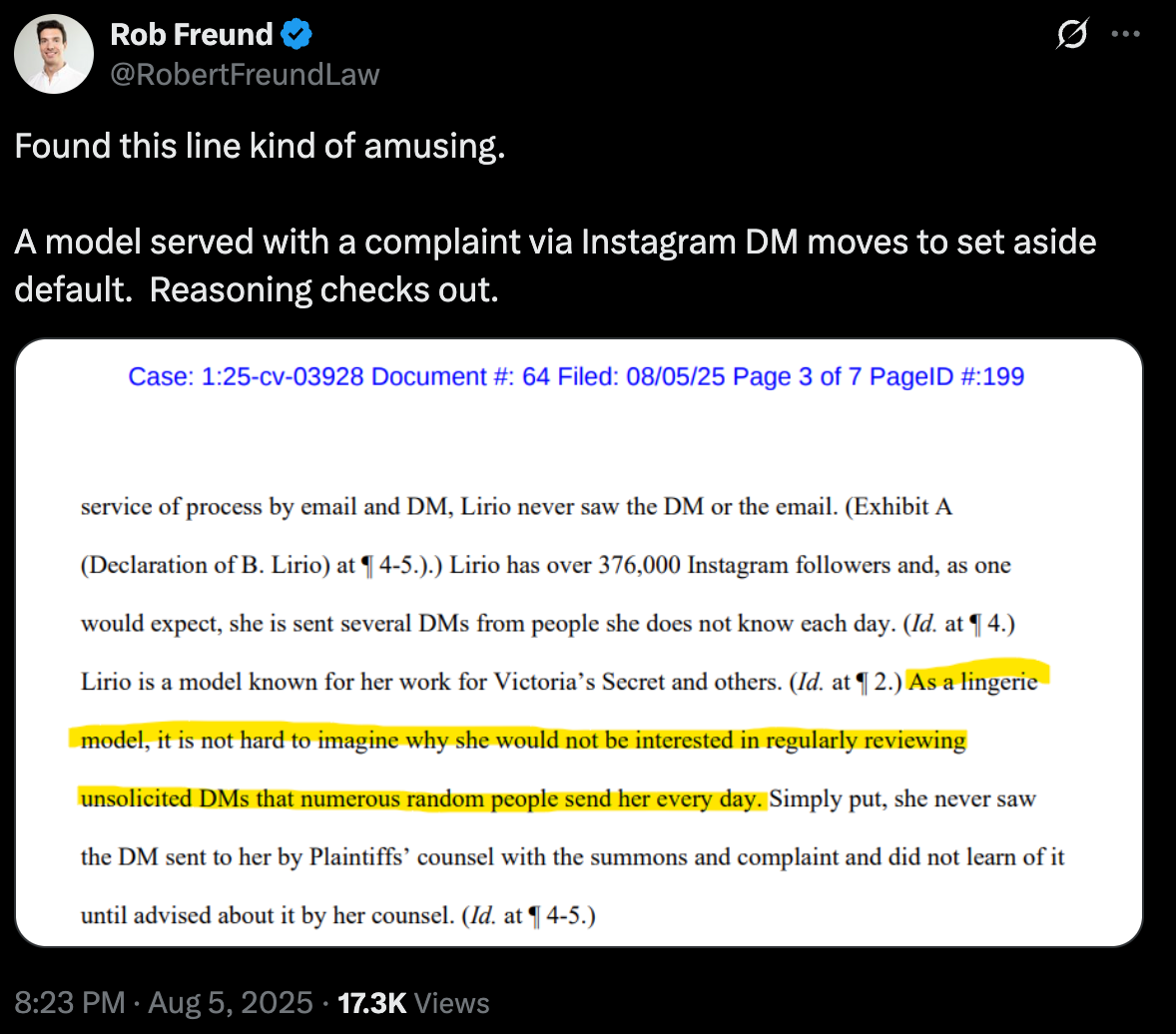
The ‘Slide Into Her DMs’ Rule Of Service For Civ Pro Buffs – Above the Law

Bruna
Lírio
(Photo
by
Rachpoot/Bauer-Griffin/GC
Images)

Move
over
Mailbox
Rule,
there’s
a
new
theory
of
service
out
there.

The
plaintiffs
in

Sulici
and
Chihaia
v.
Color
Image
Apparel
et
al.

purported
to
serve
defendant
Bruna
Lírio
by
depositing
the
complaint
in
her
Instagram
DMs.
When
Lírio
failed
to
respond,
the
Northern
District
of
Illinois
entered
default
judgment
against
her.

She’s
now
challenging
the
default
asking
for
more
time
to
respond
to
the
complaint

and
the
plaintiffs
aren’t
contesting.

It
might
seem
odd
for
plaintiffs
to
concede
a
default
this
easily,
but
it’s
probably
because
Lírio’s
reasoning
seems
pretty
sound:


Nestled
between
gooner6969420’s
“U
R
so
hot!!”
and
patrioteagle4547’s
“go
back
where
you
came
from”
is
not
the
optimal
location
for
a
summons.
Are
DMs
presumptively
an
improper
avenue
of
service
or
should
the
exclusion
be
limited
to
public
figures
dealing
with
various
levels
of
online
harassment?
Should
it
matter
how
vile
and
therefore
reasonably
ignored
a
person’s
DMs
are?
Seems
like
a
final
exam
hypo.

It’s
actually
unclear
why
anyone
would
think
a
model
spends
her
day
meticulously
scanning
her
messages
for
insightful
conversation,
but
the
case
is
about
social
media
so
maybe
it
seemed
apropos.

The
class
action
complaint
alleges
that
ALO
Yoga
deceptively
marketed
its
goods
through
undisclosed
relationships
with
influencers
like
Lírio.
The
FTC
is
pretty
adamant
about
covert
advertisements
on
social
media…
or
at
least
they
were
before
the
current
administration
started

firing
commissioners

and
selling
memecoin
from
the
Oval
Office.
Using
one’s
personal
brand
to
hawk
garbage
on
an
unsuspecting
public
is

the
whole
Trump
business
plan

so
it’s
hard
to
imagine
those
rules
hold
up.
Still,
the
plaintiffs
have
claims
that
sound
in
state
consumer
laws
and
general
common
law
principles.

For
what
it’s
worth,
Lírio
also
received
service
via
her
email
inbox,
though
that’s
also
a
business
account
she
doesn’t
monitor,
leaving
it
to
an
assistant
to
flag
important
messages.
Honestly,
“you’re
being
sued”
probably
should’ve
trickled
up
through
that
process,
but
the
plaintiffs
aren’t
pressing
the
issue.

At
least
no
one
tried
to
serve
her
over
LinkedIn.
What
kind
of
psychopath
checks
that
daily?


HeadshotJoe
Patrice
 is
a
senior
editor
at
Above
the
Law
and
co-host
of

Thinking
Like
A
Lawyer
.
Feel
free
to email
any
tips,
questions,
or
comments.
Follow
him
on Twitter or

Bluesky

if
you’re
interested
in
law,
politics,
and
a
healthy
dose
of
college
sports
news.
Joe
also
serves
as
a

Managing
Director
at
RPN
Executive
Search
.

DOJ Has Lost So Many Lawyers It Might Not Have Enough Left To Help Trump Destroy America – Above the Law

First,
the
Trump
administration gutted
the
DOJ’s
Civil
Rights
Division
,
probably
because
it
was too concerned
about
protecting
constitutional
rights.
Whoever
still
remained
was
“allowed”
to
do
whatever
Trump’s
DOJ
(now
headed
by
yet
another
regrettable
Trump
pick, Pam
Bondi
)
wanted
it
to
do…
like
go
to
bat for
the Second
Amendment
,
which
has
never
been
seriously
threatened
by
anyone
anywhere
since
its
inception.

Whoever
didn’t
get
fired
for
not
being
all-MAGA,
all
the
time
decided
it
was
time
to
call
it
a
career.
Anyone
who
forgot
to
lie
to
courts
or
failed
to
push
abject
bullshit
past
federal
judges was
shown
the
door
.
And
with
the
Civil
Rights
division
(or
CRT
in
DOJ
parlance)
down
to
just
the
Trump
loyalists,
it
would
have
made
sense
to
do
as
little
as
possible
with
these
extremely
limited
resources.

But
Trump
wants
more
stuff
to
be
done
and
he’s
quickly
running
out
of
people
with
the
civil
rights
litigation
experience
to
do
it, as
Eric
Katz
reports
for
Government
Executive
.


The
Justice
Department
is
soliciting
staff
within
its
Civil
Rights
Division
to
take
reassignments
to
fill
vacancies
in
areas
related
to
education,
employment
and
voting,
with
leaders
citing
the
“deep
need”
created
by
significant
vacancies. 


The
requests
come
as
the
division
has
shed
hundreds
of
employees—or
more
than
60%
of
its
workforce—since
January
and
the
Trump
administration
has
assigned
attorneys
to
tackle
new
priorities.
The
department
is
now
scrambling
to
fill
vacancies
it
has
incentivized
employees
to
leave
through
the
extended
paid
leave
program
known
as
“deferred
resignations,”
early
retirement
and
other
offers. 

Obviously,
this
has
nothing
to
do
with
a
suddenly
renewed
interest
in
investigating
abusive
law
enforcement
agencies
or
otherwise
trying
to
restore
and
uphold
a
whole
lot
of
severely
bruised
civil
rights.
No,
this
scramble
for
litigators
is
entirely
propelled
by
the
Trump
administration’s
undying
interest
in
making
America
worse
again.

This
version
of
the
DOJ
CRT
is
missing
nearly
three-quarters
of
its
legal
team
thanks
to
Trump.
And
somehow
the
DOJ
thinks
the
priorities
of
the
Trump
administration
will
attract
some
litigators
who
have
left
as
well
as
convince
others
doing
less
heinous
things
(maybe!)
this
shift
in
focus
will
be
good
for
their
careers,
even
if
it
won’t
do
much
for
their
souls.

The
head
of
CRT,
Harmeet
Dhillon,
has
a
list
of
priorities
that
all
sound
pretty
good
in
theory:
education,
employment,
and
voting.
In
practice,
it’s
an
absolute
horror
show.


In
May,
for
example,
Deputy
Attorney
General
Todd
Blanche
created
the
Civil
Rights
Fraud
Initiative
to
investigate
any
recipient
of
federal
funds
that
promotes
diversity,
equity
and
inclusion,
allows
antisemtism—which
the
administration
has
increasingly
defined
as
college
campuses
that
enable
protests
against
the
Israeli
government—supports
transgender
women
playing
women’s
sports
or
other
perceived
violations
of
administration
policy. 


[…]


Under
its
new
mission
statement,
the
voting
section
is
now
focused
on
ensuring
accurate
voter
databases
and
eliminating
fraud.
Sen.
Peter
Welch,
D-Vt.,
said
in
report he
issued
last
week
on
the
changes
taking
place
at
CRT
that
the
section
has
gone
“from
protecting
voting
rights
to
restricting
voting
access.”
The
employment
section
has
recently
shifted
away
from
pursuing
cases
in
which
organizations
allegedly
engaged
in
race-based
pay
discrimination. 

Yep,
these
positions
are
open
to
anyone
willing
to
help
the
DOJ
censor
students,
mistreat
transgender
kids,
support
voter
suppression
efforts,
and
let
companies
get
away
with
paying
people
less
just
because
they
aren’t
white.

There’s
nothing
involving
civil
rights
happening
here,
at
least
not
in
a
positive
way.
Instead,
the
DOJ
is
hoping
there
are
still
enough
lawyers
left
in
the
building
to
assist
Trump
in
ideological
lawfare
efforts
that most voters

even
many
of
his
own

don’t
support.

This
is
an
entire
administration
consumed
with
a
undying
passion
for
punching
down.
No
one
here
is
seeking
to
elevate
anyone
but
themselves.
The
only
thing
we
might
be
able
to
enjoy

at
least
for
the
time
being

is
that
they’ve
fired
so
many
people
they
don’t
have
enough
people
left
to
help
them
with
their
punching.


DOJ
Has
Lost
So
Many
Lawyers
It
Might
Not
Have
Enough
Left
To
Help
Trump
Destroy
America


More
Law-Related
Stories
From
Techdirt:


Middle
School
Cheerleaders
Made
A
TikTok
Video
Portraying
A
School
Shooting.
They
Were
Charged
With
A
Crime.


DOJ
Files
Frivolous
Misconduct
Complaint
Against
Judge
For…
Doing
His
Job
And
Being
Right
About
Government
Lawlessness


Trump
Admin
Warns
States
They’ll
Lose
Billions
In
Broadband
Grants
If
They
Try
To
Make
Broadband
Affordable


Australia
Completely
Loses
The
Plot,
Plans
To
Ban
Kids
From
Watching
YouTube

Elite Law Firm Wows Associates With Market-Beating Summer Bonuses – Above the Law

After
months
of
speculation
amid
an
uncertain
economy,
it
looks
like
it’s
going
to
be
a
hot
bonus
summer
after
all!
First
came
boutique
firm

Vartabedian
Hester
&
Haynes
,
followed
by
midsize
firm

Otterbourg
,
and
last
but
certainly
not
least,

Milbank
.
We
wondered
if
any
other
firms
would
step
up
to
match
(or
beat)
the
Biglaw
firm,
and
the
answer
is
a
resounding
yes.

Prominent
California
boutique
firm
Hueston
Hennigan
has
announced
that
it
will
be
awarding
associates
with
summer
bonuses
ranging
from
$10,000
to
$30,000,
regardless
of
class
year.
This
means
that
associates
at
the
firm
are
eligible
to
receive
bonuses
that
top
any
of
the
other
summer
bonus
scales
that
have
been
announced.
Staff
at
the
firm
will
also
be
receiving
bonuses.

Attorneys
at
the
firm
must
be
on
track
to
bill
at
least
2,000
hours
to
be
eligible
to
receive
a
bonus,
and
like
at
most
firms,
more
hours
equals
more
money.
For
example,
those
on
track
for
2,400
hours
will
receive
a
$20,000
bonus,
while
those
on
track
to
hit
2,700
hours
will
receive
a
$30,000
bonus.

Hueston
Hennigan
is
the
first
major
firm
we
know
of
to
have
announced
summer
bonuses
in
Milbank’s
wake.
What
does
this
mean
for
the
rest
of
the
Biglaw,
midsize,
and
boutique
firms
that
are
always
so
eager
to
match
the
compensation
offered
by
market
leaders?
Should
we
be
expecting
another
round
of
bonus
announcements
sometime
soon?
All
we
know
is
that
it’s
time
for
associates
to
cross
their
fingers
and
hope
for
a
special
summer
surprise
in
the
form
of
cold,
hard
cash.

Congratulations
to
everyone
at
Hueston
Hennigan!

Remember
everyone,
we
depend
on
your
tips
to
stay
on
top
of
this
stuff.
So
when
your
firm
matches,
please
text
us
(646-820-8477)
or email
us
 (subject
line:
“[Firm
Name]
Summer
Bonuses”).
Please
include
the
memo
if
available.
You
can
take
a
photo
of
the
memo
and
send
it
via
text
or
email
if
you
don’t
want
to
forward
the
original
PDF
or
Word
file.

And
if
you’d
like
to
sign
up
for
ATL’s
Bonus
Alerts
(which
is
the
alert
list
we’ll
also
use
for
salary
announcements),
please
scroll
down
and
enter
your
email
address
in
the
box
below
this
post.
If
you
previously
signed
up
for
the
bonus
alerts,
you
don’t
need
to
do
anything.
You’ll
receive
an
email
notification
within
minutes
of
each
bonus
announcement
that
we
publish.


Staci Zaretsky


Staci
Zaretsky
 is
the
managing
editor
of
Above
the
Law,
where
she’s
worked
since
2011.
She’d
love
to
hear
from
you,
so
please
feel
free
to

email

her
with
any
tips,
questions,
comments,
or
critiques.
You
can
follow
her
on BlueskyX/Twitter,
and Threads, or
connect
with
her
on LinkedIn.

The Blickstein COO Study Reflects Continued Lawyer Hubris, Arrogance, Independence – And Dread – Above the Law

The
new
Blickstein
Group
COO
Study
demonstrates
continued
lawyer
hubris,
arrogance,
and
independence
that
impairs
job
satisfaction

and
profitability.

The
July

Law
Firm
COO
Survey

gathered
responses
from
COOs
about
law
firm
operations,
AI
adoption,
compensation,
and
business
challenges.
The

Blickstein
Group

is
a
legal
industry
research
and
consulting
firm.


Two
Key
and
Related
Points

Two
points
among
many
stood
out
to
me
as
a
former
partner
in
a
large
law
firm.
Both
points
reflect
law
firm
culture
and
are
related.

Point
1:
COOs
see
law
firm
partners
as
the
biggest
obstacle
to
implementing
change.
In
other
words,
law
firm
partners
are
ignoring
change
recommendations
by
their
COOs.

Point
2:
COOs,
who
if
given
the
opportunity,
can
be
extremely
valuable
to
a
law
firm
since
they
are
business
people,
not
lawyers,
and
understand
business
issues
like
finance,
talent,
marketing,
and
operations.
But
many
firms
don’t
value
their
COOs,
don’t
include
them
in
strategic
discussions,
don’t
provide
clear
lines
of
authority,
and
undercut
them.
COOs
at
these
firms
are
often
dissatisfied
and
prone
to
leave.

Given
their
understanding
of
business
and
particularly
the
business
of
law
firms,
talented
COOs
can
bring
significant
value
to
law
firms
(translated,
help
them
make
more
money).
So,
you
would
think
law
firms
would
value
their
judgment,
compensate
them
well,
and
treat
them
as
C-suite
partners.

Indeed,
COOs
who
work
at
firms
where
they
manage
most
if
not
all
of
the
administrative
functions,
where
they
report
to
the
managing
partner,
and
have
a
meaningful
seat
at
the
executive
committee
are
the
happiest
and
most
likely
to
stay.
Firms
that
don’t
include
these
things
are
missing
out
and
are
at
an
obvious
competitive
disadvantage.

Bottom
line,
law
firms
that
resist
change
recommendations
of
their
COOs
and
who
treat
COOs
as
second-class
citizens
fail
to
capture
the
advantages
of
keen
business
insight.
And
in
today’s
competitive
legal
market,
it
stands
to
reason
that
failure
places
them
at
a
short-
and
long-term
competitive
disadvantage.


But
Why?

The
most
important
question
is
why.
Why
do
firms
not
value
the
COOs
and
resist
what
they
say?

The
easy
answer
is
that
most
law
firms
are
still
run
under
a
consensus
model
that
affords
partners,
particularly
those
with
big
books
of
business,
considerable
independence.
To
say
that
managing
lawyers
is
like
herding
cats
is
an
insult
to
the
cats.

Adoption
of
change
in
law
firms
frequently
means
not
only
convincing
the
managing
partner
or
executive
committee,
it
means
convincing
most
every
partner
to
adopt
the
change.
Many
of
these
partners
are
incredibly
busy
and
have
neither
the
time,
experience,
nor
expertise
to
correctly
evaluate
business-related
recommendations
(which
is
why
they
should
of
course
rely
on
their
COO
and
administrative
staff.)
So,
they
fall
back
and
keep
doing
what
they
have
always
done.
Change
is
hard
and
if
they
don’t
personally
believe
it’s
needed,
they
don’t
do
it.


But
There
is
More

But
there
is
something
else
which
leads
into
why
law
firms
don’t
treat
COOs
as
full
partners
in
business-related
decision
making.
Most
smart
people
(and
partners
in
law
firms
for
the
most
part
are
smart
people),
when
faced
with
decisions
for
which
they
have
neither
the
time
nor
expertise
to
make
a
valid
judgment,
rely
on
those
who
do
have
the
time
and
expertise
to
make
sound
recommendations.

We
all
do
it
every
day.
When
we
are
sick,
we
go
to
the
doctor.
Why?
Because
they
do
have
the
time
and
knowledge
to
make
a
recommendation
what
to
do.
The
same
is
true
for
virtually
any
field.

Lawyers?
Particularly
when
it
comes
to
business-related
decisions,
many
aren’t
so
ready
to
adopt
and
rely
on
the
business
acumen
of
their
COOs.
Why?
Three
words:
hubris,
arrogance,
and
independence.

Lawyers
think
they
know
everything
to
begin
with.
And
when
it
comes
to
their
business,
their
law
firms
in
which
they
are
owners,
they
believe
that
only
they
can
make
valid
financial
decisions.
Those
“non-lawyers”
who
aren’t
owners
should
butt
out,
as
I
have

previously
discussed
.
As
one
of
my
partners
used
to
say
to
the
administrative
staff:
“You
work
for
me.
Don’t
tell
me
what
to
do.”
And
as
I
said
before,
the
ability
of
partners
to
retain
their
independence
enhances
this
hubris
and
arrogance.


One
More
Thing…

There
may
be
another
factor
at
play
as
well:
the
innate
stubborness
and
resistance
to
change
many
lawyers
have.

Brad
Blickstein
,
CEO
the
Blickstein
Group,
calls
this
dread.
Blickstein
says,
“I
believe
a
lot
of
time
it’s
not
so
much
that
the
partners
don’t
respect
what
their
COOs
bring
to
the
table,
but
rather
that
they
don’t
want
to
adopt
the
practices
they
suggest.
For
many
partners,
the
way
they
deliver
legal
services
and
the
way
they
bill
for
them
is
deeply
embedded,
and
while
they
may
agree
with
their
experts
on
an
intellectual
level,
they
don’t
have
it
in
them
to
make
the
changes.”

As
a
result,
COOs
feel
like
second-class
citizens
and
get
tired
of
beating
their
heads
against
the
wall.

Blickstein
offers
a
doctor
analogy:
“I
don’t
ignore
my
doctor’s
advice
to
eat
better because I
don’t
respect
her.
It’s
not
that
I
think
I
know
better,
I
just
don’t
bring
myself
to
act
on
her
advice.”

Blickstein
does
agree
about
lawyer
arrogance,
though.
There
are
certainly
a
lot
of
“arrogant
partners
who
think
only
they
know
how
to
run
a
firm.”


The
Result?

This
lack
of
respect
for
COOs
shows
up
in
those
firms
who
do
not
bring
COOs
into
the
internal
management
circle.
The
firms
who
don’t
even
bother
to
conduct
regular
performance
reviews
or
realign
the
position
based
on
evolving
and
competitive
needs.
The
Blickstein
conclusion
that
these
firms
don’t
change
until
the
COO
leaves
may
be
correct,
although
I
tend
to
think
that
these
kinds
of
firms
aren’t
prone
to
change
how
they
treat
those
in
the
firm
who
aren’t
lawyers.

And
for
the
firms
who
do
change,
the
disruption
of
making
the
change
and
finding
a
new
COO
is
significant.
As
I
have

mentioned
before
,
it’s
much
better
to
work
to
retain
present
staff
and
embrace
change
in
their
role
than
to
bring
in
somebody
new
who
has
no
understanding
of
the
firm
and
the
firm
culture.

In
short,
the
reasons
partners
don’t
embrace
changes
suggested
by
their
COOs
and
their
minimization
of
the
COO
role
are
related.
It’s
the
same
old
lack
of
respect
for
those
who
aren’t
lawyers
that
we
have
seen
over
and
over.

Hubris,
arrogance,
independence,
and
a
reluctance
to
change.
It’s
a
perfect
storm
for
poor
business
decisions.
Firms
that
tolerate
and
encourage
these
things
will
be
left
behind
in
today’s
legal
world
where
change,
being
nimble,
and
adapting
to
new
trends
are
critical.
Law
firms
can’t
ignore
this
reality.


Stephen
Embry
is
a
lawyer,
speaker,
blogger,
and
writer.
He
publishes TechLaw
Crossroads
,
a
blog
devoted
to
the
examination
of
the
tension
between
technology,
the
law,
and
the
practice
of
law
.

PACER Gets Pwned: Hackers Breach Dinosaur Filing System – Above the Law

Someone
hacked
the
federal
courts’
beloved
filing
platform.
Once

a
humble
slush
fund

for
courts
to
finance
office
renovations,
PACER
is
now
just
a
creaking
but
functional
database
struggling
under
the

demands
of
power
users

and
the

sort
of
morons
who
think
feeding
every
filing
into
an
AI
model
will
replace
lawyering
.[1]
That’s
not
a
recipe
for
keeping
a
system
at
the
cutting
edge
of
cybersecurity
and
it
seems
we’re
now
paying
the
price
for
that.


According
to
Politico
,
hackers
broke
into
the
system
through
“a
series
of
breaches
across
multiple
U.S.
states.”

While
this
is
the
first
the
public
is
hearing
of
it,
apparently
the
breaches
took
place
over
a
month
ago,
with
the
Administrative
Office
of
the
U.S.
Courts
first
coming
to
grips
with
the
severity
of
the
attack
around
July
4.
Politico’s
reporting
suggests
the
Justice
Department
and
the
judiciary
are
still
trying
to
ascertain
how
deep
the
cyberattack
goes.
But
it’s
believed
to
have
revealed
the
identities
of
confidential
informants.

Look
out,
Tod
!
Beyond
the
informants,
hackers
getting
inside
the
system
can
also
access
documents
under
seal
and
potentially
see
warrants
before
they’re
executed.

And
yet
the
Epstein
files
are
somehow
still
not
out
there.

Michael
Scudder,
who
chairs
the
Committee
on
Information
Technology
for
the
federal
courts’
national
policymaking
body, told
the
House
Judiciary
Committee
 in
June
that
CM/ECF
and
Pacer
are
“outdated,
unsustainable
due
to
cyber
risks,
and
require
replacement.”

He
also
said
that
because
the
federal
Judiciary
holds
such
sensitive
information,
it
faces
“unrelenting
security
threats
of
extraordinary
gravity.”

Those
opposing
free
PACER
may
cite
this
disaster
as
proof
that
courts
should
continue
to
nickel
and
dime
everyone
to
access
public
records,
but
that’s
a
bullshit
argument.
The
courts
collected
fees
for
years
and
failed
to
keep
the
website
at
the
cutting
edge
even
though
we
all
knew
cyber
risks
kept
escalating.
And
there’s
also
no
reason
why
updating
the
central
repository
of
court
records
has
to
be
accomplished
through
usage
fees.
Not
everything
has
to
“pay
for
itself”
and
some
projects
are
important
enough
to
just
allocate
the
resources
because
they
are,
in
fact,
important.

But
maybe
we
should
be
thanking
the
court
system.
The
costs
may
be
dire,
but
at
least
we’ve
got
a
legal
tech
story
that’s
not
explicitly
about
AI.
So
that’s
something.


Federal
court
filing
system
hit
in
sweeping
hack

[Politico]


Earlier
:

PACER
Sucks
More
Than
Usual…
And
We
Know
Exactly
Who
To
Blame
DOGE
Cuts
Off
Government
PACER
Access
Because
They
Are
The
Dumbest
People
On
The
Planet


When
Federal
Judges
Said
Free
PACER
Would
Cost
$2B,
They
Were
Completely
Full
Of
Crap

[1]
Speaking
of
that
particular
moron,
he
also

arbitrarily
cut
off
government
access
to
PACER
on
a
whim
earlier
this
year
.
We
are
a
very
serious
country!


HeadshotJoe
Patrice
 is
a
senior
editor
at
Above
the
Law
and
co-host
of

Thinking
Like
A
Lawyer
.
Feel
free
to email
any
tips,
questions,
or
comments.
Follow
him
on Twitter or

Bluesky

if
you’re
interested
in
law,
politics,
and
a
healthy
dose
of
college
sports
news.
Joe
also
serves
as
a

Managing
Director
at
RPN
Executive
Search
.

Morning Docket: 08.08.25 – Above the Law

*
Tariffs
starting
to
drag
down
client
earnings.
[Bloomberg
Law
News
]

*
Reed
Smith
putting
a
cheerful
face
on
massive
defections
to
Crowell.
[American
Lawyer
]

*
An
interview
with
Andry
Hernández,
the
makeup
artist
the
Trump
administration
kidnapped
and
sent
to
El
Salvador
torture
prison.
[Bulwark/YouTube]

*
Law
license
reform
efforts
dismissed
by
casually
branding
applicants
as
weak.
It’s
not
just
for
America
anymore!
[LegalCheek]

*
Does
Greg
Abbott
have
a
case
against
Texas
Democrats?
No,
of
course
not.
[Lawfare]

*
Historians
will
debate
when
the
federal
government
went
started
to
go
off
the
rails,
but
this
is
a
pretty
compelling
case
for

INS
v.
Chadha
.
[SSRN]

*
Ghislaine
Maxwell’s
lawyer
says
he
loves
representing
the
underdog.
Just
another
one
of
those
“underdogs”
who
the
entire
Justice
Department
has
retooled
itself
around
buying
their
silence.
[Vanity
Fair
]

Another Zimbabwe Gold Coin Sale Registers Little For Most

HARARE,
ZIMBABWE

With
the
price
of
gold
up
globally,
the
Reserve
Bank
of
Zimbabwe
in
April
put
the
gold
coins
it
stopped
minting
a
year
earlier
back
on
the
market.

But
interested
investors
had
to
act
fast.

By
mid-June,
the
sale
of
coins
from
its
accumulated
stock
was
abruptly
concluded
and
another
chapter
of
the
currency
chaos
that
has
characterized
the
nation’s
economy
for
decades
was
in
the
books.
This
time,
at
least,
economists
say
the
experiment
had
little
effect.

The
short-lived
sale
is
just
the
latest
example
in
a
long
line
of
inconsistent
policies,
says
Ithiel
Mavesere,
a
lecturer
in
the
economics
and
development
department
at
the
University
of
Zimbabwe.
Storing
value
in
a
gold
coin
is
not
a
viable
option
for
the
majority
of
the
population,
he
adds.

“Ideally,
what
they
should
have
done
is
come
up
with
low-value
coins,
with
denominations
as
low
as
equivalent
to
US$20
for
the
majority
of
the
population
to
afford,”
Mavesere
says.

However,
Reserve
Bank
of
Zimbabwe
Governor
John
Mushayavanhu
says
in
a
written
response
to
Global
Press
Journal
that
the
gold
coins
were
effective
as
an
alternative
investment
instrument
and
there
was
huge
demand
from
both
corporations
and
individuals.
According
to
RBZ
data,
corporations
bought
about
79%
of
the
gold
coins
and
individuals
bought
about
21%.

About
US$12
million’s
worth
sold

The
lowest
denomination
of
the
coins
represents
a
tenth
of
an
ounce
of
gold,
equivalent
to
9,299.13
in
Zimbabwe
gold,
or
ZiG,
the
national
currency,
or
about
US$347.
The
highest
denomination
of
the
coins
represents
one
ounce
of
gold,
equivalent
to
ZiG
92,991.34
or
about
US$3,470.

In
all,
the
central
bank
has
sold
gold
coins
worth
ZiG
343
million,
or
about
US$12.8
million,
according
to
Mushayavanhu,
who
says
the
recent
sale
happened
after
the
bank
noted
increased
demand
following
the
rise
in
international
gold
prices.

“In
this
context,
the
Reserve
Bank
re-issued
an
accumulated
parcel
of
gold
coins
from
a
combination
of
gold
coins
which
had
been
bought
back
from
the
market
through
redemptions
and
some
coins
which
were
still
being
held
at
the
Reserve
Bank
from
the
previously
minted
stock,”
the
governor
wrote.

A
statement
from
the
bank
in
mid-June
announcing
the
halt
to
the
sale
indicated
it
had
been
intended
to
clear
the
stock
of
gold
coins
it
had
and
those
that
had
been
cashed
in
by
their
holders.

Mushayavanhu
says
the
bank
stopped
minting
gold
coins
in
April
2024
to
prioritize
its
gold
reserve
which,
along
with
foreign
currency
reserves,
backs
the
Zimbabwe
gold
currency.

He
says
foreign
reserves
increased
from
US$270
million
in
April
2024
to
US$731
million
as
of
the
end
of
June.

The
central
bank
first
introduced
the
Mosi-oa-Tunya
gold
coins

which
share
an
indigenous
name
for
Victoria
Falls

in
2022
at
a
time
when
the
country
was
experiencing
currency
instability
with
high
inflation
and
continued
devaluation
of
what
was
then
the
national
currency,
the
Zimbabwe
dollar.

The
coins
aimed
to
reduce
dependency
on
the
US
dollar
and
help
stabilize
the
economy.
The
coins
helped
mop
up
excess
cash
in
local
currency
that
was
circulating
in
the
market.
Coupled
with
other
monetary
measures
in
2022,
the
monthly
inflation
rate
dropped
from
about
31%
in
June
to
about
12%
in
August
that
year.

However,
the
exchange
rate
of
the
Zimbabwe
dollar
drastically
fell
against
the
US
dollar
and
the
government
replaced
it
with
the
new Zimbabwe
gold
currency
 in
April
2024.
Since
its
introduction,
the
currency’s
value
has
been
cut
in
half.

A
‘drop
in
the
ocean’

Lyle
Begbie,
an
economist
with
Oxford
Economics
Africa,
believes
the
sale
of
the
gold
coins
when
they
were
introduced
in
2022
was
more
of
a
revenue-generating
scheme,
as
it
happened
at
a
time
when
inflation
was
very
high.

He
says
it
makes
sense
that
the
recent
sale
of
gold
coins
was
influenced
by
the
increase
in
gold
prices
on
the
global
market.
But
he
adds
that
the
value
of
gold
coins
was
too
little
to
have
an
impact
on
the
economy.
Begbie
says
the
US$12.8
million
in
coins
the
central
bank
reported
selling
is
less
than
1%
of
Zimbabwe’s
gross
domestic
product

which
the
World
Bank
estimates
at
US$44
billion

a
“drop
in
the
ocean”
when
it
comes
to
the
country’s
macroeconomic
picture.

Prosper
Chitambara,
an
economist
based
in
Harare,
agrees
the
impact
of
the
recent
sale
was
minimal.
He
says
gold
coins
don’t
have
a
significant
impact
on
currency
stability
in
an
economy
like
Zimbabwe’s,
which
is
highly
informal
and
also
highly
dollarized

meaning
it’s
heavily
reliant
on
the
US
dollar
as
a
currency.

“Most
economic
agents
in
our
economy
prefer
to
transact
using
their
US
dollars
because
it’s
a
highly
tradable
and
highly
liquid
asset.

So
there’s
a
huge
confidence
and
trust
in
the
USD
than
in
the
gold
coins
or
even
in
the
Zimbabwe
gold,”
Chitambara
says.

Samuel
Wadzai,
the
executive
director
of
Vendors
Initiative
for
Social
and
Economic
Transformation,
an
organization
in
Harare
that
advocates
for
the
informal
business
sector,
says
there
have
been
a
few
instances
where
members
have
tried
to
use
gold
coins
for
everyday
transactions,
but
it
hasn’t
been
widespread.

“Most
traders
still
prefer
cash
due
to
the
challenges
of
acceptance
and
the
limited
understanding
of
gold
coins
in
everyday
trade,”
he
says.

Gamuchirai
Masiyiwa,
GPJ
Zimbabwe

Isheanesu
Kwenda
sets
up
his
clothing
stall
along
Park
Street
in
Harare.
Like
many
in
Zimbabwe’s
vast
informal
economy,
the
street
vendor
says
he
has
never
bought
gold
coins
and
prefers
to
store
value
in
US
dollars.

Isheanesu
Kwenda,
31,
a
Harare
street
vendor
with
a
sociology
degree,
says
the
recent
sale
of
gold
coins
didn’t
offer
any
benefit
for
him.
Like
many
Zimbabweans,
he
has
heard
about
the
gold
coins,
but
has
never
seen
or
opted
to
buy
them.
The
vendor
is
part
of
Zimbabwe’s
informal
economy,
which
sustains
over
80%
of
Zimbabwe’s
population
and
contributes
nearly
72%
to
the
country’s
GDP.

“Street
economics
informs
that
you
should
not
attempt
to
get
something
you
are
not
sure
of
or
do
not
understand.

I
prefer
to
sell
my
goods
and
keep
my
money
in
US
dollars
because
it
holds
value,
or
I
can
keep
my
money
in
stock,”
Kwenda
says
of
the
clothing
he
sells.

Last
year,
Kwenda
lost
more
than
half
his
earnings
after
Zimbabwe
gold
was
introduced.
After
being
paid
the
equivalent
of
US$1,000
in
Zimbabwe
dollars,
he
only
managed
to
salvage
US$360
and
lost
the
rest
in
exchange
rate
losses.

For
Kwenda,
restoring
confidence
is
simple:
The
government
must
stick
to
a
plan,
without
making
sudden
U-turns.