
5 Crucial Lessons From The Bar Exam’s Near Deadly Failure – Above the Law

As
the
bar
exam
itself
fades
into
the
rearview
mirror,
New
York’s
confused
handling
of
a
genuine
medical
emergency
shouldn’t.
In
case
you
missed
it

perhaps
because
you
were
taking
the
bar
exam
yourself
and
promptly
crawled
under
a
rock
for
the
last
week

an
applicant
taking
the
NY
bar
exam
at
the
Hofstra
location

went
into
cardiac
arrest
.
While
other
applicants
called
out
for
help,
the
proctors
reportedly
responded
by
telling
people
to
be
quiet
and
keep
taking
the
test.
Some
witnesses
have
come
forward
to
say
the
administrators
seemed
reluctant
to
call
emergency
services
at
all.
The
test
was
not
stopped
until
the
scheduled
lunch
break
and
resumed
on
time
afterward.
The
bar
examiners
have
defended
their
actions…

and
witnesses
dutifully
called
bullshit
.

Thankfully,
the
woman
survived
despite
the
delayed
medical
response.
One
of
her
classmates

has
set
up
a
GoFundMe

to
help
with
medical
costs.

But
what
lessons
should
we
take
away
from
this
debacle?
When
the
bar
examiners
sit
down
to
think
about
how
this
went
awry,
what
new
protocols
should
they
implement?
Or
does
the
problem
run
far
too
deep
for
quick
fixes?


1.
Emergency
medical
resources
on-site

A
former
Florida
bar
exam
proctor
reached
out
to
tell
me
that
they’ve
actually
thought
ahead
about
this:

City
firefighter
paramedics
are
on-site
from
8:00
am
from
when
the
test
takers
are
coming
in
until
all
have
left
at
the
end
of
the
day.
They
are
in
uniform,
with
a
full
gurney
with
their
orange
medicine
and
equipment
boxes,
defibrillator,
etc.
set
on
the
gurney
in
the
area
right
outside
the
entrance
to
the
main
hall.
Their
ambulance
is
parked
outside.
Fortunately
I’ve
never
seen
them
called
to
a
situation,
but
they
are
always
there
and
could
be
anywhere
needed
within
seconds. 

How
is
it
possible
that
FLORIDA
is
better
prepared
to
deal
with…
anything?
Florida’s
top
policymakers
are
passed
out
drunk
and
naked
on
the
floor
of
a
Waffle
House
getting
sniffed
by
a
live
gator
and
yet
somehow
they
figured
out
that
EMTs
should
be
on
hand
whenever
tons
of
people
are
crammed
into
a
venue.
Concerts
have
paramedics,
why
wouldn’t
a
bar
exam?


2.
More
testing
locations

This
might
seem
to
conflict
with
the
idea
that
the
exam
should
pony
up
for
two
days
worth
of
paramedics,
but
it’s
an
alternative
solution.
If
the
examiners
persist
in
the
delusion
that
stopping
the
test
for
thousands
of
test-takers
to
deal
with
an
emergency
is
too
onerous,
then
don’t
have
a
location
with
more
than
50
examinees.
If
we
have
to
pretend
that
every
single
test
must
be
collected
before
temporarily
suspending
the
test
to
deal
with
someone

maybe
dying

then
have
more,
small
locations
that
make
it
easier
to
collect
tests.


3.
Proctor
flexibility

The
key
reason
why
proctors
appeared
befuddled
is
that
they’re
handed
a
rulebook
by
the
bar
examiners

influenced
by
the
NCBE’s
nonsense
rules
about
preserving
the
purity
of
their
precious
test

and
told
never
to
deviate.
Medical
emergencies
should
be
covered
in
those
rules,
but
also
proctors
need
to
be
free
to
improvise
when
the
unexpected
should
arise.


4.
Get
over
yourselves

This
is
a
more
fundamental
issue
but…
if
the
difference
between
passing
and
not
passing
is
a
trip
to
the
bathroom,
then
your
test
sucks.
Any
good
educator
will
tell
you
that
the
goal
is
to
develop
a
test
where
the
students
either
know
it
or
they
don’t.
If
there’s
an
insight
they
can
gain
in
60
seconds
that
alters
their
outcome
on
the
test,
then
it’s
not
doing
its
job.
Or,
conversely,
just
let
examinees
do
research
during
the
test
since

researching
legal
questions
is
what
actual
practicing
attorneys
do
.
Either
way,
stop
acting
like
the
sanctity
of
the
test
is
the
highest
value.


5.
End
the
bar
exam

It’s
a
generalist
memory
test
for
a
profession
that
lacks
generalists
and
where
working
from
memory
would
amount
to
malpractice.
Bar
exam
supporters
claim
it
“protects
the
public”
and
yet
there’s
no
difference
in
the
number
of
disciplinary
issues
in
states
with
the
bar
exam
and
those
without.
Because
protecting
the
public
from
an
unscrupulous
litigator
does
not
turn
on
making
sure
they
know
the
Rule
Against
Perpetuities.
The
dumbest,
most
unethical
lawyer
you
know…
passed
a
bar
exam.

The
exam
is
also
the
tool
that
enables
destructive
diploma
mill
practices.
Law
schools
are
incentivized
to
collect
hundreds
of
thousands
of
dollars
and
turn
people
loose
knowing
that
the
bar
exam
will
filter
out

maybe

the
people
incapable
of
practicing.
If
law
schools
were
held
to
stricter
guidelines
and
benchmarking,
we
could
trust
that
anyone
who
passed
three
years
of
iterative
testing
is
ready
to
practice
(and
pay
off
their
loans).

Make
optional
practice-area
specific
certification
exams
if
the
state
wants
to
provide
more
guidance
to
the
public.
If
a
tax
lawyer
wants
to
bill
themselves
as
a
certified
expert,
they
can
take
the
affirmative
step
of
taking
and
passing
a…
tax
law
exam.
That
does
a
lot
more
to
communicate
to
the
public
that
their
lawyer
is
(a)
competent
for
the
task
and
(b)
confident
enough
to
have
taking
the
extra
step
of
getting
certified.


Conclusion

All
of
these
suggestions
boil
down
to
a
single
philosophical
problem.
Bar
examiners
consistently
fail
in
viewing
examinees
as
actual
humans.
It’s
why
we
always
have
stories
of
examinees

facing
religious
harasment
,
or

forced
to
sit
in
their
own
urine
,
or
screwed
over
because
they’re

menstruating
or
lactating
during
the
exam
.
There’s
just
no
minimum
contacts
between
the
exam
cultists
and
humanity.

Interpersonal
Shoe
,
if
you
will.

But
it’s
why
no
one
thinks
of
EMTs.
Or
the
practicalities
of
a
testing
site.
Or
why
the
humanity
of
the
examinees
matters.
It’s
all
tradition
and
the
uncritical
acceptance
of
the
exam
as
a
false
idol.

As
of
this
writing,
the
GoFundMe
has
just
passed
two-thirds
of
its
goal
and
the
classmate
who
organized
the
fundraiser
told
me
“I
am
thankful
for
the
support
so
far.”
The
most
consistent
question
I
received
from
readers
over
the
weekend
was
if
we
knew
of
any
way
they
could
contribute
to
help
out.
Which
is
the
ray
of
hope
in
this
mess.
While
bar
examiners
offer
bland
statements
without
acknowledging
how
the
refusal
to
give
up
on
putting
the
test
first
could’ve
ended
in
tragedy,
the
normal,
rank-and-file
lawyers
out
there
are
stepping
up
and
helping
out.
Because
lawyers
are,
ultimately,
humans.

Most
of
them
anyway.


Earlier
:

Bar
Exam
Taker
Suffers
Apparent
Heart
Attack


Bar
Applicants
Call
B.S.
On
Examiner’s
Account
Of
Test-Taker
Suffering
Cardiac
Arrest

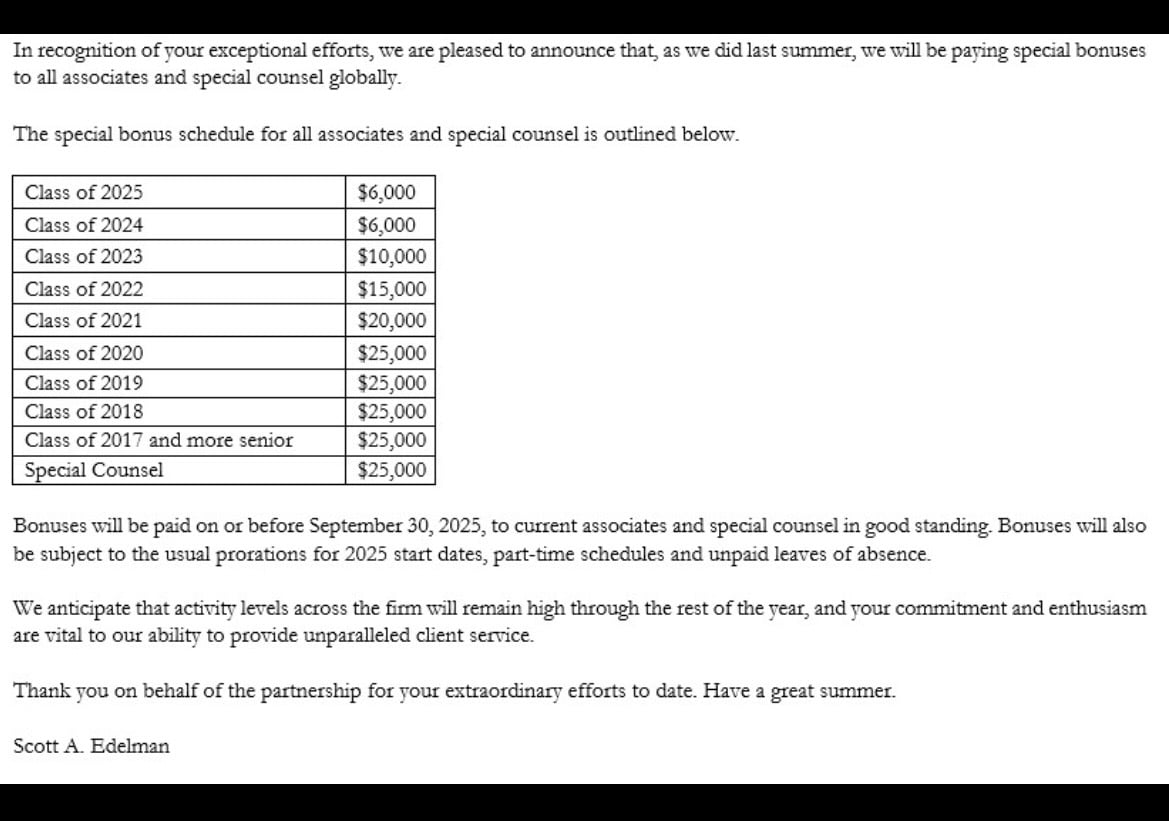
Milbank Issues Summer Bonuses – Above the Law

(Image
via
Getty)

After
boutique
firm
Vartabedian
Hester
&
Haynes

offered
summer
bonuses

and
midsized
firm
Otterbourg

joined
the
fun
,
we
wondered
if
the
Biglaw
bonuses
would
eventually
follow.

The
answer
is
yes…
at
least
at
Milbank.

Earlier
today,
the
firm
announced
that
it
would
be
paying
out
special
bonuses
to
associates
and
counsel
across
its
global
presence.
Hey,
lawyers
have
to
pay
for
all
that
Trump
tariff
inflation
starting
today
too!

Milbank
has
taken
a
lead
on
attorney
compensation
for
a
while
now,
causing
ripples
in
the
old
guard
“wait
and
see”
approach
in
Biglaw
by
issuing

earlier
bonuses

and
even

cost
of
living
adjustments

to
keep
its
team
properly
valued.

Will
the
rest
of
Biglaw
follow?
Despite
the
follow-the-leader
nature
of
an
industry
in
a
constant
pitch
battle
for
talent,
firms
have
left
Milbank
hanging
on
compensation
moves
in
the
past.
Hopefully
this
is
one
of
those
times
where
the
industry
pitches
in.

This
can
take
a
little
of
the
sting
out
of
working
for
a
firm
that

promised
Trump
$100
million
in
free
legal
services
.

Please
help
us
help
you
when
it
comes
to
salary
news
at
other
firms.
As
soon
as
your
firm’s
memo
comes
out,
please email
it
to
us
 (subject
line:
“[Firm
Name]
Salary”)
or
text
us
(646-820-8477).
Please
include
the
memo
if
available.
You
can
take
a
photo
of
the
memo
and
send
it
via
text
or
email
if
you
don’t
want
to
forward
the
original
PDF
or
Word
file.

And
if
you’d
like
to
sign
up
for
ATL’s
Salary
&
Bonus
Alerts,
please
scroll
down
and
enter
your
email
address
in
the
box
below
this
post.
If
you
previously
signed
up
for
the
bonus
alerts,
you
don’t
need
to
do
anything.
You’ll
receive
an
email
notification
within
minutes
of
each
bonus
announcement
that
we
publish.


HeadshotJoe
Patrice
 is
a
senior
editor
at
Above
the
Law
and
co-host
of

Thinking
Like
A
Lawyer
.
Feel
free
to email
any
tips,
questions,
or
comments.
Follow
him
on Twitter or

Bluesky

if
you’re
interested
in
law,
politics,
and
a
healthy
dose
of
college
sports
news.
Joe
also
serves
as
a

Managing
Director
at
RPN
Executive
Search
.

Become A Legal Legend With Litera At ILTACON 2025 – Above the Law

To
become
a
legal
legend,
talent
isn’t
enough.
Lawyers
need
the
right
tools,
the
right
support,
and
the
right
technology.

At

ILTACON
2025
,
Litera
is
turning
lawyers
into
legends.
From
drafting
airtight
documents
and
surfacing
firm-wide
knowledge
to
driving
growth
and
ensuring
operational
excellence,
Litera
works
where
lawyers
do:
in
Microsoft
365
and
across
every
device
with
unmatched
speed
and
efficiency.

With
30+
years
of
innovation,
trusted
by
the
majority
of
the
world’s
largest
law
firms
and
2M+
daily
users,
Litera
AI+
is
built
for
legal
success.
It
integrates
seamlessly,
scales
securely,
and
empowers
lawyers
to
deliver
legendary
results

every
day.


Where
Legal
Legends
Are
Made:
Booth
#711

Here’s
your
all-access
preview
to
what
Litera’s
bringing
to
Booth
#711.
Get
ready
to
see
what
it
takes
to
become
a
legal
legend.


Draft
Faster.
Like
“600
Minutes
in
an
Hour
Faster.”

With
the
advantage
of

Litera
One

in
Microsoft
365,
lawyers
can
draft,
review,
and
respond
faster

with
fewer
clicks,
fewer
errors,
and
smarter
workflows
powered
by
precedent.


Meet
Lito:
The
AI
Agent
Behind
Every
Legal
Legend.

AI
agents
are
everywhere.
Lito
is
the
only
one
powered
by
30+
years
of
legal
experience.
Built
on
Litera’s
new
agentic
AI
architecture,
it
understands
legal
workflows,
orchestrates
the
right
tools,
and
delivers
results

right
inside
Outlook
and
Word.


The
First
to
Wow
is
the
First
to
Win.

With

Foundation

and
Foundation
365
powering
your
insights,
lawyers
can
instantly
find
relevant
matter
experience
and
client
intelligence.
Lito
takes
it
a
step
further

anticipating
what
you
need
and
surfacing
it
instantly.


Meet
Your
GrowthTech
Command
Center.

We’re
helping
law
firms
grow
business
with

unified
marketing,
CRM,
and
firm-experience

data.
Think
of
it
as
turnkey
marketing
for
growth.


Learn
About
Litera’s
Legends

See
how
legal
professionals
like
you
are
using
Litera
to
reduce
friction,
speed
up
delivery,
and
win
more
work.


Want
to
See
Litera
in
Action?

Our
demo
rooms
in
Azalea
1,
2,
&
3
are
where
the
real
magic
happens.
From
deal
point
intelligence
to
lightning-speed
drafting,
we’ll
show
you
how
the
fastest
firms
are
winning
more

because
they
know
more.


Schedule
a
demo

ahead
of
ILTACON
with
our
experts
today.


Explore
the
Experience
Lounge
at
Booth
#815

Whether
you’re
looking
for
expert
advice,
real-time
support,
or
just
a
friendly
face,
our
product
specialists,
support
team,
and
Customer
Success
Managers
are
here
to
help
you
get
the
most
from
your
Litera
solutions.

Drop
by
anytime

or
reserve
a
time
in
advance
using
the
form

here
.


Attend
Our
Company
Update
Built
for
Growth:
Litera’s
Vision
for
the
Modern
Law
Firm


Date:

Monday,
August
11,
2025

Time:

4:00
PM

5:00
PM

Location:

Cherry
Blossom

Join
Avaneesh
Marwaha,
CEO
of
Litera,
Gbenga
Ige
from
Microsoft,
and
Litera
product
leaders
for
an
engaging
session
on
platform
thinking,
AI
innovation,
and
meeting
lawyers
in
their
workflow.
Expect
fast-paced
demos,
product
previews,
and
a
live
customer
showcase,
all
centered
on
Litera’s
2025
goals
for
customer
success
and
growth
in
the
legal
industry.


Join
Inspiring
Thought
Leadership
Sessions

Litera
is
bringing
a
powerhouse
lineup
of
thought
leadership
sessions
to
ILTACON
2025,
designed
to
equip
legal
professionals
with
the
tools,
strategies,
and
insights
needed
to
thrive
in
a
rapidly
evolving
industry.

Below
is
a
look
at
the
schedule
of
can’t-miss
discussions
and
workshops.
To
learn
more
about
each
session,
head
to
our

website
.


Monday,
August
11,
2025
@
4:00
PM


Feedback
in
Motion:
How
to
Request,
Deliver,
and
Apply
It
for
Growth


Speaker:

Ashley
Miller,
VP
of
Sales,
North
America,
Litera

Location:

Maryland
C


Tuesday,
August
12,
2025
@
9:00
AM


Master
Class:
Adoption
That
Actually
Sticks


Speakers:

Cynthia
Gumbert,
CMO,
Litera;
Rachael
Rekart,
Chief
of
Staff,
Litera

Location:

Potomac
C


Tuesday,
August
12,
2025
@
10:30
AM


The
Accidental
Project
Manager:
Charting
Uncharted
Waters


Speaker:

Ashley
Gibbs,
Sr.
Director,
Product
Value
Engineers,
Litera

Location:

Maryland
C


Wednesday,
August
13,
2025
@
11:00
AM


Orchestrating
Intelligence:
AI
Agents
in
the
Legal
Space


Speaker:

Adam
Ryan,
Chief
Product
Officer,
Litera

Location:

National
Harbor
10/11


Wednesday,
August
13,
2025
@
11:00
AM


How
To
Be
a
Data-naut
and
Untangle
Data-knots


Speaker:

Amanda
Keith,
Product
Manager,
Litera

Location:

Maryland
B456


Wednesday,
August
13,
2025
@
3:30
PM


Give
Me
My
Shared
Drive
Back

Let’s
Make
a
Deal!


Speaker:

Tina
Harkins,
Director,
Product
Management,
Litera

Location:

Woodrow
Wilson
A


Legendary
Status
Awaits

Become
a
legend
with
us.
Join
us
at
Booth
#711
and
Experience
Lounge
#815,
and
together,
we’ll
shape
the
future
of
legal
work.
We
can’t
wait
to
see
you
there!

Not
heading
to
ILTACON?
No
problem.
Witness
the
power
of
Litera
by

scheduling
a
demo

with
one
of
our
experts
today.

The Law Schools That Are The Best For State Clerkships (2025) – Above the Law

If
you’re
a
law
student
who’s
interested
in
a
clerkship,
but
you’ve
missed
the
boat
on
landing
a
coveted
position
with
a
federal
judge,
worry
not

there
are
still
plenty
of
options
for
you
at
the
state
level.
It’s
not
only
the
strength
of
your
application
that
matters
for
securing
a
state
clerkship.
Attending
a
law
school
with
high
placement
rates
for
state
and
local
clerkships
can
be
very
helpful
too,
as
it
reflects
past
graduates’
reputation
with
judges,
and
the
law
school’s
pull
within
the
local
community.
If
you
prefer
to
work
close
to
home,
which
law
schools
have
the
greatest
influence
when
it
comes
to
state
clerkships?

The
latest
Princeton
Review
law
school
rankings
are
out,
and
today,
we’ll
focus
on
yet
another
valuable
ranking
for
those
who
are
trying
to
get
a
local
job
within
the
judiciary:
The
law
schools
that
are
the
best
for
state
clerkships.

Which
law
schools
do
you
think
came
out
on
top
of
this
list?

First,
we’ll
begin
with
the
methodology
Princeton
Review
used
to
determine
which
law
schools
are
the
best
for
getting
state
clerkships.
This
ranking
was
based
on
school-reported
data,
specifically,
the
percent
of
2024
JD
graduates
who
were
employed
in
state
and
local
judicial
clerkships.

According
to Princeton
Review
,
these
are
the
law
schools
that
are
the
best
for
obtaining
state
clerkships:

  1. Seton
    Hall
    University
    School
    of
    Law
  2. Rutgers
    School
    of
    Law
  3. Widener
    University
    Delaware
    Law
    School
  4. University
    of
    Maryland
    Francis
    King
    Carey
    School
    of
    Law
  5. University
    of
    Hawaii
    Willian
    S.
    Richardson
    School
    of
    Law
  6. Vermont
    Law
    and
    Graduate
    School

    Law
    Program
  7. University
    of
    St.
    Thomas
    School
    of
    Law
    (MN)
  8. University
    of
    Minnesota
    Law
    School
  9. University
    of
    South
    Carolina
    Joseph
    F.
    Rice
    School
    of
    Law
  10. University
    of
    Colorado
    School
    of
    Law

Way
to
go
New
Jersey
for
coming
out
on
top,
with
two
schools
in
first
and
second
place!
We
also
see
two
Minnesota
law
schools
on
this
list,
repping
their
home
states
with
pride.
Congratulations
on
filling
out
these
important
positions
within
the
state
court
systems.

Did
your
law
school
make
the
cut?
If
it
did,
do
you
think
it
was
ranked
fairly?
If
it
didn’t
make
the
list
for
being
best
for
state
clerkships,
do
you
agree
with
that
assessment?
Please email
us
 or
text
us
(646-820-8477)
your
thoughts.


Best
Law
Schools
2025
 [Princeton
Review]

Best
for
State
and
Local
Clerkships
2025
 [Princeton
Review]


Staci Zaretsky


Staci
Zaretsky
 is
the
managing
editor
of
Above
the
Law,
where
she’s
worked
since
2011.
She’d
love
to
hear
from
you,
so
please
feel
free
to

email

her
with
any
tips,
questions,
comments,
or
critiques.
You
can
follow
her
on BlueskyX/Twitter,
and Threads, or
connect
with
her
on LinkedIn.

Reading The Room: Improving Your Communication Skills – Above the Law

We
lawyers
love
to
talk.
But
listening?
Not
so
much.
Yet
active
listening
and
paying
close
attention
go
a
long
way
to
understanding
others
and
improving
your
communication
with
them.

Here
are
tips
to
improve
your
next
conversation:


  • Adopt
    a
    learner’s
    mindset.

    Treat
    every
    conversation
    as
    an
    opportunity
    to
    learn,
    not
    to
    speak.

  • Assume
    positive
    intent.

    Approach
    every
    conversation
    as
    if
    the
    other
    person
    has
    something
    valuable
    to
    share.

  • Be
    patient.

    Don’t
    rush
    the
    other
    person.
    Allow
    them
    to
    express
    themselves
    fully.

  • Be
    curious,
    not
    judgmental.

    Ask
    yourself
    why
    they
    think
    or
    feel
    the
    way
    they
    do.

  • Set
    aside
    your
    agenda.

    Prioritize
    understanding
    them
    instead
    of
    pushing
    your
    narrative.

  • Stay
    present.

    Eliminate
    distractions.
    Put
    your
    phone
    away.

  • Be
    willing
    to
    be
    wrong.

    Accept
    that
    they
    may
    know
    something
    you
    don’t.

  • Show
    humility.

    Avoid
    dominating
    the
    conversation
    and
    allow
    them
    to
    feel
    valued.

  • Focus
    on
    their
    needs,
    not
    your
    response.

    Listening
    is
    about
    them
    and
    what
    they’re
    saying,
    not
    about
    formulating
    your
    response.

  • Use
    open-ended
    questions.

    This
    encourages
    more
    fulsome
    responses.

  • Mirror
    language
    subtly.

    Repeat
    key
    phrases
    or
    words
    they
    use
    to
    show
    understanding.

  • Paraphrase
    their
    statements.

    Summarize
    their
    statements
    to
    ensure
    you
    understand
    them.

  • Ask
    clarifying
    questions.

    Probe
    gently
    when
    you
    are
    unsure
    what
    they
    are
    saying.

  • Avoid
    interrupting.

    Let
    them
    finish
    before
    you
    speak,
    even
    if
    you
    think
    you
    know
    the
    point
    they
    are
    making.

  • Use
    minimal
    encouragers.

    Use
    words
    to
    show
    you’re
    tracking
    with
    them.

  • Don’t
    rush
    the
    conversation.

    Let
    the
    conversation
    flow
    naturally.

  • Respect
    topic
    shifts.

    Notice
    when
    and
    why
    they
    change
    topics.

  • Track
    their
    word
    choice.

    Pay
    attention
    to
    their
    diction

    it
    reveals
    their
    mood
    and
    comfort
    level.

  • Validate
    their
    perspective.

    Even
    if
    you
    disagree,
    acknowledge
    that
    their
    view
    has
    value
    to
    them.

  • Don’t
    hijack
    their
    story.

    Avoid
    turning
    their
    experience
    into
    a
    story
    from
    your
    life.

  • Speak
    less,
    listen
    more.

    They
    should
    speak
    70-80%
    of
    the
    time.

  • Maintain
    good
    eye
    contact.

    Shows
    you’re
    paying
    attention.

  • Keep
    an
    open
    posture.

    Avoid
    crossing
    arms
    or
    turning
    away.

  • Lean
    slightly
    forward.

    This
    shows
    interest.

  • Mirror
    their
    body
    language.

    Subtly
    reflect
    their
    posture
    and
    gestures.

  • Observe
    facial
    expressions.

    Are
    they
    making
    eye
    contact?
    Their
    eyes,
    eyebrows,
    and
    mouth
    reveal
    a
    lot.

  • Watch
    for
    micro
    expressions.

    Quick
    flashes
    of
    emotion
    can
    reveal
    underlying
    feelings.

  • Look
    for
    physical
    distance.

    Do
    they
    lean
    in
    or
    pull
    away?
    Shows
    comfort
    or
    discomfort.

  • Notice
    hand
    gestures.

    They
    can
    signal
    confidence,
    nervousness,
    or
    other
    emotions.

  • Note
    changes
    in
    posture.

    Sudden
    shifts
    may
    indicate
    a
    reaction
    to
    a
    given
    topic.

  • Recognize
    fidgeting.

    May
    indicate
    anxiety.

  • Watch
    breathing
    patterns.

    Fast
    or
    shallow
    breathing
    may
    indicate
    stress.

  • Pay
    attention
    to
    feet.

    People
    often
    point
    their
    feet
    in
    the
    direction
    they
    want
    to
    go. 
    If
    their
    feet
    are
    pointing
    away
    from
    you,
    they
    may
    be
    looking
    to
    end
    the
    conversation.

  • See
    where
    they
    look.

    Breaking
    eye
    contact
    repeatedly
    may
    indicate
    interest
    in
    someone
    or
    something
    else.

  • Note
    speech
    pace.

    Fast
    can
    mean
    nervousness
    and
    excitement. 
    Slow
    could
    mean
    deliberate
    or
    uncertain.

  • Listen
    to
    pitch
    changes.

    A
    rising
    pitch
    may
    signal
    stress.

  • Identify
    filler
    words.

    Filler
    words
    may
    indicate
    uncertainty
    or
    that
    they’re
    trying
    to
    choose
    their
    words
    carefully.

  • Pay
    attention
    to
    breathing.

    Labored
    or
    shallow
    breathing
    may
    indicate
    stress.

  • Spot
    unnatural
    pauses.

    They
    may
    be
    hiding
    something.

  • Notice
    sighs
    or
    deep
    breaths
    before
    responding.

    Suggesting
    something
    is
    not
    being
    said.

  • Notice
    what
    they
    avoid.

    Avoided
    subjects
    may
    carry
    emotional
    weight.

  • See
    what
    energizes
    them.

    They
    light
    up
    or
    speed
    up
    when
    discussing
    something
    they
    are
    passionate
    about.

  • Identify
    repeated
    topics.

    Frequently
    speaking
    about
    a
    topic
    shows
    genuine
    interest
    in
    it.

  • Watch
    for
    contradictions.

    May
    signal
    unresolved
    feelings
    or
    an
    incomplete
    truth.

  • Focus
    on
    emotional
    words.

    Words
    reflecting
    one’s
    emotional
    state
    reveal
    something
    more
    profound.

  • Track
    how
    long
    they
    spend
    on
    each
    topic.

    More
    time
    equals
    more
    importance.

  • Check
    for
    time
    orientation.

    Are
    they
    focused
    on
    the
    past,
    present,
    or
    future?

  • See
    if
    they
    talk
    about
    solutions
    or
    problems.

    Reveals
    whether
    they
    are
    problem
    solvers
    or
    worry
    about
    problems.

  • Blinking
    rapidly.

    It
    may
    be
    a
    sign
    of
    stress.

  • Smile
    with
    eyes.

    Shows
    a
    genuine
    smile
    and
    happiness.

  • Jaw
    clenching.

    Suggestions
    of
    tension
    or
    anger.

  • Chewing
    lips.

    Reflects
    anxiety,
    hesitation
    of
    deep
    thought.

  • Frequent
    head
    shaking
    “no”
    while
    speaking
    “yes.”

    May
    reveal
    inner
    conflict
    or
    disagreement
    with
    what
    they
    are
    saying.

  • Crossed
    arms
    tightly.

    May
    show
    disagreement
    or
    defensiveness.

  • Covering
    the
    mouth
    when
    speaking.

    May
    show
    fear
    of
    saying
    too
    much
    or
    insecurity.

Effective
communication
requires
active
listening,
a
close
eye
for
detail,
and
taking
in
everything
the
other
person
is
giving
you
(their
body
language,
their
voice,
their
breathing,
their
cadence,
their
diction,
their
choice
of
topics,
their
approach
to
those
topics)
to
show
them
you’re
there
in
that
moment
with
them. 


Frank
Ramos
is
a
partner
at
Goldberg
Segalla
in
Miami,
where
he
practices
commercial
litigation,
products,
and
catastrophic
personal
injury. You
can
follow
him
on LinkedIn.

RFK Jr. Cancels $500M in mRNA R&D Contracts as HHS Turns Focus to Older, Slower Vaccine Technologies – MedCity News

The
U.S.
Department
of
Health
and
Human
Services
is

terminating
contracts

for
messenger
RNA
vaccine
research,
the
latest
move
by
the
current
administration
against
technology
that
led
to
the
successful
development
of
mRNA-based
Covid-19
vaccines.

The
decision
announced
late
Tuesday
covers
22
mRNA
vaccine
contracts
funded
by
the
Biomedical
Advanced
Research
and
Development
Authority
(BARDA),
the
agency
that
supports
development
of
medical
countermeasures
addressing
health
threats,
such
as
pandemics.
The
canceled
contracts

awarded
to
entities
including
Moderna,
Pfizer,
AstraZeneca,
CSL
Seqirus,
and
Emory
University

represent
nearly
$500
million
in
BARDA
funding.

In
the
announcement,
HHS
Secretary
Robert
F.
Kennedy
Jr.
said
data
show
that
mRNA
vaccines
fail
to
protect
effectively
against
upper
respiratory
infections
from
Covid-19
and
influenza.
He
added
that
the
funding
will
shift
toward
“safer,
broader
vaccine
platforms
that
remain
effective
as
viruses
mutate.
Kennedy,
who
has
made
“radical
transparency”
a
mantra
for
the
department,
provided
no
evidence
for
his
claims.

The
terminated
contracts
remove
a
technology
particularly
well-suited
to
providing
a
faster
pandemic
response.
With
mRNA
vaccines,
the
mRNA
provides
the
instructions
for
a
person’s
own
protein-making
machinery
to
make
the
antigen
that
prompts
an
immune
response.
Once
the
target
pathogen
has
been
sequenced,
mRNA
can
be
designed
and
produced
to
address
it.
When
a
virus
mutates,
mRNA
vaccines
offer
the
ability
to
adjust
to
the
mutations.

Covid-19
vaccines
based
on
mRNA
technology
received
emergency
use
authorization
and
then
FDA
approval
based
on
clinical
trial
data
showing
both
safety
and
efficacy.
An
mRNA
vaccine
offers
faster
turn-around
times
than
older
vaccine
methods,
such
as
using
chicken
eggs
as
the
medium
for
growing
a
virus.
That
virus
is
then
weakened
or
killed,
so
it
cannot
cause
illness
but
can
still
prompt
an
immune
response.
Vaccines
made
by
growing
a
virus
in
cell
culture
is
faster
than
egg-based
vaccines,
but
still
takes
several
months.

Kennedy
said
going
forward,
BARDA
will
focus
on
vaccine
platforms
with
“stronger
safety
records
and
transparent
clinical
and
manufacturing
data
practices.”
He
offered
no
details
on
the
safety
risks
he
believes
are
associated
with
mRNA
vaccines.
But
he
said
technologies
funded
during
the
emergency
phase
of
the
pandemic
that
failed
to
meet
current
scientific
standards
will
be
phased
out
in
favor
of
other
solutions,
such
as
whole-virus
vaccines
(which
can
be
produced
by
egg
and
cell
culture
methods).

Kennedy
had
a
long
track
record
of
anti-vaccine
activity
prior
to
taking
the
top
post
at
HHS.
In
his
new
position,
Kennedy’s
HHS
signaled
its
skepticism
of
mRNA
vaccines
in
May,
when
the
agency

canceled
a
federal
contract
supporting
Moderna’s
clinical
testing
of
an
mRNA
vaccine
for
avian
influenza
.
The
initial
contract
awarded
a
little
more
than
a
year
ago

provided
$176
million
in
federal
funding
.
In
January,
prior
to
President
Trump
taking
office,
HHS
expanded
the
Moderna
contract
to
$590
million.
Moderna
has
advanced
this
vaccine,
code-named
mRNA-1018,
through
Phase
1/2
testing
and
was
preparing
to
advance
to
Phase
3
testing.

In
June,

Kennedy
fired
the
entire
Advisory
Committee
on
Immunization
Practices
,
the
body
that
makes
vaccine
recommendations
to
the
Centers
for
Disease
Control
and
Prevention.
Without
evidence,
Kennedy
claimed
the
committee
members
were
a
“rubber
stamp”
for
the
pharmaceutical
industry.
Kennedy
replaced
the
committee
members
with
eight
hand-picked
selections,
some
of
whom
have
made
statements
critical
of
Covid-19
vaccines
and
mRNA
technology.
In
the
HHS
announcement,
Kennedy
said
the
terminations
of
the
BARDA
mRNA
contracts
was
about
safety

without
offering
evidence
of
safety
risks.

“Let
me
be
absolutely
clear:
HHS
supports
safe,
effective
vaccines
for
every
American
who
wants
them,”
Kennedy
said.
“That’s
why
we’re
moving
beyond
the
limitations
of
mRNA
and
investing
in
better
solutions.”

In
a

post

to
the
social
media
platform
X,
American
Medical
Association
President
Bobby
Mukkamala
expressed
concern
about
the
HHS
plans
to
terminate
investment
in
mRNA
vaccines.

“Covid-19
vaccines
using
mRNA
technology
helped
saved
countless
lives
during
the
pandemic,”
he
said.
“We
urge
the
Administration
to
continue
vital
research
to
improve
mRNA
vaccines,
not
throw
the
baby
out
with
the
bathwater
by
effectively
preventing
research
from
moving
forward.”


Photo:
Eric
Lee/Bloomberg,
via
Getty
Images

Morning Docket: 08.07.25 – Above the Law

*
DOJ
seeking
sanctions
against
lawyer
for
taking
immigration
pro
bono
case.
[Politico]

*
To
Elon
Musk’s
chagrin,
appellate
court
once
again
upholds
the
legality
of
the
SEC
imposing
gag
rules
on
voluntary
settlements.
[Reuters]

*
Woman
sees
charges
dropped
after
hiring
Brad
Bondi.
Is
this
necessarily
related?
No.
But
this
is
exactly
why
he
couldn’t
credibly
serve
as
head
of
the
DC
Bar
at
the
same
time
his
sister
runs
the
DOJ.
[ABC
News
]

*
Following
up
on
the
lawyers
who
responded
swiftly
to
Biglaw
surrender
deals.
[Bloomberg
Law
News
]

*
Oklahoma
tribe
uses
FOIA
request
to
uncover
effort
by
senator
to
redefine
Cherokee
status
to
strip
group
of
its
rights.
[Law360]

*
Small
firms
yet
again
taking
up
the
slack
abandoned
by
Biglaw.
[National
Law
Journal
]

*
Trump’s
rewiring
of
the
federal
justice
system
to
tamp
down
its
independence
could
have
long-term
ramifications.
[ABA
Journal
]

Thomson Reuters New Pricing Model: A Step Towards Simplicity In The Unnecessarily Complicated Legal Tech World – Above the Law

Scales

Along
with
yesterday’s
announcement
of
new
AI
features,

Thomson
Reuters

quietly
mentioned
a
revised
commercial
model
that
purportedly
will
allow
customers
to
benefit
from
new
advancements
in
Thomson
Reuters’
products.
The
newest
AI
offering,
CoCounsel
Legal,
will
be
offered
through
multiyear
subscriptions
with
“mostly”
increased
annual
fees.
According
to
TR,
these
subscriptions
will
include
continual
upgrades
at
no
additional
cost.

Admittedly,
it
sounds
a
little
cryptic.
But
if
I’m
following
the
idea
correctly,
the
concept
is
similar
to
Microsoft
365:
you
pay
a
subscription
and
then
as
upgrades
occur,
your
cost
goes
up
some
but
you
automatically
get
the
upgrade.
The
concept
addresses,
at
least
marginally,
a
couple
of
problems
most
legal
vendors
present
to
their
customers,
particularly
when
it
comes
to
AI-related
offerings,
at
least
in
my
opinion.


Secret
Pricing

The
first
is
pricing.
With
most
products,
you
ask
the
price,
and
you
get
an
answer.
With
legal
tech
products,
particularly
subscription-based
ones,
you
get
a
lawyer
answer:
“It
depends.
But
let
me
demo
the
product
for
you
and
you
can
use
it
for
a
bit
and
then
we
will
talk
price.”

That’s
like
a
car
dealer
saying,
“I
can’t
tell
you
the
price
of
the
car
but
hop
in
for
a
test
drive.
Better
yet,
keep
it
for
a
week
or
two
and
then
come
back
and
I’ll
let
you
know
the
price
after
I
find
out
more
about
you.”

The
vendors
will
claim
they
need
to
understand
your
usage
patterns
before
discussing
price.
I
suspect
it’s
more
about
customizing
deals
based
on
who’s
asking
and
how
much
they
think
you
can
pay.
Legal
tech
customers
are
often
left
playing
the
Price
is
Right
to
get
any
idea
of
cost.


Over
Segmentation

The
second
problem
in
my
view
is
product
line
proliferation
or
over
segmentation.
Most
of
the
leading
legal
vendors
offer
so
many
products
that
do
similar
things,
it’s
hard
to
keep
track
of.
And
each
slightly
different
product
often
comes
with
a
higher
price
point.

LexisNexis
,
for
example,
offers
Lexis+,
Lexis+AI,
Protégé,
Lexis
Create+,
and
Lex
Machina,
all
of
which
do
some
sort
of
AI
legal
research
and
analytics.

TR
offers
Practical
Law,
Checkpoint
Edge,
Westlaw
Classic,
Westlaw
Edge,
Westlaw
Precision
with
CoCounsel,
HighQ,
CoCounsel
Core,
and
now
CoCounsel
Legal.

Another
legal
tech
provider,
vLex,
offers
Vincent
AI,
vLex
Analytics,
Docket
Alarm,
Fastcase
Legal
Research,
vLex
Legal
Research,
Next
Chapter,
QuoLaw,
and
a
slew
of
other
offerings
according
to
its

website
,

It’s
enough
to
make
your
head
spin.


But
Why??

The
vendors
got
into
this
in
part
due
to
the
rapid
advancements
in
AI
and
wanting
to
appear
to
stay
ahead
of
the
competition.
And
because
they
wanted
to
charge
customers
extra
for
each
new
advancement.
Since
the
advancements
were
coming
at
such
a
fast
and
furious
pace,
the
vendors
just
added
a
new
product
with
a
new
name
each
time
there
was
an
advancement,
even
if
it
was
slight.
Each
of
these
developments
was
a
separate
a
la
carte
menu
item.
The
result?
A
technological
arms
race
that
had
customers
dazed
and
confused.
Quite
frankly,
I
write
about
this
stuff
and
talk
to
vendors
regularly
and
even
I
can’t
keep
track
of
this
stuff.

And
pricing
that
was
just
as
confusing
and
non-transparent.
A
customer
could
buy
some
or
all
of
the
menu
items
but
the
price
in
many
cases
was
negotiable
as
the
AI
vendors
raced
to
procure
an
increased
customer
base
for
their
rapidly
developing
AI
product
base.
In
their
efforts
to
stay
ahead,
they
came
out
with
advancements
that
really
didn’t
offer
that
much
different
but
were
hyped
as
a
big
advance.
So,
pricing
could
likely
be
a
little
flexible.


The
Problem
for
Lawyers

For
lots
of
law
firms,
this
array
of
products
and
models
and
unclear
pricing
presents
an
issue.
For
larger
firms,
IT
personnel
will
likely
be
dealing
with
the
vendor
and
may
understand
the
offerings.
But
they
then
have
to
explain
them
to
the
lawyers
making
the
final
decision
who
have
neither
the
time
nor
interest
in
understanding
the
nuances
and
differences
in
the
various
products.

So,
they
either
buy
none,
some,
or
all
without
really
understanding
what
they
are
getting,
whether
they
really
need
what
they
are
buying,
or
not
buying
what
they
really
need.
Then
when
it’s
time
for
implementation,
the
lawyers
using
the
products
may
be
just
as
confused
and
as
a
result
the
products
go
unused.

The
situation
is
even
worse
in
small
firms
with
limited
or
no
IT
personnel.
Think
about
it.
You’re
a
full-time
practicing
lawyer
and
managing
partner
in
a
small
shop
with
little
time
to
spare.
You
think
you
need
a
set
of
AI
tools.
But
which
ones
and
for
what?
The
first
vendor
you
talk
to
gives
you
five
products
to
pick
from.
A
second
vendor
gives
you
seven.
A
third
vendor
only
gives
you
four.
But
you
can’t
understand
what
they
all
do
or
whether
you
need
all
that
each
vendor
offers.
On
top
of
that,
you
can’t
find
out
the
cost
until
you
at
least
sit
through
multiple
different
demos.

The
problem
is
compounded
by
the
use
of
too
much
tech
jargon
by
vendors
instead
of
plain
English
to
describe
what
their
products
do.
Vendors
sometimes
get
comfortable
talking
to
IT
personnel
who
may
understand
the
jargon
but
forget
that
IT
personnel
have
to
then
describe
the
offerings
to
the
lawyers
who
don’t
know
the
jargon.
It’s
no
wonder
lawyers
have
a
sour
taste
for
technology.


TR’s
New
Plan

The
new
TR
pricing
plan,
if
it
does
what
it
appears
to,
is
at
least
a
step,
albeit
small,
in
the
right
direction.
Buy
one
product
and
then
get
upgrades
instead
of
a
new
product
offering
and
different
name
(with
a
modest
price
increase,
whatever
that
means).
Less
confusion,
less
work
required
to
understand
what
each
new
product
is.
Simpler,
cleaner.
Some
sanity
in
the
AI
arms
race.

When
Steve
Jobs
returned
to
Apple,
the
first
thing
he
did
was
jettison
the
array
of
products
Apple
was
offering
to
a
confused
customer
base.
Perhaps
legal
tech
vendors
should
do
the
same.
The
legal
profession
is
already
skeptical
of
technology;
clarity
and
simplicity
aren’t
just
nice
to
have,
they’re
essential.


Stephen
Embry
is
a
lawyer,
speaker,
blogger,
and
writer.
He
publishes TechLaw
Crossroads
,
a
blog
devoted
to
the
examination
of
the
tension
between
technology,
the
law,
and
the
practice
of
law
.

Non-AI Businesses Now Use Artificial Intelligence To Charge Customers For Minor Or Made-Up Damage – Above the Law

Once
upon
a
time,
I
was
on
the
way
to
a
major
sporting
event
with
a
good
friend
of
mine
in
his
car.
(What’s
the
difference
between
a
BMW
full
of
lawyers
and
a
porcupine?
With
the
porcupine,
the
pricks
are
on
the
outside!)
When
we
happened
upon
what
seemed
to
me
to
be
an
impossibly
small
parking
space
open
on
the
street,
he
skillfully
backed
right
in.

Not,
however,
without
the
slightest
jolt
when
we
gently
tapped
the
vehicle
behind
us.
Then
there
was
another
tiny
impact
against
the
car
in
front
of
us
when
he
pulled
forward
to
even
out.
“Bumpers
are
for
bumping,”
my
friend
said
matter-of-factly.

Coming,
as
I
do,
from
a
part
of
the
world
where
there
is
typically
space
to
leave
several
car-lengths
between
vehicles
in
a
parking
lot,
and
where
many
drivers
view
the
slightest
scratch
to
the
treasured
vehicles
from
which
they
derive
their
entire
personalities
as
a
murderable
offense,
this
“bumpers
are
for
bumping”
philosophy
caused
me
to
momentarily
panic.
I
looked,
though,
as
closely
as
I
could
at
all
three
vehicles,
hopefully
without
letting
my
friend
catch
me
being
that
uncool.
I
couldn’t
make
out
even
the
slightest
amount
of
damage
to
any
of
them.

Since
my
preconceptions
were
challenged
on
this
fateful
day
many
years
ago,
I
have
continued
to
mellow
out
on
minor,
purely
cosmetic
damage
to
motor
vehicles.
If
you
treat
every
ding
and
dent
to
the
skin
of
an
object
you’re
going
to
be
driving
around
outside
in
all
kinds
of
weather
at
70
miles
per
hour
like
it
is
the
vilest
insult
to
your
beloved
mother,
I
just
don’t
think
we
are
going
to
be
friends.

Compared
to
my
evolution
on
this
subject,
the
rental
car
company
Hertz
has
decided
to
go
in
the
opposite
direction.
Instead
of
a
human
person
taking
three
seconds
to
walk
around
the
car
when
you
return
it
in
order
to
spot
any
glaringly
obvious
problems,
Hertz
is
now
running
its
returned
vehicles
(at
least
at
its
airport
locations)
through

an
artificial
intelligence
hardware
and
software
system

called
UVeye.

UVeye’s
damage
scanning
system
looks
a
bit
like
the
entrance
to
an
automated
car
wash,
except
instead
of
dousing
your
car
with
a
delightful
medley
of
multicolored
solutions,
it
bathes
your
car
in
light
that
can
detect
imperfections
invisible
to
the
human
eye.
Reports
are
rampant
of
Hertz
customers
being
automatically
charged
hundreds
of
dollars
for
damage
allegedly
discovered
by
UVeye
that
is
trivial,
non-existent,
or
predated
their
rental.
When
rental
customers
have
tried
to
contest
these
charges,
they
faced
the
challenges
we
have
all
become
accustomed
to
of
needing
both
the
patience
of
Job
and
the
luck
of
the
Irish
to
ever
reach
an
actual
human
being
capable
of
doing
something
to
address
the
issue.

For
now,
you
can
mostly
prevent
the
AI
nanny
state
from
charging
you
for
using
your
bumper
for
bumping
if
you
give
your
business
to
one
of
the
other
major
domestic
rental
car
companies.
That
being
said,
other
car
rental
companies
are
reportedly
beginning
to
invest
in
implementing
similar
technologies.
Soon,
we
might
all
simply
be
stuck
with
another
dystopian
layer
built
in
to
the
already
unpleasant
task
of
renting
a
car
while
traveling.

Car
rental
companies
are
far
from
the
only
businesses
to
enjoy
the
power
imbalance
of
holding
all
the
informational
cards
when
using
AI
to
accuse
customers
of
causing
damage
to
property
they
no
longer
have
access
to.
For
instance,
a
London-based
academic
recently
renting
an
apartment
in
Manhattan
through
Airbnb
was
stunned
to
discover
when
she
got
home

that
she
was
being
charged

the
equivalent
of
more
than
$15,000
for
damage
she
supposedly
caused
to
the
premises.
After
Herculean
efforts
with
customer
service
in
pointing
out
that
several
images
from
the
host
allegedly
showing
the
damage
were
inconsistent
with
one
another
and
had
apparently
been
altered
by
AI,
Airbnb
not
only
eventually
dropped
the
additional
charges
but
also
refunded
her
for
her
entire
stay.
The
host,
meanwhile,
was
given
a
warning
for
violating
Airbnb’s
terms.
His
listing
for
the
apartment
remains
live
on
the
site.

Of
course,
customers
can
be
AI
cheaters
too.
Surely
there
are
many
examples
out
there
of
consumers
using
artificial
intelligence
to
try
to
fake
evidence
of
a
bad
stay,
a
faulty
product,
etc.
in
order
to
get
something
of
value
for
free.

Still,
even
as
AI
becomes
increasingly
affordable
and
accessible,
companies
that
have
themselves
outsourced
so
much
internal
judgment
and
decision-making
to
machines
will
always
have
the
advantage.
A
corporation
rarely
has
to
listen
to
an
individual
calling
in
to
try
to
rectify
something,
and
the
big
ones
can
afford
to
alienate
a
lot
of
us
(especially
if
all
their
competitors
are
employing
similar
business
practices)
before
they
see
any
consequences
in
their
bottom
lines.

Completely
faked
images
or
videos
are
one
thing.
I
suppose
short
of
all
of
us
becoming
AI-debunking
experts,
we
are
just
going
to
have
to
find
ways
to
live
in
a
world
where
you
really
can’t
believe
a
lot
of
what
you
see
with
your
own
eyes.
When
it
comes
to
shit
like
UVeye,
though,
can
we
not
just
all
agree
to
pull
the
plug?

Renting
out
cars
could
be
profitable
as
a
business
long
before
UVeye
came
along.
UVeye
does
not
improve
the
customer
experience,
but
rather
annoys
and
alarms
consumers.
Let’s
say
it
could
detect
some
microscopic
dimpling
in
a
“bumpers
are
for
bumping”
scenario

is
that
really
a
valid
thing
to
charge
a
customer
for
anyway
if
no
unaided
human
could
detect
it?

Even
if
UVeye
makes
Hertz
a
little
more
money,
it
is
not
a
reasonable
trade-off
for
what
it
takes
away
from
the
car
rental
experience
for
the
traveler.
Perhaps
executives
somewhere
at
some
point
will
realize
that
using
AI
to
more
efficiently
screw
their
own
customers
is
not
a
good
long-term
recipe
for
success.


Jonathan
Wolf
is
a
civil
litigator
and
author
of 
Your
Debt-Free
JD
 (affiliate
link).
He
has
taught
legal
writing,
written
for
a
wide
variety
of
publications,
and
made
it
both
his
business
and
his
pleasure
to
be
financially
and
scientifically
literate.
Any
views
he
expresses
are
probably
pure
gold,
but
are
nonetheless
solely
his
own
and
should
not
be
attributed
to
any
organization
with
which
he
is
affiliated.
He
wouldn’t
want
to
share
the
credit
anyway.
He
can
be
reached
at 
[email protected].