Zimbabwe launches the End Learning Poverty for All in Africa Campaign “Read, Write, Count Foundation4Life”

The
event
marked
a
significant
milestone
in
the
country’s
commitment
to
foundational
education
and
was
attended
by
government
leaders,
African
Union
officials,
UNICEF
representatives,
education
stakeholders,
and
civil
society
actors.
Zimbabwe
becomes
the
third
country,
following
Zambia
and
Malawi,
to
join
the
continental
movement
led
by
the
African
Union
in
partnership
with
UNICEF
to
end
learning
poverty
across
Africa.

Officially
launched
at
the
African
Union
Conference
on
Foundational
Literacy
and
Numeracy
(FLN)
in
September
2024,
in
partnership
with
UNICEF,
under
the
theme
“Read,
Write,
Count
Foundation4Life”,
the
ELPAf
campaign
is
a
continent-wide
initiative
to
mobilise
resources,
expertise,
and
political
will
to
tackle
the
learning
crisis
by
enhancing
the
foundational
learning
provision
across
Africa.
The
campaign
is
also
contributing
to
achieving
the
objective
of
the
Continental
Education
Strategy
for
Africa
(CESA),
which
aims
to
expand
cost-effective
approaches
to
improve
early
childhood
education
and
foundational
learning,
leading
to
quality
basic
education.

Officially
launching
the
national
campaign,
Honourable
Torerayi
Moyo,
Minister
of
Primary
and
Secondary
Education
in
the
Republic
of
Zimbabwe,
stated,
“Accelerating
foundational
learning
is
not
just
an
education
sector
reform.
It
is
an
economic
imperative,
a
social
justice
issue,
and
a
moral
responsibility;
hence,
our
commitment
to
fulfilling
this
obligation.
It
is
imperative
that
we
walk
the
talk,
educators,
parents,
and
community
members,
to
implement
effective
strategies
that
will
empower
our
children
and
secure
a
brighter
future
for
Zimbabwe.”

Speaking
at
the
launch,
Ms.
Sophia
Ashipala,
Head
of
Education
for
AUC-ESTI,
reaffirmed
“Zimbabwe
has
already
made
strides
in
education
and
shown
that
it
is
possible
to
lead
with
vision
and
determination.
By
launching
ELPAF
today,
Zimbabwe
is
reaffirming
its
commitment
to
ensuring
that
every
child—not
just
those
in
urban
centers
or
elite
schools,
but
every
child
across
the
nation—acquires
the
fundamental
skills
to
succeed
in
life.
This
is
more
than
a
campaign.
It
is
a
movement
for
equity,
quality,
and
justice
in
education”.

Despite
increased
school
enrollment
in
recent
decades,
the
learning
crisis
persists
across
Africa.
The
ELPAf
campaign
directly
addresses
this
challenge
by
shifting
focus
from
access
alone
to
actual
learning
outcomes,
targeting
the
critical
need
for
political
leaders,
policymakers,
development
partners,
and
communities
to
tackle
learning
poverty
among
school-going
children.

The
campaign
aims
to
increase
the
number
of
children
who
can
read,
write,
and
perform
basic
math
by
the
age
of
10,
ensuring
that
every
child
in
Africa
achieves
quality
foundational
literacy
and
numeracy
(FLN)
skills
by
2035.

UNICEF
Representative
in
Zimbabwe,
Etona
Ekole
emphasised
that
“while
Zimbabwe
takes
pride
in
being
among
the
African
countries
with
high
literacy
rates,
it
is
equally
important
to
acknowledge
and
address
the
persistent
gaps
within
the
education
system.
Observations
made
during
Joint
Monitoring
Visits
have
revealed
anecdotal
evidence
of
a
significant
number
of
non-readers
in
both
primary
and
secondary
schools.
This
is
also
reflected
in
pass
rates
as
less
than
50%
of
learners
pass
the
national
examinations
(Grade
7

49%;
O
levels

33.7%).
This
highlights
the
urgent
need
to
focus
on
foundational
literacy
and
ensure
that
no
learner
is
left
behind,
despite
the
national
literacy
achievements”.

Aligned
with
the
African
Union’s
second
ten-year
implementation
plan
2024-2033
of
Agenda
2063
and
specifically
the
Continental
Education
for
Africa
(CESA
2016-2035)
and
Sustainable
Development
Goal
4
(Quality
Education
for
All),
the
campaign’s
key
objectives
include:

Improving
foundational
literacy
and
numeracy
skills
for
children
across
Africa

Strengthening
teacher
support
and
training,
especially
in
underserved
areas

Mobilizing
political
will
and
financial
investment
in
quality
education

Engaging
communities
and
youth
to
drive
grassroots
change

The
first
phase
will
launch
in
25
countries
across
Africa
over
24
months,
targeting
an
improved
understanding
of
learning
poverty,
strengthened
continental
and
national
institutions,
and
advocacy
for
increased
government
investment
in
foundational
learning,
as
well
as
scaling
up
proven
pedagogical
practices
among
participating
countries.

The
campaign
will
mobilise
education
stakeholders
across
African
Union
Member
States
through
expert
conferences,
high-level
policy
dialogues,
teacher
capacity-building
workshops,
South-South
cooperation,
and
school
competitions.
Source:


Zimbabwe
launches
the
End
Learning
Poverty
for
All
in
Africa
Campaign
“Read,
Write,
Count
Foundation4Life”

|
Union
africaine

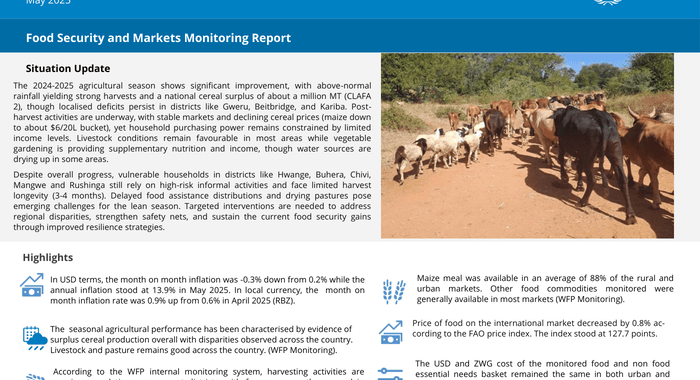
Food Security and Markets Monitoring Report, May 2025


29.6.2025


7:30

The
2024-2025
agricultural
season
shows
significant
improvement,
with
above-normal
rainfall
yielding
strong
harvests
and
a
national
cereal
surplus
of
about
a
million
MT
(CLAFA
2),
though
localised
deficits
persist
in
districts
like
Gweru,
Beitbridge,
and
Kariba.


Situation
update

Postharvest
activities
are
underway,
with
stable
markets
and
declining
cereal
prices
(maize
down
to
about
$6/20L
bucket),
yet
household
purchasing
power
remains
constrained
by
limited
income
levels.
Livestock
conditions
remain
favourable
in
most
areas
while
vegetable
gardening
is
providing
supplementary
nutrition
and
income,
though
water
sources
are
drying
up
in
some
areas.

Despite
overall
progress,
vulnerable
households
in
districts
like
Hwange,
Buhera,
Chivi,
Mangwe
and
Rushinga
still
rely
on
high-risk
informal
activities
and
face
limited
harvest
longevity
(3-4
months).
Delayed
food
assistance
distributions
and
drying
pastures
pose
emerging
challenges
for
the
lean
season.
Targeted
interventions
are
needed
to
address
regional
disparities,
strengthen
safety
nets,
and
sustain
the
current
food
security
gains
through
improved
resilience
strategies.

Post
published
in:

Agriculture

Zimbabwe records 5,932 AIDS-related deaths in first half of 2025: Health Minister

Addressing
a
media
workshop
on
HIV
reporting
and
stigma
reduction
in
the
capital
Harare,
Mombeshora
stated
that
between
January
and
June
2025,
the
country
recorded
5,932
AIDS-related
deaths,
up
from
5,712
during
the
same
period
last
year.

“An
increase
of
220
deaths
is
a
reminder
that
our
work
is
not
done,”
he
said,
without
specifying
the
main
cause
behind
the
rise.

The
minister
noted
that
while
Zimbabwe
has
made
significant
strides
in
combating
HIV/AIDS

particularly
in
achieving
the
UNAIDS
95-95-95
targets

the
gains
remain
fragile
and
are
threatened
by
multiple
challenges,
including
limited
resources,
stigma,
and
discrimination.

“As
a
nation,
we
must
confront
these
realities
with
honesty
and
resolve.
Addressing
stigma
and
discrimination
is
not
only
a
moral
obligation;
it
is
a
public
health
imperative,”
he
said.

Zimbabwe
is
now
seeking
to
transition
to
full
domestic
financing
for
its
HIV
and
AIDS
response
amid
declining
external
funding,
Mombeshora
said.

During
this
transition,
the
country
is
facing
difficulties
in
maintaining
outreach
staff
and
ensuring
continuity
of
community-based
services,
according
to
a
report
by
Xinhua.

Operational
adjustments
are
being
made
to
safeguard
service
delivery,
he
added,
stressing
the
need
for
innovation,
stronger
domestic
partnerships,
and
a
resilient,
self-sustaining
national
response
to
the
epidemic.

According
to
the
World
Health
Organization
(WHO),
HIV
(human
immunodeficiency
virus)
attacks
the
body’s
immune
system,
specifically
the
white
blood
cells,
weakening
the
body’s
defense
against
infections
and
diseases.
If
untreated,
HIV
can
progress
to
AIDS
(acquired
immunodeficiency
syndrome),
the
most
advanced
stage
of
the
infection.

HIV
is
transmitted
through
body
fluids
such
as
blood,
semen,
vaginal
fluids,
and
breast
milk,
and
can
also
be
passed
from
mother
to
child.
It
is
not
spread
through
casual
contact
like
kissing,
hugging,
or
sharing
food.

The
disease
can
be
prevented
and
managed
through
antiretroviral
therapy
(ART).
Without
treatment,
HIV
can
take
years
to
develop
into
AIDS.

Source:


Zimbabwe
records
5,932
AIDS-related
deaths
in
first
half
of
2025:
Health
Minister

Zimbabwe Hearings Over Mugabe-era Massacres Delayed

Tens
of
thousands
of
people
were
killed
over
several
years
in
the
so-called
Gukurahundi
massacre
under
former
leader
Robert
Mugabe,
a
few
years
after
Zimbabwe’s
independence
from
Britain.

Starting
in
1983,
Mugabe
deployed
an
elite
North
Korean-trained
army
unit
to
crack
down
on
a
revolt
in
the
western
Matabeleland
region.

Critics
say
the
soldiers
targeted
dissidents
loyal
to
Mugabe’s
rival,
fellow
revolutionary
and
nationalist
leader
Joshua
Nkomo.
Most
of
the
victims
belonged
to
the
minority
Ndebele
tribe.

Current
President
Emmerson
Mnangagwa
had
announced
that
survivors
would
be
interviewed
in
village
hearings
starting
on
Thursday,
in
a
bid
to
settle
longstanding
grievances
and
tensions.

But
on
Friday,
the
president
of
the
Chiefs
Council
leading
the
hearings
told
AFP
the
start
was
delayed,
mainly
because
a
number
of
traditional
leaders
had
been
busy
at
a
state
function.

However,
everything
was
in
place
“except
for
a
few
things”,
Chief
Mtshane
Khumalo
said.

Two
other
chiefs,
who
spoke
to
AFP
on
condition
of
anonymity,
said
the
delay
was
because
they
had
not
yet
been
given
promised
“fuel
and
money”
and
there
was
“confusion”
about
the
programme.

Mnangagwa
pushed
for
the
initiative
despite
some
survivors
and
human
rights
activists
saying
they
had
not
been
consulted.

Politician
Sibangilizwe
Nkomo,
son
of
Mugabe’s
late
rival
Joshua
Nkomo,
told
AFP
that
his
party
had
approached
the
High
Court
for
a
halt
to
the
proceedings.

Among
the
concerns
is
whether
the
chiefs
have
a
legal
mandate
to
preside
over
the
hearings.

Musa
Kika,
executive
director
of
the
pan-African
Institute
for
Human
Rights
and
Development
in
Africa,
said
there
were
also
questions
over
the
objectivity
of
the
traditional
leaders.

“The
chiefs
as
traditional
leaders…
do
have
legal
standing
to
deal
with
Gukurahundi,”
Kika
told
AFP.
But,
he
said,
they
“are
heavily
politicised
and…
not
neutral
arbiters”.

The
Gukurahundi
massacres
killed
an
estimated
20,000
people
over
several
years,
according
to
the
Catholic
Commission
for
Justice
and
Peace
in
Zimbabwe,
whose
toll
is
backed
by
Amnesty
International.

The
operation
took
place
in
a
region
where
support
for
Mugabe’s
rival
Nkomo
was
strong
among
the
minority
Ndebele
group.

The
name
Gukurahundi
is
a
term
in
the
majority
Shona
language
that
loosely
translates
as
“the
early
rain
that
washes
away
the
chaff”.

Mugabe,
who
died
in
2019,
never
acknowledged
responsibility
for
the
massacres,
only
referring
to
them
as
a
“moment
of
madness”.

After
taking
power
in
2017,
Mnangagwa,
who
was
security
minister
at
the
time
of
the
massacre,
promised
to
deal
with
the
issue.

Source:


Zimbabwe
Hearings
Over
Mugabe-era
Massacres
Delayed


Barron’s

Trump Thinks Reporting The Truth Is A Punishable Offense – See Also – Above the Law

Accurate
News
Coverage
Of
Unilateral
Iran
Strike
Angers
Trump:
He
wants
the
Press
to
apologize.
First
Amendment,
who?
So
Long
And
Thanks
For
All
The
National
Injunctions:
Major
blow
to
meaningfully
stopping
Trump
from
doing
whatever
he
wants.
Do
Women
Wearing
Pants
Offend
Your
Religious
Sensibilities?:
This
SCOTUS
decision
gives
you
permission
to
opt
your
kids
out
of
class.
A
Huge
Merger
Is
On
The
Way!:
McDermott
Will
&
Emery
and
Schulte
Roth
&
Zabel
poised
to
sign
merger
agreement
by
July
1st!
Department
Of
Justice
Investigates
University
of
California
For
Racial
Discrimination:
The
state
hasn’t
had
legally
permissible
affirmative
action
polices
since
1996.

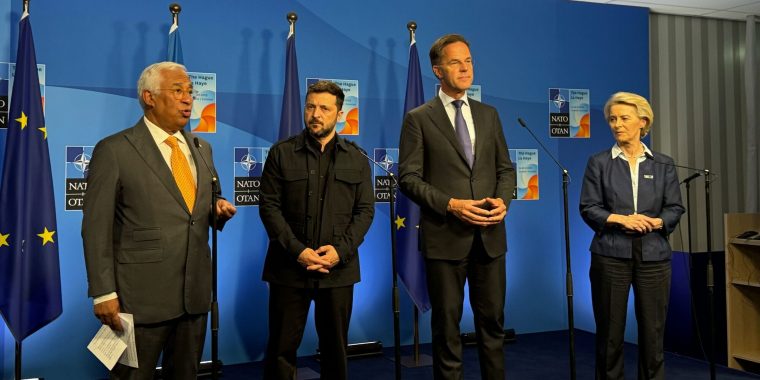
At the NATO Summit at The Hague, Ukraine takes a backseat – Breaking Defense

From
left,
European
Council
President
António
Costa,
Ukrainian
President
Volodymyr
Zelenskyy,
NATO
chief
Mark
Rutte
and
European
Commission
President
Ursula
von
der
Leyen
address
the
press
at
the
NATO
summit
in
The
Hague
on
Tuesday,
June
24.
(Michael
Marrow
/
Breaking
Defense)


THE
HAGUE

On
Tuesday
for
the
first
day
at
the


NATO
summit


here,
Ukrainian
President
Volodymyr
Zelenskyy
made
a
plea
for
continued
support
while
delivering
a
warning:
Russian
President
Vladimir
Putin
has
ambitions
beyond
Ukraine,
and
could
seek
to
move
on
a
member
of
the
multinational
alliance
within
five
years.


Shortly
after,
Zelenskyy
faced
the
press
alongside
NATO
chief
Mark
Rutte,
European
Commission
President
Ursula
von
der
Leyen
and
European
Council
President
António
Costa.
Each
gave
short
speeches,
with
Zelenskyy’s
colleagues
reaffirming
their
commitment
to
support
Ukraine
in
its
defense
against
Russia.


But
then
they
promptly
exited
the
stage

the
last
time
Zelenskyy
would

be
seen
for
much
of
the

conference. 

European
leaders
were
steadfast
in
their
support
of
Kyiv,
but
throughout
the
high-level
meeting
Ukraine’s
plight
seemed
to
be
pushed
into
the
background,
overshadowed
by
inter-NATO
negotiations
about
a
5
percent
GDP
spending
target
and
the
surprise
American
bombing
of
Iranian
nuclear
sites
just
days
before.


Perhaps
the
most
stark
example
was
a
joint
declaration
signed
by
the
alliance
at
the
end
of
the
summit.
Whereas
the
same
event
held
in
Washington
last
ye
ar
under
then-US
President
Joe
Biden


produced
a
declaration


that
mentioned
Ukraine
59
times,
this
year’s


much
shorter
document

only
garnered
two
mentions
of
the
country.

“Allies
reaffirm
their
enduring
sovereign
commitments
to
provide
support
to
Ukraine,
whose
security
contributes
to
ours,
and,
to
this
end,
will
include
direct
contributions
towards
Ukraine’s
defence
and
its
defence
industry
when
calculating
Allies’
defence
spending,”
reads
the
only
mentions.
It
did
not
discuss
the
potential
for
Ukraine
to
join
the
alliance,
whereas
last
year’s
statement
described
Kyiv
on
an
“irreversible
path”
to
membership.

If
the
declaration
was
any
indication

along
with
some

fawning
private
text
messages


it
was
clear
this
year
that
NATO
leadership
would
play
a
deferential
role
to
US
President
Donald
Trump,
who
has
for
years
embraced
Putin
and
sharply
criticized
Zelenskyy.


Some
aesthetic
choices
may
also
have
been
made
to
placate
Trump.
At
the
summit,
Zelenskyy
opted
for
more
formal
attire,
ditching
his
casual
clothing
that
has
defined
his
image
but


earned
the
ire


of
the
American
president’s
orbit. 


And
while
Zelenskyy
was
still
successful
in


securing
aid


for
Ukraine
from
Europe,
it
doesn’t
appear
he
made
progress
with
the
US,
Ukraine’s
most
important
benefactor,
whose
equipment
has
been
critical
to
stymie
Russia’s
advance. 


At
a
press
conference
Wednesday
following
a
meeting
with
Zelenskyy,
Trump
acknowledged
it
is
“possible”
Putin
has
ambitions
to
invade
a
NATO
country,
but
ultimately
demurred
when
asked
whether
money
and
equipment
will
still
flow
from
Washington
to
Kyiv.


“As
far
as
money
going,
we’ll
see
what
happens,”
he
said.

(A
senior
NATO
official
later
told
reporters
US
equipment
was
still
flowing
to
Ukraine
and
would
not
run
out
anytime
“soon.”)

As
for
giving
Ukraine
desperately
needed
additional
Patriot
air
defense
systems,
Trump
said
only
that,
“we’re
going
to
see
if
we
can
make
some
available

they’re
very
hard
to
get.”
In
April,
Rutte
revealed
that
most
Patriots
pledged
to
Ukraine
had
arrived
in
country
and
the
remainder
would
be
delivered
in
the
near
future,

according
to
Newsweek
.


While
no
material
agreements
were
made
at
the
summit,
it
didn’t
appear
to
be
a
complete
loss
for
Zelenskyy
in
his
relations
with
Trump.
At
the
very
least,
the
Ukrainian
president
received
a
consolation
prize:
Trump
softening
his
tone
on
the
conflict,
a
rhetorical
gesture
that
may
prove
to
be
important
down
the
road.


“He’s
fighting
a
brave
battle.
It’s
a
tough
battle,”
Trump
said
of
Zelenskyy,
later
adding
that


“Vladimir
Putin
really
has
to
end
that
war.
People
are
dying
at
levels
that
people
haven’t
seen
before
for
a
long
time.”

Trump nato presser

US
President
Donald
Trump,
flanked
by
Defense
Secretary
Pete
Hegseth
and
Secretary
of
State
Marco
Rubio,
in
a
press
briefing
at
the
NATO
summit
on
Wednesday,
June
25.
(Michael
Marrow
/
Breaking
Defense)

Meanwhile
on
the
battlefield,

NATO
does
not
anticipate
a
strategic
breakthrough
by
either
side
in
the
near
future,
a
separate
senior
alliance
official
told
reporters
in
a
different
briefing
on
Tuesday.
But
a
grueling
summer
is
shaping
up,
which
still
carries
the
possibility
of
an
unforeseen
advance. 


Every
week
has
seen
“near
record
numbers”
of
combined
drone
and
missile
attacks
by
Russia,
the
official
said,
also
speaking
on
the
condition
of
anonymity.
The
United
States
remains
the
chief
contributor
of
intelligence,
the
official
added,
noting
that
“increasing
the
level
of
aid
delivered
to
Ukraine
will
certainly
improve
the
dynamics
on
the
battlefield,
and
vice
versa.”


Elaborating
further,
the
official
said
Russia
is
making
“steady
advances”
in
Sumy
and
eastern
Ukraine,
while
“aiming
to
create
a
buffer
zone”
around
Kyiv’s


surprise
incursion


into
Kursk.


Russia
remains
ultimately
disinterested
in
meaningful
ceasefire
talks,
the
official
added,
and
Moscow’s
arms
production
remains
strong,
with
the
ability
to
continue
financing
the
war
until
at
least
2027.


The
real
bottom
line
is
the
situation
on
the
battlefield
continues
to
be
difficult,”
the
official
said,
praising
the
“innovative
spirit”
of
Ukrainian
forces.
“But
we’re
in
for
a
stressful
and
difficult
summer.”


Tim
Martin
contributed
to
this
report.

Are Lawyers More Likely To Suffer Health Problems? – Above the Law

Most
lawyers
can
attest
that
being
an
attorney
is
a
stressful
occupation
due
to
the
conflict
and
human
drama
that
lawyers
experience
daily. In
addition,
many
lawyers
work
long
hours,
which
only
compounds
the
stress
and
adverse
health
effects. Perhaps
owing
to
this
stress,
some
lawyers
are
more
likely
to
suffer
substance
abuse
and
mental
help
problems. Due
to
all
of
these
compounding
factors,
lawyers
might
have
worse
health
outcomes
than
people
who
work
in
other
professions.

Over
the
past
few
years,
I
personally
knew
four
lawyers
who
died
of
heart
attacks
in
their
50s. People
suffer
heart
attacks
at
relatively
young
ages
for
many
reasons.
I
was
not
particularly
close
to
any
of
these
lawyers,
and
it
has
been
years
since
I
worked
with
any
of
them
closely. However,
I
could
see
that
the
stress
of
the
legal
profession
was
impacting
at
least
a
few
of
them,
and
I
wonder
if
years
of
practicing
law
had
an
adverse
health
effect
on
them.

I
also
personally
know
many
lawyers
who
seek
mental
health
help,
possibly
due
to
the
stress
experienced
in
the
legal
profession. Let
me
be
clear:
I
think
it
is
great
for
lawyers
(and
anyone
else)
to
see
therapy
and
other
methods
for
dealing
with
mental
health
issues. I
am
happy
that
many
state
bars
have
deemphasized
mental
health
issues
on
bar
applications
since
there
should
not
be
a
stigma
associated
with
people
who
suffer
from
depression,
anxiety,
or
other
similar
issues
and
accordingly
seek
help.

However,
it
is
extremely
likely
that
being
a
lawyer
contributes
to
mental
health
issues. Dealing
with
human
drama
and
needing
to
square
off
against
adversaries
and
other
stakeholders
to
the
legal
profession
can
exacerbate
depression. In
addition,
tight
deadlines
and
the
fear
of
messing
up
can
add
to
a
lawyer’s
anxiety.
Attorneys
routinely
need
to
make
arguments
that
run
counter
to
their
deep-seated
beliefs
and
engage
in
other
conduct
that
can
be
difficult
to
bear. This
can
all
have
an
adverse
impact
on
the
mental
health
of
legal
practitioners.

The
legal
industry
is
not
healthy
at
baseline,
even
if
practitioners
do
not
have
jobs
in
the
more
stressful
branches
of
the
profession. Being
a
lawyer
is
mostly
a
sedentary
pursuit
since
attorneys
usually
sit
behind
desks
and
apply
their
trade
behind
computers. I
like
going
to
court
as
it
requires
walking
and
movement,
but
more
and
more
court
appearances
and
depositions
have
gone
virtual
after
the
pandemic,
and
these
opportunities
to
get
exercise
throughout
the
workday
have
almost
vanished.

The
office
environment
in
many
legal
workplaces
is
no
picnic
either. Lawyers
are
not
always
the
best
people
to
work
with,
and
the
many
opportunities
for
conflict,
office
politics,
and
intrigue
can
also
impact
the
mental
well-being
of
practitioners. Many
lawyers
do
not
need
to
work
from
the
office
five
days
a
week
like
in
earlier
years,
but
there
are
still
stressful
moments
caused
by
working
in
a
legal
workplace
that
are
not
connected
to
the
work
lawyers
perform
for
clients.

I
am
not
a
physician,
and
I
have
not
conducted
any
research
on
the
topic
of
health
outcomes
for
lawyers. I
have
just
anecdotally
witnessed
many
lawyers
suffer
adverse
health
outcomes
at
relatively
young
ages,
which
may
or
may
not
be
associated
with
their
work. I’d
love
any
feedback
readers
may
have,
especially
if
you
too
have
seen
lawyers
suffer
adverse
health
effects
at
ages
or
in
quantities
that
seem
unusual. Perhaps
if
there
was
an
acknowledgement
of
the
health
issues
that
lawyers
face
it
might
be
easier
to
propose
solutions
to
this
possible
problem.


Jordan
Rothman
is
a
partner
of 
The
Rothman
Law
Firm
,
a
full-service
New
York
and
New
Jersey
law
firm.
He
is
also
the
founder
of 
Student
Debt
Diaries
,
a
website
discussing
how
he
paid
off
his
student
loans.
You
can
reach
Jordan
through
email
at 
jordan@rothman.law.

Mary Meeker’s Trends In AI Report: A Must Read For Lawyers And Legal Professionals – Above the Law


Mary
Meeker
’s
recent
Trends
in
Artificial
Intelligence

report
didn’t
get
much
legal
tech
fanfare
but
it
should.
It
contains
insights
and
information
that
lawyers
and
legal
professionals
simply
can’t
afford
to
ignore.

Meeker
is
a
former
Wall
Street
analyst
turned
venture
capitalist,
best
known
for
her
long-running
annual

Internet
Trends

reports.
Running
from
1995
to
2019,
her
reports
were
some
of
the
most
respected
and
reliable
surveys
about
internet
trends
and
usage.
I
have

written

about
her
reports
before.


The
AI
Trends
Report

Meeker’s
AI
report
contains
data
and
analysis
lawyers
need
to
be
considering
when
they
look
to
the
future
and
engage
in
any
long-term
planning
(yes,
“lawyers”
and
“long-term
planning”
in
the
same
sentence
is
a
bit
of
an
oxymoron).

As
Meeker
puts
it
at
the
outset,
“breakthroughs
in
large
models,
cost-per-token
declines,
open
source
proliferation,
and
chip
performance
are
making
tech
advances
increasingly
more
powerful,
accessible,
and
economically
viable.”

She
continues:
“Rapid
advances
in
artificial
intelligence,
compute
infrastructure,
and
global
connectivity
are
fundamentally
reshaping
how
work
gets
done,
how
capital
is
deployed,
and
how
leadership
is
defined.”

Let
that
sink
in.
As
I’ve
said
before,
legal
needs
to
start
thinking
today
about
how
future
work
will
be
done,
how
it
will
be
valued,
and
how
the
definition
of
a
“good
lawyer”
is
evolving.

Backed
by
solid
data,
Meeker
confirms
that
change
is
now
happening
faster
than
ever.
She
calls
AI
a
“compounder,”
which
enables
“wicked
fast
adoption”
of
easy-to-use
services.
These
are
key
points
when
thinking
about
what’s
next
for
AI,
LLMs,
and
their
impact
on
legal.


AI
Today

Meeker
backs
these
ideas
up
with
ChatGPT
usage
data.
Consider
10
things
AI
can
already
do:

  • Write
    or
    edit
    anything
    from
    emails,
    contracts,
    even
    poems,
    instantly
    and
    fluently.
  • Summarize
    and
    explain
    complex
    material.
  • Tutor
    extensively
    on
    any
    subject.
  • Be
    a
    thinking
    partner.
  • Roleplay
    anyone.
  • Connect
    to
    tools
    like
    spreadsheets,
    calendar
    or
    the
    internet.
  • Offer
    therapy
    and
    companionship.
  • Help
    find
    purpose
    and
    define
    long
    term
    strategy
    by
    clarifying
    values
    and
    goals
    and
    mapping
    relevant
    actions.
  • Organize
    your
    life.

How
many
law
firms
are
thinking
strategically
about
what
AI
can
now
do
and
how
that
affects
(or
could
affect)
their
practice?
More
importantly,
how
are
they
using
those
capabilities
to
actually
improve
what
they
do
and
how
they
do
it?
Understanding
today’s
these
capabilities
is
a
prerequisite
to
preparing
for
what
the
systems
will
be
able
do
in
the
future.
And
the
changes
those
capabilities
will
usher
in.


In
Five
Years

Meeker
cites
what
ChatGPT
thinks
AI
tools
will
be
able
to
do
in
five
years:

  • Generate
    human
    level
    text,
    code
    and
    logic.
  • Create
    full-length
    films
    and
    games.
    (Particularly
    challenging
    for
    litigators
    and
    courts
    facing
    deep
    fake
    challenges.)
  • Understand
    and
    speak
    like
    a
    human.
    (See
    above.)
  • Power
    advanced
    person
    assistants-coordinating
    across
    apps
    and
    devices.
  • Operate
    humanlike
    robots:
    household
    helpers,
    elder
    care
    and
    retail
    and
    hospitality
    automation.
  • Run
    automated
    customer
    service
    and
    sales.
    (Imagine
    the
    delivery
    of
    automated
    legal
    services
    in
    a
    virtual,
    no
    cost
    fashion.)
  • Personalize
    entire
    digital
    lives:
    adaptive
    learning,
    curated
    content
    and
    individualized
    legal
    and
    health
    coaching
  • Build
    and
    run
    autonomous
    businesses.
    Is
    legal
    ready
    for
    this?
  • Drive
    autonomous
    discovery
    in
    science.
    (And
    in
    legal.)
  • Collaborate
    creatively
    like
    a
    partner.
    Co-write
    novels
    and
    music.
    Or
    act
    as
    the
    senior
    partner
    mentor?

All
of
these
developments
will
inevitably
affect
legal
in
just
five
years
if
not
sooner.
How
many
are
planning
for
this?
Is
law
firm
management
taking
these
possibilities
into
account
in
formulating
their
strategic
plans?
They
damn
well
should
be.


In
10
Years

But
what
if
we
go
out
10
years.
Here’s
what
AI
systems
could
be
capable
of:


Simulate
human-like
minds.

Operate
fully
autonomous
companies.

Perform
complex
physical
tasks
with
precision.

Coordinate
global
systems
in
real
time.

Model
entire
biological
systems.

Deliver
expert
decisions.

Influence
public
debate
and
shape
policy.

Build
immersive,
fully
interactive
virtual
worlds.

The
10-year
outlook
is
less
about
how
lawyers
work
and
more
about
what
they’ll
even
be
doing.
What
kinds
of
disputes
will
exist?
How
will
they
be
resolved?
What
will
the
legal
and
factual
issues
of
the
next
decade
look
like?
Smart
firms
and
in-house
teams
should
be
asking
these
questions
now.
Is
anyone
listening?
Bueller?


AI
Agents

And
all
this
ignores
the
coming
development
of
AI
agents
that
can
reason,
act,
and
complete
multistep
tasks.
Meeker
says,
“They
don’t
just
answer
questions

they
execute:
booking
meetings,
submitting
reports,
logging
into
tools,
or
orchestrating
workflows
across
platforms,
often
using
natural
language
as
their
command
layer.”

Meeker
observes
it’s
still
early
in
the
development
of
these
agents.
But
the
implications
are
massive.
These
agents
will
reshape
how
users
interact
with
AI
across
research,
scheduling,
and
operations.

Thinking
about
how
this
will
impact
to
legal
workflows
is
critical:
from
staffing
to
valuing
services
to
rethinking
how
lawyers
spend
their
time
will
change. 


Artificial
General
Intelligence

We
haven’t
even
gotten
to
Artificial
General
Intelligence,
systems
capable
of
handling
the
full
range
of
human
intellectual
tasks.
Meeker
admits
the
timeline
is
uncertain,
but
notes
that
“expert
expectations
have
shifted
forward
meaningfully
in
recent
years.”


Exponential
Change

Meeker
makes
a
good
point:
development
is
moving
exponentially.
Global
AI
adoption
is
happening
at
breakneck
speed
and
with
it,
faster,
cheaper,
more
capable
tools.
Meeker
notes
a
100%
spike
in
developers,
startups,
and
apps
in
just
four
years.
Who
knows
what’s
coming
next
or
when?

Here’s
an
insightful
quote
from
Nvidia’s
Jensen
Huang
that
Meeker
includes
in
her
Report:
“In
10
years,
you’ll
look
back
and
realize
AI
has
integrated
into
everything.
We
need
AI
everywhere.”

Lawyers
and
legal
professionals
who
don’t
accept
this
and
plan
for
it
risk
getting
left
behind.
Not
just
by
forward-looking
legal
competitors,
but
by
entirely
new,
unimagined
businesses
and
models.


Where
Does
All
This
Leave
Us?

Meeker
is
one
of
the
most
astute
observers
of
tech’s
impact
and
where
things
are
headed.
She’s
been
right
more
times
than
not.
Based
on
her
report,
the
well-worn
legal
management
strategy
of
driving
forward
while
staring
in
the
rearview
mirror
simply
isn’t
going
to
work
anymore.


Stephen
Embry
is
a
lawyer,
speaker,
blogger
and
writer.
He
publishes TechLaw
Crossroads
,
a
blog
devoted
to
the
examination
of
the
tension
between
technology,
the
law,
and
the
practice
of
law
.

Stat(s) Of The Week: Perennial Favorites – Above the Law

Although
there’s
been
some
movement
near
the
top
of
the
latest

ATL
law
school
rankings
,
a
few
institutions
have
been
consistent
leaders
over
the
past
decade.

Three
schools
have
made
the
Top
5
for
at
least
eight
of
the
last
10
years:

  • Duke
    (nine
    times)
  • University
    of
    Chicago
    (10
    times)
  • University
    of
    Virginia
    (eight
    times)

The
University
of
Virginia,
ranked
No.
4
this
year,
has
been
a
regular
in
the
Top
5
since
2018.

Duke,
this
year’s
No.
1,
has
been
among
the
Top
5
since
2017
and
has
also
appeared
more
often
than
any
other
law
school

four
times

at
the
very
top
of
the
ranking.

Meanwhile,
the
University
of
Chicago
is
the
only
law
school
consistently
ranked
among
the
Top
5
every
year
since
2016.


Earlier:


The
2025
ATL
Top
50
Law
School
Rankings
Are
Here!


Do
Law
School
Rankings
Affect
Your
Choice?


Complete
this


brief
survey


and
you
may
be
eligible
to
win
a
$250
gift
card!