For
many
law
students,
having
a
cold
call
on
unexpected
topics
broadcasted
to
millions
would
be
a
nightmare.
But
Jamie
Ding
has
been
answering
with
style
—
he
showed
off
his
knowledge
and
recall
for
31
straight
games
of
“Jeopardy!.”
While
he
was
dethroned
on
his
32nd
showing,
the
silver
lining
is
that
his
win
record
will
be
cemented
in
the
show’s
history.
USA
Today
has
coverage:
Jamie
Ding,
the
New
Jersey
law
student
whose
“Jeopardy!”
run
cemented
himself
among
the
show’s
greatest
players,
lost
on
April
27
after
a
31-game
win
streak.
The
33-year-old
was
defeated
by
Greg
Shahade,
a
chess
player
from
Philadelphia
who
won
$33,000
during
Monday’s
game. … Ding
won
31
straight
games
on
“Jeopardy!,”
marking
a
historic
run
on
the
show.
It
puts
the
Princeton
University
alumnus
as
the
player
with
the
fifth
most
consecutive
game
wins
and
fifth
highest
winnings
in
the
show’s
history,
according
to
the
“Jeopardy!”
leaderboard.
As
sad
as
it
is
to
see
Ding
go,
the
$882,605
in
total
winnings
he
secured
helps
to
soften
the
blow.
And
if
you’re
looking
for
some
inspiration
on
what
to
spend
the
cash
on,
an
understated
bomber
jacket
with
the
number
31
sewn
on
the
wrist
would
be
one
hell
of
a
flex.
Cheers
to
an
amazing
showing!
As
important
as
it
is
to
focus
on
your
readings
in
law
school,
you’ll
come
out
of
the
ordeal
a
more
balanced
person
if
you
have
some
other
hobbies
on
the
side.
Not
everyone
is
suited
to
make
history
on
Jeopardy!,
but
there’s
a
lot
of
value
in
gaming
from
time
to
time.
Joining
a
D&D
group
probably
won’t
be
a
~$900k
side
quest
like
Ding’s
win
streak
was,
but
it
could
still
be
a
great
way
to
get
out
of
your
comfort
zone
and
meet
some
new
people
along
the
way.
Or
if
public
game
shows
are
your
thing,
Survivor
might
be
more
your
speed.
Live
a
little!
Chris
Williams
became
a
social
media
manager
and
assistant
editor
for
Above
the
Law
in
June
2021.
Prior
to
joining
the
staff,
he
moonlighted
as
a
minor
Memelord™
in
the
Facebook
group Law
School
Memes
for
Edgy
T14s
.
He
endured
Missouri
long
enough
to
graduate
from
Washington
University
in
St.
Louis
School
of
Law.
He
is
a
former
boat
builder
who
is
learning
to
swim
and
is
interested
in
rhetoric,
Spinozists
and
humor.
Getting
back
in
to
cycling
wouldn’t
hurt
either.
You
can
reach
him
by
email
at
[email protected]
and
by
Tweet/Bluesky
at @WritesForRent.
For
decades,
the
legal
industry
has
operated
on
a
pricing
model
protected
by
a
comfortable
buffer:
the
gap
between
what
legal
work
actually
costs
to
produce
and
what
the
market
has
been
willing
to
pay
for
it.
That
gap
has
been
sustained
by
information
asymmetry,
process
opacity,
and
institutional
inertia.
It
is
the
foundation
on
which
law
firm
economics
have
been
built.
AI
is
collapsing
that
foundation,
and
it
is
doing
so
faster
than
most
firms
or
legal
departments
fully
appreciate.
Every
industry
has
structural
inefficiencies
that
sustain
its
economics.
In
legal
services,
the
billable
hour
is
not
merely
a
pricing
mechanism.
It
is
the
operating
system
of
the
entire
business
model.
It
determines
how
firms
staff
matters,
how
they
evaluate
associates,
how
they
compensate
partners,
and
how
they
grow
revenue.
It
is
also
fundamentally
misaligned
with
the
value
clients
actually
receive.
Consider
a
straightforward
example.
Two
attorneys
handle
the
same
type
of
employment
matter.
One
resolves
it
in
40
hours.
The
other
takes
120
hours.
Under
hourly
billing,
the
client
pays
three
times
more
for
the
slower
attorney,
despite
receiving
the
same
outcome.
The
system
does
not
reward
efficiency.
As
most
general
counsel
would
acknowledge,
it
rewards
the
opposite.
This
misalignment
has
persisted
for
so
long
that
many
in
the
industry
treat
it
as
a
law
of
nature
rather
than
what
it
actually
is:
a
market
distortion
that
has
been
too
expensive,
too
invisible,
and
too
entrenched
to
close.
Until
now.
Across
the
broader
economy,
AI
is
systematically
eliminating
the
gaps
between
what
work
costs
to
produce
and
what
the
market
charges
for
it.
In
financial
markets,
automated
systems
have
already
dismantled
inefficiencies
that
once
sustained
entire
trading
desks.
The
same
dynamic
is
now
accelerating
across
professional
services,
and
the
legal
industry
is
squarely
in
the
crosshairs.
AI
attacks
the
economics
of
legal
services
on
multiple
fronts.
The
most
obvious
is
the
production
layer.
Legal
research
that
consumed
hours
of
associate
time
can
now
be
completed
in
minutes.
Contract
review,
document
drafting,
deposition
summaries,
and
regulatory
analysis
are
all
experiencing
dramatic
compression
in
production
time.
When
an
AI
tool
can
generate
a
competent
first
draft
of
a
research
memo
in
minutes,
the
10
hours
historically
billed
for
that
task
no
longer
reflect
an
economic
reality.
But
the
compression
goes
deeper
than
speed.
AI
also
eliminates
variance
in
execution
quality.
A
brief
produced
by
AI
at
2
a.m.
is
no
different
from
one
produced
at
10
a.m.
There
is
no
fatigue,
no
distraction,
no
inconsistency.
In
an
industry
where
variation
in
human
performance
has
long
been
absorbed
into
billable
hours
without
consequence
to
the
provider,
this
is
a
direct
challenge
to
the
economic
model.
AI
further
commoditizes
the
information
synthesis
layer.
Law
firms
have
historically
charged
a
premium
for
the
ability
to
aggregate
information
from
multiple
sources
and
apply
judgment
across
complex
fact
patterns.
When
a
corporate
legal
department
can
run
a
comprehensive
research
query
across
regulatory
filings,
case
law,
and
internal
documents
in
minutes,
the
intermediary
whose
value
rests
on
assembling
information
loses
its
pricing
power.
If
there
were
any
doubt
that
corporate
clients
intend
to
act
on
these
shifts,
recent
moves
by
major
technology
companies
should
dispel
it.
Meta
has
updated
its
outside
counsel
billing
guidelines
to
flag
and
refuse
payment
for
tasks
the
company
believes
could
have
been
performed
by
AI.
If
a
line
item
on
an
invoice
looks
like
something
an
AI
tool
could
handle,
such
as
summarizing
a
deposition,
drafting
routine
correspondence,
or
compiling
case
law
on
a
settled
question,
Meta
reserves
the
right
to
reject
it.
Meta
is
not
alone.
Zscaler’s
published
outside
counsel
guidelines
already
state
that
any
time
and
cost
associated
with
AI-generated
work
product
shall
not
be
passed
on
to
the
company.
UBS
updated
its
billing
guidelines
in
early
2026
with
AI-specific
provisions.
The
message
from
major
corporate
legal
departments
is
converging
fast:
If
a
machine
can
do
the
work,
the
client
is
not
paying
a
lawyer’s
hourly
rate
for
it.
Think
about
what
this
means
structurally
for
firms.
A
large
portion
of
associate
billing
has
historically
been
based
on
tasks
now
within
the
capabilities
of
commercially
available
AI
tools:
document
summarization,
first-pass
research,
deposition
digests,
contract
provision
extraction,
and
timeline
construction.
When
clients
systematically
refuse
to
pay
for
those
line
items,
the
firms
that
survive
are
the
ones
that
have
already
restructured
their
workflows
to
use
AI
for
the
commodity
layer
and
bill
for
the
judgment
layer
on
top.
The
firms
still
staffing
three
associates
to
summarize
a
document
production
are
going
to
watch
their
invoices
come
back
redlined.
This
also
creates
a
paradox
for
firms
operating
on
an
hourly
billing
basis.
If
a
firm
discloses
that
it
used
AI
to
complete
a
task
efficiently,
the
client
may
refuse
to
pay
for
it.
If
the
firm
fails
to
disclose
it
and
continues
to
bill
full
hours,
the
disconnect
between
effort
and
invoice
becomes
increasingly
difficult
to
defend.
There
is
no
clear
path
through
that
dilemma
under
the
hourly
model.
The
pricing
structure
itself
is
broken.
The
hourly
billing
model
has
survived
previous
waves
of
technology
because
those
waves
were
incremental.
E-discovery
tools
made
document
review
faster,
but
firms
adjusted
staffing
and
rates
to
preserve
revenue.
Legal
research
databases
reduced
time
in
law
libraries,
but
the
billing
conversation
did
not
change.
AI
is
different
in
kind,
not
just
degree.
The
compression
is
happening
across
multiple
dimensions
simultaneously,
and
the
pace
is
accelerating
with
each
model
release.
More
importantly,
what
Meta,
Zscaler
and
UBS
are
doing
is
something
no
previous
technology
cycle
produced:
clients
imposing
AI-efficiency
standards
on
their
outside
counsel
through
private
contract,
faster
and
more
precisely
than
any
regulatory
body
could.
This
is
the
market
doing
what
legislation
cannot.
There
is
a
useful
parallel
from
the
design
and
publishing
industry.
In
the
mid-1980s,
the
arrival
of
desktop
publishing
software
fundamentally
disrupted
the
commercial
typesetting
business.
For
decades,
producing
professional-quality
printed
materials
required
specialized
typesetting
equipment,
trained
operators,
and
a
production
workflow
that
could
take
days
or
weeks.
Clients
paid
for
access
to
that
infrastructure
because
there
was
no
alternative.
When
PageMaker
and
then
QuarkXPress
arrived,
a
single
designer
with
a
Macintosh
could
produce
camera-ready
output
in
hours.
The
early
adopters
charged
traditional
typesetting
rates
for
work
done
at
a
fraction
of
the
old
cost.
For
a
while,
the
margins
were
extraordinary.
But
within
a
few
years,
every
design
firm
had
the
same
tools.
Clients
realized
the
output
was
no
longer
scarce.
Typesetting
as
a
standalone
billable
service
collapsed
entirely.
The
value
migrated
upstream
to
design
strategy,
brand
thinking,
and
creative
direction.
The
production
layer
became
table
stakes.
The
legal
industry
is
in
the
early
stage
of
this
same
arc.
Firms
using
AI
to
produce
deliverables
at
a
fraction
of
the
old
cost
while
still
billing
at
historical
hourly
rates
are
enjoying
a
temporary
margin
advantage.
But
that
window
is
closing.
As
AI
tools
become
universally
available
and
clients
develop
their
own
capabilities
and
OCG
enforcement
mechanisms,
such
as
Meta’s,
the
information
asymmetry
that
protects
hourly
billing
will
evaporate.
The
firms
and
legal
departments
that
recognize
this
trajectory
and
act
now
will
be
positioned
for
what
comes
next.
Those
that
continue
to
operate
as
if
hourly
billing
is
permanent
will
find
themselves
on
the
wrong
side
of
a
rapid
repricing.
The
good
news
for
legal
operations
professionals
is
that
the
alternative
to
hourly
billing
is
not
hypothetical.
Value-based
pricing
(VBP)
has
been
the
standard
in
virtually
every
other
major
professional
services
industry
for
decades.
Management
consulting
firms,
accounting
firms,
and
investment
banks
all
moved
away
from
hourly
billing
long
ago.
They
price
on
deliverables,
outcomes,
and
defined
scopes
of
work.
The
legal
industry
has
been
the
last
holdout.
Under
a
properly
structured
value-based
pricing
model,
clients
pay
fixed
fees
tied
to
specific
tasks,
phases,
and
deliverables.
The
conversation
shifts
from
effort
to
outcomes.
Budget
predictability
improves
dramatically.
Invoice
review,
which
in
some
legal
departments
consumes
10
to
20
percent
of
in-house
attorney
time,
is
eliminated
entirely.
And
total
legal
spend
typically
drops
by
20
to
50
percent.
VBP
also
resolves
the
AI
disclosure
paradox
that
hourly
billing
creates.
When
a
firm
is
paid
a
fixed
fee
for
a
defined
phase
of
work,
it
does
not
matter
whether
the
firm
used
AI,
associates,
or
a
combination
of
both
to
produce
the
deliverable.
The
client
is
paying
for
the
outcome,
not
the
input.
The
firm
is
incentivized
to
be
efficient,
to
deploy
AI
where
it
adds
value,
and
to
apply
attorney
judgment
where
it
matters.
There
is
no
conflict
between
disclosure
and
compensation.
The
transition
to
VBP
does
not
require
firms
to
take
on
unlimited
risk.
Properly
structured
fixed-fee
arrangements
use
per-occurrence
pricing
for
unpredictable
activities
like
depositions
or
motions,
phased
pricing
that
reflects
the
natural
progression
of
a
matter,
and
defined
scopes
that
make
the
economics
clear
to
both
sides.
This
is
not
a
capped-fee
arrangement,
which
still
requires
hourly
billing
and
invoice
review.
It
is
a
fundamentally
different
approach
to
pricing
legal
services,
based
on
the
value
delivered
rather
than
time
spent.
AI
does
not
eliminate
the
need
for
lawyers.
It
eliminates
the
need
for
a
particular
type
of
legal
work
to
be
performed
by
lawyers
in
the
way
it
has
always
been
done.
The
value
does
not
disappear.
It
migrates
upstream.
When
AI
collapses
the
cost
of
legal
research,
the
value
shifts
to
judgment,
strategy,
and
client
counseling.
When
AI
automates
contract
drafting,
the
value
shifts
to
deal
structuring,
negotiation,
and
risk
assessment.
When
AI
handles
the
production
layer
of
litigation,
the
value
shifts
to
case
strategy,
courtroom
advocacy,
and
settlement
judgment.
This
pattern
is
predictable
and
consistent:
The
new
value
is
always
closer
to
judgment,
taste,
and
relationships,
and
further
from
production,
execution,
and
information
retrieval.
The
economics
of
that
migration
only
work
if
the
pricing
model
changes
along
with
the
work.
You
cannot
price
upstream
judgment
on
an
hourly
basis
and
expect
the
market
to
function
rationally.
The
attorney
who
resolves
a
matter
with
a
single
well-placed
phone
call
delivers
enormous
value.
Under
hourly
billing,
that
value
generates
a
fraction
of
the
revenue
that
a
drawn-out
process
would.
VBP
corrects
this
by
paying
for
the
outcome,
not
the
clock.
The
pace
of
AI
development
is
accelerating.
Major
model
releases
are
now
quarterly,
with
each
release
expanding
the
frontier
of
what
can
be
automated.
The
gap
between
firms
that
have
adopted
AI
and
those
that
have
not
is
growing.
Meanwhile,
the
gap
between
legal
departments
that
have
moved
to
VBP
and
those
still
mired
in
hourly
billing
is
growing
even
faster.
More
importantly,
corporate
clients
are
not
waiting
for
firms
to
adapt.
Meta’s
OCG
update
is
not
an
isolated
event.
It
is
the
leading
edge
of
a
wave.
As
more
legal
departments
adopt
their
own
AI-specific
billing
provisions,
firms
that
have
not
restructured
their
economics
will
face
a
choice:
Either
disclose
AI
use
and
accept
reduced
revenue,
or
remain
silent
and
hope
clients
do
not
notice.
Neither
option
is
sustainable
under
the
hourly
model.
For
legal
operations
professionals,
this
is
not
a
future
problem.
It
is
a
present-tense
strategic
decision.
Every
month
spent
reviewing
hourly
invoices
for
work
that
could
be
priced
on
a
fixed
fee
basis
is
a
month
of
wasted
in-house
attorney
productivity.
Every
engagement
structured
on
hourly
rates
is
an
engagement
where
the
client
bears
all
the
risk,
absorbs
all
inefficiency,
and
has
no
budget
predictability.
The
firms
that
will
thrive
over
the
next
five
years
are
the
ones
that
embrace
both
AI-driven
efficiency
and
value-based
pricing.
The
firms
that
cling
to
the
billable
hour
will
find
their
economics
hollowed
out
as
clients
like
Meta
simply
stop
paying
for
the
work
that
AI
can
do.
Ken
Callander
is
Managing
Principal
of
Value
Strategies
LLC,
a
consulting
practice
that
advises
corporate
legal
departments
on
outside
counsel
pricing
strategy.
He
previously
served
as
Head
of
Legal
Operations
at
Uber
Technologies.
He
is
a
Certified
Pricing
Professional
and
holds
a
degree
in
Physics
from
Stanford
University.
Spring
has
sprung,
and
you
know
what
that
means:
we’re
now
seeking
submissions
for
our
annual law
revue
video
contest.
As
far
as
last
year’s
submissions
are
concerned,
some
of
them
were
funny,
some
of
them
were
“meh,”
and
some
of
them
made
us
want
to
close
our
heads
inside
of
our
laptops.
Trust
us
when
we
say
you
do
NOT
want
to
be
in
the
last
category.
If
you
think
you
can
carry
a
tune
or
tell
a
joke,
we
ask
that
you
send
us
your
very
best
law
revue
videos
so
that
we
—
and
the
Above
the
Law
audience
—
may
pass
judgment
upon
them.
Prepare
for
the
worst,
but
hope
for
the
very
best.
Those
responsible
for
the
winning
video
will
get
Above
the
Law
prizes
and
the
pleasure
of
knowing
they’re
the
envy
of
their
law
school
peers.
As
always,
there
will
be
complete
and
total
exoneration
for
the
losers.
There’s
always
next
year.
Before
you
start
sending
us
your
videos,
we’ve
got
some
rules.
As
future
members
of
the
legal
profession,
we
hope
you’ll
be
able
to
follow
them.
Your
video
must
be publicly
available
online somewhere.
Send
us
the
link
at [email protected] with
the
subject
line “Law
Revue
Video
Contest
Submission
–
[School
Name].” We’ll
accept
submissions
of
any
videos
posted
after
April
25,
2025
(the
deadline
for
our
last
contest).
To
avoid
complaints
from
competitors
(see,
e.g., West
Virginia’s
2013
winning
entry),
your
primary
performers
must
come
from
within
the
law
school
community
(but
cameos
from
outsiders
are
okay).
How
do
we
define
a
“primary
performer”?
Don’t
test
us,
gunners.
We’ll
know
a
violation
when
we
see
it.
Send
us
your
submission
by FRIDAY,
MAY
1,
at
5:00
P.M. (Eastern
time).
That’s
not
a
soft,
law
school
deadline;
it’s
a
hard,
law
firm
deadline.
(NO
EXCEPTIONS,
so
don’t
even
try
pleading
with
us;
if
you’re
reading
this
post
after
the
deadline,
you
don’t
read
ATL
frequently
enough.)
Your
editors
here
at
ATL
will
make
a
list
of
our
favorites,
the
competition
finalists,
and
post
them.
We
will NOT watch
videos
longer
than 5
minutes.
Use
editing
tools,
people.
Please
submit no
more
than
two
entries
per
school (one
per
school
is
even
better).
Try
to
collaborate
with
your
fellow
students
and
submit
no
more
than
two
entries.
If
the
leadership
of
Law
Revue
can
come
up
with
“official”
submissions,
that
would
be
ideal.
ATL
readers
will
then
vote
to
choose
the
funniest
of
the
finalists.
The
winning
team
will
receive
ATL
prizes
(limit
five
prizes).
Here
are
some
unofficial
rules:
Please
send
funny
videos
only.
You
have
no
idea
how
short
our
attention
spans
are.
If
you
use
the
full
five
minutes,
it
better
be
absolutely
freakin’ HILARIOUS.
Gratuitous
shout-outs
to
Above
the
Law
are
appreciated
and
encouraged.
Video
quality
matters.
A
shaky
clip
shot
on
a
handheld
from
a
third-floor
balcony
is
probably
not
going
to
make
the
cut.
Don’t
make
us
hate
you.
Send
those
videos
in.
Best
of
luck
—
we
have
a
feeling
the
competition
will
be
even
fiercer
than
usual,
so
you’re
going
to
need
it!!!
We
look
forward
to
judging
you.
Staci
Zaretsky is
the
managing
editor
of
Above
the
Law,
where
she’s
worked
since
2011.
She’d
love
to
hear
from
you,
so
please
feel
free
to email her
with
any
tips,
questions,
comments,
or
critiques.
You
can
follow
her
on Bluesky, X/Twitter,
and Threads, or
connect
with
her
on LinkedIn.
Does
the
risk
of
“cognitive
offloading”
alter
your
plans
for
AI
adoption?
Does
working
from
the
office
appeal
to
you
more
than
it
did
last
year?
Are
law
schools
and
law
firms
doing
enough
to
develop
the
necessary
skills
for
young
lawyers
to
succeed?
Please
take
this
(always)
brief
and
anonymous
survey
to
help
us
benchmark
the
industry
in
2026.
We’ll
be
sharing
the
results
in
a
report
later
this
year,
and
respondents
will
have
a
chance
to
receive
a
$250
gift
card.
After
a
gunman
unsuccessfully
attempted
to
bust
into
the
White
House
Correspondents’
Dinner
on
Saturday
night,
Georgetown
Law
Professor
Randy
Barnett
decided
what
the
situation
called
for
was
a
post
on
social
media
comparing
the
shooter
to
Barack
Obama.
Or,
more
accurately,
Obama’s
hypothetical
son
—
who
Barnett
presumes
would
be
a
violent
threat
to
society.
He
put
this
up
at
4:12
p.m.
on
Monday,
by
the
way.
So
this
was
not
an
ill-advised,
heat
of
the
moment
Saturday
night
post.
He
had
a
full
day-and-a-half
to
workshop
this
gem.
That
description
may
sound
like
a
hyperbolic
account
designed
to
cast
a
luminary
of
the
conservative
legal
movement
in
a
shockingly
racist
light,
but
if
anything
it
undersells
his
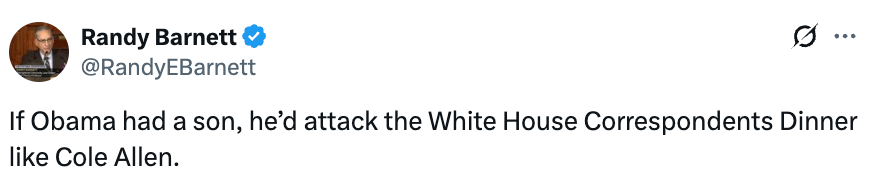
post:
In
case
you’re
missing
the
context
—
and
the
level
of
sheer
racism
is
distracting
—
Barnett
is
trying
to
mirror
Obama’s
2012
remark
that
“If
I
had
a
son,
he’d
look
like
Trayvon,”
which
the
former
president
offered
after
George
Zimmerman
stalked
and
killed
a
Black
teenager
for
walking
through
the
neighborhood
with
a
bag
of
Skittles.
Obama
got
emotional
imagining
this,
Barnett
jokes
about
it
because,
you
know,
racism.
Barnett’s
conservative
fellow
travelers
are
hailing
the
quip
as
clever
satire,
because
snarky
callbacks
to
14-year-old
political
speeches
about
the
violent
death
of
innocent
children
is
kneeslapping
entertainment
to
the
sort
of
people
who
say
“why
can’t
we
tell
jokes
anymore?”
and
then
this
is
the
joke.
Barnett’s
version
trips
over
its
own
laces
before
it
gets
to
the
punchline.
The
point
of
Obama’s
line
was
about
appearance
—
about
how
Black
kids
in
this
country
with
nothing
else
in
common
can
be
killed
simply
because
there
are
white
people
who’ve
decided
based
on
mere
appearance
that
they
pose
a
threat.
Barnett’s
supposedly
clever
inversion
crafts
something
meaningfully
stupider:
that
someone
who
looks
like
Obama’s
son
would
necessarily
be
a
violent
menace
to
society.
Rather
than
inverting
Obama’s
observation,
Barnett
reveals
himself
as
precisely
the
sort
of
white
guy
who
thinks
how
someone
looks
makes
them
a
threat.
You
really
cannot
overestimate
the
level
of
status
trauma
a
lot
of
white
Americans
experienced
at
the
election
of
Barack
Obama
and
how
much
of
our
politics
is
still
influenced
by
it.
Because
Barnett’s
attempt
at
comedy
isn’t
just
racist.
It’s
the
entire
psychic
boo
boo
of
right-wing
politics
distilled
into
a
Tweet.
It’s
always
about
having
to
watch
a
Black
guy
be
powerful
for
8
years.
That’s
the
lens.
Lately,
Randy
Barnett
has
embraced
a
role
as
one
of
the
loudest
cheerleaders
for
the
Trump
administration’s
effort
to
read
the
Citizenship
Clause
of
the
Fourteenth
Amendment
out
of
the
Constitution.
He
co-authored
the
New
York
Times
op-ed
attempting
to
slap
together
the
pseudo-intellectual
scaffolding
for
Trump’s
executive
order
to
deny
citizenship
to
children
born
here
to
non-citizen
parents.
But,
despite
fancying
himself
a
Fourteenth
Amendment
expert
(who
wrote
a
2021
book
titled
The
Original
Meaning
of
the
Fourteenth
Amendment:
Its
Letter
and
Spirit),
Barnett
seems
to
have
never
previously
considered
the
idea
that
the
birthright
citizenship
clause
and
the
125
years
of
precedent
that
goes
with
it
meant
anything
other
than
what
it
says.
Apparently,
his
years
of
scholarly
attention
to
the
Fourteenth
Amendment
totally
whiffed
on
this
point
until
Stephen
Miller
pointed
it
out.
Originalism
is,
after
all,
a
serious
endeavor.
This
all
springs
from
the
same
place.
Consistency
and
principle
are
unnecessary
trifles
in
a
politics
fully
defined
by
lashing
back
against
the
event
of
a
Black
president.
If
the
law
professor
needs
to
make
a
racist
joke
about
Obama’s
hypothetical
son
to
register
his
objection
to
that
fact,
he’ll
make
the
racist
joke.
If
he
needs
to
discover,
a
century
and
a
half
after
ratification,
that
the
Fourteenth
Amendment
doesn’t
mean
what
every
court
has
ever
said
it
means,
he’ll
discover
it.
There
is
no
honest
reading
of
Barnett’s
tweet
that
isn’t
ugly.
It
is
racist
as
a
literal
claim,
as
an
attempted
joke,
and
as
a
matter
of
revealed
worldview.
But
it
is
refreshing
to
see
one
of
the
figures
charged
with
providing
the
bogus
intellectual
cover
for
retrograde
bigotry
drop
the
charade
for
a
second
and
reassure
everyone
that
there
isn’t
a
high-minded
argument
for
this
project.
It’s
just
racism
and
Obama-era
grievances
all
the
way
down.
Photographer:
Graeme
Sloan/Bloomberg
via
Getty
Images
Yesterday,
Acting
Attorney
General
Todd
Blanche
stepped
up
to
the
podium
to
give
a
straightforward
criminal
investigation
update
on
the
White
House
Correspondents’
Dinner
shooting
—
the
kind
of
routine
law
enforcement
briefing
that
happens
after
any
high-profile
incident.
And
then
he
explained
that
investigators
had
been
unable
to
recover
all
the
physical
evidence
from
the
scene
because,
when
weapons
are
fired
inside
a
hotel,
evidence
recovery
is
“not
an
exact
science”
and
“sometimes
you
find
the
bullet,
and
sometimes
it
just
disappears.”
It
just
disappears.
Blanche
says
evidence
recovery
is
“not
an
exact
science”
and
that
when
weapons
are
fired
[inside
a
hotel],
“sometimes
you
find
the
bullet,
and
sometimes
it
just
disappears.”
Now,
to
be
fair:
we
are
a
society
that
has
badly
over-indexed
on
forensic
procedurals.
Gil
Grissom
is
not
walking
through
that
door.
Real
crime
scenes
are
messy,
chain
of
custody
is
complicated,
and
the
CSI
effect
has
been
warping
jury
expectations
in
ways
that
have
driven
defense
attorneys
crazy
for
20
years.
Bullets
do
sometimes
end
up
in
unexpected
places.
All
of
that
is
true.
But
holding
a
press
conference
where
the
Acting
Attorney
General
shrugs
and
says
the
bullet
kind
of
just
vanished
is
Keystone
Cops-level
shit.
Not
because
it
isn’t
technically
possible.
But
because
you
have
already
handed
the
conspiracy
theorists
the
keys
to
the
car,
and
“sometimes
it
just
disappears”
is
them
finding
the
gas
pedal.
We
said
it
before
and
we
will
say
it
again:
there
is
no
credible
evidence
this
was
a
false
flag.
The
suspect
sent
his
family
an
apology
note
10
minutes
before
the
attack.
The
evidence
points
to
exactly
what
it
looks
like.
But
false
flag
theories
do
not
run
on
evidence.
They
run
on
the
appearance
of
suspicious
incompetence,
and
the
DOJ
is
currently
providing
that
in
quantities
that
would
satisfy
even
the
most
demanding
conspiracy
theorist.
The
sequence
of
events
the
online
crowd
is
now
working
with:
shooting
occurs
at
event
Trump
chose
to
attend
and
chose
not
to
designate
as
a
high-security
event;
DOJ
sends
letter
to
opposing
counsel
demanding
ballroom
lawsuit
be
dropped
within
hours;
DOJ
holds
press
conference
and
confirms
it
cannot
account
for
all
the
physical
evidence
because
bullets
sometimes
just
disappear.
The
DOJ
did
not
plan
any
of
this
as
a
coherent
narrative.
It
is
just
what
happened.
But
it
is
really
something
as
a
coherent
narrative.
There
is
also
the
small
matter
of
Blanche’s
words
now
living
permanently
in
the
record.
The
Deputy
Attorney
General
of
the
United
States,
on
camera,
stating
that
evidence
recovery
is
not
an
exact
science
and
that
bullets
fired
inside
buildings
sometimes
just
vanish.
Defense
attorneys
in
federal
cases
from
coast
to
coast
are
already
reaching
for
their
screenshot
buttons.
Expect
“as
the
Acting
Attorney
General
himself
acknowledged”
to
appear
in
suppression
motions
for
years.
The
DOJ
handed
every
defendant
challenging
forensic
evidence
a
pull
quote,
and
he
doesn’t
even
seem
to
realize
his
blunder.
Kathryn
Rubino
is
a
Senior
Editor
at
Above
the
Law,
host
of The
Jabot
podcast,
and
co-host
of Thinking
Like
A
Lawyer.
AtL
tipsters
are
the
best,
so
please
connect
with
her.
Feel
free
to
email her with
any
tips,
questions,
or
comments
and
follow
her
on
Twitter @Kathryn1 or
Bluesky @Kathryn1
As
AI
chatbots
become
more
popular
in
mental
healthcare,
the
American
Medical
Association
is
urging
Congress
to
strengthen
safeguards.
The
organization
sent
letters
to
the
Congressional
Artificial
Intelligence
Caucus,
the
Congressional
Digital
Health
Caucus
and
the
Senate
Artificial
Intelligence
Caucus.
The
letters
follow
numerous
reports
of
AI
chatbots
encouraging
suicide
and
self-harm
among
vulnerable
populations.
Congress
held
hearings
on
the
role
of
AI
in
mental
health
last
year,
which
“emphasized
several
critical
mental
health
concerns,
including
emotional
dependency
on
AI
systems,
the
potential
distortion
of
reality
through
prolonged
interaction
with
chatbots,
and
the
current
lack
of
consistent
safety
protocols,”
the
AMA
said
in
the
letters.
These
hearings
showed
the
need
for
“immediate
attention”
to
ensure
AI
tools
don’t
harm
those
seeking
mental
health
support,
the
letter
added.
That
said,
the
AMA
acknowledged
that
AI
tools
could
be
potentially
valuable
in
mental
health
care
if
used
safely.
“Across
the
country,
patients
persistently
struggle
to
access
mental
health
care,
either
for
reasons
of
access
or
affordability,”
the
AMA
said.
“Well-designed
AI-enabled
tools
may
serve
as
supportive
resources
that
expand
access
to
evidence-based
information,
facilitate
early
identification
of
mental
health
concerns,
and
connect
individuals
with
appropriate
clinical
services.
When
developed
and
deployed
within
clear
regulatory
guardrails,
these
technologies
have
the
potential
to
complement,
not
replace,
clinicians
and
help
mitigate
persistent
workforce
shortages
and
other
access
issues.”
The
AMA
provided
several
recommendations
for
AI
chatbot
safeguards,
including:
Improve
transparency:
Require
chatbots
to
clearly
disclose
that
users
are
communicating
with
AI,
as
well
as
ban
systems
from
presenting
themselves
as
licensed
clinicians.
Create
clear
regulatory
boundaries:
Prevent
chatbots
from
diagnosing
or
treating
mental
health
conditions
without
the
right
regulatory
review.
The
AMA
calls
on
Congress
to
direct
agencies
to
create
a
“modern,
risk-based
oversight
framework
and
clarify
when
AI
tools
qualify
as
medical
devices.”
Improve
oversight:
Require
ongoing
safety
monitoring,
reporting
of
adverse
events
and
strict
standards
for
technology
used
by
children
and
adolescents.
Protect
privacy
and
security:
The
AMA
called
for
rigid
data
protection
standards,
such
as
limits
on
data
collection
and
retention
and
clear
user
consent
for
data
use.
Limit
commercial
use:
Ban
advertising
on
mental
health
chatbots,
especially
for
minors.
“AI-enabled
tools
may
help
expand
access
to
mental
health
resources
and
support
innovation
in
health
care
delivery,
but
they
lack
consistent
safeguards
against
serious
risks,
including
emotional
dependency,
misinformation,
and
inadequate
crisis
response,”
said
Dr.
John
Whyte,
AMA
CEO,
in
a
statement.
“With
thoughtful
oversight
and
accountability,
policymakers
can
support
innovation
and
ensure
technologies
prioritize
patient
safety,
strengthen
public
trust,
and
responsibly
complement—not
replace—clinical
care.”
*
SEC
begs
Congress
for
legislative
action
on
crypto
regulation.
Congress
nodded
and
held
a
press
conference
about
using
taxpayer
dollars
to
build
a
ballroom
instead.
[National
Law
Journal]
*
Big
day
for
Milbank
as
one
of
its
own
breaks
world
record
for
fastest
marathon
dressed
as
a
comic
character.
[LegalCheek]
*
Southern
University
looks
to
open
a
new
law
school.
[ABA
Journal]
*
White
House
officially
endorses
renaming
ICE
as
“NICE,”
which
will
absolutely
be
pronounced
“Nice-ee”
to
sound
like
Nazi
because
the
White
House
is
incapable
of
thinking
things
through.
[Mother
Jones]
*
When
it
comes
to
charges
against
Terry
Rozier,
hopefully
you
took
the
over.
[Courthouse
News
Service]
Posting
on
X,
Mliswa
launched
a
scathing
attack
on
Chiwenga,
alleging
that
the
Vice
President
was
pandering
to
social
media
narratives
and
opposition
sentiment
by
engaging
in
what
he
described
as
“content
creation”.
His
remarks
followed
the
circulation
of
a
viral
video
showing
Chiwenga
addressing
congregants
at
a
Roman
Catholic
Church
gathering
in
Murewa
over
the
weekend,
where
he
reflected
on
biblical
themes
during
an
address.
In
the
footage,
Chiwenga
turned
to
the
Book
of
Isaiah
and
the
biblical
account
of
King
Hezekiah.
In
his
narration,
he
recounted
how
the
prophet
Isaiah
warned
Hezekiah
to
“put
his
house
in
order”
as
his
time
had
come,
and
how
the
king
initially
resisted
the
message.
He
said
God
later
granted
Hezekiah
an
additional
15
years
of
life,
a
reprieve
he
suggested
ultimately
proved
fraught
with
consequences.
Critics
have
since
argued
that
Chiwenga’s
choice
of
scripture
carried
pointed
political
undertones,
coming
at
a
sensitive
moment
amid
Mnangagwa’s
reported
push
to
reshape
the
Constitution
and
extend
his
hold
on
power.
Wrote
Mliswa:
“This
is
as
brazen
an
attack
on
the
President
as
one
can
ever
give
and
coming
from
his
own
Deputy
its
shocking.
For
one
so
close
to
the
President
to
resort
to
this
is
diplomatically
gross
and
strategically
poor.
“The
VP
is
now
seriously
endangering
his
standing
by
pandering
to
the
whims
of
social
media
and
the
opposition
by
indulging
in
content
creation.
“The
subject
matter,
which
he
poorly
dresses
in
Biblical
frocks
instead
of
explicitly
stating
his
opposition
to
CAB3,
as
any
serious
politician
would
do,
shows
his
level
of
frustration.
“Politically,
the
man
has
been
outmanoeuvred,
and
if
he
is
sincere
that
he
opposes
what
ZANU
PF
has
come
to
represent,
then
he
should
resign
like
any
self-respecting
leader.
“What
he
is
contesting
is
a
party
decision,
and
he
can’t
continue
within
an
entity
whose
thinking
and
direction
he
doesn’t
accept!
“Resigning,
not
metaphors,
is
the
only
redemptive
path
for
him.
“He
should
resign
and
then
canvass
for
the
support
of
the
opposition,
which
he
is
clearly
pandering
to,
against
his
own
party.
“CAB3
is
not
the
product
of
any
single
individual
but
is
a
ZANU
PF
project,
a
party
to
which
he
belongs.
“He
cannot
reduce
it
to
any
single
Hezekiah
when
he
has
been
part
of
the
Cabinet
that
approved
it.”
Mliswa
claimed
that
Chiwenga
had
become
ZANU-PF’s
principal
internal
opposition
figure,
allegedly
fuelling
tension
and
instability
through
what
he
described
as
veiled
attacks.
“He
failed
to
block
the
resolution
from
the
Conference,
Politburo,
Central
Committee,
Cabinet,
Public
Hearings,
and
we
are
now
reaching
the
Parliament
stage,”
argued
Mliswa
“For
the
ruling
party,
he
has
become
the
main
opposition,
providing
fodder
for
continued
tension
and
instability
through
such
veiled
attacks.
“The
biggest
takeaway
from
all
this
is
that
he
lacks
the
necessary
political
muscle
and
internal
support
for
anything
of
significance.
“That’s
a
hard
truth
which
the
doomsday
prophets
should
quickly
recognise
and
stop
putting
pressure
on
him
to
become
some
action
hero.
“Party
members
have
accepted
the
party’s
decisions
and
moved
on.
Only
social
media
and
the
motley
crowd
of
illusionists
hanging
in
shadows
amount
to
the
‘army’
that
is
beckoning
him
into
what
will
surely
amount
to
self-immolation.
“Fuelled
by
this
‘virtual
army’,
he
has
instigated
multiple
political
infractions,
goading
President
Mnangagwa,
who
has
himself
remained
dignified
and
quiet.
ED’s
patience
and
Long-Game
tactics
are
clearly
unsettling
him.
“It’s
just
that
the
political
standards
for
the
opposition,
which
has
embraced
him
on
social
media,
are
very
low,
such
that
they
can’t
recognise
the
absurdity
of
the
VP
remaining
part
of
the
machinery
which
they
deride
and
yet
embrace
him
as
a
shining
light.
“For
the
ruling
party,
he
is
becoming
a
liability
publicly
questioning
party
resolutions
and
feeding
the
public
mentality
with
treasonous
thoughts.”
Zimbabwe
is
facing
a
deepening
health
emergency
after
423
people
died
and
154,000
malaria
cases
were
recorded,
as
climate
change
is
blamed
for
fuelling
the
rapid
spread
of
the
disease
into
new
areas.
Health
advocates
warn
the
situation
could
worsen,
with
outbreaks
intensifying
in
provinces
such
as
Mashonaland
West
and
critical
shortages
of
mosquito
nets
undermining
prevention
efforts.
Climate
Change
Driving
Spread
Into
New
Areas
According
to
ZiFM
Stereo
News,
the
Community
Working
Group
on
Health
(CWGH)
confirmed
that
Zimbabwe
recorded
154,000
malaria
cases
and
423
deaths
in
2025,
raising
alarm
among
public
health
experts.
CWGH
Executive
Director
Itai
Rusike
said
environmental
changes
are
playing
a
major
role
in
the
resurgence.
“The
resurgence
of
malaria
is
closely
linked
to
climate-related
changes
and
health
system
challenges.
Erratic
rainfall
patterns,
rising
temperatures,
and
flooding
have
expanded
mosquito
breeding
sites
and
extended
transmission
seasons,
even
into
areas
previously
considered
low-risk,”
said
Rusike.
He
warned
that
the
trend
threatens
to
undo
years
of
progress
in
controlling
the
disease.
“The
recent
increase
in
malaria-related
illness
and
deaths
threatens
to
reverse
progress
made
over
the
years,
particularly
in
vulnerable
rural
communities,”
he
added.
Globally,
experts
project
that
climate
change
could
contribute
to
more
than
550,000
additional
malaria
deaths
by
2050,
largely
driven
by
extreme
weather
disruptions.
Health
officials
said
infections
are
rising
بسرعة
(quickly),
with
64
new
cases
recorded
within
24
hours.
Authorities
also
raised
concern
over
the
unavailability
of
insecticide-treated
mosquito
nets
across
affected
districts.
“Insecticide-treated
nets
are
currently
out
of
stock
across
targeted
districts,
although
orders
have
been
placed,”
officials
said.
Districts
such
as
Hurungwe,
Sanyati
and
Kariba
have
recorded
some
of
the
highest
case
numbers,
while
children
under
five
and
pregnant
women
remain
the
most
vulnerable.
“Early
diagnosis
and
prompt
treatment
remain
critical
to
prevent
fatalities,”
health
officials
stressed.
Health
System
Gaps
Expose
Communities
Experts
say
the
crisis
is
being
worsened
by
challenges
within
the
health
system,
including
delays
in
indoor
residual
spraying,
logistical
constraints
and
increasing
insecticide
resistance.
Rusike
emphasised
the
need
to
strengthen
community-based
responses.
“Ensuring
village
health
workers
are
adequately
supported,
trained,
and
supplied
with
Rapid
Diagnostic
Tests
will
enhance
early
diagnosis
and
treatment
at
the
community
level,
saving
lives,”
he
said.
The
CWGH
has
also
called
for
increased
domestic
funding
for
malaria
programmes,
urging
authorities
to
ring-fence
resources
such
as
the
sugar
tax
and
airtime
levy
to
reduce
dependence
on
donors.
The
warning
comes
as
the
world
marked
World
Malaria
Day
under
the
theme
“Driven
to
End
Malaria:
Now
We
Can,
Now
We
Must,”
highlighting
the
urgency
of
sustained
action.
Health
authorities
continue
to
urge
communities
to
remain
vigilant,
seek
treatment
early
and
adopt
preventive
measures
as
the
malaria
season
persists.