Biglaw Chairman Says U.S. Lawyers Just ‘Work Harder’ – And Firms Are Paying Big Money To Keep Them – Above the Law


Ed.
note
:
Welcome
to
our
daily
feature, Quote
of
the
Day
.


Law
practice
at
the
highest
level,
especially
litigation,
is
a
labour-intensive
exercise.
There
really
aren’t
any
shortcuts.
There
are
no
‘Einsteins’
that
enable
you
to
do
projects
and
get
right
to
the
end
sooner
because
you’ve
had
a
flash
of
brilliance.


It’s
hard
work,
it’s
time
consuming.
I’ve
seen
data
that
indicates
US
firms
on
average
tend
to
work
much
longer
hours,
or
materially
longer
hours.
You
could
say
that
maybe
the
British
firms
have
a
healthier
sense
of
work-life
balance,
that
may
be
one
explanation.


— John
Quinn
,
executive
chairman
of
Quinn
Emanuel,
in
comments
given
to

The
Times
,
concerning
the
tendency
of
lawyers
at
U.S.
firms
in
London
to
work
more
hours
than
their
counterparts
in
British
firms.
“US
firms,
they
may
work
harder,
that’s
one
thing,”
Quinn
went
on
to
say.
“The
other
thing
is,
you
see
these
stories
about
partners
being
poached
by
[American]
firms
in
London
and
the
US
as
well,
with
large
sums
being
enticed
to
make
moves
with
very
large
increases
in
compensation.
I
think
they’d
be
more
willing
to
do
that,
and
they
have
more
money,
they
have
more
wherewithal,
too.”


Staci
Zaretsky
 is
the
managing
editor
of
Above
the
Law,
where
she’s
worked
since
2011.
She’d
love
to
hear
from
you,
so
please
feel
free
to email her
with
any
tips,
questions,
comments,
or
critiques.
You
can
follow
her
on BlueskyX/Twitter,
and Threads, or
connect
with
her
on LinkedIn.

Former Minority Student Dean Sues Rutgers Law Over Firing – Above the Law

Picking
a
dean
can
come
down
to
a
games
of
politicking.
Firing
deans
can
too.
Over
the
last
few
years,
we’ve
seen
employers
nix
diversity-focused
positions
to
avoid
getting
sued
because
the
Supreme
Court
decided
that
the
Fourteenth
Amendment
hates
measures
that
help
minorities
enjoy
privileges
and
rights
long
denied
to
them,
actually.
Clifford
Dawkins
Jr.,
a
former
assistant
dean
at
Rutgers
Law,
was
fired
over
his
responses
to
diversity
matters.
He
recently
launched
a
suit
over
his
treatment
at
Rutgers
Law.

Reuters

has
coverage:

[Clifford
Dawkins
Jr.]
said
in
a
new
lawsuit
that
he
was
fired
after
he
questioned
how
funds
raised
for
​diversity
efforts
were
spent
and
school
officials
accused
him
of
“watering
down”
a
‌minority
student
program
in
the
wake
of
the
U.S.
Supreme
Court’s
2023
decision
banning
the
consideration
of
race
in
admissions.

Firing
a
dean
for
questioning
where
the
money
goes?
Considering
that
fundraising
is
a
huge
part
of
their
job
description,
wouldn’t
it
make
sense
for
them
to
have
some
interest
in
making
sure
that
the
money
goes
toward
the
stated
ends?
Let’s
look
at
the
details:

Dawkins
said
his
relationship
with
Bond
began
to
sour
in
2023
when
he
objected
to
‌the
⁠school
using
about
$20,000
raised
during
the
Minority
Student
Program’s
annual
gala
toward
an
overall
law
school
deficit.

At
face
value
that
sort
of
objection
makes
total
sense.
Granted,
2023
was
a
watershed
year
in
terms
of
diversity-related
managerial
decisions
for
obvious
reasons,
but
that
doesn’t
mean
you
should
be
able
to
just
redirect
funds
given
for
a
specific
reason
willy-nilly.
The
second
pain
points
also
seems
to
have
strong
roots
in
the
Court’s

SFFA
v.
Harvard

decision:

Dawkins
said
​he
faced
further
hostility
⁠after
he
sought
in
2025
to
include
white
and
affluent
students
in
the
Minority
Student
Program
in
an
effort
to
ensure
​it
complied
with
the
Supreme
Court’s
2023
ruling.

Again,
appears
to
be
fair
game.
It
should
have
been
obvious
that
a
new
basis
for
diversity

race-based
or
otherwise


should
have
been
thoroughly
fleshed
out

in
light
of
mounting
pressure
to
de-divers
duifye
to
ahistoric
readings
of
the
Fourteenth
Amendment

being
preferred
to
the
truth

and
Trump
promising
to
get
rid
of
DEI
to
bring
back

merit-based
leadership
and
competent
decision
making
.
No
clue
on
the
ETA
on
that;
it
seems
like
the
identity
preference
just
shifted
toward

demanding
fealty
to
Trump
if
they
want
summer
jobs
.
Orange
really
is
the
new
Black,
I
guess.

Jokes
aside,
Dawkins’s
inclusion
of
White
and
affluent
students
seems
less
like
“watering
down”
the
the
program
(again,
few
things
could
douse
it
more
than

SFFA
v.
Harvard
)
and
more
like
good
optics.
Just
look
at
the
basis
for
so
many
of
the
spite
suits
we’ve
seen
recently.
FASORP
suing
Northwestern
because
they
aren’t
White
enough
deserves
a
mention,
but
the
biggest
mover
in
this
space
might
be

Blum
&
Co.
suing
any
and
every
summer
program

that
was
focused
on
law
students
hailing
from
historically
underrepresented
groups
in
the
legal
industry.
Few
things
would
serve
as
terminal
defense
in
a
lawsuit
like
being
able
to
point
to
Old
Money
Steve™
to
show
that
the
minority
group’s
actions
are
in
line
with
SCOTUS
holdings.
Also,
can
we
be
honest
with
each
other?
Many
minority
groups
have
been
open
to
anyone
who
wants
to
join
for
a
while
now


here’s
an
article

on
Harvard’s
BLSA
opening
themselves
up
to
non-Black
members

over
30
years
ago
.
It
looks
like
the
watering
down
accusation
assumes
some
level
of
“purity”
that
hasn’t
been
the
case
for
decades.

On
balance
there
are
worse
ways
to
engage
cautiously
with
SCOTUS
canning
diversity.
It
isn’t
like
he
said
the
students
couldn’t
use
the
word
Black
on
any
of
their
advertisements
or
anything.

The
complaint
alleges
additional
inequities
like
barring
him
from
speaking
at
faculty
meetings,
a
defamation
claim,
and
unnecessary
investigations
into
legal
work
he’s
done
outside
of
the
university.
He’s
suing
for
reinstatement,
back
pay,
and
punitives.
Whatever
the
outcome,
I
hope
that
it
benefits
the
students.


Ex-Minority
Student
Dean
Sues
Rutgers
Law
School
Over
Firing

[Reuters]


Chris
Williams
became
a
social
media
manager
and
assistant
editor
for
Above
the
Law
in
June
2021.
Prior
to
joining
the
staff,
he
moonlighted
as
a
minor
Memelord™
in
the
Facebook
group Law
School
Memes
for
Edgy
T14s
.
 He
endured
Missouri
long
enough
to
graduate
from
Washington
University
in
St.
Louis
School
of
Law.
He
is
a
former
boat
builder
who
is
learning
to
swim
and
is
interested
in
rhetoric,
Spinozists
and
humor.
Getting
back
in
to
cycling
wouldn’t
hurt
either.
You
can
reach
him
by
email
at [email protected]
and
by
tweet
at @WritesForRent.

SCOTUS Justices Air Internal Debate Over Shadow Docket At Public Event – Above the Law

via
ChatGPT

Last
night,

at
an
event

honoring
the
late
Judge
Thomas
Flannery
of
the
U.S.
District
Court
of
Washington,
D.C.,
Justices
Ketanji
Brown
Jackson
and
Brett
Kavanaugh
found
themselves
on
opposite
sides
of
one
of
the
Supreme
Court’s
most
controversial
procedural
tools:
the
so-called
shadow
docket.

When
asked
about
the
emergency
docket
by
moderator
Judge
Paul
Friedman,
Justice
Jackson
was
not
subtle
about
her
concerns.

“The
administration
is
making
new
policy

and
then
insisting
the
new
policy
take
effect
immediately,
before
the
challenge
is
decided,”
Jackson
said,
drawing
applause
from
the
room.
“This
uptick
in
the
court’s
willingness
to
get
involved
in
cases
on
the
emergency
docket
is
a
real
unfortunate
problem.”

According
to
Jackson,
the
practice
risks
distorting
the
judicial
process
itself.
The
Court
is
“creating
a
kind
of
warped”
legal
process,
she
said,
effectively
predicting
how
a
case
will
come
out
before
the
parties
have
fully
developed
the
arguments.

Justice
Kavanaugh,
however,
was
having
none
of
the
suggestion
that
the
emergency
docket
is
some
sort
of
bespoke
service
for
one
particular
president.
Even
though,
you
know,

scoreboard.

(A
recent
analysis
by
Court
Accountability
found
that
the
Trump
administration
has
enjoyed
an
eye-popping
84%
success
rate
at
the
Supreme
Court,
with
much
of
that
success
coming
through
emergency
orders
rather
than
the
Court’s
traditional
merits
docket.)

Kavanaugh
pushed
back,
arguing
that
emergency
applications
are
a
structural
feature
of
modern
governance,
not
a
partisan
one.

“It’s
not
unique
to
the
Trump
administration,”
he
explained.
As
passing
legislation
through
Congress
becomes
harder,
administrations
increasingly
rely
on
executive
actions
and
aggressive
regulatory
efforts.
That
inevitably
leads
to
litigation,
and
requests
for
emergency
relief.

Administrations
“push
the
envelope
in
regulations,”
Kavanaugh
said.
“Some
are
lawful,
some
are
not.”

In
his
telling,
critics
of
the
Court’s
emergency
work
have
“short
memories.”
The
Biden
administration
also
regularly
sought
emergency
intervention
when
lower
courts
blocked
its
policies.

And
when
those
requests
land
at
One
First
Street,
the
Court
has
to
do
something
with
them.

Jackson,
who
clerked
at
the
Court
around
the
same
time
as
Kavanaugh,
wasn’t
convinced
that
the
Court’s
current
posture
is
inevitable.

“I
think
it’s
because
the
Supreme
Court
has
shown
a
willingness
to
grant
these
emergency
motions,”
she
replied.

“Brett
will
remember
that
when
we
clerked
some
20
years
ago,
this
was
not
the
Supreme
Court’s
stance,”
Jackson
added.
“Just
because
these
motions
were
filed
[didn’t
mean]
the
Court
actually
had
to
entertain
and
grant
them
on
their
merits.”

Justice
Jackson
thinks
the
Court
should
take
a
page
from
old
school
parents
and
say
no
more
often.

The Path To AI Maturity: What Leaders Should Consider In The Coming Year – Above the Law

AI
has
reached
a
tipping
point
in
the
legal 
industry.
What
was
once
experimental
is
now 
shaping
how
legal
teams
operate,
compete,
and 
deliver
results.
But
while
adoption
is 
accelerating,
maturity
levels,
use
cases,
and 
confidence
in
AI
still
vary.

Please
join
us
on

March
31st
at
1
p.m.

and
we’ll
break
down
the
most
important
findings
from
Litify’s
2025
State
of
AI
in
Legal
Report
and
examine
what
they
mean
for
legal
teams.
Moderated
by
Litify
and
featuring
voices
from
across
the
legal
industry,
the
conversation
will
explore
what’s
driving
AI
adoption,
the
challenges
teams
are
facing,
and
what
law
firms
and
legal
teams
should
prioritize
in
the
next
3–12
months.

We’ll
discuss:

>Why
AI
has
become
unavoidable
in
legal
operations
>How
legal
teams
are
progressing
along
the
AI
maturity
curve
>Why
teams
started
using
AI
and
what
their
approach
looks
like
today
>The
biggest
challenges
and
misconceptions
around
AI
adoption
>What
leaders
should
be
doing
now
to
prepare
for
what’s
next

Whether
you’re
early
in
your
AI
journey
or
looking
to
scale
more
advanced
use
cases,
this
session
will
provide
data-backed
insights
and
peer
perspectives
to
help
you
move
forward
with
confidence.

1
hour

CLE
credit

is
available
for
live
attendees.


Navigating Law Firm Mergers: Communication, Culture, And The Marketer’s Influence – Above the Law


Ed.
note:

This
article
first
appeared
in
Strategies
&
Voices
,

an
LMA
publication.

My
first
exposure
to
a
law
firm
merger
was
in
2004,
long
before
combinations
became
as
common
as
they
are
today.
At
the
time,
I
was
a
legal
marketing
contractor
trying
to
break
into
the
industry,
and
I
accepted
an
assignment
supporting
the
marketing
department
of
Hale
and
Dorr
as
the
firm
was
merging
with
Wilmer
Cutler
Pickering.
Both
firms
were
highly
respected
and
deeply
rooted
in
their
markets.
For
someone
eager
to
understand
the
business
of
law,
watching
two
trusted
brands
come
together
felt
like
stepping
behind
the
curtain
at
exactly
the
right
moment.

Twenty-one
years
later

after
shepherding
hundreds
of
lateral
transitions
and
supporting
two
major
law
firm
mergers
from
the
inside

I
have
a
far
more
nuanced
perspective.
I’ve
experienced
both
sides
of
the
equation:
once
as
part
of
the
larger
partner
absorbing
another
firm,
and
once
as
the
smaller
partner
joining
a
far
bigger
platform.

Now,
as
a
consultant,
I
often
coach
attorneys
and
business
professionals
through
mergers,
helping
them
understand
the
business
drivers,
anticipate
cultural
shifts
and
position
themselves
for
opportunity.

What
I
know
for
certain
is
this:
Mergers
are
far
more
than
a
press
release,
and
they
reverberate
through
every
layer
of
the
firm.
Done
well,
they
create
opportunities
for
growth,
expanded
client
service
and
cultural
renewal.
Done
poorly,
they
introduce
confusion
or
cultural
drift.
The
difference
almost
always
comes
down
to
communication,
leadership
and
a
willingness

individually
and
collectively

to
engage
with
change.


A
Tale
of
Two
Mergers:
Being
the
Bigger
Partner
and
the
Smaller
Partner

Experiencing
a
merger
as
the
larger
firm
feels
very
different
from
experiencing
it
as
the
smaller
one.
When
my
firm
absorbed
a
smaller
practice,
our
culture
naturally
became
the
default.
We
had
the
infrastructure,
processes,
and
governance,
and
the
incoming
lawyers
were
trying
to
learn
how
things
worked
at
our
firm.
The
challenge
for
us
was
to
avoid
what
I
call
the
“dominant
partner
blind
spot”:
failing
to
recognize
the
anxiety
and
identity
loss
that
can
accompany
being
acquired.

Years
later,
when
the
tables
turned,
I
found
myself
in
the
opposite
position,
joining
a
firm
many
times
our
size.
Even
as
a
senior
professional,
I
felt
some
of
the
same
uncertainty
my
lawyers
expressed:
How
will
we
fit
in?
How
will
decisions
be
made?
What
expectations
will
change?

What
parts
of
our
culture
will
endure,
and
what
parts
will
disappear?

Both
perspectives
taught
me
that
people
at
every
level,
from
the
executive
committee
to
professional
staff,
want
to
understand
what
the
change
means
for
them.
Culture
is
not
preserved
by
accident;
it
is
shaped
by
communication
and
leadership
choices.


How
Mergers
Affect
Firm
Culture

Mergers
are
cultural
events
long
before
they
are
operational
ones.
Strategically,
they
signal
what
a
firm
idealizes
for
itself:
expanded
footprint,
industry
depth,
financial
fortification,
or
broader
client
service.
This
vision
is
conceived
at
the
highest
levels,
and
although
outcomes
don’t
always
unfold
exactly
as
imagined,
the
narrative
around
why
the
merger
is
happening
provides
insight
into
the
firm’s
aspirations.

But
impacts
are
uneven.
For
some,
mergers
create
tremendous
opportunity

larger
platforms,
more
diverse
client
needs,
and
new
pathways
for
specialization
or
leadership.
For
others,
mergers
bring
uncertainty.
Some
roles
evolve;
some
become
redundant.
Lawyers
may
worry
about
internal
competition
or
compensation
alignment.
Staff
may
question
how
new
systems
or
structures
will
affect
their
day-to-day
work.

The
hardest
part
is
merging
the
invisible
infrastructure:
the
unwritten
norms
of
communication,
inclusivity
and
decision-making.
Merging
technology
systems
is
a
technical
project;
merging
values
and
behaviors
is
a
human
one.
And
depending
on
the
structure

verein
or
full
merger

true
cohesion
can
take
years.

Still,
mergers
offer
a
rare
chance
to
rethink
identity,
strengthen
values
and
intentionally
design
the
kind
of
workplace
the
firm
wants
to
be.
With
thoughtful
leadership,
mergers
can
energize
a
firm
and
refresh
its
culture.


Communicating
Internally:
What
Firms
Need
to
Get
Right

The
most
successful
mergers
I’ve
been
part
of
have
one
thing
in
common:
consistent,
human-centered
internal
communication.
Employees
can
manage
uncertainty,
but
they
struggle
with
silence.
Transparent
communication

anchored
in
facts,
intention,
and
empathy

goes
further
than
any
external
rollout.

Effective
communication
includes:


Clear
messaging
about
the
strategic
rationale

not
just
what
is
happening,
but
why.

Updates
on
what
will
change
and
what
will
remain
the
same.

Opportunities
for
two-way
dialogue,
especially
for
staff.

Acknowledgment
of
fear,
confusion,
or
fatigue
instead
of
assuming
across-the-board
enthusiasm.

Leadership
credibility
is
often
built
or
damaged
during
these
moments.


The
Legal
Marketer’s
Role:
Leading
From
Any
Seat

Legal
marketers
sit
at
a
unique
intersection
within
firms:
connected
to
leadership,
plugged
into
practice
needs,
and
attuned
to
staff
perspectives.
In
a
merger,
this
makes
you
not
only
a
communicator
but
a
cultural
translator.

Here’s
what
legal
marketers
can
do
to
support
their
lawyers,
their
teams
and
themselves.


1.
Understand
the
business
motivation
behind
the
merger.
Is
the
firm
seeking
national
expansion?
Industry
specialization?
Cross-sell
opportunities?
Financial
stability?
Knowing
the
why
helps
marketers
craft
messaging,
anticipate
client
concerns,
and
help
lawyers
position
themselves
for
growth.


2.
Be
an
ambassador

but
also
a
realist.
Marketers
naturally
step
into
the
role
of
champions,
but
it’s
equally
important
to
acknowledge
the
staff
member
who
feels
overlooked
or
the
lawyer
who
fears
losing
autonomy.
Support
people
where
they
are,
not
where
the
firm
hopes
they
will
be.


3.
Lead
within
your
sphere,
regardless
of
title.
Integration
requires
coordination,
creativity,
and
emotional
intelligence

all
core
strengths
of
seasoned
marketing
professionals.
Whether
you
oversee
a
team
or
not,
your
ability
to
bring
clarity,
reduce
friction,
and
facilitate
collaboration
will
be
invaluable.


4.
Take
care
of
yourself.
Marketers
often
shoulder
enormous
merger-related
workloads
while
navigating
their
own
uncertainty.
Give
yourself
the
same
grace
and
intentionality
you
extend
to
your
colleagues.


Final
Thoughts

No
merger
is
seamless.
They
are
layered,
unpredictable,
and
deeply
human.
But
with
transparent
communication,
thoughtful
leadership
and
a
willingness
to
embrace
possibility,
mergers
can
become
catalysts
for
growth

for
firms
and
for
the
individuals
navigating
them.


Toni
Wells
is
a
seasoned
marketing
and
business
development
leader
with
22
years
of
experience
in
the
legal
industry.
She
helps
lawyers
and
law
firms
accelerate
revenue
growth
through
targeted
business
development,
client
relationship
expansion,
and
personal
brand
elevation.
As
a
coach
and
consultant,
she
delivers
practical,
results-driven
strategies.
Toni
holds
a
master’s
degree
from
Johns
Hopkins
University
and
is
an
ICF-accredited
coach.

Clio Launches Clio Capital to Provide Fast, Low-Friction Financing for Law Firms

Clio
has
officially
launched

Clio
Capital
,
a
financing
program
designed
exclusively
for
law
firms
that
use
the
company’s
practice
management
platform.

The
product,
which
went
live
Feb.
26,
provides
eligible
law
firms
with
pre-qualified
access
to
working
capital
through
a
streamlined
application
process
directly
within
the
Clio
platform,
bypassing
the
paperwork-heavy,
rejection-prone
process
that
has
historically
made
borrowing
difficult
for
small
legal
practices.

In
an
interview
with
LawSites,
A.J.
Axelrod,
Clio’s
vice
president
of
payments
and
financial
services,
said
the
program
had
disbursed
well
over
$1
million
in
loans
within
its
first
week
of
full
operation,
with
more
than
35
loans
issued
ranging
from
$1,500
at
the
low
end
to
approximately
$218,000–$230,000
at
the
high
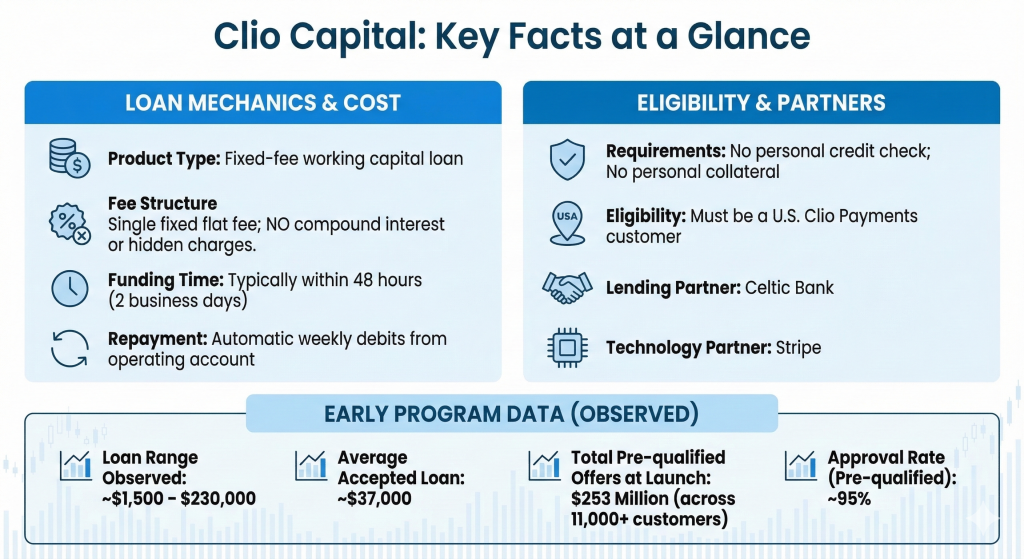
end. While
still
in
its
early
days,
the
program’s
average
accepted
loan
amount
so
far
is
approximately
$37,000.

In
total,
as
of
launch,
roughly
$253
million
in
pre-qualified
offers
had
been
extended
across
more
than
11,000
Clio
customers

though
not
all
of
those
customers
are
expected
to
accept.

Clio
Capital
loans
are
issued
by
Celtic
Bank
and
powered
by
Stripe.
The
program
is
available
now
to
eligible
Clio
Payments
customers
in
the
United
States.

A
Market
Underserved
by
Traditional
Lenders

Axelrod
said
the
motivation
for
Clio
Capital
was
the
structural
market
failure
that
has
affected
small
businesses

including
small
law
firms

for
decades.
The
traditional
loan
process
is
time-consuming,
manual
and
often
discouraging,
requiring
applicants
to
gather
financial
documents,
visit
a
bank,
complete
extensive
applications,
and
frequently
face
rejection
even
after
all
that.

Beyond
the
friction,
Axelrod
said,
banks
generally
have
little
economic
incentive
to
lend
small
amounts.
As
a
result,
firms
that
need
$1,500
or
$5,000
may
be
entirely
shut
out
of
the
traditional
lending
market

and
may
instead
resort
to
carrying
revolving
credit
card
balances
at
interest
rates
of
20–24%
or
higher.

Law
firms
also
face
a
challenge
specific
to
their
industry.
They
typically
lack
the
tangible
assets

equipment,
inventory,
real
estate

that
traditional
lenders
use
as
collateral.
Recent
regulatory
changes
to
SBA
lending
rules
have
intensified
these
pressures,
sometimes
forcing
partners
to
pledge
personal
assets
such
as
their
homes
to
secure
business
funding.

The
time
burden
also
falls
disproportionately
on
lawyers.
Every
hour
spent
packaging
financials
for
a
bank
loan
is
an
hour
not
spent
serving
clients
and
generating
revenue.
For
many
small
firm
owners,
the
calculus
simply
does
not
favor
pursuing
a
traditional
loan.

Pre-Qualification
Based
on
Payments
Data

What
is
particularly
interesting
about
Clio
Capital
is
that
it
uses
data
that
Clio
already
has
about
its
customers
to
underwrite
loans
prospectively
rather
than
reactively.

Because
Clio,
through
its
Clio
Payments
produce,
processes
payments
for
tens
of
thousands
of
law
firms,
it
has
real-time
visibility
into
billing
frequency,
payment
volumes
and
related
financial
activity.
Clio
Capital
uses
that
data
for
a
pre-qualification
process
that
evaluates
all
eligible
Clio
Payments
customers
on
a
rolling
basis.


Firms
that
meet
eligibility
criteria
receive
a
pre-qualified
offer
directly
within
Clio
Manage,
the
company’s
practice
management
application.
The
offer
includes
a
loan
amount
and
interest
rate,
and
firms
can
use
a
slider
to
adjust
the
amount
they
want
to
borrow.

Because
customers
are
pre-qualified
before
they
initiate
an
application,
Clio
projects
an
approximately
95%
approval
rate

meaning
only
about
1
in
20
customers
who
click
through
to
accept
an
offer
will
be
declined.

A
secondary
layer
of
underwriting
supplements
the
payments
data,
Axelrod
said.
Prospective
borrowers
are
asked
to
connect
their
bank
account
(with
their
consent)
so
that
additional
signals
can
be
reviewed,
such
as
whether
the
firm
has
an
active
bankruptcy
or
a
pattern
of
returned
payments.

Axelrod
described
this
step
as
designed
to
be
as
frictionless
as
possible,
and
said
it
accounts
for
most
of
the
cases
in
which
pre-qualified
customers
are
ultimately
not
approved.

Completing
the
application
typically
takes
only
a
few
minutes.
The
application
then
enters
a
brief
review
queue

usually
resolved
within
a
day

after
which
funds
are
transferred
via
ACH.
Clio
says
most
borrowers
receive
funds
in
their
bank
accounts
within
approximately
48
hours.

That
pre-qualification
process
means
that
eligibility
is
based
on
a
firm’s
business
performance
within
the
Clio
ecosystem

not
on
the
personal
credit
scores
of
the
firm’s
partners.
Borrowers
do
not
need
to
pledge
personal
assets
as
collateral.

Loan
Structure
and
Pricing

Clio
Capital
loans
are
structured
as
traditional
installment
loans,
meaning
they
have
a
fixed
repayment
schedule
with
a
defined
term
and
a
fixed
total
cost.
There
is
no
compound
interest,
and
Clio
says
there
are
no
origination
fees,
data
processing
fees
or
other
add-on
charges.

Axelrod
said
the
effective
interest
rate
Clio
has
been
seeing
runs
around
15%,
which
he
described
as
meaningfully
better
than
typical
credit
card
rates
(roughly
22–24%)
and
competitive
with
what
a
borrower
might
expect
from
a
quality
small-business
loan.

He
noted
that
some
alternative
lenders
charge
rates
of
30–40%
or
obscure
their
true
cost
with
fees,
neither
of
which
applies
to
Clio
Capital.

Each
borrower’s
offer
is
customized
based
on
their
individual
payment
history
and
risk
profile,
so
rates
and
available
loan
amounts
will
vary.

Repayment
is
handled
through
automatic
weekly
debits
from
the
borrower’s
bank
account,
which
Clio
describes
as
designed
to
keep
cash
flow
predictable
without
requiring
manual
management.

If
borrowers
run
into
difficulty
making
repayments,
Axelrod
said,
Clio
intends
to
work
with
them,
potentially
through
payment
relief
or
program
modifications,
rather
than
leaving
them
on
their
own
to
navigate
the
situation.

Partnering
with
Celtic
Bank
and
Stripe

Clio
is
not
itself
a
lender,
bank
or
licensed
depository
institution,
and
it
does
not
hold
the
loans
on
its
balance
sheet.
Instead,
the
program
operates
through
a
partnership
structure
that
Axelrod
described
as
drawing
on
the
respective
strengths
of
each
participant.

Clio
contributes
what
Axelrod
characterized
as
its
two
most
valuable
assets
for
a
lending
program:
distribution
(direct
access
to
a
large,
engaged
base
of
law
firm
customers)
and
data
(detailed,
real-time
payment
and
billing
information
that
can
be
used
to
underwrite
credit
decisions).

Celtic
Bank,
a
Utah-chartered
industrial
bank,
provides
the
regulatory
standing
and
cost
of
capital
required
to
issue
loans
at
competitive
rates.
Stripe
serves
as
the
payments
infrastructure
underpinning
the
program.

Axelrod
noted
that
navigating
the
regulatory
landscape
for
lending

which
involves
both
federal
rules
and
state-by-state
licensing
requirements

is
a
significant
undertaking
that
Clio
could
not
efficiently
manage
on
its
own.

The
bank
partnership
allows
Clio
to
offer
a
compliant
product
without
having
to
build
that
regulatory
infrastructure
internally.

Privacy
and
Data
Use

Addressing
potential
privacy
concerns,
Axelrod
said
that
Clio
discloses
throughout
the
application
process
exactly
how
customer
data
can
and
cannot
be
used.

The
program
operates
under
what
he
described
as
a
data
wrapper,
meaning
that
the
payments
data
and
lending/repayment
information
collected
as
part
of
the
program
can
only
be
used
for
purposes
within
that
program
and
cannot
be
repurposed
elsewhere
within
Clio’s
platform
or
operations.

For
example,
if
a
borrower
misses
payments
on
a
Clio
Capital
loan,
Clio
cannot
use
that
information
to
affect
the
customer’s
standing
with
respect
to
other
Clio
products.

Axelrod
said
Clio
takes
compliance
across
all
dimensions
of
the
program,
not
just
privacy,
“incredibly
seriously,”
and
he
said
that
the
company
chose
best-in-class
partners
in
part
because
of
their
compliance
capabilities.

Who
Is
Eligible

Currently,
eligibility
for
Clio
Capital
requires
that
a
law
firm
be
an
active
Clio
Payments
customer.
Payment
processing
data
is
what
drives
the
pre-qualification
engine,
so
firms
that
do
not
use
Clio
Payments
do
not
yet
qualify.

Axelrod
said
Clio
hopes
to
expand
eligibility
in
the
future
by
incorporating
additional
data
sources,
so
that
firms
using
Clio
for
practice
management
but
not
payments
might
eventually
qualify.

He
noted
that
the
program
is
starting
with
payments
data
because
that
data
provides
a
high-confidence,
real-time
signal
about
business
health
that
enables
favorable
underwriting
terms.

The
program
is
currently
available
only
in
the
United
States.
Axelrod
said
the
company
intends
to
explore
international
expansion,
but
emphasized
that
regulatory
complexity
makes
it
important
not
to
rush
into
markets
without
the
right
partners
in
place.

How
Firms
Can
Use
the
Funds

Clio
does
not
restrict
how
borrowers
use
their
loan
proceeds.
The
application
does
not
require
firms
to
state
a
specific
use
of
funds,
and
a
firm’s
stated
purpose
does
not
affect
whether
it
is
approved.

The
early
signals
suggest
a
broad
range
of
uses,
Axelrod
said.
Cash
flow
management
is
a
common
motivation

small
firms
with
irregular
revenue
still
face
predictable
obligations
such
as
payroll,
rent
and
operating
expenses.

Beyond
that,
firms
are
using
capital
to
invest
in
growth:
new
technology,
marketing,
hiring
and
other
initiatives
that
require
upfront
spending.

Axelrod
also
foresees
that
data
on
what
types
of
firms
apply
for
loans
and
how
they
use
them
could
eventually
yield
meaningful
industry-level
insights.

Axelrod
also
foresees
a
possible
positive
feedback
loop
in
the
program’s
design.
He
expects
that
borrowers
who
successfully
repay
a
loan
will
be
quickly
re-approved
for
new
financing

and
potentially
eligible
for
larger
amounts
at
lower
rates.
Successful
repayment
is
a
strong
credit
signal,
and
Clio
intends
to
use
it
to
offer
progressively
better
terms
to
reliable
borrowers.

The
goal,
as
he
described
it,
is
to
create
a
cycle
in
which
firms
that
gain
access
to
capital,
deploy
it
effectively,
grow
their
practice,
and
repay
their
loans
are
progressively
rewarded
with
cheaper,
more
accessible
financing.

Broader
Fintech
Expansion

Clio
Capital
is
not
the
company’s
first
foray
into
financial
services.
The
company
already
offers
Clio
Payments,
a
payment
processing
product,
as
well
as
a
buy-now,
pay-later
feature
for
legal
services.
Axelrod
said
that
Clio
Capital
represents
an
expansion
of
that
broader
fintech
strategy,
and
that
additional
financial
products
are
under
consideration.

He
noted
that
different
firms
have
different
financing
needs.
A
revolving
line
of
credit,
a
multi-draw
facility,
or
a
merchant
cash
advance
might
serve
some
customers
better
than
an
installment
loan.
Clio
intends
to
listen
to
customer
signals
and
develop
products
accordingly.
The
current
installment
loan
was
chosen
as
a
starting
point
because
it
is
simple,
transparent
and
broadly
applicable.


GenAI: A Slippery Slope Of Too Much Kool-Aid? – Above the Law


Legalweek 2026
,
the
massive
trade
show
more
or
less focused
on
Biglaw,
kicked
off
on
Monday,
March
9,
in
New
York. According to
the
organizers,
this
year’s
show
will
attract
some 6,000
registered
attendees
and
over
400
speakers.
That’s
big
by
any
standard. 

The
show
kicked
off
with
a
series
of
workshops.
One workshop
track
was,
not
surprisingly, entitled the “AI
workshop.”
The
topics
included
how
AI
is
shaping
the
profession,
how
to
look
at AI ROI,
and how to
lead
and
thrive
in
“the
AI-transformed Legal
Workplace.”
The
sessions
were
led
primarily
by Jeff Reihl of
LexisNexis.

It
was
the
last
of
these workshops,
which
dealt
with
human
advancement with AI
that
offered
some
interesting
insights
into
the
thinking
of lawyers and
legal professionals. Particularly
of
those
in-house and
consultants.


T
he Legal
GenAI 
Cliche

The central idea
of the
panel played off the
now cliché concept
that
AI won’t replace lawyers, but
it
may
replace
lawyers
that
don’t
use AI
or
use
it
well. The
idea
seemed
to
revolve
around
the
notion
that those
who
master
AI
and
use it appropriately will
have
more
time
for
strategic
and
critical
thinking.
(Assuming
they
know
how
to
do
that.)
As
workforces
tighten
(since
AI
can
do
more),
it
will
be
these folks who
will
be
left
standing.

Following this
logic,
the
notion
also
seemed
to
be
that the
profession
will
need
completely
different evaluation processes
and
advancement criteria based
in
large
part
on
how
well AI is
being used. As one
panelist
put
it, in
the
future, evaluation
criteria
will
center
around
“who
are
the
best
people using
these
skills.” 

In
addition, this
resulting
increased
use
of
AI
will
mean
a
decline
in the specialist
in
legal
and
more
emphasis
on
the
generalist
who
presumably
can
supplement
their
lack
of
training
and
experience
by
using
AI.
All
this
means
of
course
an
emphasis
on
AI all
the
way around.


Too
Much
Kool-Aid?

I
think
there
is
a
little
too
much
AI Kool-Aid being
consumed
right
now. Too
much
GenAI
writing. You
know
what
I
mean:

The
one
sentence
paragraph.

The
room
suddenly
got
quiet
statement.

The
real
question
is
not
this
but
that.

The
dramatic
two
sentence
conclusion.

Etc.

The
problem
is
that
in
the
process of
embracing
GenAI
as
the
be
all
and
end
all we
may
be ignoring a
few
dangers. For
example, I
have
noticed of
late the amount of
AI-written
slop
being
produced is
increasing every
day. 

The
problem is
not
only
that it’s clear
that
a
human
didn’t
take
the
time
to
write
this
slop
or
even
edit it but
it’s
also
just
not
very
good
writing.
 And if
we
keep emphasizing AI
skills
over
all
else,
this
kind
of
writing
and,
for
that
matter,
thinking,
will
become
the
norm. So
much
so
that
what
we
now
consider
good
writing, and
critical
thinking,
will
no
longer
be
the
standard
by
which
we evaluate.
And
what
is
now
good
will
no
longer
be
considered
good.

We
are
already
facing increased usage
of
AI
because
it’s
so
easy.
Why
take
the
time
to
think through a
problem
when
you
can
just
ask
ChatGPT
to
do
the
work
for
you?
It’s
too
tempting.
I
fear
the
more
we
emphasize
the
need
for
“GenAI
skills”
the
more
we
will also encourage
lazy
thinking.

It’s like
the addition
of
the
word
“at”
at
the
end
of
a sentence.
Good grammar used
to demand that
you never end
a sentencewith
a
preposition. It’s like “where’s
the
coffee
at” replaced “where’s
the
coffee.”

So
much
so
that
good grammar now
sounds,
well,
weird. And similarly thinking
that
GenAI
slop
can replace
expertise
is
dangerous
for
another
reason
as
well.


The
Rise
of
Mediocre Generalist at
the
Expense
of
Expertise

Moreover,
the
whole
notion
that
we
will
no
longer
need
the
subject
matter
expert
because
AI
can
replace
that
expertise
so
that it’s not
needed
ignores
what
makes you
an
expert.
I
wasn’t
a
good
mass
tort defense lawyer
because
I
read
about
it
on
some
GenAI
output.
I
was
good
because
I
lived through several
cases.
I
knew
from experience what
would
happen.
I
saw
patterns
and similarities in
how
people
would
react.
Do
we
really
think
that
can
be
replaced
with
a
prompt that
gets a GenAI
answer with
some
platitude? The
end
result:
mediocrity
at
the
expense
of
real
expertise.

Something
else:
those
who
are
advocating
for
an
increased
emphasis
on
greater
AI
skills
and
training
and
a corresponding
emphasis
on advancement
based on
those skills are
already
good
lawyers.
They
didn’t
become
what
they
are
by relying
on
AI. They
have critical thinking
and
writing
skills
that
were
developed
pre-AI. So, I
fear
they
have
forgotten
how
those
skills
were
honed.

In
fact,
we
may
be
ignoring
the
rule
of
unintended
consequences.
Overemphasizing GenAI
skills
and
use
risks
dragging
everyone
down
to
the
mediocre.
And
the mediocre
becomes
more
accepted than
the
good.
And
the
good
is
lost
and
replaced
in
the
process.
That’s
the
risk.


So
What
Can
Be
Done?

Make
no
mistake:
I’m
not
an
anti-AI
curmudgeon.
But
I
am
a
realist
and
what
I’m
seeing
is
a
proliferation
and
acceptance
of
GenAI-generated
stuff.
That
worries
me
since
right
now
it’s
humorous
but
tomorrow
it
may
be
accepted. 

Practicing
law
well
is
exacting
and,
frankly,
hard.
It
means
reading
the
cases,
it
means
good,
thoughtful
writing
and
editing.
It
means
using
judgment
honed
over
time.
It
takes
time
and
energy.
 Practicing
mediocre
law,
on
the
other
hand,
is
easy
and
sloppy.

Instead
of
focusing
on
how
to train
younger lawyers on
how
to
use
GenAI,
maybe
we do
something different: let’s first define
and
then emphasize what
and how
to
be a good
lawyer. Skills like
problem
solving.
Understanding
clients.
Listening. Resilience.
Knowing
the
law.
Thinking critically. We
can’t expect
good
lawyering
by saying go
use
AI
and then
just
rewarding that
use
if
we
don’t
first
define
and
develop
those
skills. 

If
we
start
there
and
then
figure
out
how
GenAI
can
enhance
those
skills,
we
may
end
up
with
lawyers with
the
skill
of those
who
are
now
talking
about
what
needs
to
change.

To quote
ChatGPT: “Practicing
law
well
is
hard.
Practicingmediocre
law
is
easy.
The
real
question
for
lawyers
is
which
path
they
are
willing
to
choose.”

Classic
GenAI
line. Sigh.


Stephen
Embry
is
a
lawyer,
speaker,
blogger,
and
writer.
He
publishes TechLaw
Crossroads
,
a
blog
devoted
to
the
examination
of
the
tension
between
technology,
the
law,
and
the
practice
of
law
.

It Took Years for Congress to Enact PBM Transparency, Delinking. What About Vertical Integration? – MedCity News

In
February,

Congress
finally
took
action

to
rein
in
PBMs
via
the
Consolidated
Appropriations
Act
of
2026.
It
included
reforms
like
the
delinking
of
PBM
compensation
from
the
price
of
a
drug
in
Medicare
Part
D
and
more
detailed
reporting
to
plan
sponsors.

But
this
is
only
the
tip
of
the
iceberg
when
it
comes
to
the
PBM
reform
that
advocates
are
calling
for.
Many
would
like
to
see
Congress
address
vertical
integration
with
insurers
and
pharmacies.
The
three
biggest
PBMs
are
owned
by
large
insurance
companies:
CVS
Health’s
Caremark,
UnitedHealth
Group’s
Optum
Rx
and
Cigna’s
Express
Scripts. 

A
bill

introduced

in
February
by
Senators
Elizabeth
Warren
(D-Massachusetts)
and
Josh
Hawley
(R-Missouri)
would
take
on
this
issue.
The
Break
Up
Big
Medicine
bill
would
“prohibit
a
parent
company
from
owning
a
medical
provider
or
management
services
organization
and
a
PBM
or
an
insurer.”
It
also
takes
action
beyond
PBMs,
such
as
banning
a
parent
company
of
a
prescription
drug
or
medical
device
wholesaler
from
owning
a
medical
provider
or
management
services
organization. 

However,
according
to
several
healthcare
policy
experts,
it’s
not
likely
that
this
will
pass.

“I
think
the
chances
of
it
passing
are
slim
to
none.
I
think
the
chances
of
it
getting
attention
and
actually
starting
conversations
and
possibly
additional
hearings
might
be
likely,
but
I
would
be
shocked
if
this
got
passed,”
said
Chris
Deacon,
principal
and
founder
of
VerSan
Consulting.

One
only
needs
to
look
at
how
long
it
took
for
the
first
set
of
PBM
reforms
to
pass
to
know
that
the
path
ahead
for
this
bill
is
rocky.

While
it’s
difficult
to
put
a
number
on
just
how
many
bills
have
been
introduced
or
reintroduced
that
involve
PBMs,
one
of
the
early
bills
can
be
traced
back
to
2011:
the

Pharmacy
Competition
and
Consumer
Choice
Act
.
This
bill
would
have
increased
transparency
of
PBMs.

Bipartisan
congressional
efforts
to
control
PBMs
really
started
to
ramp
up
in
the
last
decade,
first
with
the
introduction
of
the
Prescription
Drug
Pricing
Reduction
Act
of
2019,
which
would
have
required
more
PBM
reporting
of
rebates
and
discounts,
according
to
Meredith
Freed,
senior
policy
manager
with
KFF’s
Program
on
Medicare
Policy. 

Since
then,
numerous
other
bills
involving
PBMs
have
been
introduced
or
reintroduced,
most
not
even
making
it
past
being
referred
to
committee
(at
least

20
were
introduced

during
the
2023-2024
congressional
session).
However,
a
few
have
gotten
out
of
committee,
notably
the
Pharmacy
Benefit
Manager
Transparency
Act
of
2023
and
the
Modernizing
and
Ensuring
PBM
Accountability
Act
of
2023.

The
closest
the
U.S.
got
to
federal
PBM
reform
(prior
to
the
Consolidated
Appropriations
Act
of
2026)
was
in
December
2024
when
Congress
attempted
to
pass
a
spending
bill
that
included
changes
to
PBMs,
like
disconnecting
PBM
revenue
from
drug
prices
in
Medicare
Part
D.
But
Elon
Musk
argued
that
the
bill
included
too
much
government
waste,
and
President
Joe
Biden
later
signed
a

narrower
spending
bill

that
left
out
PBM
reform. 

“There
have
been
a
fair
number
of
bipartisan
efforts
over
the
years.

Depending
how
you
view
it,
I
think
some
people
from
the
pharmacy
side
might
have
said
this
is
a
multi-decade
effort
to
address
PBM
reform.
But
in
Congress,
the
momentum
has
really
picked
up
in
the
last
decade,”
Freed
said.

It’s
worth
noting
that
some
states
have
enacted
PBM
reform,
most
recently

California
.
Its
law
bans
spread
pricing,
the
practice
of
when
a
PBM
charges
a
health
plan
more
for
a
drug
than
it
pays
the
pharmacy
and
keeps
the
difference
as
profit.
Arkansas
also
passed
a
law
that
would
prevent
PBMs
from
owning
pharmacies,
but
a

federal
judge
blocked
it

from
being
implemented.
Arkansas
appealed
this
decision. 


Could
the
Break
Up
Big
Medicine
bill
pass?

It’s
highly
unlikely
that
the
Break
Up
Big
Medicine
bill
will
pass,
particularly
after
the
Consolidated
Appropriations
Act
of
2026
passed,
according
to
Deacon
of
VerSan
Consulting.
The
Department
of
Labor
also
recently
proposed
a
rule
that
included
additional
PBM
reforms,
and
Congress
may
be
waiting
to
see
how
these
initial
reforms
pan
out.

The
bill
also
includes
broader
reforms
preventing
parent
companies
of
a
prescription
drug
or
medical
device
wholesaler
from
owning
a
medical
provider.
Deacon
noted
that
while
Warren
isn’t
wrong
when
she
says
companies
have
manipulated
the
healthcare
system
to
enrich
themselves,
this
“didn’t
happen
in
the
dark.”
It
happened
in
plain
sight
and
often
with
the
support
of
lawmakers
to
enable
better
coordination
and
more
efficiency.
And
undoing
this
will
be
extremely
difficult
and
unrealistic
in
the
near
term,
Deacon
said.

She
added
that
there
are
economic
factors
to
consider
as
well.

“The
profits
of
these
large
insurers
and
healthcare
conglomerates
don’t
just
go
to
corporate
executives
or
‘greedy
shareholders.’
They
are
deeply
embedded
in
public
pension
funds,
retirement
accounts,
and
401(k)s
held
by
millions
of
Americans.

So
while
the
concerns
about
consolidation
are
real,
reversing
decades
of
structural
integration
across
the
healthcare
system
is
far
more
complicated
than
simply
passing
a
bill;
simply
a
bridge
too
far
for
politicians
today,”
she
said. 

On
an
episode
of

MedCity
Debunked
,
Samir
Batra,
managing
partner
of
Health
Innovation
Pitch,
echoed
these
comments,
stating
that
this
bill

while
appealing

would
cause
“epic
destruction”
of
existing
industry
structures.
That’s
because
it
goes
beyond
just
aiming
to
break
up
the
legacy
PBMs
that
dominate
the
market.
It
also
seeks
to
break
up
companies
like
Cardinal
Health
and
McKesson

companies
that
aren’t
even
PBMs.

“Epic
destruction”
aside,
the
political
and
legal
hurdles
would
make
it
highly
unlikely
to
succeed,
especially
considering
the
lobbying
power
companies
like
UnitedHealthcare,
CVS
Health
and
Cigna
have,
he
said.

A.J.
Barbarito,
associate
attorney
at
Frier
Levitt,
agreed
that
this
bill
is
unlikely
to
pass,
especially
as
a
standalone
bill.

“Congress
is
not
famous
these
days
for
passing
many
laws,”
he
said.
“The
PBM
bill
that
did
finally
get
through
was
[part
of]
a
larger
budgeting
act.
That’s
the
kind
of
law
that
typically
gets
through
when
we’re
seeing
any
major
reform
or
any
major
law
being
passed,
it
is
with
an
appropriations
bill.
A
standalone
bill
like
this,
I
don’t
see
a
great
deal
of
potential
for
passing.”

The
fact
that
it
is
a
bipartisan
bill
sponsored
by
one
of
the
most
liberal
members
of
Congress
(Warren)
along
with
one
of
the
most
conservative
members
of
Congress
(Hawley)
may
work
in
its
favor,
Barbarito
noted.
Still,
this
bill
is
likely
too
extreme
for
most
Republicans
and
even
some
“middle-of-the-road”
Democrats,
he
said.

Meanwhile,
Patients
for
Affordable
Drugs,
an
advocacy
organization,
believes
the
bill
could
go
either
way.
Some
lawmakers
may
argue
that
they’ve
already
enacted
PBM
reform,
so
why
bother
going
even
further?
However,
Americans
want
prescription
drug
reform,
with
9
out
of
10
urging
Congress
to
do
more
to
lower
drug
prices.

“I
think
there
will
be
a
continued
appetite
to
go
after
insurance
and
vertical
integration,”
said
Merith
Basey,
CEO
of
the
organization.
Patients
for
Affordable
Drugs’
first
priority,
however,
is
patent
reform
with
pharma
companies,
she
noted.

While
most
PBM
reform
bills
have
stalled
before
gaining
meaningful
traction,
their
introduction
still
serves
an
important
purpose,
according
to
Barbarito.

“I
do
find
there
to
be
value
in
putting
forth
bills
like
this.

I
think
that
it
is
very
important
for
people
to
start
discussing
the
problem
of
consolidation
and
vertical
integration.

It
is
very
obvious
that
there
is
a
profound
conflict
of
interest
with
a
PBM
that
contracts
with
pharmacies
setting
rates
for
the
pharmacy
that
it
itself
owns,
and
setting
rates
for
its
own
competitors.
It’s
viscerally
disturbing
to
see
a
system
that
currently
permits
that,”
he
said.
“What
I
really
like
about
this
bill
is
that
it
brings
that
to
light,
and
it
opens
up
a
conversation
for
folks.”


Photo:
bong
hyunjung,
Getty
Images

Morning Docket: 03.10.26 – Above the Law

*
Anthropic
sues
over
Defense
Department
blackballing
with
WilmerHale’s
help.
[BBC]

*
Court
rules
that
the
New
Jersey
U.S.
Attorney’s
Office
continues
to
be
run
by
illegal
appointees.
[Reuters]

*
Ballard
Spahr
enjoys
healthy
boost
following
merger.
[American
Lawyer
]

*
Ticketmaster
trial
thrown
for
a
loop
as
administration
settles
its
antitrust
claims.
[Courthouse
News
Service
]

*
AI
law
firm
founder
says
she’s
working
harder
now
than
she
did
in
Biglaw.
[Fortune]

*
Brett
Kavanaugh
claims
anyone
suggesting
that
the
Supreme
Court
is
issuing
far
more
shadow
docket
opinions
in
support
of
the
administration
have
“short”
memories.
Brett
Kavanaugh
is
on
the
Supreme
Court
because
he
spent
his
nomination
hearings
swearing
he
didn’t
recall
anything
about
his
past.
[Law360]

*
ChatGPT
sued
for
telling
a
woman
to
fire
her
lawyer.
[Forbes]

Busted! Anti-sanctions boss ousted over US$26K borehole scam


In
a
damning
letter
dated
9
March
2026,
seen
by
ZiFM
Stereo
News,
the
board
of
Citizens
Against
Economic
Sanctions
(CAES)
formally
expelled
its
chairman
and
executive
director
Martin
Zharare,
accusing
him
of
fraud,
theft
and
misappropriation
of
funds
collected
from
desperate
villagers
across
several
provinces.

The
letter
issued
from
the
organisation’s
offices
at
No.
2
Manby
Avenue,
Harare,
states
that
an
internal
review
allegedly
uncovered
a
pattern
of
financial
misconduct
linked
to
a
borehole
drilling
scheme
in
which
communities
were
asked
to
pay
US$1,800
per
borehole.

According
to
the
board,
the
projects
were
never
carried
out.

“Following
an
internal
review
and
investigation,
it
has
been
established
that
you
were
involved
in
acts
of
fraud,
misappropriation
of
funds,
and
theft,”
the
board
wrote
in
the
letter
addressed
to
Zharare.

The
allegations
paint
the
picture
of
an
organisation
whose
leader
allegedly
leveraged
its
proximity
to
political
power
and
its
anti-sanctions
activism
to
extract
money
from
some
of
Zimbabwe’s
poorest
communities.

The
board
claims
the
alleged
scheme
targeted
rural
districts
already
grappling
with
chronic
water
shortages.

Matabeleland
North
appears
to
have
been
among
the
worst
affected.

The
letter
states
that
more
than
50
boreholes
in
Binga
district
alone
were
never
drilled,
despite
communities
allegedly
paying
thousands
of
dollars
in
advance.

“Matabeleland
North
has
been
grossly
affected,
with
more
than
50
boreholes
undrilled,
each
borehole
costing
USD
1,800,”
the
board
wrote.

It
also
cites
EcoCash
transaction
records,
which
board
members
claim
shows
Zharare
receiving
US$1,800
from
a
villager
identified
as
Muleya
of
Binga,
referencing
transfer
codes
F32444,
K75554
and
F40207.

The
board
further
alleges
that
Zharare
collected
US$1,200
in
Zaka
district
under
the
guise
of
a
membership
drive,
funds
which
it
says
were
never
accounted
for
and
have
now
been
classified
among
the
financial
irregularities
under
investigation.

The
accusations
extend
beyond
financial
misconduct
into
claims
that
vulnerable
individuals
were
directly
targeted.

Board
members
allege
that
on
6
October
2025,
Zharare
traveled
to
Binga,
where
he
defrauded
a
90-year-old
woman
of
US$1,800
for
a
borehole
that
was
never
drilled.

Another
alleged
victim,
Thabani
Moyo
of
Dobola,
Ward
16
in
Binga,
was
reportedly
invited
to
Bulawayo
on
12
August
2025,
where
he
was
told
CAES
had
an
office
in
the
city.

But
according
to
the
board,
the
office
was
mysteriously
“closed”.

Instead,
Moyo
was
allegedly
instructed
to
sign
an
exercise
book
outside
the
premises
and
hand
over
US$1,800
in
cash.

The
borehole,
the
board
says,
was
never
drilled.

The
allegations
widen
further.

In
Mashonaland
Central,
the
board
claims
Zharare
allegedly
defrauded
US$1,500
from
a
woman
identified
as
Mrs.
Magarate.

The
matter,
according
to
the
letter,
has
already
been
reported
to
the
Zimbabwe
Republic
Police
in
Mount
Darwin
under
case
reference
RRB
6771010.

Board
members
say
additional
villagers
in
the
province
were
also
allegedly
defrauded
of
US$7,500
under
the
same
borehole
scheme.

In
another
startling
allegation,
the
letter
claims
Zharare
created
a
fictitious
administrative
ward
in
Mhondoro
Ngezi
labeled
“Ward
4B”
and
used
it
to
allegedly
withdraw
agricultural
inputs
valued
at
more
than
US$6,000.

The
board
says
the
listed
beneficiaries
do
not
exist
in
the
organisation’s
database.

The
alleged
fraud
trail
stretches
yet
again
to
Bubi
district,
where
the
board
claims
villagers
were
allegedly
fleeced
of
US$4,500
for
boreholes
that
were
never
drilled.

Taken
together,
the
accusations
outlined
by
the
board
suggest
villagers
across
Zimbabwe
may
have
lost
more
than
US$26,000
in
the
alleged
scheme.

CAES
vice
chairperson
Ellison
Muchenje
Samuriwo,
speaking
in
a
telephone
interview,
described
what
he
said
was
a
clandestine
operation
carried
out
outside
the
knowledge
of
the
organisation’s
leadership.

“He
has
been
moving
across
the
country
alone,
collecting
money
from
communities
while
claiming
the
organisation
had
been
tasked
with
drilling
boreholes,”
Samuriwo
said.

“But
after
pocketing
the
money,
the
projects
never
happened,
and
now
he
claims
he
has
no
idea
where
the
funds
are.”

Samuriwo
said
the
alleged
scheme
only
began
to
unravel
when
communities
started
demanding
answers.

“The
truth
only
exploded
when
we
started
receiving
frantic
phone
calls
from
communities
across
the
country
demanding
their
money
back.
That
is
when
we
realised
something
was
terribly
wrong.”

According
to
Samuriwo,
the
board
believes
the
true
scale
of
the
alleged
scam
may
be
far
higher.

“The
amount
involved
could
easily
exceed
US$40,000
because
in
some
cases
communities
were
forced
to
make
down
payments
of
up
to
US$800.”

He
also
claimed
that
even
traditional
leaders
were
allegedly
misled.

“Even
a
traditional
leader
was
not
spared.
A
chief
recently
contacted
us
expressing
his
anger
and
disappointment
after
realising
he
had
also
been
duped.”

In
perhaps
one
of
the
most
troubling
allegations,
Samuriwo
claimed
communities
were
allegedly
told
that
the
drilling
would
be
carried
out
using
a
government
drilling
rig,
yet
villagers
were
charged
US$1,800,
more
than
double
what
he
described
as
the
typical
US$800
cost.

“What
makes
it
even
more
shocking
is
that
the
drilling
was
allegedly
being
done
using
a
government
rig,
yet
communities
were
charged
an
inflated
US$1,800
instead
of
the
normal
US$800,”
he
said.

The
board
says
it
attempted
to
intervene
when
complaints
first
surfaced.

“When
the
first
reports
came
in,
we
tried
to
caution
him,”
Samuriwo
said.

“Instead,
he
became
arrogant
and
defiant,
boasting
that
he
was
the
founder
and
no
one
could
tell
him
how
to
run
the
organisation.”

According
to
the
vice
chairman,
the
situation
escalated
to
the
point
where
ZANU
PF’s
commissariat
allegedly
summoned
the
organisation’s
leadership
on
18
December
2025
following
mounting
complaints.

“Even
that
warning
did
not
stop
him,”
Samuriwo
said.

The
board
claims
that
by
January
2026,
Zharare
had
effectively
disappeared.

“Right
now,
his
phone
number
is
no
longer
going
through.
He
has
vanished.
He
has
completely
gone
off
the
radar.”

The
expulsion
letter
states
that
during
a
national
executive
meeting
held
in
Gweru
on
7
March
2026,
CAES
leaders
passed
a
vote
of
no
confidence
in
Zharare’s
leadership.

The
board
says
his
conduct
was
found
to
be
“inconsistent
with
the
principles
and
values
upheld
by
the
organisation”
and
contrary
to
the
governance
principles
associated
with
President
Emmerson
Dambudzo
Mnangagwa.

“You
adversely
affected
our
mobilisation
strategy,
as
we
have
700,000
members
across
all
10
provinces,”
the
letter
states.

Zharare
has
been
ordered
to
immediately
return
all
organisational
property,
documents,
and
presidential
inputs
in
his
possession.

The
organisation
also
warned
that
it
reserves
the
right
to
cooperate
fully
with
law
enforcement
authorities
and
pursue
further
legal
action.

Efforts
to
obtain
Zharare’s
response
to
the
allegations
were
unsuccessful.

His
registered
mobile
number
is
not
going
through,
repeatedly
diverting
to
voicemail,
while
WhatsApp
messages
sent
to
the
number
are
not
being
delivered.

Meanwhile,
CAES
leaders
say
more
victims
may
still
be
emerging.

“We
are
urging
everyone
who
paid
money
to
come
forward
and
report
because
more
victims
are
still
emerging
every
day,”
Samuriwo
said.
ZiFM
Stereo
News


Reporting
by
Anesu
Masamvu

Post
published
in:

Featured