HARARE
–
War
veteran
Blessed
Geza,
who
died
in
exile
in
South
Africa
last
Friday,
deserves
a
national
hero’s
burial
despite
his
fallout
with
President
Emmerson
Mnangagwa,
Zanu
PF
spokesperson
Christopher
Mutsvangwa
has
said.
Geza,
a
former
MP
and
Zanu
PF
central
committee
member,
died
with
treason
charges
hanging
over
his
head
after
calling
for
national
protests
last
year
aimed
at
removing
Mnangagwa
from
power.
The
protests
ultimately
failed
but
triggered
widespread
disruptions,
with
more
than
a
dozen
activists
still
in
custody
while
scores
of
other
dissidents
fled
into
exile
alongside
him.
Opinion
within
Zanu
PF
over
Geza’s
legacy
appears
split,
and
Mutsvangwa’s
remarks
mark
the
first
public
reaction
by
a
senior
party
figure
since
his
death.
“Both
the
party
and
war
veterans
feel
that
he
is
a
comrade
who
faltered
at
the
last
mile.
We
blame
this
on
the
fact
that
Geza
was
no
longer
well,”
Mutsvangwa
told
The
Daily
News.
“He
was
thus
not
thinking
properly,
which
made
him
vulnerable
to
people
who
want
to
steal
the
history
of
the
people
of
Zimbabwe.
“We
embrace
him
back.
As
Zanu
PF
and
war
veterans,
we
say
your
history
will
not
change
despite
what
happened
recently.”
Mutsvangwa
said
Geza
“deserves
a
decent
burial,”
adding
that
war
veterans
would
push
for
him
to
retain
his
national
liberation
war
status.
“It
cannot
be
taken
away
from
him,”
he
said,
adding
that
they
would
also
provide
immediate
support
to
Geza’s
widow,
Roseline
Tawengwa.
He
appeared
confident
that
Mnangagwa
would
ultimately
approve
a
burial
“befitting
of
a
liberation
war
veteran.”
Geza
was
largely
unknown
nationally
until
January
2025
when
he
appeared
on
a
YouTube
broadcast
announcing
that
he
and
a
group
of
fellow
war
veterans
were
withdrawing
their
support
for
Mnangagwa,
accusing
the
president
of
corruption
and
misrule.
He
soon
fled
into
exile,
continuing
online
broadcasts
that
drew
significant
attention
among
Zimbabweans.
Without
providing
evidence,
Mutsvangwa
alleged
that
figures
linked
to
the
late
former
president
Robert
Mugabe’s,
whom
he
described
as
“remnants
of
the
vanquished
Generation
40
(G40)”
faction,
had
influenced
Geza’s
campaign
against
Mnangagwa.
“Why
can’t
the
G40s
and
other
such
groups
identify
anybody
else
whom
they
could
make
a
deal
with
and
abuse?
Why
go
for
somebody
who
fought
a
liberation
war?”
Mutsvangwa
said.
“They
wanted
to
steal
him
from
fellow
comrades.
It’s
theft
of
history,
and
Zanu
is
totally
against
theft
of
history.”
It
remains
unclear
whether
Mnangagwa
is
prepared
to
grant
Geza
national
hero
status,
given
their
public
political
rupture
and
Geza’s
role
in
mobilising
protests
that
nearly
destabilised
his
government.
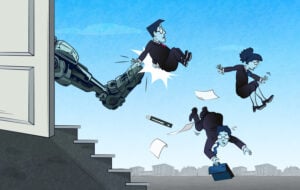
Talk
about
how
artificial
intelligence
will
someday
take
lawyers’
jobs
continues
to
be
dismissed
—
but
maybe
that
talk
will
be
granted
more
credence
now
that
AI
has
come
for
business
professionals’
jobs
at
one
Biglaw
firm.
Sources
tell
us
that
Baker
McKenzie
recently
conducted
a
“massive
staff
layoff”
among
its
global
business
services
team,
with
cuts
made
across
nearly
all
functions
across
all
offices,
including
the
firm’s
IT,
knowledge,
admin,
DEI,
leadership
&
learning,
secretarial,
marketing,
and
design
teams,
among
others.
The
firm
is
reportedly
planning
to
cut
ties
with
less
than
a
tenth
of
its
staff
—
a
little
more
than
700
people,
based
on
current
employee
headcount
at
the
firm.
“To
position
the
firm
for
continued
growth
and
remain
agile
in
a
fast-evolving
business
context,
we
recently
undertook
a
careful
review
of
our
business
professionals
functions.
This
review
was
aimed
at
rethinking
the
ways
in
which
we
work,
including
through
our
use
of
AI,
introducing
efficiencies,
and
investing
in
those
roles
that
best
serve
our
clients’
needs.”
“Following
the
review,
and
consistent
with
many
other
organisations,
we
are
proposing
a
series
of
changes
to
how
we
operate
and
deliver
important
business
services.
Subject
to
consultation
processes
in
applicable
jurisdictions,
some
roles
will
likely
be
phased
out,
while
others
will
evolve.
We
have
not
taken
decisions
around
these
proposed
changes
lightly,
but
felt
it
was
necessary
to
deliver
on
our
long-term
plans.
We
appreciate
the
valuable
contributions
our
impacted
colleagues
have
made
to
the
Firm
and
will
be
supporting
them.”
Best
of
luck
to
all
of
the
staff
members
at
Baker
McKenzie
who
may
have
lost
their
jobs
thanks
to
AI
disruption.
If
your
firm
or
organization
is
reducing
the
ranks
of
its
lawyers
or
staff,
whether
through
deferrals,
open
layoffs,
stealth
layoffs,
or
voluntary
buyouts,
please
don’t
hesitate
to
let
us
know.
Our
vast
network
of
tipsters
is
part
of
what
makes
Above
the
Law
thrive.
You
can email
us or
text
us
(646-820-8477).
Thank
you
for
your
assistance.
Staci
Zaretsky is
the
managing
editor
of
Above
the
Law,
where
she’s
worked
since
2011.
She’d
love
to
hear
from
you,
so
please
feel
free
to email her
with
any
tips,
questions,
comments,
or
critiques.
You
can
follow
her
on Bluesky, X/Twitter,
and Threads, or
connect
with
her
on LinkedIn.
At
Above
the
Law,
we
know
that
in
the
legal
world,
information
isn’t
just
power;
it’s
a
competitive
advantage.
But
with
the
sheer
volume
of
news
breaking
every
hour,
the
most
important
insights
can
sometimes
get
buried
under
a
mountain
of
generic
search
results.
Google
has
introduced
a
way
for
you
to
change
that.
With
their
Preferred
Sources
feature,
you
can
take
the
steering
wheel
from
the
algorithm
and
tell
Google
exactly
which
voices
you
trust.
By
adding
Above
the
Law
as
a
preferred
source,
you
will
cut
through
the
noise
and
ensure
our
latest
stories
and
original
commentary
will
appear
more
often
in
your
“Top
Stories”
section.
How
to
set
Above
the
Law
as
your
preferred
source:
The
quickest
way
is
to
use
our
direct
link
(make
sure
you
are
signed
in
to
your
Google
account).
•
Search
for
a
trending
legal
topic
(like
“Biglaw
bonuses”
or
“Supreme
Court
news”)
on
Google. •
Locate
the
“Top
Stories”
box
near
the
top
of
your
results. •
Click
the
star
icon
(or
the
overlapping
cards
icon)
to
the
right
of
the
“Top
Stories”
header. •
Search
for
“abovethelaw.com”
and
check
the
box
to
add
us. •
Click
“Reload
results”
and
you’re
all
set.
Frequently
Asked
Questions
Will
I
only
see
Above
the
Law?
No.
Google
will
still
show
a
diverse
range
of
outlets,
but
Above
the
Law
will
be
prioritized
whenever
we
have
fresh,
relevant
coverage
of
your
search.
Can
I
add
more
than
one
source?
Absolutely.
Google
notes
that
over
half
of
early
users
selected
four
or
more
sources
to
curate
their
perfect
news
feed.
Does
this
work
on
mobile?
Yes!
This
feature
is
active
across
both
desktop
and
mobile
browsers,
as
well
as
the
Google
app.
Thank
you
for
being
a
part
of
the
Above
the
Law
community.
By
making
us
a
preferred
source,
you’re
making
sure
the
most
colorful
personalities
and
powerful
institutions
in
law
are
always
just
one
click
away.
The
economy
doesn’t
move
in
straight
lines,
and
oftentimes
law
firms
feel
every
shift.
Costs
rise,
clients
hesitate,
and
financial
decisions
carry
more
weight
than
they
used
to.
Firms
with
clear
visibility
into
cash
flow
and
systems
that
can
adapt
as
client
needs
shift
are
better
positioned
for
longevity
—
no
matter
how
the
market
moves.
In
this
guide,
our
friends
at
8am
share
practical,
real-world
ways
law
firms
can
strengthen
financial
stability,
support
clients
through
economic
ups
and
downs,
and
build
a
business
that
can
adapt
to
evolving
conditions.
Ed.
note:
Please
welcome
Renee
Knake
Jefferson
back
to
the
pages
of
Above
the
Law.
Subscribe
to
her
Substack,
Legal
Ethics
Roundup,here.
Welcome
to
what
captivates,
haunts,
inspires,
and
surprises
me
every
week
in
the
world
of
legal
ethics.
Hello
from
Ithaca,
NY.
I’m
visiting
Cornell
Law
School
today
for
a
faculty
workshop,
where
I’m
presenting
my
piece
“When
Lawyers
Protest,”
which
will
be
published
later
this
year
in
the
Michigan
Law
Review.
It’s
cold
here,
but
the
snowy
campus
is
beautiful.
Cornell
University
(photo
by
Renee
Jefferson)
Now
for
your
headlines.
It
was
a
busy
week,
especially
for
judicial
ethics,
so
you
get
fifteen
headlines
instead
of
the
usual
ten.
Highlights
from
Last
Week –
Top Ten Fifteen
Headlines
#1
“Failure
to
Alert
Judge
to
Press
Law
for
Reporter
Search
Draws
Ethical
Scrutiny.” From The
New
York
Times: “The
Justice
Department
may
have
violated
a
candor
rule
by
not
disclosing
a
1980
law
when
seeking
a
warrant
for
a
Washington
Post
reporter’s
home.”
Read
more here.
#2
“Court
Finds
Probable
Cause
for
Hostile
Workplace
by
US
Judge.” From Bloomberg
Law: “The
chief
judge
of
the
Boston-based
federal
appeals
court
found
that
a
district
judge
within
the
circuit
likely
created
a
hostile
work
environment
following
an
interview
with
the
judge’s
former
law
clerk. Chief
Judge
David
Barron
of
the
US
Court
of
Appeals
for
the
First
Circuit said
there
was
‘probable
cause’
to
believe
the
judge
engaged
in
misconduct,
as
described
in
a
judiciary
rule
against
treating
litigants,
lawyers,
or
employees
‘in
a
demonstrably
egregious
and
hostile
manner’
or
‘creating
a
hostile
work
environment
for
judicial
employees.’
The decision,
dated
Nov.
24
but
recently
posted,
doesn’t
name
the
judge.”
Read
more here.
#3
Three
headlines
for
#3:
First, Part
I
of
II
in
investigative
reporting
from
the Arizona
Republic,
“Arizona
Lets
Investors
Own
Law
Firms.
Consumers
Pay
the
Price.” Here’s
a
preview:
“An
Arizona
Supreme
Court
experiment
to
make
legal
services
cheaper
for
the
state’s
residents
has
instead
become
an
epicenter
for
consumer
complaints,
leaving
a
trail
of
clients
across
the
United
States
who
say
they
were
mistreated,
misled,
or
—
in
the
words
of
a
lawsuit
against
one
firm
—
outright
‘scammed.’
Loopholes,
a
lack
of
oversight
and
financial
conflicts
of
interest
plague
the
state’s
‘Alternative
Business
Structures’
program,
which
allows
Wall
Street
investors,
marketing
professionals
and
other
nonlawyers
to
own
law
firms.”
Read
more here. Second, Part
II
of
II
in
the Arizona
Republic reporting: “Loopholes
Let
Arizona
Law
Firm
Experiment
Spread
Nationwide.” Read
more here. Third, compare
this
December
2025
article
“Stanford
Law
Gives
Arizona
a
Report
Card” from
the Maricopa
Lawyer:
“Five
years
ago,
Arizona
became
the
first
state
to
allow
non-lawyers
to
have
ownership
interests
in
law
firms.
This
was
not
popular
in
many
circles.
…
A
recent
report
by
Standford
Law
School’s
Center
on
the
Legal
Profession
entitled
‘Legal
Innovation
After
Reform:
Five
Years
of
Data
on
Regulatory
Change’
takes
stock
of
the
effects
of
legal
services
reform
five
years
out
from
the
changes
made
by
Arizona.
It
seems
predictions
of
Arizona’s
descent
into
a
lawless,
unethical
hellscape
were
not
accurate.
…
In
short,
Arizona’s
allowance
for
alternative
business
structures
has
not
caused
the
sky
to
fall
or
for
the
public
to
be
harmed.
The
Stanford
report
described
the
resulting
consumer
harm
as
‘de
minimis.’”
Read
more here.
#4
“How
the
Supreme
Court
Secretly
Made
Itself
Even
More
Secretive.” From The
New
York
Times: “Amid
calls
to
increase
transparency
and
revelations
about
the
court’s
inner
workings,
the
chief
justice
imposed
nondisclosure
agreements
on
clerks
and
employees.”
Read
more here.
#5
“Leader
of
Paul
Weiss
Resigns
Over
Epstein
Ties.” From The
Wall
Street
Journal: “Brad
Karp,
the
leader
of
Paul
Weiss,
one
of
the
country’s
biggest
law
firms,
resigned
as
chair
in
the
wake
of
new
revelations
about
his
association
with Jeffrey
Epstein.
Karp
is
an
influential
lawyer
in
corporate
circles,
who
advised
boards
of
directors
and
business
leaders,
including
the
Apollo
Global
Management
co-founder
Leon
Black.
Karp
faced
criticism
in
legal
circles
last
year
after
he
brokered
a
deal
with President
Trump to
resolve
an
executive
order
that
cracked
down
on
law
firms.”
Read
more here (gift
link).
#6
“Newly
Released
Court
Records
Reveal
Misconduct
Inquiry
Into
Federal
Judge.” From National
Public
Radio: “New
information
is
emerging
that
could
complicate
the
retirement
last
year
of
a
prominent
federal
judge. Mark
Wolf,
79,
retired
from
the
federal
district
court
in
Massachusetts
last
November,
after
more
than
40
years
of
service. He
penned
an
essay
in The
Atlantic tying
his
departure
to
actions
by
President
Trump.
Wolf’s
decision
to
retire
coincided
with
an
inquiry
by
another
federal
judge
into
potential
misconduct,
according
to
newly
published
orders.
That
inquiry
found
probable
cause
to
believe
an
unnamed
jurist
had
engaged
in
misconduct
by
creating
a
hostile
workplace
for
court
employees.
…
A
source
familiar
with
the
inquiry,
who
spoke
on
condition
of
anonymity
to
discuss
the
sensitive
internal
investigation,
said
the
judge
in
question
is
Wolf
and
his
resignation
terminated
the
review
of
his
conduct.”
Read
more here.
#7
“Justice
Department
Struggles
Under
Weight
of
Immigration
Crackdown.” From The
Wall
Street
Journal: “Current
and
former
prosecutors
say
they
can
relate
to
the
government
lawyer
who
told
judge
she
was
overwhelmed.
When
a
lawyer
representing
the
Justice
Department
told
a
judge
in
open
court
this
week
that
she
was
exhausted
and
‘this
job
sucks,’
she
said
out
loud
what
many
federal
prosecutors
have
been
privately
feeling
for
months.”
Read
more here (gift
link).
#8
“OpenAI
Ducks
Order
to
Disclose
Confidential
Counsel
Messages.” From Bloomberg
Law: “OpenAI
Inc.
convinced
a
federal
judge
to
overturn
an
order
requiring
the
company
to
disclose
confidential
messages
with
its
attorneys
to
authors
and
newspapers
accusing
it
of
violating
copyrights
by
training
AI
models
on
their
works.
The
November
order
to
turn
over
messages
about
the
artificial
intelligence
company’s
deletion
of
pirated
copies
of
books
is
unsound
because
it
was
‘clearly
erroneous’
or
‘contrary
to
law,’ Judge
Sidney
H.
Stein said
in
a decision issued
Friday
in
the
US
District
Court
for
the
Southern
District
of
New
York.
‘Simply
put,
OpenAI
did
not
disclose
material
protected
by
the
attorney-client
privilege.’”
Read
more here.
#9
“FTC
Crackdown
on
Law
Firm
DEI
Efforts
Tests
Antitrust
Limits.” From Reuters: “The
U.S.
Federal
Trade
Commission
took
a
fresh
tack
last
week
in
the
federal
government’s
crackdown
on
diversity,
equity
and
inclusion
efforts,
warning
42
major
law
firms
that
their
hiring
practices
may
violate
federal
antitrust
law.
By
invoking
alleged
threats
to
competition,
the
strategy
could
buttress
broader,
ongoing
efforts
by President
Donald
Trump’s administration
to
combat
DEI
using
anti-discrimination
law.
But
bringing
an
antitrust
case
would
face
a
high
bar,
legal
experts
said.”
Read
more here.
#10
“Threats
to
the
Rule
of
Law
Should
Concern
Us
All.” From
the Cleveland
Plain
Dealer: “Retired
former Ohio
Supreme
Court
Chief
Justice
Maureen
O’Connor and
former Justice
Michael
P.
Donnelly are
working
with
other
lawyers
and
judges
in
Cleveland
to
stand
up
for
the
Rule
of
Law.”
Read
more here.
#11
“In
Under
500
Words,
a
Judge
Weaponized
Wit
to
Free
the
Child
Detained
by
ICE.” From The
New
York
Times: “The
extra
in
this
case
transforms
what
might
have
been
a
routine
decision
into
a
thorough
scourging
of
the
Trump
administration’s
approach
to
governance.
…
In
fewer
than
500
words,
Judge
Biery
marshals
literature,
history,
folk
wisdom
and
Scripture
to
challenge
the
theory
of
executive
power
that
has
defined
Trump’s
second
presidency.
It’s
worth
looking
at
how
he
does
it.”
Read
more here (gift
link).
#12
“This
Federal
Judge
Hid
His
DUI
for
Four
Months.
Now
What?” From Fix
the
Court: “On
Oct.
3,
2025, Judge
Thomas
Ludington of
E.D.
Michigan
was arrested for
driving
under
the
influence.
According
to
court
and
law
enforcement
records,
Ludington
was
registering
a
blood
alcohol
level
of
0.17,
more
than
twice
the
legal
limit,
at
the
time
of
his
arrest.
His
trial
is
scheduled
to
begin
later
this
month.
The
catch?
This
news
was
hidden
from
the
public
for
four
months,
and
the
judge
continued
his
work
as
usual.”
Read
more here.
#13
“Judging
AI:
How
U.S.
Judges
Can
Harness
Generative
AI
Without
Compromising
Justice.” From Judicature: “E-discovery
tools
that
harness
the
power
of
artificial
intelligence
(AI)
assist
attorneys
somewhat
regularly.But
my
recent
experience
presiding
over
a
bench
trial
in La
Union
Del
Pueblo
Entero
v.
Abbott showed
me
that
generative
AI
(GenAI)
can
help
judges
in
several
crucial
ways
that
go
far
beyond
discovery.
…
This
case
provided
an
opportunity
to
evaluate
how
GenAI
might
help
a
judge
in
a
complex
and
document-intensive
case.
This
article
explores
how
GenAI
can
help
locate
documents
and
summarize
witness
testimony,
whether
GenAI
tools
are
currently
capable
of
completing
a
rough
draft
of
a
judicial
opinion,
and
how
GenAI
can
review
party
submissions.”
Read
more here.
#14
“Watchdog
Renews
Halligan
Bar
Complaint
After
Court
Rulings.” From Law360: “The
nonprofit
Campaign
for
Accountability
once
again
launched
a
bar
complaint
against
former
interim U.S.
Attorney
Lindsey
Halligan in
Virginia,
after
the
Virginia
State
Bar
declined
to
pursue
an
ethics
investigation
against
the
attorney
last
year,
calling
it
a
matter
for
the
courts
to
determine.”
Read
more here.
#15
“Texas
Dropped
ABA
Law
School
Accreditation
After
4
Decades.
Can
It
Come
Up
With
a
Better
System?” From Houston
Public
Media: “The
Texas
Supreme
Court
decided
the
American
Bar
Association
should
“no
longer
have
the
final
say”
on
which
law
school
graduates
can
become
licensed
lawyers.
Will
the
move
foster
accessibility
and
innovation
in
the
legal
field
as
advocates
hope
—
or
will
most
things
stay
the
same?”
Read
more here.
Get
Hired
Did
you
miss
the
400+
job
postings
from
previous
weeks?
Find
them
all here.
Upcoming
Ethics
Events
&
Other
Announcements
️
Did
you
miss
an
announcement
from
previous
weeks?
Find
them
all here.
Keep
in
Touch
News
tips?
Announcements?
Events?A
job
to
post?Reading
recommendations? Email [email protected] –
but
be
sure
to
subscribe
first,
otherwise
the
email
won’t
be
delivered.
Do
you
have
colleagues
who
care
about
legal
ethics? Please
share
the
Roundup
with
them.
I’d
love
to
see
our
community
continue
to
grow!
Renee
Knake
Jefferson
holds
the
endowed
Doherty
Chair
in
Legal
Ethics
and
is
a
Professor
of
Law
at
the
University
of
Houston.
Check
out
more
of
her
writing
at
the Legal
Ethics
Roundup.
Find
her
on
X
(formerly
Twitter)
at @reneeknake or
Bluesky
at legalethics.bsky.social.
Everyone
knows
about
hallucinations.
Well,
apparently
not
everyone,
which
is
why
hallucinations
provide
so
much
amusement.
Lawyers
keep
putting
them
into
their
briefs
and,
sometimes,
lying
about
it
when
caught.
Judges
are
even
getting
in
on
the
action
with
hallucinations
of
their
own.
The
plague
of
hallucinations
remains
the
most
discussed
AI
threat
for
lawyers.
But
one
AI
weakspot
that
gets
almost
no
attention
—
despite
being
arguably
more
dangerous
—
is
the
case
where
AI
is
both
perfectly
accurate
and
fundamentally
incomplete.
Hallucinations,
while
pernicious,
should
be
caught
by
a
human.
Sending
a
brief
out
the
door
without
cite
checking
is
a
you
problem,
not
an
AI
problem.
Sure,
the
AI
hype
cycle
and
seductively
confident
interface
may
be
making
lawyers
dumber,
but
to
borrow
from
Smokey
the
Bear:
only
YOU
can
prevent
yourself
from
stupidity.
But
incompleteness
arises
under
a
whole
different
set
of
circumstances.
It’s
one
thing
to
search
a
few
hundred
cases
for
helpful
precedent,
and
another
to
scour
millions
of
documents
to
make
sure
there’s
nothing
harmful
in
there.
This
is
work
that
humans
simply
can’t
manage
on
their
own
and
there’s
no
equivalent
to
cite-checking
when
the
whole
assignment
is
to
“prove
a
negative.”
If
AI set
to
that
task
misses a
document,
it’s
an
“unknown
unknown.”
And
missing
a
lone
prior-art
document
buried
in
the
weeds
can
mean
millions
in
patent
litigation.
A new
case
study delves
into
this
risk
of
unknown
unknowns
and
how
to
get
ahead
of
it.
Melange,
a
patent
analytics
company,
set
out
to
build
patent
search,
monitoring,
and
mapping
tools
to
aide
clients
in
high-stakes
intellectual
property
issues.
Finding
those
obscure
prior
art
gems
hidden
within
hundreds
of
millions
of
global
patent
filings,
machine-translated
foreign
documents,
obscure
academic
papers,
and
technical
manuals
can
have
massive
repercussions
in
litigation.
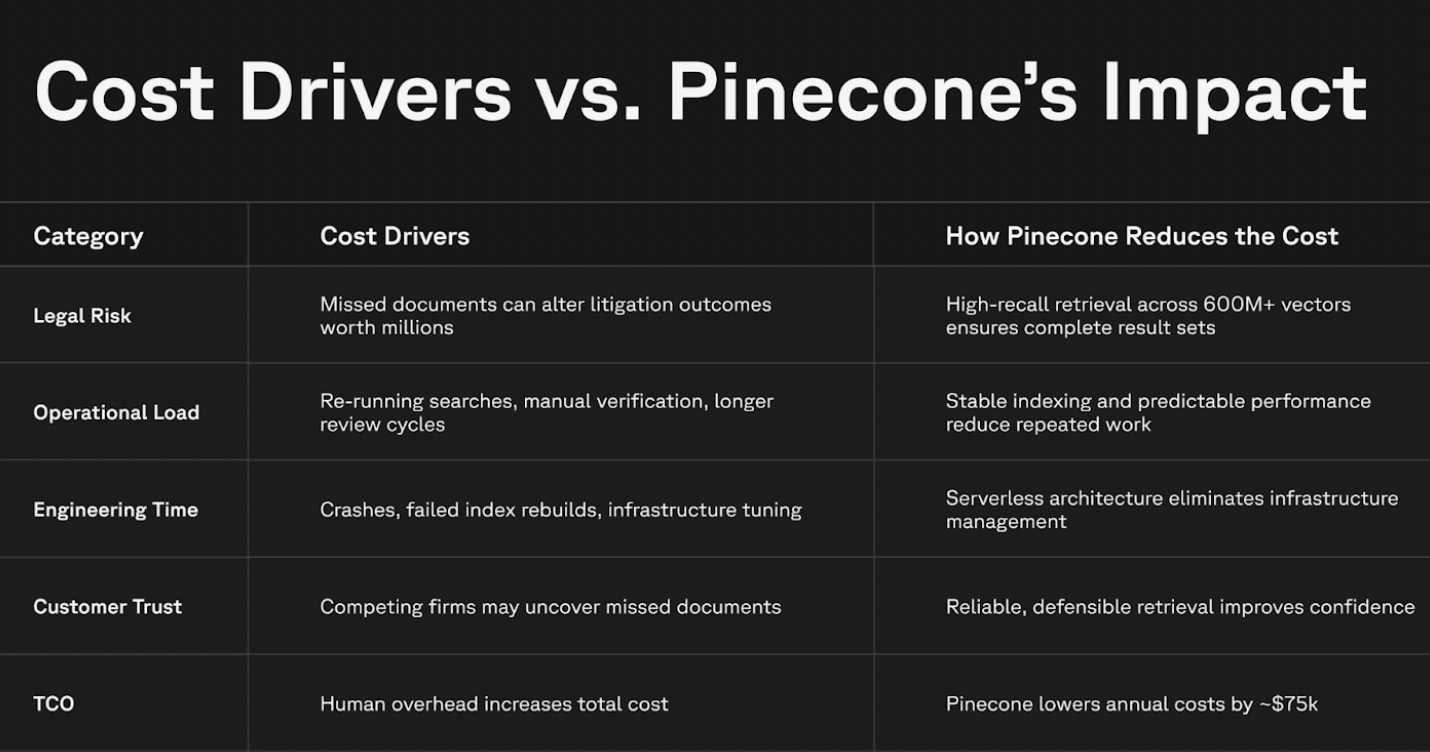
The
average
cost
of
patent
litigation
runs
between
$2.3
million
and
$4
million
and
the
average
damages
clock
in
around
$24
million.
A
single
missed
prior-art
document
can
materially
shift
those
numbers.
“When
we
find
that
one
killer
piece
of
prior
art
that
the
customer
thinks
might
win
their
case,
we
lock
in
the
customer
for
life,”
Melange
CEO
Joshua
Beck
says.
What
Melange
discovered
is
that
the
primary
risk
in
this
work
isn’t
model
quality
or
the
dreaded
hallucinations,
but
infrastructure
reliability.
Scaling
AI
search
to
deal
with hundreds
of
millions
of
global
patents
and
technical
papers,
takes
a
lot
and
a
self-hosted
system
will
struggle
with
incomplete
recall
and
downtime.
And
when
Melange
sought
to
scale
from
a
manageable
40
million
documents
to
the
full
global
patent
corpus
of
roughly
450
million,
they
identified
this
precise
problem.
Those
drawbacks
could
cost
a
client
money.
So
they
hooked
up
with
Pinecone,
a
vector
database
provider,
to
address
the
underlying
infrastructure.
Using
AI
for
massive
searches
is
limited
by
recall.
“Intelligence,
provided
by
the
LLM,
is
a
‘frozen’
reasoning
engine
that
knows
how
to
think
and
process
language,”
Pinecone
CEO
Ash
Ashutosh
explained.
“Knowledge,
on
the
other
hand,
represents
the
dynamic,
factual
state
of
the
world
that
the
LLM
must
draw
upon.
Without
infrastructure
that
derives
knowledge
from
proprietary
data,
even
the
most
intelligent
model
is
prone
to
costly,
inaccurate,
and
incomplete
conclusions.”
An
infrastructure
that
supports
these
insanely
high
levels
of
recall
are
what
keeps
“index
structures
stable
and
query
performance
predictable,”
as
the
study
notes.
For
most
tasks
a
90
percent
recall
is
all
well
and
good,
but
when
seeking
out
prior
art,
a
10
percent
failure
rate
isn’t
acceptable.
With
Pinecone’s
help,
Melange
scaled
beyond
600
million
documents
without
reliability
issues.
In
the
human
quest
to
be
distracted
by
shiny
objects,
we’re
obsessed
with
debating
the
merits
of
these
new
algorithms
and
pointing
and
laughing
at
the
hallucinations.
“Lawyers
should
stop
focusing
solely
on
the
brain
(the
model)
and
start
asking
about
the
nervous
system
(the
infrastructure),”
Beck
explained.
“Can
this
system
accurately
and
reliably
scale
to
the
full
universe
of
data
without
degrading?”
If
your
vendor
can’t
answer
that
clearly,
well,
that is your
answer.
Of
course
patent
litigation
is
just
one
context.
Run-of-the-mill
discovery
faces
the
same
problems.
At
conferences,
attendees
chatter
about
new
context
limits
and
clever
workarounds
slowly
chipping
away
at
the
problem,
but
building
infrastructure
capable
of
handling
the
load
is
a
key
part
of
the
equation.
Because
the
model
itself
may
be
“accurate”
but
if
it’s
incomplete
it’s
still
not
right.
The
Department
of
Health
and
Human
Services
is
scrapping
the
340B
Drug
Pricing
Program’s
rebate
model,
according
to
a
Thursday
court
filing.
Hospitals
are
reacting
with
glee,
as
the
rebate
model
would
have
added
administrative
headaches
and
forced
them
to
return
millions
in
discounts.
The
model
was
slated
to
go
live
on
the
first
of
the
year,
but
courts
blocked
implementation
before
it
could
take
effect,
citing
procedural
and
legal
issues.
The
340B
program
allows
hospitals
to
buy
outpatient
drugs
at
steep
discounts,
with
the
purported
purpose
of
helping
them
fund
care
for
low-income
and
uninsured
patients.
The
now-axed
rebate
model
would
have
invited
drugmakers
to
participate
voluntarily
in
a
rebate-based
discount
system.
Basically,
instead
of
the
provider
receiving
a
discount
upfront
at
purchase,
the
340B
discount
would
be
applied
after
purchase
via
rebate
—
and
subject
to
tedious
data
submission
requirements.
The
pilot
aimed
to
boost
transparency
and
prevent
duplicate
discounts,
but
it
risked
introducing
financial
challenges
and
added
administrative
burdens
that
would
have
likely
disproportionately
affected
the
smaller,
safety
net
providers
that
the
340B
program
was
initially
designed
to
assist
when
it
was
established
in
1992.
For
instance,
Bill
Keeton
—
chief
advocacy
officer
at
Vivent
Health,
a
nationwide
provider
of
HIV
care
for
low-income
patients
—
told
MedCity
News
in
November
that
the
model
would
create
difficult
cash
flow
problems
for
healthcare
providers,
especially
organizations
like
his
that
have
to
buy
HIV
medications,
which
are
incredibly
expensive.
Biktary,
the
most
popular
medication
used
to
treat
HIV,
costs
about
$4,200
per
month.
Under
340B,
clinics
pay
about
half
of
that,
but
the
rebate
model
could
force
clinics
to
front
the
full
cost
temporarily.
Now
that
the
rebate
model
is
being
thrown
out,
hospitals
are
relieved.
“A
rebate
program
that
undermines
safety-net
hospitals’
ability
to
offer
more
comprehensive
care
would
only
harm
the
nation’s
most
vulnerable
communities,”
AHA
CEO
Rick
Pollack
said
in
a
statement.
Tom
Kraus,
vice
president
of
government
relations
at
the
American
Society
of
Health-System
Pharmacists,
also
applauded
the
move,
calling
the
rebate
model
“unworkable
and
a
threat
to
program
integrity”
in
his
statement.
“Rebates
in
both
the
340B
program
and
the
Inflation
Reduction
Act
negotiated
pricing
program
improperly
shift
costs
from
manufacturers
to
providers,
effectively
raising
the
costs
of
medications
in
direct
opposition
to
Congressional
intent.
Providers
should
not
shoulder
increased
costs
for
programs
intended
to
require
manufacturer
discounts,”
he
stated.
If
HHS
seeks
to
reform
the
340B
program’s
administrative
processes
going
forward,
it
has
agreed
to
issue
a
new
announcement
and
receive
comments
from
the
public.
*
Fifth
Circuit
bucks
rest
of
judiciary,
precedent,
and
basic
statutory
interpretation
to
authorizing
indefinite
detention
for
anyone
suspected
of
being
in
the
country
illegally.
[One
First]
*
Speaking
of
“Fifths,”
Ghislaine
Maxwell
heading
to
Congress,
but
not
going
to
answer
any
questions.
[Reuters]
*
HBCU
law
school
tells
student
not
to
use
the
word
“Black”
in
“Black
History
Month”
materials.
Sorry,
the
law
school
probably
prefers
to
be
called
an
“H…CU.”
*
The
fascinating
“pay
it
forward”
story
that
gave
us
the
iconic
fictional
lawyer.
[Tedium]
*
CFTC
taking
on
prediction
markets.
I’ve
got
$20
on
they
won’t
end
up
doing
anything.
[National
Law
Journal]
*
Lawyers
getting
sick
and
tired
of
people
using
AI
for
legal
advice.
[Axios]
*
Court
blocks
administration
effort
to
halt
NYC
infrastructure
until
Penn
Station
is
renamed
after
him.
[Law360]
DOJ
Lawyer
Invites
Judge
To
Hold
Her
In
Contempt
Just
To
Get
Some
Rest:
Government
attorney
called
out
the
challenges
preventing
her
from
complying
with
court
orders
and
begs
for
rest.
The
DOJ
immediately
fired
her.
Brad
Karp
Era
Ends
At
Paul
Weiss:
Paul
Weiss
undergoes
impromptu
leadership
shuffle
after
Epstein
files
reveal
conversations
with
Epstein.
Republicans
Get
Huffy
About
Justice
Jackson
Attending
The
Grammys:
GOP
decides
the
real
scandal
is
a
Supreme
Court
justice
hearing
musicians
as
mad
about
ICE
as
the
rest
of
the
country.
Biglaw
Epstein
Victim
Drafted
Own
Sex
Contract:
Clifford
Chance
alum
went
on
to
law
school
at
Berkeley,
paid
for
by
Epstein.
Anthropic
Enters
Legal
Tech,
Creates
Immediate
Freakout:
New
twist
in
AI
arms
race
as
one
of
the
big
players
enters
the
fray
directly.
DOJ
Hiring
Prosecutors
Based
On
Sliding
Into
DMs:
Federal
hiring
hits
new
low.