Zambia, Zimbabwe ignore climate change risks, proceed with hydro project on drying Zambezi River

The
governments
of
Zambia
and
Zimbabwe
are
brushing
aside
concerns
about
the
worsening
effects
of
climate
change,
with
the
two
southern
African
nations
recently
pledging
$220
million
each
in
seed
capital
for
the
construction
of
the
Batoka
Gorge
Hydro
Electric
Scheme
(BGHES).

The
decision
by
the
two
countries
to
commit
the
$440
million

about
10
per
cent
of
the
project’s
expected
cost
of
$4.5
billion

was
taken
at
a
December
29,
2025
meeting
of
the
Council
of
Ministers
of
the
Zambezi
River
Authority
(ZRA),
the
bi-national
body
that
manages
water
resources
on
the
shared
river.
The
ZRA
will
manage
the
proposed
project,
just
as
it
already
manages
the
bi-national
Kariba
Dam
and
its
hydropower
station.

The
$440
million
is
intended
to
improve
the
project’s
bankability
and
attract
private
investors.
Funding
has
previously
been
one
of
the
major
obstacles
faced
by
the
project.


A
2,400-megawatt
hydropower
project

Located
on
River
Zambezi,
a
short
distance
from
the
Victoria
Falls
on
the
border
between
Zambia
and
Zimbabwe,
the
BGHES
plant
has
a
design
power-generating
capacity
of
2,400
megawatts
(MW).
Once
completed,
it
is
expected
to
supply
1,200
MW
to
each
country,
helping
boost
electricity
supplies
for
two
countries
currently
experiencing
severe
power
cuts.

The
project
was
first
conceived
in
1972
but
has
remained
on
the
drawing
board,
with
several
false
starts
over
the
decades.
However,
as
climate
change
increasingly
affects
southern
Africa

making
the
region
drier
due
to
erratic
rainfall
and
increased
evapotranspiration
driven
by
rising
temperatures

water
levels
on
the
Zambezi
River
have
been
declining.
This
has
led
to
serious
misgivings
about
the
long-term
viability
of
the
hydropower
project.

The
Zambezi
is
Africa’s
sixth-largest
river.
It
originates
in
Zambia
and
flows
through
Angola,
Namibia,
Botswana,
Zimbabwe
and
Mozambique.
Two
major
dams
lie
on
the
river:
Lake
Kariba,
shared
by
Zambia
and
Zimbabwe,
and
Cahora
Bassa,
downstream
in
Mozambique.
Hydropower
plants
on
both
dams

with
a
combined
capacity
of
3,800
MW

have
in
recent
years
been
affected
by
climate
change-related
low
water
levels.

Power
generation
at
Kariba

downstream
from
the
proposed
project
site

was
halted
in
2022
and
2024,
due
to
low
water
levels.
Generation
was
also
reduced
at
Cahora
Bassa
in
Mozambique.
In
Zambia,
climate
change
has
not
only
affected
power
generation
on
its
plant
on
River
Zambezi,
but
also
at
three
others,
namely
Kafue
Gorge,
Lower
Kafue
Gorge
and
at
Itezhi-Tezhi.


Studies
raise
viability
questions

These
developments
reflect
projections
from
earlier
studies
that
raised
concerns
about
the
viability
of
the
BGHES.
One
study
by
researchers
at
the
University
of
Edinburgh
in
the
United
Kingdom,
which
used
the
Batoka
Gorge
scheme
as
a
case
study,
found
that
while
expanding
renewable
energy

including
hydropower

is
a
key
strategy
for
limiting
climate
change,
the
paradox
is
that
climate
change
itself
is
altering
the
availability
of
water
resources,
adversely
affecting
the
financial
viability
of
both
existing
and
planned
schemes.

The
study
assessed
the
relationship
between
climate
change
and
the
technical
and
financial
viability
of
hydropower
development,
and
the
results
were
not
encouraging.

“Simulations
with
climate
change
scenarios
illustrate
the
sensitivity
of
the
Batoka
Gorge
scheme
to
changes
in
climate,”
the
study
noted.
“They
suggest
significant
reductions
in
river
flows,
declining
power
production,
reductions
in
electricity
sales
revenue
and,
consequently,
an
adverse
impact
on
a
range
of
investment
measures.”

It
concluded
that
trends
towards
deregulation
in
the
electricity
sector
would
require
increasing
levels
of
private
investment,
which
may
not
favour
hydropower
projects.

“More
importantly,
the
very
fact
that
climate
is
changing
may
alter
the
availability
of
this
natural
resource,
and
the
impact
of
such
changes
on
the
financial
viability
of
schemes
will
be
of
particular
interest
to
investors.”
Another
study,
conducted
in
2014
by
four
researchers
focusing
on
southern
Africa,
warned
that
worsening
climate
change
would
not
only
reduce
available
water
but
also
increase
demand
for
irrigation
and
other
uses,
resulting
in
much
lower
flows
on
the
Zambezi
River.

“Accelerating
economic
growth
increases
the
potential
for
competition
for
water
between
hydropower
and
irrigated
agriculture,
and
climate
change
will
add
further
stress
to
this
system,”
the
researchers
wrote.
“The
objective
of
this
study
was
to
assess
the
vulnerability
of
major
existing
and
planned
hydropower
plants
to
changes
in
climate
and
upstream
irrigation
demand.”

“Our
results
show
that
Kariba
is
highly
vulnerable
to
a
drying
climate,
potentially
reducing
average
electricity
generation
by
12
per
cent.
Furthermore,
expansion
of
Kariba’s
generating
capacity
is
unlikely
to
deliver
expected
increases
in
production
even
under
a
favourable
climate.
The
planned
Batoka
Gorge
plant
may
also
fail
to
reach
anticipated
production
levels
outlined
in
the
original
feasibility
study.”

“This
implies
that
climate
change
and
upstream
development
must
be
explicitly
incorporated
into
both
project
planning
and
system
expansion.”


Project
proceeds
despite
risks

Despite
these
warnings,
the
governments
of
both
countries
insist
on
proceeding
with
the
project.

“Batoka
was
high
on
our
agenda,
and
we
agreed
that
the
two
governments
must
put
some
money
on
the
table
to
demonstrate
commitment,”
Zimbabwe’s
Energy
Minister
July
Moyo
said
after
the
most
recent
Council
of
Ministers
meeting.
“The
intention
is
clear

this
project
must
take
off.”
In
a
statement,
Zambia’s
Energy
Minister
Makozo
Chikote
defended
the
decision.
“Comprehensive
feasibility
studies,
including
climate
change
assessments,
confirm
that
the
Zambezi
River
can
sustainably
support
the
project,”
he
said.

“The
Batoka
Gorge
Hydro
Electric
Scheme
remains
technically
sound,
environmentally
compliant,
economically
justified
and
central
to
Zambia’s
long-term
energy
security.”

Chikote
added
that
Batoka
Gorge
is
part
of
a
sequential
hydropower
system
on
the
Zambezi
River

alongside
Victoria
Falls,
Kariba
and
future
developments

designed
to
maximise
power
generation
from
the
same
water
resource
in
line
with
international
best
practice.

ZRA
chief
executive
officer
Munyaradzi
Munodawafa
also
said
the
project
remains
viable.
“Batoka
will
serve
as
a
mitigation
measure
for
some
of
the
hydrological
challenges
at
Kariba,
while
directly
contributing
a
significant
increase
to
the
urgently
needed
power
supply
capacity
of
Zambia
and
Zimbabwe.”


Hydropower
remains
central
despite
climate
risks

Engineer
Stephen
Dihwa,
executive
director
of
the
Southern
African
Power
Pool
Coordination
Centre,
which
coordinates
regional
power
systems,
said
hydropower
would
remain
central
to
electricity
supply
despite
climate
risks.

He
noted
that
periods
of
low
rainfall
are
often
followed
by
higher
rainfall,
allowing
dams
to
refill.
“This
shows
there
is
still
a
future
for
both
existing
and
planned
hydropower
plants,”
he
said.

“What
is
required
is
plant
operation
based
on
well-forecast
hydrology
and
careful
management
of
reservoir
water
use,”
Dihwa
told Down
To
Earth
.

He
added
that
studies
are
under
way
on
reducing
the
impact
of
drought
on
hydropower
plants,
including
the
possibility
of
inter-basin
water
transfers.

Two
years
ago,
after
all
four
of
Zambia’s
hydropower
plants
were
either
severely
restricted
or
shut
down
due
to
climate
change-related
drought,
Lusaka
proposed
an
inter-basin
water
transfer
project.
It
engaged
the
Chinese
government
to
help
dig
a
300-km
canal
to
transfer
water
from
the
Luapula
River

a
tributary
of
the
Congo
River
in
the
north

to
the
Kafue
River
in
the
south,
where
two
major
hydropower
plants
are
located.

Zimbabwe’s
hydropower
generation
at
Kariba
has
also
been
severely
affected
by
poor
rains
and
the
country
is
exploring
a
1,200-km
tunnel
to
draw
around
16
billion
cubic
metres
of
water
annually
from
the
Lualaba
River
in
the
Democratic
Republic
of
the
Congo
to
Lake
Kariba.

IPCC
climate
projections
indicate
that
Central
Africa
is
likely
to
become
wetter,
while
southern
Africa
continues
to
dry.
The
two
regions
lie
in
different
river
basins.

“There
are
ways
to
reduce
the
impact
of
drought
on
hydropower
plants,
but
much
more
effort
is
needed,”
Dihwa
said.
“Studies
on
drought
resilience
in
southern
Africa
are
already
under
way
and
should
provide
practical
and
sustainable
solutions.”

“Some
solutions
are
based
on
regional
integration
and
coordinated
operation
of
plants
on
shared
watercourses.
Others
recognise
that
not
all
river
basins
are
affected
by
drought
at
the
same
time.
For
example,
the
Congo
Basin
in
the
DRC
is
relatively
less
affected,
and
ways
in
which
it
could
support
power
generation
in
other
basins
should
be
explored.”

Source:


Zambia
and
Zimbabwe
Push
Forward
with
Controversial
Hydro
Project
Amid
Climate
Concerns
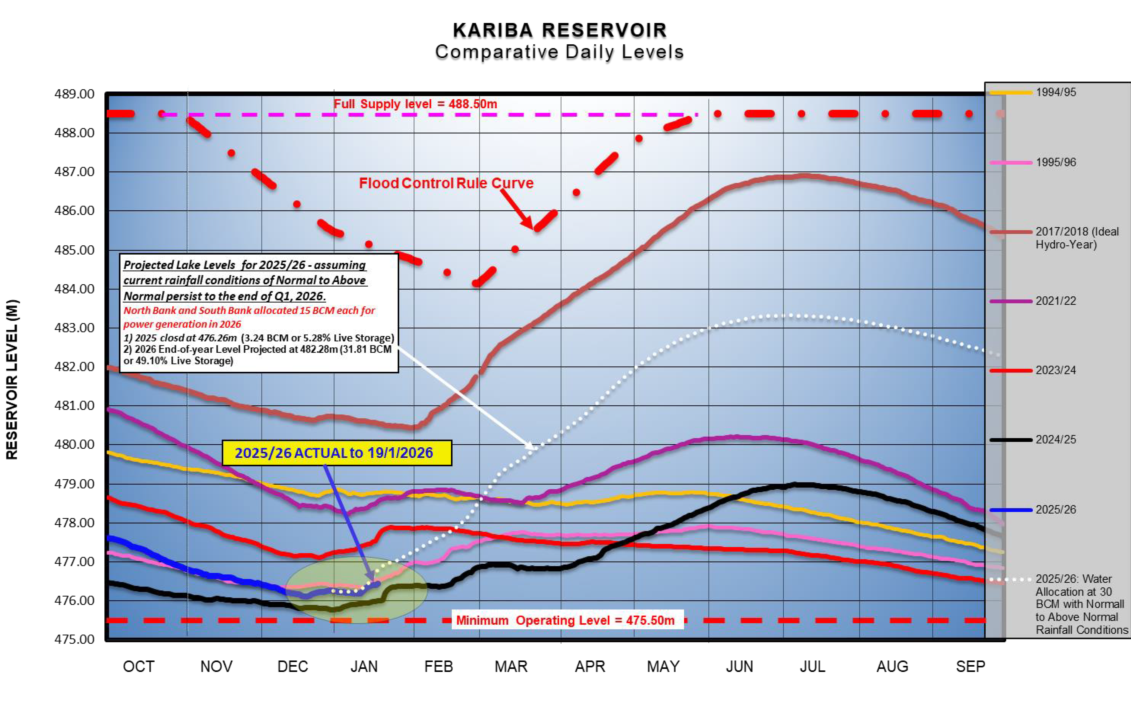
Lake Kariba Weekly Levels in Meters


22.1.2026


19:46

The
Kariba
Lake
is
designed
to
operate
between
levels
475.50m
and
488.50m
(with
0.70m
freeboard)
for
hydropower
generation.


The
Lake
level
that
fluctuated
due
to
variations
in
rainfall
on
the
lake
and
immediate
catchment,
closing
the
period
under
review
at
476.44m
(6.52%
usable
storage)
as
of
18th January
2026,
compared
to
475.98m
(3.37%
usable
storage)
recorded
on
the
same
date
last
year.


From:


5
January
2026


To:


18
January
2026

 
Day This
Year
%Full Last
Year
%Full
5-Jan 476.22 5.01% 475.85 2.48%
6-Jan 476.21 4.94% 475.87 2.61%
7-Jan 476.21 4.94% 475.88 2.68%
8-Jan 476.2 4.87% 475.9 2.82%
9-Jan 476.18 4.74% 475.9 2.82%
10-Jan 476.18 4.74% 475.91 2.89%
11-Jan 476.18 4.74% 475.92 2.96%
12-Jan 476.19 4.80% 475.93 3.02%
13-Jan 476.27 5.35% 475.94 3.09%
14-Jan 476.33 5.76% 475.94 3.09%
15-Jan 476.36 5.97% 475.95 3.16%
16-Jan 476.38 6.11% 475.97 3.30%
17-Jan 476.4 6.24% 475.98 3.37%
18-Jan 476.41 6.31% 475.98 3.37%
lake

Post
published
in:

Featured

Zimbabwe Diaspora Vote Initiative Creates GoFundMe to raise funds for Court Case for Diaspora Vote


It
is
our
view
that
Zimbabweans
living
outside
the
country
need
to
be
treated
equally
as
they
all
contribute
to
the
well-being
of
the
country,
whether
they
work
for
the
Government
of
Zimbabwe
or
work
for
businesses
and
institutions
in
their
domiciled
countries.

In
2018,
President
Mnangagwa
told
Zimbabweans
who
he
met
with
on
the
side
lines
of
the
United
Nations
General
Assembly
that
under
his
leadership,
Government
was
going
to
work
to
ensure
Zimbabweans
living
in
the
Diaspora
could
vote
in
2023.
The
following
year,
in
what
many
thought
was
a
move
towards
implementing
the
President’s
pledge,
Justice,
Legal
and
Parliamentary
Affairs
Minister,
Honourable
Ziyambi
Ziyambi
said
Government
was
instituting
research
to
establish
diaspora
voting
patterns
in
other
countries
in
order
to
work
on
the
legislative
changes
that
would
allow
diaspora
voting:


We
want
to
commission
a
study
to
see
how
other
jurisdictions
are
implementing
the


Diaspora
vote
and
hopefully
we
will
be
done
with
that
by
June
2020,”
said
Minister
Ziyambi.

Zimbabwe
Diaspora
Vote
Initiative
Chairperson
Rosewiter
Mangiroza
said
the
situation
was
getting
desperate
and
measurers
had
to
be
taken
to
ensure
that
the
objective
is
achieved.


“We
cannot
continue
to
wait
for
government
do
this
noble
work
at
its
own
pace,
so
we
will
use
all
possible
means
to
lobby
for
the
fulfilment
of
our
voting
rights.
We
have
engaged
legislators
in
the
lobbying
process,
are
prepared
to
discuss
with
the
President
what
challenges
he
has
faced
in
fulfilling
his
2018
promise,
and
have
also
resolved
to
approach
the
courts”,
said
Mangiroza.

To
help
raise
funds
for
the
legal
challenge,
the
development
of
a
Private
Member’s
Bill
and
other
expenses,
the
Zimbabwe
Diaspora
Vote
Initiative
has
created
a
GoFundMe
account
to
mobilise
resources.

“We
are
appealing
to
all
progressive
forces
to
support
us
in
this
endeavour”,
said
Fundraising
Coordinator
Frank
Chikowore.

Well-wishers
can
support
through
the
GoFundMe
on
the
link

Fundraiser
by
Frank
Chikowore
:


Urgent
Appeal:
Zimbabweans
are
demanding
their
right
to
vote

The
Zimbabwe
Diaspora
Vote
Initiative
is
a
non-partisan,
not-for-profit
organisation
bringing
together
Zimbabweans
who
are
interested
in
exercising
their
constitutional
right
to
vote.
It
is
registered
in
Australia,
and
hopes
to
register
in
other
parts
of
the
world.

For
further
information
about
the
Zimbabwe
Diaspora
Vote
Initiative
or
the
GoFundMe
project,
contact
any
one
of
the
following:

  1. Rosewiter
    Mangirosza,
    Chairperson
    +61
    481
    262
    557
  2. Padmore
    Kufa,
    Spokesperson
    +61
    414
    477
    659
  3. Frank
    Chikowore,
    Fundraiser
    +61
    410
    945
    261

Reference

Minister
Ziyambi
Ziyambi
on
preparations
for
Diaspora
Vote.
See
link:

 
Zimbabwe
Government


considers
diaspora
vote


FurtherAfrica

Post
published
in:

Featured

8,000 remote primary and secondary schools to get Starlink

HARARE

The
government
has
begun
distributing
Starlink
satellite
internet
kits
to
about
8,000
primary
and
secondary
schools
without
fibre
connectivity,
officials
said
on
Wednesday.

The
equipment
was
handed
over
to
Primary
and
Secondary
Education
Minister
Torerayi
Moyo
by
his
Information
Communication
Technology
counterpart
Tatenda
Mavetera
under
the
so-called
Presidential
Internet
Scheme.

Mavetera
said
the
initiative
was
intended
to
close
the
digital
divide
in
the
education
sector,
particularly
for
schools
in
remote
and
underserved
areas.

“This
is
not
merely
a
ceremonial
exchange
of
equipment,
but
a
strategic
intervention
aimed
at
building
an
inclusive,
digitally
empowered
education
system
that
leaves
no
learner
behind,”
Mavetera
said.

“Our
two
ministries
are
working
closely
together
to
pursue
a
whole-of-government
approach,
ensuring
that
education
and
digital
technology
converge
to
transform
our
learners
into
confident
digital
citizens.”

She
described
the
rollout
as
“a
massive
leap
forward”
in
tackling
longstanding
connectivity
challenges
in
Zimbabwe’s
education
system.

“For
too
long,
geography
has
determined
opportunity,”
Mavetera
added.

According
to
government
figures
released
in
2021,
Zimbabwe
had
6,798
primary
schools
and
2,980
secondary
schools
at
the
time,
with
authorities
launching
an
ambitious
programme
to
construct
3,000
additional
schools
by
2025.

However,
it
remained
unclear
how
the
Starlink
kits
would
be
powered,
as
many
of
the
targeted
remote
schools
have
no
access
to
electricity.
Solar
power
is
widely
viewed
as
the
most
viable
option,
but
neither
ministry
indicated
whether
funding
had
been
secured
for
such
installations.

The
Starlink
kits
are
believed
to
have
been
supplied
by
ICM
Communications,
a
company
owned
by
controversial
businessman
Wicknell
Chivayo.
Chivayo
disclosed
last
year
that
he
had
signed
contracts
with
the
ICT
ministry
worth
US$200
million
as
an
“internet
service
provider.”

Five political parties unite to oppose Zanu PF ‘2030 Agenda’

The
five
parties,
which
issued
a
joint
statement
on
Wednesday,
the
Progressive
Alliance
of
Mthwakazi
Unions
(PAMU),
Assembly
of
Minorities
(AM),
Mthwakazi
United
Party
(MUP),
Freedom
Alliance
and
the
Mayibuye
Peoples
Party
(MPP)
denounced
efforts
by
Zanu
PF
to
extend
Mnangagwa’s
term
beyond
2028,
describing
the
move
as
illegal,
politically
motivated
and
symptomatic
of
Zimbabwe’s
deepening
governance
crisis.

This
move
comes
amid
growing
national
debate
over
Zanu
PF’s
push
to
alter
Zimbabwe’s
Constitution
to
allow
Mnangagwa
to
remain
in
office
until
2030.

Last
year,
the
ruling
party
resolved
at
its
22nd
Annual
National
People’s
Conference
in
Mutare
to
begin
legal
steps
towards
extending
the
president’s
tenure,
instructing
the
government
to
draft
constitutional
and
legislative
amendments
to
effect
the
change.

Although
Zanu
PF
has
framed
the
proposal
as
necessary
to
safeguard
“stability”
and
align
leadership
with
the
national
Vision
2030
development
agenda,
critics
say
it
is
a
thinly
veiled
attempt
to
entrench
executive
power
and
undermine
term
limits
enshrined
in
the
Constitution.

The
Matabeleland-based
alliance
argues
that
the
2030
agenda
reflects
a
broader
pattern
in
which
constitutional
provisions
are
selectively
amended
to
serve
elite
political
interests.

PAMU
president,
Cosmas
Ncube,
said
the
proposed
amendment
is
both
illegal
and
unconstitutional,
as
Zimbabwe’s
Constitution
explicitly
bars
an
incumbent
president
from
benefiting
from
changes
to
term
limits.

“This
proposal
serves
the
narrow
self-interests
of
a
political
faction
rather
than
the
democratic
will
of
the
people,”
Ncube
said,
adding
that
extending
Mnangagwa’s
term
would
not
resolve
Zimbabwe’s
political,
economic
or
social
crises.

Ncube
called
on
citizens
to
engage
in
peaceful
but
active
civic
participation
to
defend
constitutionalism,
warning
democratic
erosion
has
become
normalised
in
Zimbabwe.

The
Assembly
of
Minorities
took
an
even
stronger
stance,
describing
the
manoeuvre
as
a
“constitutional
coup.”

AM
leader,
Chilumbo
Mudenda,
cited
Sections
91,
95
and
328
of
Zimbabwe’s
Constitution,
which
outline
presidential
term
limits
and
the
non-retrospective
application
of
constitutional
amendments.

“Zanu
PF’s
attempt
to
circumvent
these
provisions
is
unlawful,”
Mudenda
said.

“Citizens
do
not
need
to
wait
for
the
courts
to
intervene.
The
Constitution
already
provides
mechanisms
for
peaceful
protest
and
assembly
under
Sections
58
and
59.”

Mudenda
accused
senior
state
officials
including
Acting
Attorney
General
Virginia
Mabiza,
Speaker
of
Parliament
Jacob
Mudenda
and
Justice
Minister
Ziyambi
Ziyambi
of
driving
unconstitutional
changes,
declaring
their
actions
amounted
to
a
“declaration
of
war
on
the
people.”

These
political
groupings
also
indicated
that
their
opposition
to
the
2030
agenda
is
also
rooted
in
longstanding
grievances
over
political
exclusion,
underdevelopment
and
historical
injustices
in
Matabeleland.

Mthwakazi
United
Party
president
Bernard
Dube,
said
the
2030
agenda
fails
to
address
deep-rooted
structural
problems,
particularly
in
marginalised
regions.

“Without
genuine
democratic
and
electoral
reforms,
devolution
of
power,
economic
justice
and
accountability,
these
slogans
remain
symbolic
rather
than
transformative,”
Dube
said.

The
Freedom
Alliance
framed
the
debate
in
explicitly
liberationist
terms,
arguing
the
agenda
represents
a
continuation
of
domination
rather
than
development.

“The
so-called
2030
Agenda
is
not
a
national
vision
but
a
counter-liberation
project
designed
to
entrench
permanent
rule
over
Zimbabwean
nations,”
said
Freedom
Alliance
leader,
Presia
Ngulube.

Ngulube
highlighted
Matebeleland’s
history
of
political
repression,
economic
exploitation
and
silencing,
declaring
the
region’s
struggle
had
entered
a
“new
phase
of
national
liberation.”

“Unity
imposed
by
fear
or
hunger
is
not
unity,”
she
said.

The
Mayibuye
Peoples
Party
echoed
concerns
that
the
2030
agenda
prioritises
power
consolidation
over
citizens’
welfare.

MPP
president,
Zanele
Mguni
said
the
proposal
ignores
widespread
poverty,
corruption
and
regional
inequality.

“This
agenda
is
superficial
and
politically
driven.
It
does
not
speak
to
the
lived
realities
of
ordinary
Zimbabweans,”
she
said.

Mguni
said
any
credible
national
vision
must
restore
respect
for
the
Constitution,
strengthen
accountability
mechanisms,
provide
equitable
development
and
empower
citizens
to
meaningfully
participate
in
governance.

The
joint
statement
underscores
growing
unease
not
only
with
the
prospect
of
term
extension
but
also
with
what
critics
see
as
the
hollowing
out
of
democratic
institutions.

Zimbabwe
has
previously
amended
the
Constitution
to
extend
the
tenure
of
Chief
Justice
Luke
Malaba,
a
move
widely
criticised
as
setting
a
dangerous
precedent.

Observers
argued
that
same
logic
is
now
being
applied
to
the
presidency,
to
serve
the
whims
of
those
in
power.

Meanwhile,
while
the
five
movements
differ
ideologically
and
organisationally,
analysts
say
their
unity
reflects
mounting
frustration
in
Matabeleland
with
centralised
power
and
perceived
political
disregard.

“Whether
the
alliance
will
translate
into
coordinated
political
action
remains
to
be
seen,
considering
the
challenges
that
are
always
seen
in
the
opposition,
where
individual
egos
affect
progress,”
said
analyst
Mxolisi
Ncube,
when
interviewed
by
CITE.

However,
in
its
joint
statement,
the
five
Matabeleland
groups
say
their
unity
is
rooted
in
a
shared
commitment
to
defending
constitutionalism
and
democratic
governance.

“We
reaffirm
our
unity
in
defending
the
Constitution,
democratic
governance
and
the
genuine
interests
of
all
Zimbabweans,”
the
statement
reads.

Mthuli Clears Civil Registry Department’s Coffers

In
a
Facebook
post
on
Wednesday,
Makumire
said
he
contacted
the
Civil
Registry
Head
Office
in
Harare
to
find
out
why
stationery
shortages
had
stopped
the
issuance
of
these
documents.

He
was
told
that
the
Ministry
of
Home
Affairs
and
Cultural
Heritage,
which
oversees
the
Registrar-General’s
Office,
has
no
funds
to
buy
basic
items
such
as
receipt
books
and
printer
toner.

This
is
because
all
revenue
from
passports,
IDs,
and
related
services
is
taken
by
the
Treasury,
leaving
nothing
for
the
departments
to
use.
Said
Makumire:

“This
afternoon,
I
engaged
the
Civil
Registry
Department
Head
Office
in
Harare
on
the
stationery
shortages
that
have
halted
the
issuance
of
national
IDs
and
birth
certificates
in
Chiredzi
District.

“From
the
engagement,
it’s
now
clear
that
the
problem
goes
beyond
the
Registrar-General’s
Office
and
the
Ministry
of
Home
Affairs.

“The
ministry
has
no
funds
to
buy
basic
supplies
such
as
receipt
books
and
printer
toners
because
all
revenue
collected
from
passports,
IDs,
and
related
services
is
taken
by
the
Treasury,
with
nothing
retained
by
the
departments.

“More
than
55
districts
across
Zimbabwe
are
affected.
This
is
no
longer
an
administrative
problem;
it
is
now
a
national
identity
crisis,
with
thousands
of
citizens
unable
to
access
essential
documents.

“This
same
problem
is
affecting
other
ministries
such
as
Mines
and
Local
Government.
The
Minister
of
Finance
must
be
summoned
urgently
when
Parliament
opens.”

Fury grows as Bulawayo dams fail to fill

According
to
the
City
of
Bulawayo
Dam
Watch:
Dam
Level
Statistics
and
Inflows
Summary
as
at
Monday,
19
January
2026,
the
city’s
six
operational
dams
are
collectively
43.25
percent
full,
a
marginal
improvement
from
33.97
percent
recorded
at
the
same
time
last
year.

The
cumulative
increase
in
dam
levels
since
the
onset
of
the
rainy
season
in
October
stands
at
9.32
percent
of
total
system
capacity,
a
figure
many
residents
say
does
not
reflect
the
volume
of
rainfall
received.

Individually,
Mtshabezi
Dam
shows
the
strongest
recovery
at
95.01
percent
full,
up
from
53.84
percent
in
January
2025,
while
Insiza
Mayfair
Dam
stands
at
46.98
percent,
Lower
Ncema
at
39.03
percent,
Upper
Ncema
at
34.58
percent,
Umzingwane
at
27.21
percent
and
Inyankuni
remains
critically
low
at
16.65
percent.

The
city
council
said
they
received
inflows
into
the
City’s
supply
dams
on
21
October
2025
following
the
onset
of
the
rainy
season.

“The
cumulative
increase
in
dam
levels
attributable
to
the
rains
stands
at
9.32
percent
of
the
total
dam
system
capacity,”
said
the
council.

While
the
figures
indicate
some
improvement,
residents
argue
the
gains
are
disproportionately
small
when
compared
to
dam
levels
in
other
parts
of
the
country,
where
several
reservoirs
have
reportedly
spilled
over.

“I
see
there
is
a
slight
improvement
on
all
of
them,
particularly
Mtshabezi
which
has
gone
above
the
50
percent
mark.
However,
it
remains
worrisome
in
comparison
to
national
statistics
for
other
dams. Kambe
mhlonitshwa
kubangelwa
yini
ukuthi
amanzi
amanengi
kangaka
alahleke
 and
not
flow
into
the
dams?”
said
a
resident
in
a
community
discussion
forum,
asking
the
Ward
2
councillor,
Adrian
Rendani
Moyo.

Residents
are
increasingly
questioning
whether
rainfall
is 
lost
before
reaching
the
reservoirs,
with
illegal
mining
emerging
as
a
central
concern.

Bulawayo
Mayor
David
Coltart
has
repeatedly
warned
that
illegal
gold
and
lithium
mining
activities
in
catchment
areas
are
devastating
the
city’s
water
security.

“I
have
been
speaking
out
about
this
for
two
years,
but
it
has
fallen
on
deaf
ears,”
Coltart
said
recently.

“Our
catchment
areas
have
been
utterly
devastated
by
illegal
gold
and
lithium
miners.
It
needs
the
intervention
of
the
Environmental
Management
Agency
(EMA),
the
Zimbabwe
Republic
Police
(ZRP)
and
possibly
the
military
to
stop
this
existential
crisis.”

The
mayor’s
remarks
echo
sentiments
expressed
by
the
Ward
2
Councillor,
who
acknowledged
that
mining
activities
were
undermining
water
inflows.

“The
problem
is
the
illegal
mining
activity
within
our
catchment
areas.
This
is
something
that
we
have
been
speaking
about,”
Moyo
said.

“There
is
a
team
of
people
that
is
going
to
visit
our
dams
very
soon.”

That
admission,
however,
did
little
to
reassure
residents,
some
of
whom
directly
questioned
the
effectiveness
of
environmental
regulators.

“So
EMA
has
failed
to
rein
in
illegal
miners
in
order
to
save
Bulawayo?”
one
resident
asked
bluntly.
“Yes,”
the
councillor
responded.

The
exchange
intensified
calls
for
stronger
intervention,
including
the
involvement
of
civil
society
experts
and
controversially,
the
military.

“I
allow
some
volunteers
from
civil
society,”
another
resident
said.

“You
will
be
surprised
by
the
amount
of
technical
expertise
that
could
contribute
to
a
solution.
I
am
sure
there
is
provision
in
our
Constitution,
once
such
a
situation
occurs,
to
call
in
the
last
line
of
defence,
which
is
the
Zimbabwe
National
Army
(ZNA).”

Residents
argued
the
consequences
of
inaction
are
already
visible,
with
Bulawayo
residents
enduring
water
supplies
as
infrequent
as
once
a
week.

“To
not
have
a
cholera
outbreak
is
through
God’s
mercy,”
one
contributor
warned.

Yet
not
all
residents
agree
that
illegal
mining
is
the
sole
cause
of
the
crisis.

Others
argued
that
Bulawayo’s
water
problems
pre-date
the
current
mining
boom
and
are
rooted
in
decades
of
infrastructure
neglect.

“Our
dams
can
be
full
to
capacity
and
still
not
be
enough
for
Bulawayo,”
one
resident
wrote.
“These
dams
were
built
for
the
population
at
the
time.
The
population
has
since
grown
by
more
than
60
percent
yet
we
are
still
using
the
same
dams.”

The
resident
pointed
out
that
municipal
records
indicate
that
one
new
dam
should
be
constructed
every
ten
years,
noting
that
no
new
dam
has
been
built
in
over
four
decades,
leaving
the
city
short
of
at
least
four
major
reservoirs.

Councillor
Moyo,
however,
said
dam
construction
falls
outside
the
city’s
mandate,
placing
responsibility
on
the
Zimbabwe
National
Water
Authority
(ZINWA).

“The
City
of
Bulawayo
does
not
have
the
authority
to
construct
dams,”
he
said.

Residents
countered
that
the
council
still
has
a
duty
to
lobby
for
additional
infrastructure
when
existing
systems
fail
to
meet
demand.

The
matter
also
drew
the
attention
of
Bulawayo
North
MP,
Minenhle
Gumede,
who
said
Members
of
Parliament
from
the
city
have
been
pushing
for
structural
reform
in
water
governance.

“All
Bulawayo
Members
of
Parliament
have
been
vocal
about
the
water
challenges
facing
our
city,”
Gumede
said.

“We
have
consistently
pushed
for
ZINWA
to
hand
back
its
mandate
to
the
council,
as
it
has
failed
to
adequately
address
these
challenges,
including
the
basic
responsibility
of
constructing
dams.”

Jack Smith Publicly Testifies On Donald Trump’s Revenge Tour Against Lawyers, Public Servants – Above the Law

Jack
Smith
(Photo
by
Kent
Nishimura/Bloomberg
via
Getty
Images)


Ed.
note
:
Welcome
to
our
daily
feature, Quote
of
the
Day
.


President
Trump
has
sought
to
seek
revenge
against
career
prosecutors,
FBI
agents
and
support
staff,
simply
for
having
worked
on
these
cases.
To
vilify
and
seek
retribution
against
these
people
is
wrong.
Those
dedicated
public
servants
are
the
best
of
us.


— Former
Special
Counsel Jack
Smith
,
in
testimony
given
today
before
the
House
Judiciary
Committee,
where
he
asserted
that

Donald
Trump
is
on
a
revenge
tour

against
those
who
worked
on
investigations
concerning
the
president’s
alleged
attempts
to
overturn
the
2020
election
and
his
alleged
mishandling
of
classified
information.
Defending
his
work,
Smith
went
on
to
say,
“Our
investigation
developed
proof
beyond
a
reasonable
doubt
that
President
Trump
engaged
in
criminal
activity.
If
asked
whether
to
prosecute
a
former
president
based
on
the
same
facts
today,
I
would
do
so
regardless
of
whether
that
president
was
a
Republican
or
a
Democrat.”


Staci
Zaretsky
 is
the
managing
editor
of
Above
the
Law,
where
she’s
worked
since
2011.
She’d
love
to
hear
from
you,
so
please
feel
free
to email her
with
any
tips,
questions,
comments,
or
critiques.
You
can
follow
her
on BlueskyX/Twitter,
and Threads, or
connect
with
her
on LinkedIn.

Proposed Evidentiary Rule 707: Addressing A Nonexistent Problem Instead Of Real Ones – Above the Law

Back
in
May
2025,
the
U.S.

Judicial
Advisory
Committee
on
Evidence
Rules

proposed
 a
new
draft
Rule
to
the
Federal
Rules
of
Evidence.
The
Rule
purportedly
would
regulate
how
AI-generated
evidence
is
to
be
introduced
at
federal
trials.
It
opened
the
Rule
up
for
comment
and
on
January
15,
2026,
a
hearing
was
held.
Suffice
it
to
say
there
was
not
much
support

for
once,
plaintiffs
class
action
lawyers
and
in-house
legal
counsel
both
objected.
And
for
good
reason:
the
proposed
rule
addresses
a
problem
that’s
not
a
problem
while
ignoring
the
very
real
challenges
facing
the
judiciary.


The
Proposed
Rule

The
draft
Rule
in
question,

Rule
707
,
states
as
follows:

When
machine-generated
evidence
is
offered
without
an
expert
witness
and
would
be
subject
to
Rule
702
if
testified
to
by
a
witness,
the
court
may
admit
the
evidence
only
if
it
satisfies
the
requirements
of
Rule
702(a)-(d).
This
rule
does
not
apply
to
the
output
of
simple
scientific
instruments.


Rule
702

deals
with
the
standards
by
which
expert
testimony
and
evidence
is
to
be
determined
to
be
admissible.
Generally
speaking,
the
evidence
must
be
helpful
to
the
trier
of
fact,
be
based
on
reliable
principles,
and
constitute
a
reliable
application
of
those
principles.
It
grew
out
of
a

Supreme
Court
ruling

in
1993
in

Daubert
v.
Merrell

which
set
standards
for
how
courts
are
to
assess
expert
testimony
admissibility.
The
result
is
frequent
hearings
challenging
the
admissibility
of
expert
testimony
in
court.

According
to
the

Committee
Notes

on
the
proposed
Rule,
the
idea
is
that
the
same
standards
for
admissibility
should
apply
to
“machine-generated
evidence”
offered
by
a
layperson
as
to
that
offered
by
an
expert.
The
Committee
reasoned
that
a
lay
witness
might
apply
a
“program”
but
know
little
or
nothing
about
its
reliability.
The
Committee
seemed
to
be
thinking
about
a
technician
who
would
enter
a
question
and
then
print
out
the
answer
and
then
testify
about
what
they
found.

It
appears
that
this
Rule
is
one
of
the
first
efforts
to
deal
with
presumably
AI-generated
evidence.


Rule
707
Ignores
the
Real
Issues

What
is
alarming
is
that
the
Rules
Committee
is
focusing
on
something
that
is
not
that
big
of
a
problem
particularly
for
experienced
lawyers
and
judges
when
there
are
plenty
of
bigger
issues
facing
the
judiciary.
Like
the
proliferation
of
deepfakes
about
which
I
have

written
several
times
.
Like
the
threats
of
AI
to
judicial
decision
making
and
how
judges
should
be
using
it,
also
a
subject
I
and
others

have
addressed
.
Like
the
cost
of
litigation
that
freezes
so
many
people
out
of
courtrooms.
Like
bias
in
the
AI
tools
that
are
being
used
every
day.
Like
the
lack
of
technological
training
and
understanding
many
judges
desperately
need
to
conduct
fair
trials.
Like
access
to
justice.
Like
threats
to
the
rule
of
law
itself.

If
you
want
a
good
understanding
to
the
threats
to
the
judiciary
and
what
can
be
done
about,
I
suggest
you
read
the
comments
of
Dr.
Maura
Grossman,
Hon.
Herbert
Dixon,
Hon.
Allison
Goddard,
Hon.
Xavier
Rodriguez,
Hon.
Scott
Schlegel,
and
Hon.
Samuel
Thumma
in
the
section
entitled
AI
and
the
Courts
in
the
recent

ABA
Report
on
the
Impact
of
AI
on
the
Practice
of
Law
.
I
know
most
of
these
judges
and
experts:
they
are
truly
the
cutting-edge
thinkers
on
the
state
of
the
judiciary
today.

The
proposed
Rule
focuses
on
none
of
these
things.
Nor
have
any
other
proposed
Rules.


Rule
707
Ignores
Courtroom
Practicalities

Beyond
ignoring
serious
problems,
Rule
707
creates
new
ones
and
ignores
practicalities.

First
and
foremost,
what
the
hell
is
machine-generated
evidence?
A
calculator
is
a
machine
and
can
generate
numbers
used
as
evidence.
So
can
a
spreadsheet
on
a
computer.
So
can
a
lot
of
“machines”
we
use
in
daily
life.
The
Committee
tries
to
save
itself
by
adding
the
last
sentence
which
provides
that
the
Rule
won’t
apply
to
simple
scientific
instruments.
But
again,
what
does
that
mean?
What
is
considered
simple?
For
that
matter,
what
is
an
instrument?
Not
to
mention
the
fact
that
what
is
considered
a
simple
instrument
today
once
upon
a
time
was
far
from
it.

Certainly,
the
rule
is
aimed
at
GenAI.
But
the
Committee
ought
to
just
say
that
and
provide
a
definition.
Otherwise,
it
just
muddies
the
water.

Another
faulty
presumption:
experts
who
testify
have
more
knowledge
about
the
reality
of
machine-generated
evidence
than
anyone
else.
The
truth
is
some
experts
may
have
knowledge
of
this
kind
of
evidence
(whatever
it
is)
but
many
don’t.
An
accident
reconstruction
expert
may
know
about
how
to
reconstruct
an
accident
but
not
how
ChatGPT
created
the
drawing
and
image
they
want
to
use.

And
courtroom
practicalities
suggest
that
we
don’t
really
need
this
kind
of
ambiguity.
If
a
lay
witness
wants
to
use
evidence
generated
by
ChatGPT
or
anything
else
for
that
matter,
most
lawyers
request
a
voir
dire
examination
in
front
of
just
the
judge
and,
if
necessary,
would
then
argue
the
witness
is
not
qualified
to
talk
about
or
rely
on
something
they
know
little
about.
Why
get
into
whether
the
evidence
is
machine-generated?

A
lay
witness
is
not
an
expert
and
can’t
render
opinions
on
technical
issues
for
which
they
aren’t
qualified.
We
don’t
need
a
separate
rule.

And
our
trials
(when
we
have
them

which
isn’t
often,
at
least
on
the
civil
side,
as
I

have
discussed
)
are
already
too
costly
and
time-consuming.
Under
this
new
Rule,
we
would
now
have
to
have
a
separate
Rule
702
or
Daubert
type
inquiry
for
lay
testimony
when
admissibility
is
easy
to
resolve.
I’ve
been
in
those
Daubert
fights.
They
are
long
and
often
pointless.

Plus,
it
opens
the
door
to
all
sorts
of
attacks
on
lay
testimony
based
upon
the
claim
the
witness
used
some
sort
of
evidence
that
was
generated
by
a
machine.
More
attacks,
more
time
spent
on
things
that
are
obvious.

Experienced
judges
can
deal
with
admissibility
of
lay-witness
testimony.
They
don’t
need
more
unclear
rules
for
lawyers
to
waste
their
time
arguing
about.

And
if
we
don’t
have
enough
experienced
judges,
then
let’s
try
to
solve
the
real
problem.

Many
similar
sentiments
were
expressed
at
the
January
15th
hearing.


Both
Sides
Question
the
Proposed
Rule

According
to
a

Reuters
article

reporting
on
the
hearing,
those
attending
generally
made
many
of
the
same
points.
The
interesting
thing
is
that
both
sides
of
the
aisle
seemed
to
question
whether
the
rule
was
a
good
idea
right
now,
particularly
when
technology
is
changing
so
rapidly.
Plaintiffs’
lawyers
worried
that
it
could
increase
cost
especially
in
complex
litigation.
The
in-house
legal
representatives
worried
that
the
rule
would
create
uncertainty
and
was
overly
broad
since
it
could
sweep
in
routine
uses
of
AI
tools.

Both
sides
worried
that
it
would
result
in
more
expert
testimony.
This
is
a
particularly
valid
point.
Experts
are
great
but,
in
my
experience,
there
is
usually
an
expert
somewhere,
someplace
to
opine
on
virtually
anything,
at
the
right
price.
The
result
is
the
process
is
gummed
up
and
juries
are
left
confused
and
uncertain
when
presented
with
diametrically
opposed
opinions
but
two
seemingly
qualified
experts.
We
don’t
need
more
of
that.


Taking
the
Easy
Way
Never
Works

These
are
lots
of
hard
topics
we
need
to
address
as
set
out
above.
Many
may
be
controversial.
But
they
are
real.
Taking
the
easy
way
out
and
offering
Rules
like
707
that
aren’t
needed
seems
like
an
effort
to
appear
to
be
doing
something
while
avoiding
things
we
don’t
want
to
talk
about.

That’s
not
a
solution.
Lawyers
and
judges
should
unite
and
talk
about
real
problems
and
solutions
that
challenge
us
both
if
we
are
interested
in
the
rule
of
law.
Because
the
real
problems
confronting
us
in
the
new
age
of
AI,
if
not
handled
correctly
and
soon,
may
threaten
the
rule
of
law
bedrock
on
which
we
all
depend.


Stephen
Embry
is
a
lawyer,
speaker,
blogger,
and
writer.
He
publishes TechLaw
Crossroads
,
a
blog
devoted
to
the
examination
of
the
tension
between
technology,
the
law,
and
the
practice
of
law

Opening of the 2026 Legal Year


Opening
of
the
2026
Legal
Year

Introduction

Zimbabwe’s
justice
delivery
system
continues
to
operate
under
pressure
from
limited
resources,
uneven
access
and
the
demands
for
reform.
 Courts
have
been
decentralised
to
bring
justice
closer
to
communities
yet
staffing
levels
remain
critically
low,
leaving
magistrates
and
judges
overstretched.
 Case
backlogs
reflect
the
strain
on
a
system
expected
to
serve
over
16
million
citizens.

Against
this
backdrop,
Chief
Justice
Luke
Malaba
officially
opened
the
2026
legal
year
on
Monday
12
January. 
This
annual
event
provides
the
Judiciary
with
an
opportunity
to
articulate
its
vision
for
the
administration
of
justice
and
to
engage
with
stakeholders
as
the
new
year
commences.
 In
his
address
the
Chief
Justice
acknowledged
both
the
resilience
of
the
judiciary
and
the
urgent
need
for
reform,
highlighting
technology,
performance
management
and
institutional
renewal
as
key
pathways
to
strengthening
public
confidence
in
the
courts. 
The
address
can
be
accessed
on
the
Veritas
website [link].

The
Theme
for
2026

The
theme
for
the
2026
Legal
Year
is:
“Using
Performance
Management
and
Technology
to
Ensure
Quality,
Inclusive
and
Sustainable
Judicial
Service.”
 The
Chief
Justice
described
this
theme
as
a
“bridge”
between
the
Judiciary’s
constitutionally
based
vision
and
its
daily
operational
priorities.
 He
said
that
judicial
trust
must
be
translated
into
demonstrable
performance

presumably
meaning
that
judicial
officers
must
earn
the
public’s
trust
through
performing
their
duties
competently
and
ethically. 
He
added
that
modern
tools
must
be
used
ethically
to
uphold
the
rule
of
law.

The
2026–2030
Strategic
Plan

The
conclusion
of
the
2025
legal
year
marked
the
end
of
the
Judicial
Service
Commission’s
(JSC)
2021–2025
Strategic
Plan,
which
focused
on
decentralisation
of
courts
and
digitisation
of
processes
through
the
Integrated
Electronic
Case
Management
System
(IECMS).
 During
the
opening
ceremony,
the
Chief
Justice
launched
a
new
Strategic
Plan
for
the
period
2026–2030.
This
new
roadmap,
according
to
the
Chief
Justice,
prioritises
quality
of
adjudication
and
court
administration,
expanded
access
to
justice
and
digital
transformation,
strengthening
customary
and
local
justice,
and
the
welfare,
wellness
and
security
of
judicial
officers
and
staff.

Performance
Management
and
Accountability

The
Chief
said
the
major
focus
for
2026
is
the
integration
of
the
Integrated
Results-Based
Management
(IRBM)
system,
linking
planning,
budgeting,
and
evaluation
to
clearly
defined
results.
 This
follows
a
2025
monitoring
exercise
that
revealed
systemic
shortcomings,
including
unreliable
statistical
reporting
and
thousands
of
dormant
cases.
 Under
Practice
Direction
No.
1
of
2025 [link],
the
Judiciary
dismissed
6,524
dormant
matters
in
the
High
Court
that
had
been
abandoned
by
litigants
or
legal
practitioners.
 The
Chief
Justice
stressed
that
while
judicial
independence
remains
inviolable
under
Section
164
of
the
Constitution,
judicial
officers
must
also
be
held
accountable
for
administrative
efficiency,
including
the
timeliness
of
judgments.

Technology
and
Artificial
Intelligence
(AI)

The
Judiciary,
according
to
the
Chief
Justice,
is
now
in
“overdrive”
regarding
technology,
with
all
superior
courts
operating
paperless.
 The
IECMS
continues
to
expand,
with
Phase
4.3
set
to
operationalise
the
system
in
magistrates’
courts
in
Mashonaland
East
and
Manicaland. 
Its
rollout,
however,
has
not
been
without
challenges.
 Many
litigants
and
legal
practitioners
initially
struggled
with
access
due
to
limited
digital
infrastructure,
connectivity
issues,
and
the
cost
of
adapting
to
new
systems.
 Training
gaps
for
both
judicial
officers
and
court
users
slowed
adoption,
while
rural
courts
faced
particular
difficulties
in
implementing
the
technology.

The
JSC
has
begun
using
artificial
intelligence
for
recording
and
transcribing
court
proceedings,
and
policies
are
being
developed
to
regulate
its
further
use
and
guard
against
risks
such
as
algorithmic
bias. 
To
support
these
reforms,
the
JSC
is
appointing
a
Deputy
Secretary

ICT,
Innovation
and
Corporate
Services.

Infrastructure
and
Staffing
Challenges

The
Chief
Justice
noted
that
Zimbabwe’s
judiciary
is
operating
with
only
80
judges
and
250
magistrates
to
serve
a
population
of
over
16
million.
 He
said
this
was
“untenable,”
warning
that
decentralisation
of
courts
has
not
been
matched
by
adequate
deployment
of
judicial
officers
and
support
staff.
 Despite
these
staff
shortages,
he
said,
case
backlogs
have
been
largely
contained,
though
at
great
strain
to
existing
personnel.
 He
pointed
out
that
staffing
levels
must
increase
dramatically
to
keep
pace
with
the
growing
court
network.

Significant
infrastructure
progress
in
2025
included
the
commissioning
of
the
Mutawatawa
courthouse
in
April,
progress
on
the
Kwekwe
court
complex
which
will
house
the
sixth
seat
of
the
High
Court,
and
construction
at
Gwanda,
Cowdray
Park
and
Mabvuku-Tafara.

Court
Performance
in
2025

The
superior
courts
performed
well,
the
Chief
Justice
said,
and
the
overall
backlog
of
cases
was
reduced
by
20
per
cent

starting
2025
with
12 514
cases
and
closing
with
10 045.
On
the
other
hand,
the
magistrates
courts
backlog
in
civil
cases
increased
sharply
from
863
to
6 174
cases.
 This
was
attributed
to
a
surge
in
summonses
from
local
authorities
and
poor
supervision
in
certain
regions.

Losses
to
the
Judiciary

The
Chief
Justice
noted
the
passing
of
several
distinguished
judicial
officers
in
2025.
These
included
Justice
Felicia
Chatukuta
of
the
Supreme
Court,
Justice
Mavis
Gibson,
Zimbabwe’s
first
black
female
High
Court
Judge,
Justice
Herbert
Mandeya,
retired
Senior
Judge
of
the
Administrative
Court,
and
Justice
Moses
Chinhengo,
former
High
Court
Judge
who
continued
to
serve
as
a
judge
in
Botswana,
Lesotho
and
Namibia
after
he
left
the
Bench
in
Zimbabwe.  One
very
distinguished
former
judge
whose
passing
the
Chief
Justice
did
not
mention
was
Justice
George
Smith,
who
passed
away
on
the
21st
December
after
long
and
valued
service
in
the
highest
levels
of
Government
and
on
the
Bench.

Retirement
of
the
Chief
Justice

In
May
2026
Chief
Justice
Malaba
turns
75,
the
constitutional
retirement
age
for
judges.
 His
impending
departure
adds
weight
to
his
remarks,
as
the
judiciary
prepares
for
leadership
transition
at
a
politically
sensitive
time.

Veritas
Comments

Access
to
justice
remains
a
concern.
 Without
increased
staffing,
decentralisation
risks
becoming
symbolic
rather
than
substantive,
leaving
citizens
in
newly
established
courts
facing
delays
and
overstretched
services.
 Digitisation
may
increase
efficiency,
but
it
requires
sustained
investment
in
infrastructure,
training,
and
public
awareness.
 With
looming
constitutional
debates,
the
judiciary’s
role
in
safeguarding
constitutionalism
will
be
closely
scrutinised.
Performance
management
and
transparency
are
critical
to
restoring
trust
in
the
courts,
especially
amid
political
and
economic
uncertainty.

The
Chief
Justice’s
last
opening
speech
is
both
a
warning
and
a
roadmap.
It
is
a
warning
because
the
judiciary
cannot
continue
to
function
effectively
with
such
severe
staffing
shortages.
 It
is
a
roadmap
because
digitisation
and
performance
management
provide
a
path
toward
sustainable
justice
delivery.
 For
Parliament
and
Government,
the
Chief
Justice’s
message
is
clear:
 invest
in
human
resources
for
the
judiciary,
align
decentralisation
with
staffing,
and
support
digital
reforms
with
adequate
funding.
 Without
these,
constitutional
promises
of
access
to
justice
will
remain
aspirational.


Veritas
makes
every
effort
to
ensure
reliable
information,
but
cannot
take
legal
responsibility
for
information
supplied.

Post
published
in:

Featured