Hogan
Lovells
and
Cadwalader
describe
their
upcoming
merger
as
the
largest
law
firm
merger
in
history,
creating
a
firm
of
approximately
3,100
lawyers
globally
and
over
$3.6
billion
in
annual
revenue.
What
2015
law
firm
tie-up
—
since
abandoned
—
was
arguably
a
bigger
law
firm
merger?
Hint:
Unlike
Hogan
Lovells
and
Cadwalader,
the
firms
in
question
didn’t
technically
“merge,”
owing
to
its
unique
legal
structure.
Can
technology
help
create
a
positive
workplace
culture?
How
can
a
growing
law
firm
leverage
the
latest
tools?
Just
how
big
is
the
competitive
advantage
you
can
get
from
successful
AI
adoption?
In
this
episode
of
“Adventures
in
Legal
Tech,”
host
Jared
Correia
speaks
with
Jack
O’Donohue,
an
attorney
who
owns
a
law
firm
and
real
estate
closing
company,
about
how
his
firm
has
stayed
on
track
by
adopting
modern
technology.
The
Role
of
Software
How
can
a
modern
law
firm
and
real
estate
closing
company
leverage
the
latest
tools?
Jack
shares
his
general
view
here.
Building
Culture
What
about
technology’s
impact
on
morale?
Here,
Jack
shares
the
importance
of
culture
in
his
organization.
Adapting
to
AI
Will
AI
actually
eliminate
lawyers
who
don’t
use
it
well?
Jack
weighs
in
here.
Hear
the
Full
Conversation
Curious
to
learn
more?
Check
out
this
episode
below.
Twitter,
the
world’s
former
public
stage
turned
Stormfront
alternative
and
porn
site
not
long
after
Elon
Musk’s
takeover,
is
facing
new
legal
trouble
over
Grok’s
penchant
for
turning
any
photo
into
goon
material
at
a
user’s
request.
Pornographic
deepfakes
are
nothing
new,
we’ve
covered
attempts
to
regulate
it
in
the
past,
but
Grok’s
near
omnipresence
combined
with
the
need
for
Twitter
users
to
control
women’s
bodies
has
made
it
very
easy
to
sexually
harass
women
and
children
online.
Given
that
the
world’s
foremost
free
speech
absolutist
only
seems
to
give
a
damn
when
someone
acts
in
a
way
that
directly
harms
him,
there
needs
to
be
some
external
pressure
if
there’s
any
hope
of
people
posting
pictures
of
their
spouse
or
child
on
Twitter
without
@Lowkirkenuinely65
asking
Grok
to
put
her
in
a
saran
wrap
bikini.
Thankfully,
California
is
stepping
up
to
bat.
The
Guardian
has
coverage:
“The
avalanche
of
reports
detailing
the
non-consensual,
sexually
explicit
material
that
xAI
has
produced
and
posted
online
in
recent
weeks
is
shocking,”
California
attorney
general,
Rob
Bonta,
said
in
a
statement.
“I
urge
xAI
to
take
immediate
action
to
ensure
this
goes
no
further.”
Bonta’s
office
is
investigating
whether
and
how
xAI
violated
state
law.
On
X,
California
governor
Gavin
Newsom
called
for
an
investigation
into
“Grok’s
disgusting
spread
of
child
porn
on
this
website”.
Musk
responded
that
there
has
been
no
use
of
the
stripping
tactic
to
turn
photos
of
children
into
lewd
images.
One
of
the
most
vocal
dissenters
to
that
stance
has
been
Grok
itself.
It’s
still
doing
it
btw..
they
just
shut
off
its
media
tab
&
thanked
their
lucky
stars
that
the
world
is
currently
being
run
by
Fucking
Pedophiles,
so
can
do
what
they
like.
pic.twitter.com/WxZroKxYu8
The
undress
feature
was
reworked
to
only
work
for
the
fools
that
paid
for
Twitter
premium.
When
this
didn’t
fix
the
problem,
the
feature
was
apparently
removed
for
everyone:
Chris
Williams
became
a
social
media
manager
and
assistant
editor
for
Above
the
Law
in
June
2021.
Prior
to
joining
the
staff,
he
moonlighted
as
a
minor
Memelord™
in
the
Facebook
group Law
School
Memes
for
Edgy
T14s
.
He
endured
Missouri
long
enough
to
graduate
from
Washington
University
in
St.
Louis
School
of
Law.
He
is
a
former
boatbuilder
who
is
learning
to
swim, is
interested
in
critical
race
theory,
philosophy,
and
humor,
and
has
a
love
for
cycling
that
occasionally
annoys
his
peers.
You
can
reach
him
by
email
at [email protected]
and
by
tweet
at @WritesForRent.
Phony
cases
continue
to
proliferate
across
the
docket.
This
recent
explosion
stems
from
the
advent
of
artificial
intelligence
tools,
with
over
700
instances
of
embarrassing
hallucinations
working
their
way
into
filings
so
far.
The
problem
will
inevitably
get
worse
since
these
AI
tools
are
eager
to
provide
users
with
whatever
answer
they
desire,
even
if
it’s
wholly
made-up
garbage.
That’s
not
entirely
the
fault
of
the
AI.
A
non-savvy
user
is
more
likely
to
prompt
the
tool
in
ways
that
incentivize
the
algorithms
to
produce
results
to
match
the
user’s
request.
Ask
a
large
language
model
for
key
landlord-tenant
citations
and
it
will
—
often
—
do
a
decent
job.
Ask
it
to
provide
case
citations
for
the
proposition
that
my
bonkers
argument
is
actually
correct,
and
it
has
a
much
higher
chance
of
going
off
the
rails.
Some
tools
have
more
robust
safeguards
than
others,
but,
at
the
end
of
the
day,
a
large
language
model
wants
to
give
the
user
what
it
wants.
That’s
trouble
if
the
user
makes
the
wrong
ask
and
isn’t
careful
about
checking
the
work
of
their
semi-random
word
generator.
While
lawyers
keep
screwing
this
up,
the
pro
se
litigant
presents
a
vector
for
hallucinatory
infection.
They’re
already
up
against
it
with
a
system
they
don’t
fully
understand
and
AI
provides
easy,
seemingly
right
answers.
If
AI
is
mansplaining-as-a-service
—
exceedingly
confident,
regardless
of
accuracy
—
then
its
most
trusting
victims
will
be
people
just
trying
to
figure
out
how
to
enforce
their
rights.
And
it’s
a
problem
bound
to
get
worse
because
AI
is
cheap
and
lawyers
are
expensive.
That
said,
once
the
courts
warn
a
litigant
to
stop
using
AI,
that
should
be
the
end
of
it.
One
litigant,
however,
went
the
other
direction
and
claimed
the
court’s
warning
proved
its
bias
against
his
case.
This
argument
fared…
poorly.
Finally,
Plaintiffs
[sic]
objects
to
the
Magistrate
Judge’s
“criticism”
of
his
use
of
artificial
intelligence
to
cite
to
non-existent
case
law
and
errors
in
other
citations.
Id.
at
3
(citing
Non-Final
R&R
at
2-4).
Notwithstanding
that
a
review
of
Plaintiffs
“citations”
proves
the
Magistrate
Judge’s
point,
the
warning
given
by
the
Magistrate
Judge
with
respect
to
Plaintiffs
future
filings
had
no
impact
on
the
full
analysis
conducted
by
the
Magistrate
Judge
on
each
of
Plaintiff
s
claims.
The
plaintiff’s
specific
objection
was
that
the
magistrate
judge’s
warning
was
unclear:
No
Specific
Misquotes;
Opposing
Misstatements,
Overlooked
[Doc.
65
p.
2]
R&R
Error:
Vague
“AI-generated,
incorrect
laws”
claim
[citing
Doc.
12-1]
without
examples.
The
problem
with
this
claim
is
that
there
were,
in
fact,
multiple
specific
examples
of
false
citations.
They
were
laid
out
by
opposing
counsel
in
its
motion.
Most
notably
the
response
to
plaintiff’s
citing
“Solomon
v.
Norwest
Corp.,
546
S.E.2d
330
(Ga.
2001),”
prompting
opposing
counsel
to
write:
The
citation
of
“546
S.E.2d
330”
is
actually
for
the
case
Nunley
v.
Nunley,
248
Ga.
App.
208,
546
S.E.2d
330
(2001),
involving
a
hen
farm
partnership.
The
regulations,
formally
titled Indigenisation
and
Economic
Empowerment
(Foreign
Participation
in
Reserved
Sectors)
Regulations,
2025,
strengthen
the
government’s
policy
of
reserving
certain
areas
of
the
economy
for
Zimbabwean
citizens
and
limiting
foreign
participation.
According
to The
Herald,
the
new
rules
require
foreign-owned
businesses
operating
in
these
sectors
to
outline
how
they
will
comply
with
the
indigenisation
framework,
including
ownership
and
participation
requirements.
The
move
is
part
of
broader
efforts
by
the
Government
of
Zimbabwe
to
promote
local
ownership
and
economic
empowerment,
particularly
in
industries
deemed
accessible
to
indigenous
entrepreneurs.
The
measures
are
contained
in
Statutory
Instrument
215
of
2025,
titled Indigenisation
and
Economic
Empowerment
(Foreign
Participation
in
Reserved
Sectors)
Regulations,
2025,
which
requires
foreign
investors
to
offload
a
minimum
of
25%
equity
annually
to
Zimbabweans,
ensuring
a
phased
but
accelerated
localisation
of
ownership
and
control.
According
to
the
state
broadcaster,
the
Zimbabwe
Broadcasting
Corporation
(ZBC),
the
newly
gazetted
law
ring-fences
everyday
sectors
for
local
investors,
including
passenger
transport
services
such
as
taxis
and
buses,
barber
shops,
hairdressing
and
beauty
salons,
bakeries,
employment
agencies,
advertising
agencies,
tobacco
grading
and
packaging,
artisanal
mining,
borehole
drilling
and
pharmaceutical
retailing.
ZBC
reported
that
estate
agencies,
clearing
and
customs
services,
shipping
and
freight
forwarding,
and
haulage
and
logistics
are
also
affected,
with
foreign
participation
permitted
only
under
strict
conditions
or
through
recognised
international
brands
and
franchises.
We
think
2026
is
going
to
be
on
fire,
and
we
have
a
number
of
partners
who
are
just
getting
ready
to
give
notice
and
start
at
their
new
firms
in
the
very,
very
near
future,
and
we’re
seeing
that
all
across
the
country.
Like
the
end
of
2025,
firms
are
going
to
be
extremely
aggressive
in
their
lateral
partner
hiring.
— Jeffrey
Lowe,
market
president
of
Washington
DC
for
legal
recruitment
firm
CenterPeak,
in
comments
given
to
the
National
Law
Journal,
concerning
expected
lateral
activity
in
2026.
Amy
Savage,
a
D.C.-based
recruiter
at
Garrison
&
Sisson,
echoed
Lowe’s
thoughts,
saying,
“2026
might
be
a
record
year
in
terms
of
lateral
hiring.”
Staci
Zaretsky is
the
managing
editor
of
Above
the
Law,
where
she’s
worked
since
2011.
She’d
love
to
hear
from
you,
so
please
feel
free
to email her
with
any
tips,
questions,
comments,
or
critiques.
You
can
follow
her
on Bluesky, X/Twitter,
and Threads, or
connect
with
her
on LinkedIn.
(Photo
by
Alex
Kormann/The
Minnesota
Star
Tribune
via
Getty
Images)
With
polls
showing
more
Americans
now
favor
abolishing
ICE
than
keeping
it,
a
lot
of
people
will
be
disappointed
to
learn
that
the
law
is
set
up
to
make
it
almost
impossible
to
hold
anyone
accountable
for
killing
Renee
Good.
From
sovereign
immunity,
to
the
Federal
Officer
Removal
Statute,
to
the
decline
of
Bivens,
to
qualified
immunity,
the
whole
system
is
arrayed
to
shield
federal
agents
from
legal
redress.
Speaking
of
the
Minnesota
ICE
surge,
we
moved
a
step
closer
to
a
genuine
Third
Amendment
case
after
the
Department
of
Homeland
Security
pressured
Hilton
Hotels
into
dropping
a
franchisee
that
had
refused
to
rent
rooms
to
DHS.
And
finally,
Judge
James
Ho
published
a
broadside
against
fellow
judges
in
his
bid
to
reach
the
top
of
the
Trump
administration’s
Supreme
Court
wishlist.
And
all
he
had
to
do
was
mock
judges
receiving
violent
threats
and
dishonor
a
judge’s
murdered
son.
On
October
27,
2024,
Caitlin
Tracey,
36,
the
wife
of
former
Duane
Morris
tax
partner
Adam
P.
Beckerink,
was
found
dead
in
the
stairwell
of
Beckerink’s
apartment
building
in
Chicago’s
South
Loop.
Her
severed
foot
was
found
nearby.
One
year
later,
he
was
arrested,
with
prosecutors
accusing
him
of
throwing
his
wife
over
the
stairwell
railing,
where
she
fell
24
floors
to
her
death.
Beckerink
was
later
removed
from
the
Biglaw
firm’s
partnership,
and
in
the
interim,
he’s
spent
time
behind
bars
in
Michigan
on
domestic
violence-related
charges
that
he
abused
Tracey.
Earlier
this
week,
Beckerink
was
extradited
from
Michigan
to
Chicago,
Illinois,
where
he
was
formally
charged
with
first-degree
murder
in
his
wife’s
death.
The
ex-Biglaw
partner
is
in
custody
at
the
Cook
County
Jail
as
he
awaits
a
detention
hearing.
The
state
argues
that
Beckerink
poses
a
threat
to
the
community.
Cook
County
State’s
Attorney
Eileen
O’Neill
Burke
offered
the
following
statement
on
the
charges
against
Beckerink:
“Domestic
violence
has
reached
a
crisis
point
in
our
communities,
with
domestic
violence-related
homicides
spiking
to
levels
that
shock
the
conscience.
With
these
charges,
we
are
sending
a
strong
message:
violent
crimes
rooted
in
domestic
abuse
will
be
aggressively
prosecuted
as
we
work
to
bring
justice
to
families
and
protect
survivors.
This
office
will
treat
domestic
violence
cases
with
the
urgency,
seriousness
and
resolve
they
demand.”
Antoinette
Ursitti,
the
Chicago
Police
Department’s
Chief
of
Detectives,
echoed
Burke’s
statement,
saying,
“For
more
than
a
year,
our
Area
3
detectives
fought
to
bring
justice
in
this
case
for
Caitlin
Tracey
and
her
loved
ones.
The
determination
of
our
detectives
to
secure
charges
in
this
case
underscores
our
commitment
to
all
victims and
families
who
have
experienced
domestic
violence.
We
will
always
work
to
hold
the
offenders
accountable
in
partnership
with
the
Cook
County
State’s
Attorney’s
Office.”
Beckerink’s
next
court
date
is
set
for
Friday,
January
16.
If
you’re
a
victim
of
familial
or
domestic
violence,
reach
out
if
you
need
help.
If
you
are
in
immediate
danger,
please
call
the National
Domestic
Violence
Hotline at
1-800-799-SAFE
(7233).
Assistance
is
available
in
English
and
Spanish.
Staci
Zaretsky is
the
managing
editor
of
Above
the
Law,
where
she’s
worked
since
2011.
She’d
love
to
hear
from
you,
so
please
feel
free
to email her
with
any
tips,
questions,
comments,
or
critiques.
You
can
follow
her
on Bluesky, X/Twitter,
and Threads, or
connect
with
her
on LinkedIn.
Remember
when
the
Supreme
Court
was
absolutely
consumed
with
figuring
out
who
leaked
the
Dobbs
draft
opinion?
They
assigned
the
Marshal
to
investigate,
brought
in
outside
help,
and
made
scores
of
employees
sign
affidavits.
The
response
was
immediate,
muscular,
and
deeply
unserious.
The
investigation
did
basically
everything
except
interview
the
justices,
because
why
interview
anyone
with
both
opportunity
AND
motive?
Say,
a
justice
credibly
accused
of
leaking
the
results
of
other
decisions
who
might
have
feared
that
colleagues
would
water
down
the
maximalist
draft
before
the
case
came
down?
No
need
to
check
in
on
anyone
like
that!
Well,
it
turns
out
they
might’ve
spent
less
time
worrying
about
threats
from
inside
the
building
and
more
time
assessing
how
easily
someone
could
waltz
in
through
the
digital
front
door.
A
24-year-old
from
Springfield,
Tennessee,
named
Nicholas
Moore
is
set
to
plead
guilty
to
hacking
the
Supreme
Court’s
electronic
filing
system.
Not
once
or
twice,
but
25
times
over
a
two-month
span.
If
the
Supreme
Court
didn’t
know
he
was
hanging
out
in
the
system
for
two
months,
is
it
still
trespassing?
When
does
adverse
possession
kick
in?
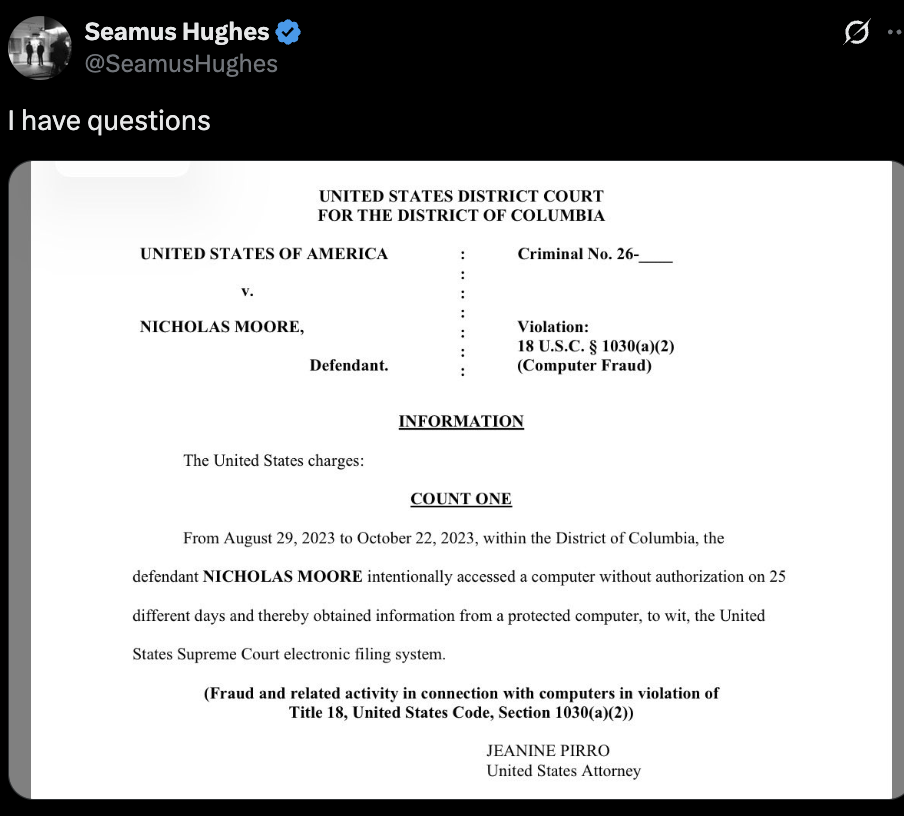
Court
Watch’s
Seamus
Hughes,
who
first
spotted
the
filing,
posted
his
reaction
on
X:
Indeed.
The
filing
is
notably
spare
on
details.
Maybe
Jeanine
Pirro
learned
that
less
is
more
if
she
needed
to
pursue
an
indictment
without
D.C.
grand
jurors
responding
with
a
resounding,
“Are
you
kidding,
lady?”
The
former
Fox
News
personality
who
now
serves
as
U.S.
Attorney
has
had
a
rough
go
of
it
in
D.C.,
between
the
juries
refusing
to
convict
and
judges
openly
questioning
whether
her
office
understands
basic
Fourth
Amendment
principles
—
but
now
she’s
found
a
case
where
the
defendant
is
just
going
to
plead
guilty
and
save
her
the
risk
of
another
embarrassing
fail.
The
charge
itself
rests
on
the
Computer
Fraud
and
Abuse
Act,
a
statute
prosecutors
love
the
way
DIYers
love
duct
tape.
The
CFAA
is
intended
to
put
sophisticated
hackers
in
prison,
but
in
practice,
prosecutors
deploy
it
whenever
a
computer
makes
someone
feel
bad.
Its
vague
“unauthorized
access”
language
has
become
a
hammer
used
against
people
for
logging
into
computers
when
company
policy
should
have
blocked
access.
It’s
a
computer
crime
law
written
for
an
era
where
our
grasp
of
the
technology
came
from
movies
like
The
Net,
with
that
girl
from
the
bus.
Did
Moore
maliciously
hack
into
the
system,
or
did
he
just
walk
blithely
through
an
open
door?
Unfortunately,
it
wouldn’t
matter
much
under
the
CFAA.
Prosecutors
told
TechCrunch
they
“cannot
provide
any
more
information
that
hasn’t
already
been
made
public.”
But
based
on
the
bare-bones
of
the
Information,
the
defendant
only
gained
access
to
the
electronic
filing
system
as
opposed
to
the
Court’s
emails
or
document
management
system.
Moore
presumably
wasn’t
getting
access
to
internal
deliberations
or
Clarence
Thomas’s
next
billionaire-funded
luxury
vacation
through
the
filing
system.
Not
to
downplay
the
seriousness
of
the
breach
—
insider
access
to
the
filing
system
would
afford
access
to
any
sealed
documents
—
but
this
doesn’t
sound
like
the
start
of
a
future
Dobbs
leak.
Are
they
any
better
in
2026?
If
they
approached
cybersecurity
with
the
same
vim
and
vigor
they
brought
to
revamping
the
Court’s
ethical
code,
let’s
say
no.
With
the
Supreme
Court
potentially
poised
to
invalidate
recent
tariffs,
organizations
face
a
confusing
scenario:
the
possibility
of
some
$200B
in
refunds
to
be
sought,
the
specter
of
tariff
reinstatement
through
other
means,
and
general
ongoing
unpredictability
regarding
costs
and
processes
for
global
trade.
Having
clear
visibility
into
contract
terms
—
such
as
price
adjustments
and
renegotiation
provisions
—
is
essential
to
navigating
this
volatility,
while
implementing
favorable
terms
in
supplier,
customer,
and
partner
agreements
can
help
build
resilience.
Tune
in
to
legal
and
technology
leaders
including
Bob
Ambrogi
of
Above
the
Law,
Jonathan
Todd,
Vice
Chair
of
the
Transportation
&
Logistics
Practice
Group
at
Benesch
Law,
and
Hal
Marcus,
Legal
AI
Evangelist
at
Workday
for
a
CLE-approved
webinar
focused
on
practical
solutions
to
help
organizations
thrive
through
uncertainty.
Come
join
us
on
January
27th
at
1
p.m.
ET
and
we’ll
discuss
the
current
state
of
the
tariff
conundrum
and
explore
strategies
for
achieving
contract
visibility
with
the
latest
AI
innovations.
In
this
session,
you’ll
learn
how
to:
How
to
find
the
tariff-related
contractual
answers
you
need
quickly
and
easily
just
by
asking
questions.
How
to
continuously
rank,
classify,
and
summarize
financial
terms
—
without
even
having
to
ask.
Strategies
to
mitigate
supply
chain
disruptions
and
cost
volatility
with
negotiated
terms.
Real-world
examples
of
businesses
leveraging
AI-powered
contract
data
to
overcome
challenges.
Learn
how
contract
intelligence
can
help
you
confidently
navigate
uncertainty
and
protect
your
bottom
line.