‘The
time
is
right’
considering
the
under-reported
level
of
economic
activity
in
Zimbabwe,
says
McCormick
Property
Development’s
Jason
McCormick.
Construction,
cranes.
Image
credit:
Pixabay
McCormick
Property
bets
$100
million
on
Zimbabwe’s
retail
market
McCormick
Property
Development
(MPD)
is
expanding
its
African
reach
with
the
construction
of
a
$100
million
(around
R1.65
billion)
shopping
mall
in
Zimbabwe.
The
time
is
right
for
the
realisation
of
the
Mall
of
Zimbabwe
in
the
capital,
Harare,
together
with
its
project
partners,
says
MPD’s
Jason
McCormick,
also
CEO
of
Exemplar
REITail.
According
to
a
Business
Day
report, McCormick
will
be
handling
the
property
development and
Exemplar
will
be
assisting
with
leasing.
McCormick
believes
that
the
economic
activity
happening
in
Zimbabwe
currently
is
not
reflected
in
the
formal
GDP
figures
coming
out
of
that
country.
Established
in
1983,
MPD
has
focused
on
developments
in
previously
under-serviced
areas
of
South
Africa.
“As
developers
of
especially
township
retail
in
South
Africa
for
the
last
45
years,
we’ve
always
kind
of
gone
where
angels
fear
to
tread”,
quips
McCormick,
“so
I’d
say
we’re
no
more
fearful
of
Zimbabwe.”
The
retail
property
developer
acquired
the
land
earmarked
for
the
project
about
12
years
ago
already,
waiting
for
the
time
to
be
right
for
the
Mall
of
Zimbabwe.
“There’s
no
doubt
in
our
minds
that
the
time
is
now
right
–
in
much
the
same
way
that
the
formal
economic
figures
coming
out
of
our
townships,
our
employment
stats
and
the
rest
of
it
have
been
a
bone
of
contention…
I
think
it’s
very
much
the
same
way
with
Zimbabwe’s
GDP.”
McCormick
also
details
the
reasons
why
building
in
Zimbabwe
is
actually
cheaper
than
in
South
Africa.
The
main
concern
for
Zimbabwe’s
driving
instructors
is
not
teaching
the
highway
code
to
their
students
but
making
sure
they
“survive
some
of
the
world’s
deadliest
roads”,
said The
Associated
Press.
In
2024,
the
country
recorded
more
than
2,000
deaths
from
road
traffic
accidents
and
more
than
10,000
injuries,
according
to
the Traffic
Safety
Council
of
Zimbabwe.
Africa
as
a
whole
has
the
“world’s
highest
fatality
rate
at
26.6
deaths
per
100,000
people,
compared
with
a
global
average
of
about
18”,
said
AP.
And
Zimbabwe
has
one
of
the
highest
rates
–
nearly
30
deaths
per
100,000
people
–
within
Africa.
‘Pothole-riddled
reality’
Zimbabwe
was
once
known
for
“orderly
traffic
and
well
kept
roads”
but
its
network
has
“deteriorated
since
the
2000s”.
A
series
of
economic
crises
has
taken
its
toll
on
road
infrastructure,
while
“weakened”
enforcement
of
maintenance
has
led
to
“traffic
chaos”.
Despite
attempts
to
bolster
police
presence
on
the
roads,
“dangerous
driving
remains
deeply
entrenched”.
Transport
minister
Felix
Mhona
told
the
country’s
Senate
that
over
90%
of
road
accidents
are
attributable
to
human
error,
said The
Herald.
Deaths,
injuries
and
damage
from
road
traffic
accidents
constitute
a
“devastating
and
predictable
public
health
disaster”.
Such
is
the
scale
of
the
problem
that
motorists
have
been
“holding
prayers
at
blackspots”,
looking
for
“divine
intervention
to
tame
the
carnage”
and
to
ward
off
“avenging
spirits”,
said News
Day.
When
Nigerian
newspaper
Vanguard
recently
placed
Zimbabwe
in
the
top
10
of
the
best
road
networks
in
Africa,
“many
Zimbabweans
laughed
in
disbelief”,
said
Tendai
Ruben
Mbofana
in The
Zimbabwean.
Road
users
are
used
to
a
“pothole-riddled
reality”
caused
by
“years
of
underfunding,
corruption,
weak
maintenance
cultures,
and
political
mismanagement”.
In
some
places,
the
deterioration
has
been
so
marked
that
roads
are
left
“resembling
post-conflict
zones”.
‘Strikingly
inadequate’
enforcement
To
promote
road
safety,
Zimbabwean
police
have
begun
using
body
cameras
and
breathalysers,
and
want
a
“review
of
the
driver
licensing
system”,
said
AP.
This
would
include
improvements
to
training
programmes,
public
information
campaigns
to
raise
awareness
of
reckless
driving,
and
tougher
enforcement,
including
deducting
points
for
more
driving
offences.
A
free
daily
email
with
the
biggest
news
stories
of
the
day
–
and
the
best
features
from
TheWeek.com
The
Zimbabwean
government
is
targeting
tourist
routes
for
improvement,
hoping
the
investment
will
“deliver
a
key
economic
benefit”
for
the
country
and
its
struggling
economy,
said Global
Highways.
One
example
is
the
road
linking
Beitbridge,
on
the
South
African
border,
with
Bulawayo
and
the
ever-popular
Victoria
Falls.
The
Zimbabwe
Transport
Ministry
has,
however,
“exceeded
its
planned
budget”,
meaning
“there
are
concerns
as
to
how
future
works
will
be
funded”.
“While
road
rehabilitation
is
a
positive
step,
it
cannot
solve
the
problem
alone,”
said
The
Herald.
The
government
has
shown
it
can
take
hardline
legislative
stances
–
such
as
its
recent
strategy
to
tackle
drug
trafficking
and
substance
abuse
–
and
it
is
essential
that
the
same
“model
of
commitment
and
resource
intensity”
is
“replicated”
in
the
road
safety
sector.
New
road
safety
policies
have
been
introduced
but
their
enforcement
is
“strikingly
inadequate”.
Inconsistent
action
by
the
authorities
has
led
to
drivers
and
passengers
feeling
“empowered
to
flout
safety
rules
without
fear
of
consequence”.
The
Thomson
Reuters
Institute
and
Georgetown
Law’s
Center
on
Ethics
and
the
Legal
Profession
released
their
annual
State
of
the
U.S.
Legal
Market
report
today,
and
the
good
news
is
that
law
firms
are
absolutely
crushing
it.
Profits
are
up.
Rates
are
up.
Demand
surged
in
2025
at
levels
the
industry
hasn’t
seen
in
more
than
a
decade.
The
Am
Law
100
is
printing
money,
midsize
firms
are
having
a
moment,
and
everyone
is
congratulating
themselves
for
their
“resilience.”
Have
we
ever
seen
numbers
like
these
before?
*Laughs
nervously
in
Lehman
Brothers*
The
legal
industry
has
surged
like
this
before
—
in
2007
before
the
Global
Financial
Crisis
(GFC),
and
in
2021
before
an
inflation
crunch
—
and
each
time,
firms
that
mistook
altitude
for
stability
found
themselves
falling
furthest
when
conditions
shifted.
First
of
all,
it
seems
like
terminal
lawyer
brain
to
initialize
the
recession.
The
term
only
comes
up
three
more
times!
But
more
importantly,
the
market’s
present
exuberance
coincides
perfectly
with
past
crashes.
Take
a
moment
to
brush
off
that
resume.
The
report
opens
with
an
extended
metaphor
about
the
formation
of
the
Himalayas,
crediting
tectonic
forces
for
sending
peaks
soaring
into
the
atmosphere,
while
noting
that
“the
very
forces
creating
today’s
peaks
are
simultaneously
undermining
the
ground
beneath
them.”
For
the
legal
market,
this
translates
to
a
market
heavily
reliant
on
legal
problems
generating
hefty
profits
in
the
short
term
and
leaving
lawyers
unemployed
in
the
medium
term.
It’s
the
regulatory
whiplash
and
random
trade
wars
and
all
around
geopolitical
instability.
That’s
why
the
market
saw
peaks
in
both
transactional
work
and
counter-cyclical
work,
a
feat
the
report
describes
as
“highly
atypical,
again
except
for
in
periods
of
severe
market
disruption.”
If
chaos
is
a
ladder,
the
Trump
administration
is
a
mountain
range
and
the
legal
market
is
high
enough
to
start
getting
delusional
from
oxygen
deprivation.
Unfortunately,
once
you
hit
the
summit,
there’s
nowhere
to
go
but
down,
passing
the
corpses
of
2007
and
2021
along
the
way.
Throw
into
this
unstable
business
climate
the
fact
that
firms
are
pouring
money
into
artificial
intelligence
with
the
enthusiasm
of
a
tech
bro
who
just
discovered
ketamine.
Law
firms
increased
technology
spending
by
nearly
10%
in
2025,
racing
to
deploy
AI
tools
that
can
draft
briefs
and
analyze
contracts
in
minutes
instead
of
hours.
At
the
same
time,
they
increased
lawyer
compensation
by
8.2%
and
grew
headcount
by
2.9%.
At
the
same
time,
some
90%
of
all
legal
dollars
still
flow
through
standard
hourly
billing
arrangements.
Spending
more
to
do
work
in
less
time
while
getting
paid
by
time.
The
report
diplomatically
describes
this
as
creating
“an
almost
absurd
tension.”
It’s
why
the
billable
hour
should
get
a
serious
rethink
in
2026…
but
probably
won’t.
The
result
is
a
standoff
that
would
be
comical
if
the
stakes
weren’t
so
high.
Client
interviews
reveal
that
corporate
legal
departments
want
their
outside
law
firms
to
propose
innovative
billing
solutions
that
incorporate
AI’s
efficiencies,
while
law
firms
complain
that
clients
still
evaluate
everything
by
converting
it
back
to
hourly
rates.
Why
spend
months
developing
a
sophisticated
value-based
pricing
model
when
the
procurement
team
will
just
divide
the
total
by
estimated
hours
and
compare
it
to
last
year’s
rates?
This
is
why
legal
can’t
have
nice
things.
And
so
rather
than
figure
out
a
new
billing
solution,
clients
are
busy
figuring
out
how
to
cut
costs.
Why
move
to
value-based
billing
when
leaning
on
AI-optimized
hours
gives
clients
an
easy
place
to
nitpick?
Spending
going
down
right
when
law
firm
costs
are
going
up?
Sounds
troubling.
Thomson
Reuters
Market
Insights
research
calls
this
phenomenon
a
client
value
squeeze,
and
it’s
becoming
a
major
factor
behind
these
constrained
spending
choices
inside
corporate
legal
departments.
Even
as
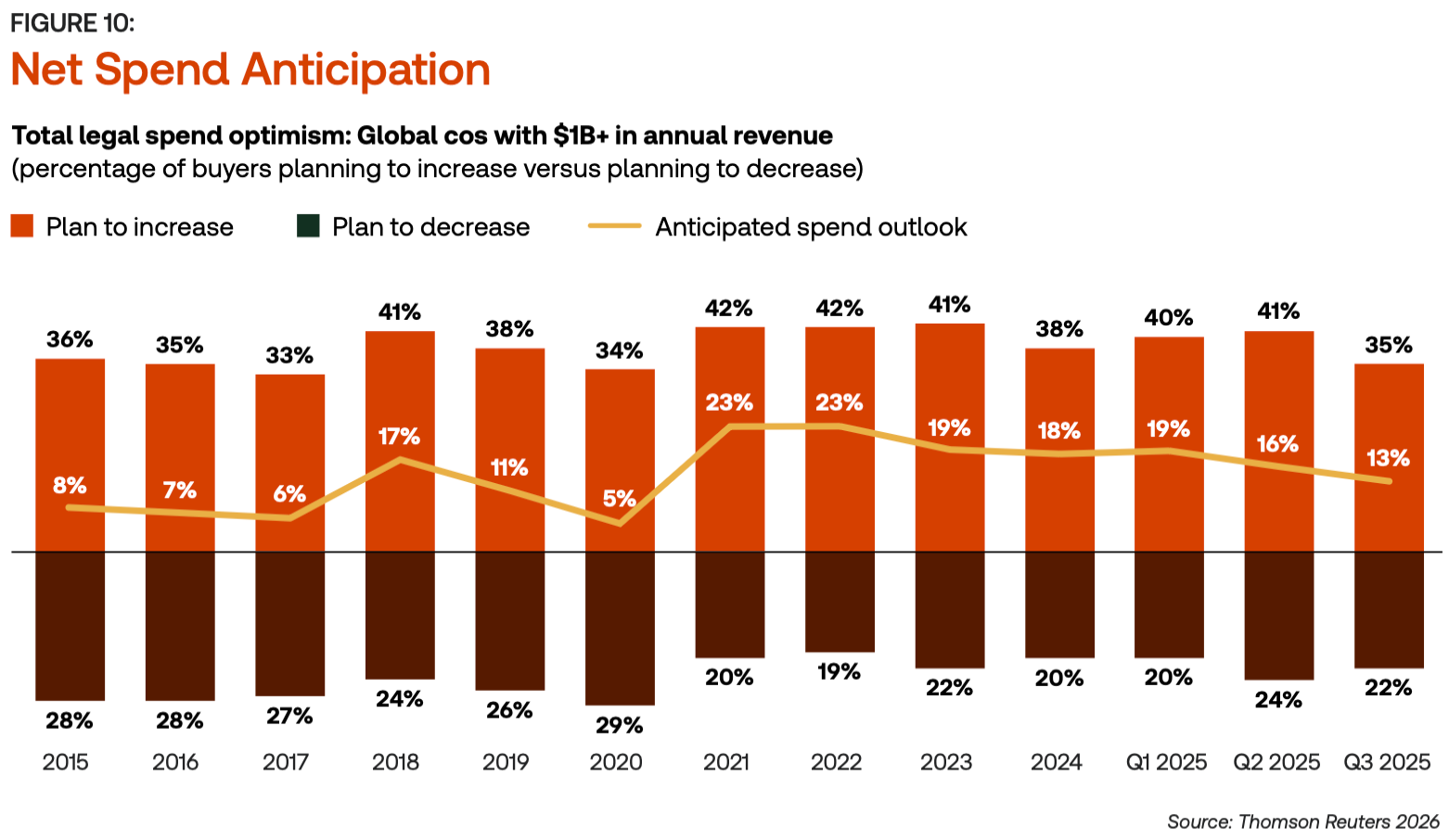
86%
of
GCs
say
they
believe
they
are
making
significant
contributions
to
organizational
objectives,
nearly
90%
report
that
resource
limitations
are
preventing
them
from
delivering
the
level
of
strategic
impact
their
organizations
expect.
OK,
why
didn’t
we
abbreviate
this?
You
invent
a
new
term
and
don’t
give
it
the
“CVS”
treatment?
The
crucial
insight
here
isn’t
that
there
may
be
less
legal
work
on
the
horizon
—
if
anything,
the
complexity
and
chaos
guarantee
continued
need
for
legal
services.
Instead,
it’s
that
clients
are
being
forced
to
make
increasingly
brutal
choices
about
which
firms
get
their
limited
dollars.
The
math
isn’t
complicated.
When
Am
Law
100
lawyers
cross
the
$1,000/hour
threshold
while
everyone
else
averages
around
$600,
GCs
start
making
different
choices.
The
report
calls
this
“mobile
demand.”
Normal
people
might
call
it
“shopping
around.”
In
any
event,
between
high
costs
and
technology
narrowing
the
gap
between
what
big
and
small
firms
can
pull
off,
clients
see
more
value
at
lower
price
points.
Clients
actually
spent
less
per
hour
on
average
legal
services
in
2025
than
in
2024.
This
is
despite
firms
raising
rates
7.3%.
Pretty
clear
evidence
that
rate
hikes
are
pushing
work
downstream.
Midsize
firms
surged
ahead
with
nearly
5%
demand
growth
in
the
latter
half
of
the
year
while
the
Am
Law
100
couldn’t
crack
2%,
resulting
in
the
largest
percentage
point-spread
gap
in
demand
between
the
top
and
bottom
segments
since
the
GFC.
For
much
of
the
year,
the
Am
Law
100
actually
contracted
while
smaller
firms
captured
all
the
growth.
Indeed,
top
firms
needed
the
third
quarter’s
explosive
surge
just
to
crawl
into
positive
territory
for
the
year.
There’s
the
GFC
again,
which
still
sounds
like
an
ominous
Roald
Dahl
character.
But
while
the
report
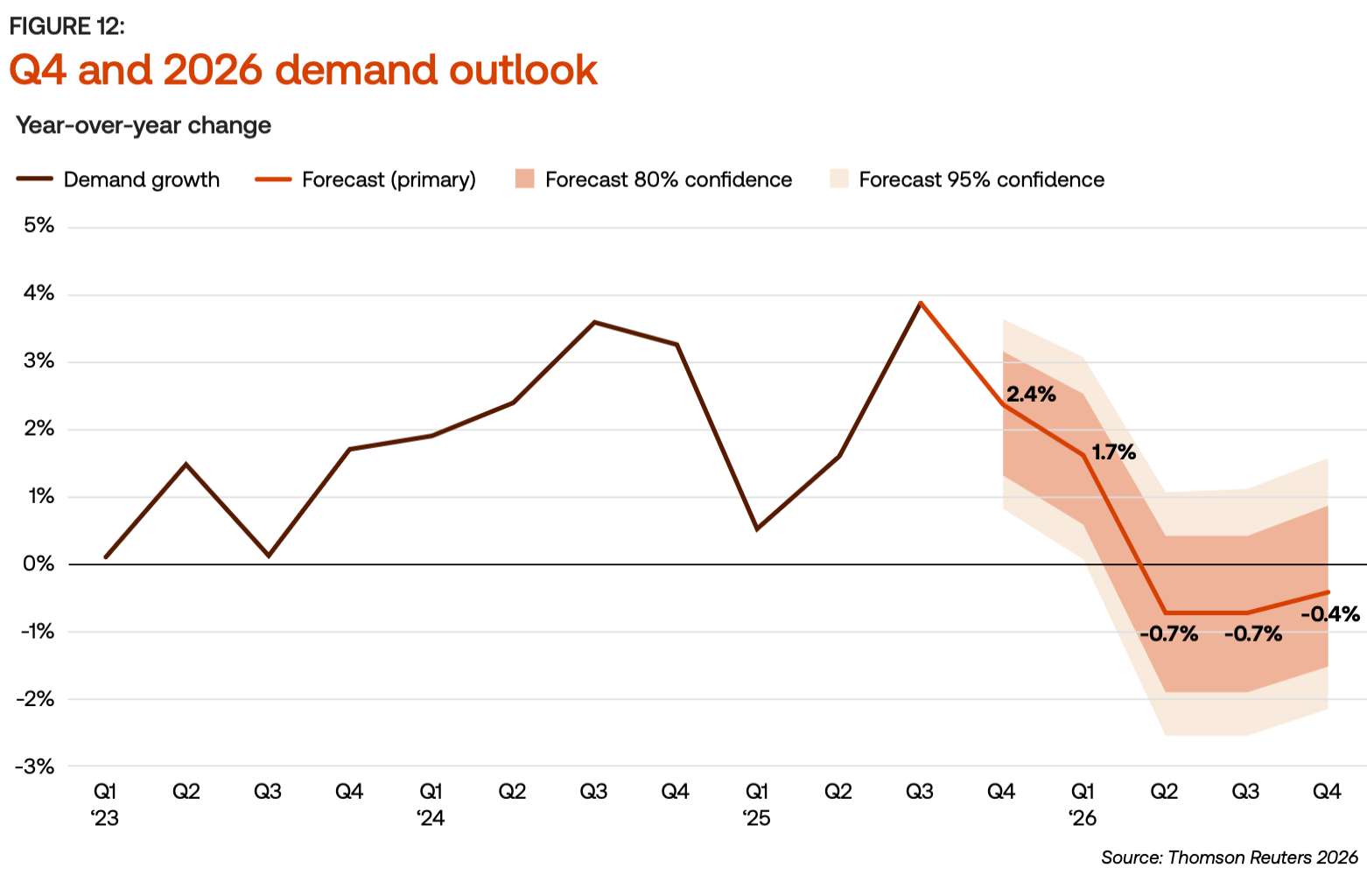
forecasts
continued
need
for
legal
services
amidst
the
chaos,
it
does
see
that
need
shrinking
too:
Law
firms
are
doing
great
because
the
world
is
on
fire,
AI
is
poking
holes
in
their
pricing
model,
and
clients
are
running
out
of
patience.
That’s
not
a
golden
age;
it’s
a
sugar
high.
And
history
suggests
the
crash
will
come
right
after
everyone
finishes
congratulating
themselves
for
surviving
the
last
one.
And
here’s
the
part
that
should
really
keep
Biglaw
up
at
night.
After
the
2008
financial
crisis
—
sorry…
the
GFC
—
corporate
legal
departments
absorbed
laid
off
talent
and
used
this
newfound
talent
to
get
stingier
with
firms.
“Suddenly
GCs
had
former
Big
Law
lawyers
on
staff
who
knew
exactly
how
firms
made
up
their
bills,
which
matters
required
senior
attention,
and
what
work
could
be
done
for
a
fraction
of
the
price,”
the
report
notes.
This
rewiring
of
the
firm-client
relationship
played
a
key
role
in
the
rise
of
absurd
billing
guidelines
and
heightened
all-around
scrutiny.
If
this
comes
to
pass
again,
corporate
legal
departments
will
also
come
armed
with
AI
tools
capable
of
transforming
every
invoice
discussion
into
a
financial
colonoscopy.
And
their
rebound
hires
might
be
able
to
use
other
AI
products
to
move
in-house
all
that
work
that
once
required
the
brute
force
of
a
large
firm.
A
round
of
layoffs
that
give
clients
more
outside
counsel
refugees
could,
at
this
point,
tilt
the
balance
of
power
irrecoverably
toward
clients.
So
enjoy
the
view
from
the
summit!
Maybe
all
this
mountaineering
will
come
in
handy
when
firms
have
to
open
their
new
Greenland
offices.
Conventional thinking is that agentic
AI
is
thrown
around
enough
to
be a cliché. We
aren’t sure
what
it
means. We
aren’t
sure
what
it
does. Whatever
it
is
and
does
really
doesn’t
mean
much
for
legal,
right?
I’ve
heard
all
sorts
of tech concepts
thrown
around during the
first
two
days of CES:
robotics,
longevity,
vertical
AI,
industrial
AI.
But
the
one
talked
about
the
most
is
agentic
AI
and
what
it
can
do.
I
admit I’ve
been
a
skeptic. But
the
press conferences and
keynotes
by
the
big
players
like Nvidia, Samsung, LG, and
a
smaller player, AGI
Inc., suggest that
agentic
is
not
just
some
pie
in
the
sky hyperbole but
a
real
thing
that
can
do
real
things for real people.
As Amit
Jain,
CEO
of Luma AI, put
it as
a
guest
in the
AMT Keynote,
“2026
will
be
the
year
of
the
agents.”
I’m now convinced
that
agentic
AI
is
enough
of
a
thing
for
legal
to
begin
thinking
about
its
benefit
and
risks.
What Agentic AI
May
Mean
What
all these keynote speakers
talked
about
was
the potential
for agentic
AI
to
create
an
honest
to
God
assistant.
Not
a
dumb
GenAI
assistant
that
tries
to
answer just what
you
ask,
albeit
often unsuccessfully.
But
a
real
assistant
who
answers
you,
makes
suggestions
for
next
steps,
helps
you
think through solutions,
and
helps
you implement
them.
It’s
like having a devoted friend at
your
side
whose
only
job
is
to
help
in
every
way.
Some consumer examples mentioned
by CES
speakers demonstrate
what agentic AI may do for business. An agent
can
decipher
what’s
in
your fridge and create
a recipe
suggestion
based
on
what’s
there
and
what
you
have
historically
liked.
It
can
figure
out
how
to
season
the
food
based
on
your
taste.
It
can
help
you
plan
an
anniversary
night
out
with
your
spouse
based
on
likes
and
dislikes
it knows.
It
can
call
you
an
Uber
based
on your request
to
get
you
an
Uber.
And
then
provide
you
with
all
the
information
you
need to
catch
the
Uber.
No
more
wandering
around
airport
trying
to
figure
out
where
and how
to
catch
your
Uber.
It doesn’t
take
much
imagination
to
think
of examples that
may
aid business
and
even
legal.
I’m
sure
you’re
thinking,
as I
was,
it’s
the CES same
old,
same
old.
Wild
claims
backed
by
extravagant
productions
with heartwarming videos
about
how
AI is going
to
change
our
world.
But
this
felt
a
little
different
once
I
reflected
on
a
couple
of my
own recent experiences and after I
heard
Jensen
Huang,
founder
and
CEO
of Nvidia, speak.
Some Personal
Examples
I
got
a
glimpse
of what
agentic
AI
could
do when
I
recently
tried
OpenAI’s
web
browser, ChatGPT Atlas.
I
asked it to
help
me
pick
flights
to
Las
Vegas
for
CES.
It
accurately
sorted
through
the
options on
several
websites,
directed
me
to
the best
one, and
with
my
permission,
booked
the
flight on
that
site.
It
saved
me
a
bunch
of clicks, and
it worked pretty
seamlessly.
I’m
pretty
sure
with
some
more
use,
it
would
learn
I
only
want
direct
flights
and would like
an
aisle
seat. Admittedly,
there
have
been criticisms of Atlas,
but its
capabilities
I
witnessed
suggests
its
potential.
As
for
the
notion
that
this
is
all
pie
in
the
sky
and
will
never
happen,
the
same
has
been
said
for self-driving cars.
I bought one
a
few
years
ago
and
while
the self-driving features
at
that
time
were
okay,
they
weren’t
something
I
used
every
day
or
relied
on. But
the improvements since
then are
remarkable. They
are
now
so
good, I
use them every
day on just
about
every
trip.
And
as Jensen pointed
out in
his
keynote,
much
of
what
is
going
on
with
these vehicles is
a
form
of and
powered
by agentic
AI.
The
notion that
we may
be
on
the
cusp
of
something big was reiterated when
Jensen
explained
why this
may
be
the
case.
Jensen’s
Keynote
Jensen
explained
why
agentic
AI may
be ready
to become
mainstream. Here’s why:
• Computing
power
has
grown exponentially.
• That
growth
has
enabled
AI
programs
to understand
and
grasp
data
in
things
like
PDFs,
images,
and
audio
files.
• AI
programs
are
seeking solutions from
multiple
LLM
and
cloud
servers,
increasing
the
amount
of
data
from
which
to
cull
answers.
• AI
programs
can
now
simulate solutions
for situations
for
which
there
is
an
absence
of
data
by recognizing
patterns
from
similar
situations
and
understanding
outcomes.
What
this
means,
says
Jensen, is
it
can
make
recommendations
as
to
what
to
do
and
tell
you
why
it
has
come up
with
its conclusions. Agentic
AI
can
now
understand
things
like
sequences
of
events.
It can
reason
through
new
problems
that
may demonstrate similar sequences. It can
reason
what
will
likely
happen
next. It can
encounter
something
new
upon
which it
has not
been
trained
or recognizes and nevertheless determine
what to
do.
Moreover,
Jensen
described the
ability
for
programmers
to
easily
make
customized LLMs
for
specific
needs
of
a
certain
business and
then have
that
LLM
combine
with
more
generic
LLMs
with
greater training and
more
simulations
for
tailored
outputs.
Jensen
says
the
result
of
all
this is a
creative,
helpful
assistant
that
can
think through what
needs
to
be
done
based
on
what
you
have
done
in
the
past,
the requirements, goals, and
visions
of
your
business,
and similar outcomes across
the
ecosystem. It’s
an
agent
that
understands
and
can
interact
with
our
world.
As you
might
expect,
Jensen
was
long
on
optimism
but
a
little
short
on
what all has
to be
in
place
for
agentic
AI
to
work
as
promised. It
remains
to
be
seen
if
Jensen
and
others
are
right.
But
there
is
enough
evidence
at
the
show
for
me
to
think
that agentic
AI
is
real.
Just
how
real,
we
don’t
know
yet.
But
it’s
enough
of
a
possibility
for
legal
not
to
ignore.
For
Legal: A Blessing
It’s easy
to
write
all
this
off
when
it
comes
to
legal.
The conventional view
is
that no
lawyer
in
their
right
mind
would
let
a
bot unilaterally act
and
make
decisions
for
it.
Much
too
dangerous.
And
of
course,
agents
are
probably
not
going
to
happen
in
legal
anyway.
But
as
my experience with
Atlas
and
my
car demonstrate,
agentic
AI
being
an
erstwhile
companion
even
in
legal
may
not
be
that
far
off.
Such
a
legal
companion
could
also
be
a tremendous aide.
It
could
almost
be
like
a
practice
mentor,
always
ready
to
help.
Here’s
an
example
of
how
this
could
work.
When
I
was
a
young
lawyer,
I
was
given
a
case
to
practice.
I
sat down and
drew
up
a
set
of interrogatories. It
was
not
until
the
eve
of
trial
that
I learned
that
out
of
ignorance,
I left
out
a
set
of fundamental,
standard
interrogatory questions:
who
is
your
expert
and
what
are
they
going
to
say. Had
I
been
able
to merely
feed the initiating complaint
into
an
agentic
AI
tool,
it
could
have
run
with
it
and
created a
case
playbook
that
included
a set
of
comprehensive interrogatory questions.
No
more
digging
through
countless
files
to
see
what
others
in
the
firm
or
elsewhere
had
done
in similar situations.
No
more
worrying
if
I
missed
something
critical.
No
more
waking
up
in
the
middle
of
the
night
wondering
if
I
had
filed
something
in
time.
Less
stress,
better
results.
Of
course,
all
this
depends
on
the
agent
giving
the
why
certain
things
need
to
be
done
so
the
human
can
decide,
given
the
particular
facts
of
the
case, that
they’re appropriate.
More
importantly,
its
viability
as
a
tool depends
on a human being in
the
loop
reading,
understanding,
and
evaluating
what
the
agent is
suggesting.
It’s
the
human
in
the
loop
problem
that
creates
a potential
curse.
The
challenge
is how
to
avoid
it.
And
a
Potential
Curse
The
truth
is
it’s the
human
of
the
loop that
can screw
things
up. For
example, I
had
a
case
where
a
tragic weather-related
accident
injured and
killed
several
people. Clearly, they
had
nothing
to
do
with
what
happened
other
than
they
were
in
the
wrong
place
at
the
wrong
time. But
one
of
the
lawyers
for
another
defendant
in
the
case filed their
standard
set
of
pleadings
which
included
the
claim
that
the
victims
negligently
contributed
to
their
injuries
and
deaths.
It
was
wrong for
multiple
reasons. Suffice
it
to
say,
the
media
picked
it
up
and
the
client
was embarrassed and possibly prejudiced.
I
mention
that
here
because
it
is
precisely
this
human
in
the
loop
problem
that
poses
the danger for lawyer
use
of agentic
AI. It’s
the
temptation
or inability to critically think through a
problem
and
determine
if
what
the
agent
suggests
is
appropriate
given
the
situation. It’s the
same
human
in
the
loop
problem
we
have
with
cybersecurity:
you
can
warn
and
warn
to
not
click
on
unknown
links
but
sooner
or
later, a
human
in
the
loop will
ignore
the
warning
and
do
it
anyway.
I
fear
that
will
end
up
being
the
curse
of
things
like
agentic
AI.
It’s too
easy
and
tempting
to
overrely
on
it, particularly for
busy
or,
for
that
matter,
lazy
lawyers
who
don’t
take
the
time
to
treat
the agent’s roadmap
with
some
skepticism.
Not
to
mention
the
fact,
as
I
have
discussed
before,
GenAI
tools
and
LLMs
have
the
propensity
to
rot
our
brains
and
diminish the critical thinking
skill
necessary
to
be
discriminating.
The
fact
that
so
many
lawyers
are
getting
caught
citing
nonexistent
cases
proves
the
point,
The
Agentic
Future
But
for
those
who
do
and
can
think
critically,
I can see
the
advantages
of
agentic
AI.
It’s
like
my
car.
I
can
tell
it
where
I
need
to
end
up
and
it
maps
the
route
and
by
and
large
drives
itself
there.
It saves me
time
and
energy and,
in
many
instances,
makes
it
less
likely
for
a
mistake
to
occur.
But
I
don’t
go
to
sleep
while it’s doing
so
because
sometimes
it
will
decide
to
act
in
a
way
not appropriate for
the
circumstances at
hand.
That’s
when
my
skills
and experience come
into
play.
The
challenge
we
have
as
a profession is
to
make
sure
we
don’t
end
up
with
a
profession
where
those
using
the
agents
don’t
know
how
to drive. That
requires
attention
to
training
and
the
challenges.
It
also
requires
understanding
what
agentic
can
—
and
can’t
do.
One
thing
we
can’t
do
is
ignore
it.
Things
that
you
say
will
never
happen,
indeed
don’t
happen
until
they
do.
And
by
then,
preparing
is too
late.
Stephen
Embry
is
a
lawyer,
speaker,
blogger,
and
writer.
He
publishes TechLaw
Crossroads,
a
blog
devoted
to
the
examination
of
the
tension
between
technology,
the
law,
and
the
practice
of
law.
Meanwhile,
the
Acting
President
Rtd
General
Constantino
Guveya
Chivengwa
appeared
to
publicly
snub
a
handshake
from
Defence
Minister
and
ZANU
PF’s
national
Chairman,
Oppah
Kashiri
Muchinguri.
This
happened
during
the
burial
of
late
national
hero
Brigadier-General
(retired),
Mathias
Tizirai
Ngarava
on
3
January
2025,
at
Zimbabwe’s
national
heroes’
acre,
Harare.
Oppah
Muchinguri
could
be
seen
embarrassingly
pulling
back
her
extended
hand
and
appearing
confused
as
to
what
next.
There
are
unconfirmed
reports
within
the
public
domain
that
suggest
Oppah
and
her
daughter
are
involved
in
drug
trafficking
with
impunity.
It
would
appear
the
Acting
President’s
moral
campaign
against
corruption,
in
which
he
again
chastised
the
‘zvigananda
(rogues)’
is
apparently
targeted
at
Oppah
Muchinguri,
and
the
other
usual
suspects,
including
Wicknell
Chivhayo,
Kudakwashe
Tagwirei,
Scott
Sakupwanya,
Tungwarara,
the
list
goes
on.
With
reports
suggesting
that
Wicknell
Chivhayo
has
donated
USD
5
million
worth
of
vehicles
to
ZANU
PF,
one
wonders
if
Chiwenga
will
win
this
war,
or
he,
like
those
before
him
(Edgar
Tekere,
Margaret
Dongo,
Simba
Makoni,
Joshua
Nkomo,
Ndabaningi
Sithole),
will
fall
by
the
wayside
in
this
high
stakes
succession
struggle
within
ZANU
PF.
One
thing
is
clear
though,
all
is
not
well
within
ZANU
PF
and
the
infighting,
finger-pointing,
counter-blaming,
is
set
to
escalate
even
more
until
the
succession
question
is
resolved.
In
the
meantime,
the
gap
between
the
rich
and
the
poor
continues
to
grow
exponentially
and
more
than
half
of
the
population
languishes
in
abject
poverty.
The
poor
in
Zimbabwe
have
only
God
to
turn
to
whilst
the
rich
and
powerful
claim
everything
good
in
Zimbabwe.
As
for
human
rights,
this
has
now
been
pushed
to
the
dustbin
of
the
state’s
priorities.
Zimbabweans
needs
to
rise
up
against
the
military
dictatorship
and
fight
for
what
rightly
belongs
to
them!
Events
and
Notices:
Next
Vigil
meeting
outside
the
Zimbabwe
Embassy.
Saturday
17th
January
2026
from
2
–
5
pm.
We
meet
on
the
first
and
third
Saturdays
of
every
month.
On
other
Saturdays
the
virtual
Vigil
will
run.
The
Restoration
of
Human
Rights
in
Zimbabwe
(ROHR)
is
the
Vigil’s
partner
organisation
based
in
Zimbabwe.
ROHR
grew
out
of
the
need
for
the
Vigil
to
have
an
organisation
on
the
ground
in
Zimbabwe
which
reflected
the
Vigil’s
mission
statement
in
a
practical
way.
ROHR
in
the
UK
actively
fundraises
through
membership
subscriptions,
events,
sales
etc
to
support
the
activities
of
ROHR
in
Zimbabwe.
The
Vigil’s
book
‘Zimbabwe
Emergency’
is
based
on
our
weekly
diaries.
It
records
how
events
in
Zimbabwe
have
unfolded
as
seen
by
the
diaspora
in
the
UK.
It
chronicles
the
economic
disintegration,
violence,
growing
oppression
and
political
manoeuvring
–
and
the
tragic
human
cost
involved.
It
is
available
at
the
Vigil.
All
proceeds
go
to
the
Vigil
and
our
sister
organisation
the
Restoration
of
Human
Rights
in
Zimbabwe’s
work
in
Zimbabwe.
The
book
is
also
available
from
Amazon.
Facebook
pages:
Vigil
:
https
://www.facebook.com/zimbabwevigil
The
Vigil,
outside
the
Zimbabwe
Embassy,
429
Strand,
London
meets
regularly
on
Saturdays
from
14.00
to
17.00
to
protest
against
gross
violations
of
human
rights
in
Zimbabwe.
The
Vigil
which
started
in
October
2002
will
continue
until
internationally-monitored,
free
and
fair
elections
are
held
in
Zimbabwe.
We
begin
the
year
by
peering
into
our
crystal
balls
and
issuing
some
predictions
for
2026.
Who
will
be
fired?
What’s
going
to
happen
with
law
schools?
Is
a
big
change
on
the
horizon
for
Biglaw?
Our
predictions
will
inevitably
be
wrong,
but
we’ll
offer
them
with
a
lot
of
confidence
—
just
like
AI
would.
Also
a
whole
lot
of
sports
talk
for
a
law
podcast.
As
law
firms
look
ahead
to
2026,
the
legal
sector’s
outlook
is
one
of
continued
opportunity
—
but
the
abrupt
closure
of
a
firm
in
the
first
week
of
the
new
year
is
a
stark
reminder
that
some
instability
in
the
market
remains.
McGlinchey
Stafford
—
a
Louisiana-based
firm
on
the
NLJ
500
with
18
offices
spread
across
the
Southeast
and
Northeast
—
announced
last
night
that
it
would
be
closing
its
doors,
apparently
to
the
surprise
of
the
bulk
of
its
employees.
As
noted
by
the
American
Lawyer,
the
150-lawyer
firm’s
equity
partners
voted
on
Monday
to
wind
down.
Sources
tell
Above
the
Law
that
staff
at
the
firm
“had
no
warning,”
and
that
the
news
was
a
“huge
mess”
for
those
who
were
“kept
in
the
dark.”
“As
we
begin
McGlinchey’s
52nd
year
of
operation,
my
colleagues
and
I
are
saddened
to
announce
its
final
chapter.
McGlinchey’s
attorneys
and
legal
professionals
have
focused
for
51
years
on
solving
our
clients’
legal
problems,
and
that
will
remain
our
focus
as
we
wind
down
our
business.
…
There
was
no
single
triggering
event
or
one
definitive
action
that
brought
us
to
this
point.
This
is
not
because
of
any
specific
attorney’s
departure,
or
any
individual
financial
decision
or
leadership
action
that
led
us
to
this
point.
This
is
the
result
of
a
combination
of
market
factors,
such
as
lagging
collections,
compounded
with
various
internal
factors
over
several
years.”
We
wish
the
lawyers
and
legal
professionals
at
McGlinchey
Stafford
the
best
of
luck
as
they
seek
new
opportunities
in
the
legal
industry
and
beyond.
If
your
firm
or
organization
is
closing
its
doors
or
reducing
the
ranks
of
its
lawyers
or
staff,
whether
through
open
layoffs,
stealth
layoffs,
or
voluntary
buyouts,
please
don’t
hesitate
to
let
us
know.
Our
vast
network
of
tipsters
is
part
of
what
makes
Above
the
Law
thrive
—
we’ll
never
ignore
you.
You
can email
us or
text
us
(646-820-8477).
Thank
you!
Staci
Zaretsky is
the
managing
editor
of
Above
the
Law,
where
she’s
worked
since
2011.
She’d
love
to
hear
from
you,
so
please
feel
free
to
email
her
with
any
tips,
questions,
comments,
or
critiques.
You
can
follow
her
on Bluesky, X/Twitter,
and Threads, or
connect
with
her
on
LinkedIn.
Costs
for
employer-sponsored
health
insurance
surged
from
2023
to
2024,
rising
faster
than
inflation,
according
to
a
new
analysis.
The
report
was
conducted
by
researchers
from
the
State
Health
Access
Data
Assistance
Center
(SHADAC)
at
the
University
of
Minnesota.
They
examined
trends
in
employer-sponsored
insurance
both
nationally
and
at
the
state
level
by
comparing
2024
data
to
2023.
The
researchers
found
that
annual
premiums
for
family
coverage
offered
through
employers
increased
by
more
than
$600
to
$24,540
in
2024,
a
3%
increase
from
2023.
This
is
about
the
cost
of
a
new
car,
such
as
a
2025
Toyota
Corolla,
according
to
the
report.
Premiums
for
individuals
rose
$300
to
$8,486,
a
4%
increase
from
2023.
Employers
in
several
states
experienced
premium
hikes
that
exceeded
the
national
average,
with
Delaware
seeing
the
steepest
increase.
Family
premiums
there
jumped
more
than
26%
—
over
$5,800
in
a
single
year
—
while
Alabama
and
Rhode
Island
also
recorded
notably
large
year-over-year
increases.
Deductibles,
meanwhile,
rose
an
average
8%
from
2023
to
2024
for
both
individual
and
family
coverage,
the
report
found.
The
average
annual
deductible
for
family
coverage
exceeded
$4,000
for
the
first
time
in
2024
due
to
a
$330
increase.
More
than
half
of
private
sector
workers
with
employer-sponsored
insurance
are
enrolled
in
high-deductible
health
plans.
These
provide
lower
monthly
premiums
but
often
lead
to
higher
out-of-pocket
costs.
In
22
states,
enrollment
in
high
deductible
plans
surpasses
60%.
Researchers
found
that
employee
contributions
to
employer-sponsored
insurance
remained
largely
stable
nationwide,
with
workers
continuing
to
pay
about
one-fifth
of
the
cost
for
individual
coverage
and
just
under
30%
for
family
coverage
from
2023
to
2024.
Currently,
more
than
half
of
Americans
receive
coverage
through
their
employer,
and
healthcare
costs
are
becoming
a
major
concern
for
both
consumers
and
employers.
“Employer-sponsored
insurance
remains
the
backbone
of
health
coverage
in
the
United
States,
but
it
is
becoming
increasingly
unaffordable
for
employers
and
their
employees,”
said
Elizabeth
Lukanen,
director
at
SHADAC,
in
a
statement.
“As
policymakers
look
for
solutions
to
curb
the
growing
healthcare
affordability
crisis,
addressing
the
decades-long
trend
of
increasing
costs
in
employer-sponsored
insurance
must
be
part
of
the
conversation.”
An
executive
at
the
Robert
Wood
Johnson
Foundation,
which
supported
the
analysis,
echoed
this.
“Employer-provided
health
coverage
is
not
immune
from
the
healthcare
affordability
crisis
that
is
tightening
its
grip
throughout
America,”
said
Katherine
Hempstead,
senior
policy
adviser
at
the
Robert
Wood
Johnson
Foundation.
“The
trend
of
moving
to
high-deductible
plans
to
shield
companies
and
individuals
from
large
monthly
premium
increases
is
understandable,
but
it
means
greater
financial
risk
down
the
road
in
the
event
of
a
medical
emergency.
It’s
a
gamble
no
one
should
have
to
take.”
As
we
complete
the
rollout
of
our
2025
Outside
Counsel
Rankings,
we
focus
this
week
on
the
law
firms
rated
highest
by
in-house
counsel
at
specific
types
of
organizations.
As
a
reminder,
our
survey
asked
more
than
500
in-house
attorneys
to
tell
us
which
firms
their
organization
engages
for
legal
services
and
indicate
the
highest
level
of
legal
work
for
which
they
engage
the
firms.
The
levels
of
work
were
defined
along
a
four-point
scale:
Cost-efficient,
bulk
tasks
Routine
matters
High-value,
complex
matters
“Bet-the-company”
matters
The
ratings
for
each
firm
were
averaged
and
the
law
firms
with
the
highest
scores
made
it
into
our
list
of
the
Top
Outside
Counsel.
We
also
drew
up
industry-specific
rankings
based
on
the
sectors
represented
by
the
in-house
lawyers
surveyed.
For
our
organization
rankings,
we
segmented
the
responses
based
on
the
type
of
organization
in
which
the
respondents
work
to
compile
lists
of
the
highest-rated
firms
among
eight
groups:
Small
Private
Companies
(with
fewer
than
100
employees)
Nonprofit
Institutions
The
firm
that
appears
most
frequently
across
types
of
organizations
is
Sidley
Austin,
which
ranks
in
six
different
categories.
Five
other
firms
feature
on
at
least
three
lists:
Sidley
Austin
(6):
Fortune
500,
Fortune
1000,
Other
Public,
Large
Private,
Midsize
Private,
Small
Private
Kirkland
&
Ellis
(4):
Fortune
1000,
Large
Private,
Midsize
Private,
Small
Private
Latham
&
Watkins
(4):
Fortune
250,
Other
Public,
Large
Private,
Midsize
Private
Cooley
(3):
Other
Public,
Small
Private,
Nonprofit
Institutions
DLA
Piper
(3):
Fortune
250,
Fortune
1000,
Large
Private
Morgan
Lewis
(3):
Fortune
250,
Fortune
500,
Nonprofit
Institutions
For
the
complete
lists
of
firms,
check
out
the
full
organization
rankings
here.
*
Judge
demands
to
know
why
Lindsey
Halligan
is
still
listed
as
“U.S.
Attorney”
when
she
is
most
definitely
not
a
“U.S.
Attorney.”
[Law360]
*
Could
law
firms
be
on
the
brink
of
a
financial
downturn?
[Reuters]
*
McGlinchey
Stafford
will
close
down.
Which
might
go
a
ways
toward
answering
the
prior
question.
[American
Lawyer]
*
“Mid-market
legal
powerhouse”
launches.
Which
might
go
a
ways
toward
further
complicating
that
question.
[ABA
Journal]
*
Texas
Supreme
Court
decides
to
break
with
ABA
and
do
its
own
law
school
accrediting.
So
now
would
be
a
very
good
time
to
start
a
shady
correspondence
law
school
with
a
vaguely
religious
name.
[Texas
Lawyer]
*
University
considers
suing
player
who
announced
intention
to
transfer.
[Yahoo]