Zimbabwe
remains
committed
to
curbing
inflation,
but
plans
to
shift
the
focus
of
monetary
policy
to
place
more
emphasis
on
managing
the
money
supply,
the
central
bank
said.
Writing
in
a
five-year
strategy
plan
published
on
Monday,
the
central
bank
characterised
this
as
a
shift
“from
a
tight
to
prudent
monetary
policy
thrust”
and
said
policy
decisions
will
be
“calibrated
to
reflect
emerging
inflationary
pressures
and
crystallisation
of
any
inflation
risks.”
It
didn’t
specify
what
this
would
mean
for
interest
rates
going
forward,
but
noted
that
businesses
had
told
it
that
local
borrowing
costs
in
the
southern
African
nation
“were
viewed
as
potentially
prohibitive.”
The
central
bank
held
interest
rates
at
35%
last
month
to
maintain
downward
pressure
on
inflation
and
support
the
ZiG.
The
gold-backed
currency
was
launched
in
2024
and
is
the
country’s
latest
effort
to
stand
up
a
viable
local
unit
after
previous
attempts
collapsed.
Zimbabwe’s
inflation
was
0.2%
in
December
compared
to
the
month
before
and
slowed
to
15%
on
an
annual
basis
from
19%
in
November.
The
bank
said
it
expects
the
trend
to
continue
and
that
the
rate
will
reach
single
digits
during
the
course
of
2026.
It
also
reiterated
its
goal
of
transitioning
the
Zimbabwean
economy
away
from
reliance
on
the
US
dollar,
which
continues
to
account
for
more
than
half
of
all
transactions.
The
bank
said
the
transition
would
largely
be
market
driven,
but
it
will
concentrate
on
creating
the
pre-conditions
for
success.
Such
conditions
included
“low
inflation,
adequate
reserve
buffers,
safe
and
sound
financial
and
payment
systems,
and
efficient
exchange
rate
system
and
congruence
between
monetary
and
fiscal
policies,”
the
bank
said.
Everyone
check
your
2026
Bingo
cards
because
we’re
not
even
a
week
in,
and
we’ve
already
got
a
Third
Amendment
controversy
brewing
in
Minnesota!
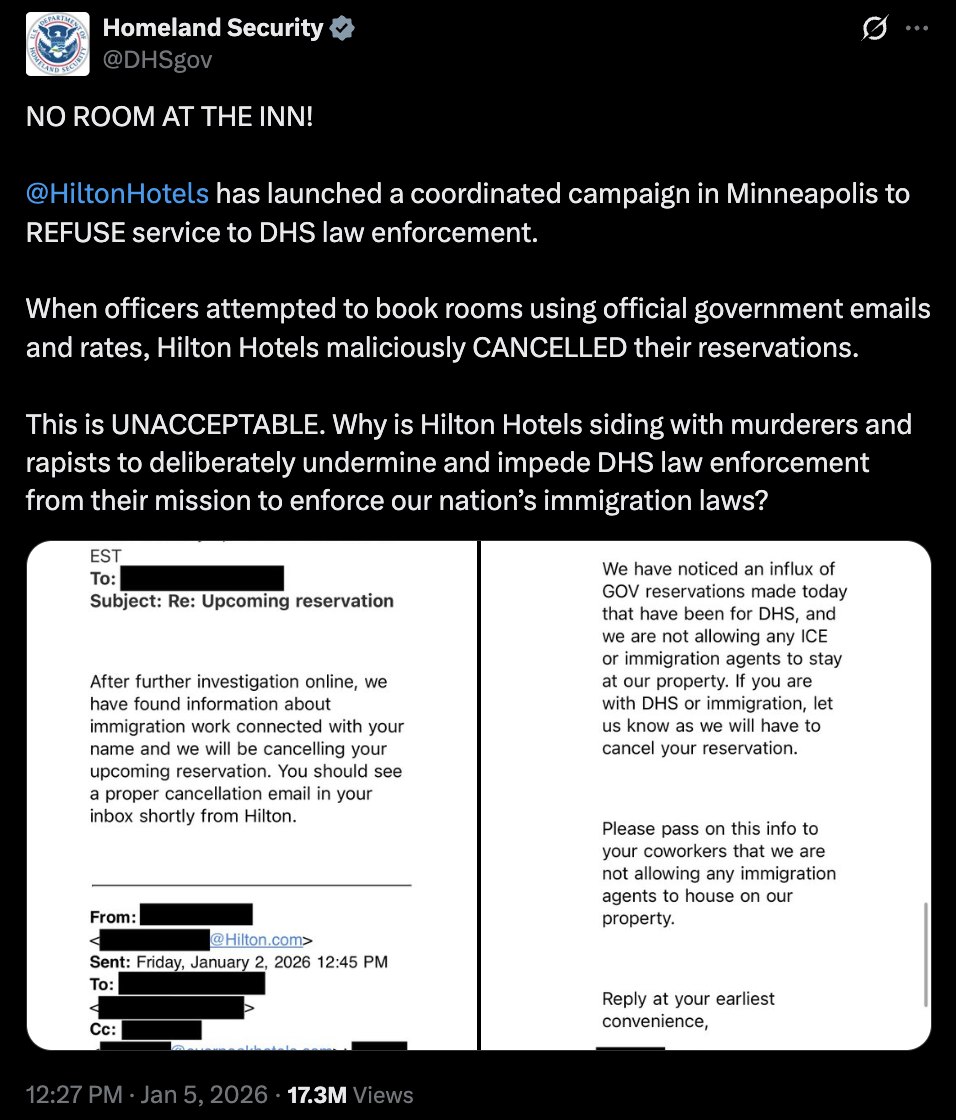
A
Hilton
Hotels
franchisee
allegedly
refused
to
house
ICE
forces
sent
to
the
state
as
part
of
the
administration’s
most
recent
anti-immigration
surge
and
rather
than
accept
the
private
entity’s
right
to
refuse
service
to
anyone…
the
Department
of
Homeland
Security
put
them
on
blast.
We’ve
gone
two
centuries
without
a
Third
Amendment
challenge
—
the
provision
barring
the
government
from
forcing
people
to
house
troops
in
peacetime
—
because
we’ve
lived
in
a
stable
democracy
governed
by
officials
and
a
Supreme
Court
more
or
less
committed
to
maintaining
the
rule
of
law.
But
since
that’s
all
gone
out
the
window,
we
could
finally
see
the
Third
Amendment’s
historic
streak
as
the
only
member
of
the
Bill
of
Rights
team
to
duck
the
Supreme
Court
all
these
years.
ICE
officers
dispatched
to
Minnesota
need
a
place
to
stay
and
tried
to
book
rooms
at
a
Hampton
Inn,
part
of
the
Hilton
Hotels
chain,
only
to
have
those
reservations
canceled
by
the
hotel.
Given
that
other
hotels
housing
Trump’s
surges
around
the
country
have
faced
protests,
the
hotel
likely
made
the
prudent
business
decision
to
honor
its
existing
guests
by
not
forcing
them
to
wade
through
a
picket
line
every
morning.
Rather
than
accept
this
exercise
of
free
market
capitalism,
the
Department
of
Homeland
Security
opted
to
go
full
Government
Karen
and
demanded
to
speak
to
a
manager.
ONE
STAR.
WOULD
NOT
DEMAND
QUARTER
HERE
AGAIN.
By
“This
is
UNACCEPTABLE,”
they
mean
“this
is,
of
course,
well
within
your
rights
under
the
Constitution
that
we
have
taken
an
oath
to
preserve,
protect,
and
defend.”
We
have
been
in
direct
contact
with
the
hotel,
and
they
have
apologized
for
the
actions
of
their
team,
which
was
not
in
keeping
with
their
policies.
They
have
taken
immediate
action
to
resolve
this
matter.
Hilton’s
position
is
clear:
Our
properties
are
open
to
everyone
and
we
do
not
tolerate
any
form
of
discrimination.
ICE
is
not
a
protected
class,
so
Hilton
is
conceding
that
it
does
not
believe
in
refusing
service
to
anyone,
subject
to
anti-discrimination
laws.
Remember
this
interpretation
of
“discrimination”
the
next
time
they
try
to
throw
you
out
for
throwing
a
kegger
in
your
room.
After
the
Hampton
Inn
supposedly
resolved
the
matter,
a
conservative
hidden
camera
operation
showed
up
at
the
hotel
claiming
to
be
booking
rooms
for
the
Department
of
Homeland
Security,
only
to
be
told
that
the
hotel
management
still
has
a
policy
against
renting
to
DHS
at
this
time.
At
least
in
the
edit
posted
online,
the
person
attempting
to
make
the
booking
said
he
was
using
his
“personal”
email
and
that
“they’d”
need
rooms,
presumably
to
keep
themselves
just
outside
the
range
of
impersonating
a
federal
officer.
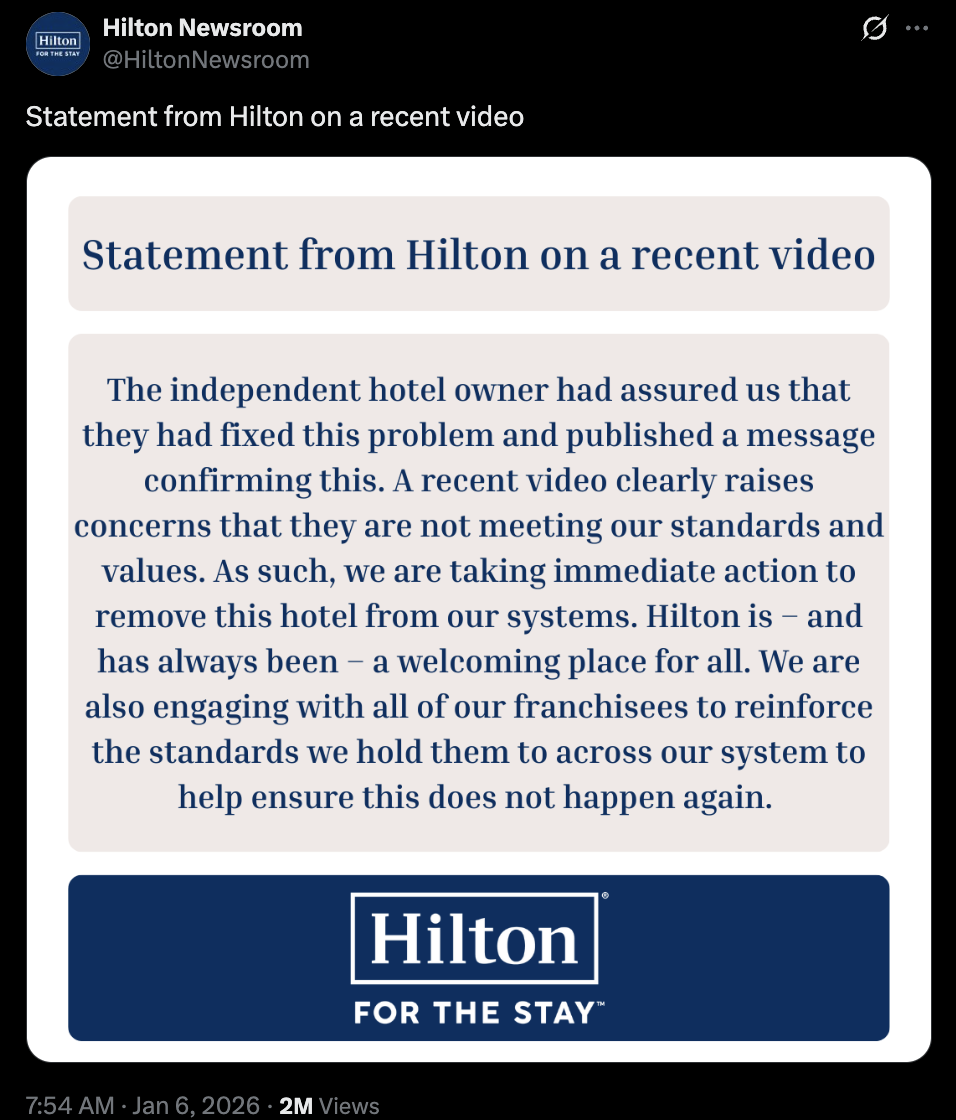
In
any
event,
Hilton
corporate
accepted
the
video’s
claims
and
issued
another
follow
up.
The
Department
of
Homeland
Security
is
not
commandeering
hotel
rooms
(yet!),
but
the
Third
Amendment,
patiently
sitting
on
the
constitutional
bench
since
1791
like
the
Constitution’s
third
string
QB,
finally
gets
called
up.
Discussing
the
case,
Professor
Kreis
quipped:
He’s
only
half-kidding
in
that
he
doesn’t
think
it
would
stand
up
in
court,
but
that
it
really
is
worthy
fodder
for
a
law
review
piece.
The
Third
Amendment
was
meant
to
prohibit
troops
from
taking
rooms,
not
renting
them
out.
Assuming
the
government
is
still
willing
to
pay,
there
shouldn’t
be
a
case.
But
here
we
have
an
independently
owned
and
operated
business
refusing
to
rent
rooms,
at
any
rate,
to
a
customer.
If
the
government
just
dropped
money
on
the
desk
and
kicked
in
room
doors,
it’s
hard
to
say
that
wouldn’t
violate
the
spirit
of
the
thing.
Hilton,
as
the
franchise
licensing
entity,
can
tell
the
hotel’s
management
to
rent
to
ICE
or
lose
its
branding.
But
in
this
instance,
Hilton
is
doing
this
because
the
federal
government
is
using
its
pressure
and
implied
threats
to
compel
Hilton
to
lean
on
the
hotel.
Jawboning
became
a
hot
topic
of
conversation
when
right-wing
anti-vaxxers
and
conspiracy
theorists
accused
the
Biden
administration
of
improperly
coercing
social
media
platforms
to
censor
public
health
misinformation.
At
that
time,
the
government’s
take
was
that
they
merely
passed
along
information
and
left
the
ultimate
decision
up
to
the
private
companies.
Technically,
DHS
is
doing
the
same
here…
though
if
you’re
comparing
“please
consider
that
these
Lysol
injection
stories
will
cost
lives”
to
“we’re
taking
the
position
that
if
you
don’t
comply
you’re
aiding
and
abetting
murderers
and
rapists”
you’re
not
really
evaluating
in
good
faith.
But
it’s
the
fuzziness
of
this
“Third
Amendment
jawboning”
argument
that
makes
it
a
potential
candidate
for
a
real
court
case,
depending
on
how
this
all
shakes
out.
If
the
local
management
sticks
to
its
guns
and
then
loses
its
franchise
rights,
they
have
as
good
a
claim
as
any
that
the
government
cost
them
real
money
when
it
leaned
on
Hilton.
Is
it
really
a
First
Amendment
case?
A
tortious
interference
with
contract
case?
Either
would
probably
work
out
better
for
the
hotel
if
it
got
to
that
point.
But
if
this
really
did
end
up
in
court…
we’re
begging
you
to
at
least
throw
the
Third
Amendment
claim
in
there
because
it’s
certainly
colorable.
George
Conway
is
betting
Manhattan
Democrats
want
his
brand
of
anti-Trump
lawyering.
Today,
the
infamous
lawyer
announced
his
entry
into
the
race
to
replace
Rep.
Jerry
Nadler
in
New
York’s
12th
District.
It’s
one
of
those
rare
moves
that
simultaneously
feels
like
a
logical
sequel
and
a
full-on
narrative
pivot.
The
onetime
Republican
lawyer,
fervent
Trump
critic,
and
co-founder
of
the
anti-Trump
Lincoln
Project
has
officially
jumped
into
the
ring
and
even
moved
back
to
Manhattan
to
do
it.
Conway,
62,
is
no
stranger
to
being
in
the
spotlight.
Once
a
partner
at
the
elite
Wachtell,
Lipton,
Rosen
&
Katz
where
he
made
his
name
in
commercial
litigation,
he
became
nationally
known
not
for
legal
wins
but
for
how
loudly
he
opposed
Donald
Trump’s
presidency…
even
when
he
was
married
to
Trump
aide
Kellyanne
Conway.
And
now?
He’s
gone
from
commentary
to
candidacy
with
a
perfectly
timed
announcement,
as
per
the
New
York
Times:
Mr.
Conway’s
launch
on
Tuesday
was
timed
to
coincide
with
the
fifth
anniversary
of
the
Jan.
6
Capitol
riot.
If
elected,
he
said
he
hopes
to
be
a
“wingman”
for
Representative
Jamie
Raskin,
a
Maryland
Democrat
who
led
the
House’s
impeachment
case
against
Mr.
Trump
at
the
time.
“At
62,
I
can’t
do
this
for
very
long
and
I
don’t
want
to
do
this
for
very
long,”
he
said.
“I
am
kind
of
like
a
special-teams
player
coming
in.”
Conway
is
leaning
into
that
storyline
hard.
“This
is
no
ordinary
time.
And
I
will
not
be
an
ordinary
member
of
Congress,”
Conway
said
in
his
launch
video,
underscoring
that
his
bid
isn’t
about
parking
a
nameplate
on
Capitol
Hill
but
about
combating
Trumpism
in
the
legislature
itself.
He
also
officially
registered
as
a
Democrat
for
this
run,
a
noteworthy
detail
for
a
man
who
long
identified
as
a
Republican
and
once
actively
supported
Trump’s
2016
campaign.
“I
get
how
people
can
be
upset
how
I
once
supported
Trump,”
Conway
said.
“But
I
think
if
people
really
listen,
my
views,
my
philosophy,
my
values,
have
always
been
the
same.”
Though
he
has
made
some,
erm,
adjustments
to
his
former
conservative
positions.
If
elected,
he
said
he
would
fight
to
protect
the
Affordable
Care
Act
and
support
legislation
that
would
enshrine
the
abortion
rights
that
the
Supreme
Court
eradicated
into
law.
(Mr.
Conway
once
argued
that
Roe
v.
Wade
had
been
incorrectly
decided,
but
he
said
this
week
that
he
thought
the
court’s
decision
overturning
it
was
“appalling.”)
But
is
that
enough
to
win
an
election
in
a
crowded
Democratic
primary
in
Manhattan
which
already
features
a
clutch
of
high-profile
candidates,
including
state
lawmakers,
advocates,
and
even
Jack
Schlossberg,
the
grandson
of
John
F.
Kennedy?
Only
time
will
tell,
but
knowing
George
Conway,
it’s
bound
to
be
an
entertaining
ride.
Kathryn
Rubino
is
a
Senior
Editor
at
Above
the
Law,
host
of
The
Jabot
podcast,
and
co-host
of
Thinking
Like
A
Lawyer.
AtL
tipsters
are
the
best,
so
please
connect
with
her.
Feel
free
to
email
her
with
any
tips,
questions,
or
comments
and
follow
her
on
Twitter
@Kathryn1 or
Mastodon
@[email protected].
Last
year
was,
for
better
or
worse,
a
big
year
in
legal
news.
So
it
should
come
as
no
surprise
to
see
big
names
dominating
our
list
of
finalists
for
2025
Lawyer
of
the
Year.
Thanks
to
everyone
who
responded
to
our
request
for
nominations
for
2025
Lawyer
of
the
Year.
We
narrowed
the
many
excellent
nominees
to
a
slate
of
six
(yes,
that’s
how
eventful
this
year
was)
lawyers
—
distinguished,
despicable,
or
debatable,
depending
on
your
point
of
view.
Here
are
the
nominees,
in
alphabetical
order,
with
a
brief
blurb
about
each:
Pam
Bondi:
The
former
Florida
AG
who
became
Trump’s
AG
and
turned
the
once
respected
Department
of
Justice
into
the
hottest
of
messes.
In
2025,
she
oversaw
the
mass
exodus
of
career
attorneys,
backed
several
legally
dubious
U.S.
Attorney
appointments,
and
generally
acted
like
her
office
was
the
legal
department
for
Trump’s
revenge
tour.
Bondi’s
DOJ
has
been
giving
ethics
scholars
nightmares
and
has
been
the
source
of
frequent
judicial
eye
rolls.
Thanks
to
her,
the
Justice
Department
is
now
Trump’s
personal
law
firm.
Rachel
Cohen:
In
2025,
this
former
Skadden
associate
did
what
very
few
Biglaw
associates
were
willing
to
do:
she
put
her
principles
ahead
of
her
paycheck.
She
became
a
flashpoint
in
the
legal
profession
by
challenging
her
firm
and
the
broader
Biglaw
establishment
over
their
shocking
responses
to
Trump’s
executive
orders.
She
organized
an
open
letter
signed
by
nearly
2,000
associates,
where
she
urged
firms
to
defend
the
rule
of
law.
Cohen’s
stand
drew
national
attention,
galvanizing
associates
across
the
industry
as
she
continued
advocating
for
legal
ethics
and
accountability,
and
earned
her
recognition
—
including
a
Civil
Courage
Award
—
for
her
willingness
to
sacrifice
a
lucrative
career
in
defense
of
her
principles.
Alina
Habba:
Trump’s
onetime
personal
lawyer
got
a
promotion
to
U.S.
Attorney
for
New
Jersey
in
2025…
and
then
multiple
courts
ruled
that
she
was
unlawfully
in
the
job.
Judges
said
her
appointment
wasn’t
legit,
leading
to
her
disqualification
and
eventual
resignation
from
a
role
she
wasn’t
technically
supposed
to
be
holding
in
the
first
place.
Not
to
worry,
because
shortly
after
quitting
a
job
she
never
really
had,
Habba
was
elevated
to
become
a
Senior
Advisor
to
the
Attorney
General
for
U.S.
Attorneys.
You
can
only
fail
upwards
in
the
Trump
administration!
Brad
Karp:
The
Biglaw
chairman
whose
most
notable
2025
legal
act
wasn’t
a
motion
or
brief
but
a
negotiated
capitulation.
Trump
targeted
his
firm
with
a
retaliatory
executive
order,
and
instead
of
fighting
it
out
in
court,
Karp
cut
a
deal
that
offered
up
$40
million
in
pro
bono
payola
aligned
with
the
administration’s
policies.
Karp’s
move
not
only
inspired
lawyers
to
cut
bait
and
leave
the
firm,
but
it
led
to
him
being
heckled
at
industry
award
events,
with
Paul,
Weiss
being
protested
in
the
streets
of
Manhattan.
The
firm’s
deal
opened
the
door
for
eight
other
firms
to
bend
a
knee
to
Trump,
leaving
an
ugly,
orange
stain
on
the
legal
profession.
And
now,
the
moment
you’ve
all
been
waiting
for:
Who
should
be
named
Above
the
Law’s
Lawyer
of
the
Year
for
2025?
Cast
your
vote
below.
Polls
are
open
until SUNDAY,
JANUARY
11,
2026
at
11:30
p.m.
(EST).
Staci
Zaretsky is
the
managing
editor
of
Above
the
Law,
where
she’s
worked
since
2011.
She’d
love
to
hear
from
you,
so
please
feel
free
to
email
her
with
any
tips,
questions,
comments,
or
critiques.
You
can
follow
her
on Bluesky, X/Twitter,
and Threads, or
connect
with
her
on
LinkedIn.
Opening
day
at
the
Media
Days
at
CES
brought
an
unexpected
discovery:
an
AI
proctor
designed
to
detect
whether
someone
being
remotely
questioned
might
be
using
AI
for
answers.
Has
its
time
come?
Or
is
it
an
unfair
tool
that
creates
more
problems
than
it
solves?
For
several
years,
the
Media
Days
have
kicked
off
with
a
startup
pitch
competition
hosted
by
the
Japan
External
Trade
Organization
(JETRO)
in
partnership
with
Showstoppers,
which
also
hosts
numerous
media
events
at
CES.
As
I
mentioned
in
my
CES
kickoff
piece,
I
attend
the
show
to
identify
developments
that
could
impact
legal
practice
in
general,
and
given
my
litigation
background,
litigation
proceedings
in
particular.
I
wasn’t
expecting
to
stumble
across
something
relevant
at
the
initial
startup
competition
among
primarily
Japan-based
entrepreneurs.
In
truth,
I
was
sort
of
half
listening
as
a
series
of
entrepreneurs
took
the
stage
to
talk
about
things
like
AI-generated
avatars,
meeting
anime
characters,
and
autonomous
microgravity
devices.
Then,
a
young
man
took
the
stage
to
talk
about
a
company
that’s
designed
a
tool
to
detect
potential
cheating
in
online
tests
and
more
importantly,
online
interviews,
by
detecting
when
candidates
use
AI
to
provide
the
answers.
Qlay
Tom
Nakata
is
the
co-founder
and
CEO
of
Qlay
which
has
created
AI
Proctor
that
does
just
that.
The
tool
listens
in
on
remote
interviews
and
detects
if
the
interviewee
is
using
AI
to
generate
an
ideal
answer
to
a
question
and
who
then
reads
it
off
a
teleprompter.
It
works
by
detecting
eyeball
movement
and
speech
analytics.
It
also
has
a
feature
where
the
interviewee
can
be
required
to
log
into
the
Qlay
app
and
set
up
their
mobile
phone
as
a
side
camera
as
a
second
check.
It
all
sounded
reasonable
in
a
pitch
environment,
but
of
course,
as
we
all
know,
the
devil
will
be
in
the
details.
But
I’m
pretty
sure
using
AI
tools
to
cheat
is
a
fact
of
life
and
a
tool
that
helps
ferret
it
out
is
a
logical
and
timely
idea.
What
Does
This
Have
to
Do
with
Legal?
There’s
a
lot
of
parallels
between
remote
depositions
and
remote
interviews.
A
remote
interview
format
is
where
questions
are
asked
by
interviewers
and
answers
given
by
interviewees.
The
answers
are
then
evaluated
to
determine
if
the
interviewee
is
really
qualified.
In
that
regard,
it’s
pretty
similar
to
a
deposition
where
the
answer
to
a
deposition
can
be
critical
to
seeking
truth
and
therefore
the
credibility
of
the
answer
and
the
witness
is
important.
And
while
it’s
not
got
much
publicity,
in
the
age
of
remote
proceedings
—
depositions
and
court
proceedings
—
cheating
with
AI
tools
has
to
be
a
real
risk.
Even
in
my
day
a
kind
of
cheating
in
depositions
was
not
all
that
unusual.
A
lawyer
tapping
their
witness
under
the
table
where
the
answer
was
important
or
the
witness
was
droning
on
too
long.
A
prearranged
cough
as
a
signal.
A
sudden
need
to
use
the
restroom
to
keep
the
witness
on
track.
I
even
had
an
opposing
lawyer
knock
over
a
pitcher
of
water
to
disrupt
the
questioning.
But
when
you
combine
the
fact
of
remote
proceedings
with
the
existence
of
AI
tools
that
can
suggest
a
“right”
or
“best”
or
even
a
more
articulate
answer,
we
now
have
a
real
problem.
Testimony
by
an
AI
bot
is
akin
to
the
deepfake
problems
I
recently
wrote
about
in
that
it
poisons
the
validity
of
the
answer
and
the
proceeding.
And
it’s
a
real
risk.
Nakata
told
us
he
used
to
run
a
recruiting
service,
and
he
estimated
that
some
40%
of
the
interviewees
were
using
AI
tools
to
cheat
in
remote
interviews.
He
showed
us
a
video
of
an
interviewee
cheating
and
the
cheating
was
nondetectable
until
Nakata
pointed
it
out.
Early
last
year,
a
startup
with
an
app
that
promised
to
help
people
“cheat
on
everything”
including
interviews
reportedly
raised
$5.3
million.
Moreover,
the
ease
with
which
this
can
be
accomplished
makes
it
awfully
tempting
for
a
nervous
witness
to
seek
help
from
a
smooth-talking
bot.
So,
it’s
naïve
to
think
that
witnesses
in
remote
depositions
or
other
proceedings
are
not
doing
the
same
thing.
The
cheating
may
not
even
involve
the
lawyer
—
the
witness
could
set
up
an
AI
tool
unbeknownst
to
their
lawyer.
I
can
also
see
this
kind
of
cheating
being
particularly
tempting
for
expert
witnesses
to
help
them
give
the
correct
technical
answer,
stretch
their
credentials,
or
even
find
support
for
their
findings.
The
Advantages
Nakata
cited
several
advantages
of
the
tool
that
should
resonate
with
lawyers.
For
example,
he
told
us
that
the
Qlay
tool
is
different
than
that
of
its
competitors
who
rely
on
humans
to
make
the
determination.
Interviewers
get
tired,
especially
after
going
through
multiple
interviews
in
one
day,
and
would
be
less
likely
to
notice
badges
of
cheating
as
the
day
went
on.
The
same
is
true
of
lawyers
taking
depositions,
especially
after
several
hours
looking
at
a
screen.
Nakata
also
noted
the
difficulty
for
a
human
trying
to
determine
if
cheating
is
occurring
and
concentrating
on
the
question.
Lawyers
have
the
same
problem.
Using
a
tool
like
this
would
allow
the
lawyer
to
dig
in
on
questions
where
the
proctor
noted
there
was
evidence
of
this
kind
of
cheating.
Asking
the
witness
if
it
was
using
an
AI
tool
for
answers
would
force
the
witness
to
admit
or
deny
it.
It
would
give
the
examiner
grounds
to
ask
for
a
180-degree
camera
view.
It
would
give
grounds
for
the
examiner
to
take
a
break
and
ask
for
a
second
camera
such
as
what
Qlay
has
developed
be
put
in
place.
Ultimately,
it
would
allow
the
lawyer
to
make
credibility
arguments
to
the
judge
or
jury
based
on
what
the
tool
has
revealed.
It
would
allow
folks
like
Nakata
to
testify
as
expert
witnesses
as
to
what
the
tool
suggests.
It’s
Not
Foolproof
Nakata
admitted
that
the
tool
is
“not
the
judge
of
whether
cheating
has
occurred.”
It
merely
records
the
interview,
brings
up
evidence
of
possible
cheating,
and
notes
when
it
occurred.
It’s
up
to
the
human
to
decide
if
cheating
has
really
happened.
And
of
course,
it
could
be
claimed
that
a
proctor
makes
people
nervous
and
affects
their
testimony.
Or
that
it’s
biased
and
finds
possible
cheating
when
it’s
not
there.
That
it’s
somehow
not
fair.
But
as
long
as
we
say
it’s
not
determinative
but
something
that
a
fact
finder
needs
to
know,
it
could
on
balance
be
an
aid.
Even
if
the
AI
testimony
is
not
false
or
fabricated
but
just
more
articulate
than
what
it
would
otherwise
be,
isn’t
that
something
a
fact
finder
should
know?
An
AI-generated
answer
is
not
the
witness’s
answer,
it’s
the
bot’s
answer.
And
if
the
answer
is
generated,
isn’t
that
something
that
a
lawyer
should
be
able
to
inquire
into?
Is
it
fair
for
a
witness
to
secretly
substitute
what
should
be
his
testimony
with
that
of
a
bot?
The
whole
point
of
discovery
and
witness
examination
is
to
get
the
witness’s
testimony,
not
that
of
someone
else.
The
AI
Proctor:
Its
Time
Has
Come
Just
because
the
potential
for
deposition
cheating
didn’t
exist
before
AI
doesn’t
mean
we
should
ignore
it
now.
With
more
and
more
depositions
being
taken
remotely
and
more
and
more
proceedings
being
conducted
online,
it
stands
to
reason
that
more
witnesses
will
cheat.
If
Nakata’s
estimate
that
40%
of
people
use
AI
to
cheat
in
interviews
is
even
half
right,
the
problem
is
significant
and
a
like
percentage
probably
applies
to
depositions
as
well.
Like
deepfakes,
this
kind
of
substitution
of
AI
for
what
is
real
has
the
capacity
to
impinge
on
the
validity
and
integrity
of
proceedings
and
ultimately
our
rule
of
law.
It
makes
a
joke
of
the
notion
of
witness
veracity.
Whether
Nakata’s
tool
can
do
what
he
says
remains
to
be
seen.
He
candidly
admitted
that
it
was
a
challenge
to
create
a
tool
to
simultaneously
live
stream
an
interview
while
the
analytics
detect
what
the
candidate
is
doing.
“It’s
hard
to
check
if
the
interviewee
is
using
a
cheating
device
in
real
time,”
he
noted.
While
Nakata
was
personable,
articulate,
and
frankly
seemed
credible,
I
have
no
way
of
knowing
how
accurate
what
he
said
is
and
what
his
tools
actually
can
do.
But
I
do
know
that
we
need
to
face
the
fact
that,
like
deep
fakes,
cheating
in
testimony
is
a
real
threat.
It
can’t
be
ignored
if
we
want
to
protect
the
integrity
of
legal
proceedings
and
the
rule
of
law.
Stephen
Embry
is
a
lawyer,
speaker,
blogger,
and
writer.
He
publishes TechLaw
Crossroads,
a
blog
devoted
to
the
examination
of
the
tension
between
technology,
the
law,
and
the
practice
of
law.
Ed.
note:
This
is
the
latest
in
the
article
series, Cybersecurity:
Tips
From
the
Trenches, by
our
friends
at Sensei
Enterprises,
a
boutique
provider
of
IT,
cybersecurity,
and
digital
forensics
services.
Every
few
months,
headlines
claim
that
artificial
intelligence
will
soon
replace
lawyers.
However,
the
reality
is
more
nuanced
and
intriguing.
Despite
significant
progress,
current
AI
systems
still
struggle
with
deep
legal
reasoning,
judgment,
and
innovative
problem-solving.
They
can
summarize
information,
organize
data,
and
draft
documents,
but
they
often
struggle
to
think
like
a
lawyer.
Meanwhile,
law
firms
are
heavily
investing
in
AI
leadership
and
infrastructure.
They
are
hiring
chief
AI
officers,
bringing
in
technologists
from
outside
the
legal
field,
and
creating
dedicated
AI
teams.
At
first
glance,
this
might
seem
like
panic;
in
reality,
it’s
a
strategic
move.
These
two
trends
aren’t
at
odds.
Instead,
they
show
where
AI
truly
fits
within
legal
practice
today.
AI
Is
Not
Replacing
Lawyers
AI
is
not
replacing
lawyers
because
it
cannot
reliably
perform
the
core
work
that
defines
the
profession.
Complex
legal
analysis
requires
context,
experience,
ethical
judgment,
and
strategic
reasoning.
Even
the
most
advanced
models
still
hallucinate,
misapply
precedent,
and
fail
when
confronted
with
genuinely
hard
legal
questions.
That
is
not
a
recipe
for
trusted
advocacy.
Most
lawyers
see
this
firsthand.
AI
can
help
review
documents,
draft
outlines,
or
flag
issues,
but
its
output
almost
always
requires
significant
human
correction.
Clients
still
expect
their
lawyers
to
explain
risks,
negotiate
outcomes,
persuade
decision
makers,
and
stand
behind
the
advice
they
give.
That
responsibility
has
not
changed.
Why
Law
Firms
Are
Betting
on
AI
Anyway
So
why
are
law
firms
racing
to
build
AI
capabilities?
Because
while
AI
is
not
good
enough
to
replace
lawyers,
it
is
already
good
enough
to
change
how
legal
services
are
delivered.
Firms
that
understand
this
are
not
trying
to
automate
judgment.
They
are
trying
to
remove
friction.
Law
firms
are
appointing
AI
leaders
to
incorporate
tools
into
their
workflows,
set
governance
standards,
train
lawyers
to
use
AI
responsibly,
and
develop
proprietary
systems
aligned
with
their
legal
practices.
These
roles
focus
on
enhancing
productivity,
ensuring
consistency,
and
maintaining
competitive
advantage,
rather
than
mere
experimentation.
AI
significantly
reduces
time
spent
on
routine
tasks
such
as
research,
discovery,
document
comparison,
and
initial
drafts,
allowing
lawyers
to
dedicate
more
time
to
strategy,
counseling,
and
advocacy.
This
results
in
faster
turnaround
times,
better
client
experience,
and
improved
profit
margins.
Some
firms
even
permit
associates
to
count
AI
training
as
part
of
their
billable
hours,
highlighting
AI
literacy
as
a
key
aspect
of
professional
competence.
Lawyers
who
lack
an
understanding
of
these
tools
and
their
limitations
will
find
it
challenging
to
supervise
their
use
effectively.
The
Real
Model:
Co-Pilot,
Not
Replacement
The
current
reality
is
not
about
replacement.
It
is
about
partnership.
AI
today
functions
more
like
a
co-pilot
(not
to
be
confused
with
Microsoft’s
Copilot
AI
product)
than
a
decision-maker.
It
handles
well-defined,
repeatable
tasks
efficiently.
Lawyers
remain
firmly
in
control
of
interpretation,
judgment,
and
accountability.
That
division
of
labor
is
not
a
weakness.
It
is
exactly
how
complex
professional
systems
evolve.
The
real
risk
for
lawyers
is
not
that
AI
will
take
their
jobs.
It
is
that
other
lawyers
will
use
AI
better
than
they
do.
Competitive
Risk,
Not
Job
Panic
Companies
that
prioritize
investment
in
leadership,
governance,
and
training
will
advance
more
quickly,
price
projects
more
competitively,
and
produce
more
reliable
results.
Conversely,
firms
that
dismiss
AI
as
a
mere
trend
or
prohibit
its
use
entirely
risk
lagging,
not
necessarily
because
machines
are
more
intelligent,
but
because
their
competitors
operate
more
efficiently.
Clients
are
already
inquiring
about
AI
in
proposals
and
projects.
They
want
assurance
on
confidentiality,
output
validation,
and
accountability.
These
questions
are
persistent
and
will
become
commonplace.
The
Bottom
Line
The
future
of
legal
work
is
not
fully
automated,
nor
is
it
unchanged.
It
is
augmented.
Lawyers
who
understand
AI’s
strengths
and
limits
will
thrive.
They
will
use
technology
to
handle
volume
while
reserving
human
expertise
for
the
moments
that
matter
most.
Lawyers
who
ignore
AI
or
fear
it
outright
will
find
themselves
explaining
why
routine
work
takes
longer
and
costs
more
than
it
should.
AI
is
not
coming
for
lawyers’
jobs.
It
is
coming
for
inefficiency,
complacency,
and
firms
without
a
plan.
And
that
is
a
much
more
uncomfortable
reality.
Michael
C.
Maschke
is
the
President
and
Chief
Executive
Officer
of
Sensei
Enterprises,
Inc.
Mr.
Maschke
is
an
EnCase
Certified
Examiner
(EnCE),
a
Certified
Computer
Examiner
(CCE
#744),
an
AccessData
Certified
Examiner
(ACE),
a
Certified
Ethical
Hacker
(CEH),
and
a
Certified
Information
Systems
Security
Professional
(CISSP).
He
is
a
frequent
speaker
on
IT,
cybersecurity,
and
digital
forensics,
and
he
has
co-authored
14
books
published
by
the
American
Bar
Association.
He
can
be
reached
at [email protected].
Sharon
D.
Nelson
is
the
co-founder
of
and
consultant
to
Sensei
Enterprises,
Inc.
She
is
a
past
president
of
the
Virginia
State
Bar,
the
Fairfax
Bar
Association,
and
the
Fairfax
Law
Foundation.
She
is
a
co-author
of
18
books
published
by
the
ABA.
She
can
be
reached
at [email protected].
John
W.
Simek
is
the
co-founder
of
and
consultant
to
Sensei
Enterprises,
Inc.
He
holds
multiple
technical
certifications
and
is
a
nationally
known
digital
forensics
expert.
He
is
a
co-author
of
18
books
published
by
the
American
Bar
Association.
He
can
be
reached
at [email protected].
We’ve
spent
the
better
part
of
the
last
two
years
documenting
the
parade
of
attorneys
firing
off
AI-muddled
filings.
It’s
been
a
field
day
for
bar
disciplinary
authorities
and
an
endless
source
of
content
for
us.
But
at
the
end
of
the
day,
lawyers
confidently
citing
Martinez
v.
Maldonia
Airways
have
—
for
the
most
part
—
been
mostly
caught
and
laughed
at.
Once
lawyers
are
involved
in
a
case,
there
are
often
opposing
counsel
and,
more
importantly,
judges
that
will
check
their
work.
It’s
not
foolproof.
There
are,
of
course,
asymmetric
cases
where
one
party
has
more
superior
legal
resources
and
could
slip
one
past
a
judge
when
the
opposing
counsel
doesn’t
see
it.
That
said,
in
the
majority
of
cases
involving
hallucinated
filings
there’s
someone
to
catch
the
lazy
lawyers
with
their
pants
down
and
a
large
language
model
in
their
hands.
It
gets
much
more
dangerous
when
law
enforcement
gets
into
AI
hallucinations.
Like
these
Utah
cops
auditioning
for
Paw
Patrol
as
Chase’s
new
amphibious
partner
“Croaker”
—
a
new
addition
who
doesn’t
have
time
to
play
it
by
the
book
but,
dammit,
he
gets
results!
HEBER
CITY,
Utah
—
An
artificial
intelligence
that
writes
police
reports
had
some
explaining
to
do
earlier
this
month
after
it
claimed
a
Heber
City
officer
had
shape-shifted
into
a
frog.
All
Cops
Are
Bullfrogs
as
they
say.
The
culprit
behind
the
officer’s
miraculous
transformation
is
the
AI
credulously
accepting
magic
of
cinema
just
like
those
Nicole
Kidman’s
AMC
ads
tell
us
we
should.
“The
body
cam
software
and
the
AI
report
writing
software
picked
up
on
the
movie
that
was
playing
in
the
background,
which
happened
to
be
‘The
Princess
and
the
Frog,’”
Sgt.
Keel
told
FOX
13
News.
“That’s
when
we
learned
the
importance
of
correcting
these
AI-generated
reports.”
So
someone
was
watching
The
Princess
and
the
Frog
in
the
background,
and
the
AI
—
which
processes
audio,
but
apparently
lacks
the
discernment
of
a
moderately
alert
golden
retriever
—
wove
Disney’s
magical
narrative
into
the
official
record.
As
ominous
warnings
about
the
dangers
of
massive
police
budgets
and
reckless
technological
advances
go,
consider
this
the
proverbial
“frog
in
the
pot
of
water”
moment…
and
the
water
was
just
run
through
a
data
center
to
generate
400
words
about
how
to
sit
in
a
library.
By
the
way,
the
implication
of
the
above
quote
is
that
before
turning
one
of
the
officers
into
a
frog,
the
department
had
NOT
considered
“the
importance
of
correcting
these
AI-generated
reports.”
The
cops
had
been
using
an
AI
tool
called
“Draft
One”
from
Axon
(the
Taser
people)
to
use
AI
models
to
transform
body
camera
audio
into
police
reports.
Apparently,
the
department
was
also
testing
a
program
that
uses
AI
to
generate
reports
from
the
footage
itself,
and
it
was
not
fooled
into
conflating
the
officer
with
Prince
Naveen.
Critics
also
argue
that
the
tool
could
be
used
to
introduce
deniability
and
make
officers
less
accountable
in
case
mistakes
were
to
fall
through
the
cracks.
According
to
a recent
investigation by
the
Electronic
Frontier
Foundation,
Draft
One
“seems
deliberately
designed
to
avoid
audits
that
could
provide
any
accountability
to
the
public.”
According
to
records
obtained
by
the
group,
“it’s
often
impossible
to
tell
which
parts
of
a
police
report
were
generated
by
AI
and
which
parts
were
written
by
an
officer.”
Add
in
that
generative
AI
systems
have
been
repeatedly
shown
to
perpetuate
racial
and
gender
biases
—
and
that’s
before
they
started
teaching
Grok
to
preach
about
White
Genocide
and
digitally
undress
children.
These
models
are
trained
on
data
sets
that
inevitably
reflect
society’s
existing
prejudices.
Then
consider
what
happens
when
that
technology
is
deployed
by
law
enforcement
—
an
institution
with
its
own
thoroughly
documented
history
of
acting
upon
racial
bias.
It’s
just
stacking
bias
on
top
of
bias.
And
it’s
doing
it
in
the
name
of
“efficiency,”
which
is
certainly
one
argument
you
can
make
for
embracing
prejudices.
This
should
all
give
everyone
pause
that
the
software
is
already
—
sigh
—
jumping
to
conclusions
elsewhere.
A
frog
in
a
police
report
is
funny
because
it’s
falsifiable…
presumably.
“Suspect
appeared
nervous
and
evasive”
is
not.
The
real
concern
rests
in
these
less
comical
areas
where
the
AI
shades
police
reports
in
directions
that
are
prejudicial,
unfalsifiable,
and
completely
invisible
to
review.
Criminal
cases
already
present
the
most
glaring
asymmetries
in
the
legal
system.
When
bots
are
falsifying
the
record
and
making
it
look
“neutral,”
there’s
not
much
hope
for
the
average
defendant.
According
to
one
expert
at
Pitchbook,
two
core
issues
are
likely
to
dominate
healthcare
reform
discussions
in
2026:
rising
costs
and
flaws
in
Medicare
Advantage.
Healthcare
affordability
remains
a
major
systemic
issue
preventing
millions
of
Americans
from
accessing
care,
and
Medicare
Advantage’s
risk-adjustment
system
is
“clearly
broken,”
creating
incentives
that
pull
excess
money
into
the
program,
explained
Brian
Wright,
lead
analyst
for
healthcare
research
at
Pitchbook.
On
the
Affordable
Care
Act
and
commercial
market
side
of
things,
reforms
will
probably
aim
to
improve
affordability
and
risk
pooling,
he
said.
With
Medicaid
eligibility
pressures
pushing
providers
to
shift
costs
to
commercial
payers,
Wright
suggested
that
lawmakers
may
look
for
ways
to
make
the
commercial
market
function
more
effectively
rather
than
serve
as
the
system’s
subsidizer.
“Medicaid
eligibility
issues
are
going
to
pressure
hospital
systems
—
and
what
do
they
do?
They
typically
make
up
for
it
by
billing
to
the
commercial
side.
The
commercial
side
always
is
that
subsidizer
for
the
rest
of
the
healthcare
system.
So
the
thought
process
is
‘Okay,
how
can
you
go
about
making
a
market
on
the
commercial
side
work
better
than
it
is
now?’”
he
remarked.
One
potential
ACA-related
reform
involves
loosening
age
rating
restrictions,
Wright
noted.
Under
the
ACA
today,
payers
can
generally
charge
older
adults
no
more
than
three
times
what
they
charge
younger
adults.
If
those
limits
were
to
be
expanded
to
allow
payers
to
charge
older
adults,
say,
up
to
five
times
more,
then
there
would
be
lower
premiums
for
younger
people.
“That
way
younger,
healthier
people
are
incentivized
to
get
into
the
risk
pool,”
Wright
declared.
Another
potential
reform
would
give
states
greater
flexibility
to
define
minimum
coverage
standards
across
the
ACA’s
metal
tiers,
Wright
said.
This
would
allow
states
to
revisit
which
benefits
must
be
included
in
bronze,
silver
or
gold
plans,
rather
than
adhering
to
a
blanket
national
standard
—
which
might
give
payers
more
room
to
design
lower-cost
plans.
Wright
also
pointed
to
eliminating
or
reworking
so-called
“silver
loading
subsidies”,
a
pricing
practice
that
raises
premiums
for
silver
plans
to
offset
federal
cost-sharing
requirements.
He
said
the
approach
can
distort
pricing
across
the
market
and
influence
how
people
choose
their
plans.
In
addition,
other
reforms
could
include
expanding
wellness
incentives
and
giving
out
larger
financial
rewards
for
healthy
behaviors.
As
for
Medicare
Advantage
reform,
Wright
thinks
this
will
likely
center
on
addressing
flaws
in
risk
adjustment.
He
noted
that
while
Medicaid
also
uses
risk
adjustment,
it
does
not
incentivize
plans
to
increase
coding
in
ways
that
drive
higher
overall
spending.
Moving
Medicare
Advantage
toward
using
full
claims
and
encounter
data
—
rather
than
partial
data
—
could
help
limit
those
incentives
and
rein
in
costs.
While
none
of
these
potential
changes
are
guaranteed
to
materialize
in
2026,
Wright
said
they
reflect
a
growing
willingness
among
policymakers
to
rethink
the
long-standing
rules
that
have
shaped
healthcare
costs
and
coverage.
*
Maduro’s
legal
team
anchored
by
Julian
Assange’s
lawyer.
[NY
Law
Journal]
*
Meanwhile,
the
DOJ
just
dropped
its
claims
that
Maduro
ran
the
“Cartel
de
los
Soles”
after
acknowledging
that
it’s
not
even
a
real
group.
Exactly
the
sort
of
airtight
prosecution
you’d
expect
to
see
before
killing
40-80
people
to
make
an
arrest.
[NY
Times]
*
Chamber
of
Commerce
will
get
an
expedited
appeal
on
challenge
to
Trump’s
$100,000
H-1B
visa
fee.
[Law360]
*
Alan
Dershowitz
wants
the
Supreme
Court
to
overturn
Sullivan
to
bail
out
his
case
against
CNN.
[Reuters]
*
Florida
Supreme
Court
kills
proposal
to
let
state
government
lawyers
practice
without
taking
the
bar
exam.
[ABA
Journal]
*
George
Conway
announces
congressional
bid.
[ABC
News]
*
Marc
Elias
writes
the
encapsulation
of
2025
in
“Big
Law
Walks
Away
From
Democracy.”
[Democracy
Docket]
Siansundu
Clinic
Nurse
in
Charge,
Gideon
Muzamba,
says
the
facility
is
recording
a
steady
flow
of
STI
patients
every
month
despite
sustained
health
education
efforts
by
clinic
staff.
“We
are
in
a
community
of
artisanal
miners,
and
you
know
their
behavior,”
Muzamba
said.
“When
they
go
to
the
mines
and
get
money,
they
have
many
partners.
When
they
come
back,
they
infect
their
wives
and
other
girlfriends.”
Clinic
records
show
between
eight
and
ten
STI
cases
every
month,
a
significant
figure
for
a
rural
health
facility
serving
a
small
population.
More
worrying,
Muzamba
says,
is
the
pattern
of
reinfections,
with
some
patients
returning
within
weeks
of
treatment.
“We
treat
someone,
and
in
a
month
or
two,
they
are
back
with
the
same
condition,”
he
said.
“That
tells
you
behavior
is
not
changing.”
According
to
Muzamba,
while
some
community
members
are
responding
to
education
campaigns,
a
significant
number
continues
to
ignore
advice
from
healthcare
workers,
fuelling
repeated
transmission
cycles
within
households
and
the
wider
community.
“We
are
doing
our
level
best
to
give
health
education,”
he
said.
“Some
are
adhering,
but
others
are
very
difficult
to
change.”
The
clinic
continues
to
manage
cases
through
treatment,
counseling,
and
outreach,
but
the
persistence
of
high-risk
behavior
linked
to
artisanal
mining
remains
a
major
challenge
in
containing
the
spread
of
STIs
in
the
Siansundu
area.
–
ZiFM
Stereo
News







 Kathryn