The
amendments,
passed
by
parliament
last
week
as
part
of
changes
to
the
Medical
Services
Bill,
include
wide-ranging
revisions
to
existing
abortion
laws.
The
bill
passed
the
National
Assembly
on
October
23
and
is
now
before
the
Senate.
Speaking
on
Tuesday
at
a
children’s
charity
event
in
Bulawayo,
Coltart
urged
senators
to
reject
the
bill
when
it
comes
before
the
upper
house
and
to
allow
further
public
consultation.
“As
a
father,
a
grandfather
and
a
citizen,
I
am
deeply
concerned
about
these
changes
and
the
threat
that
they
pose,”
he
said.
“Not
just
to
the
unborn
child,
but
to
teenage
girls
and
the
fabric
of
our
families.”
Coltart
criticised
the
legislative
process,
saying
the
amendments
had
been
introduced
without
adequate
public
engagement.
“This
bill
has
been
sneaked
into
our
legislation
without
consultation,”
he
said.
“There
has
been
no
meaningful
public
input,
and
I
have
no
doubt
that
if
there
were
consultations,
many
of
these
provisions
would
be
changed.”
He
said
any
changes
to
such
sensitive
laws
should
reflect
what
he
described
as
the
country’s
national
values
and
the
views
of
the
majority.
The
mayor
said
national
priorities
should
focus
on
protecting
and
supporting
children,
particularly
those
born
into
difficult
circumstances,
rather
than
policies
that
could
place
them
at
further
risk.
“As
a
nation,
instead
of
focusing
on
terminating
the
lives
of
children,
we
should
be
asking
what
we
need
to
do
to
ensure
that
children
born
into
hardship
are
protected
and
nurtured,”
he
said,
calling
for
increased
funding
for
orphanages
and
child
welfare
institutions.
Coltart
also
linked
child
welfare
concerns
to
education
funding,
warning
that
cuts
to
support
programmes
were
leaving
vulnerable
children
at
risk
of
dropping
out
of
school.
He
criticised
the
allocation
of
about
US$9
million
to
the
Basic
Education
Assistance
Module
(BEAM)
in
the
latest
national
budget,
describing
it
as
inadequate.
“If
anything
should
be
a
priority,
it
should
be
the
education
of
our
children,
especially
those
whose
parents
cannot
afford
school
fees,”
he
said,
urging
the
government
to
clear
outstanding
BEAM
arrears
and
ensure
no
children
are
excluded
from
school
in
2026.
Mnangagwa,
who
also
serves
as
the
party’s
First
Secretary,
appoints
members
of
the
ZANU-PF
Politburo,
among
other
responsibilities.
Speaking
at
what
he
called
the
party’s
final
press
conference
of
2025,
held
at
ZANU-PF
headquarters
in
Harare
on
Wednesday,
Mutsvangwa
said
Mnangagwa
had
successfully
guided
the
party
through
what
some
had
predicted
would
be
a
“watershed
year.”
He
said:
“We
have
crossed
this
year,
which
many
felt
would
be
a
watershed
year
for
Zimbabwe.
“He
has
shepherded
the
Zimbabwean
revolution
with
acumen,
and
we
have
crossed
the
year
with
very
united
leadership.
His
authority
in
the
party
is
unchallenged.”
Mutsvangwa
said
the
resolutions
adopted
at
the
party’s
annual
conference
in
Manicaland
demonstrate
both
unity
and
the
unchallenged
authority
of
President
Mnangagwa.
He
also
pointed
out
a
series
of
recent
party
meetings,
including
the
Politburo,
Central
Committee,
and
Consultative
Assembly,
as
further
proof
of
discipline
and
cohesion
within
the
ruling
party.
He
said:
“In
all
those
meetings,
the
authority
of
the
President
was
evident.
Everybody
is
dancing
according
to
the
codes
of
the
leadership
of
the
party,
in
this
orchestra
of
harmony
which
is
ZANU
PF.”
“For
those
who
entertained
ideas
about
where
ZANU
PF
would
go,
we
are
living
up
to
the
billing
of
a
60-year-old
revolutionary
party
shaping
the
destiny
of
the
people
of
Zimbabwe.”
HARARE
–
President
Emmerson
Mnangagwa
on
Wednesday
appointed
new
deputy
ministers
for
the
ministries
of
Women
Affairs
and
Mines.
Zvishavane-Runde
lawmaker
Fred
Moyo
has
been
appointed
deputy
minister
of
mines,
deputising
newly
appointed
minister
Polite
Kambamura.
Moyo
is
reprising
a
role
he
previously
held
between
2013
and
2017.
Kambamura
was
promoted
to
the
mines
portfolio
last
week
following
the
abrupt
dismissal
of
Winston
Chitando
by
Mnangagwa.
Meanwhile,
Zanu
PF
legislator
for
Mt
Pleasant,
Kiven
Mutimbanyoka,
has
been
appointed
deputy
minister
of
Women
Affairs
and
Small
and
Medium
Enterprises
(SMEs).
The
appointments
were
announced
by
Chief
Secretary
to
the
President
and
Cabinet,
Martin
Rushwaya.
Boutique
Firm
Blows
The
Market
Out
Of
The
Water!:
Never
a
better
time
to
work
at
Bursor
&
Fisher!
They
Aren’t
The
Only
Ones!:
Groombridge,
Wu,
Baughman
&
Stone,
Glenn
Agre,
Selendy
Gay,
Irell
&
Manella,
HSF,
and
Hueston
Hennigan!
Some
Make
You
Go
Above
And
Beyond
For
The
Green:
Arnold
&
Porter,
Foley
&
Lardner.
The
Order
Is
Disorder:
Don’t
expect
the
U.S.
News
Law
School
ranking
to
make
a
lick
of
sense.
Nick
Reiner
hired
what
Los
Angeles
criminal
defense
attorney
to
represent
him
on
charges
he
murdered
his
parents,
director
and
actor
Rob
Reiner
and
photographer
and
film
producer
Michele
Singer
Reiner?
Hint:
The
attorney
is
no
stranger
to
high-profile
cases,
having
previously
represented
Kevin
Spacey,
Harvey
Weinstein,
and
Karen
Read.
No
one
likes
another
call
when
they’re
already
swamped
with
work,
but
Hueston
Hennigan
just
gave
all
of
their
associates
a
reason
to
be
happy
about
the
phone
going
off.
The
boutique
trial
firm
saw
some
huge
wins
this
year,
allowing
them
to
share
the
successes
with
their
colleagues.
Best
thing
about
it?
The
share
is
way
above
market
compensation!
While
we
do
not
have
a
scale,
a
tipster
let
us
know
that
they’ve
recently
begun
communicating
bonuses
today
to
associates
and
other
non-partners.
Each
associate
received
above
market
bonuses
and,
in
several
cases,
near
or
more
than
double
the
market
bonus!
For
everyone
in
the
know,
that’s
a
lot
of
money!
For
everyone
else,
you
can
look
at
the
market
scale
below
for
some
context
on
how
much
money
we’re
talking:
To
everyone
at
Hueston
Hennigan,
big
congrats
on
the
big
money!
And
to
the
firm
proper,
congrats
on
10
years
of
excellence!
We
like
hearing
about
bonuses
almost
as
much
as
you
enjoy
spending
them.
As
soon
as
your
firm’s
memo
comes
out,
please email
it
to
us
(subject
line:
“[Firm
Name]
Bonus”)
or
text
us
(646-820-8477).
Please
include
the
memo
if
available.
You
can
take
a
photo
of
the
memo
and
send
it
via
text
or
email
if
you
don’t
want
to
forward
the
original
PDF
or
Word
file.
And
if
you’d
like
to
sign
up
for
ATL’s
Salary
&
Bonus
Alerts,
please
scroll
down
and
enter
your
email
address
in
the
box
below
this
post.
If
you
previously
signed
up
for
the
bonus
alerts,
you
don’t
need
to
do
anything.
You’ll
receive
an
email
notification
within
minutes
of
each
bonus
announcement
that
we
publish.
Chris
Williams
became
a
social
media
manager
and
assistant
editor
for
Above
the
Law
in
June
2021.
Prior
to
joining
the
staff,
he
moonlighted
as
a
minor
Memelord™
in
the
Facebook
group Law
School
Memes
for
Edgy
T14s
.
He
endured
Missouri
long
enough
to
graduate
from
Washington
University
in
St.
Louis
School
of
Law.
He
is
a
former
boatbuilder
who
is
learning
to
swim, is
interested
in
critical
race
theory,
philosophy,
and
humor,
and
has
a
love
for
cycling
that
occasionally
annoys
his
peers.
You
can
reach
him
by
email
at [email protected]
and
by
tweet
at @WritesForRent.
It
was
only
earlier
this
year
that
the
Biglaw
world
got
its
latest
mega
firm
following
the
merger
of
Herbert
Smith
Freehills
and
Kramer
Levin.
The
combined
firm
grosses
more
than
$2
billion,
and
they’re
putting
all
that
cash
to
good
use
—
associate
bonuses.
Earlier
today,
Herbert
Smith
Freehills
Kramer
unveiled
its
first
associate
bonus
scale,
matching
the
market
standard
with
both
year-end
and
special
bonuses
for
associates
in
good
standing.
The
bonus
scale
is
as
follows:
Bonuses
will
be
paid
on
February
13,
2026.
The
full
memo
is
available
below.
We
like
hearing
about
bonuses
almost
as
much
as
you
enjoy
spending
them.
As
soon
as
your
firm’s
memo
comes
out,
please email
it
to
us (subject
line:
“[Firm
Name]
Bonus”)
or
text
us
(646-820-8477).
Please
include
the
memo
if
available.
You
can
take
a
photo
of
the
memo
and
send
it
via
text
or
email
if
you
don’t
want
to
forward
the
original
PDF
or
Word
file.
Kathryn
Rubino
is
a
Senior
Editor
at
Above
the
Law,
host
of
The
Jabot
podcast,
and
co-host
of
Thinking
Like
A
Lawyer.
AtL
tipsters
are
the
best,
so
please
connect
with
her.
Feel
free
to
email
her
with
any
tips,
questions,
or
comments
and
follow
her
on
Twitter
@Kathryn1 or
Mastodon
@[email protected].
They
shoot
first,
they
aim
later,
and
even
then,
they
miss.
Because
there
is
no
wall
between
the
White
House
and
the
Justice
Department
in
terms
of
interaction
and
political
process,
this
is
what
happens.
—
Gene
Rossi,
a
former
prosecutor,
in
comments
given
to
Reuters,
concerning
the
Trump
Justice
Department’s
many,
many
missteps
over
the
course
of
the
past
year.
Staci
Zaretsky is
the
managing
editor
of
Above
the
Law,
where
she’s
worked
since
2011.
She’d
love
to
hear
from
you,
so
please
feel
free
to
email
her
with
any
tips,
questions,
comments,
or
critiques.
You
can
follow
her
on Bluesky, X/Twitter,
and Threads, or
connect
with
her
on LinkedIn.
Sometimes
extra
money
comes
with
extra
work.
Foley
&
Lardner
is
paying
their
associates
handsomely
—
$25k
above
market
in
some
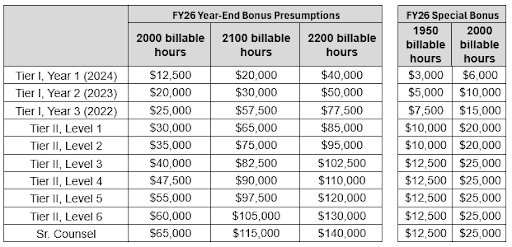
cases
—
but
you’ve
got
to
hit
the
2200
hour
mark
for
that
extra
compensation.
2100
gets
you
market
value
and
2000
or
below
gets
you
a
push
to
do
better
next
year.
While
there’s
no
questioning
that
the
firm
is
raking
in
a
large
amount
of
money,
$1,275,570,000
gross
revenue
in
2024
according
to
Am
Law
100,
the
firm’s
relatively
high
headcount
could
explain
why
the
hours
threshold
shows
such
stark
differences
in
pay.
Here’s
the
scale:
To
the
hard
workers
at
Foley
&
Lardner,
enjoy
the
money!
If
you’re
feeling
festive,
set
aside
some
of
that
cash
to
buy
a
scent
that
reminds
you
of
the
holiday
season.
Bonuses
are
scheduled
to
be
paid
by
the
end
of
January
2026.
We
like
hearing
about
bonuses
almost
as
much
as
you
enjoy
spending
them.
As
soon
as
your
firm’s
memo
comes
out,
please email
it
to
us
(subject
line:
“[Firm
Name]
Bonus”)
or
text
us
(646-820-8477).
Please
include
the
memo
if
available.
You
can
take
a
photo
of
the
memo
and
send
it
via
text
or
email
if
you
don’t
want
to
forward
the
original
PDF
or
Word
file.
And
if
you’d
like
to
sign
up
for
ATL’s
Salary
&
Bonus
Alerts,
please
scroll
down
and
enter
your
email
address
in
the
box
below
this
post.
If
you
previously
signed
up
for
the
bonus
alerts,
you
don’t
need
to
do
anything.
You’ll
receive
an
email
notification
within
minutes
of
each
bonus
announcement
that
we
publish.
Chris
Williams
became
a
social
media
manager
and
assistant
editor
for
Above
the
Law
in
June
2021.
Prior
to
joining
the
staff,
he
moonlighted
as
a
minor
Memelord™
in
the
Facebook
group Law
School
Memes
for
Edgy
T14s
.
He
endured
Missouri
long
enough
to
graduate
from
Washington
University
in
St.
Louis
School
of
Law.
He
is
a
former
boatbuilder
who
is
learning
to
swim, is
interested
in
critical
race
theory,
philosophy,
and
humor,
and
has
a
love
for
cycling
that
occasionally
annoys
his
peers.
You
can
reach
him
by
email
at [email protected]
and
by
tweet
at @WritesForRent.
Ed.
note:
This
article
is
part
of
Parental
Leave
&
The
Legal
Profession,
a
special
series
for
Above
the
Law
that
explores
the
realities
of
parental
leave
and
return-to-work
in
law
firms.
From
planning
leave
to
reintegration,
from
the
role
of
managers
to
the
mental
load
of
Biglaw
parents,
these
articles
bring
research,
clinical
insight,
and
practical
strategies
to
help
lawyers
and
the
firms
that
employ
them
navigate
one
of
the
most
critical
transitions
of
their
careers.
The
Quiet
Shock
of
Coming
Back
When
Dana,
a
senior
associate,
returned
from
parental
leave,
she
expected
a
few
chaotic
days.
What
she
didn’t
expect
was
the
lingering
disorientation:
guilt
for
leaving
her
baby,
guilt
for
not
being
fully
present
at
work,
and
a
fear
that
she
no
longer
fit
neatly
into
either
world.
She
also
felt
the
pressure
of
returning
to
a
culture
that
sent
a
clear
message:
Say
yes
to
everything,
that’s
how
you
survive
here.
Working
parents
know
that
life
without
boundaries
isn’t
viable,
yet
law
firms
still
reward
constant
availability.
That
tension
fuels
enormous
anxiety
during
the
return.
Even
in
firms
that
offer
lengthy
leaves,
there
is
often
little
guidance
on
what
the
return
looks
like:
how
re-onboarding
works,
how
to
talk
to
partners
about
workload,
where
flexibility
exists,
or
what
a
healthy
ramp-up
might
entail.
The
leave
may
be
supported,
but
the
return
is
often
invisible.
Layered
on
top
of
the
transition
to
parenthood
is
a
shift
that
gets
less
attention:
the
transition
from
working
person
to
working
parent.
That
identity
change
is
profound,
and
rarely
named.
As
one
partner
shared
after
her
third
leave:
“You
don’t
come
back
as
the
same
person.
But
you
might
come
back
clearer,
stronger,
and
more
sustainable
if
you
stop
fighting
the
fact
that
things
have
changed.”
Why
It
Feels
So
Hard
The
challenge
of
returning
is
multidimensional
–
logistical,
emotional,
physiological,
and
systemic.
You’re
navigating
two
major
roles
at
once.
Holding
the
demands
of
your
career
and
early
parenthood
simultaneously
is
complex.
Your
brain
is
still
adjusting.
Research
shows
there
are
ongoing
neuroplastic
changes
over
the
first
postpartum
year,
and
those
cognitive
shifts
create
unfamiliar
feelings
as
you
settle
back
into
work.
The
workplace
hasn’t
evolved
fast
enough.
Many
firms
operate
on
an
unrealistic
“ideal
worker”
model
who
is
always
available,
despite
the
realities
of
caregiving.
The
tension
that
arises
does
not
reflect
a
lack
of
commitment
or
capability
but
the
systems
and
culture
you’re
returning
to.
Step
One:
Rebuild
Confidence
Gradually
Some
lawyers
experience
a
dip
in
confidence
when
they
return,
not
because
their
skills
eroded,
but
because
they’re
holding
two
enormous
responsibilities
at
once.
Rather
than
overextending
yourself
to
“make
up”
for
being
gone,
start
with
intention.
Choose
one
or
two
matters
where
you
can
quickly
add
value
and
rebuild
momentum.
Schedule
early
check-ins
with
key
partners
or
clients,
not
to
justify
yourself,
but
to
reestablish
clarity
and
connection.
Confidence
grows
from
competence,
not
perfection.
And
the
capacity
to
nurture
and
lead
are
not
opposites;
they
often
strengthen
each
other.
Step
Two:
Redefine
What
“Full
Capacity”
Means
One
of
the
most
damaging
myths
is
that
you
should
“bounce
back”
to
your
old
pace
immediately.
Your
normal
has
changed
for
now.
But
this
is
a
season,
not
your
permanent
reality.
A
gradual
ramp-up
with
lower
billables
for
a
few
weeks,
more
remote
days,
or
easing
into
major
matters
can
create
a
sustainable
foundation.
Research
from
the
Center
for
WorkLife
Law
shows
that
phased
reintegration
improves
both
retention
and
performance
for
new
parents.
If
your
firm
doesn’t
offer
a
phased
ramp-up
option,
propose
one
as
a
strategy
for
delivering
consistent,
high-quality
work
during
this
transitional
period.
At
home,
give
yourself
the
same
grace:
ask
for
a
lot
of
help.
Delegate,
outsource
when
possible,
and
allow
some
tasks
to
be
“good
enough.”
Sustainability
over
martyrdom
is
the
goal.
Step
Three:
Protect
Your
Mental
Health
The
return
period
is
a
vulnerable
time.
Sleep
deprivation,
identity
shifts,
and
cognitive
overload
can
mimic
early
burnout.
Professional
women
in
high-pressure
fields
are
at
increased
risk
for
postpartum
anxiety
and
depression
during
the
first
year
(Rihm,
et.
al.,
2025).
If
you
notice
persistent
irritability,
overwhelm,
or
guilt,
reach
out
early,
whether
to
a
therapist,
coach,
doctor,
or
trusted
peer.
Ensuring
you
have
these
resources
is
not
a
weakness;
it’s
foundational
to
effective
leadership.
Advocate
for
support
at
work
too.
Join
a
working-parent
ERG
if
your
firm
has
one.
Use
coaching
or
parental-leave
resources.
And
if
these
supports
don’t
exist,
your
request
may
be
the
catalyst
for
building
them.
Step
Four:
Create
a
Home
System
That
Works
for
You
A
sustainable
return
requires
a
sustainable
home
ecosystem.
Discuss
logistics
with
your
partner
or
support
system
before
you
go
back:
who
handles
daycare
drop-offs,
sick
days,
bedtime
routines,
or
last-minute
emergencies?
Unspoken
assumptions
create
resentment;
clear
agreements
create
stability.
Research
shows
that
women
still
perform
most
of
the
“cognitive
labor”
at
home
even
in
dual-career
households
(Daminger,
2019).
This
invisible
work
of
anticipating,
planning,
and
coordinating
is
one
of
the
biggest
contributors
to
overwhelm
during
the
return-to-work
transition.
We’ll
be
devoting
a
full
article
to
the
mental
load
in
February:
how
it
impacts
lawyers
specifically,
why
it’s
often
ignored
inside
firms,
and
what
can
actually
help
to
address
it.
For
now,
know
that
redistributing
invisible
labor
can
dramatically
reduce
stress
and
increase
capacity.
Community
matters
here
too:
neighbors,
friends,
and
other
working
parents
at
the
firm
can
create
a
support
network
that
buffers
the
unpredictability
of
early
parenthood.
Step
Five:
Let
Yourself
Reassess
Returning
from
leave
is
not
the
time
for
sweeping
career
decisions,
but
it
is
a
time
to
pay
attention.
You
may
gain
clarity
about
your
priorities,
leadership
style,
or
long-term
goals.
You
may
discover
that
certain
roles
energize
you
more
than
before,
or
that
changes
are
needed.
You
don’t
have
to
decide
everything
now.
But
staying
curious
about
what
this
transition
is
teaching
you
can
be
grounding.
The
Bigger
Picture
Some
firms
have
made
meaningful
progress.
Many
have
not.
Individuals
cannot
fix
systemic
problems
alone,
but
choices
you
make
matter
in
realms
such
as
setting
boundaries,
ramping
up,
and
caring
for
yourself.
In
the
next
article,
we’ll
shift
to
the
organizational
lens:
the
business
case
for
supporting
working
parents,
and
why
the
firms
that
do
this
well
win.
Marny
Requa,
JD is
an
academic,
coach,
and
consultant
with
global
experience
and
gender
equity
expertise. Dr.
Anne
Welsh is
a
clinical
psychologist,
executive
coach,
and
consultant
with
a
specialization
in
supporting
working
parents
in
law.
Both
are
certified
RETAIN
Parental
Leave
Coaches,
engaging
a
research-backed
methodology
to
support
and
retain
employees
as
they
grow
their
families.












 Kathryn