Maybe The Legal Industry Has Just Lost All Sense Of Shame – Above the Law

Biglaw
recruiting
director
out
after

racist
rant
goes
public
.
A
squabble
between
lawyers
and
their
former
firm
presents
important
lessons
on
document
management,
but
we
spend
most
of
the
time
wondering
about
the

best
legally
themed
dominatrix
names
.
And
we
talk
about
Paul
Weiss

getting
heckled

at
the
New
York
Bar
Foundation
awards
gala,
providing
one
more
embarrassing
story
to
a
rough
year.

It Is Not Only Alright To Shame, And Ultimately Ostracize, Your MAGA Relatives, It Is Your Patriotic Duty As An American – Above the Law

I
agree
with
Ezra
Klein
on
a
lot.
Heck,
I

even
recommended
his
latest

book.

However,
he
recently
made
a
comment
on
his
podcast
the
substance
of
which
was
that
he
thinks
it’s
nuts
to
cut
off
contact
with
a
family
member
because
of
vastly
different
political
views.
To
which
I
say,
“The
f*ck?!”

It
is
pretty
much
the
archetypal
essence
of
being
an
American
not
to
cut
off
contact
with
a
family
member
for
stringently
disagreeing
politically
but
to
cut
off
the
flow
of
blood
to
the
brain
of
a
family
member
for
stringently
disagreeing
politically.
There
are
tons
of

examples
of
brothers
fighting

brothers,
fathers
fighting
sons,
etc.,
ad
nauseam,
in
the
Civil
War
over
political
differences.

Yne
could
argue
that
the
Civil
War
was
a
special
circumstance

good
versus
evil,
slavery
versus
freedom,
and
the
like

and
it
most
certainly
was
unique
in
many
respects.
Yet,
the
Civil
War
is
not
unique
at
all
in
terms
of
American
family
members
splitting
with
one
another
in
matters
of
life
and
death
because
of
differing
political
opinions,
like
American
patriots

antagonizing
loyalist
relatives

in
the
American
Revolution,
for
instance.

I
am
by
no
means
saying
you
should
go
out
and
slaughter
your
relatives
who
disagree
with
you.
What
I
am
saying
is
that
in
the
scope
of
American
history
it
is
quite
a
paltry
consequence
of
holding
a
clearly
incorrect
political
opinion
just
to
have
a
relative
decide
you
are
no
longer
worth
talking
to.

I’ve
just
recently
seen
my
brother
for
pretty
much
the
only
time
of
the
year
I
ever
see
him
anymore:
deer
hunting
season
back
home.
We
used
to
be
close.
We
went
on
a
trip
together
every
year.
One
time
in
Boston
we
bought
a
round
of
Sam
Adams
beer,
snuck
it
outside,
scaled
the
fence
at
the
historic
Granary
Burying
Ground
cemetery,
and
shared
a
midnight
beer
with
Samuel
Adams
himself,
or
what
is
left
of
him,
on
his
grave
(I
think
the
statute
of
limitations
has
passed
on
anything
related
to
that).

All
the
good
memories
aside,
the
last
ten
years
have
not
been
kind
to
our
relationship.
I
am
unabashedly
progressive,
and
my
brother
is
an
unthinking
reflexive
MAGA
gun
nut
whose
mind
has
been
pickled
by
the
right-wing
internet.
He’s
also
not
a
very
good
brother:
I
don’t
need
to
worry
too
much
about
insulting
him
because
he
doesn’t
even
care
enough
about
his
only
sibling
to
spend
six
minutes
reading
this
column
every
week.

I
have
not
cut
off
my
brother
from
all
contact.
I
just
don’t
go
out
of
my
way
to
initiate
it
anymore,
and
make
a
point
of
challenging
the
more
heinous
viewpoints
he
expresses
when
we
do
encounter
one
another.

Like
Ezra
Klein,
many
people
are
averse
to
politics
coming
between
relatives.
I
think
such
people
lack
charm.
I
have
many,
many
friends
who
have
helped
me
out
and
who
I
have
helped
out
much
more
than
has
been
the
case
with
my
brother.
I
have
many,
many
friends
who
I
enjoy
spending
time
with
more
than
my
brother.
I
have
many,
many
friends
whose
decisions
have
not
contributed
to
the

deaths
of
millions
of
people

due
to
support
for
Trump’s
second-term
policies,
to
say
nothing
of
the
countless
daily
nonfatal
miseries
his
supporters
continue
to
inflict.
To
spend
extra
time
with
someone
whose
company
you
do
not
generally
enjoy,
who
you
find
overall
to
be
an
odious
human
being,
just
because
you
share
some
DNA,
reeks
of
eugenics
to
me.

For
the
sake
of
my
aging
parents,
I
still
try
to
pretend
to
mostly
get
along
with
my
brother
for
the
three
or
four
days
a
year
we
see
each
other.
I
will
never
forgive
him
and
all
the
other
fake
patriots
out
there
for
what
I
see
as
being
a
traitor
to
the
country
and
the
Constitution,
though.
I
think
it
is
the
obligation
of
every
real
American
to
either
try
to
deradicalize
such
people,
or,
if
that
fails,
to
shame
them
back
into
the
shadows.

So,
as
Thanksgiving
approaches,
remember
you
are
not
obliged
to
spend
time
with
anyone
you
don’t
enjoy
spending
time
with.
You’re
not
helping
anyone
by
just
letting
MAGA
relatives
think
they’re
getting
away
with
it.
Finally,
as
for
deer
hunting
(the
Thanksgiving
of
rural
America),
I
can
attest
that
a
whiny
liberal
ATL
columnist
can
put
a
round
right
through
a
cervid
heart
at
100
yards
with
an
old
bolt
action
rifle
even
as
a
certified
gun
nut
range
instructor
with
a
multiple-thousand
dollar
AR-15
setup
registers
a
clean
miss.


Jonathan
Wolf
is
a
civil
litigator
and
author
of 
Your
Debt-Free
JD
 (affiliate
link).
He
has
taught
legal
writing,
written
for
a
wide
variety
of
publications,
and
made
it
both
his
business
and
his
pleasure
to
be
financially
and
scientifically
literate.
Any
views
he
expresses
are
probably
pure
gold,
but
are
nonetheless
solely
his
own
and
should
not
be
attributed
to
any
organization
with
which
he
is
affiliated.
He
wouldn’t
want
to
share
the
credit
anyway.
He
can
be
reached
at 
[email protected].

Brand New Biglaw Megafirm Announces Bonuses, Offering Associates Top Dollar For Hard Work – Above the Law

Bonus
news
is
being
announced
left
and
right,
and
Biglaw
firms
are
busy
stuffing
their
associates’
bank
accounts
like
the
Thanksgiving
turkeys
they’ll
be
gobbling
down
next
week.
The
latest
bonus
news
comes
from
a
brand
new
megafirm
that
last
night
issued
its
first
round
of
bonuses
under
its
new
name.

McDermott
Will
&
Schulte

formed
from
the

August
2025
union

of
McDermott
Will
&
Emery
and
Schulte
Roth
&
Zabel

has
adopted
the
Cravath
bonus
scale,
as
well
as
the
Milbank
special
bonus
scale.
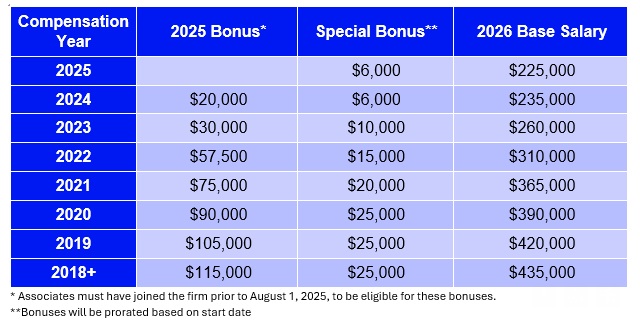
Here’s
what
that
looks
like
at
the
firm:

On
top
of
these
bonuses,
MWS
will
be
continuing
one
of
MWE’s
traditions
of
offering
bonuses
that
go
above
and
beyond
the
market
scale.
As
chairman
Ira
Coleman
notes
in
the
firm’s
announcement,
“We
remain
committed
to
being
top
of
market
in
all
that
we
do
and
are
pleased
to
note
that,
consistent
with
prior
years,
about
two-thirds
of
legacy
MWE
Associates
will
earn
above
the
Cravath
scale.”
We
suppose
legacy
SRZ
associates

who
were
formerly
able
to
cash
in
on
step-up
bonuses
for
their
extraordinary
contributions

will
be
able
to
get
in
on
that
action
next
year.

Bonuses
for
legacy
MWE
associates
will
be
paid
out
on
December
26,
2025,
while
bonuses
for
legacy
SRZ
associates
will
be
paid
out
on
January
16,
2026.

Congratulations
to
everyone
at
McDermott
Will
&
Schulte!

Remember
everyone,
we
depend
on
your
tips
to
stay
on
top
of
compensation
updates,
so
when
your
firm
announces
or
matches,
please
text
us
(646-820-8477)
or email
us
 (subject
line:
“[Firm
Name]
Bonus/Matches”).
Please
include
the
memo
if
available.
You
can
take
a
photo
of
the
memo
and
send
it
via
text
or
email
if
you
don’t
want
to
forward
the
original
PDF
or
Word
file.

And
if
you’d
like
to
sign
up
for
ATL’s
Bonus
Alerts
(which
is
the
alert
list
we
also
use
for
salary
announcements),
please
scroll
down
and
enter
your
email
address
in
the
box
below
this
post.
If
you
previously
signed
up
for
the
bonus
alerts,
you
don’t
need
to
do
anything.
You’ll
receive
an
email
notification
within
minutes
of
each
bonus
announcement
that
we
publish.
Thanks
for
your
help!


Staci
Zaretsky
 is
the
managing
editor
of
Above
the
Law,
where
she’s
worked
since
2011.
She’d
love
to
hear
from
you,
so
please
feel
free
to

email

her
with
any
tips,
questions,
comments,
or
critiques.
You
can
follow
her
on BlueskyX/Twitter,
and Threads, or
connect
with
her
on LinkedIn.

Economic Resilience In Action – Helping Law Firms Thrive In 2025 And Beyond – Above the Law

When
it
comes
to
today’s
economy,
are
you
feeling
cautious?
Optimistic?
Cautiously
optimistic? 

Perhaps
you’re
struggling
to
determine
the
most
effective
metrics
to
monitor,
or
considering
cost-cutting
measures,
or
looking
to
sharpen
your
leadership
skills. 

Whatever
your
approach,
building
resilience
is
the
key
to
navigating
a
turbulent
economy.

Join
us
on

December
5th
at
1
p.m.
ET,

for
this
webinar
presented
by
our
friends
at
8am,
where
an
expert
panel
will
walk
you
through
today’s
emerging
management
considerations.

You’ll
learn:
>
Key
metrics
to
predict
your
business
environment 
>
Avoiding
blanket
cost-cutting
and
building
agility
instead
>
Building
trust
and
loyalty
in
difficult
times
>
Small
actions
you
can
take
this
quarter
to
prepare
for
2026


This Top Biglaw Firm Is Offering Associates A Full Cravath Match – With Premium Bonuses On Top Of Special Bonuses – Above the Law

Proxy
for
race?

Bonus
season
is
off
to
a
great
start,
with

Cravath
leading
the
Biglaw
pack

in
the
annual
follow-the-leader
of
compensation
announcements.
The
elite
firm’s
2025
year-end
bonuses
echo
last
year’s
scale,
and
include

Milbank’s
special
bonuses

as
well.
Which
firm
is
the
latest
to
match
these
bountiful
bonus
bucks?
To
be
frank,
we’re
not
surprised
about
this
one,
since
the
firm
is
“committed
to
paying
competitive
compensation.”

Fried
Frank

which
reported
$1,136,370,000
in
gross
revenue
and
profits
per
equity
partner
of
$5,184,000
in
2024
according
to
the
most
recent
Am
Law
100

is
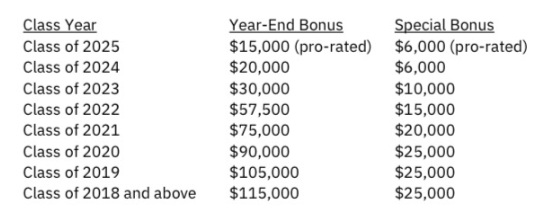
offering
the
following
bonus
scale
to
associates
in
New
York,
Washington,
DC,
and
London:

In
addition
to
these
year-end
and
special
bonuses
(available
to
those
who
recorded
a
minimum
of
1850
hours),
Fried
Frank
is
offering
up
premium
bonuses
for
associates
who
reach
2200
hours
or
2450
hours,
ranging
from
$3,000
to
$34,500
above
market
bonuses,
which
is
a
pretty
nice
payday
for
hardworking
attorneys.

Cash
will
hit
bank
accounts
for
associates
at
the
firm
before
December
31.

Congratulations
to
everyone
at
Fried
Frank!

Remember
everyone,
we
depend
on
your
tips
to
stay
on
top
of
compensation
updates,
so
when
your
firm
announces
or
matches,
please
text
us
(646-820-8477)
or email
us
 (subject
line:
“[Firm
Name]
Bonus/Matches”).
Please
include
the
memo
if
available.
You
can
take
a
photo
of
the
memo
and
send
it
via
text
or
email
if
you
don’t
want
to
forward
the
original
PDF
or
Word
file.

And
if
you’d
like
to
sign
up
for
ATL’s
Bonus
Alerts
(which
is
the
alert
list
we
also
use
for
salary
announcements),
please
scroll
down
and
enter
your
email
address
in
the
box
below
this
post.
If
you
previously
signed
up
for
the
bonus
alerts,
you
don’t
need
to
do
anything.
You’ll
receive
an
email
notification
within
minutes
of
each
bonus
announcement
that
we
publish.
Thanks
for
your
help!


Staci
Zaretsky
 is
the
managing
editor
of
Above
the
Law,
where
she’s
worked
since
2011.
She’d
love
to
hear
from
you,
so
please
feel
free
to

email

her
with
any
tips,
questions,
comments,
or
critiques.
You
can
follow
her
on BlueskyX/Twitter,
and Threads, or
connect
with
her
on LinkedIn.

Congress should establish, fund new quantum tech initiative to beat China: Panel – Breaking Defense

WASHINGTON

Congress
should
set
in
motion
a
sweeping
initiative
to
ensure
that
the
United
States
can
stay
ahead
of
China’s
rapid
development
of
dual-use

quantum

technologies
and

artificial
intelligence
,
urges
the
US-China
Economic
and
Security
Review
Commission
in
its

latest
annual
report
.

“Whoever
leads
in
quantum
(and
artificial
intelligence)
will
control
the
encryption
of
the
digital
economy;
enable
breakthroughs
in
materials,
energy,
and
medicine;
and
gain
asymmetric
and
likely
persistent
advantage
in
intelligence
and
targeting,”
the
commission’s
2025
report,
presented
to
Congress
today,
says.

“It
is
imperative
that
the
United
States
treat
quantum
not
as
a
research
silo
but
as
a
mission-critical
national
capability—and
act
accordingly,”
the
report
adds.

The
commission’s
2025
report
finds
that
China
is
continuing
to
“pour
significant
resources
into
over-the-horizon
technologies
such
as
artificial
intelligence
and
quantum
computing
that
have
dual-use
purposes
and
could
accelerate
China’s
military
and
intelligence
capabilities.”

Thus,
the
group
recommends
that
lawmakers
establish
by
2030
a
“quantum
first”
goal
to
“focus
on
quantum
computational
advantage
in
three
mission-critical
domains—cryptography,
drug
discovery,
and
materials
science.”
The
commission
argues
that
the
2030
timeline
“is
essential
to
ensure
the
United
States
achieves
quantum
leadership
before
any
adversary
can
leverage
these
capabilities
against
American
interests.”

In
tandem,
Congress
should
provide
“significant
funding”
for
US
quantum
development,
“focused
on
scalable
quantum
computing
modalities,
secure
communications,
and
post-quantum
cryptography,”
as
well
as
to
new
“workforce
development”
programs.

This
includes
the
creation
of
a
“Quantum
Software
Engineering
Institute
(QSEI)
focused
on
developing
the
software
foundations
for
scalable,
secure,
and
interoperable
quantum
computing,”
modeled
on
the
National
Artificial
Intelligence
Research
Institutes
and
National
Manufacturing
Institutes.
“[T]he
QSEI
would
ensure
that
U.S.
quantum
hardware
is
matched
by
world-class
software
capabilities,
enabling
early
operational
advantage
across
science,
industry,
and
defense,”
the
report
says.

The
bipartisan
US-China
Commission
was
established
by
Congress
in
2000
to
“investigate,
and
report
to
Congress
on
the
national
security
implications
of
the
bilateral
trade
and
economic
relationship
between
the
United
States
and
the
People’s
Republic
of
China,”
according
to
the

commission
website
.

Stronger
Export
Controls,
Congressional
Oversight

More
broadly,
the
US-China
Commission
is
calling
for
series
of
measures
to
substantially
beef
up
US

export
controls

on
key
technologies,
such
as
semiconductors.

The
report’s
number
one
recommendation
is
that
Congress
mandate
a
new,
interagency
organization
to
“address
the
evolving
national
security
challenges”
being
created
by
China’s
“systematic
and
persistent
evasion”
of
US
export
controls
and
sanctions.

This
“unified
economic
statecraft
entity”
should
at
a
minimum
include:
the
Commerce
Department’s
Bureau
of
Industry
and
Security
(BIS),
the
Treasury
Department’s
Office
of
Foreign
Assets
Control,
the
Office
of
Export
Control
Cooperation
at
the
State
Department’s
Bureau
of
International
Security
and
Nonproliferation,
and
the
Defense
Department’s
Defense
Technology
Security
Administration,
the
report
elaborates.
Further,
it
should
be
tightly
integrated
with
the
Intelligence
Community
to
allow
“enhanced
access
to
real-time
intelligence
on
evasion
networks.”

“[T]his
is
not
something
that
we’d
snap
our
fingers
and
all
of
a
sudden
have
an
entity
ready
to
go
in
in
trade
negotiations
with
the
current
administration.
It’s
something
that’s
going
to
take
time
to
implement
and
to
integrate,”
explained
Commissioner
Leland
Miller,
who
is
the
CEO
of
the
China
Beige
Book
that
provides
data
on
the
Chinese
economy
to
companies
and
investors.

“The
idea,
though,
is
that
the
piecemeal
approach
to
economic
sanctions
and
to
export
controls
has
meant
that
there
hasn’t
been
coordination.

[D]ifferent
agencies
have
sort
of
prioritized
and
and
operated
separately,”
he
told
reporters
on
Monday.
“So,
I
think
one
of
the
reasons
that
we
have
pushed
on
this,
and
have
elevated
this
to
our
top
recommendation,
is
that
there
is
a
need
at
this
point
for
these
really
important
national
security
priorities
to
be
put
forward
as
more
than
a
throw
in
in
a
trade
negotiation.”

In
addition,
the
commission
urges
lawmakers
to
strengthen
the
ability
of
BIS
“to
manage
strategic
competition
with
China
in
fast-moving
technology
sectors,
such
as
leading-edge
semiconductors
used
in
artificial
intelligence
(AI)
applications,
and
increase
congressional
oversight.”

This
includes
two
key
changes
to
US
export
controls
on

AI-enabling
chips
.
First,
Congress
should
direct
BIS
to
change
the
“presumption
of
denial”
for
licenses
to
export
to
China
those
microchips
now
on
Commerce’s
export
control
list
to
a
more
stringent
“policy
of
denial”

meaning
that
exports
of
certain
chips
would
be
barred
if
deemed
potentially
harmful
to
US
national
security.

The
second
change
would
call
for
Congress
to
force
BIS
to
set
up
a
system
to
“rent”
rather
than
sell
“advanced
chips”
by
“mandating
that
any
advanced
chips
above
a
certain
threshold
that
are
not
designated
as
prohibited
for
export
be
accessible
exclusively
via
the
cloud.”
Under
the
new
system,
exporters
would
be
required
as
part
of
their
licenses
to
vet
their
customers
and
report
any
“suspicious”
activities.

Space

Over
the
past
few
years
the
commission
has

outsourced
reports

on
China’s
rapidly
expanding
space
capabilities,
and
the
new
report
doubles
down
on
those
concerns.

“China
is
pursuing
an
aggressive
long-term,
whole-of-government
campaign
to
expand
its
space
capabilities
across
military,
commercial,
and
civil
domains
with
the
explicit
intent
of
surpassing
the
United
States.
These
rapid
advances
in
space
pose
an
escalating
threat
to
U.S.
national
security,
intensify
U.S.-China
strategic
competition
for
international
partnerships,
and
undermine
the
ability
of
U.S.
commercial
firms
to
compete
internationally,”
the
report
finds.

In
the
military
arena,
the
report
focuses
in
on
the
PLA’s
pursuit
of

counterspace

capabilities
designed
to
“degrade,
damage,
or
destroy”
US
satellites
“that
provide
the
backbone”
the
military’s
command
and
control
network
and
targeting
systems.
The
commissioners
stress
that
over
the
past
decade
China
has
maintained
an
“aggressive
schedule”
of
satellite
launches
for
its
own
military
use,
as
well
as
strengthen
its
ability
to
keep
tabs
on,
and
in
the
case
of
conflict
target,
US
forces,
especially
those
in
the
Indo-Pacific.

“Beijing’s
investment
in
counterspace
systems

including
direct-ascent
anti-satellite
weapons
and
co-orbital
interference
platforms

illustrates
its
strategy
of
blinding
and
disorienting
U.S.
forces
in
the
opening
phase
of
a
conflict,”
the
report
states.

The
commissioners
thus
recommend
that
Congress
take
actions
“to
preserve
and
strengthen
U.S.
primacy
in
the
critical
space
domain
as
China
pursues
sweeping
advancements
across
military,
commercial,
and
civil
space
sectors.”

These
include
moving
to
“increase
or
reallocate
appropriations”
for
the
Space
Force
“to
levels
necessary
to
achieve
space
control
and
establish
space
superiority
against
China’s
rapidly
expanding
space
and
counterspace
capabilities.”
Lawmakers
also
should
“direct”
DoD
to
improve
the
Space
Force’s
capacity
for
wargaming,
modeling,
simulation
and
training.

In
addition,
the
report
urges
Congress
to
hold
oversight
hearings
designed
“to
ensure
the
United
States
maintains
primacy
in
the
space
domain
by
identifying
investments
in
cutting-edge
space
technologies
and
assessing
China’s
space
capabilities
and
threats
to
U.S.
space
industrial
base
capacity.”


Morning Docket: 11.19.25 – Above the Law

*
Meta
survives
social
media
antitrust
action
because
TikTok
exists.
Which
it
doesn’t
legally,
but
the
administration
has
refused
to
comply
with
the
law
so…
good
news
for
Meta.
[New
York
Times
]

*
Court
orders
former
couple
to
bid
for
custody
of
dog.
If
that
doesn’t
work,
she
should
try
threatening
to
cut
it
in
half.
[ABA
Journal
]

*
Trump
administration
targets
whistleblower
protections.
[Reuters]

*
Pillsbury
Winthrop
hit
with
data
breach.
[Law360]

*
The
argument
against
releasing
the
Epstein
Files
lays
out
why
grand
jury
materials
are
normally
kept
secret.
[Vox]

*
How
might
Ashurst
and
Perkins
Coie
merger
impact
Asia?
[Law.com
International
]

Disasters have cost global agriculture US$3.26 trillion: FAO

According
to
the
FAO,
disasters
caused
an
average
of
US$99
billion
in
agricultural
losses
annually
between
1991
and
2023.
Cereal
crops
were
the
hardest
hit,
with
an
estimated
4.6
billion
tonnes
lost,
followed
by
2.8
billion
tonnes
of
fruits
and
vegetables,
and
900
million
tonnes
of
meat
and
dairy.

“Africa
is
estimated
to
bear
the
highest
relative
burden
at
7.4
percent
of
agricultural
gross
domestic
product
(GDP)
despite
lower
absolute
losses,”
the
report
says.
It
adds
that
lower-middle-income
countries
face
the
greatest
pressure,
with
losses
equivalent
to
5
percent
of
agricultural
GDP.

The
FAO
warns
that
the
impact
of
these
losses
is
already
visible
in
global
food
availability.
Reduced
production
corresponds
to
a
decline
of
around
320
kilocalories
per
person
per
day.
“Iron
losses
correspond
to
60
percent
of
requirements
for
men
and
critical
shortfalls
in
essential
vitamins
and
minerals
that
have
the
potential
to
disproportionately
affect
vulnerable
populations,”
the
report
states.

The
analysis
goes
beyond
crops
and
livestock.
The
FAO
notes
that
marine
systems
are
also
being
hit
hard,
yet
losses
in
fisheries
and
aquaculture
often
go
unreported
despite
supporting
500
million
livelihoods.

“Marine
heatwaves
alone
are
estimated
to
have
caused
US$6.6
billion
in
fisheries
losses
from
1985
to
2022,
with
15
percent
of
global
fisheries
affected
and
production
losses
exceeding
5.6
million
tonnes,”
the
report
says.

The
FAO
warns
that
disaster
impacts
are
long-lasting,
calling
for
better
tools
to
measure
both
direct
and
indirect
effects
on
ecosystems,
vulnerable
communities
and
markets.

“Disaster
impacts
on
agriculture
extend
far
beyond
immediate
production
losses
to
include
infrastructure
damage,
market
disruptions,
financial
system
failures
and
ecosystem
service
degradation
that
can
persist
for
years
after
initial
events,”
it
says.

The
report
highlights
the
growing
role
of
technology—including
artificial
intelligence—in
helping
farmers
and
governments
prepare
and
respond.
“Digital
technologies
and
tools
are
revolutionising
risk
monitoring
in
agriculture.
Advanced
analytics
powered
by
artificial
intelligence
(AI)
and
machine
learning
(ML)
now
deliver
integrated
hyperlocal,
real-time
and
actionable
risk
information,”
the
FAO
says.

It
adds
that
digital
systems
can
strengthen
early-warning
mechanisms,
guide
anticipatory
action
and
support
tools
such
as
agricultural
insurance
and
social
protection
programmes.
However,
the
FAO
stresses
that
technology
alone
is
not
enough.

“Digital
transformation
succeeds
when
innovation
is
matched
with
sustained
investment
in
capacity
development,
institutional
strengthening
and
enabling
infrastructure,”
it
says,
adding
that
solutions
must
be
adapted
to
local
needs.
“Digital
solutions
are
most
effective
when
they
are
co-designed
with
the
communities
they
are
supposed
to
serve.
Evidence
shows
that
human-centred
approaches
significantly
boost
adoption.”

The
FAO
also
noted
that
long-term
resilience
will
depend
on
collaboration
and
tailored
approaches.
“Tailoring
tools
to
local
conditions
and
fostering
collaboration
across
government,
research,
the
private
sector,
civil
society,
and
farming
communities
ensures
scalable,
interoperable
and
sustainable
impacts,”
the
report
says.

High Court strikes down key parts of Zimbabwe’s abortion law

HARARE

The
High
Court
has
delivered
a
landmark
ruling
declaring
parts
of
Zimbabwe’s
abortion
law
unconstitutional,
finding
that
provisions
of
the
Termination
of
Pregnancy
Act
violate
several
fundamental
rights,
particularly
the
rights
of
mentally
ill
women
and
victims
of
sexual
abuse
in
mental
health
institutions.

Justice
Slyvia
Chirawu-Mugomba,
handing
down
judgment,
ruled
that
section
4(a)
of
the
law
governing
the
circumstances
under
which
a
pregnancy
may
be
lawfully
terminated
“to
the
extent
that
it
excludes
mental
health”
fails
to
meet
constitutional
standards
and
unjustifiably
limits
key
rights
such
as
dignity,
equality,
and
the
right
to
health.

The
applicants,
the
Community
Working
Group
on
Health
and
Member
of
Parliament
Nyasha
Batisa,
challenged
the
constitutionality
of
the
law,
arguing
that
it
discriminates
against
mentally
ill
women
by
permitting
pregnancy
termination
only
under
narrow
physical-health
exceptions.

They
sought
declarations
that
both
s
4(a)
and
the
definition
of
“unlawful
intercourse”
in
s
2(1)
of
the
Act
are
unconstitutional.

In
a
detailed
25-page
ruling,
Justice
Chirawu-Mugomba
found
that
the
law’s
failure
to
recognise
mental
health
as
a
basis
for
accessing
safe
and
lawful
abortion
imposes
a
discriminatory
and
unconstitutional
burden
on
women
with
mental
health
challenges.

The
judge
noted
that
the
applicants
had
“well-articulated
the
impact
of
the
exclusion
of
mental
health
as
a
ground
to
access
safe
abortion,”
concluding:
“Therefore,
s
4(a)
in
my
view,
to
the
extent
that
it
excludes
mental
health,
does
not
meet
the
standards
enunciated
in
the
constitution…

“It
is
clear
that
women
with
mental
health
challenges
are
treated
differently
when
it
comes
to
the
permissible
health-related
grounds
for
termination.”

Justice
Chirawu-Mugomba
rejected
the
argument
by
the
minister
of
health
that
mental
health
risks
were
already
implicitly
covered
under
“life-threatening”
physical
conditions,
holding
that
such
an
interpretation
would
be
“not
explicit”
and
left
vulnerable
women
without
clear
legal
protection.

She
emphasised
that
mental
health
is
integral
to
overall
health,
citing
evidence
of
“genuine
challenges
women
experience
with
mental
health,
including
those
that
may
arise
after
childbirth.”

The
judge
also
held
that
the
definition
of
“unlawful
intercourse”
in
s
2(1)
is
unconstitutional
because
it
fails
to
include
sexual
abuse
defined
under
s
106
of
the
Mental
Health
Act,
which
criminalises
sexual
intercourse
with
mental
health
patients.

The
judge
said
in
the
November
11
ruling:
“Excluding
mental
health
in
the
definition
of
unlawful
intercourse,
as
proscribed
in
s
106…
denies
women
in
such
circumstances
access
to
safe
abortion
services.”

She
found
that
the
omission
violates
multiple
constitutional
rights,
including
the
right
to
life
(s
48),
dignity
(s
51),
equality
(s
56),
and
reproductive
health
(s
76),
noting
that
mentally
ill
women
“face
legal
and
procedural
barriers
to
accessing
necessary
reproductive
healthcare.”

The
judgment
sharply
criticised
the
inconsistency
between
the
Termination
of
Pregnancy
Act
and
the
Mental
Health
Act,
observing:
“The
inconsistency
between
these
legislative
frameworks
undermines
the
principle
of
equality
before
the
law.”

While
acknowledging
parliament’s
primary
role
in
law-making,
the
judge
said
that
courts
are
constitutionally
required
to
intervene
where
rights
are
unjustifiably
limited.

She
noted:
“Judicial
intervention
is
necessary
to
uphold
constitutional
rights,
fill
legal
gaps,
or
develop
the
law
in
line
with
evolving
social
values.”

The
court
considered
whether
to
“read
in”
new
provisions

a
remedy
used
where
a
statute
is
unconstitutional
due
to
an
omission

but
concluded
that
the
applicants
had
not
framed
their
requested
relief
with
sufficient
precision.

The
judge
ultimately
declared
portions
of
s
4(a)
and
s
2(1)
unconstitutional
but
suspended
the
declarations,
as
required
by
section
175
of
the
constitution,
pending
confirmation
by
the
Constitutional
Court.

The
judge
ordered:
“The
above
declarations
of
constitutional
invalidity
are
suspended
until
such
time
as
the
Constitutional
Court
has
confirmed
the
same…
The
above
order…
is
referred
to
the
Constitutional
Court
for
confirmation.”

No
order
as
to
costs
was
made.

Rights
lawyer
Tendai
Biti
brought
the
application
on
behalf
of
Batitsa
and
the
Community
Working
Group
on
Health.

Mpofu, Chimombe sentencing hearing set for Wednesday

HARARE

Businessmen
Moses
Mpofu
and
Mike
Chimombe
will
be
back
in
court
on
Wednesday
for
pre-sentencing
procedures
after
failing
in
two
legal
bids
to
halt
the
process,
following
their
October
22
conviction
on
fraud
charges
linked
to
an
US$87
million
goat
supply
contract.

Mpofu
and
Chimombe,
represented
by
lawyers
Lovemore
Madhuku,
Ashiel
Mugiya
and
Tapson
Dzvetero,
first
asked
Justice
Pisirayi
Kwenda
to
defer
sentencing
until
they
were
furnished
with
his
written
judgment.
When
that
application
was
dismissed,
they
immediately
sought
leave
to
appeal
to
the
Supreme
Court,
arguing
that
sentencing
cannot
proceed
without
a
written
judgment

but
that
too
was
thrown
out.

Justice
Kwenda
ruled
that
the
request
lacked
merit,
insisting
that
his
judgment
had
already
been
delivered
in
open
court
and
was
final.

“My
decision
is
that
we
move
to
the
pre-sentencing
stage
and
we
should
proceed
on
Wednesday.
We
should
not
keep
delaying
this
matter,”
the
judge
said,
adjourning
the
matter
to
November
19
at
2PM.

During
arguments,
Madhuku
said
access
to
the
written
judgment
was
a
legal
right
and
necessary
for
fairness,
warning
that
proceeding
without
it
risked
“rendering
the
trial
unfair.”
Dzvetero
added
that
failing
to
provide
it
could
prejudice
the
convicts.

State
counsel
Whisper
Mabhaudhi
countered
that
there
was
no
legal
impediment
to
proceeding,
accusing
the
defence
of
relying
on
the
wrong
legal
provision
and
stressing
that
both
accused
were
present
when
the
judgment
was
delivered,
where
they
“were
supposed
to
take
notes.”

The
two
were
convicted
of
using
forged
documents
to
secure
a
tender
to
supply
632,001
goats
under
a
government
livestock
pass-on
scheme
valued
at
US$87,757,16.
The
tender
was
awarded
to
Blackdeck
Private
Limited,
but
prosecutors
said
an
unregistered
entity,
Blackdeck
Livestock
and
Poultry
Farming,
later
signed
contractual
documents
with
the
agriculture
ministry.

Investigations
also
found
that
Blackdeck
did
not
possess
a
valid
tax
clearance
certificate
for
2021
and
that
a
QR
code
on
an
NSSA
compliance
certificate
belonged
to
a
different
company,
Skywalk
Investments.

Following
the
award
of
the
tender,
the
ministry
paid
ZWL1.6
billion

equivalent
to
US$7,712,197
at
the
time

in
two
instalments
in
2022.
Blackdeck
later
claimed
to
have
mobilised
32,500
goats
nationwide,
but
a
verification
exercise
found
only
3,713
available.

The
ministry
cancelled
the
contract
on
August
29,
2022.
To
date,
prosecutors
say
only
4,208
goats
worth
US$331,445.25
have
been
delivered,
leaving
a
prejudice
of
US$7,380,751.85.

Mpofu
and
Chimombe
maintain
the
charges
are
politically
motivated
and
accuse
their
former
partner
Wicknell
Chivayo
of
orchestrating
their
arrest
after
they
fell
out.