ZBC licence fees to be reduced by January 2026

Speaking
at
the
Media
Alliance
of
Zimbabwe
(MAZ)
annual
stakeholders’
conference
in
Harare
recently,
Minister
Muswere
said
the “whole
government”
had
taken
an approach to
bring down
ZBC
tariffs,
an
acknowledgment
of
the
widespread
concern
from
motorists
and
media
stakeholders.

“We
have
a
whole
government
approach
to
reduce
prices,
that
is,
the
licence
fees
of
ZBC,”
Muswere
said.

“The
reduction
will
be
coming
by
January,
I
am
sure
that’s
when
the
reduction
will
be
finalised.”

His
remarks
follow
intense
backlash
triggered
on
23
May
2025,
when
the
Broadcasting
Services
Amendment
Act
(No.
2
of
2025)
came
into
force.

The
new
law
made
it
compulsory
for
motorists
to
pay
ZBC
radio
licence
fees
when
renewing
vehicle
insurance
or
obtaining
a
ZINARA
licence
disc.

Under
the
current
tariff
structure,
private
vehicle
owners
pay
US$23
per
quarter
or
US$92
per
year, 
while
corporate-owned
vehicles
pay
US$50
per
quarter,
amounting
to
US$200
per
year.

The
requirement
applies
even
to
motorists
who
do
not
receive
ZBC
radio
signals,
as
long
as
they
own
a
vehicle
with
a
radio
set.

Those
without
radios
may
apply
for
an
exemption
affidavit
while
motorists
who
do
not
pay
the
licence
fee
are
barred
from
obtaining
insurance
or
a
licence
disc.

The
move
triggered
widespread
criticism,
especially
from
motorists
who
argued
they
were
being
forced
to
subsidise
a
public
broadcaster
they
did
not
necessarily
consume,
while
others
questioned
ZBC’s
content
quality
and
its
reliance
on
compulsory
fees.

Reports
estimate
that
Zimbabwe
has
1.2
million
registered
vehicles,
but
only
around
800,000
have
valid
insurance,
suggesting
potential
revenue
gaps
and
compliance
challenges.

ZBC
currently
survives
on
a
combination
of
licence
fees,
limited
advertising
revenue
and
government
grants.

However,
Muswere
defended
the
licensing
framework,
saying
ZBC
plays
a
constitutional
public
service
role
that
requires
predictable
funding
to
sustain
nationwide
broadcasting.

“I
want
to
assure
you…
you
recall
ZBC
is
a
platform
that
serves
as
a
national
broadcaster,”
he
said.

“Resources
secured
from
ZBC
will
be
utilised
for
local
content
production,
the
same
resources
will
be
utilised
to
expand
our
terrestrial
infrastructure,
which
means
all
of
you
as
players
will
benefit
from
the
licence
fees.”

He
said
ZBC
does
not
operate
in
isolation,
but
within
a
broader
broadcasting
ecosystem
that
includes
the
Broadcasting
Authority
of
Zimbabwe
(BAZ)
and
Transmedia,
the
national
signal
carrier,
of
“most
of
the
resources
go
toward
the
expansion
of
the
infrastructure.”

Muswere
said
Zimbabwe
missed
the
International
Telecommunication
Union
(ITU)
deadline
to
migrate
from
analogue
to
digital
broadcasting
by
a
decade
so
the
reforms,
including
licence
fees
were
designed
to
correct
that.

“A
decision
was
made
that
each
and
every
country
should
move
from
analogue
to
digital.
The
deadline
was
in
2015.
We
are
now
in
2025,
we
missed
the
deadline
by
a
decade,”
he
said.

Muswere
said
the
Broadcasting
Services
Amendment
Act
forms
part
of
a
broader
national
digitalisation
and
media
sustainability
strategy,
structured
around
three
pillars,
which
were
licensing
satellite
service
providers
to
expand
coverage,
making
sure
international
players
such
as
DStv
carry
at
least
three
ZBC
channels
and
strengthening
media
sustainability
frameworks

“As
I
indicated,
each
and
every
player
contributes
to
BAZ
a
certain
portion
of
your
licence
fees.
That
automatically
means
you
have
more
resources
to
support
community
stations,”
said
the
minister.

“Part
of
the
licensing
framework
also
allows
the
government
and
ZMC
to
be
able
to
conduct
human
capital
development
training
across
all
media
houses.”

Muswere
also
added
that
the
Media
Practitioners
Bill
would
soon
be
finalised
to
distinguish
accredited
journalists
from
citizen
content
creators.

Former
Information
Deputy
Minister
,Kindness
Paradza,
who
attended
the
meeting,
challenged
those
calling
for
scrapping
the
license
fees.

“They
(the
media)
are
talking
about
sustainability
and
want
a
media
fund
and
ZBC
licence
fees
are
going
toward
the
media
fund
that
you
will
be
borrowing
from 
and
want
that
to
be
dropped.
What
nonsense
is
that?
You
want
money
from
the
media
fund…,”
Paradza
said.

The
minister
said
as
a
public
broadcaster,
ZBC
is
mandated
to
cover
national
events
that
commercial
stations
avoid.

He
added
that
when
he
assumed
office,
ZBC’s
compliance
rate
was
below
25
percent,
but
the
new
licensing
regime
had
significantly
increased
revenues.

“I
can
indicate
that
millions
have
gone
up
at
the
public
broadcaster.
The
public
broadcaster
has
the
responsibility
to
inform,
educate
and
entertain
the
nation.
But
because
we
liberalised
the
media
sector,
we
also
expanded
the
licensing
framework
for
other
commercial
players,”
he
said.

Muswere
highlighted
the
roll-out
of
Zim
Digital
Phase
Two,
which
will
expand
television
coverage
beyond
the
current
38
percent
and
increase
radio
signal
reach
beyond
62
percent.

“Most
of
those
funds
will
be
utilised
to
support
the
same
ecosystem
in
terms
of
Zim
Digital,”
he
said.
“If
Transmedia
expands
in
terms
of
its
responsibility
as
a
signal
carrier,
it
also
means
the
entirety
of
the
media
sector
is
expanded.”

He
said
the
convergence
of
telecoms
and
broadcasting
had
improved
mobile
penetration
to
over
97
percent
and
funds
from
the
Universal
Services
Fund
would
support
further
expansion.

Muswere
also
said
the
government
was
establishing
10
provincial
content
hubs
under
ZiTESA
to
boost
local
content
production.

“We
also
then
created
a
new
film
industry,
which
totally
collapsed…
I
am
now
happy
and
confident
that
the
public
broadcaster
now
has
the
resources
to
support
the
National
Arts
Cou
Bonus Season Has Begun! – See Also – Above the Law

Cravath
Is
Spreading
Some
Holiday
Cheer!:
Nothing
brightens
the
spirit
like
some
green!
And
They
Aren’t
The
Only
Ones!:
McKool
Smith,
Paul
Hastings
and
Cadwalader
line
their
associates’
pockets
with
cash!
A
Disbarment
Long
Fought
For:
The
profession
wishes
you
adieu,
Josh
Kindred!
Praying
For
Hallucinations:
Is
AI
or
human
error
to
blame
for
this
misreading
of

Jones
?
Will
The
ABA
Finally
Get
Rid
Of
Its
Diversity
Requirements:
Been
on
its
last
legs
for
a
while
now.

Bonus News Drops As Firm Engages In Merger Talks – Above the Law

Cadwalader
hasn’t
enjoyed
the
smoothest
2025.

Key
partners

defected
,
the
firm
announced
a
snap

leadership
shakeup
,
and
finally
admitted
they’re
looking
for
a

merger
proposal
with
Alston
&
Bird
.
And
that
Trump
administration
capitulation

story
didn’t
help.
But,
as
the
year
winds
down,
firm
lawyers
can
look
past
2025
and
comfort
themselves
with
a
tidy
bonus
match.

At
6:02,
the
co-managing
partners
sent
out
the
memo
laying
out
the
following
baseline
bonuses:


Class
Year

Year-End
Bonus
Class
of
2025
$15,000
(pro-rated)
Class
of
2024
$20,000
Class
of
2023
$30,000
Class
of
2022
$57,500
Class
of
2021
$75,000
Class
of
2020
$90,000
Class
of
2019
$105,000
Class
of
2018
and
2017
$115,000

But
that’s
not
all,
with
special
bonuses
available
for
those
recording
2200
hours
or
more
throughout
the
year:


Year

Special
Bonus
Class
of
2025
$6,000
(pro-rated)
Class
of
2024
$6,000
Class
of
2023
$10,000
Class
of
2022
$15,000
Class
of
2021
$20,000
Class
of
2020
$25,000
Class
of
2019
$25,000
Class
of
2018
and
2017
$25,000

The
bonuses
will
be
paid
out
by
the
last
February
pay
period.

Not
bad
for
a
firm
potentially
going
to
the
(Alston
&)
Birds.


(Full
memo
on
the
next
page.)


Joe
Patrice
 is
a
senior
editor
at
Above
the
Law
and
co-host
of

Thinking
Like
A
Lawyer
.
Feel
free
to email
any
tips,
questions,
or
comments.
Follow
him
on Twitter or

Bluesky

if
you’re
interested
in
law,
politics,
and
a
healthy
dose
of
college
sports
news.
Joe
also
serves
as
a

Managing
Director
at
RPN
Executive
Search
.

Cravath’s Unusual Lease Condition – Above the Law


Ed.
Note:

Welcome
to
our
daily
feature

Trivia
Question
of
the
Day!


In
the
80s
when
Cravath
moved
from
Wall
Street
to
One
Worldwide
Plaza,
the
lease
required
the
developer
to
buy

and
demolish

what
nearby
business?


Hint:
The
firm
leased
the
space
in
exchange
for
a
7
percent
equity
stake
in
the
building
and
was
headquartered
there
from
1988
until
April
2024,
when
it
moved
to
the
Hudson
Yards.


See
the
answer
on
the
next
page.

Paul Hastings Is First Biglaw To Match Cravath’s Generous Bonus Scale – Above the Law

Cravath
announced
its

year-end
bonus
scale


complete
with

Milbank’s
special
bonuses


just
a
few
hours
ago,
and
we’ve
officially
got
our
first
bonus
match.

We’ve
now
confirmed
that
Paul
Hastings

which
reported
$2,235,739,000
in
gross
revenue
and
profits
per
equity
partner
of
$6,715,000
in
2024
according
to
the
most
recent
Am
Law
100

has
chosen
to
use
the
Cravath
scale
for
its
year-end
bonuses:

  • Class
    of
    2024

    $20,000
  • Class
    of
    2023

    $30,000
  • Class
    of
    2022

    $57,500
  • Class
    of
    2021

    $75,000
  • Class
    of
    2020

    $90,000
  • Class
    of
    2019

    $105,000
  • Class
    of
    2018+

    $115,000

Paul
Hastings
is
also
matching
the
Milbank
special
bonus
scale,
and
this
is
what
they
will
look
like
at
the
firm:

  • Class
    of
    2024

    $6,000
  • Class
    of
    2023

    $10,000
  • Class
    of
    2022

    $15,000
  • Class
    of
    2021

    $20,000
  • Class
    of
    2020

    $25,000
  • Class
    of
    2019

    $25,000
  • Class
    of
    2018+

    $25,000

Congratulations
to
everyone
at
Paul
Hastings!

Remember
everyone,
we
depend
on
your
tips
to
stay
on
top
of
compensation
updates,
so
when
your
firm
announces
or
matches,
please
text
us
(646-820-8477)
or email
us
 (subject
line:
“[Firm
Name]
Bonus/Matches”).
Please
include
the
memo
if
available.
You
can
take
a
photo
of
the
memo
and
send
it
via
text
or
email
if
you
don’t
want
to
forward
the
original
PDF
or
Word
file.

And
if
you’d
like
to
sign
up
for
ATL’s
Bonus
Alerts
(which
is
the
alert
list
we
also
use
for
salary
announcements),
please
scroll
down
and
enter
your
email
address
in
the
box
below
this
post.
If
you
previously
signed
up
for
the
bonus
alerts,
you
don’t
need
to
do
anything.
You’ll
receive
an
email
notification
within
minutes
of
each
bonus
announcement
that
we
publish.
Thanks
for
your
help!


Staci
Zaretsky
 is
the
managing
editor
of
Above
the
Law,
where
she’s
worked
since
2011.
She’d
love
to
hear
from
you,
so
please
feel
free
to

email

her
with
any
tips,
questions,
comments,
or
critiques.
You
can
follow
her
on BlueskyX/Twitter,
and Threads, or
connect
with
her
on LinkedIn.

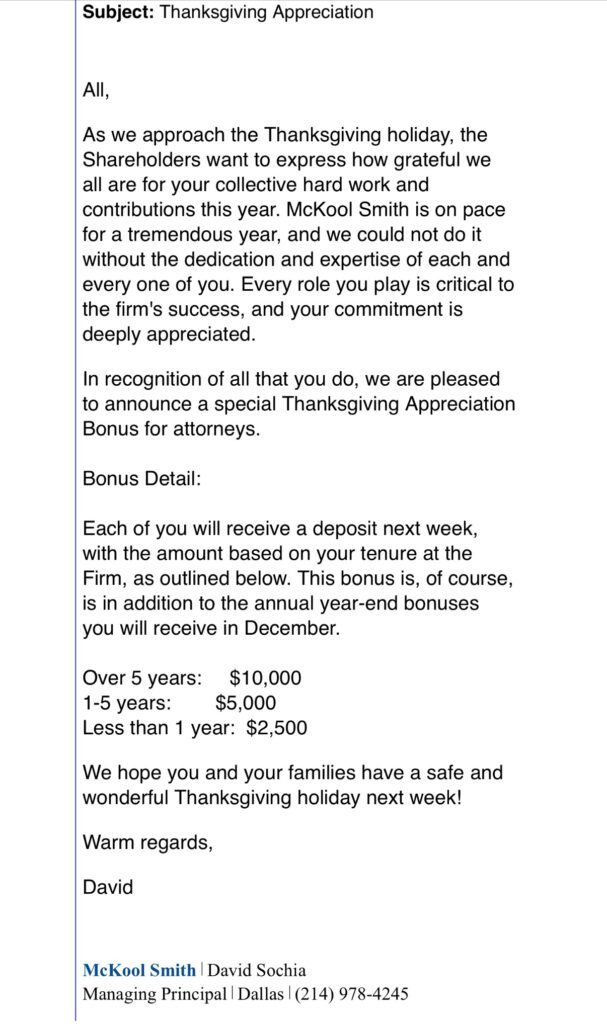
Associates Get A Kool Special Thanksgiving Bonus – Above the Law

Break
out
the
stretchy
pants
and
gratitude
journals,
because
McKool
Smith,
the
Texas-based
complex
trial
firm
that’s
been
handing
out
money
to
associates
hand
over
fist
for
years,
just
dropped
a
little
holiday
surprise
on
its
associates:
special
Thanksgiving
bonuses,
ranging
from
$2,500
to
$10,000
depending
on
seniority.

Yes,

in
addition
to

year-end
bonuses.

It’s
not
quite

Milbank’s
summer
“please
love
us,
please
stay,
please
bill”
bonus
extravaganza
,
but
McKool’s
offering
is
nothing
to
sneeze
at.
Is
it
life-changing?
No.
Is
it
enough
to
buy
a
plane
ticket
home,
a
decent
bottle
of
bourbon,
and
the
emotional
buffer
required
to
survive
a
full
Thanksgiving
weekend
with
extended
family?
Absolutely.
And
this
is
the
kind
of
gesture
that
keeps
morale
high

or
at
least
above
the
level
where
associates
start
doom-scrolling
job
boards
during
lunch.

So
congratulations,
McKool
associates.
Enjoy
the
bonus,
enjoy
the
validation,
and
enjoy
the
brief
moment
of
hope
before
December’s
year-end
chaos
begins.

Happy
Thanksgiving

and
happy
bonus
season.

Read
the
full
announcement
below.

Remember
everyone,
we
depend
on
your
tips
to
stay
on
top
of
compensation
updates,
so
when
your
firm
announces
or
matches,
please
text
us
(646-820-8477)
or email
us
 (subject
line:
“[Firm
Name]
Bonus/Matches”).
Please
include
the
memo
if
available.
You
can
take
a
photo
of
the
memo
and
send
it
via
text
or
email
if
you
don’t
want
to
forward
the
original
PDF
or
Word
file.

And
if
you’d
like
to
sign
up
for
ATL’s
Bonus
Alerts
(which
is
the
alert
list
we
also
use
for
salary
announcements),
please
scroll
down
and
enter
your
email
address
in
the
box
below
this
post.
If
you
previously
signed
up
for
the
bonus
alerts,
you
don’t
need
to
do
anything.
You’ll
receive
an
email
notification
within
minutes
of
each
bonus
announcement
that
we
publish.
Thanks
for
your
help!


Kathryn
Rubino
is
a
Senior
Editor
at
Above
the
Law,
host
of

The
Jabot
podcast
,
and
co-host
of

Thinking
Like
A
Lawyer
.
AtL
tipsters
are
the
best,
so
please
connect
with
her.
Feel
free
to
email

her

with
any
tips,
questions,
or
comments
and
follow
her
on
Twitter

@Kathryn1
 or
Mastodon

@[email protected].

ABA Diversity And Inclusion Standard Looks Like It’s On Its Last Legs – Above the Law

The
American
Bar
Association
has
come
under
fire
for
requiring
schools
to
put
some
effort
into
making
sure
that
their
student
bodies
don’t
look
like
the
start
of
a
small
ethnostate.
Schools
had
to
show
some
attempt
at
encouraging
diversity
in
recruitment,
admissions,
and
programming.
This
was
a
hard
pill
to
swallow,
especially
for
the
Trump
administration.
After
some
light
pushback,
the
ABA
has
put
a
moratorium
on
the
standard,
citing
the
difficulty
for
schools
to
follow
the
guidelines
without
running
into
legal
trouble
after

SFFA
v.
Harvard
.
Given
the
challenges,
the
ABA
has
been
reconsidering
its
standards.

Reuters

has
coverage:

The
American
Bar
Association
will
undertake
a
sweeping
review
of
its
standards
for
law
schools
as
states
weigh
dropping
the
organization
as
an
accreditor
and
critics
blame
its
regulations
for
driving
up
student
costs.

While
there’s
nothing
factually
incorrect
about
the
sentence
above,
the
word
“states”
is
carrying
a
lot
of
weight
here.
It
would
be
one
thing
if
half
of
the
country
was
thinking
about
dropping
the
ABA,
but
it’s
just
Florida
and
Texas.
And
you
know
what
they
say
about
Texas:

Texas
and
Florida
may
be
of
a
mind
to
drop
the
ABA
but
the
problem
is,
again,

the
rest
of
the
country
.
The
remaining
48
states
won’t
cede
out
just
because
they
do

and
that’ll
make
it
a
lot
harder
for
freshly
minted
Texan
and
Floridian
JDs
to
get
jobs
from
employers
looking
to
hire
accredited
graduates.
Even
if
other
states
are
thinking
about
dropping
the
ABA,
they’d
have
to
come
up
with
their
own
accreditation
process
to
replace
the
job
the
ABA
has
been
doing
well
enough
for
decades
now.
Texas
and
Florida
are
special
cases
in
that
they
are
states
who
would
go
to
lengths
to
keep
the
administration
happy,
but
everyone
else
probably
doesn’t
give
enough
of
a
damn
to
reinvent
the
wheel.

The
committee’s
proposed
elimination
of
the
diversity
and
inclusion
standard
is
the
part
of
the
story
that
actually
has
teeth
to
bite
with.
At
this
point,
just
rip
the
Band-Aid
off.
It’s
been
on
life
support
since
February
and
unless
there
are
going
to
be
some
serious
changes
in
the
Executive
or
the
Judiciary
over
the
next
three
years,
it
is
going
to
be
a
constant
buzzing
in
the
ear.
The
question
of
why
diversity
matters
to
the
ABA
has
been
open

since
February
of
last
year


maybe
it’s
time
to
stop
pretending
it’s
an
actual
priority
they
hold
dear.


ABA
To
Review
Law
School
Standards,
May
Drop
Diversity
Rule
Amid
Pressure

[Reuters]


Earlier
:

Texas
Plans
To
Cut
Law
School
Accreditation
Ties
With
The
ABA


Florida
Still
Stumbling
Through
Trying
To
Replace
ABA
Accreditation


ABA
Committee
Decides
To
Diversify
Diversity.
It
Should
Come
With
A
Clear
Reason
For
Why
That’s
Important.


Chris
Williams
became
a
social
media
manager
and
assistant
editor
for
Above
the
Law
in
June
2021.
Prior
to
joining
the
staff,
he
moonlighted
as
a
minor
Memelord™
in
the
Facebook
group Law
School
Memes
for
Edgy
T14s
.
 He
endured
Missouri
long
enough
to
graduate
from
Washington
University
in
St.
Louis
School
of
Law.
He
is
a
former
boatbuilder
who
is
learning
to
swim, is
interested
in
critical
race
theory,
philosophy,
and
humor,
and
has
a
love
for
cycling
that
occasionally
annoys
his
peers.
You
can
reach
him
by
email
at [email protected]
and
by
tweet
at @WritesForRent.

Cravath Starts Biglaw’s Bonus Season With Year-End And Special Bonuses! – Above the Law

Bonus
season
has
officially
begun.
Cravath,
the
firm
that’s
the
standard
bearer
for
Biglaw
associate
compensation,
has
kicked
off
the
2025
bonus
sweepstakes.
And
Cravath’s
not
here
for
restraint.

The
firm
announced
year-end
bonuses

and

a
round
of
special
bonuses
that

mirror
the
Milbank
summer
bonuses
.
As
reflected
in
the
chart
below,
the
year-end
bonus
amounts
echo
last
year’s
bonus
scale.
Maybe
they’re
not
reinventing
the
bonus
wheel,
but
there’s
a
pretty
big
paycheck
headed
associates’
way.

New
York
and
D.C.
associates
will
get
their
bonuses
on
December
12th
(with
no
hours
requirement,
as
per
usual
for
the
firm),
while
London
associates
will
have
to
wait
an
extra
week
for
the
money
to
hit
their
accounts.

And
because
it’s
Cravath,
every
other
Biglaw
partner
just
felt
the
sudden
urge
to
“circle
back”
with
their
executive
committees.

Now
we
wait
for
the
inevitable
parade
of
matching
announcements.
Davis
Polk
will
follow
soon.
Paul
Weiss
will
toss
in
something
shiny.
Latham
will
eventually
make
its
move,
confident
as
always.
And
every
associate
in
Biglaw
will
spend
the
next
72
hours
refreshing
their
inbox
like
it’s
a
Taylor
Swift
ticket
queue.

But
for
now,
Cravath
has
officially
fired
the
starting
gun.

Bonus
season
is
here.
May
your
hours
be
high
and
your
disappointment
minimal.

So,
is
your
firm
matching
*both*
the
year-end
and
special
bonuses?
Let
Above
the
Law
know!
We
depend
on
your
tips
to
stay
on
top
of
important
bonus
updates,
so
when
your
firm
matches
(or
if
they
fail
to
do
so),
please
text
us
(646-820-8477)
or email
us
 (subject
line:
“[Firm
Name]
Matches”).
Please
include
the
memo,
if
available.
You
can
take
a
photo
of
the
memo
and
send
it
via
text
or
email
if
you
don’t
want
to
forward
the
original
PDF
or
Word
file.

And
if
you’d
like
to
sign
up
for
ATL’s
Bonus
Alerts
(which
is
the
alert
list
we
also
use
for
salary
announcements),
please
scroll
down
and
enter
your
email
address
in
the
box
below
this
post.
If
you
previously
signed
up
for
the
bonus
alerts,
you
don’t
need
to
do
anything.
You’ll
receive
an
email
notification
within
minutes
of
each
bonus
announcement
that
we
publish.
Thanks
for
all
of
your
help!

Read
the
full
memo
below.


Kathryn
Rubino
is
a
Senior
Editor
at
Above
the
Law,
host
of

The
Jabot
podcast
,
and
co-host
of

Thinking
Like
A
Lawyer
.
AtL
tipsters
are
the
best,
so
please
connect
with
her.
Feel
free
to
email

her

with
any
tips,
questions,
or
comments
and
follow
her
on
Twitter

@Kathryn1
 or
Mastodon

@[email protected].

Perkins Coie’s Leader Says Trump’s Executive Order Had Nothing To Do With Its Merger Decision – Above the Law

(Photo
by
Win
McNamee/Getty
Images)


Ed.
note
:
Welcome
to
our
daily
feature,

Quote
of
the
Day
.


At
this
moment,
both
firms
come
to
this
announcement
with
the
position
of
financial
strength,
great
optimism
and
confidence,
looking
to
the
future
and
a
true
combination
of
equals.


Bill
Malley
,
managing
partner
of
Perkins
Coie,
in
comments
given
to

Law.com
,
concerning
the
firm’s
recent
announcement
of
a

merger
with
Ashurst
,
which
is
expected
to
be
voted
upon
by
all
partners
in
2026.
If
approved,
the
combination
will
go
live
as
soon
as
the
middle
of
next
year.
Malley
denied
that
the
tie-up
had
anything
to
do
with
the
firm’s
ongoing
battle
against
the

Trump
administration’s
executive
order

(which
a
federal
judge
has
already

ruled
unconstitutional
,
though
the
decision
is

under
appeal
),
saying
the
two
firms
had
been
chatting
before
the
EO
was
even
issued.


Staci
Zaretsky
 is
the
managing
editor
of
Above
the
Law,
where
she’s
worked
since
2011.
She’d
love
to
hear
from
you,
so
please
feel
free
to

email

her
with
any
tips,
questions,
comments,
or
critiques.
You
can
follow
her
on BlueskyX/Twitter,
and Threads, or
connect
with
her
on LinkedIn.

Court’s Latest Order In Elon Musk Case Includes Pretty Glaring Hallucination – Above the Law

(Photo
by
Apu
Gomes/Getty
Images)

Elon
Musk
gets
himself
involved
in
a
lot
of
entertaining
court
fights.
Sometimes
he

botches
these
fights
so
badly

you
wonder
if
he
really
would
fall
for
a
visit
from
the
wallet
inspector.
Other
times
he

gets
a
helping
hand
from
a
friendly
judge
.
But
it’s
not
clear
that
he’s
ever
gotten
litigation
help
from
an
AI
hallucination
before.

Though
the
latest
twist
in
the
procedural
labyrinth
of
his
tussle
with

PlainSite

developer
Aaron
Greenspan
may
have
finally
crossed
that
threshold.

Is
this
an
AI
hallucination
working
its
way
into
a
court
order?
Maybe
not.
It
could
be
the
result
of
a
human
judge
(or
clerk)
dropping
the
ball.
So,
perhaps,
we
should
hope
it’s
an
AI
hallucination,
for
the
sake
of
the
humans
involved.

The

latest
order

grants
a
motion
to
strike
brought
by
Musk
and
his
co-defendants
under
California’s
anti-SLAPP
statute.
Greenspan
argued
that
the
motion
wasn’t
timely
filed
and
the
judge
deemed
that,
pursuant
to
the
statute,

the
court
has
discretion

to
entertain
the
motion
at
any
time
and
would
do
so
here.
Whether
the
court
was
right
to
exercise
that
discretion
here
is
for
the
parties
to
battle
out.

For
those
of
us
scouring
filings
for
questionable
AI
screw-ups
though,
we
now
zoom
to
a
handwritten
insert
included
with
the
order,
justifying
the
decision
to
allow
the
motion

even
if

it
technically
missed
a
deadline
based
on


Jones
v.
Goodman
,
57
Cal.App.5th
521
,
where
the
court
writes,
that
an
amended
motion
should
relate
back
to
the
initial
motion
“as
long
as
the
initial
motion
was
in
‘substantial
compliance’
with
the
governing
rule.”

Except
that’s
not
what

Jones

actually
says.
The
defendants
in

Jones

had
themselves
argued

and
we
quote

that
“substantial
compliance
with
the
rule
is
all
that
is
required;
and
the
amended
motion
should
be
deemed
to
‘relate
back’
to
the
initial
motion,
just
as
an
amended
pleading
might
relate
back
to
the
filing
of
the
original
pleading.”
This
would
be
an
odd
rule
to
adopt
since
it
would
dispose
of
any
meaningful
deadline
throughout
a
litigation
if
every
issue
could
be
preserved
by
vomiting
up
a
half-assed
brief
and
then
“amending”
it
well
after
the
deadline.

Which
is
why
the

Jones

court
went
on
to
explicitly
reject
this
argument.
In
the
next
paragraph,
the

Jones

court
describes
the
defendants’
arguments
there
as
“not
well
taken,”
clarifying
that
“A
motion
is
not
a
complaint,
or
any
other
type
of
pleading….
Defendants
provide
no
authority
for
the
proposition
that
the
relation-back
doctrine
applies
to
anything
other
than
pleadings.”

So
then
how
did
this
case
end
up
in
a
court
order
for
the
proposition
that
an
amended

motion

“should
be
deemed
to
‘relate
back’
to
the
initial
motion
‘as
long
as
the
initial
motion
was
in
‘substantial
compliance’
with
the
governing
rule”?
And
it
probably
goes
without
saying,
but
this
quote
isn’t
in

Jones
.
At
least
not
in
this
form.

Again,
this
could
be
a
human
flub,
but
this
bears
some
of
the
key
signs
of
a
hallucinating
bot.
Consider
this,
from
Greenspan’s
latest
brief
on
the
docket:

This
is
the
opposite
of
what

Jones

stands
for.
The
paragraph
and
sentence
quoted
by
the
Court
for
the
phrase
“substantial
compliance”
begins
with
the
words
“Defendants
contend…”
indicating
that
the

Jones

court
was
merely
providing
context
before
issuing
its
actual
ruling
on
those
arguments
later
in
the
opinion. 

Which
certainly
tracks
the
actual
text
of

Jones
.
But
mixing
up
the
judge
laying
out
one
side’s
argument
for
an
actual
holding
is
exactly
the
sort
of
error
AI
makes.

At
an
AI
legal
research
briefing
I
attended
a
couple
years
ago,
one
of
the
product
team
leaders
suggested
“hallucinations,”
as
we
commonly
understood
them,
would
be
solved
soon.
The
technology
would
soon
stop
making
up
cases
from
thin
air,
but
AI
still
posed
tremendous
risk
in
misinterpreting
the
text
itself.
For
instance,
grabbing
dicta
and
treating
it
as
precedent

which
might
be

the
Supreme
Court’s
new
default
setting
,
but
historically
isn’t
how
any
of
this
is
supposed
to
work.

It’s
also
why

just
feeding
“all
court
cases”
into
an
AI
system

isn’t
going
to
work.

Here,
a
quote
makes
it
into
a
judge’s
opinion
that
explicitly
began
its
life
as
a
straw
argument,
laying
out
one
of
the
party’s
positions
before
dismissing
it
with
withering
contempt.
“Defendants’
arguments
are
not
well
taken,”
is
the
sort
of
line
in
an
opinion
that
makes
most
lawyers
wish
to
simply
curl
into
a
ball
and
die.
But
this
is
exactly
where
AI
remains
an
easy
mark,
capable
of
casually
bumbling
into
a
straw
argument
and
elevating
it
to
a
citation-worthy
conclusion.
Adding
in
the
quote
that
begins
“as
long
as
the
initial
motion…”

which
is
nowhere
to
be
found
in
the
opinion

to
double
down
on
the
initial
error
introduces
another
known
AI
flaw.

Everyone
knows
about
the
made-up
cases,
but
AI’s
most
insidious
mistakes
will
be
in
subtle
mischaracterizations
of
real
cases.
The
lowest
bar
of
cite
checking
isn’t
going
to
catch
that
since
it’s
a
real
case.
Even
a
superficial
glance
at
the
text
might
not
notice
the
error
without
panning
out
to
consider
the
context
of
the
original

Jones

opinion.

And
then
what
happens
if
this
isn’t
promptly
caught?
The
next
court
sees
this
opinion
and
decides
the
law
supports
a
new
“relate
back”
process
for
mere
motions.
Then
that
opinion
gets
on
the
books
and
the
next
thing
you
know,
we’re
all
echoing
a
hallucination.
Inaccuracies
can
compound
themselves.
Whether
Greenspan
ends
up
prevailing
or
not,
hopefully
Greenspan’s
motion
to
reconsider
gets
the
record
cleaned
up
and
gives
everyone
a
renewed
sense
of
attention
to
detail.
Even
if
this
is
a
human
error,
we’re
going
to
need
the
record
set
straight.

And
if
this
is
an
AI-induced
screw-up…
I
wonder
if
the
court
used
Grok?


HeadshotJoe
Patrice
 is
a
senior
editor
at
Above
the
Law
and
co-host
of

Thinking
Like
A
Lawyer
.
Feel
free
to email
any
tips,
questions,
or
comments.
Follow
him
on Twitter or

Bluesky

if
you’re
interested
in
law,
politics,
and
a
healthy
dose
of
college
sports
news.
Joe
also
serves
as
a

Managing
Director
at
RPN
Executive
Search
.